

The B2B Sales Process Guide That Gives You Actual Numbers
A RevOps lead we know ran a pipeline audit last quarter. The CRM had 14 defined stages, three overlapping qualification frameworks, and zero documented exit criteria. Win rates? 18%. Average cycle length? Nobody could agree on the number because the stages meant different things to different reps.
That's what happens when you build a B2B sales process from blog posts that give you steps without benchmarks. The consequences ripple all the way to the buyer: Forrester found that 81% of B2B buyers end up dissatisfied with the provider they chose - often because the selling process failed to surface the right information at the right time. Meanwhile, 86% of purchases stall somewhere in the middle of the funnel, and the median B2B SaaS sales cycle sits at 84 days with win rates hovering around 20-21%.
What follows is the numbered process, stage-by-stage benchmarks, qualification framework decision rules, and three tactics proven to compress your cycle.
The 2026 B2B Buyer Is Already Ahead of You
Your buyer has done most of the work before you even know they exist. A 2026 6sense study found that 94% of B2B buyers use LLMs during their buying process, and 83% define their requirements before talking to a single sales rep. The first meaningful contact between buyer and seller has shifted from 69% to 61% of the journey - pulling outreach earlier by about 6-7 weeks. But buyers still arrive with opinions already formed.
Buying committees have ballooned. Depending on deal size, you're navigating 6-13 stakeholders. For complex enterprise deals, that number hits 25 on average, up from 16 in 2017. And 95% of the time, the winning vendor is already on the buyer's initial shortlist - with an average of 16 interactions per person before a decision is made. If you're not on that shortlist before the first call, you're playing catch-up with terrible odds.
Here's the counterintuitive wrinkle: while the macro trend shows cycles lengthening to 6.5 months, 6sense also found the average enterprise cycle dropped from 11.3 to 10.1 months as economic pressure pushed 62% of buyers to engage sellers earlier. Cycles are getting longer and shorter simultaneously, depending on urgency and deal complexity. Your process needs to handle both compressed and extended timelines without breaking.
Your selling motion can't start at "discovery call." It starts with being findable, credible, and armed with the right data long before a hand is raised.
The 8-Step B2B Selling Process
1. Prospecting & Lead Generation
Everything downstream depends on this step. ICP-based list building - filtering by industry, headcount, tech stack, funding stage, buyer intent - is the foundation. The failure point most teams hit isn't strategy; it's data quality. Bad emails bounce, burning your sender domain. Wrong phone numbers waste rep hours. Incomplete org charts mean you're pitching the wrong person entirely. (If you need a refresher on what “ICP” should include, use an ideal customer profile template.)
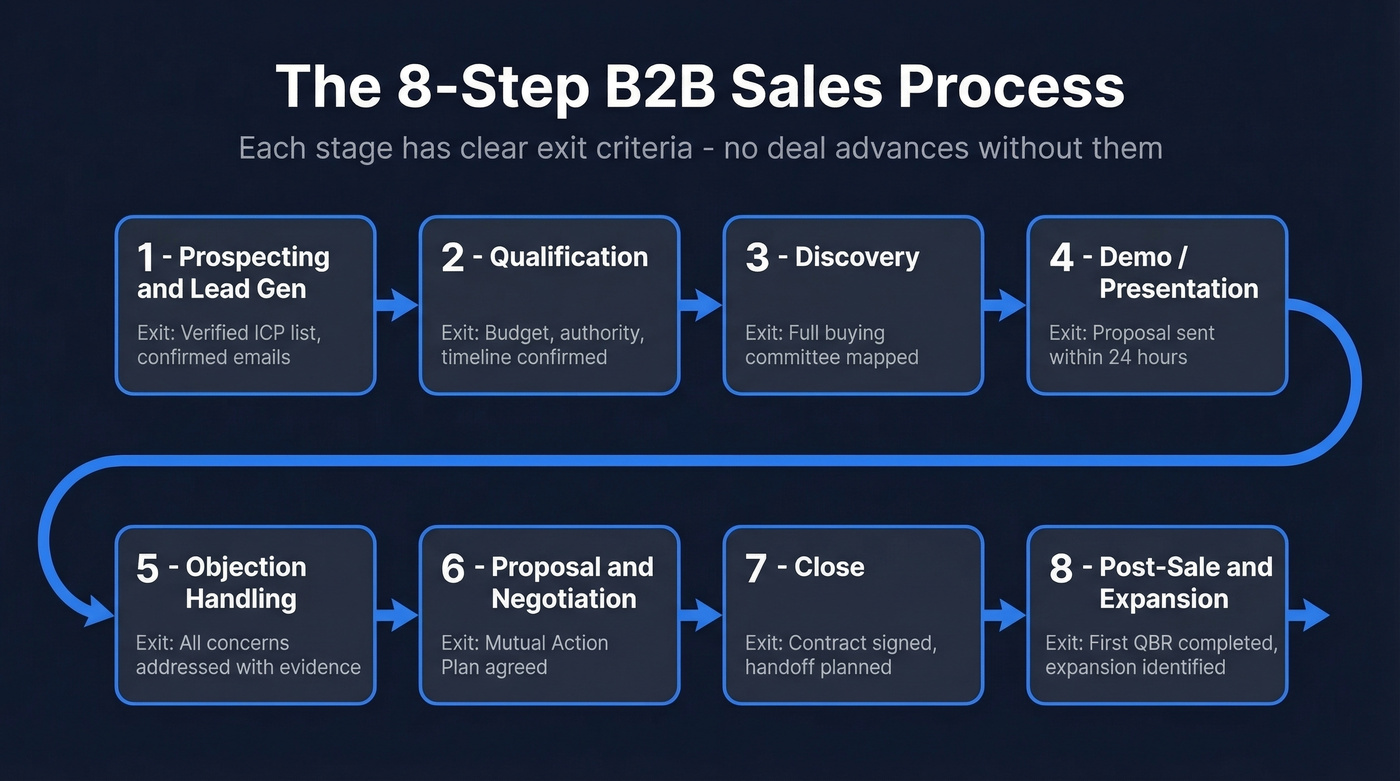
The exit criteria: a verified list of contacts matching your ICP, with confirmed email deliverability and direct dials where possible. One tactic that moves the needle hard: engage 3+ contacts per account from the start. Deals with multi-threaded engagement close 2.4x faster.
Prospeo handles this step end-to-end - 300M+ professional profiles with 30+ search filters (buyer intent, technographics, job changes, headcount growth, funding, revenue), 98% email accuracy, and a 7-day data refresh cycle. You build the list, verify it in real time, and push contacts straight into your sequencer via native integrations without worrying about bounces.

2. Qualification
This is where you decide whether a prospect deserves your pipeline or just your nurture sequence. The exit criteria: confirmed budget range, identified authority (the person who signs), defined timeline, and a real pain point you can solve.
The failure point is universal - qualifying on hope instead of criteria. If you can't articulate why this deal will close in your forecasted timeframe, it shouldn't be in your committed pipeline. Teams that implement objective exit criteria at each stage report up to 80% forecasting accuracy. (If you want a deeper framework, see lead scoring.)
3. Discovery
Discovery is buyer-centered or it's worthless. The questions you ask should map the prospect's world - their current state, desired future state, the stakeholders involved, and the consequences of doing nothing.
Here's the thing: "What's your budget?" in discovery is lazy. "Walk me through how this decision gets made and who needs to sign off" is useful. Map the full buying committee in this stage - every stakeholder you discover later is a potential deal-killer you could've addressed early. For a tighter structure, use these discovery questions.
4. Demo / Presentation
Tailor every demo to what you learned in discovery. A generic feature walkthrough is the fastest way to lose a deal you've already earned the right to advance. Don't present capabilities the prospect didn't ask about while skipping the three things they actually care about.
One benchmark worth internalizing: proposals sent within 24 hours of the demo close 35% faster than those delayed. Speed signals confidence and competence. (Use a product demo checklist to keep this repeatable.)
5. Objection Handling
Reframe these as "concerns," not objections. The language matters because it changes your posture. An objection is something you overcome; a concern is something you address collaboratively.
The best reps welcome concerns because each one resolved moves the deal forward. Unvoiced concerns are the ones that kill deals silently. Exit criteria: all voiced concerns addressed with evidence or documented commitments. If this is a chronic issue, work on how to reduce sales objection rate.
6. Proposal & Negotiation
Don't delay the pricing conversation. One of the most common failure modes in B2B selling is losing late because the buyer anchored on a competitor's number weeks ago while you were still "building value." Bring investment into the conversation early, even as a range.
Legal and procurement redlines account for 35-40% of total enterprise cycle time. Mutual Action Plans - shared timelines with both parties' milestones - reduce cycle time by 20-30%. They work because they make the buyer's internal process your shared problem instead of a black box. (If you want the underlying concept, read about anchor in negotiation.)
7. Close
Clear next steps, contract execution, and a defined handoff plan. Deals slip at this stage more often than most teams admit - a new stakeholder surfaces, legal redlines a clause, budget gets reallocated.
One tactic that creates commitment momentum: schedule the onboarding kickoff before the contract is signed. It makes the close feel like a formality rather than a decision point.
8. Post-Sale & Expansion
The sale doesn't end at close. Onboarding, quarterly business reviews, and expansion revenue are where the real LTV compounds. The rep who closed the deal should stay involved through at least the first QBR - expansion is easier when the buyer trusts the person, not just the product. If you’re formalizing this motion, start with QBR questions to ask.
Pick the Right Qualification Framework
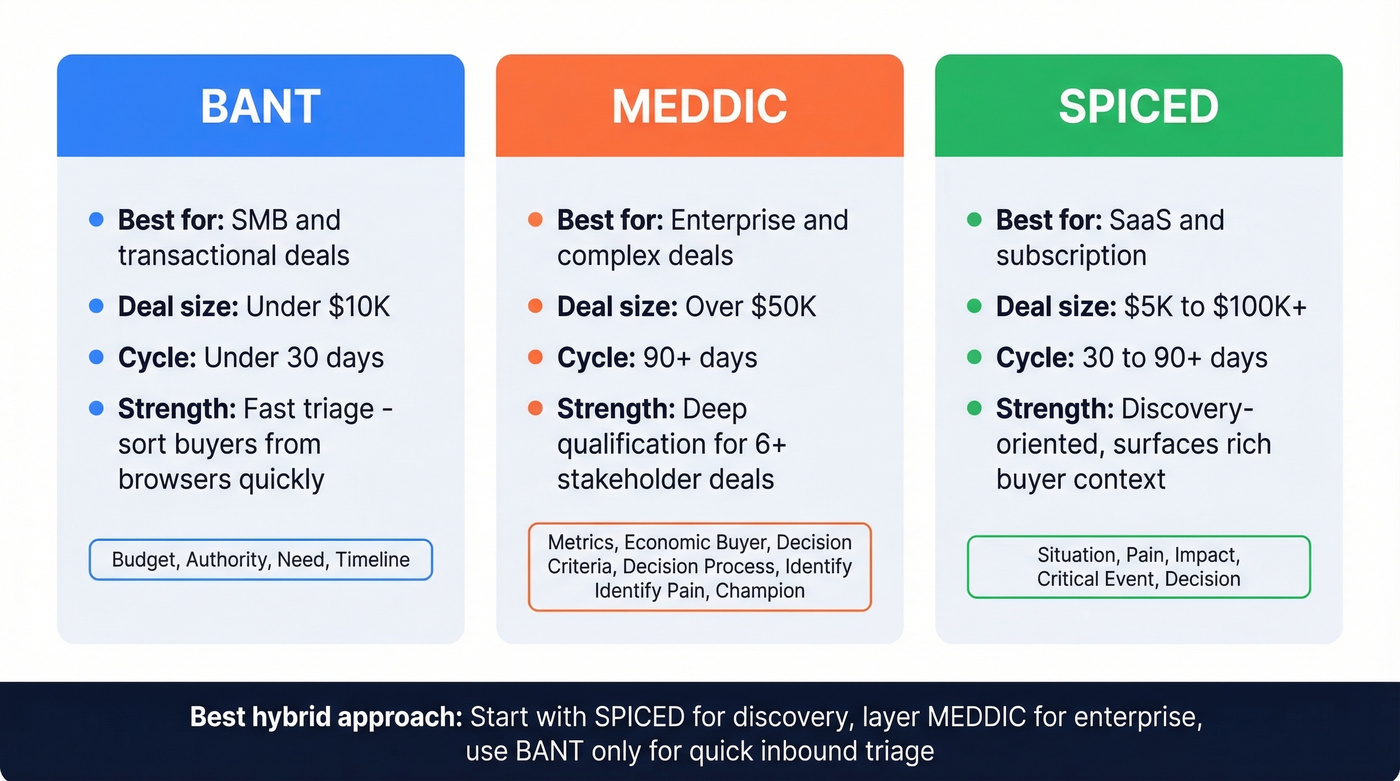
Three frameworks dominate B2B sales, and each fits a different motion.
| Framework | Best For | Deal Size | Cycle Length | Key Strength |
|---|---|---|---|---|
| BANT | SMB / transactional | Under $10K | Under 30 days | Fast triage |
| MEDDIC | Enterprise / complex | Over $50K | 90+ days | Deep qualification |
| SPICED | SaaS / subscription | $5K-$100K+ | 30-90+ days | Discovery-oriented |
BANT works for short-cycle, lower-ticket deals where you need to quickly sort buyers from browsers. MEDDIC is built for enterprise complexity - 6+ stakeholders, long procurement cycles, and deals where the economic buyer and the champion are different people. SPICED shines in SaaS and subscription contexts because it centers on the buyer's situation and pain before jumping to solution.
The hybrid approach we've seen work best: start with SPICED for discovery (it surfaces richer context), then layer MEDDIC criteria for enterprise deals that need rigorous qualification. Use BANT only as a quick-triage filter for inbound leads that need fast routing.
B2B Sales Cycle Benchmarks
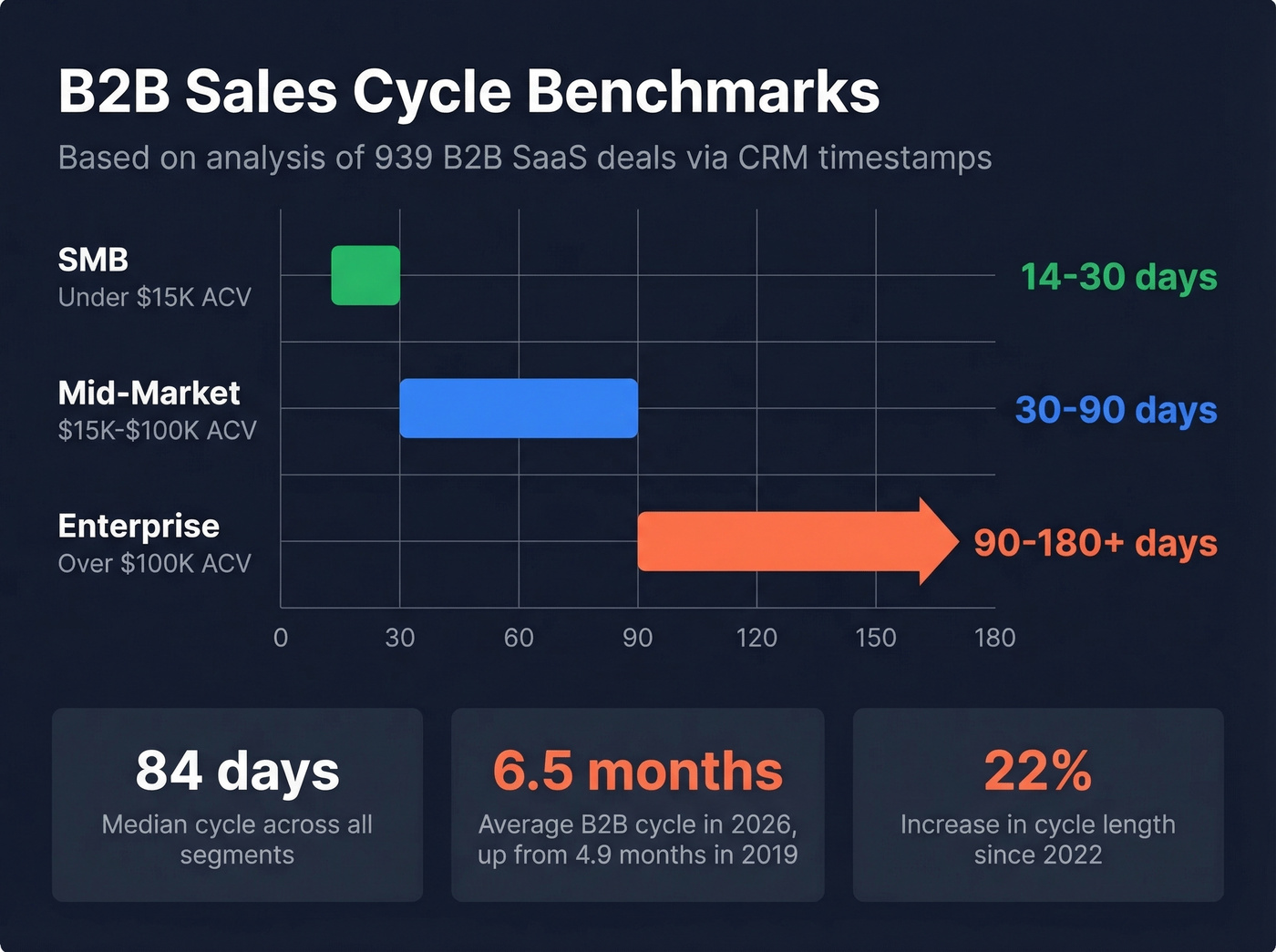
These come from an Optifai Pipeline Study of 939 B2B SaaS deals, analyzed via CRM timestamps.
Cycle Length by Deal Size
| Segment | ACV Range | Cycle (25th-75th percentile) |
|---|---|---|
| SMB | Under $15K | 14-30 days |
| Mid-market | $15K-$100K | 30-90 days |
| Enterprise | Over $100K | 90-180+ days |
The median across all segments is 84 days. But the macro trend is sobering: the average B2B sales cycle now runs 6.5 months, up from 4.9 months in 2019. Cycles have lengthened 22% since 2022 alone, driven by larger buying committees and increased security and compliance due diligence.
Stage Duration for Won Deals
| Stage Transition | SMB | Mid-Market | Enterprise |
|---|---|---|---|
| Discovery to Demo | 3-5 days | 5-10 days | 10-20 days |
| Demo to Proposal | 1-3 days | 5-15 days | 15-30 days |
| Proposal to Negotiation | 3-7 days | 10-20 days | 20-40 days |
| Negotiation to Close | 2-5 days | 10-20 days | 30-60 days |
Notice how enterprise deals spend the majority of their time in the back half. Negotiation to close alone eats 35-40% of the total enterprise cycle. That's not selling time - it's waiting-for-legal time.
Conversion Benchmarks (B2B SaaS)
Conversion benchmarks from First Page Sage's 2017-2026 dataset:
- Lead to MQL: 39%
- MQL to SQL: 38%
- SQL to Opportunity: 42%
- SQL to Closed Won: 37%
Enterprise converts lower at every stage. Digital Bloom's synthesis of 40+ studies shows enterprise opportunity-to-close rates dropping to 31% versus 39% for SMB/mid-market. Win rates across the board sit at roughly 20-21% - four out of five deals end in a loss or no-decision.

Step 1 of your sales process determines every conversion rate downstream. Prospeo gives you 300M+ profiles with 30+ ICP filters - buyer intent, technographics, headcount growth, funding - plus 98% email accuracy on a 7-day refresh cycle. No bounced emails burning your domain. No wrong numbers wasting rep hours.
Fix your pipeline at the source - start with data that actually connects.
How to Shorten Your Sales Cycle
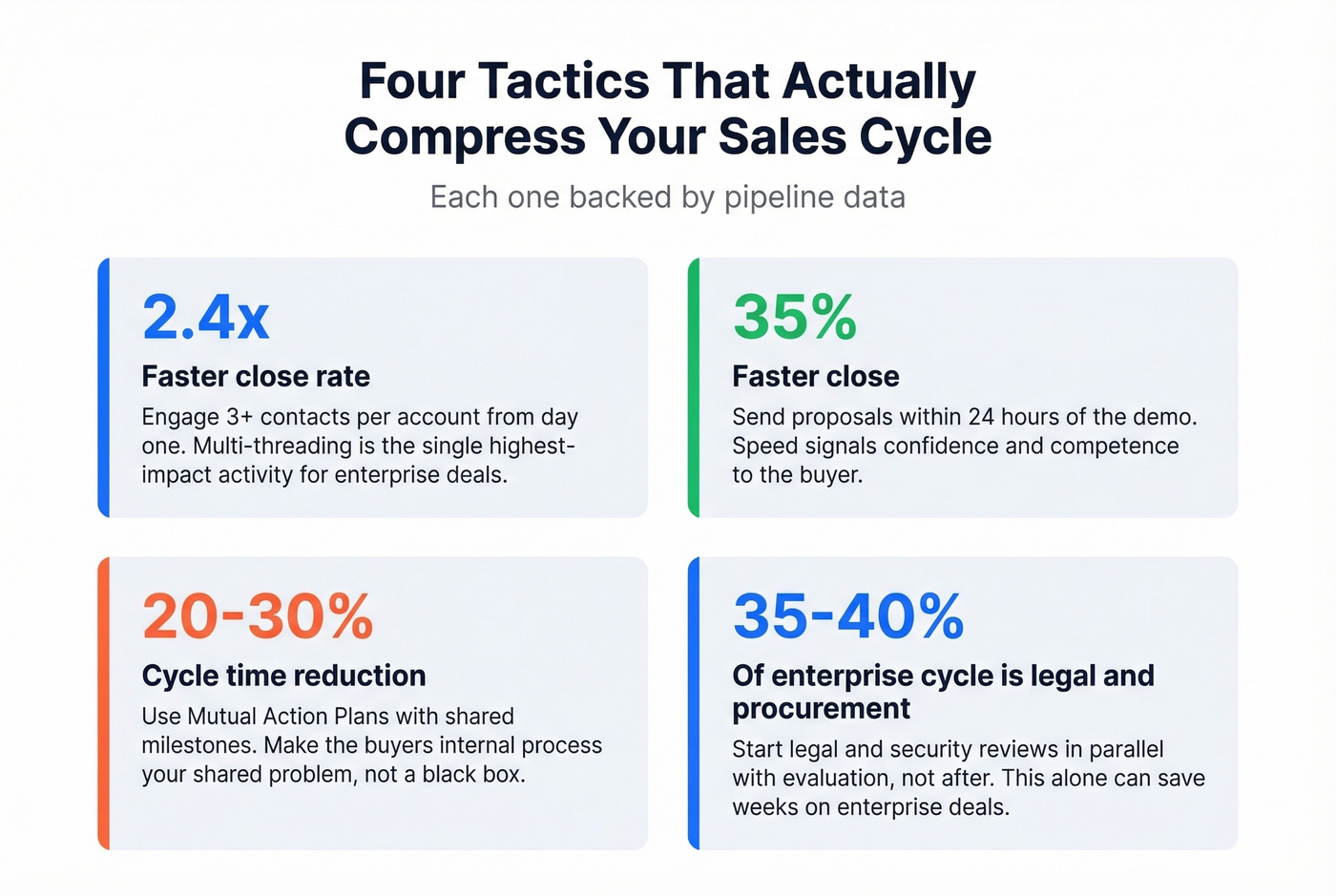
Optimizing your B2B sales process comes down to four tactics with actual data behind them.
Multi-Thread From Day One
Deals with 3+ contacts engaged close 2.4x faster. This isn't optional for enterprise - it's the single highest-impact activity your reps can adopt. Map the buying committee in discovery and engage champions, economic buyers, and technical evaluators in parallel. Skip this and you're betting your pipeline on a single thread that can snap at any point.
Send Proposals Within 24 Hours
Deals where the proposal lands within a day of the demo close 35% faster. The delay isn't about perfecting the proposal - it's about losing momentum while the buyer's attention shifts to the next vendor. We've seen teams set up proposal templates pre-demo so the rep only needs to customize 20% of the doc. That small workflow change shaved days off their average cycle.
Use Mutual Action Plans
A shared timeline with milestones for both sides reduces cycle time by 20-30%. It works because it surfaces procurement bottlenecks - legal review, security questionnaire, budget approval - before they become surprises. The consensus on r/sales is that MAPs are the single most underused tool in enterprise selling, and the data backs that up.
Fix Your Data Before It Enters the Sequence
Bounced emails burn your sender domain. Wrong numbers waste rep hours - and reps already spend only 28-30% of their time actually selling. Snyk's team of 50 AEs dropped their bounce rate from 35-40% to under 5% and generated 200+ new opportunities per month after switching to Prospeo and tightening verification. The lesson: data quality isn't a nice-to-have. It's the foundation your entire outbound workflow sits on. (If you’re diagnosing issues, start with email bounce rate.)
Where B2B Sales Processes Break
Bad data poisons everything downstream. Bounced emails damage domain reputation. Wrong phone numbers reduce connect rates. Incomplete org charts mean you're targeting the wrong stakeholders. If your CRM data is stale, your forecast is fiction.
Missing stakeholders surface too late. You've run a great discovery, nailed the demo, and the champion is ready to sign. Then a VP of Security you've never spoken to blocks the deal with a compliance requirement nobody mentioned. This is infuriating, and it's preventable. Map the full buying committee early or accept that late-stage surprises will kill your win rate.
Pricing conversations happen too late. When you delay discussing investment, you let the buyer anchor on a competitor's number. By the time you present pricing in the proposal stage, you're negotiating against a phantom benchmark.
Tool fragmentation drowns reps. The average rep uses roughly 10 tools and 66% feel swamped by the stack. When reps spend 18% of their week on CRM admin and tool-switching, that's selling time evaporating. Most teams would be better off with fewer tools used consistently than a bloated stack used poorly.
Essential Tools for Your Stack
Let's be honest: if your average deal is under $15K, you probably don't need ZoomInfo-level data. A self-serve prospecting tool, a CRM, and a sequencer will get you 90% of the way there. Stop adding tools. Pick one per category and actually use it.
| Category | Recommended | Approx. Pricing |
|---|---|---|
| CRM | HubSpot, Salesforce | Free tier available (HubSpot); ~$25-$330+/user/mo (Salesforce) |
| Sales Engagement | Outreach, Instantly, Lemlist | ~$100-$200+/user/mo (Outreach); ~$30-$100/mo (Instantly); ~$59-$99/user/mo (Lemlist) |
| Digital Sales Rooms | GetAccept, Arrows | ~$25-$100+/user/mo (GetAccept); ~$49-$99/mo (Arrows) |
For teams that need accurate contact data without enterprise-grade procurement cycles, skip the "talk to sales" gates entirely. Self-serve tools with transparent pricing and no annual contracts exist now, and they're 90% cheaper than the legacy players with higher accuracy. (If you’re rebuilding the stack, start with best contact management software.)
AI and the Modern Sales Cycle
Gartner projects that by 2028, AI will close 70% of sales cycles by automating prospecting, qualification, and portions of negotiation. By 2031, 35% of sales organizations will introduce EQ-related productivity metrics as AI handles the mechanical work.
The implication for your process: legacy activity metrics - calls made, emails sent - become meaningless when AI can inflate those numbers infinitely. The new KPIs that matter are deal acceleration, stakeholder alignment depth, and objection resolution effectiveness. Teams that cling to "100 dials a day" as a success metric will lose to teams measuring whether those dials actually moved pipeline. (For practical tooling, see generative AI sales tools.)
Multi-threading closes deals 2.4x faster, but only if you can find 3+ verified contacts per account. Prospeo maps entire buying committees with verified emails and 125M+ direct dials - at $0.01 per email. Push contacts straight to HubSpot, Salesforce, or your sequencer in one click.
Stop single-threading deals with incomplete org charts.
FAQ
How long is a typical B2B sales cycle?
The median B2B SaaS sales cycle is 84 days, based on CRM timestamp analysis of 939 deals. SMB deals close in 14-30 days, mid-market in 30-90 days, and enterprise in 90-180+ days. Cycles have lengthened 22% since 2022, primarily due to larger buying committees and increased compliance requirements.
What's the difference between B2B and B2C sales?
B2B sales involve multiple stakeholders (6-13 per deal), longer cycles measured in weeks or months, and rational buying processes driven by ROI analysis. B2C is typically single-buyer, emotionally driven, and resolved in minutes to days. B2B also requires navigating procurement, legal, and security reviews that don't exist in consumer purchases.
Which qualification framework should I use?
BANT works best for deals under $10K with cycles under 30 days - it's a fast triage tool. MEDDIC fits enterprise deals over $50K with 90+ day cycles and 6+ stakeholders. SPICED is ideal for SaaS where discovery depth matters most. Many teams run SPICED for discovery and layer MEDDIC for enterprise qualification.
What's a good B2B sales conversion rate?
For B2B SaaS, benchmark conversion rates run approximately: Lead to MQL 39%, MQL to SQL 38%, SQL to Opportunity 42%, and SQL to Closed Won 37%. Enterprise segments convert lower at every stage - expect opportunity-to-close rates around 31%. Overall win rates sit at roughly 20-21%.
How do I fix bad data in my sales process?
Use a provider with real-time verification and frequent refresh cycles - stale data is the top pipeline killer. A 5-step email verification process with catch-all handling and spam-trap removal can drop bounce rates from 35-40% to under 5%, which is the difference between a healthy sender domain and one that's blacklisted.