

The B2B Segmentation Strategy Most Teams Get Wrong
You build a segment of 5,000 "perfect-fit" accounts. Your SDRs launch the campaign. Within 48 hours, 1,400 emails bounce, 800 contacts have the wrong title, and your domain reputation takes a hit that'll take weeks to repair.
Your b2b segmentation strategy wasn't wrong. The data underneath it was.
We've watched this play out dozens of times across outbound teams we work with, and the root cause is almost always the same: teams build sophisticated segments on top of data that's already decaying. Here's the operational playbook to fix that.
The Short Version
Layer three dimensions: firmographic + technographic + intent. Any single dimension alone produces segments too broad to act on.
Fix data quality first. Your segments are useless if 30% of the contact data is stale. Verification comes before segmentation, not after.
Review quarterly, not annually. Markets shift, people change jobs, and buying signals expire. A 90-day re-verification cadence keeps segments alive.
Three Segmentation Layers That Actually Matter
Firmographic - Who They Are
Industry, employee headcount, revenue, geography, growth stage. It's where most teams start and where most teams stop. Firmographics tell you whether a company could buy - not whether they will.
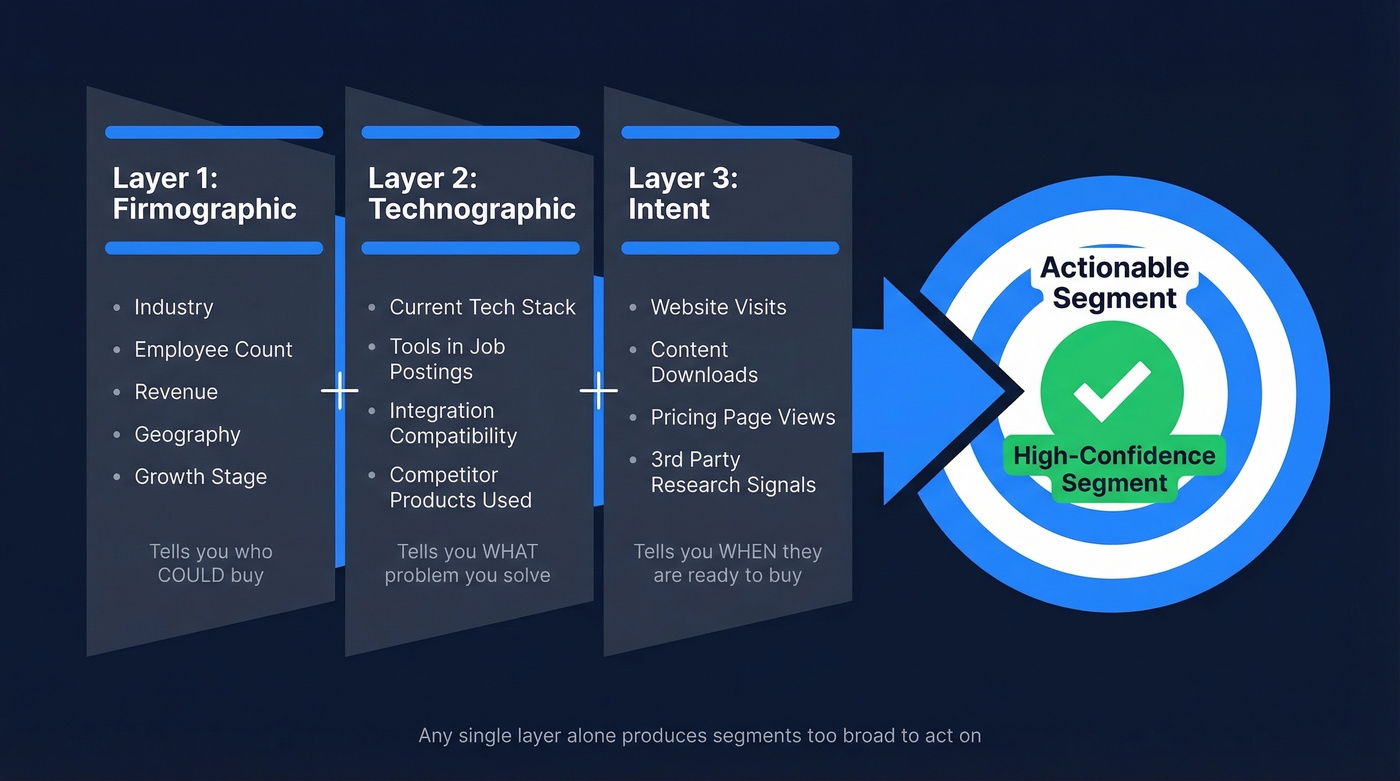
Use firmographics to define your TAM and draw the outer boundary of your ICP (see TAM and sales for how teams operationalize it). But don't rely on them as your only axis. You'll end up with segments so broad that messaging can't be personalized. Mid-market buying committees average 7 people, so even "right company" doesn't mean "right person."
Technographic - What They Use
Tech stack data is the most underused segmentation layer in B2B. If you sell a Salesforce integration, knowing which prospects already run Salesforce is more valuable than knowing their revenue band. Pull technographic signals from tools like Wappalyzer or by mining job postings for technology mentions.
Use this when your product replaces, integrates with, or competes against specific technologies. Skip it entirely if you're selling something truly horizontal - say, office furniture or corporate travel.
Here's the thing: if you can only pick one layer beyond firmographics, pick technographic. It's more actionable than intent data for most teams under $10M ARR because it tells you exactly which problem you solve for that account. No interpretation required.
Intent - Are They In-Market
Intent data separates "fits our ICP" from "fits our ICP and is actively researching solutions right now." First-party intent comes from your own channels - website visits, content downloads, pricing page views. Third-party intent comes from publishers tracking research behavior across the web.
65% of marketers say intent signals improved pipeline forecasting accuracy. That tracks, because intent collapses the timing problem - you're reaching the right company while they're actually looking. And with 80% of B2B sales interactions now happening in digital channels, those research signals are more trackable than ever.
Fix Your Data Before You Segment
None of those layers matter if your underlying contact data is garbage.
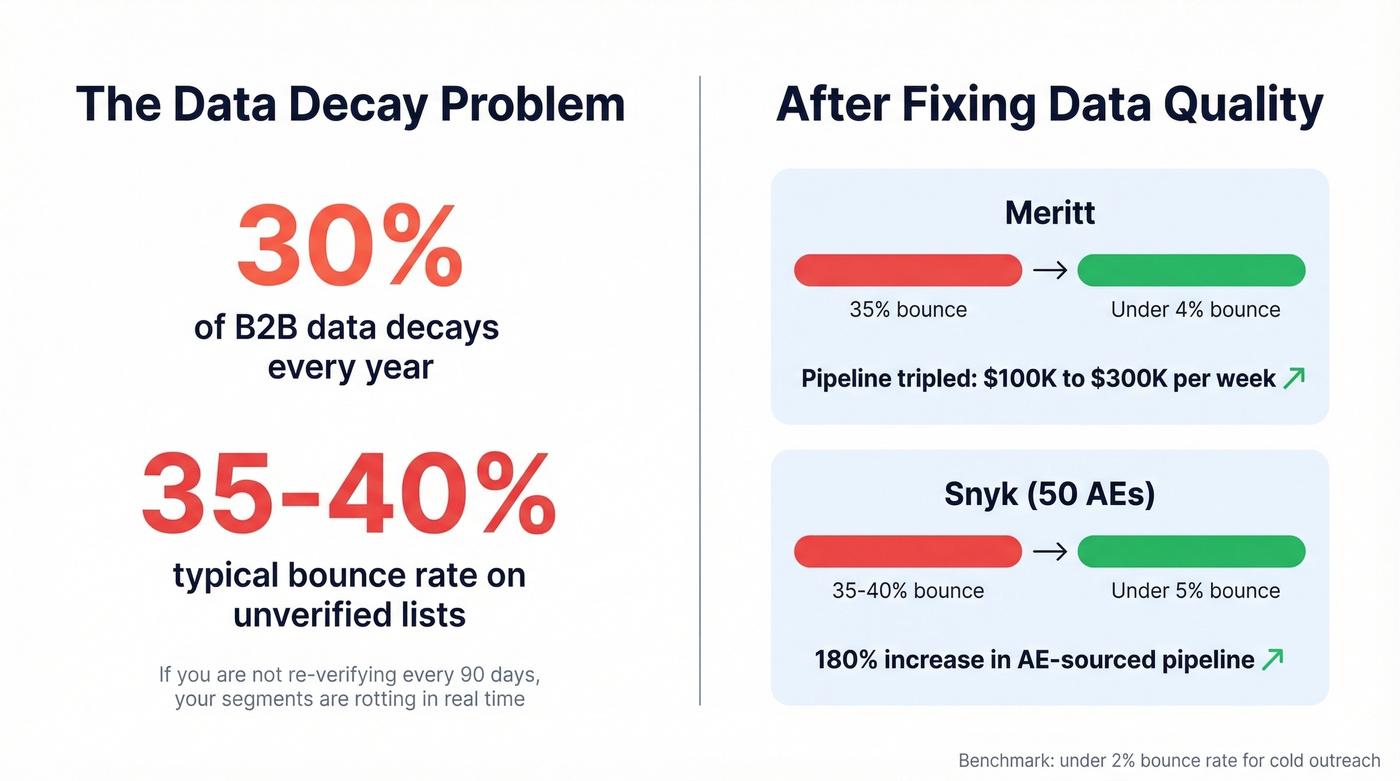
B2B data decays at roughly 30% per year. People change jobs, companies restructure, emails go stale. If you aren't re-verifying every 90 days, your segments are rotting in real time (this is classic data hygiene). The benchmark for cold outreach is a bounce rate under 2%. Under 5% is acceptable. Anything above that and you're actively damaging your sender reputation - see average bounce rate for email campaigns and how to reduce bounce rate.
The results when teams fix this are dramatic. Meritt, a B2B services firm, saw their bounce rate drop from 35% to under 4% after fixing their data foundation - and their pipeline tripled from $100K to $300K per week. Snyk's 50-person AE team went from 35-40% bounces to under 5%, driving a 180% increase in AE-sourced pipeline.
Prospeo's B2B database lets you build segments with 30+ filters - including buyer intent, technographics, and headcount growth - with every email verified at 98% accuracy on a 7-day refresh cycle. The segments you build today are still accurate next week, not just the day you exported them.


Your segmentation strategy is only as good as the data underneath it. Prospeo's B2B database combines firmographic, technographic, and intent filters - all 30+ of them - with 98% email accuracy on a 7-day refresh cycle. No more launching campaigns on stale lists.
Stop segmenting on data that's already decaying.
From Segment to Activation
Segments that live in a spreadsheet don't generate revenue. Here's the activation sequence we recommend:
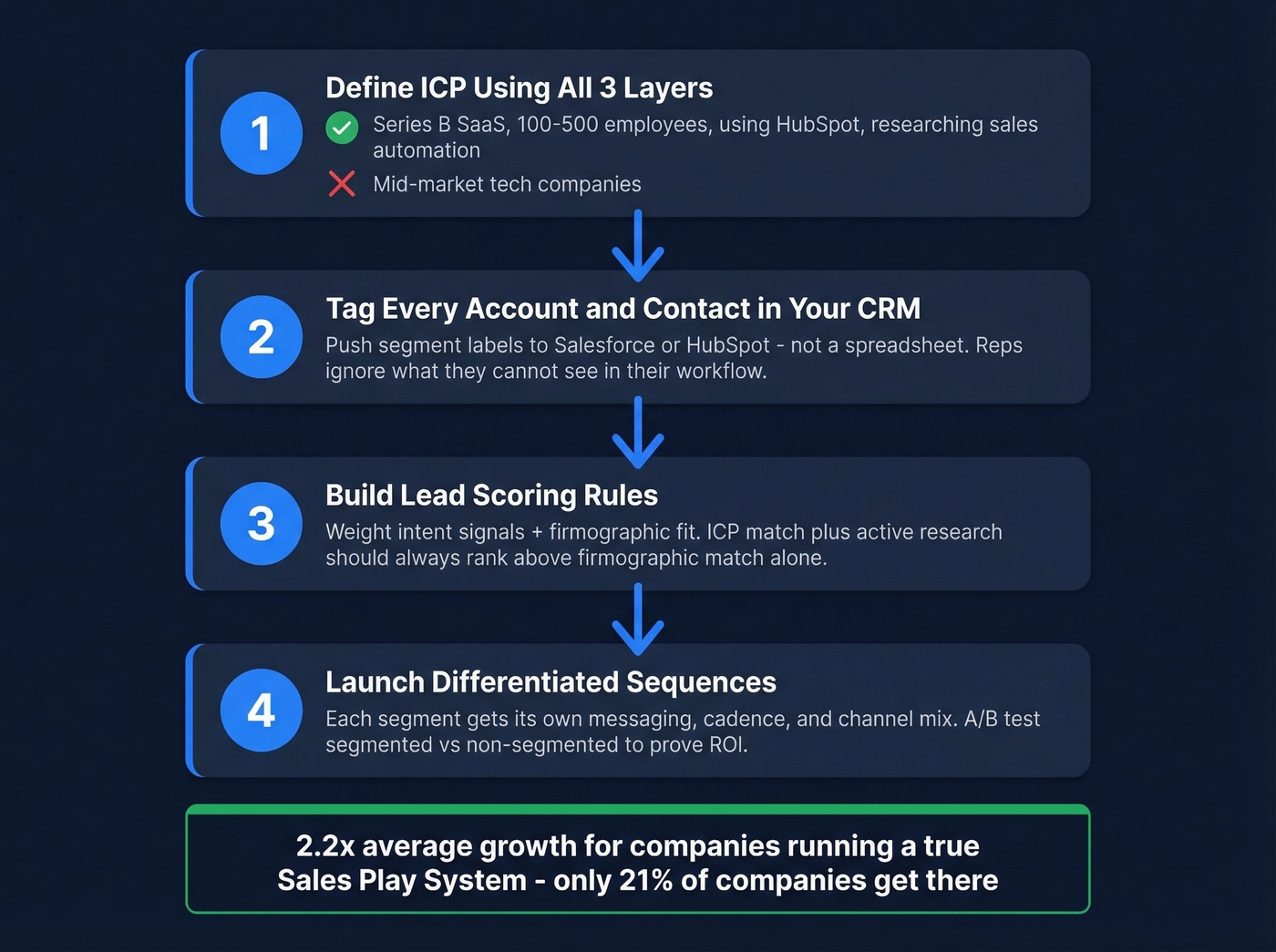
1. Define your ICP using all three layers (if you need a tighter process, use an ICP targeting framework). "Series B SaaS companies, 100-500 employees, using HubSpot, researching sales automation" is a segment. "Mid-market tech companies" isn't.
2. Tag in your CRM. Every account and contact needs a segment label. This is where most teams stall - they build the segment in a spreadsheet, never push it to Salesforce or HubSpot, and wonder why reps ignore it.
3. Build lead scoring rules that weight intent signals and firmographic fit. An ICP-match company actively researching your category should surface above one that just matches firmographics.
4. Launch differentiated sequences. Each segment gets its own messaging, cadence, and channel mix. A/B test segmented vs. non-segmented campaign performance so you can prove the ROI internally.
82% of companies say they run sales plays, but only 21% realize full value - segmentation is what separates the two groups. Companies running a true Sales Play System posted 2.2x average growth. And with buyers spending only 17% of their buying time meeting with suppliers, your segments need to meet them where they already are.
Why Most Segmentation Strategies Die
A pattern we see constantly in RevOps communities and across threads on r/sales: teams invest weeks building segments, then watch them decay because of three predictable mistakes.
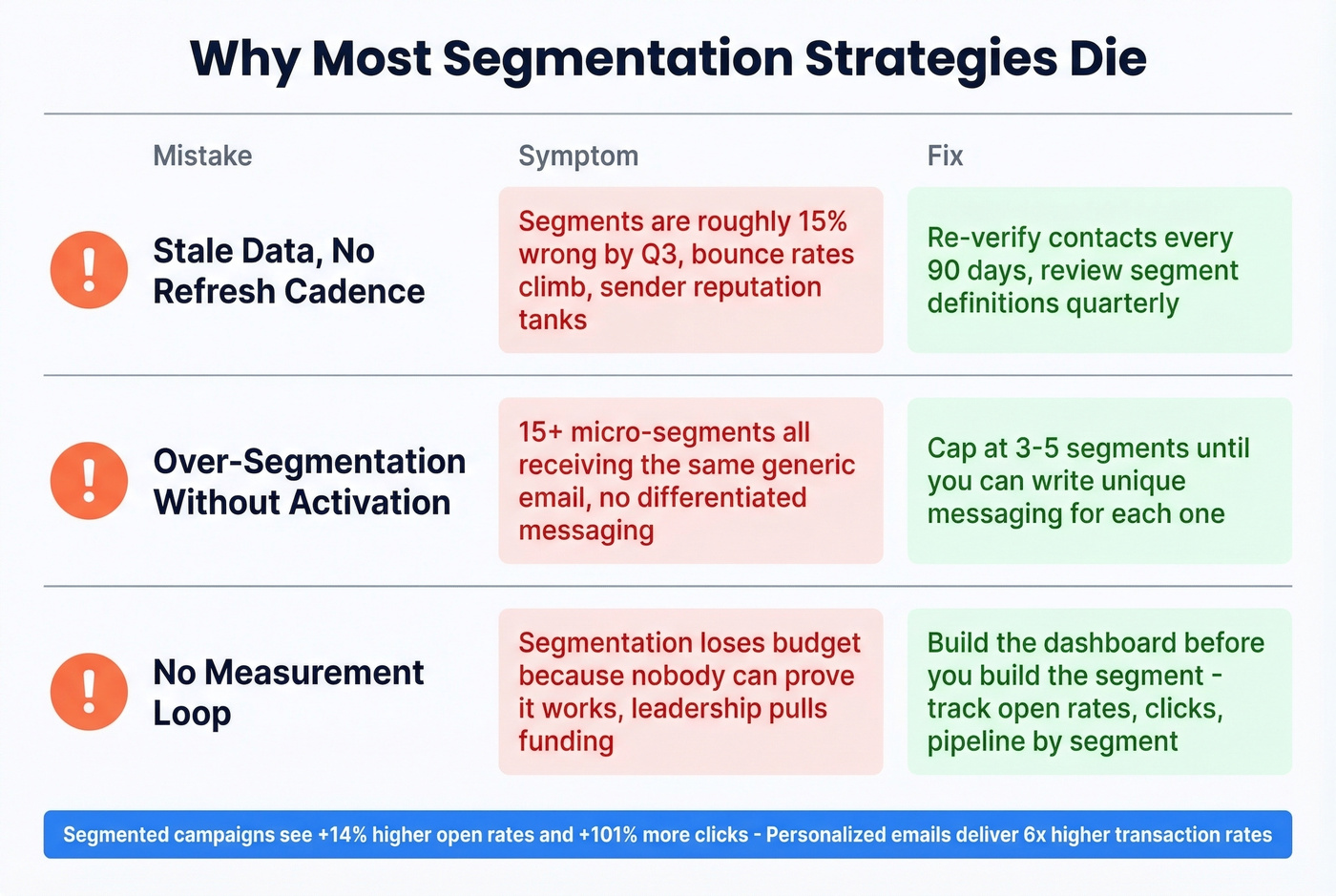
Mistake 1: Stale data, no refresh cadence. Great segments in Q1 can be roughly 15% wrong by Q3. The fix is simple but requires discipline: re-verify contact data every 90 days and review segment definitions quarterly (many teams formalize this in a quarterly business review).
Mistake 2: Over-segmentation without activation. We've seen teams build 15+ micro-segments and then send the same generic email to all of them. Let's be honest - if you can't write differentiated messaging for a segment, it shouldn't exist. Cap yourself at 3-5 actionable segments until you've proven you can activate each one.
Mistake 3: No measurement loop. Segmented campaigns see +14.31% higher open rates and +101% more clicks. Personalized emails deliver 6x higher transaction rates. If you aren't tracking segmented vs. non-segmented performance, segmentation will lose budget - even when it's working. Build the dashboard before you build the segment (an ABM dashboard is a good model to copy).
Recommended Tool Stack
You don't need ten tools. You need the right five.
| Tool | Category | Starting Price |
|---|---|---|
| Prospeo | Data enrichment + verification | Free tier; ~$0.01/email |
| HubSpot | CRM segmentation | Free CRM; Marketing Hub from ~$20/mo |
| Salesforce | CRM + tagging | From ~$25/user/mo |
| Bombora | Intent data | ~$25-50K+/year |
| UpLead | B2B lead lists | From $99/mo |
For teams that don't have Bombora budget yet, Prospeo includes intent data powered by Bombora across 15,000 topics - so you can layer buying signals without a separate five-figure contract (more on B2B lead generation and B2B list building if you're building the pipeline from scratch).
Meritt tripled pipeline from $100K to $300K/week after fixing their data foundation. Snyk's 50 AEs drove 180% more pipeline with bounce rates under 5%. The difference wasn't strategy - it was verified data at $0.01/email with 7-day refresh.
Layer intent, technographics, and firmographics on data you can trust.
FAQ
What's the difference between B2B and B2C segmentation?
B2B segments by organizational characteristics - firmographics, technographics, buying committee structure - plus longer sales cycles averaging 6-12 months. B2C segments by individual demographics and short-cycle purchase behavior. The biggest practical difference is that B2B almost always involves multiple decision-makers, which means your segments need to account for roles within an account, not just the account itself.
How often should I refresh my segments?
Re-verify contact data every 90 days and review segment definitions quarterly. B2B data decays at roughly 30% per year, so an annual review means you're operating on stale information for three quarters out of four.
How does segmentation fit into outbound campaigns?
Proper market segmentation ensures every outbound motion - email sequences, social touches, cold calls - targets a defined ICP slice rather than a generic list. Teams working off verified, well-segmented data consistently report bounce rates under 4% and significantly higher connect rates than those blasting unverified exports.
What tools do I need to start?
At minimum, a CRM for tagging and activation (HubSpot or Salesforce) plus an enrichment platform for verified contact data. Add a dedicated intent data source when you're ready to layer in buying signals. You can start small and scale - the important thing is that your data is clean before you build segments on top of it.