

ICP Targeting: How to Turn Your Ideal Customer Profile Into Actual Pipeline
Your SDR manager just showed you the outbound numbers: 2% reply rate across 8,000 emails sent last month. You have an ICP. It's in a Google Doc somewhere - written six months ago, never updated, and ignored by half the team. That's not ICP targeting. That's a wish list with a title.
The process of turning your ideal customer profile into an operational system - filtering, scoring, and prioritizing accounts so every rep and every campaign dollar hits the highest-probability prospects - is where revenue lives or dies. The gap between "we know who we sell to" and "our pipeline reflects who we sell to" is where most teams bleed out.
The Framework in Five Moves
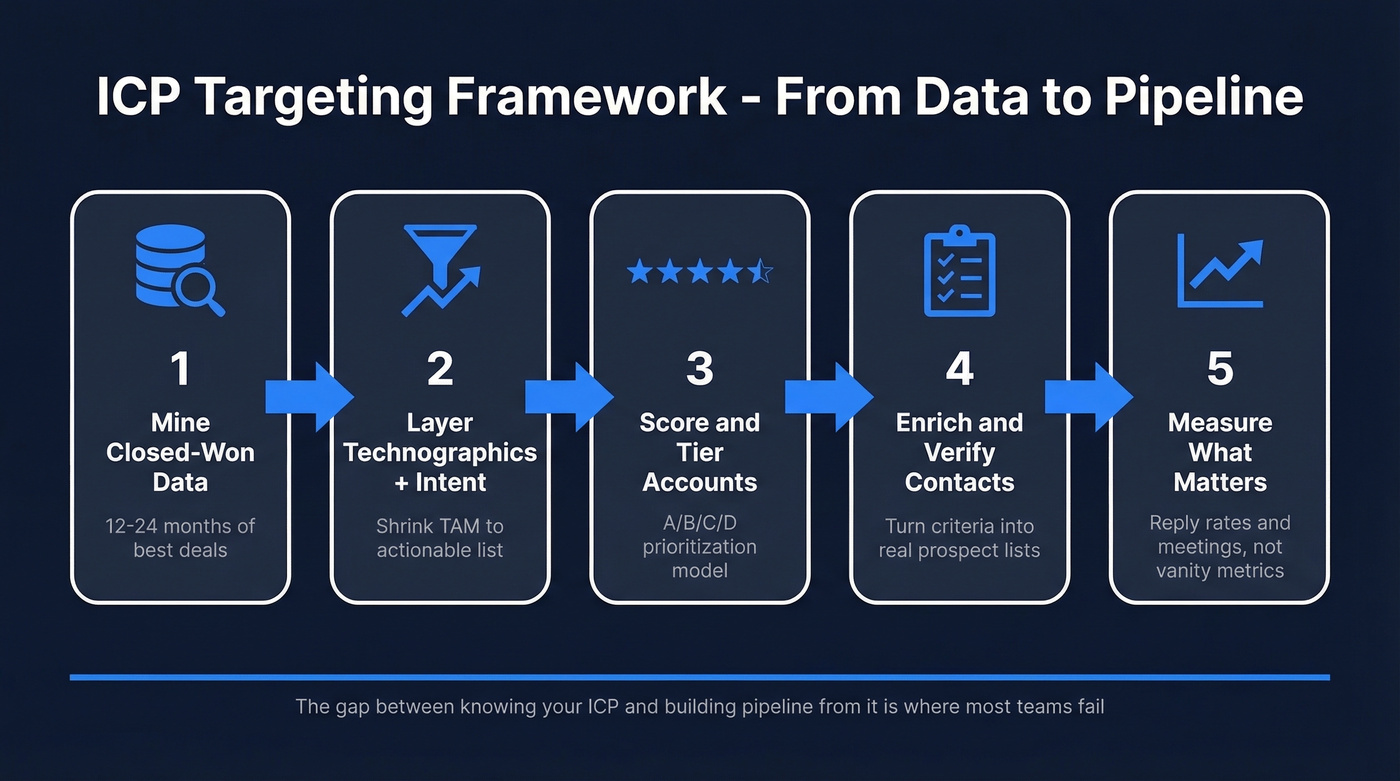
If you're short on time, here's the whole thing. Build your ICP from closed-won data, not assumptions - pull 12-24 months of deals and find the patterns. Layer technographics and intent signals to shrink your TAM to an actionable list. Score and tier accounts A/B/C/D so reps know where to spend their time. Use an enrichment tool to turn ICP criteria into a verified prospect list. Measure reply rates and meeting rates, not just "accounts targeted." The rest of this guide breaks down each step.
Why ICP Targeting Matters
The data isn't subtle. ICP-targeted campaigns achieve 68% higher ROI than broad targeting. HubSpot puts the conversion rate advantage at 36% for companies with clearly defined ICPs. And when sales and marketing actually agree on who they're targeting, the results compound: 36% higher retention, 38% higher win rates, and 208% growth in marketing-generated revenue. Aligned organizations also achieve 24% faster three-year revenue growth.
Most B2B marketers aren't bad at execution. They're bad at choosing who to execute for.
Your sequences, your ads, your content - they're probably fine. The targeting is what's broken. And the buying landscape makes this urgent: 94% of buying groups have already ranked their preferred vendors before talking to sales, and the average group consumes 13 content pieces anonymously before raising a hand. If you're not in front of the right accounts early, you're not in the consideration set at all.
ICP vs. Buyer Persona vs. Target Market
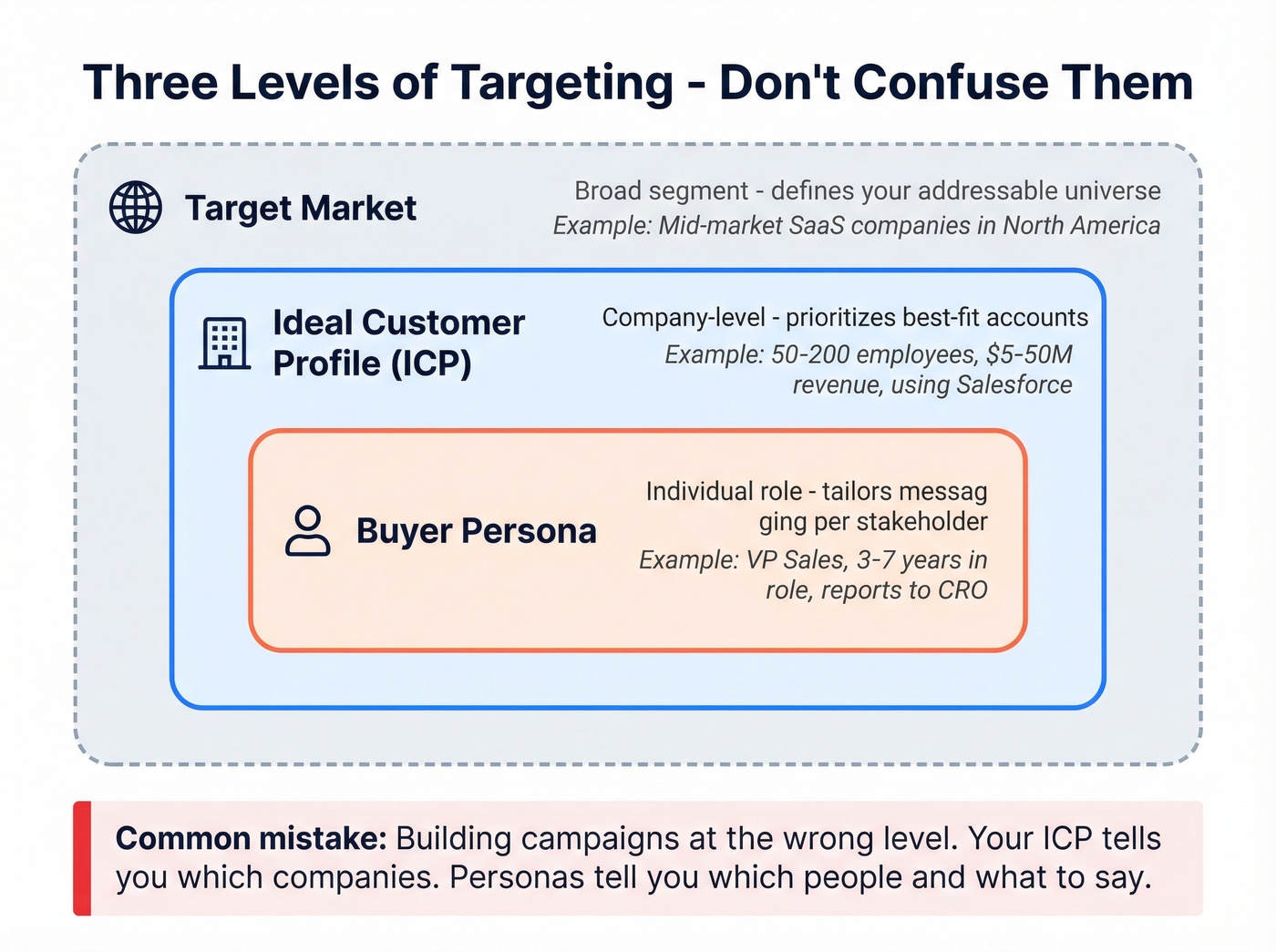
This confusion is the #1 mistake we see, and it kills execution because teams build campaigns for the wrong unit of analysis.
| Concept | Level | Purpose | Example |
|---|---|---|---|
| Target Market | Broad segment | Define addressable universe | Mid-market SaaS in NA |
| ICP | Company-level | Prioritize best-fit accounts | 50-200 employees, $5-50M rev, using Salesforce |
| Buyer Persona | Individual role | Tailor messaging per stakeholder | VP Sales, 3-7 yrs in role, reports to CRO |
Your ICP tells you which companies to pursue. Buyer personas tell you which people inside those companies to reach and what to say. Conflating the two means your SDRs are prospecting into companies that look right on paper but have the wrong internal structure, budget, or buying motion.
How to Build Your ICP for Sales Prospecting
Pull Your Closed-Won Data
Start with 12-24 months of closed-won deals. Filter for the ones you actually want more of - highest ACV, shortest sales cycle, lowest churn. This isn't about your biggest logo or your luckiest deal. It's about repeatable wins.
Then identify roughly 10 "super users" - your best-fit customers - and interview them. What made them buy? What almost stopped them? How did they find you?
Define Firmographic Fit
From those patterns, extract the firmographic criteria that matter: industry (be specific - "SaaS" is too broad, "B2B SaaS selling to mid-market" is better), headcount range, revenue band, geography, and business model.
Ask your best customers directly: What's your team structure? What tools were you using before? What triggered the search? These interview questions, recommended by Cognism's ICP template, surface the attributes that CRM data alone won't reveal.
If you want to go deeper on implementation, start with firmographic criteria and then layer firmographic and technographic data so your filters map to real systems.
Identify Buying Triggers
Firmographics tell you who could buy. Triggers tell you who's ready to buy now.
The key triggers to track: recent funding rounds, leadership changes like a new VP Sales or CRO, missed revenue targets, a failed vendor relationship, and visible growth signals like job postings in relevant departments. A company that matches your ICP firmographically but has no active trigger is a future prospect, not a current one.
If you need a repeatable process here, use a dedicated workflow for how to track sales triggers.
Map the Buying Committee
Buying committees now average 13 decision-makers. You need to know who champions your deal internally, who signs off on budget, who blocks in IT, legal, or procurement, and who actually uses the product. Mapping this at the ICP level - not just the deal level - means your reps know which roles to multi-thread into before the first call.
Document and Add Disqualifiers
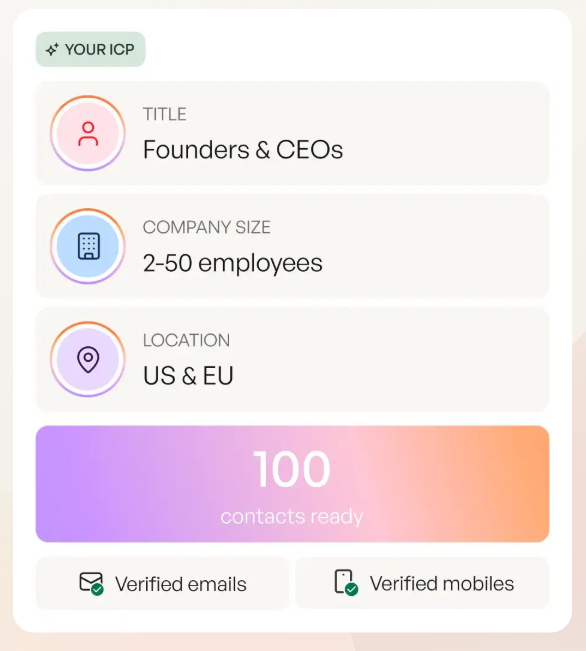
Write a one-page ICP document. Not a slide deck, not a wiki page buried in Notion - one page that every rep can reference in under 60 seconds. Include explicit disqualifiers: deal size below $10k, fewer than 3 salespeople, no existing sales process.
Here's the operational test: your ICP should be specific enough to cut your prospect list in half. If it doesn't eliminate anyone, it's not an ICP.
If you want a starting point your whole team can standardize on, use an ideal customer profile template.
Real-World ICP Examples
Gusto
Gusto started with six attributes: five or fewer employees, based in California, no existing benefits, salaried employees only, no contractors or other deductions, and paid within 8 days after payroll. That's absurdly narrow - and it worked. They expanded stepwise as customer love and engineering bandwidth grew, eventually reaching 300,000+ businesses. The narrowness wasn't a limitation. It was the strategy.
Gong
Gong's initial ICP: US-based, English-speaking, selling via video conferencing, with deal sizes between $1K and $100K. That filtered the entire market down to roughly 5,000 companies worldwide. Five thousand. They didn't try to boil the ocean - they dominated a pond first.
Snyk
Snyk targeted Node.js developers who were security-conscious. That's it. A narrow, deep use case before expanding wider.
The pattern across all three, as Lenny Rachitsky synthesized: "Everyone landed on at least three attributes to describe their ICP." Start narrow, prove the motion, then expand.
What Yours Might Look Like
A B2B SaaS company selling to mid-market finance teams might define their ICP as: 200-500 employees, US-based, running NetSuite, raised Series B+ in the last 18 months, with at least one open FP&A hire. Five attributes - specific enough to generate a list you can actually work.

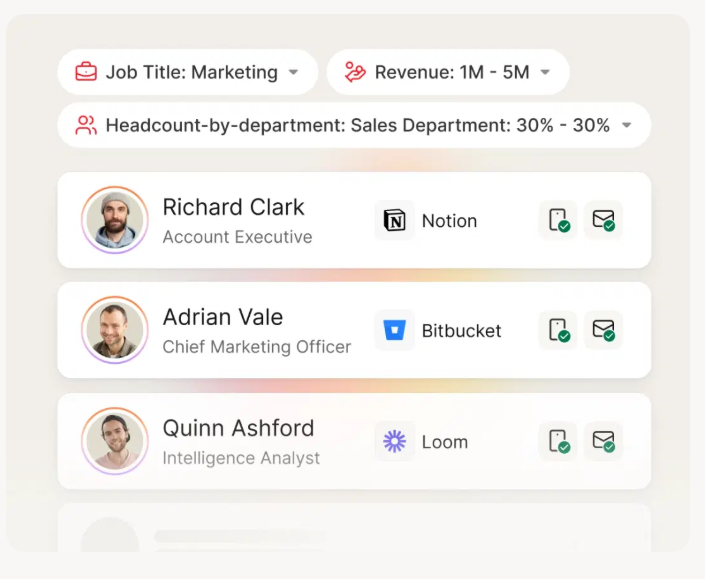
You just defined your ICP - now operationalize it. Prospeo's 30+ search filters let you target by firmographics, technographics, buyer intent, headcount growth, and funding stage. Layer in Bombora intent data across 15,000 topics to find accounts actively researching your category. Every email comes back 98% verified.
Stop targeting from a Google Doc. Start targeting from live data.
Layer Intent and Technographics
Think of it this way. Firmographics give you the neighborhood. Technographics tell you which houses have the right plumbing. Intent data tells you who's already called a contractor.
Technographics reveal what technology a company runs, how mature their stack is, and whether your product fits their infrastructure. Intent data tells you which accounts are actively researching solutions in your category. Layering both on top of your ideal customer profile is what turns a document into a pipeline engine.
If you’re building this into your GTM motion, intent based segmentation helps you route accounts by “why now,” not just “who.”
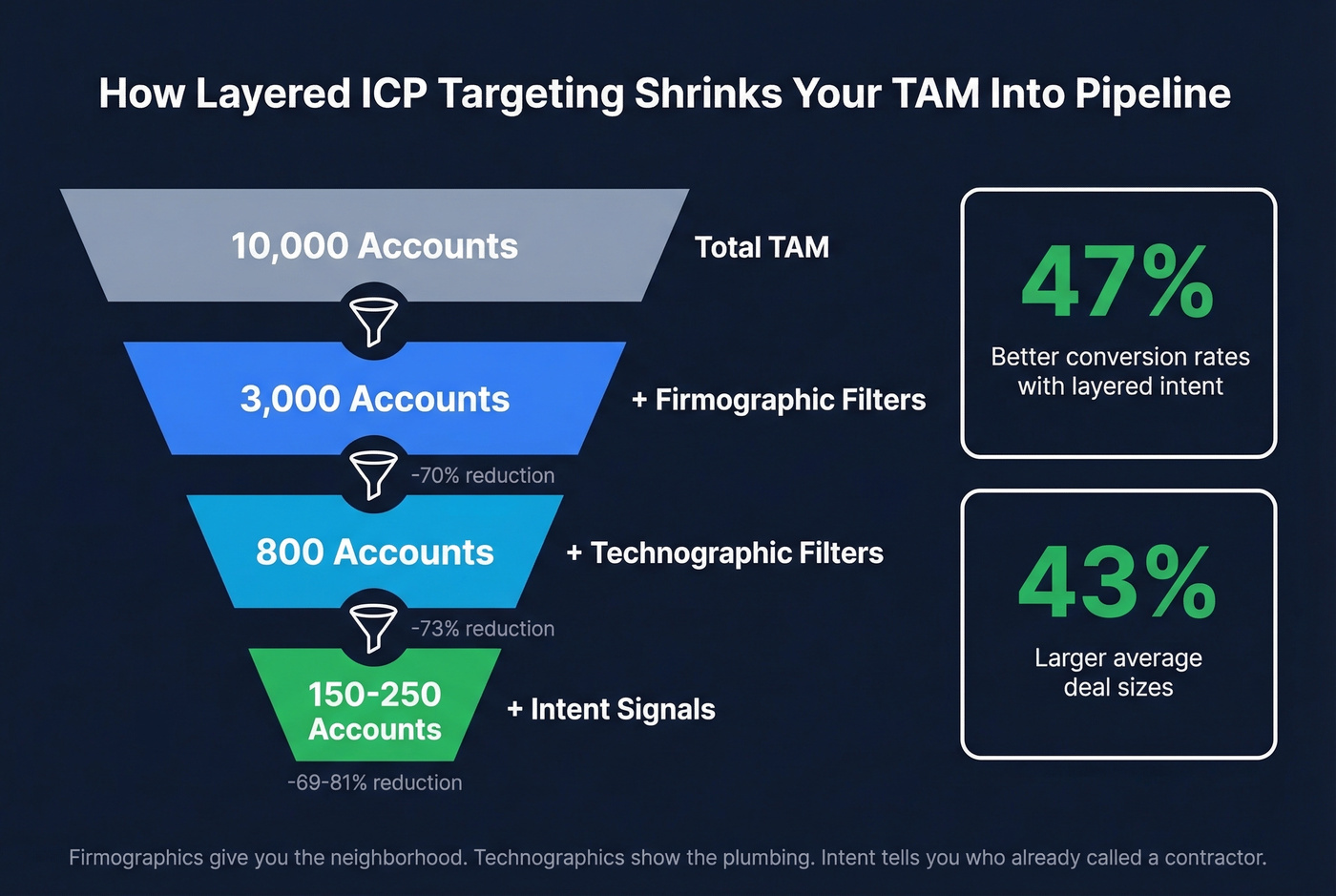
The math is dramatic. Start with 10,000 accounts in your TAM. Apply firmographic filters and you're down to 3,000. Layer technographics - say, companies running Salesforce but not a competitor's product - and you're at 800. Add intent signals, and you've got 150-250 accounts that match your profile, use compatible technology, and are actively in-market.
| Funnel Stage | Accounts | Reduction |
|---|---|---|
| Total TAM | 10,000 | - |
| + Firmographics | 3,000 | -70% |
| + Technographics | 800 | -73% |
| + Intent signals | 150-250 | -69-81% |
The payoff: organizations using layered intent signals report 47% better conversion rates and 43% larger deal sizes. That's not marginal improvement. It's a different business.
The distinction between first-party intent (your own site behavior, content downloads) and third-party intent (publisher networks, review sites, search behavior) matters. Most providers deliver account-level intent - "Acme Corp is researching sales engagement tools." Contact-level intent is rarer and far more actionable because it tells you which person at Acme is doing the research.
Here's the thing, though. 91% of B2B marketers use intent data to prioritize accounts, yet only 24% report exceptional ROI. The problem isn't the data - it's the activation. Marketing hands sales a list of "in-market accounts" without contacts, context, or routing logic. The list sits in a spreadsheet. Nobody calls.
Baseline funnel benchmarks to measure against:
| Stage | Conversion Rate |
|---|---|
| Lead to MQL | 35-45% |
| MQL to SQL | ~15% |
| SQL to Opportunity | 25-30% |
| Opp to Closed-Won | 6-9% |
That MQL-to-SQL handoff is the biggest leak - and it's exactly where intent data should have the most impact.
If you want more context on what “good” looks like across stages, compare against funnel metrics.
Build an ICP Scoring Model
Once you've defined your ideal customer profile and layered in signals, you need a system to prioritize. Account scoring combines three dimensions: ICP fit (firmographic match), engagement (behavioral signals like site visits and email opens), and intent (first-party and third-party buying signals).
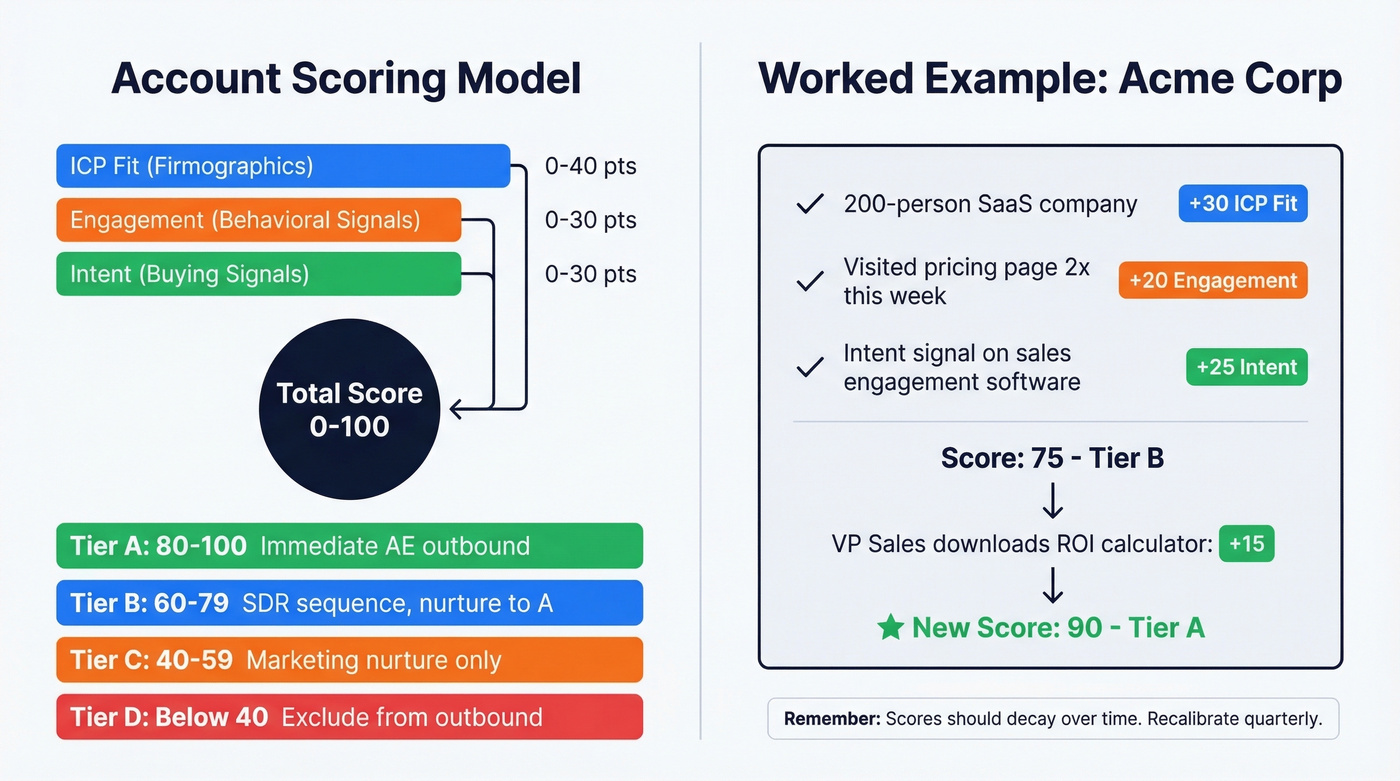
Businesses using lead/account scoring see a 77% boost in lead generation ROI. The simplest model that works is a tiered system:
| Tier | Score Range | Description | Action |
|---|---|---|---|
| A | 80-100 | Strong ICP fit + active intent + engagement | Immediate outbound, AE-led |
| B | 60-79 | Good fit + some signals | SDR sequence, nurture to A |
| C | 40-59 | Partial fit or low signals | Marketing nurture only |
| D | Below 40 | Poor fit or disqualified | Exclude from outbound |
A worked example: Acme Corp is a 200-person SaaS company (ICP fit: +30), visited your pricing page twice this week (engagement: +20), and shows third-party intent on "sales engagement software" (intent: +25). Total score: 75, Tier B. An SDR sequences them immediately. If Acme's VP Sales also downloaded your ROI calculator, add +15 - now they're Tier A and an AE picks up the phone.
Two concepts most teams miss. First, score decay - an account that showed intent three months ago but has gone quiet shouldn't keep its A-tier status. Scores need to degrade over time. Second, quarterly recalibration. Your ICP evolves as your product and market shift. The scoring model needs to evolve with it.
For teams with enough historical data, predictive scoring tools like Salesforce Einstein or MadKudu can automate this with ML models trained on your actual conversion patterns. Don't jump to predictive before you've nailed the manual version - garbage in, garbage out applies double to ML.
If you want a more detailed setup (and common pitfalls), see our guide to lead scoring.
Tools to Execute Your Strategy
You don't need a $300K ABM platform to operationalize account-based targeting. Here's what actually matters.
| Tool | Category | Starting Price | Best For |
|---|---|---|---|
| Prospeo | Enrichment + Prospecting | Free (75 verified emails/mo) | Verified emails + mobiles |
| Apollo.io | Enrichment + Prospecting | Free, from $49/user/mo | All-in-one SMB prospecting |
| Cognism | Enrichment + Prospecting | ~$1,000-$3,000/mo | EMEA data + verified phones |
| Bombora | Intent Data | $12K-$40K/yr | Standalone intent signals |
| 6sense | ABM Platform | Free (50 credits/mo), enterprise $300K+/yr | Full-stack ABM orchestration |
| Demandbase | ABM Platform | $30K-$100K+/yr | Enterprise ABM + advertising |
| HubSpot | CRM + Scoring | From $800/mo (Marketing Hub) | Mid-market lead scoring |
| Salesforce | CRM + Scoring | $25-$300/user/mo | Enterprise CRM + Einstein AI |
Prospeo collapses the gap between an ICP document and a verified prospect list. The database covers 300M+ professional profiles and 143M+ verified emails with 98% accuracy, plus 125M+ verified mobile numbers with a 30% pickup rate across all regions. Data refreshes every 7 days - the industry average is 6 weeks. Intent data tracks 15,000 topics via Bombora, and you can layer it with technographics, job changes, headcount growth, and funding signals in a single search. Pricing starts free at 75 verified emails/month, with paid plans at roughly $0.01/email. No contracts, cancel anytime.
We've seen the data quality difference firsthand. Snyk's team of 50 AEs went from a 35-40% bounce rate to under 5% after switching their data source, with AE-sourced pipeline up 180%.
If you’re comparing vendors, start with a shortlist of data enrichment services and then narrow to the best-fit sales prospecting databases for your region and ACV.
Apollo.io is the go-to for SMB teams that want prospecting, sequencing, and a CRM in one tool. The free tier is generous, and paid plans start from $49/user/month. Database depth is solid for North America.
Cognism wins for EMEA-focused teams. Their Diamond Data phone verification is genuinely useful if your reps are dialing into the UK and Europe.
Bombora is the intent data layer most other platforms resell. If you want raw intent signals without an ABM platform wrapper, it's the standard.
6sense and Demandbase are enterprise ABM platforms - powerful, but complex and expensive. If your ACV supports a $30K+ annual tool investment and you have a dedicated ops team, they're worth evaluating. Skip them if you're a team of under 10 reps. They're overkill, and you'll spend more time configuring than selling.
Let's be honest: if your average deal size is under $15K, you almost certainly don't need an enterprise ABM platform. A solid enrichment tool, a well-configured CRM, and disciplined scoring will outperform a six-figure tech stack that nobody on your team fully uses.
Measure Your Targeting Impact
The numbers tell you whether your approach is working or just feels like it is. Average B2B cold email reply rates sit at 3-5%. Top performers with tight account prioritization, strong hooks, and disciplined follow-up hit 15-25%. That's a 3-5x gap driven primarily by who you're targeting, not how clever your subject line is.
Two benchmarks worth pinning to your wall: segmenting outbound into cohorts of 50 contacts or fewer yields a 2.76x reply rate lift, and timeline-based hooks like "saw you just raised a Series B" pull a 10.01% reply rate versus 4.39% for generic problem hooks. The 3-7-7 follow-up cadence captures 93% of replies by Day 10.
If you want plug-and-play messaging for that cadence, use these sales follow-up templates.
Beyond the quantitative, Lenny Rachitsky identifies four qualitative signs you're converging on the right ICP: higher conversion rates, more enthusiasm from prospects during calls, stronger urgency in their buying timeline, and "the nod" - that moment when a prospect says "you get us" without you having to explain your value prop.
One more thing: if 20%+ of your emails bounce, your targeting isn't the problem - your data source is. Fix the data first, then measure whether your strategy works.
If bounces are the issue, start with email bounce rate benchmarks and remediation.
Common Mistakes to Avoid
Confusing ICP and buyer personas. Your ICP is a company profile. Personas are the people inside those companies. Define them separately, use them together.
Building the ICP in a marketing silo. If sales, CS, and product aren't in the room, your ICP reflects marketing's assumptions, not reality. Cross-functional input from day one. The consensus on r/sales is pretty clear on this - the best ICPs come from reps who talk to customers daily, not from a marketing offsite.
The unused ICP. An ICP in a Google Doc is a wish list. If it's not embedded in your CRM filters, your ad targeting, and your SDR workflows, it doesn't exist. Operationalize it into every tool your team touches.
Too broad. If your ICP doesn't eliminate at least half your prospect list, it's not specific enough. Add attributes until it passes the "cut in half" test.
Never refreshing. Markets shift. Your product evolves. Your best-fit customer from 18 months ago might not be your best-fit customer today. Run quarterly cross-functional ICP workshops using closed-won/lost data, churn patterns, and market shifts.
Your ICP scoring model is only as good as the data behind it. Prospeo refreshes 300M+ profiles every 7 days - not every 6 weeks like competitors. That means the job changes, funding rounds, and hiring signals you're tracking are actually current. Enrich your CRM at 92% match rate with 50+ data points per contact.
Stale data kills ICP targeting. Weekly-refreshed data fixes it.
FAQ
What is ICP targeting?
ICP targeting is the process of converting your ideal customer profile into an operational system that filters, scores, and prioritizes accounts so every outbound dollar hits the highest-probability prospects. It bridges the gap between knowing who your best customers are and actually filling your pipeline with more of them.
How is an ICP used for sales prospecting?
Your ICP acts as a filter that narrows your total addressable market to accounts most likely to convert. Reps use firmographics, technographics, and buying triggers to build targeted lists and prioritize outreach. Tools like Prospeo let you apply 30+ filters - including intent data and job changes - to turn ICP criteria into a verified contact list in minutes.
How often should you update your ICP?
Quarterly at minimum. Use closed-won and closed-lost data, churn patterns, and market shifts to recalibrate. Involve sales, CS, and product - not just marketing. An ICP that hasn't been updated in six months is based on assumptions about a market that's already moved.
How many attributes should an ICP have?
At least three. Research across successful startups found that every company landed on at least three attributes. Gusto used six. The real test isn't a number - it's whether your ICP is specific enough to cut your prospect list in half.