

Benefits of CRM for Small Business: What the Data Actually Shows
A 5-person sales team shouldn't need a $40,000 platform to stop losing deals in spreadsheet tabs. Yet 91% of companies with 10+ employees already use a CRM, while only about half of micro-businesses do - and the ones that do earn $8.71 back for every $1 spent. That's not theoretical. It's measurable, and the gap between adopters and holdouts is widening every quarter.
As Bryan Philips, head of marketing at In Motion Marketing, puts it: CRM "is a group of tools, technology and techniques used to help sales and marketing professionals understand their customers better." Simple definition. But the impact on a small team's revenue, retention, and sanity is anything but simple. The CRM market hit $73.4B in 2024 and it's still accelerating - though market size doesn't help you decide whether to ditch your Google Sheet this quarter. Let's look at what the numbers actually say for small teams.
The Quick Version
Start with HubSpot Free or Zoho CRM ($14/user/mo). Both handle contact management, deals, and basic automation without a steep learning curve. Expect $8.71 back for every $1 spent - that's the Nucleus Research benchmark. Verify your data before importing, because a CRM full of dead emails is just an expensive address book. Budget a few hours to a day for setup, not weeks.
Signs You've Outgrown Spreadsheets
The decision to adopt a CRM isn't about headcount. It's about operational complexity. A 3-person team closing 20 deals a month has more CRM need than a 15-person team with 5 long-cycle enterprise accounts. Kynetto's framework nails this: complexity drives the decision, not size.
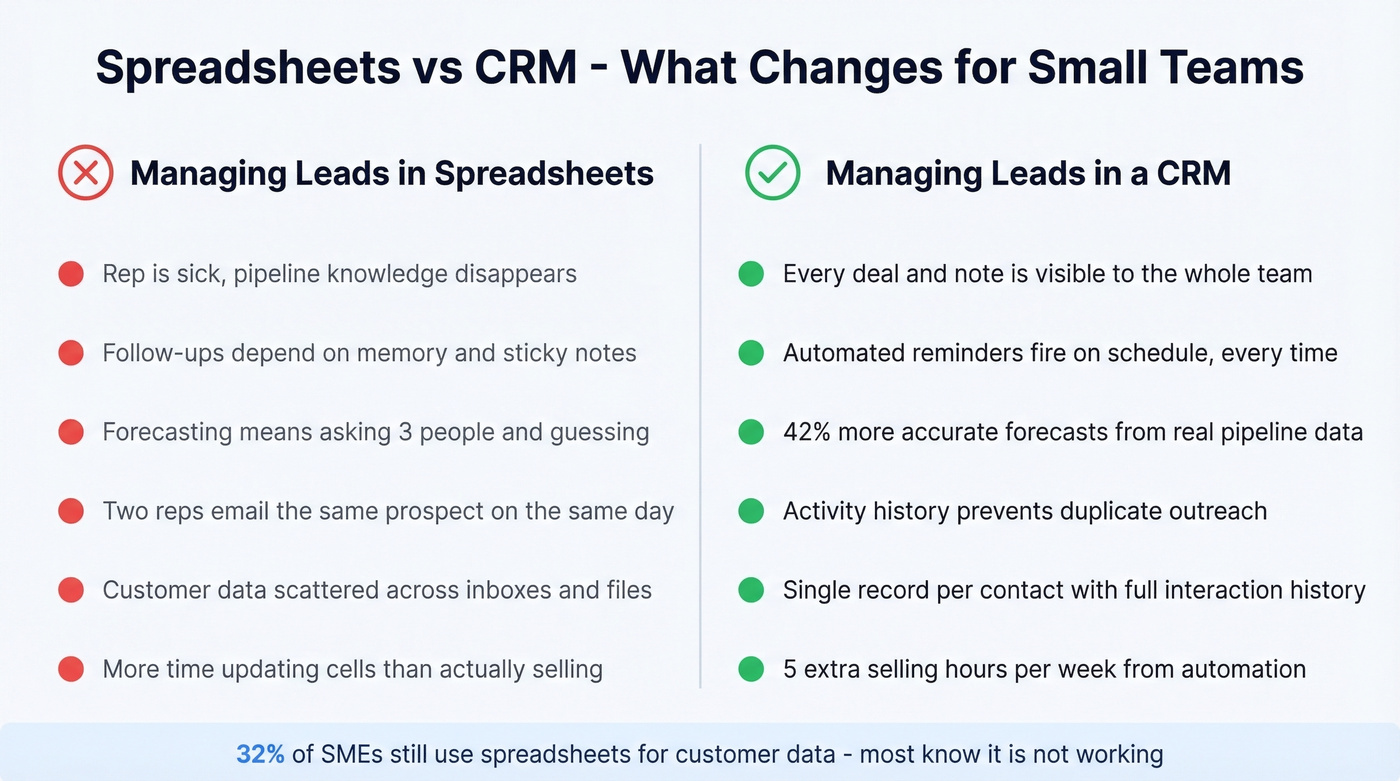
Five signs you're past the spreadsheet stage:
- Your best rep tracks 200+ leads in a personal Google Sheet - and when they're out sick, nobody knows what's in the pipeline
- Follow-ups fall through the cracks weekly - not because reps are lazy, but because there's no system reminding them (use sales follow-up templates to standardize it)
- You can't answer "how many deals close this month?" without asking three people
- Duplicate outreach is embarrassing you - two reps email the same prospect on the same day
- You're spending more time updating spreadsheets than selling - 32% of SMEs still manage customer data in spreadsheets, and most of them know it's not working
If three or more of those hit home, you're already paying the cost of not having a CRM. You just can't see it on an invoice.
The Real Advantages for Small Teams
Every CRM vendor lists 15 benefits on their marketing page. Most are variations of the same three things. Here are the ones we've seen backed by hard data and real case studies.
Centralized Customer Data
One source of truth replaces scattered inboxes, spreadsheets, and sticky notes. Every interaction - emails, calls, meetings, deal notes - lives in a single record. It's the foundation every other benefit depends on. Without it, nothing else on this list works.
More Closed Deals
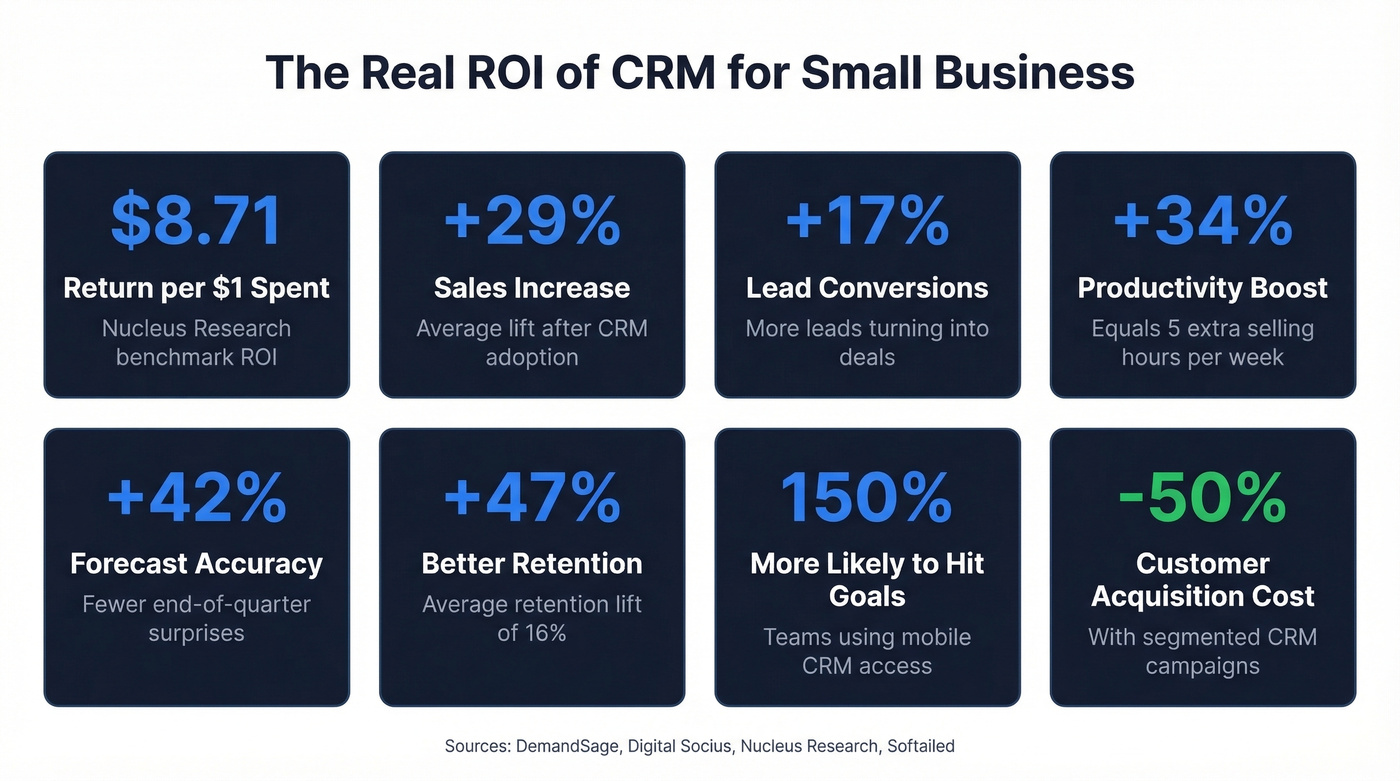
CRM usage increases sales by 29% and boosts lead conversions by 17%. For a team doing $500K/year, that's an extra $145K. Papeloja, a specialty paper company, switched from spreadsheets to Keap and saw 800% revenue growth within a few months. That's not a typo.
Automated Follow-Up and Productivity
CRM-driven automation lifts productivity by 34%. For most reps, that translates to roughly 5 extra selling hours per week - time previously burned on manual data entry, reminder-setting, and hunting for the last email thread. Five hours a week is 260 hours a year. That's six and a half working weeks your reps get back.
If you're building a repeatable system here, pair your CRM with a simple lead generation workflow so leads don't stall between stages.
Pipeline Visibility and Forecasting
You can't manage what you can't see. CRM improves forecast accuracy by 42%, which means fewer end-of-quarter surprises and better hiring decisions. For a small business owner, knowing whether next month's revenue covers payroll isn't a nice-to-have. It's survival. (If forecasting is a priority, compare sales forecasting solutions before you commit.)
Customer Retention
47% of businesses report higher retention after adopting CRM, with an average lift of 16%. Automated renewal reminders, birthday emails, and check-in sequences aren't glamorous - they're profitable. For an insurance agency, that means renewal reminders firing 60 days before expiration. For a real estate team, it's automated nurture sequences keeping cold leads warm until they're ready to buy. Acquiring a new customer costs 5-7x more than keeping one, so retention is where small businesses get the biggest bang for every dollar.
If you want to quantify this impact, track it alongside a basic churn analysis.
Marketing Segmentation
Make Influence, a Denmark-based influencer agency, adopted HubSpot and cut their customer acquisition cost by 50% - saving $300K/year on staffing alone. Segmented campaigns replaced spray-and-pray outreach. When you know which contacts are warm, which are cold, and which just visited your pricing page, every marketing dollar works harder. (This gets even sharper with intent based segmentation.)
Mobile Access
Here's a stat most people miss: businesses using mobile CRM are 150% more likely to exceed their sales goals. If your reps are in the field - visiting clients, attending trade shows, running between meetings - mobile access alone justifies the subscription.
AI-Powered Insights
This isn't hype anymore. Lead scoring, next-best-action recommendations, and auto-drafted follow-ups are available at $14-$29/user/mo in tools like Freshsales and Zoho. For a small team, AI lead scoring eliminates the guesswork of "which deal should I work on today?" Expect measurable results within 6-12 weeks of turning these features on. (If you're evaluating this category, start with lead scoring.)
Data Security
One benefit that flies under the radar: a CRM centralizes your customer data behind proper access controls, audit logs, and encrypted storage. Spreadsheets shared over email have none of that. For businesses handling sensitive client information, this alone can be the deciding factor.

A CRM full of dead emails is just an expensive address book. Prospeo's 5-step verification delivers 98% email accuracy - so every contact you import is a real person you can actually reach. At $0.01 per email, enriching your entire CRM costs less than one month of most CRM subscriptions.
Stop paying for a CRM and then filling it with garbage data.
What CRM Actually Costs
CRM pricing is straightforward until it isn't. The sticker price is real, but watch for per-user escalation, feature gating, and the jump from free to paid tiers.
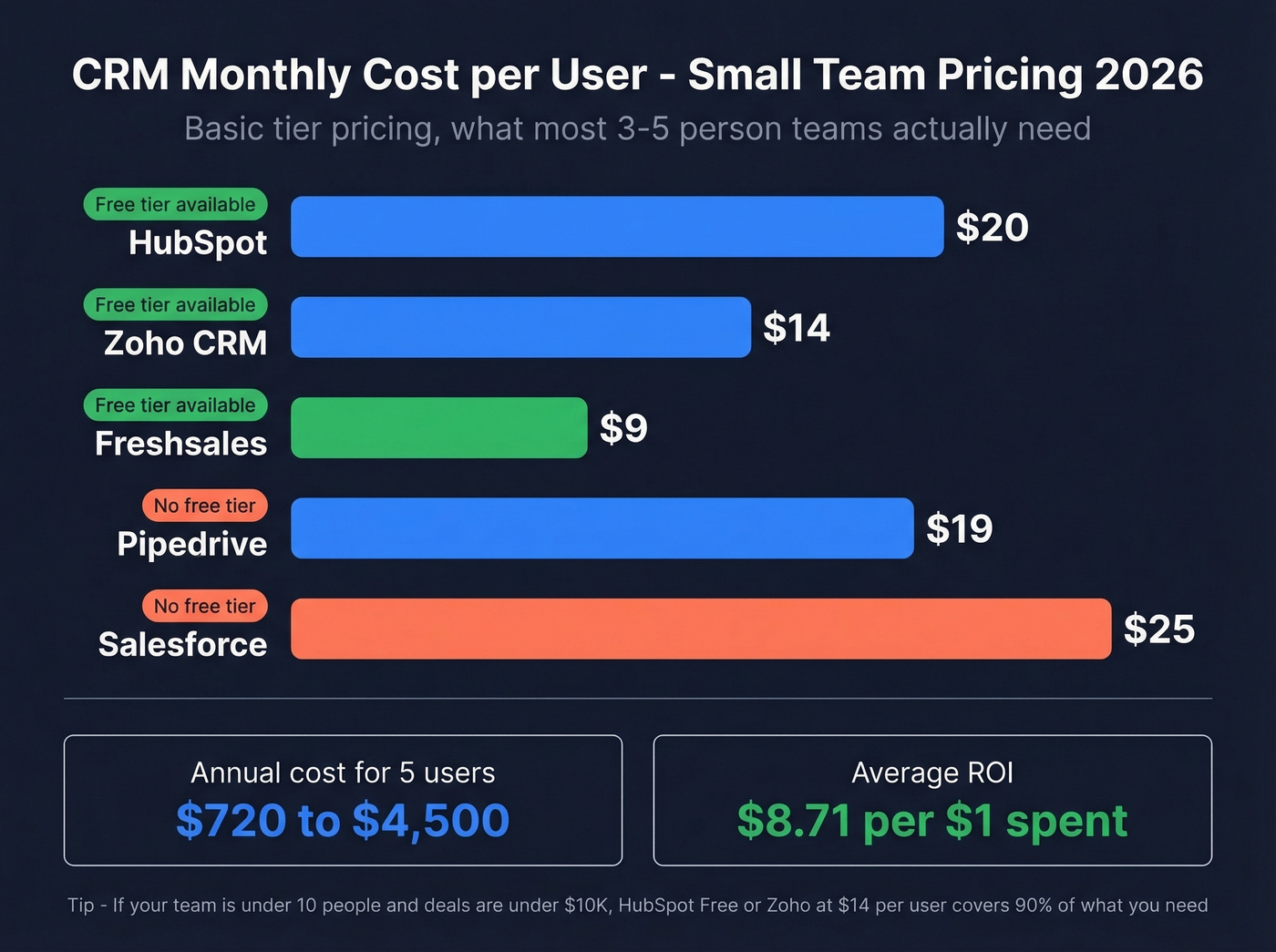
| CRM | Free Tier | Basic | Mid-Tier | Best For |
|---|---|---|---|---|
| HubSpot | Yes | $20/user/mo | ~$100/mo (5 users) | Starting from zero |
| Zoho CRM | Yes | $14/user/mo | $23/user/mo | Budget-conscious teams |
| Freshsales | Yes | $9/user/mo | $39/user/mo | AI on a budget |
| Pipedrive | No | $19/user/mo | $34/user/mo | Pure sales teams |
| Salesforce | No | $25/user/mo | $100/user/mo | Skip unless 20+ reps |
For a 3-5 person team, budget $20-$75/user/month for a CRM that covers contacts, pipeline, and basic automation. That's $720-$4,500/year - well within the ROI math at $8.71 per dollar.
Here's the thing: most small businesses overthink CRM selection. If your average deal size is under $10K and your team is under 10 people, HubSpot Free or Zoho at $14/user will cover 90% of what you need. The teams that fail aren't the ones who picked the "wrong" CRM. They're the ones who spent three months evaluating instead of three hours setting one up. (If you want a broader shortlist, see examples of a CRM.)
A word on HubSpot's free tier: it's genuinely useful, but the jump to paid plans is steep. Reddit threads on r/CRM consistently flag this - the free plan is easy to outgrow, and paid tiers escalate fast for small teams. Chargebee ran into the same "overbought complexity" problem with Salesforce and migrated to Freshsales.
CRM Adoption Mistakes That Kill ROI
We've seen teams buy the right CRM and still get zero value from it. Here's what goes wrong.
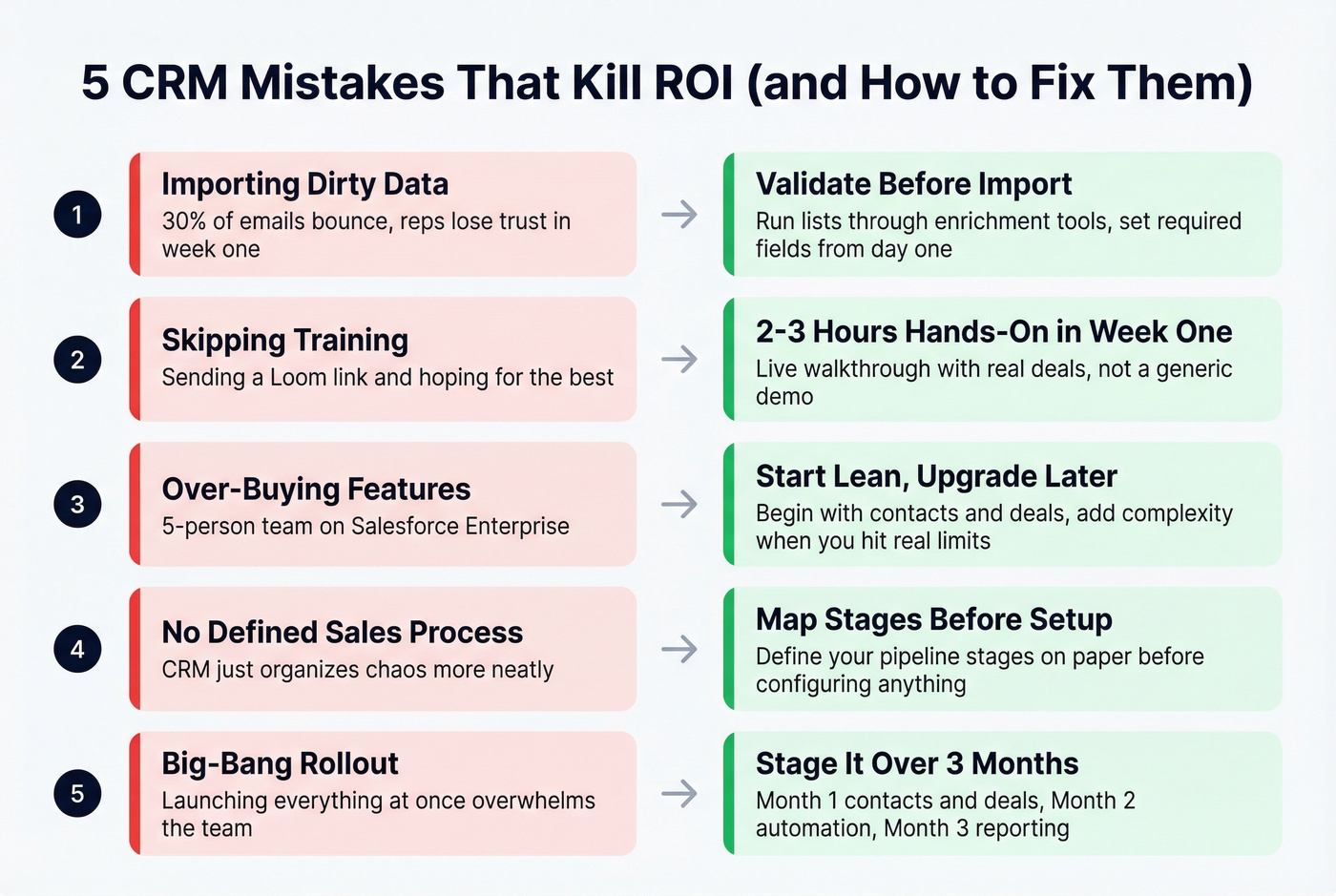
Importing dirty data is the #1 killer. If 30% of your emails bounce, your reps stop trusting the system within a week. Set required fields and validation rules from day one. (If you're seeing bounces, start with email bounce rate.)
Skipping training is close behind. Two to three hours of hands-on training in week one prevents months of low adoption. Don't just send a Loom link and hope for the best.
Over-buying features wastes budget and creates confusion. A 5-person team doesn't need Salesforce Enterprise. Start lean, upgrade when you actually hit limits. Nearly 1 in 5 businesses report that poor integrations between over-complex tools cause real operational pain - don't become that statistic.
No defined sales process means the CRM just organizes chaos more neatly. Define your stages before you configure anything. (A simple sales process optimization pass is usually enough.)
Big-bang rollout overwhelms the team. Stage it instead: contacts and deals in month one, automation in month two, reporting in month three. Role-based dashboards keep each person focused on what matters to them.
Get Your Data Right First
You sent a follow-up and got a bounce. Then another. Then you realized 30% of your emails are dead and half the phone numbers are disconnected. The whole CRM collapses before it starts.
This is where data quality tools earn their keep. Before you import a single contact, run your list through Prospeo's enrichment engine. It returns 50+ data points per contact at an 83% match rate, with 98% email accuracy - and refreshes its data every 7 days, compared to the 6-week industry average, so the contacts you import stay current. It plugs directly into HubSpot and Salesforce, meaning enriched contacts flow straight into your CRM without CSV gymnastics. (If you're comparing vendors, start with data enrichment services.)
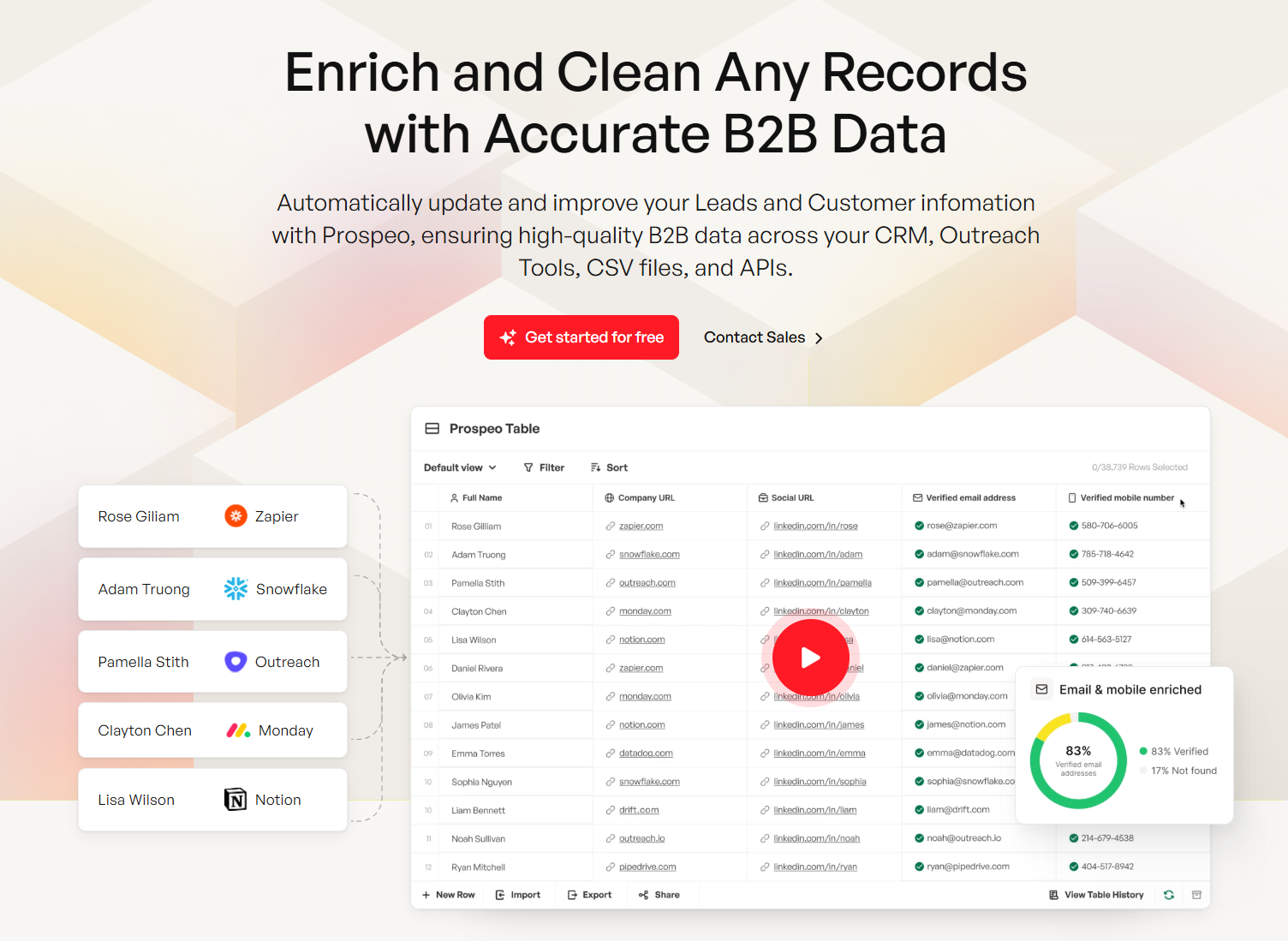
Think of it as the step between "we're getting a CRM" and "we're importing contacts." Skip it, and you're building on a rotten foundation.
The article shows CRM users earn $8.71 back for every $1 spent - but only if reps reach real buyers. Prospeo enriches your CRM contacts with 50+ data points, verified emails, and direct dials across 300M+ profiles. Teams using Prospeo book 35% more meetings than Apollo users and see bounce rates drop below 4%.
Your CRM drives revenue. Prospeo makes sure the data inside it actually connects.
FAQ
What's the best free CRM for a small business?
HubSpot CRM is the strongest free option - contact management, deal tracking, and email integration at no cost. Zoho CRM and Freshsales also offer solid free tiers. Budget for paid plans once you exceed basic automation needs, typically around 3-6 months in.
How long before a small business sees ROI from CRM?
Most small businesses see measurable results within 6-12 weeks. The average CRM returns $8.71 for every $1 spent, with payback arriving within 2-4 months if your team uses it daily.
Do small businesses really need a CRM?
If you're managing 50+ contacts and following up across email, calls, and meetings - yes. 71% of small businesses already rely on CRM systems. The deciding factor isn't company size, it's operational complexity. Three people closing 20 deals a month need one more than 15 people managing 5 accounts.
How do I keep CRM data accurate after setup?
Use an enrichment tool to verify and refresh contacts before import and on an ongoing basis. A 7-day data refresh cycle keeps records current, and native CRM integrations automate the process. Without regular enrichment, data decays roughly 30% per year - and reps stop trusting stale records fast.
What type of CRM does a small business need?
Most small businesses need an operational CRM - one focused on contact management, deal tracking, and automation. Analytical CRMs focused on heavy reporting and collaborative CRMs built for cross-department coordination matter more at scale. Start operational, add analytics as you grow.