

Best SDR Tools in 2026 (and What They Actually Cost)
The average SDR team runs 12-15 tools and spends $2,000-$5,000 per rep per month. About 30% of that effort gets burned on bad data - wrong emails, dead numbers, contacts who left the company six months ago. Reps average 94 activities per day with cold email reply rates hovering around 5%. That's a lot of motion for not much progress.
Finding the best SDR tools isn't about stacking more software. It's about getting three or four that actually work together and getting the data layer right before anything else matters. If you want a broader ranked list, see our guide to SDR tools.
Our Top Picks
We've tested dozens of sales development tools over the past year. These three cover 90% of what most teams need.
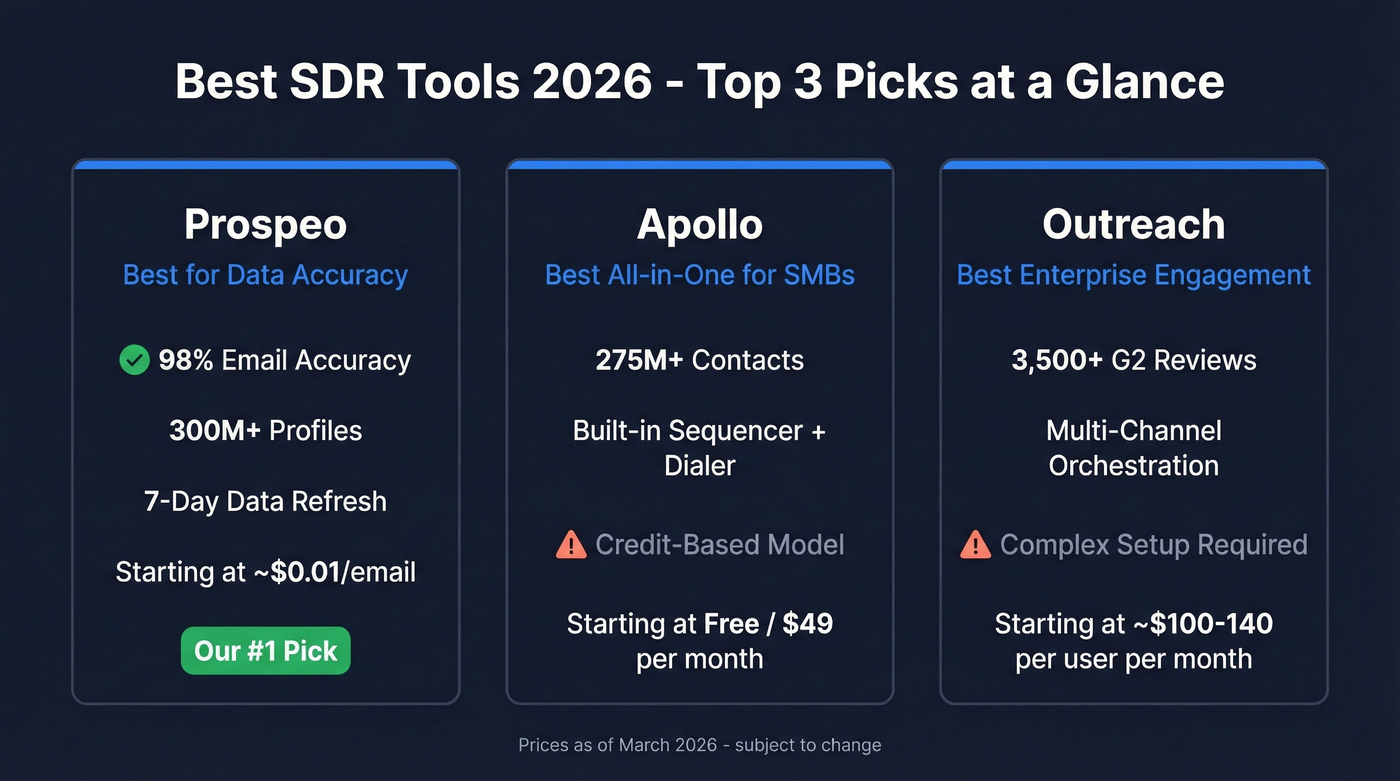
| Tool | Best For | Starting Price |
|---|---|---|
| Prospeo | Data accuracy | Free; paid ~$0.01/email |
| Apollo | All-in-one SMB | Free; paid from $49/mo |
| Outreach | Enterprise engagement | ~$100-140/user/mo |
How We Evaluated
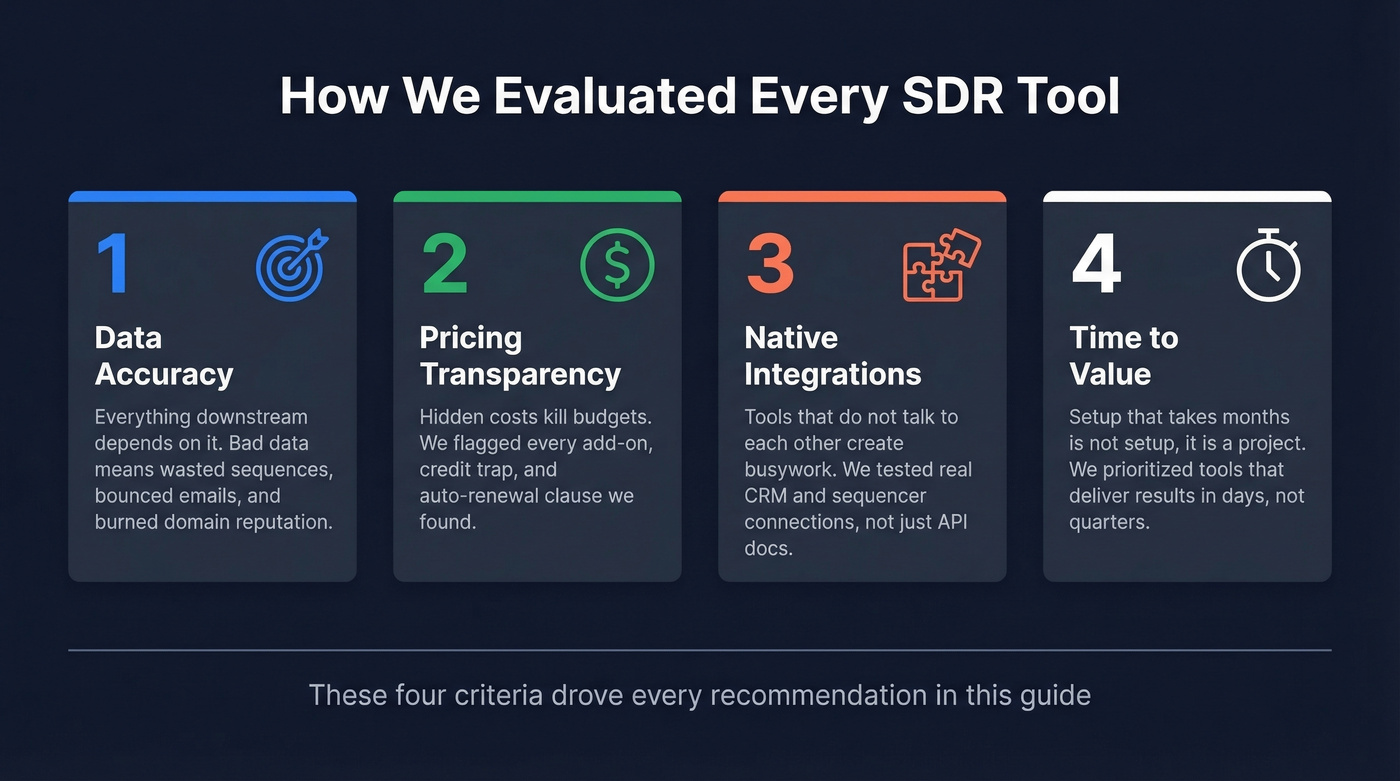
Four criteria drove every recommendation: data accuracy (because everything downstream depends on it), pricing transparency (hidden costs kill budgets), native integrations (tools that don't talk to each other create busywork), and time-to-value. Setup that takes months isn't setup - it's a project. If you're tightening your process, this pairs well with sales process optimization.

The article says it: 30% of SDR effort gets burned on bad data. Prospeo's 7-day refresh cycle and 98% email accuracy eliminate that waste. Snyk's 50 AEs dropped bounce rates from 35-40% to under 5% and generated 200+ opportunities per month - without adding headcount.
Fix the data layer first. Everything else compounds from there.
Top SDR Tools by Category
Data & Prospecting
Prospeo
Before you spend $100+/user/mo on sequencing software, make sure your emails don't bounce and your phone numbers actually ring.
Prospeo's B2B database covers 300M+ professional profiles with 98% email accuracy and a 30% mobile pickup rate - numbers that hold up in production, not just on a marketing page. Data refreshes every seven days, which matters more than most teams realize. A contact who changed jobs three weeks ago is a wasted touch at best and a domain reputation hit at worst.

You get 30+ search filters including Bombora-powered buyer intent across 15,000 topics, technographics (see our guide to firmographic and technographic data), job changes, and headcount growth signals. The Chrome extension, used by 40K+ people, works on company websites and professional profiles. Native integrations push directly into Salesforce, HubSpot, Smartlead, Instantly, Lemlist, and Clay.
Here's a real-world example: Snyk's 50-person AE team - each prospecting just 4-6 hours per week - dropped their bounce rate from 35-40% to under 5% and started generating 200+ new opportunities per month. Teams using Prospeo book 26% more meetings than ZoomInfo users and 35% more than Apollo users.
Use this if you want enterprise-grade data without enterprise pricing or contracts. The free tier gives you 75 verified emails per month plus 100 Chrome extension credits to test it. Pricing runs about $0.01 per email, 10 credits per mobile number, no annual contracts. If you need multi-vendor lookups, compare options in our roundup of data enrichment services.
Apollo
Apollo is the best value all-in-one for teams under 20 reps. You get a database of 275M+ contacts, a sequencer, a dialer, and basic intent signals in a single platform. A GTM engineer on r/gtmengineering called it "low-key an AI SDR" - and that's not wrong.
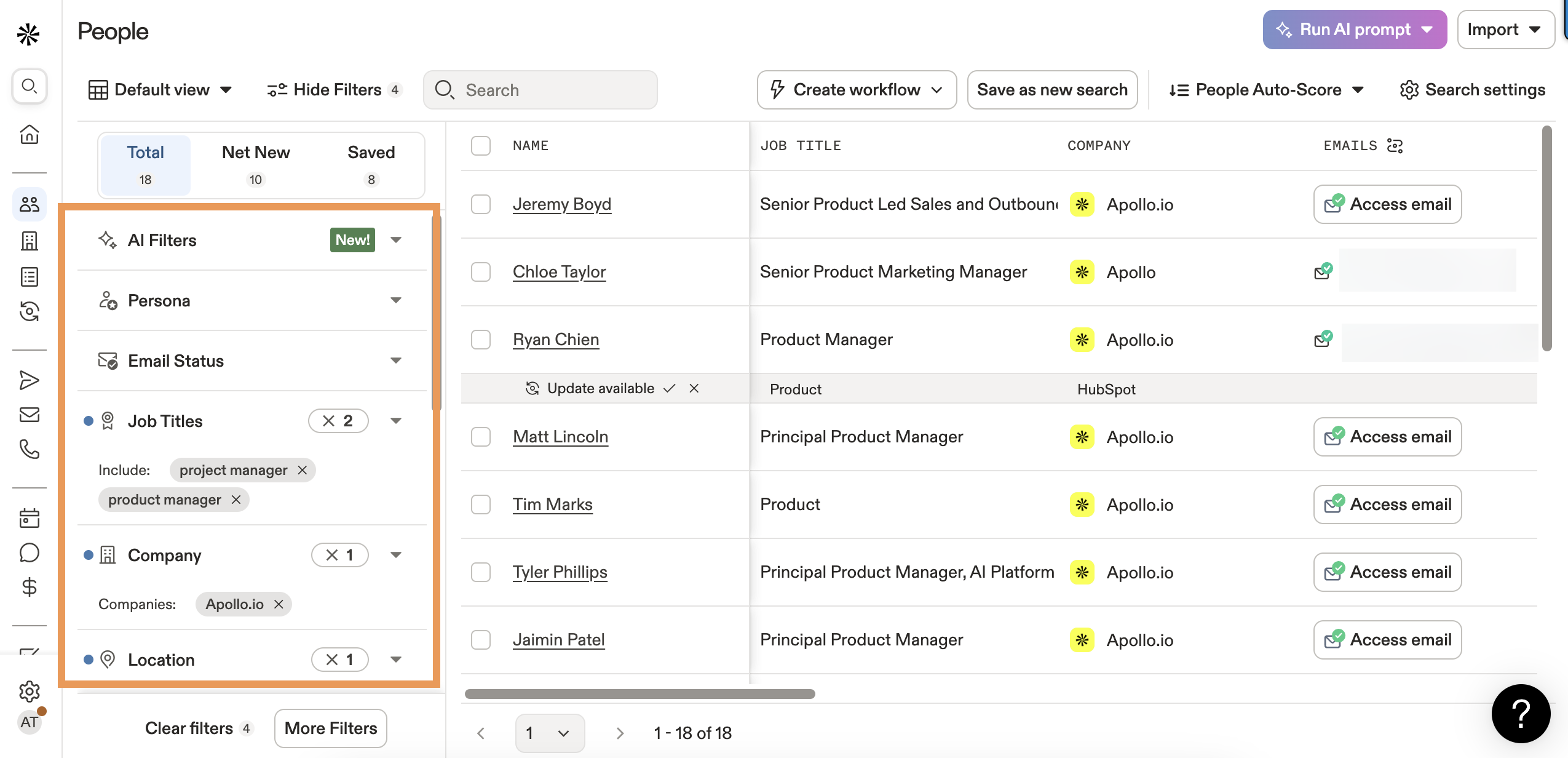
Pricing runs Free, Basic at $49/mo, Professional at $79/mo, and Organization at $119/mo with a minimum of 3 seats. The catch is the credit model. Credits don't roll over, and waterfall enrichment can burn through them faster than you'd expect. We've seen teams blow through a month's credits in two weeks because they didn't realize how enrichment queries stack.
Apollo's data is broad but less verified - expect more bounces and dead dials than with a dedicated verification platform. The smart play for most teams: use Apollo for sequencing and sales cadences, then pair it with a higher-accuracy data source for contact discovery. For more ways to fill top-of-funnel on a budget, see our list of free lead generation tools.
ZoomInfo
The 800-pound gorilla. 260M+ profiles, deep US coverage, strong intent data, and workflow integrations across the entire GTM stack.
But the pricing is brutal. A 10-seat contract with intent data and mobile numbers runs $20-50K/year after add-ons. Global Data alone is $9,995. Extra credits cost roughly $3,000 per 5,000. Multi-year contracts with auto-renewal traps are standard, and discounts of 30-65% are common - which tells you how inflated the list price is.
ZoomInfo is still the enterprise default for teams over 50 reps with budget to burn. But most teams don't need the enterprise default. They need accurate data and a sequencer that works. For everyone else, you can get higher email accuracy at roughly 90% less cost by going with a dedicated data platform. If you're comparing providers, start with our breakdown of sales prospecting databases.
Clay
Clay isn't a database - it's an enrichment workbench. You bring leads from other sources and Clay waterfall-enriches them across dozens of providers, then lets you build AI-powered research workflows on top.
The March 2026 pricing overhaul made it more accessible: Launch at $185/mo, Growth at $495/mo. Credits now split into Data Credits for provider lookups and Actions for platform operations at under $0.01 each. If an enrichment returns no result, you don't get charged. Best for technical RevOps teams who want maximum enrichment flexibility. If you're building workflows here, our Clay list building guide breaks down the real cost math.
Sales Engagement Platforms
Outreach
The deepest sequencing and analytics platform on the market. 3,500+ G2 reviews and a 4.3 rating for a reason - the multi-step, multi-channel orchestration is genuinely best-in-class for enterprise teams running complex sales cadences with meeting booking automation.
Pricing is opaque and expensive. Base Engage runs $100-140/user/mo. Add-ons like Meet and Deal stack $30-50/user/mo each, and Forecast typically adds $20-40/user/mo. Implementation runs $5,000-$25,000. Annual contracts only. A 50-user Engage deployment lists at roughly $72K/year before 15-35% discounts.
Skip this if you're under 20 reps or don't have a dedicated sales ops person to manage it. If you do implement it, use a checklist like our implementing a sales engagement platform guide.
SalesLoft
Salesloft targets mid-market and enterprise with two packages: Advanced and Premier. List price benchmarks sit around $180/user/mo, but 35-45% negotiation discounts are standard, bringing effective cost to roughly $125/user/mo.
Here's the thing: the dialer is an add-on. $7,500/year for 25 users. The Bionic Chatbot is another $10,000/year. These surprise costs catch buyers off guard during procurement. Budget accordingly.
AI SDR Agents
Human SDRs turn over at 30-40% per year, with most leaving within 14-18 months - which is why the economics of AI agents look tempting. AI cost per qualified lead runs about $39 vs $262 for humans. But in one tracked experiment, human SDRs generated 2.6x more revenue ($147K vs $56K) and hit a 71% show rate vs 52% for AI. Reddit sentiment is blunt - prospects detect AI content and detest it. If you're experimenting here, pair it with a solid AI cold email outreach playbook.
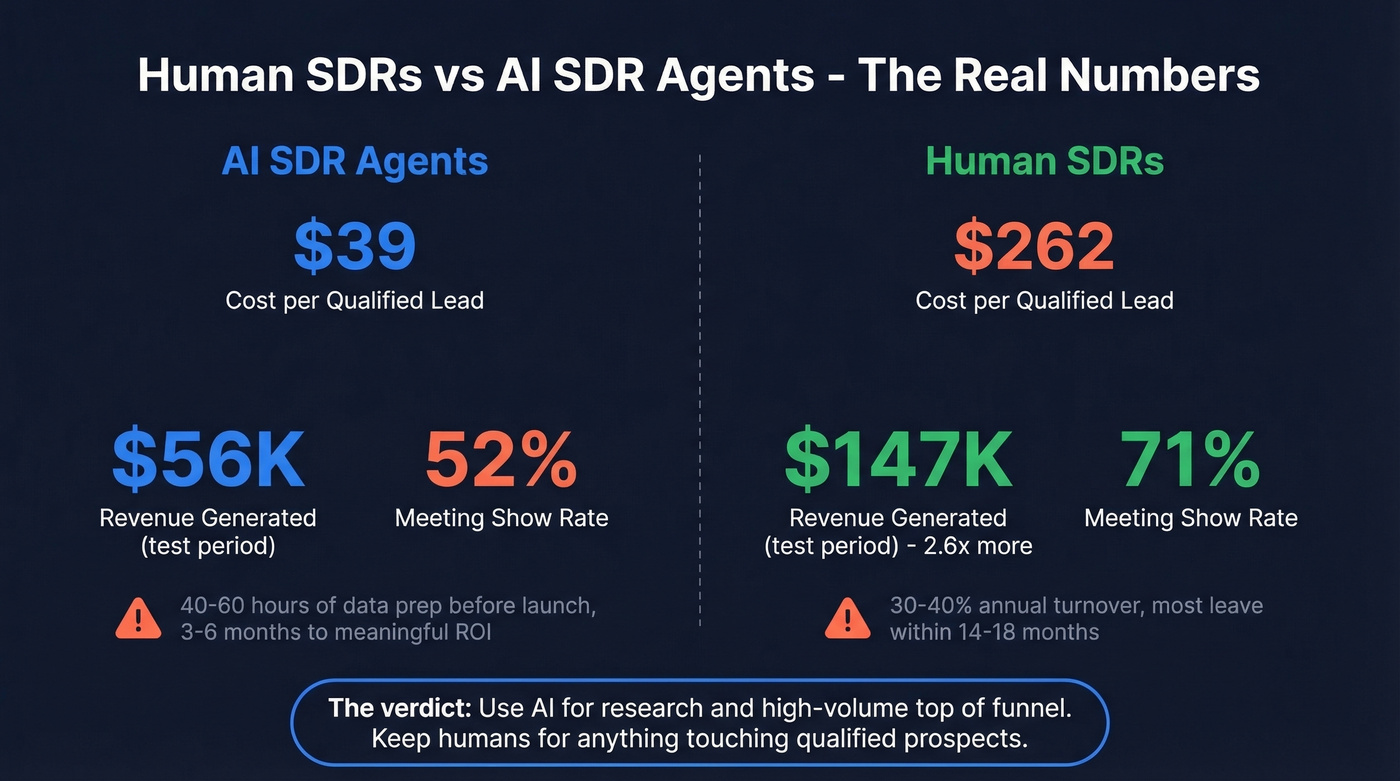
We've tested several AI SDR tools and the setup time is consistently underestimated. Expect 40-60 hours of data prep before launch and 3-6 months to meaningful ROI.
Artisan overpromises. One reviewer on r/gtmengineering said they "fell for a marketing campaign" - AI features worked poorly, and key capabilities were perpetually "coming soon." Expect $1K-3K/mo. 11x.ai targets enterprise at $1K-5K/mo. If you're spending $50K+/year on an AI agent, make sure you've exhausted what a well-equipped human SDR can do first. Skyp.ai is the practitioner standout - it focuses on deliverability and writes competent microcampaign sequences at roughly $500-1,500/mo, but requires pairing with a lead source since it's an execution layer, not a database.
Use AI for research, draft generation, and high-volume top-of-funnel. Keep humans in the loop for anything that touches a qualified prospect. One practitioner recommends human edits with intentional imperfections to bypass AI detection filters - which tells you everything about where the tech stands right now.
CRM & Conversation Intelligence
HubSpot is genuinely free and genuinely good for teams under 30. Sales Hub starts at $15/user/mo when you need sequences, pipeline velocity tracking, and automation. Salesforce is the enterprise standard from $25/user/mo - you probably already know if you need it. Gong adds conversation intelligence and discovery call analytics at roughly $100-150/user/mo; worth it for teams over 20 reps who want coaching data, but overkill for smaller squads. If you're still deciding, see examples of a CRM with real pricing.
What Things Actually Cost
| Tool | Category | Starting Price | Contract |
|---|---|---|---|
| Apollo | All-in-one | Free; $49/mo | Monthly |
| ZoomInfo | Data | ~$15K/yr | Annual |
| Clay | Enrichment | $185/mo | Monthly |
| Outreach | Engagement | ~$100/user/mo | Annual |
| Salesloft | Engagement | ~$125/user/mo | Annual |
| HubSpot | CRM | Free; $15/user/mo | Monthly |
| Salesforce | CRM | $25/user/mo | Annual |
| Gong | Intelligence | ~$100/user/mo | Annual |
Build Your Stack by Budget
$500/mo lean stack: Prospeo for verified contacts, Apollo free or Basic for sequencing and dialing, HubSpot CRM free for pipeline tracking. This covers prospecting, engagement, and pipeline management for a team of 1-5. Multichannel outreach boosts results by 287% vs single-channel, so make sure whatever you build supports email, phone, and social touches. To improve reply rates fast, borrow from these sales follow-up templates.
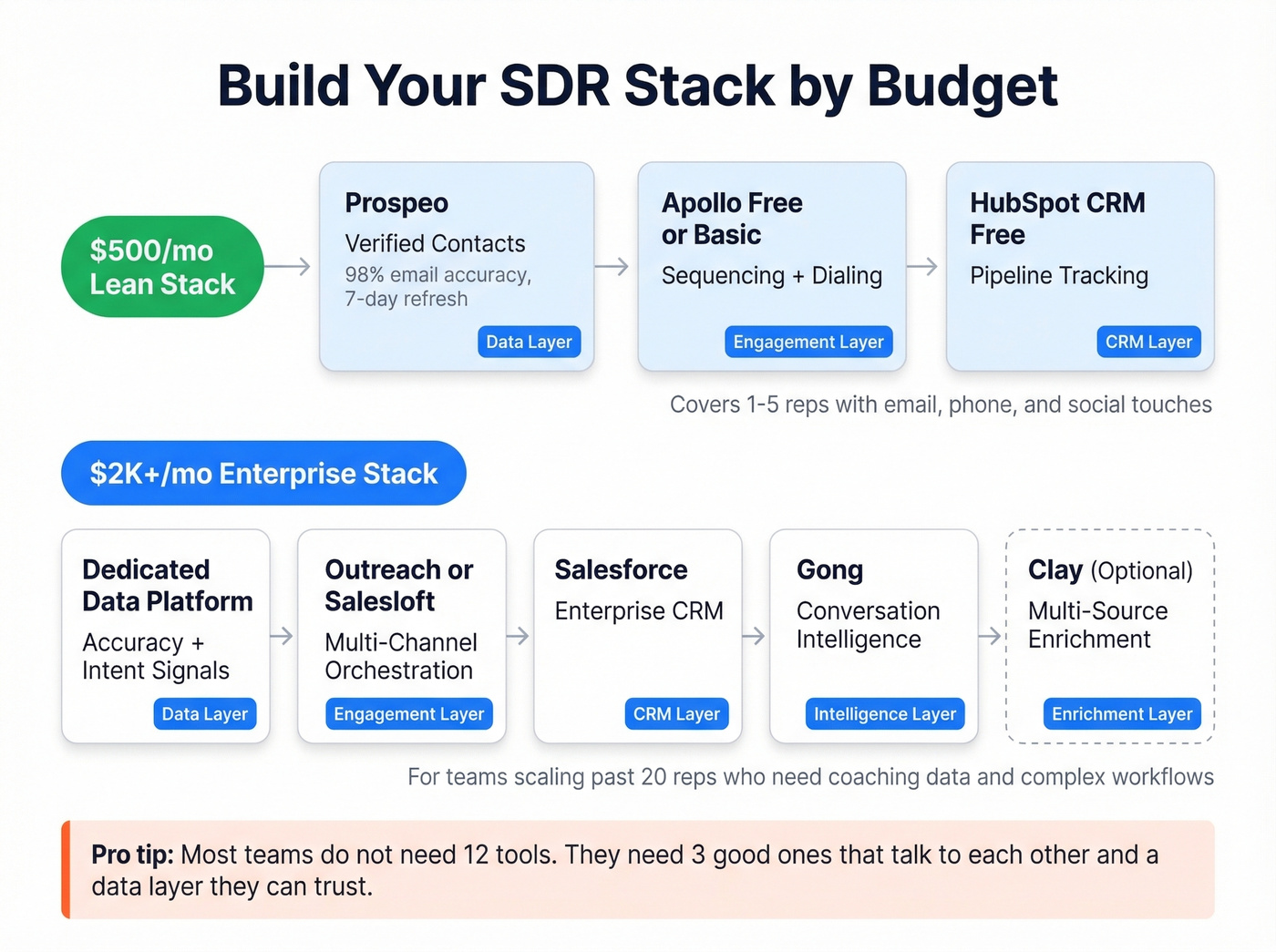
$2K+/mo enterprise stack: A dedicated data platform for accuracy, Outreach or Salesloft for engagement, Salesforce for CRM, Gong for conversation intelligence. Add Clay if you need multi-source enrichment workflows. A 7-day data refresh cycle matters here because the industry average is closer to six weeks - and stale records directly slow pipeline velocity. If you're diagnosing why pipeline is stalling, start with these sales pipeline challenges.
Let's be honest: most teams don't need twelve tools. They need three good ones that talk to each other and a data layer they can trust. Start there.
You're spending $2,000-$5,000 per rep per month on tools. At ~$0.01 per email with no annual contracts, Prospeo gives you 300M+ profiles, 125M+ verified mobiles, and 30+ filters including buyer intent - for 90% less than ZoomInfo. Teams book 26% more meetings.
Stop overpaying for data that bounces. Start with the free tier today.
FAQ
What are the best SDR tools for startups in 2026?
A data provider, an engagement platform, and a CRM cover most early-stage teams - three tools, not twelve. Prospeo's free tier (75 emails/mo), Apollo Basic ($49/mo), and HubSpot free CRM give you a complete outbound stack for under $50/mo. Prioritize native integrations over feature count.
Are AI SDR tools worth the investment?
AI agents cut cost per lead to roughly $39 vs $262 for human reps, but expect 40-60 hours of data prep and 3-6 months before meaningful ROI. Human SDRs still generate higher show rates (71% vs 52%) and more revenue per opportunity. Use AI for top-of-funnel volume, humans for qualified deals.
Which SDR tool should I invest in first?
Your data layer. If 30% of your emails bounce, every downstream tool - sequencer, dialer, CRM - underperforms. A platform with 98% email accuracy and weekly data refreshes prevents the cascade of wasted activity that bad contact data creates.
What's a good free alternative to ZoomInfo?
Prospeo's free tier includes 75 verified emails and 100 Chrome extension credits monthly - enough to validate whether higher-accuracy data improves your pipeline before committing budget. Apollo also offers a free plan with 10K records/mo, though its verification rates are lower.