

Business Development: What It Actually Is, What It Pays, and How to Do It Right
You sent 200 cold emails last Tuesday. Fourteen bounced. Six got a reply - three of those were "please remove me from your list." Your manager wants to know why pipeline is flat. You're starting to wonder if business development is just a fancy title for getting ignored at scale.
That frustration is universal. One recruiter on r/Recruitment put it bluntly: cold outreach feels "really annoying for the recipient and overall inefficient" unless you're doing it with precision and volume. Response rates are "quite low," and the natural question is - "Is that really it?"
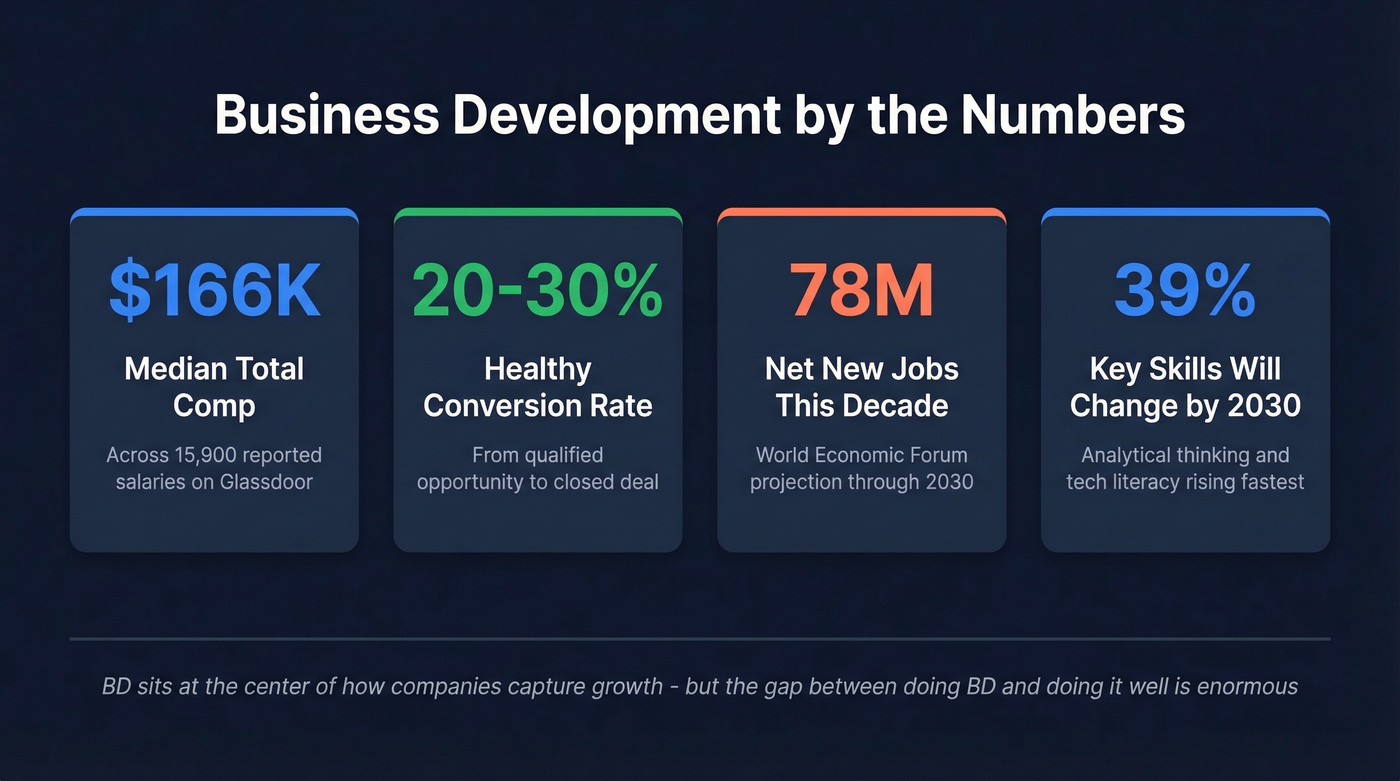
It doesn't have to be. The World Economic Forum projects 78 million net new jobs this decade, and BD sits at the center of how companies capture that growth. But the gap between "doing BD" and doing it well is enormous. Every guide tells you to "track KPIs" but none tell you what good actually looks like. We're fixing that.
What You Need (Quick Version)
Business development means opening markets and building pipeline - not closing deals. If you're starting from scratch or resetting a broken process, here's what you need on day one:
- A BD plan with quarterly KPIs. Not a 40-page strategy doc. A one-pager with target accounts, outreach cadence, and conversion goals you review every 90 days.
- A CRM to track pipeline stages. Even a free HubSpot instance beats a spreadsheet. You need to see where deals stall.
Healthy benchmark: 20-30% conversion from qualified opportunity to closed deal. Median US BD salary: $166K total comp across 15.9K reported salaries on Glassdoor. The rest of this guide gives you the specifics.
What Is Biz Dev, Really?
Business development is the upstream engine that feeds your sales pipeline. It's not "sales with a fancier title," though plenty of companies use it that way. Real BD is cross-functional - it touches marketing through content and positioning, product through market feedback loops, finance through partnership economics, and sales through qualified handoffs. The goal isn't to close a deal. It's to create the conditions where deals become possible.
Hinge Marketing's research frames BD as an umbrella term spanning both marketing and sales activities - especially in professional services, where the title exists partly to avoid the "sales stigma." That's accurate but incomplete. A BD professional isn't just generating leads. They're identifying new markets, building partnership channels, and qualifying whether an opportunity is worth pursuing before a single demo gets booked.
And BD isn't only about revenue growth. It also includes identifying cost-reduction opportunities, outsourcing partnerships, and operational efficiencies that improve margins. The best BD leaders think about both sides of the P&L - finding new revenue and reducing the cost of capturing it.
Here's the thing: the "BD is about relationships" crowd is half right. The modern BD professional who can't run a data-driven outbound campaign is bringing a Rolodex to a data fight. The WEF reports that 39% of key skills will change by 2030, with analytical thinking and tech literacy rising fastest. AI is already reshaping BD workflows - from intent data that surfaces in-market buyers to automated sequencing that lets a single BDR run campaigns that used to require three. Relationship-building still matters. But it's table stakes, not a differentiator.
In practice, BD looks different depending on the company. At an architecture firm, the BD director responds to RFPs, nurtures conference contacts, and spots account expansion opportunities. At a SaaS startup, it's a BDR sending personalized emails every day and booking discovery calls. The common thread: creating pipeline that didn't exist before.
BD vs. Sales vs. Marketing
The simplest way to think about it: marketing attracts attention, BD builds pipeline, and sales closes deals. They're sequential, not interchangeable. BD plants seeds and tends the field. Sales harvests.
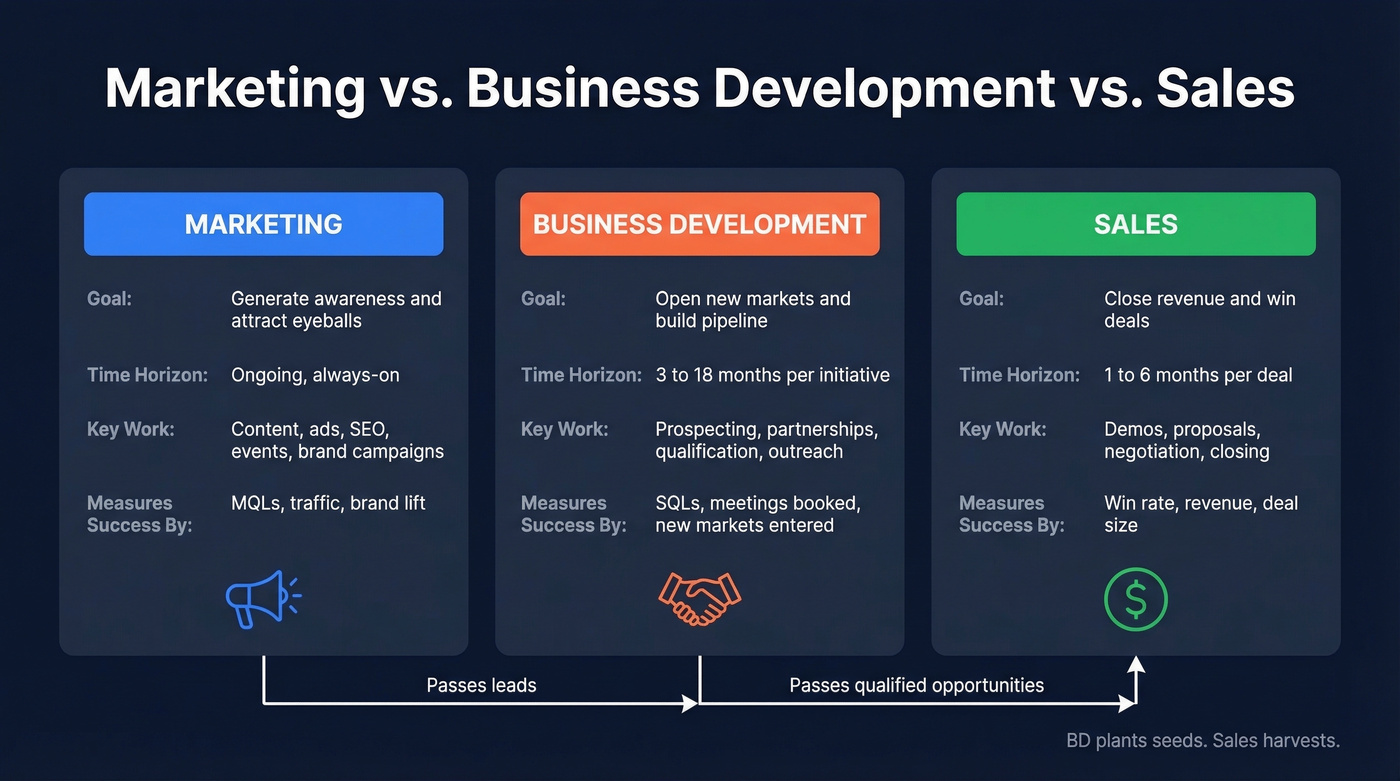
| Role | Primary Goal | Time Horizon | Key Activities | Success KPIs |
|---|---|---|---|---|
| Marketing | Generate awareness | Ongoing | Content, ads, SEO, events | MQLs, traffic, brand lift |
| BD | Open markets, build pipeline | 3-18 months | Prospecting, partnerships, qualification | SQLs, meetings booked, new markets entered |
| Sales | Close revenue | 1-6 months | Demos, proposals, negotiation, closing | Win rate, revenue, deal size |
The handoff chain is straightforward: marketing passes leads to BD or sales, BD qualifies and passes opportunities to sales, and sales closes and hands off to customer success or account management.
In our experience, dedicated BD teams consistently outperform sales-does-everything models on market entry - one industry estimate puts the gap at a 25% higher rate of successful market entry. That makes intuitive sense. When your closers are also prospecting, neither job gets done well.
In professional services, Hinge describes a "seller-doer" dynamic where senior professionals deliver client work and also participate in BD. Some firms hire dedicated business developers to reduce that burden on fee-earners. If your senior consultants are spending 30% of their time prospecting instead of billing, the math gets ugly fast.
The BD Process: Lead to Pipeline
BD follows a three-stage model that maps cleanly to how pipeline actually gets built.
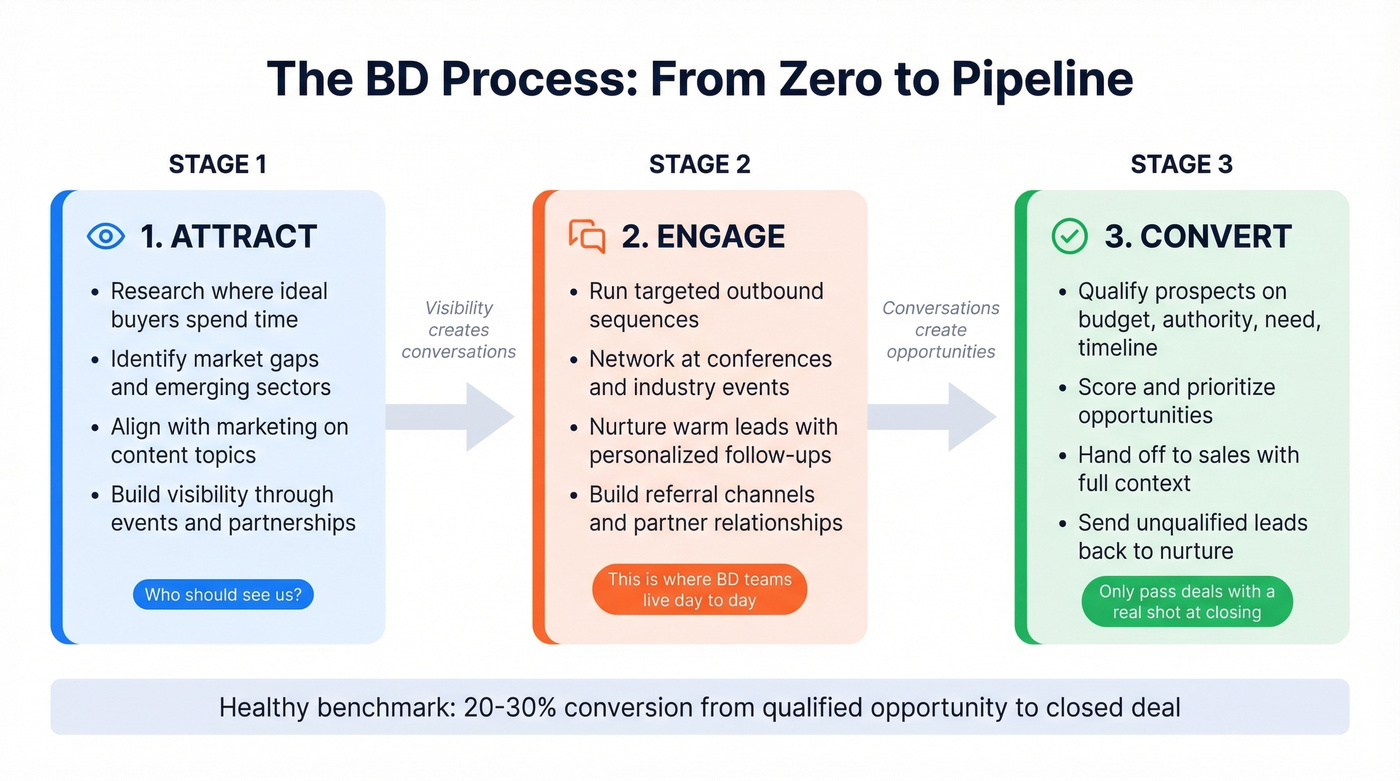
Attract is where you create visibility. Market research identifies where your ideal buyers spend time. Content, speaking engagements, and strategic partnerships put you in front of them. The BD team isn't writing blog posts - but they're telling marketing which topics resonate with the accounts they're targeting.
Engage is where relationships form. Networking at conferences, nurturing warm leads, running targeted outbound sequences, building referral channels. This is the stage most BD teams live in day-to-day. The work is repetitive - calls, emails, follow-ups, touches - but the compound effect fills pipeline over time.
Convert is where BD hands off to sales. Qualification happens here: does this prospect have budget, authority, need, and timeline? If yes, it becomes a sales opportunity. If no, it goes back to nurture. The BD team's job is to make sure sales only spends time on deals that have a real shot at closing.
An architecture firm BD director illustrates this well: they're responding to RFPs (Convert), following up with contacts from last quarter's industry conference (Engage), and tracking which sectors are issuing the most new project RFQs (Attract). All three stages, one role.
Strategies That Actually Work
Targeted Outbound
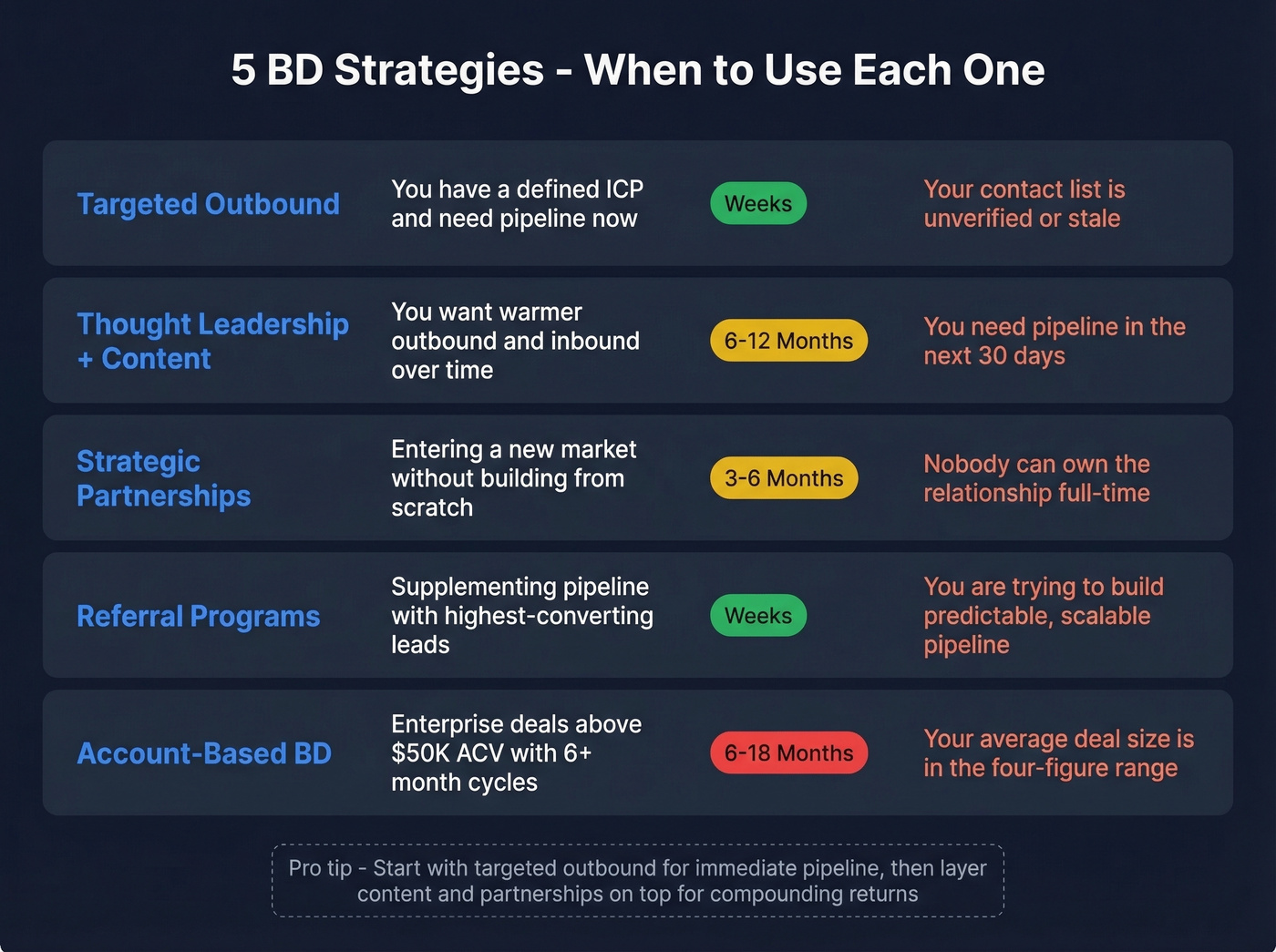
Use this if you have a defined ICP and need pipeline now. Outbound is the fastest path from zero to meetings - when the data is clean. Skip this if your contact list is unverified. We've seen teams send 5,000 emails and get 1,800 bounces because they scraped contacts from a stale database. That's not a strategy problem; it's a data problem. Verify emails in real time and flag catch-all domains before you hit send.
If you're building your outbound motion from scratch, start with proven sales prospecting techniques and a clear ideal customer profile.
Thought Leadership + Content
Thought leadership alone is a slow burn - it takes 6-12 months to generate inbound consistently. But when you combine a strong content engine with targeted outbound, the outbound gets warmer because prospects have already seen your name. If you need pipeline in the next 30 days, skip this and run pure outbound first. Layer content on top once the immediate pressure is off.
Strategic Partnerships
Use this if you want to enter a new market without building from scratch. Partnerships - channel, technology, co-selling - are BD's unique domain. A good partnership can open a market segment in months instead of years. Skip this if you don't have someone who can own the relationship full-time. Partnerships without a dedicated owner die within a quarter.
Referral Programs
Referrals convert at the highest rate of any channel. The problem is they don't scale. You can't build a predictable pipeline on "maybe our customers will introduce us to someone." Use referrals as a supplement - track them, incentivize them, make it easy - but don't build your entire growth strategy around them.
Account-Based BD
Use this for enterprise deals with 6+ month cycles and multiple stakeholders. ABM requires intent data, simultaneous engagement across buying committees, and tight coordination between BD, sales, and marketing. It's the highest-effort strategy on this list, but for deals above $50K ACV, it's often the only one that works. For deals in the four-figure range, the overhead isn't worth it.
If you're running ABM, it helps to align on account-based selling best practices so BD and AEs don’t work different playbooks.

You just read that 14 out of 200 cold emails bounced. That's a 7% bounce rate destroying your sender reputation and your BD pipeline. Prospeo's 5-step email verification delivers 98% accuracy - teams using it cut bounce rates from 35% to under 4% and tripled pipeline output.
Stop getting ignored at scale. Start reaching real buyers.
How to Build a BD Plan
Plan Components
A BD plan isn't a business plan. It's shorter, more tactical, and focused on growth initiatives over a 1-2 year horizon with quarterly checkpoints.
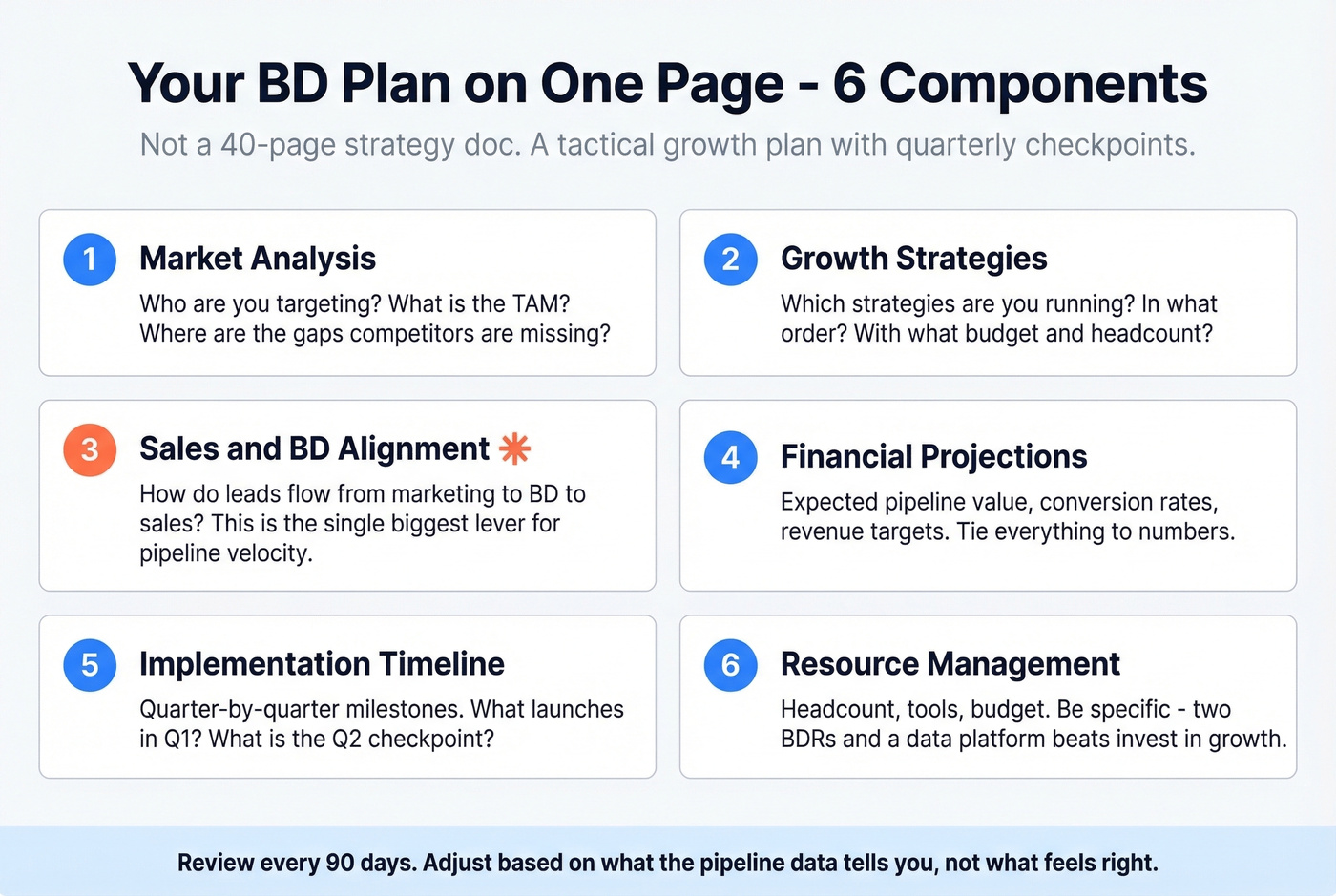
- Market analysis. Who are you targeting? What's the TAM? Where are the gaps competitors aren't covering? (If you need a refresher, start with TAM, SAM, SOM.)
- Growth strategies. Which of the five strategies above are you running? In what order? With what resources?
- Sales & BD alignment. How do leads flow from marketing to BD to sales? What's the handoff criteria? Getting this right is the single biggest lever for pipeline velocity.
- Financial projections. Expected pipeline value, conversion rates, revenue targets. Tie everything to numbers. (Pressure-test assumptions with a real cost to acquire customer model.)
- Implementation timeline. Quarter-by-quarter milestones. What gets launched in Q1? What's the Q2 checkpoint?
- Resource management. Headcount, tools, budget. Be specific - "we need 2 BDRs and a data platform" is better than "invest in growth."
The Craft.do template adds a SWOT analysis section, which is worth including if you're entering a new market. For existing markets, skip it and spend the time on competitive positioning instead.
Setting SMART BD Goals
Every goal needs a number and a deadline. "Grow pipeline" isn't a goal. "Generate 40 qualified opportunities per quarter with an average deal size of $25K" is a goal. Build your initial prospect list using a B2B database with intent filters to surface in-market accounts - you want contacts who are actively researching solutions, not just names in a spreadsheet.
The guardrail that keeps BD plans honest: target an LTV:CAC ratio of at least 3:1. If you're spending $10K to acquire a customer worth $20K in lifetime value, the math doesn't work. Every initiative in your plan should be pressure-tested against this ratio.
KPIs and Benchmarks
Let's be honest: if you can't tell me your conversion rate from MQL to opportunity, you're not doing BD - you're doing busywork.
| Metric | Benchmark Range | Context |
|---|---|---|
| Opportunity-to-close rate | 20-30% | B2B SaaS; varies by deal size |
| Enterprise sales cycle | 6-18 months | Multiple approvals, customization |
| SME sales cycle | 1-6 months | Fewer stakeholders, faster decisions |
| Daily dials (BDR) | ~50 | Baseline activity target |
| Daily personalized emails | 30-50 | Quality over volume |
| Weekly social touches | 10-15 | Comments, DMs, engagement |
| LTV:CAC ratio | 3:1 or higher | Below this, growth isn't profitable |
Activity metrics like dials, emails, and touches are inputs. Conversion metrics - MQL-to-SQL, SQL-to-opportunity, opportunity-to-close - are outputs. Track both, but optimize for outputs. A BDR hitting 80 dials a day with a 2% conversion rate is less valuable than one hitting 40 dials with a 6% conversion rate.
If you want a tighter diagnostic, run a quick pipeline health check and compare against sales pipeline benchmarks.
Reverse-Engineer Your Quota
Abstract benchmarks are useless without a planning framework. Work backward from your annual target. If your goal is $1M in new revenue and your average deal size is $25K, you need 40 closed deals. At a 25% close rate, that's 160 qualified opportunities. At a 10% meeting-to-opportunity rate, that's 1,600 meetings. Divide by 50 working weeks and you need 32 meetings per week. Now you know your BDR headcount - and whether your current team can hit the number or you're setting them up to fail.
Enterprise cycles are long. Six to eighteen months is normal. If your leadership expects enterprise pipeline to close in 90 days, that's a leadership education problem, not a BD problem. Set expectations early with data.
Essential BD Tools
You don't need 15 tools. You need 3-4 that work together. If we were building a BD stack from scratch, here's what we'd pick and why.
| Category | Tool | Best For | Starting Price | Free Tier? |
|---|---|---|---|---|
| Contact data | Prospeo | Verified emails + mobiles | ~$0.01/email | Yes (75 emails/mo) |
| CRM | HubSpot | SMB-mid-market | Free | Yes |
| CRM | Salesforce | Enterprise | ~$25/user/mo | No |
| CRM | Pipedrive | SMB deal tracking | $24/mo | No (trial) |
| Social selling | LinkedIn Sales Nav | Relationship mapping | $119.99/mo | No (trial) |
| Sales automation | Snov.io | Outbound sequences | $39/mo | Yes |
| Email finding | Hunter.io | Domain search | $34/mo | Yes |
| Calling | CloudTalk | Outbound dials | $25/user/mo | No (14-day trial) |
| CRM (lightweight) | Nutshell | Small teams | $19/user/mo | No (14-day trial) |
| Contact data | Lusha | Quick lookups | $29/mo | Yes |
| Email sequencing | Instantly | Cold email at scale | ~$30/mo | No |
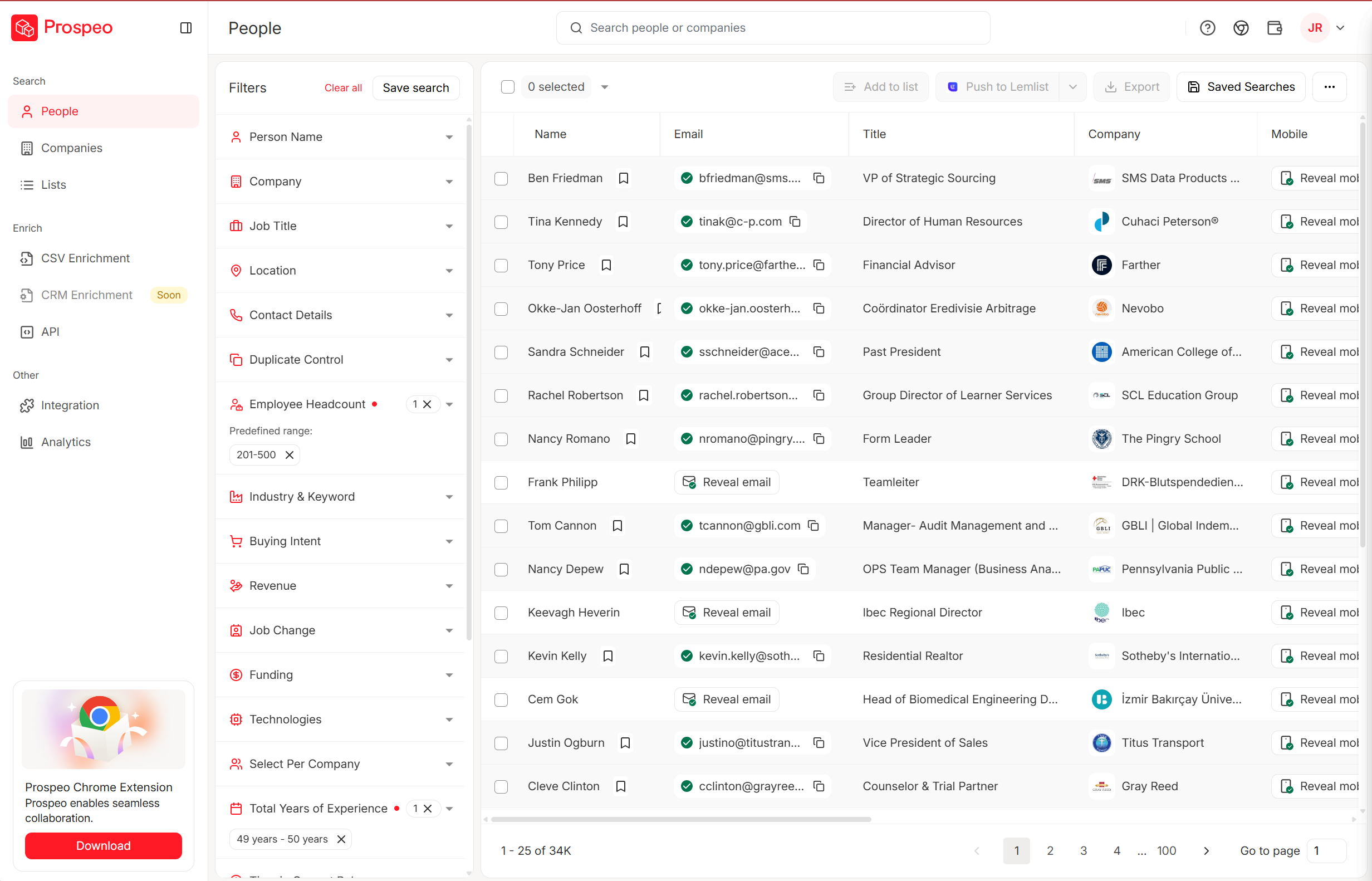
Prospeo is the foundation of the stack for contact data. It covers 300M+ professional profiles with 98% email accuracy and a 7-day data refresh cycle - the fastest in the category. The free tier gives you 75 verified emails per month to test before committing, and paid plans run about $0.01 per email. It integrates natively with HubSpot, Salesforce, Instantly, Lemlist, and Clay, so data flows straight into your CRM and sequences without manual exports.
HubSpot is the default CRM for teams under 200 people. The free tier is genuinely usable - contact management, deal tracking, basic reporting. Paid Sales Hub plans start around $20/user/month when you need sequences and automation. It's not the most powerful CRM, but it's the fastest to implement.
Salesforce is what you graduate to when HubSpot's reporting and customization hit their ceiling. Starter plans begin around $25/user/month, but realistic enterprise deployments run $150-300/user/month once you add the modules you actually need. (If you’re evaluating, see Salesforce pricing.)
Pipedrive is the best visual pipeline tool for SMB sales teams. Clean interface, fast setup, $24/month. It won't scale to enterprise, but for a 5-person BD team running 50-100 deals, it's excellent.
LinkedIn Sales Navigator at $119.99/mo is the standard for relationship mapping and social selling. It's a research and engagement layer, not a prospecting database - most BD teams pair it with a dedicated contact data tool for verified emails and phone numbers. Snov.io ($39/mo, G2: 4.6/5) combines email finding with drip campaigns. Hunter.io ($34/mo) is simpler: domain search and email verification, nothing more. CloudTalk, Nutshell, Lusha, and Instantly round out the stack for calling, lightweight CRM, quick lookups, and cold email sequencing respectively.
If email is your primary channel, add an email deliverability workflow and monitor email bounce rate as a first-class KPI.
Business development runs on precision and volume. Prospeo gives you both: 300M+ profiles with 30+ filters including buyer intent, job changes, and headcount growth - so your BDRs target accounts that are actually in-market. At $0.01 per email, scaling outbound doesn't scale your costs.
Fill your BD pipeline with verified contacts, not dead ends.
Salary and Career Path
BD pays well - and the trajectory is steep. Glassdoor reports a median total compensation of $166K/year for BD roles in the US, based on 15.9K salary submissions. The most likely range spans $124K-$230K.
| Level | Base Pay | Variable Pay | Estimated Total | Typical Titles |
|---|---|---|---|---|
| BDR / SDR | $55K-$85K | $20K-$40K | $75K-$125K | BDR, SDR, BD Associate |
| BD Manager | $90K-$130K | $40K-$70K | $130K-$200K | BD Manager, Sr. BD Mgr |
| VP of BD | $150K-$220K | $80K-$150K | $230K-$370K | VP BD, SVP BD, CRO |
The WEF projects 170 million new roles this decade - roughly 14% of today's total employment - with 92 million displaced, for a net gain of 78 million jobs. The skills rising fastest - analytical thinking, tech literacy, AI and big data fluency - map directly to what modern BD requires. If you're a BDR today who can run data-driven outbound, build automated workflows, and articulate ROI to a CFO, the path to six figures is 2-3 years, not 5-7.
Variable compensation is where the real money lives. At the BDR level, variable is typically 25-35% of total comp. At the VP level, it can exceed base pay. Negotiate your variable structure carefully - quota attainment thresholds and accelerators matter more than base salary at senior levels.
Common BD Mistakes
Mistaking activity for progress. Fifty dials a day means nothing if you're calling the wrong people. Track conversion rates, not just activity volume. If your MQL-to-opportunity rate is below 10%, the problem isn't effort - it's targeting.
Pitching before trust. Discovery comes before demos. Questions come before pitches. If your first email includes a pricing PDF, you've already lost. Lead with a question about the prospect's problem, not a feature list.
Chasing shiny objects. Every new partnership, every new market, every "strategic initiative" steals focus from the pipeline you're supposed to be building. Say no to 80% of opportunities so you can execute on the 20% that matter. Discipline beats distraction.
Keeping no-decision deals alive. Dead deals that sit in your pipeline for 6 months destroy forecast accuracy and waste follow-up time. Qualify rigorously. If a prospect can't articulate budget, timeline, and decision process, move them to nurture - they're not an opportunity yet.
Volume-based outreach without quality data. The r/Recruitment thread captures this perfectly - blasting cold emails at scale without verified contacts is "annoying and inefficient." Verify every email before sending. Bounce rates above 5% start hurting deliverability, and once your domain reputation tanks, recovery takes months.
Hiding pricing behind "request demo." A Reddit thread on startup mistakes flags this directly: lack of pricing transparency deters buyers. Arm your BD team with ballpark pricing for first calls. Transparency builds trust faster than mystery.
BD by Company Stage
How you approach growth changes dramatically as you scale. A founder doing BD at a 5-person startup looks nothing like a 20-person BD org at an enterprise company.
| Stage | Team Size | Primary BD Activities | Tools Needed | Key Metric |
|---|---|---|---|---|
| Startup | 1-2 (founder-led) | Scrappy outbound, warm intros, founder selling | Free CRM + verified data | Meetings booked/week |
| Scale-up | 3-8 (first BD hires) | Process + CRM, outbound + partnerships, content | CRM + data platform + sequencer | SQL-to-opportunity rate |
| Enterprise | 10-30+ (BDRs + managers) | ABM, intent data, strategic alliances, channel | Full stack + intent + analytics | Pipeline value + LTV:CAC |
At the startup stage, don't overthink it. The SBA's guidance on market research is a good starting point for identifying your initial target market. Your BD "process" is the founder sending personalized emails every day and taking every meeting. Track meetings booked per week and nothing else.
At scale-up, you're hiring your first dedicated BD person and building repeatable process. This is where a CRM becomes non-negotiable and data quality starts to compound. A BDR with verified contact data books 2-3x more meetings than one guessing email formats. It's also the stage where you need to clearly define what BD means in your organization - are your reps owning the full funnel, or handing off to closers?
At enterprise, BD becomes a strategic function. ABM campaigns targeting buying committees, intent data surfacing in-market accounts, channel partnerships driving indirect revenue. The tools get more expensive, but the deals justify it - enterprise cycles run 6-18 months with deal sizes that make the investment worthwhile.
Look, if your average contract value is under five figures, you probably don't need an enterprise BD stack or a 15-person team. A founder with a verified email list, a free CRM, and 2 hours a day of focused outbound will outperform a bloated BD org that spends more time in internal meetings than on the phone with prospects.
FAQ
What does a business development representative actually do?
A BDR prospects, qualifies leads, and books meetings for account executives - typically through 50+ daily dials, personalized emails, and social engagement with target accounts. BDRs don't close deals; they create the pipeline that closers work. Entry-level BDR roles pay $75K-$125K total comp.
Is business development the same as sales?
No. BD opens markets and builds pipeline; sales closes deals. They're sequential stages in the revenue process. BD plants seeds and qualifies opportunities, while sales negotiates, proposes, and closes. Companies with dedicated BD teams see roughly 25% higher rates of successful market entry.
What's a good conversion rate for BD teams?
A healthy B2B conversion rate from qualified opportunity to closed deal is 20-30%. Track it quarterly and segment by deal size - enterprise deals convert lower but at higher values. Below 15%, revisit your qualification criteria.
What skills do BD professionals need in 2026?
Analytical thinking, tech literacy, relationship building, and data fluency top the list. The WEF ranks these among the fastest-rising skills through 2030, with AI/big data competency and creative thinking close behind. BDRs who combine outbound execution with workflow automation reach six figures fastest.