

Business Development and Lead Generation: The Practitioner's Playbook
Say your SDR team generated 500 leads last month. Marketing's celebrating. But pipeline didn't move. Closed-won didn't move. The CEO's asking what everyone's actually doing all day.
This disconnect between business development and lead generation - volume without quality - is one of the most expensive problems in B2B. Most teams don't even realize they have it until the board meeting where someone pulls up the revenue slide and the room goes quiet.
79% of marketing leads never convert into sales. That's not a data problem or a tools problem. It's an alignment problem. The 95:5 rule makes it worse: only about 5% of your market is actively buying at any given time. If your lead gen and BD motions aren't working from the same playbook, you're burning budget on both sides.
The Short Version
- Lead generation fills the top of funnel with potential buyers - email outreach, SEO, paid ads, events.
- Business development turns that pipeline into revenue and long-term partnerships - relationship-building, market expansion, strategic deals.
- The core thesis: they're inseparable. Most teams fail because they treat these as separate departments with separate KPIs.
The fix is shared ICP definition, shared metrics, shared data. The alignment framework in Section 5 gives you the steps. The channel ROI table in Section 6 tells you where to spend. And the tech stack in Section 8 tells you what to buy.
Lead Generation vs Business Development
What Is Lead Generation?
Lead generation is the process of identifying and attracting potential buyers into your pipeline. It's tactical, measurable, and typically short-cycle. The output is contacts - MQLs (marketing qualified leads) that show interest and SQLs (sales qualified leads) ready for a conversation.
Common channels include email outreach, SEO and content marketing, PPC, social ads, and events. Inbound tends to produce shorter sales cycles and higher conversion rates, while outbound requires more nurturing but lets you target specific accounts and roles with precision.
What Is Business Development?
Business development is broader and longer-term. Where lead gen asks "who might buy?", BD asks "how do we grow?" That includes partnerships, market expansion, strategic alliances, and turning existing pipeline into revenue.
B2B transactions have moved overwhelmingly online - BD is now more digital than ever, but no less relevant. BD reps build relationships through email, calls, and social touches rather than steak dinners. The core function hasn't changed: BD owns the strategic growth motion that lead gen feeds into.
Key Differences at a Glance
| Dimension | Lead Generation | Business Development |
|---|---|---|
| Goal | Fill the funnel | Grow revenue |
| Timeline | Weeks to months | Quarters to years |
| Tactics | Email, SEO, PPC, events | Partnerships, expansion |
| Metrics | MQLs, CPL, reply rate | Revenue, deal size, LTV |
| Ownership | Marketing / SDRs | BD reps / partnerships |
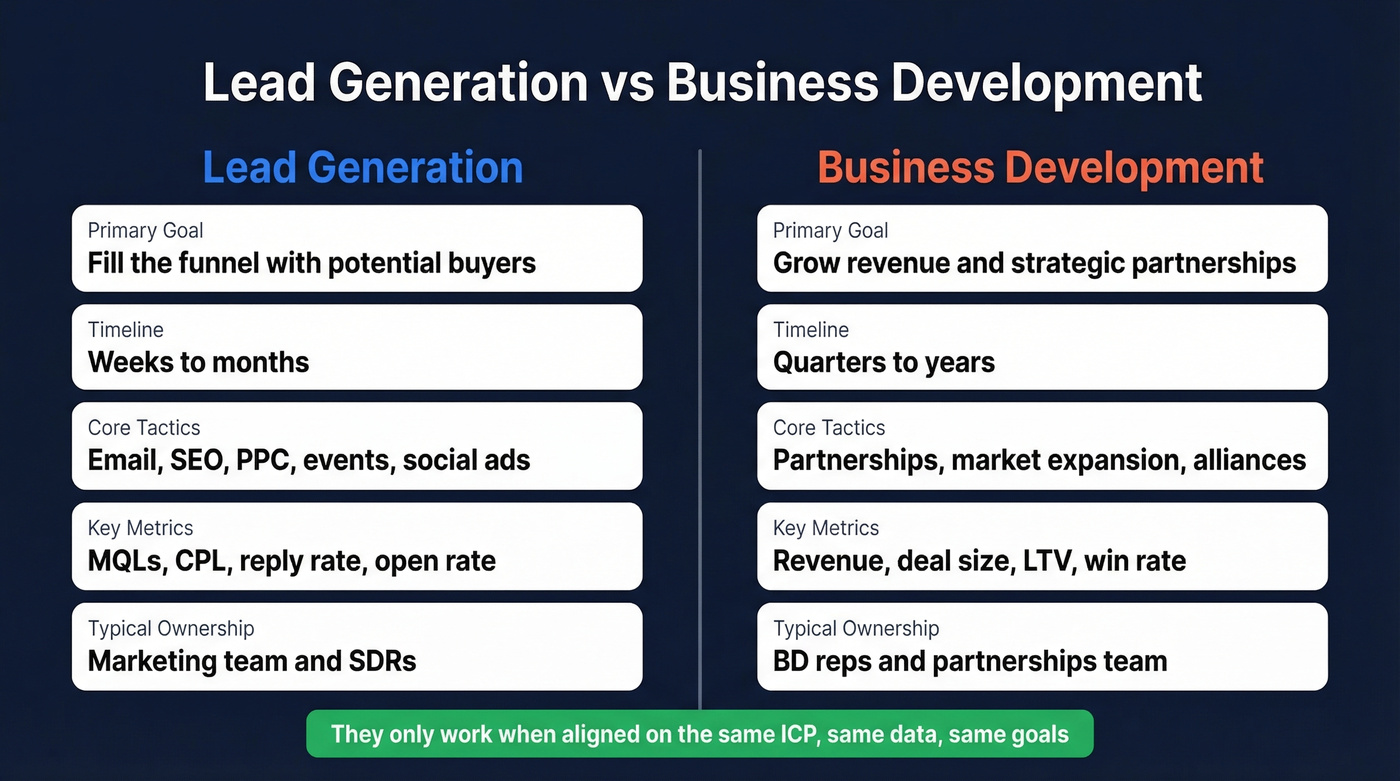
Lead gen metrics like MQLs and CPL are meaningless if they don't translate into BD metrics like pipeline and closed-won. Teams that optimize for MQL volume without tracking downstream conversion are buying expensive vanity metrics.
The Numbers That Actually Matter
Funnel Conversion Benchmarks
Here's where pipeline actually leaks. MarketJoy's aggregated benchmarks paint a clear picture:
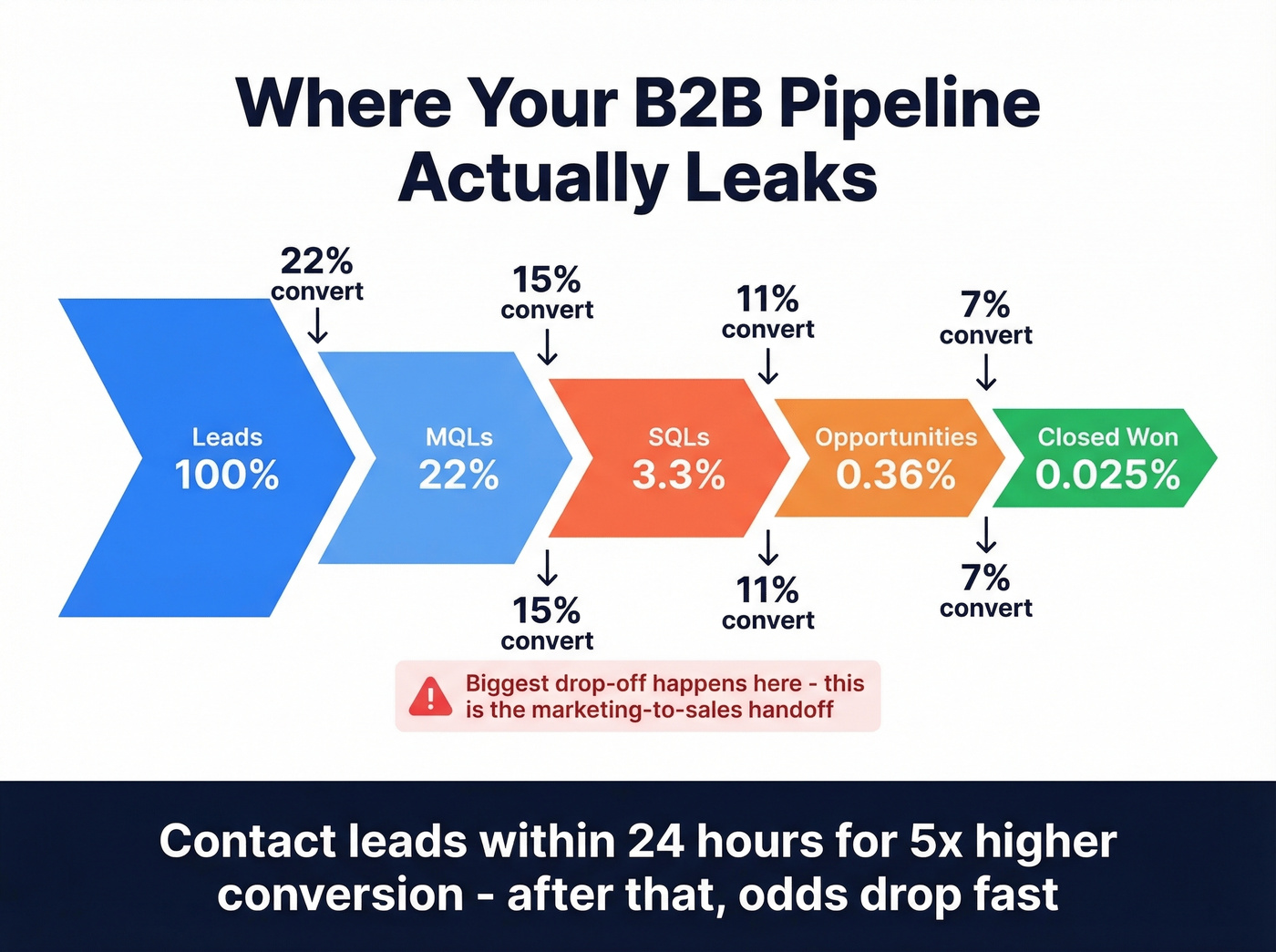
- Lead to MQL: 22%
- MQL to SQL: 15%
- SQL to Opportunity: 11%
- Opportunity to Closed-won: 7%
The biggest drop-off happens at MQL to SQL - the handoff point between marketing and sales. If your MQL to SQL conversion is below 10%, you don't have a lead gen problem. You have a qualification or routing problem.
Speed matters enormously here. Contacting leads within 24 hours increases conversion by roughly 5x. After that window, odds drop fast.
We've seen teams invest six figures in lead gen and then let leads sit in a queue for 48 hours. That's not a pipeline - it's a graveyard.
Buyer Behavior in 2026
The funnel benchmarks only tell half the story.
92% of buyers start research with at least one vendor already in mind. The winning vendor is on the buyer's "Day One shortlist" 95% of the time, and 41% already have a preferred vendor before formal evaluation begins. The average B2B buying cycle runs 10.1 months, and first contact doesn't happen until 61% of the journey is already complete - which means by the time a lead fills out your form, they've done most of their evaluation without you.
Here's the thing: lead gen isn't just about capturing demand. It's about building preference before the buyer even knows they're buying. That's where BD and lead gen have to work as one motion. Lead gen builds awareness and preference early. BD converts that preference into revenue.
If your average deal size sits below $10K, you probably don't need ZoomInfo-level data or a 12-person BD team. A sharp ICP, clean contact data, and a two-person outbound motion will outperform a bloated org every time. Most teams over-invest in headcount and under-invest in targeting.

You just read that the MQL-to-SQL handoff is where most pipelines bleed out. Bad contact data makes it worse - bounced emails, wrong numbers, dead leads. Prospeo delivers 98% email accuracy and 125M+ verified mobiles so every lead your marketing team generates is one your BD team can actually reach.
Stop feeding your pipeline leads that go nowhere.
How These Functions Work Together
Here's the five-step alignment framework that works, adapted from Rattleback's growth alignment model:
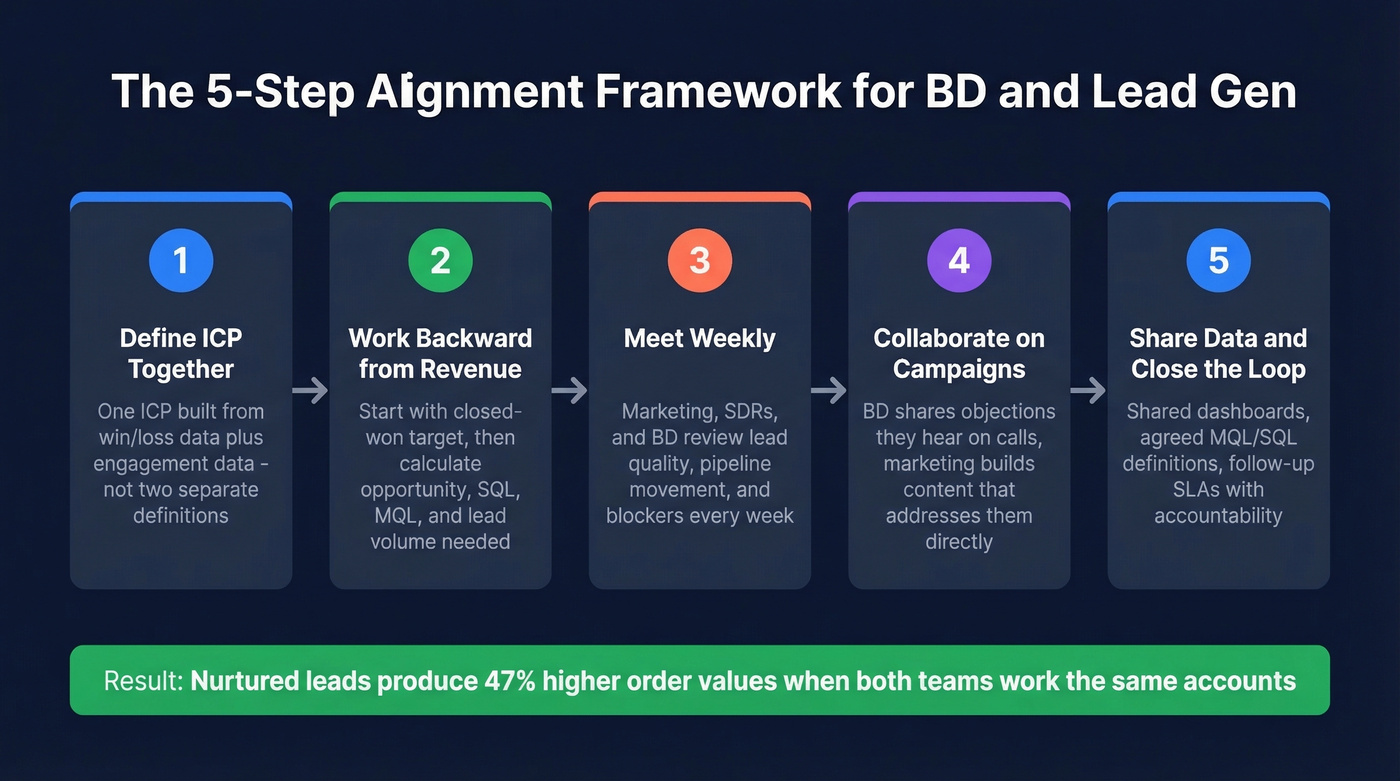
1. Define the ideal client together. Not marketing's ICP and sales' ICP - one ICP, built from both sides. BD brings win/loss data. Marketing brings engagement data. The overlap is your real target. (If you need a starting point, use an ideal client scoring rubric.)
2. Set goals by working backward from revenue. Start with the closed-won number. Work backward through opportunity, SQL, MQL, and lead volume. Now everyone knows exactly how many leads at what quality are needed.
3. Meet weekly. Not monthly. Not quarterly. Weekly standups between marketing, SDRs, and BD to review lead quality, pipeline movement, and what's stuck. Nurtured leads produce 47% higher order values - but only if the nurture motion reflects what BD is hearing on calls.
4. Collaborate on campaigns. BD reps know what objections they're hearing. Marketing knows what content drives engagement. Put those together and you get campaigns that resonate with buyers instead of generic thought leadership that nobody reads.
5. Share data and close the loop. Win/loss analysis, web analytics, and CRM activity should be visible to both sides. Use shared dashboards with agreed-upon definitions for MQL, SQL, and SAL. Set follow-up SLAs and hold people to them.
For expensive, infrequently purchased services, referrals carry more weight than cold lunches and networking. That's not an argument against outbound - it's an argument for BD and lead gen working the same accounts from different angles, building familiarity before the ask.
Channels Ranked by ROI
The average B2B buyer now touches 10 channels before purchase - up from 5 in 2016. Omnichannel engagement yields an 18.96% engagement rate versus 5.4% for single-channel. You need to be in multiple places, but not all channels deliver pipeline at the same speed or cost.
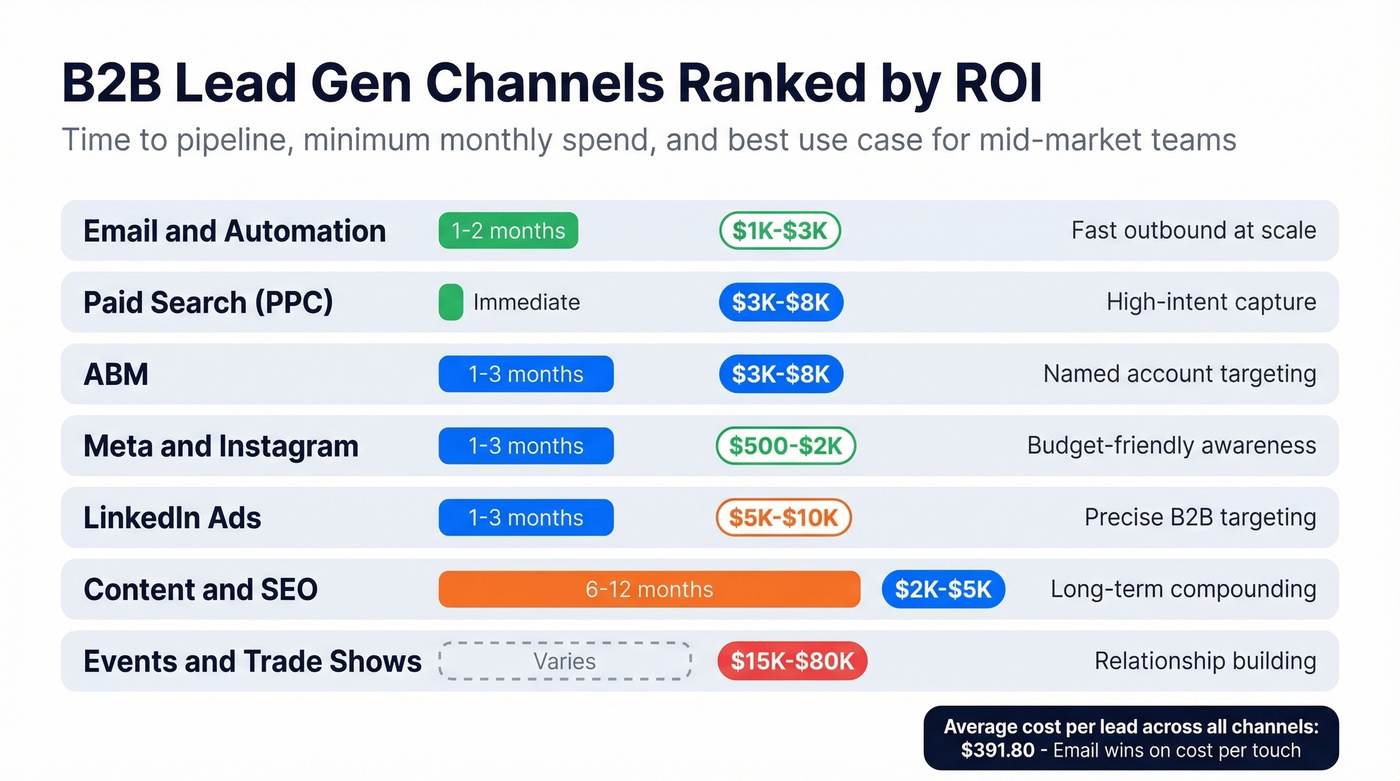
Here's how they stack up for mid-market B2B teams, based on Foes' channel ROI analysis:
| Channel | Time to Pipeline | Min. Monthly Spend | Best For |
|---|---|---|---|
| Email & automation | 1-2 months | $1K-$3K | Fast outbound at scale |
| Content / SEO | 6-12 months | $2K-$5K | Long-term compounding |
| ABM | 1-3 months | $3K-$8K | Named account targeting |
| Paid search (PPC) | Immediate | $3K-$8K | High-intent capture |
| Meta / Instagram | 1-3 months | $500-$2K | Budget-friendly awareness |
| LinkedIn Ads | 1-3 months | $5K-$10K | Precise B2B targeting |
| Events / trade shows | Varies | $15K-$80K/event | Relationship building |
Email outreach remains the fastest path to pipeline for most teams. Cold email benchmarks sit around a 5.1% reply rate and 27.7% open rate, with a two-email sequence driving the highest response rate at 6.9%. The average cost per lead across all channels runs $391.80, which makes email's low cost per touch extremely attractive.
But email performance lives and dies on data quality. A 7.5% bounce rate is the industry benchmark, and we've seen teams running 20-30% bounces because they're pulling contacts from stale databases. That's not just wasted sends - it's domain reputation damage that tanks deliverability for months. (If you're troubleshooting, start with email bounce rate benchmarks and fixes.)
LinkedIn Ads deserve a note: CPMs run $60-$200 versus $8-$30 on Meta. You'll need $8K-$15K/month minimum to make LinkedIn a primary demand gen channel. Powerful for targeting, expensive for volume.
Mistakes That Kill Your Pipeline
Targeting too broadly. You target everyone and reach no one. A sharp ICP with firmographic, technographic, and intent signals cuts waste dramatically. If your SDRs can't describe the ideal buyer in two sentences, your targeting is too broad. (Use firmographic filters to tighten targeting fast.)
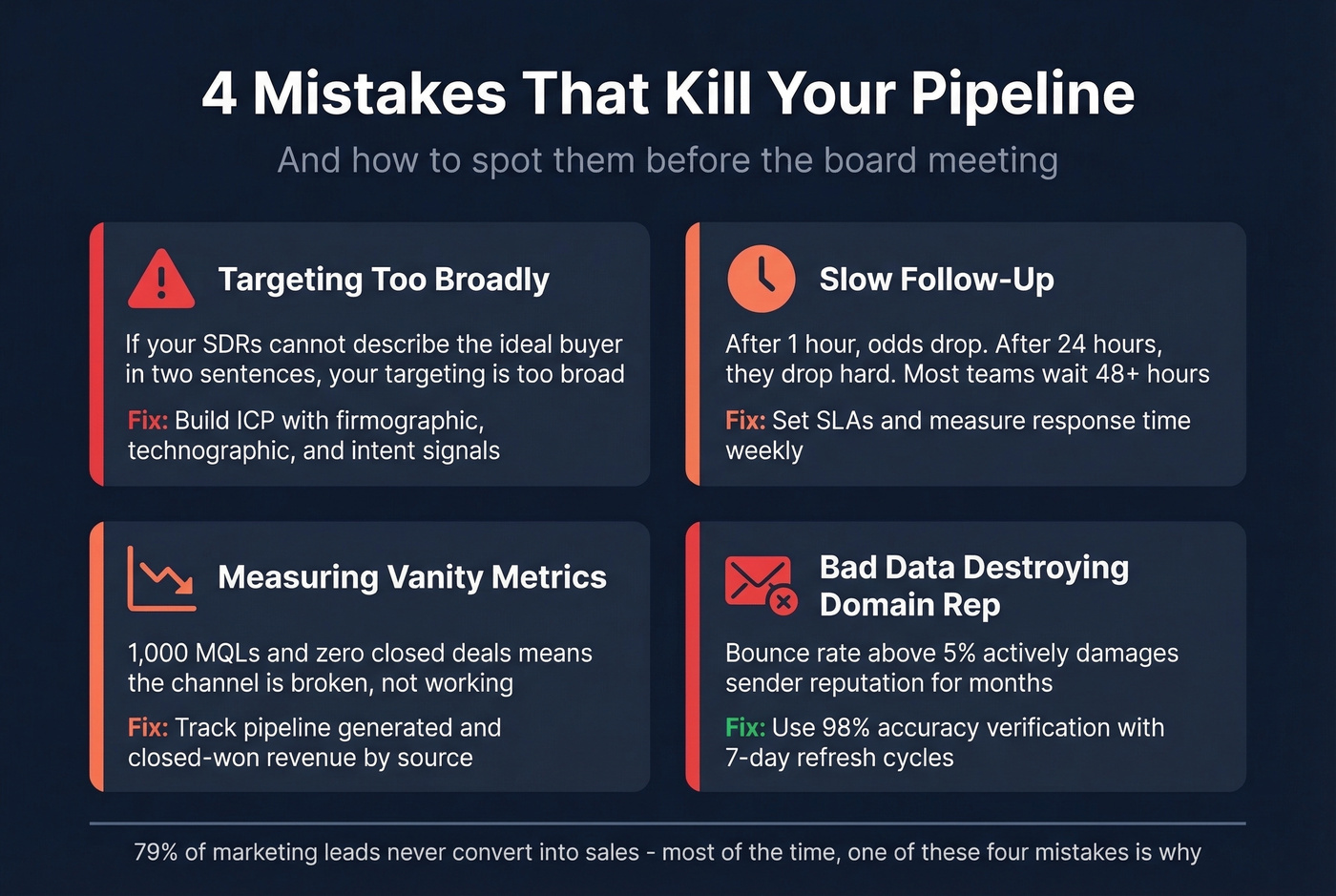
Slow follow-up. After one hour, odds drop. After 24 hours, they drop hard. Set SLAs and measure them. Sales reps already spend more than half their time hunting leads - don't compound the problem by letting qualified ones go cold. If you need copy, steal these sales follow-up templates.
Measuring vanity metrics. Page views and MQL counts feel good in a dashboard. They don't pay salaries. Track pipeline generated and closed-won revenue by source. If a channel produces 1,000 MQLs but zero closed deals, kill it. (More on what to track in lead generation metrics.)
Bad data destroying domain reputation. If your bounce rate is above 5%, you're actively damaging your sender reputation. Every bounced email tells inbox providers you don't maintain your lists. This is where data quality tools earn their keep - Prospeo's 5-step verification with catch-all handling, spam-trap removal, and honeypot filtering delivers 98% accuracy on a 7-day refresh cycle versus the 6-week industry average. That's the difference between a sequence that lands in inboxes and one that lands in spam. (For remediation, see spam trap removal and email deliverability.)
Building Your Tech Stack
The lead gen software market hit $7.4B in 2025 and is projected to reach $16.2B by 2034. Hundreds of tools exist. You need four categories: prospecting data, sequences, CRM, and enrichment.
Prospecting & Data - Prospeo
Prospeo covers 300M+ professional profiles with 143M+ verified emails and 125M+ verified mobile numbers. The 98% email accuracy rate comes from a proprietary 5-step verification process that doesn't rely on third-party email providers. Mobile numbers carry a 30% pickup rate across all regions, and the data refresh cycle runs every 7 days.
Search filters go 30+ deep: buyer intent across 15,000 Bombora topics, technographics, job changes, headcount growth, funding, and revenue. Pricing is self-serve and transparent - free tier gives you 75 verified emails plus 100 Chrome extension credits per month, and paid plans run roughly $0.01/email with no contracts. One customer, Meritt, tripled their pipeline from $100K to $300K/week after switching, with bounce rates dropping from 35% to under 4%.

Prospecting & Sequences - Apollo.io
Skip this if you already have a dedicated data provider and sequencing tool. Apollo's value is combining both in one platform.
Apollo pairs a broad contact database with built-in email sequences. Free tier available, paid plans from $49/user/month. The workflow integration is genuinely useful for smaller teams that don't want to manage multiple tools. The tradeoff: email accuracy runs lower than dedicated verification tools, so pair it with a verification layer if deliverability matters to you.
CRM - HubSpot vs Salesforce
Let's keep this simple. If you have a dedicated RevOps person, Salesforce. If you don't, HubSpot.
HubSpot's free CRM is the starting point for most SMBs. Starter runs $15/user/month, Professional $90/user/month. The marketing hub plugs in without friction. Salesforce starts at $25/user/month and scales to $175/user/month for Enterprise - more powerful, more customizable, and significantly more complex. The consensus on r/salesforce is that you shouldn't buy it unless you have someone who can actually administer it, and that advice holds up in our experience.
Enrichment & Workflows - Clay
Clay starts at $134/month for 2,000 enrichment credits. It's a workflow builder for RevOps teams that need to pull data from multiple sources, transform it, and push it into their CRM. Think of it as the orchestration layer that connects your data providers to your outbound motion. If you're running fewer than 500 leads/month, you probably don't need it yet. (If you're comparing vendors, start with data enrichment services.)
The article's math is clear: contact leads within 24 hours or lose 5x in conversion. That only works if your data is fresh. Prospeo refreshes every 7 days - not the 6-week industry average - so your SDRs and BD reps always reach real people at current companies, at roughly $0.01 per email.
Align your teams on data that's actually accurate this week.
FAQ
What's the difference between lead generation and business development?
Lead generation fills the top of funnel with potential buyers through tactics like email outreach, SEO, and paid ads. Business development converts that pipeline into revenue through relationship-building, partnerships, and market expansion. Lead gen is short-term and tactical; BD is long-term and strategic. They perform best when aligned on a shared ICP and shared KPIs.
How do I know if my lead generation is working?
Track pipeline generated and closed-won revenue by source - not MQL volume or page views. Benchmark: Lead to MQL ~22%, MQL to SQL ~15%, SQL to Opp ~11%, Opp to Won ~7%. If your MQL to SQL conversion is below 10%, you have a qualification or handoff problem, not a volume problem.
How long does it take to see results from B2B lead generation?
Email outreach can generate pipeline within 1-2 months. PPC delivers leads immediately but requires budget. Content and SEO take 6-12 months to compound. Most teams see meaningful pipeline movement within 90 days of launching a multi-channel outbound motion with clean data and a sharp ICP.