

Business Follow Up Email Templates That Get Replies (2026 Data)
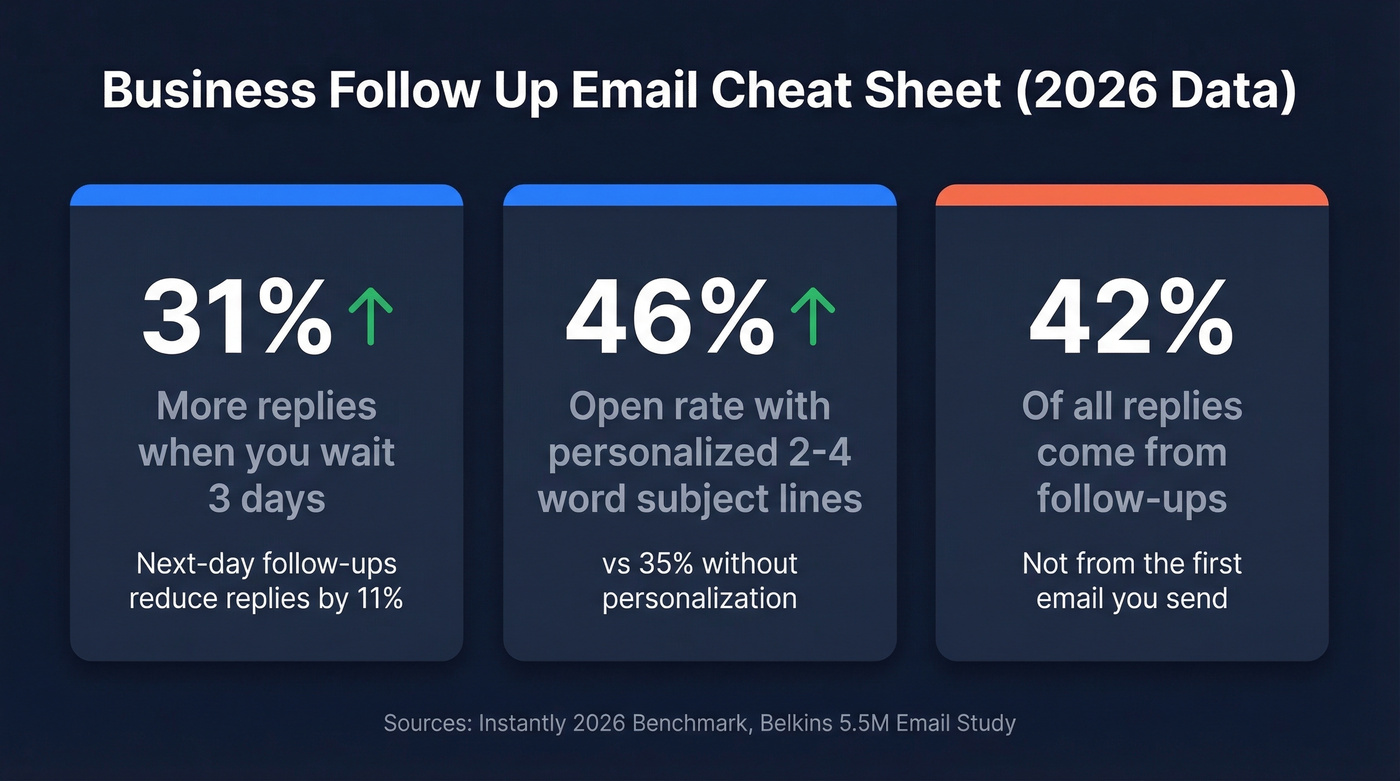
You sent a proposal three days ago. Radio silence. Here's what the data says: 42% of all replies come from follow-ups, not the first email. That proposal didn't fail - your business follow up email just hasn't been sent yet.
The average cold email reply rate sits at 3.43%. Top performers push past 10%. The difference isn't magic copywriting - it's timing, subject lines, and whether your emails actually reach inboxes.
The Cheat Sheet
- Wait 2-3 days before your first follow-up. Next-day follow-ups reduce replies by 11%. A 3-day gap increases them by 31%.
- Keep subject lines to 2-4 words, personalized. That combo hits a 46% open rate vs 35% without personalization.
- Verify your list before sending. Follow-ups to invalid addresses don't just bounce - they destroy your domain reputation.
Subject Lines That Get Opened
A 5.5M-email study from Belkins gives us the clearest picture. Personalized subject lines hit 46% opens and 7% reply rates. Non-personalized? 35% opens, 3% replies. That's a 133% reply rate difference from one change.
Question-format subject lines matched that 46% open rate, and short lines of 2-4 words did the same. Marketing hype terms like "ASAP" or "Hello, friend" dragged opens below 36%. Hunter's analysis of 20K+ subject lines confirmed that adding even a single custom attribute - company name, role, industry - boosts opens by 7% or more.
One Reddit practitioner shared internal numbers that line up perfectly: "Quick question" pulled 39% opens, company-name subject lines hit 33%, and "Partnership opportunity" cratered below 19%.
| Subject Line Format | Open Rate | Source |
|---|---|---|
| Personalized (name/company) | 46% | Belkins 5.5M study |
| Question format | 46% | Belkins 5.5M study |
| 2-4 words | 46% | Belkins 5.5M study |
| Custom attribute (+1 field) | +7% lift | Hunter 20K+ analysis |
| Marketing hype terms | <36% | Belkins 5.5M study |
| "Partnership opportunity" | <19% | Reddit practitioner |
When to Send Follow-Ups
Timing isn't a minor optimization - it's the difference between a 31% boost and an 11% penalty.
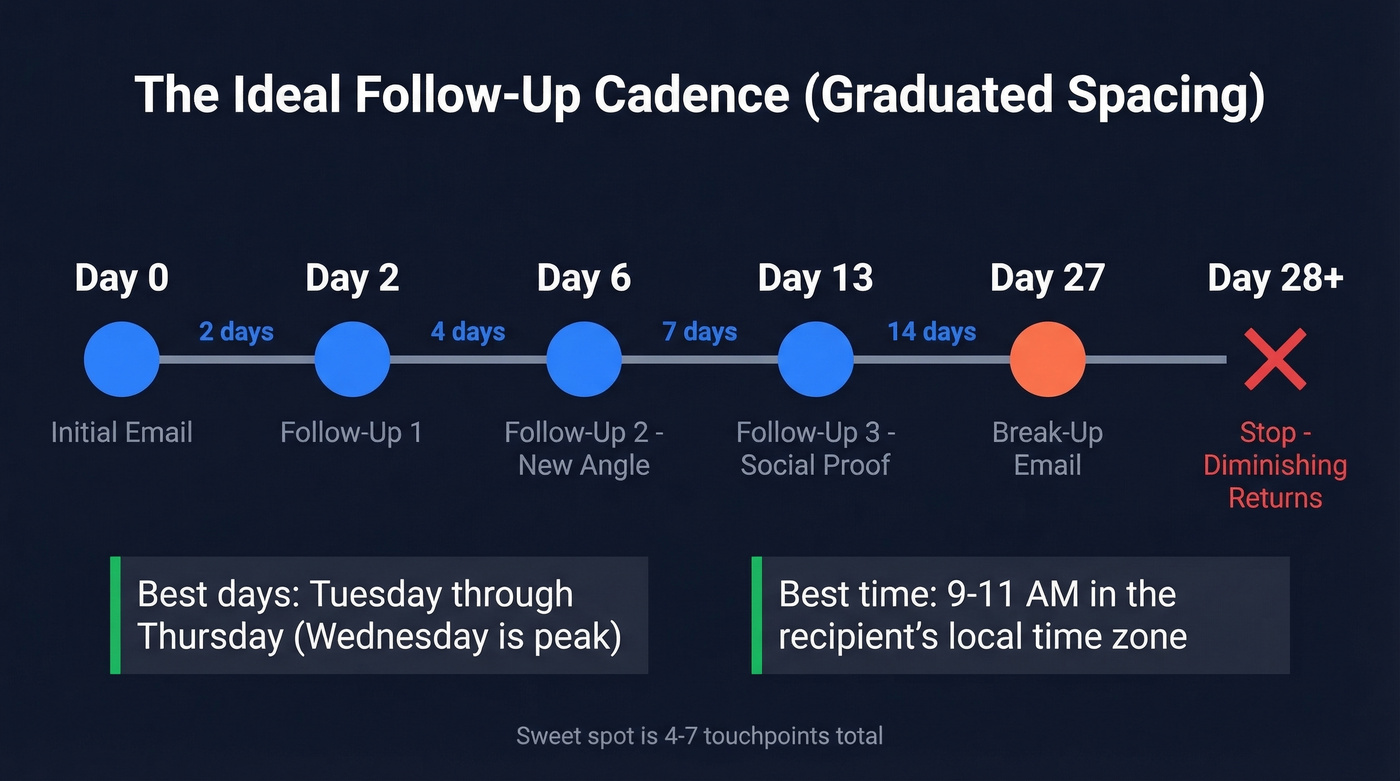
Graduated spacing beats static intervals. Instead of following up every 3 days like a metronome, stretch the gaps: 2 days, then 4, then 7, then 14. This mirrors how a real person would follow up - persistent but not desperate.
The sweet spot is 4-7 touchpoints. Beyond 7, diminishing returns kick in hard unless each touch adds genuinely new value. Best days are Tuesday through Thursday, with Wednesday pulling the highest reply rates. Send between 9-11 AM in the recipient's local time zone. If your tool shows the prospect opened your email, use that signal to prioritize them and follow up while you're still top-of-mind.
Here's the thing: most teams over-index on templates and under-index on timing. We've seen teams double reply rates without changing a single word of copy, just by fixing their cadence.

Timing your follow-up perfectly means nothing if it bounces. Bad addresses kill domain reputation and tank future deliverability - for every campaign. Prospeo's 5-step verification delivers 98% email accuracy, so every follow-up in your sequence actually reaches the inbox.
Stop perfecting templates for addresses that don't exist.
How to Write a Follow Up Email That Works
Every template below keeps the body under 80 words - the benchmark for top-performing campaigns. Exclaimer's research suggests 50-125 words as the ideal range for professional follow-ups, and every template here falls within it.
If you want a deeper framework beyond templates, see how to send a follow-up email.
After a Meeting or Call
Meeting Recap With Action Items
Subject: Next steps from [day]
Hi {{firstName}},
Good talking today. Quick recap so nothing falls through:
- You're reviewing {{specific deliverable}} by {{date}}
- I'm sending {{resource}} by {{date}}
- We're reconnecting {{date/time}}
Did I miss anything, or should we adjust priorities?
Best, {{your name}}
Send within 24 hours. Specificity signals you were paying attention. (More: follow up email after first meeting)
Post-Demo Follow-Up
Subject: {{Company}} + {{your product}} fit
Hi {{firstName}},
Thanks again for the time today. Two quick takeaways:
- {{Pain point}} - we'd address it by {{one sentence}}
- {{Feature}} - I can share a 1-page case study with outcomes
Worth a 15-minute call Thursday to loop in {{stakeholder}}?
{{your name}}
Reference something specific they said - generic recaps get ignored.
After No Response
This is where most sequences fall apart. The instinct is to resend the same message with "bumping this to the top of your inbox." Don't. Each follow-up needs to earn its spot. (If you need softer language, use a polite follow-up email.)
First Follow-Up (3 Days)
Subject: Quick question
Hi {{firstName}},
Circling back on my note from {{day}} - I know things get buried.
In one line: {{one-sentence value prop tied to their role}}.
Is a 10-minute call this week worth it, or should I close this out for now?
{{your name}}
The "close this out" option gives an easy exit - and often gets a reply.
Second Follow-Up (7 Days, New Angle)
Subject: {{Relevant stat or insight}}
Hi {{firstName}},
Different angle: {{company in their space}} just {{achieved result}} using {{approach}}. Thought it'd be relevant given {{their situation}}.
Want the short breakdown, or should I stop reaching out?
{{your name}}
New information, not a repeat ask. This is where most sequences fail. (More examples: second follow up email)
Break-Up Email
Subject: Should I close your file?
Hi {{firstName}},
I've reached out a few times and haven't heard back - totally fine. I'll assume timing isn't right and close this out.
If it becomes a priority later, reply to this thread and I'll jump back in.
{{your name}}
Break-up emails are often the best-performing message in a sequence. (Subject ideas: break up email subject lines)
Sales & Proposals
After Sending a Proposal
Subject: Thoughts on the proposal?
Hi {{firstName}},
Did you get a chance to review the proposal I sent {{day}}?
Two quick notes:
- {{specific pricing/term}} is valid through {{date}}
- {{peer company}} saw {{result}} with a similar setup
Want to do a 10-minute walkthrough with your team?
{{your name}}
Urgency through a deadline, social proof through a peer example.
Cold Email Warm Follow-Up
Subject: Re: {{original subject}}
Hi {{firstName}},
Following up on my note last week - keeping it short.
Reason I reached out: {{personalized signal: job posting, funding, tech stack, etc.}}.
Worth a quick conversation? If not, just reply "no" and I'll stop.
{{your name}}
Before sending, verify the email address is still active. A bounced cold follow-up is worse than no follow-up at all. (Related: cold email follow-up template)
Non-Sales Scenarios
Invoice / Payment Reminder
Subject: Invoice #{{number}} - quick reminder
Hi {{firstName}},
Friendly reminder: invoice #{{number}} for {{amount}} was due {{date}}. I reattached it here for convenience.
If it's already been processed, please disregard. Otherwise, can you share an ETA?
Thanks, {{your name}}
Follow Up Email for Business Opportunity
Subject: {{Your company}} + {{their company}}
Hi {{firstName}},
Following up on my partnership note from last week.
Core idea in one line: {{mutual benefit}}.
Want me to send the one-pager, or should I pause this?
{{your name}}
Offer something tangible - a one-pager, a mockup, a draft proposal. (More: business partnership email)
Networking Event Follow-Up
Subject: Good meeting you at {{event}}
Hi {{firstName}},
Great connecting at {{event}} - I enjoyed our conversation about {{specific topic}}.
As promised, here's {{resource/intro/link}}. Want to continue the conversation over coffee or a quick call next week?
{{your name}}
Send within 48 hours. Reference something specific from your conversation. (More: networking follow up email)
Post-Interview Follow-Up
Subject: Thank you - {{role}} interview
Hi {{firstName}},
Thank you for your time today discussing the {{role}} role. I'm especially excited about {{specific project/challenge}}.
If helpful, I can send a short 30/60/90-day plan for how I'd approach {{outcome}}.
Best, {{your name}}
Internal Follow-Up (Cross-Team)
Subject: Update on {{project}}?
Hi {{firstName}},
Quick check-in on {{deliverable}} from last {{day}}. We're blocked on {{dependency}} until we get {{what you need}}.
Can you share an ETA, or should we loop in {{stakeholder}} to reprioritize?
Thanks, {{your name}}
"We're blocked" is more effective than "just checking in." Internal follow-ups need clear stakes - this applies to every follow up work email you send across teams.
Five Mistakes That Kill Reply Rates
1. "Just checking in" with no new value. Every follow-up needs to earn its existence. Replacing "just making sure you saw this" with a specific proof point - "we added 10-15 warm leads for {{similar company}}" - dramatically outperforms the lazy bump. (More options: what to say instead of just checking in)
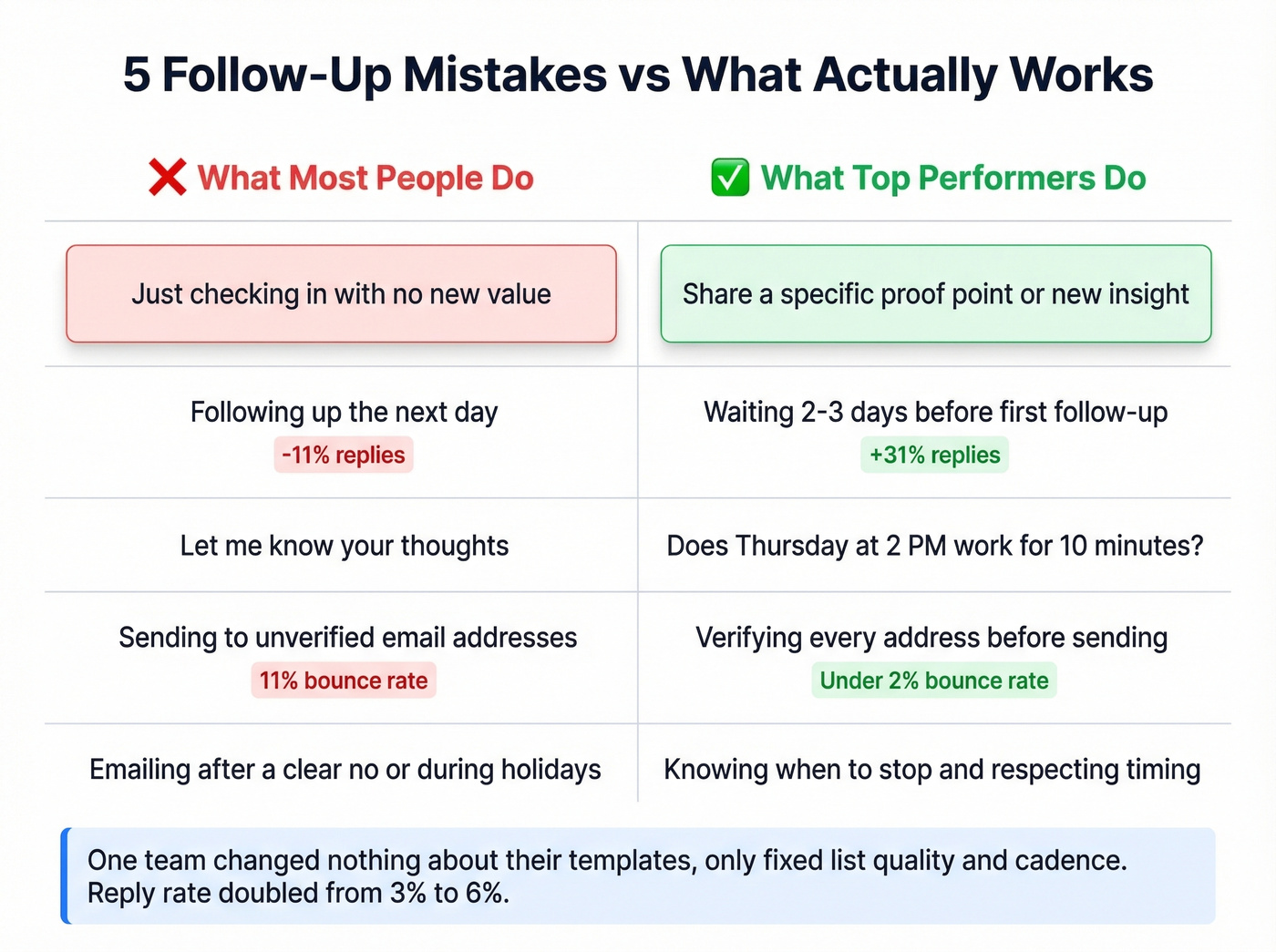
2. Following up too fast. Next-day follow-ups reduce replies by 11%. Two to three days is the right window for most cold follow-ups.
3. No clear CTA. "Let me know your thoughts" isn't a call to action. "Does Thursday at 2 PM work for a 10-minute call?" is. Give them a binary choice, not an open-ended question. And skip the funny GIFs in corporate follow-ups - they tank credibility.
4. Sending to invalid addresses. One Reddit practitioner rebuilt their entire outreach infrastructure and dropped their bounce rate from 11% to under 2%. Reply rate doubled from 3% to 6%. The templates didn't change. The list quality did.
5. Not knowing when to stop. After a clear "no," stop emailing. Before a stated decision timeframe, wait. During holidays or peak periods, pause. 69% of sales professionals report declining email performance year-over-year, partly because too many senders don't know when to back off. If someone says "not now," respect it.
Deliverability and Data Quality
Most template guides skip this part entirely. It matters more than any template. (If you're troubleshooting inboxing, start with email deliverability issues.)
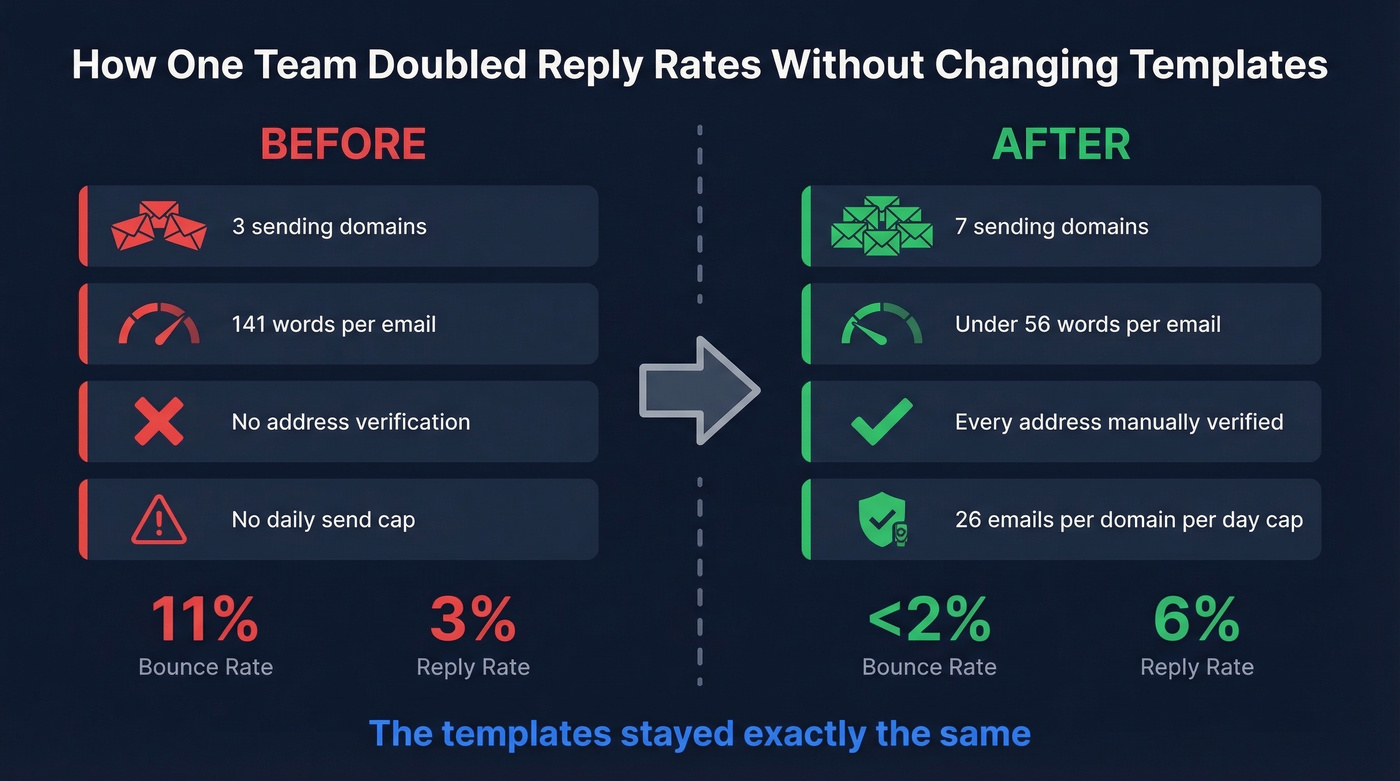
That Reddit practitioner who doubled their reply rate? Here's what they changed: expanded from 3 sending domains to 7, capped each at 26 emails per day, manually verified every address, and cut email length from 141 words to under 56. Bounce rate went from 11% to under 2%. Reply rate went from 3% to 6%. The templates stayed the same.

You don't have to verify addresses manually. Prospeo runs a 5-step email verification process - catch-all handling, spam-trap removal, honeypot filtering - with 98% accuracy on a 7-day data refresh cycle. The free tier gives you 75 verifications per month, enough to test the difference yourself. (More detail: how to validate email address.)
Let's be honest: you can craft the perfect business follow up email, and it won't matter if 10% of your list bounces. Fix the data first. Then the templates work.
The best follow-up in your sequence is the one that lands. Teams using Prospeo cut bounce rates from 35%+ to under 4% - because every email is verified on a 7-day refresh cycle, not stale data from six weeks ago. At $0.01 per verified email, cleaning your list costs less than a single bounced reply costs your domain.
Meritt tripled pipeline to $300K/week after fixing their data.
Should You Use AI for Follow-Ups?
AI can help, but it's not a shortcut. That 69% performance decline stat isn't about AI being bad - it's about AI being used lazily. Generic "just checking in" messages generated at scale are spam, whether a human or a machine wrote them.
Where AI actually works: compressing the 13 hours per week reps spend researching prospects into minutes. Feed it real signals - a funding round, a leadership change, a tech stack shift - and let it draft a personalized first line. That's the right use case. "Write me a follow-up" with no context? That's how you end up in the spam folder with everyone else. (Related: AI sales outreach tech stack.)
Skip AI-generated follow-ups entirely if you're in a high-trust industry like financial services or healthcare. In those spaces, a clearly templated message with one genuine personal detail outperforms anything that reads like it was generated in bulk.
FAQ
How many follow-up emails should I send?
Four to seven touchpoints is the sweet spot. 42% of all replies come from follow-ups, so stopping after one or two leaves nearly half your potential responses on the table. Beyond seven, add new value with each touch or stop.
How long should I wait before following up?
Two to three business days for the first follow-up, then graduate the spacing: 4 days, 7 days, 14 days. Next-day follow-ups reduce reply rates by 11%, so patience pays off.
What's the best subject line for a follow-up?
Short, personalized with the recipient's company or role, and ideally in question format. This combination hits 46% open rates - nearly double the rate of generic or hype-driven lines.
Do follow-up emails hurt my domain reputation?
Only if you're sending to invalid addresses. Keep bounce rates under 2% by verifying every address before you send. Prospeo's free tier covers 75 verifications per month - enough to clean a small campaign list and protect your sender score.
Should I reply in the same thread or start a new one?
Reply in the same thread. Emails that look like replies outperform standalone messages by about 30% and give the recipient context without forcing them to search for your original note.