

The Only Business Meeting Email Format You Actually Need
A RevOps lead we know spent an entire afternoon rewriting a meeting request email - four drafts, two Slack threads, and a 45-minute debate about "sync" vs. "discussion." The email got ignored. Meetings drain $259B per year from U.S. businesses, and a chunk of that waste starts in the inbox. You don't need 25 templates. You need one business meeting email format that flexes across every stage.
The Universal Email Structure
Every effective meeting email follows the same skeleton: grab attention, state your purpose, give the details, close with one clear ask. Memorize this once, adapt the tone for each situation.
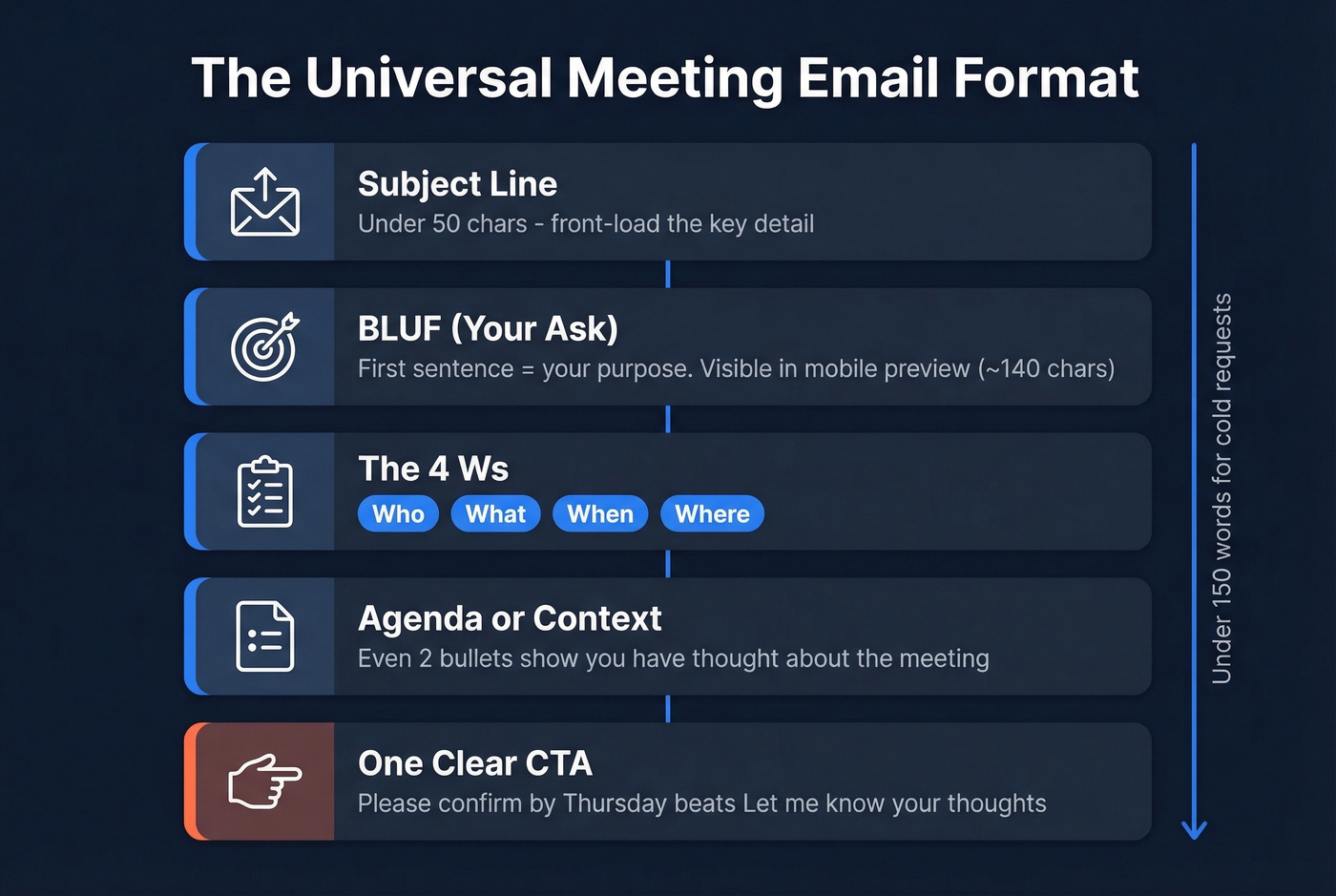
Subject line. Under 50 characters. Front-load the key detail - 47% of recipients decide whether to open based on the subject alone, and 69% flag spam based on it too. If you need inspiration, borrow from these email subject line examples.
BLUF (Bottom Line Up Front). Your ask goes in the first sentence. The first ~140 characters show up in mobile previews and AI-generated summaries. If your purpose isn't visible there, it's buried. (More on BLUF (Bottom Line Up Front)).)
The 4 Ws. Who's attending, what the meeting covers, when it happens, and where (physical location or virtual link). This framework, outlined by YouCanBookMe, turns vague invites into actionable ones.
Agenda or context. Even a two-bullet agenda signals you've thought about the meeting.
CTA. One clear next step. "Please confirm by Thursday" beats "Let me know your thoughts." If you want a tighter ask, use these email call to action rules.
Match your greeting and signature to the recipient's formality - "Hi Sarah" for a warm contact, "Dear Dr. Patel" when you're unsure. That's the whole framework. Every meeting email you'll ever write is a variation of this skeleton.
Format Rules That Move the Needle
- Subject line: under 50 characters. Put the meeting type or topic first. If you're prospecting, these prospecting email subject lines patterns help.
- Body length: under 150 words for external/cold requests, under 200 for internal. A 16.5M-email study by Belkins found the sweet spot is 6-8 sentences, hitting a 6.9% reply rate vs. the 5.8% average.
- Best send day: Thursday pulled a 6.87% reply rate vs. 5.29% on Monday in that same dataset. For send time, the 8-11 PM window performed best for replies (peak 6.52%), with 7-11 AM also strong. For a deeper breakdown, see the best time to send cold emails data.
- Time zones: Always specify. "2 PM ET / 11 AM PT" takes five seconds and prevents a no-show.
- One CTA per email. Two asks compete. Pick the one that matters.
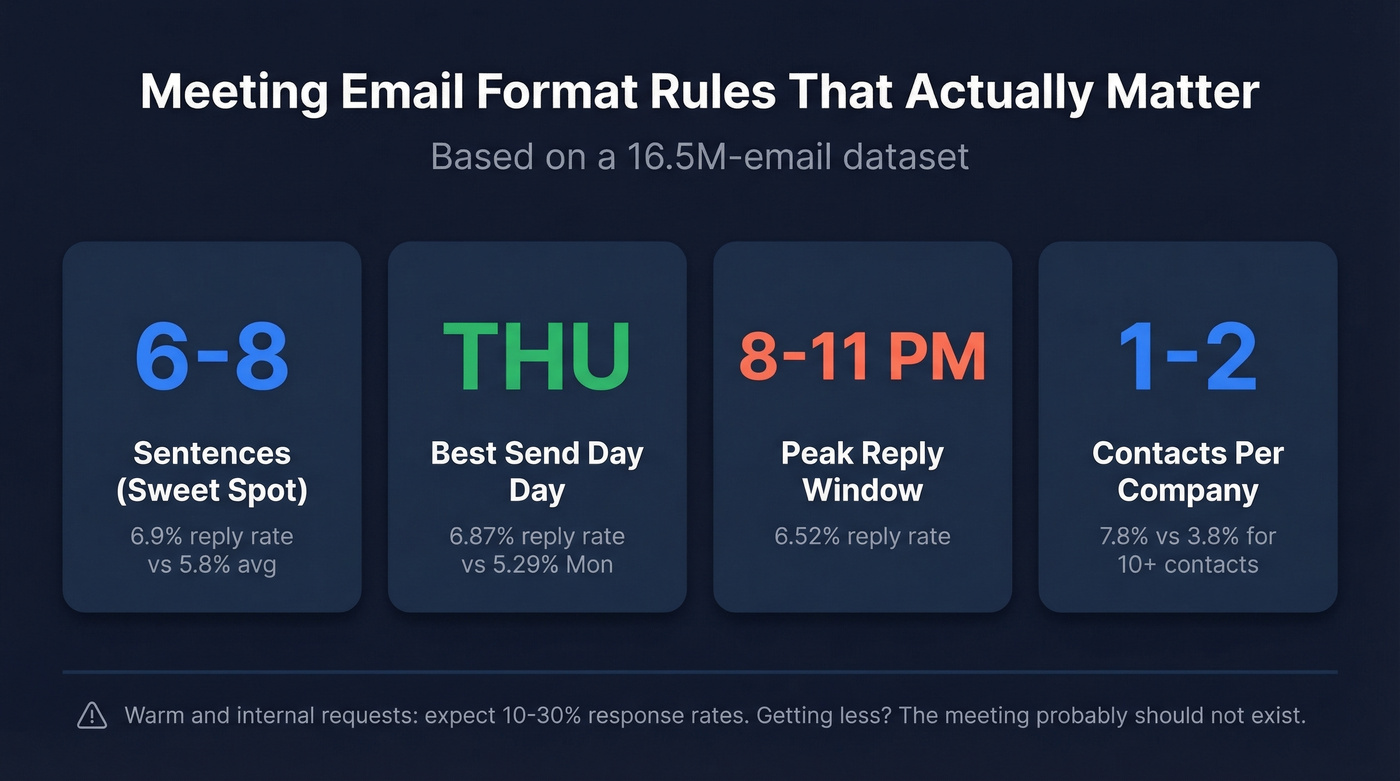
Warm and internal meeting requests perform significantly better - expect 10-30% response rates. If you're getting less than that on internal emails, the format isn't the problem. The meeting probably shouldn't exist.
Templates by Meeting Stage
Meeting Request (Cold or Warm)
The best cold meeting email still fails if it bounces. Verify the address first - Prospeo checks emails in real time with 98% accuracy, so your carefully formatted request actually lands in an inbox instead of the void. If you're troubleshooting bounces, start with email bounce rate.
Subject: 20-min call - [specific topic]
Hi [Name],
I'm [Your Name] at [Company]. We help [one-line relevance statement].
Would you have 20 minutes on [Day, Date] at [Time + TZ] to discuss [specific outcome]? If that doesn't work, here's my booking link: [scheduler URL].
No worries if the timing's off - happy to reconnect next quarter.
Including a credibility link in your signature helps reduce friction. A scheduling link eliminates back-and-forth.
Writing an Email to the CEO
Here's the thing about C-suite emails: the universal format still applies, but the tolerance for fluff is near zero. An email to a CEO that actually gets a reply leads with a concrete, quantified reason for the meeting and keeps the body under 100 words. CEOs scan. They don't read. Your BLUF sentence needs to answer "why should I care?" in under 15 words. If you're building a repeatable outbound system, use these sales prospecting techniques to tighten targeting before you write.
Subject: 15-min review - [specific initiative or metric]
Hi [CEO Name],
[One sentence tying the meeting to a revenue or strategic outcome.]
Could we meet on [Day, Date] at [Time + TZ]? I'll keep it to 15 minutes. Here's my calendar link: [URL].
The same principles apply across any C-suite context - investor updates, board prep, cross-functional reviews. Strip every sentence that doesn't earn its place.
Meeting Confirmation
Subject: Confirmed: [Meeting topic] - [Date, Time TZ]
Hi [Name],
Confirming our meeting:
- Date/Time: [Day, Date] at [Time + TZ]
- Location: [Address or video link]
Need to reschedule? Reply or use [reschedule link].
Send this immediately after booking. Speed reduces no-shows and reschedule churn.
Agenda Email
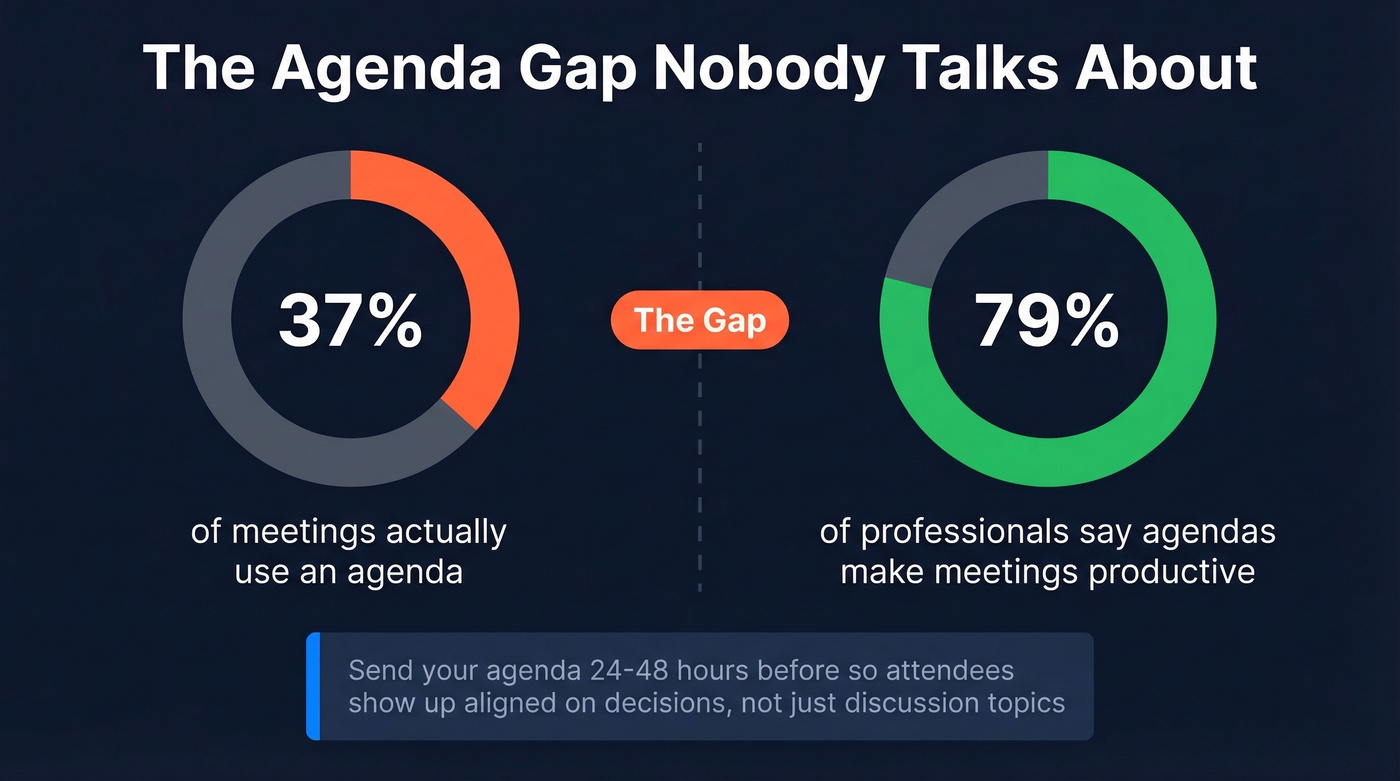
Only 37% of meetings use an agenda, yet 79% of professionals say agendas make meetings more productive. That gap is staggering. Agendas cut meeting drift because everyone shows up aligned on what's being decided, not just discussed. Send yours 24-48 hours before so attendees can prepare.
Subject: Agenda: [Meeting topic] - [Date]
Hi team,
Here's what we'll cover on [Day]:
- [Topic A] - 10 min (Owner: [Name])
- [Topic B] - 15 min (Owner: [Name])
- Open questions - 5 min
Please add anything I've missed by EOD tomorrow.
Reschedule Email
Notify as soon as you know. Take accountability. Offer two-plus alternatives so the recipient doesn't have to do the work of finding a new slot.
Subject: Reschedule request: [Meeting topic]
Hi [Name],
I need to move our [Day] meeting - apologies for the shift. Could we do [Option A: Day/Time] or [Option B: Day/Time]? Alternatively, pick a slot here: [booking link].
Reminder Email
Subject: Reminder: [Meeting topic] tomorrow at [Time TZ]
Hi [Name],
Quick reminder - we're meeting tomorrow at [Time TZ] via [link]. See you there.
Send 24-48 hours before. This is the shortest email in the lifecycle - don't overthink it.
Follow-Up / Post-Meeting
The data on follow-up sequences is clear: adding a third email drops reply rates by up to 20%, and by the fifth email, response rates fall 55%. Spam complaint rates also climb from 0.5% on the first email to 1.6% by the fourth. Two follow-ups is the ceiling. If you need options, use these sales follow-up templates.
Subject: Follow-up: [Meeting topic] - next steps
Hi [Name],
Thanks for your time today. Here's what we agreed on:
- [Action item 1] - Owner: [Name], due [Date]
- [Action item 2] - Owner: [Name], due [Date]
Let me know if I missed anything.

You just spent 20 minutes crafting the perfect meeting request. Don't let it bounce. Prospeo verifies emails in real time with 98% accuracy - so your carefully formatted ask actually reaches the inbox.
Stop perfecting emails that never land. Verify first.
Adapting the Format for Finance Stakeholders
Requesting a meeting with a CFO requires the same structural discipline as writing to a CEO, but the content emphasis shifts toward numbers. Lead with the financial impact - cost savings, budget implications, or ROI projections - in the BLUF sentence. Attach a one-page brief if the topic is complex; finance leaders prefer reviewing data before the call rather than hearing it live for the first time.
Mistakes That Kill Meeting Emails
Vague subject lines top the list. "Quick question" tells the reader nothing; "20-min call: Q3 pipeline review" does. Right behind that: missing time zones, which are especially deadly for distributed teams, and emails with no clear CTA. Every email needs exactly one next step. If you're still not getting replies, the issue is often email deliverability, not copy.
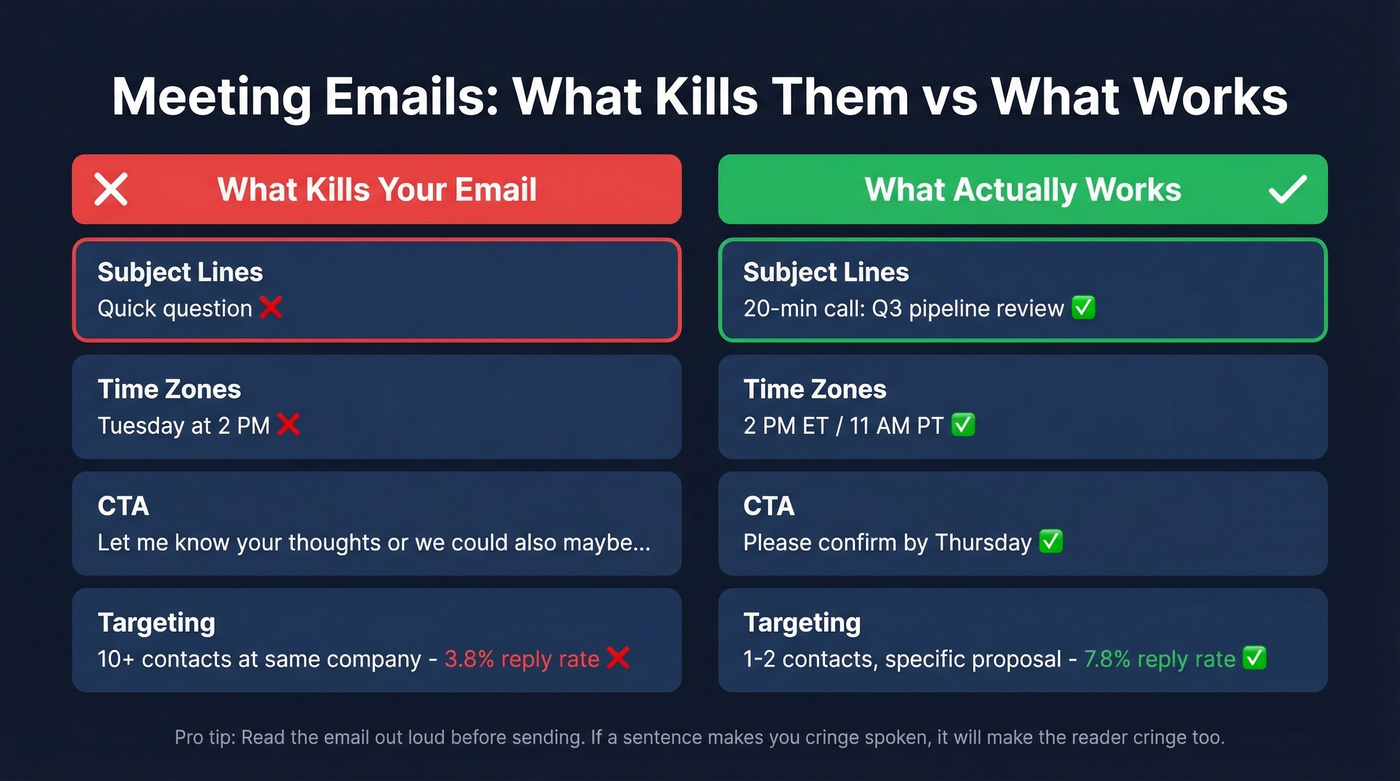
A subtler mistake is blasting too many contacts at the same company. The 16.5M-email dataset shows that targeting 1-2 contacts produces a 7.8% reply rate vs. 3.8% when you email 10+ people. Precision beats volume every time. We've seen this firsthand running outbound campaigns - specific time proposals and tight targeting outperform "spray and pray" without exception. If you're scaling outreach, sequence management helps keep volume controlled without losing personalization.
Let's be honest about one more thing: read the email out loud before sending. You'll catch tone issues and typos your eyes skip over. If a sentence makes you cringe when spoken, it'll make the reader cringe when read.
Measure Replies, Not Opens
Open rates are unreliable. Apple's Mail Privacy Protection - covering 53.67% of email client market share - pre-fetches emails and inflates open numbers. Track reply rate and meetings booked instead. Those tell you whether your format is working or just getting auto-opened by a privacy proxy. For reply benchmarks and fixes, see follow-up email reply rate.
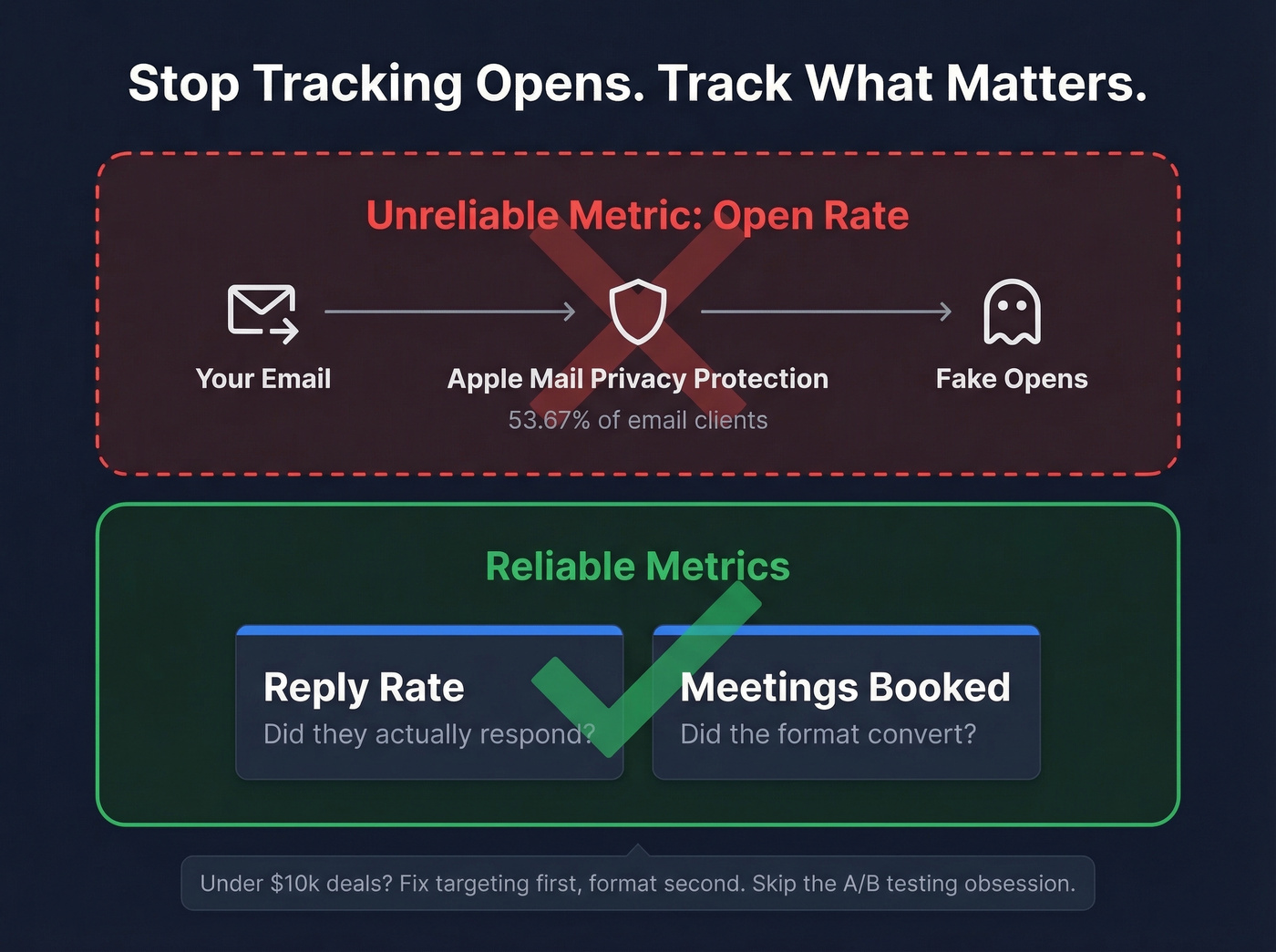
Skip the A/B testing obsession if you're closing deals under $10k. Fix your targeting first, format second. The best-formatted email in the world won't save you if it's going to the wrong person.
Cold meeting requests live or die on deliverability. Prospeo's 5-step verification catches bad addresses, spam traps, and catch-all domains before you send - at just $0.01 per email. That's cheaper than one wasted follow-up.
Every bounced meeting request is a conversation that never started.
FAQ
What's the correct business meeting email format?
Subject line under 50 characters, your ask in the first sentence (BLUF), the 4 Ws (who, what, when, where), a brief agenda or context line, and one clear CTA. This structure works for requests, confirmations, agendas, reschedules, reminders, and follow-ups.
What's the best day to send a meeting request?
Thursday. A 16.5M-email dataset shows Thursday pulled a 6.87% reply rate vs. 5.29% on Monday. The 8-11 PM window performed best for replies (peak 6.52%), with 7-11 AM also strong.
Should I include an agenda in a meeting email?
Yes - only 37% of meetings use one, yet 79% of professionals say agendas improve productivity. Send it 24-48 hours before so attendees can prepare and the meeting starts focused.
How many follow-ups should I send after a meeting request?
Two at most. A third email reduces reply rates by up to 20%, and spam complaints rise from 0.5% on the first email to 1.6% by the fourth. If two follow-ups don't work, revisit your targeting - not your volume.