

Buyer Persona: The Practitioner's Guide to Personas That Actually Drive Pipeline
It's the quarterly planning meeting. Marketing presents the persona deck - "Meet Sarah, 34, loves yoga, drinks oat milk, reads Harvard Business Review." Sales nods politely, closes the slide, and goes back to calling the same list they've been working all month. Nobody references the persona again until next quarter, when someone updates Sarah's age to 35.
This is the fairytale buyer persona problem - a term that keeps surfacing in B2B marketing communities on Reddit, and for good reason. Teams spend weeks crafting beautifully designed profiles full of demographic trivia and stock photos, then wonder why nobody uses them. The personas aren't wrong, exactly. They're irrelevant. They describe who the buyer is instead of how the buyer decides, and that gap between description and decision is where pipeline goes to die.
Let's fix that. What follows is a framework for building personas that sales actually opens, marketing actually targets against, and RevOps actually translates into prospect lists.
The Short Version
If you're pressed for time, here's the entire methodology compressed:
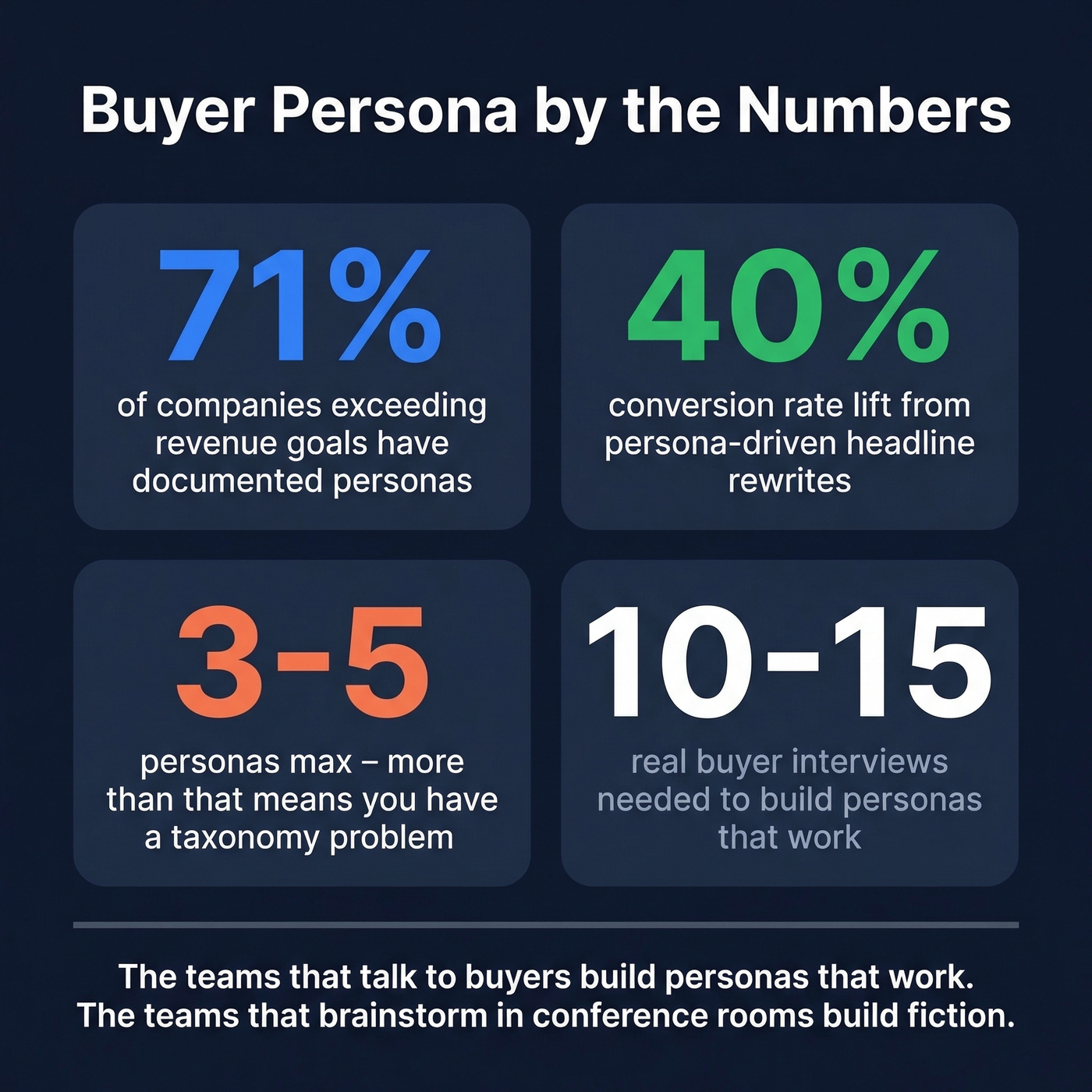
- Build 3-5 personas max. If you've got 10+, you've got a taxonomy problem, not a persona strategy.
- Base them on 10-15 real buyer interviews - not internal assumptions, not your CEO's gut feeling, not a ChatGPT prompt.
- Focus on buying decisions, not demographics. What triggered their search? What almost stopped the deal? Who else was involved?
- Pair persona fields with Jobs-to-Be-Done thinking. Personas tell you who. JTBD tells you why. You need both.
- Update quarterly or accept they'll die. Static personas become fiction fast.
Now the details.
What Is a Buyer Persona, Really?
A buyer persona is a research-based archetype that captures how a specific type of buyer makes purchasing decisions - their triggers, concerns, evaluation criteria, and journey. That's the definition that matters. Not "a semi-fictional representation of your ideal customer," which is technically accurate but practically useless.
The distinction is subtle but critical. Most persona templates ask you to fill in job title, age, hobbies, and "favorite social media platform." Adele Revella's work on the 5 Rings of Buying Insight flips this entirely: a useful persona captures priority initiatives, success factors, perceived barriers, decision criteria, and the buyer's journey. That's what helps you write better emails, build better decks, and close more deals.
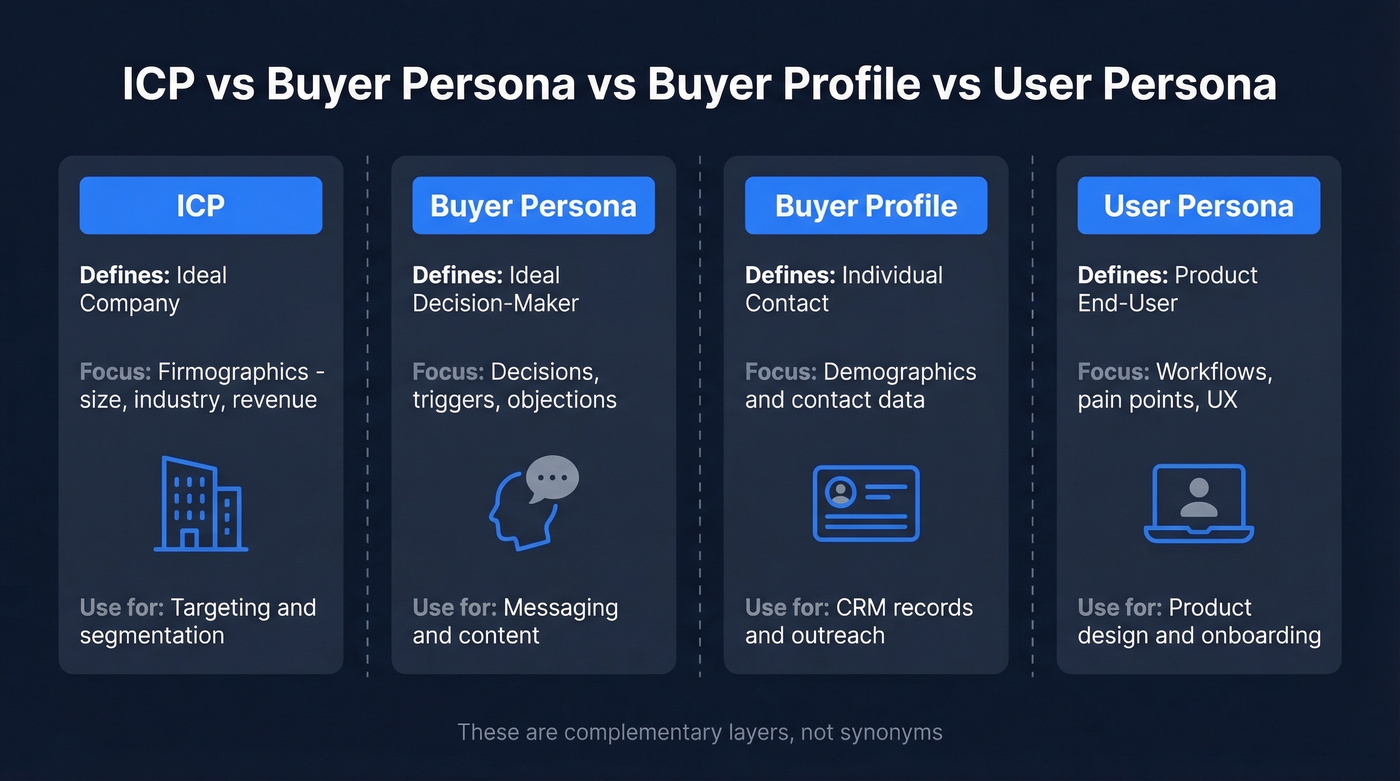
Here's where the terminology gets messy. Four terms float around interchangeably, and they shouldn't.
| Term | Defines | Focus | When to Use |
|---|---|---|---|
| ICP | Ideal company | Firmographics (size, industry) | Targeting & segmentation |
| Buyer Persona | Ideal decision-maker | Decisions, triggers, objections | Messaging & content |
| Buyer Profile | Individual contact | Demographics & contact data | CRM records & outreach |
| User Persona | Product end-user | Workflows, pain points, UX | Product design & onboarding |
Your ICP tells you which companies to target. Your persona tells you what to say when you get there. They're complementary layers, not synonyms. If you need a starting point, use an Ideal Customer Profile template first, then layer personas on top.
Some frameworks go further and segment personas by decision style - competitive, spontaneous, humanistic, or methodical - rather than by role. That's a useful lens for crafting landing pages and sales decks, but for most B2B teams, role-based personas mapped to buying behavior will get you 90% of the way there.
Are Personas Dead in 2026?
Every year, someone publishes a "buyer personas are dead" take. The argument usually boils down to: static personas built on assumptions become outdated the moment market conditions shift, buying committees evolve, or a new competitor enters the space.
That critique is completely valid. Static personas don't capture reality; they capture nostalgia.
But static personas are dead. Living personas aren't. The teams getting value from personas in 2026 treat them as continuously updated intelligence, not laminated one-pagers. They feed in data from customer interviews, CRM win/loss analysis, sales call recordings, social listening on Reddit and industry Slack communities, and review platforms like G2 and Trustpilot. Navattic, for instance, rebuilt their entire messaging framework by replacing static personas with continuous interview feedback loops - and saw immediate improvements in how their content resonated with buyers.
The "personas are dead" crowd is really saying "lazy personas are dead." Hard to argue with that.
Why Personas Still Matter
The numbers make a strong case. 71% of companies that exceed their revenue goals have documented buyer personas. That's not causation, but it's a signal that high-performing teams invest in understanding their buyers at a structural level.
More concretely, HubSpot documented a case where rewriting headlines and assets based on buyer interview insights lifted conversion rates by 40%. The change wasn't a new channel or a bigger budget - it was simply understanding what language buyers actually use and what outcomes they actually care about.
In our experience, personas drive three things that directly impact pipeline. First, targeting precision - you stop wasting spend on audiences that'll never buy. Second, message resonance - your emails and ads speak to real objections instead of imagined ones. Third, sales-marketing alignment - when both teams share the same buyer model, handoffs get cleaner and follow-up gets sharper.
Here's the thing: most companies don't have a persona problem. They have an interview problem. The teams that actually talk to buyers every quarter build personas that work. The teams that brainstorm personas in a conference room build fiction. If you're only going to do one thing after reading this, schedule five buyer interviews this month. Everything else follows from that.
Buyer Persona vs. JTBD - You Need Both
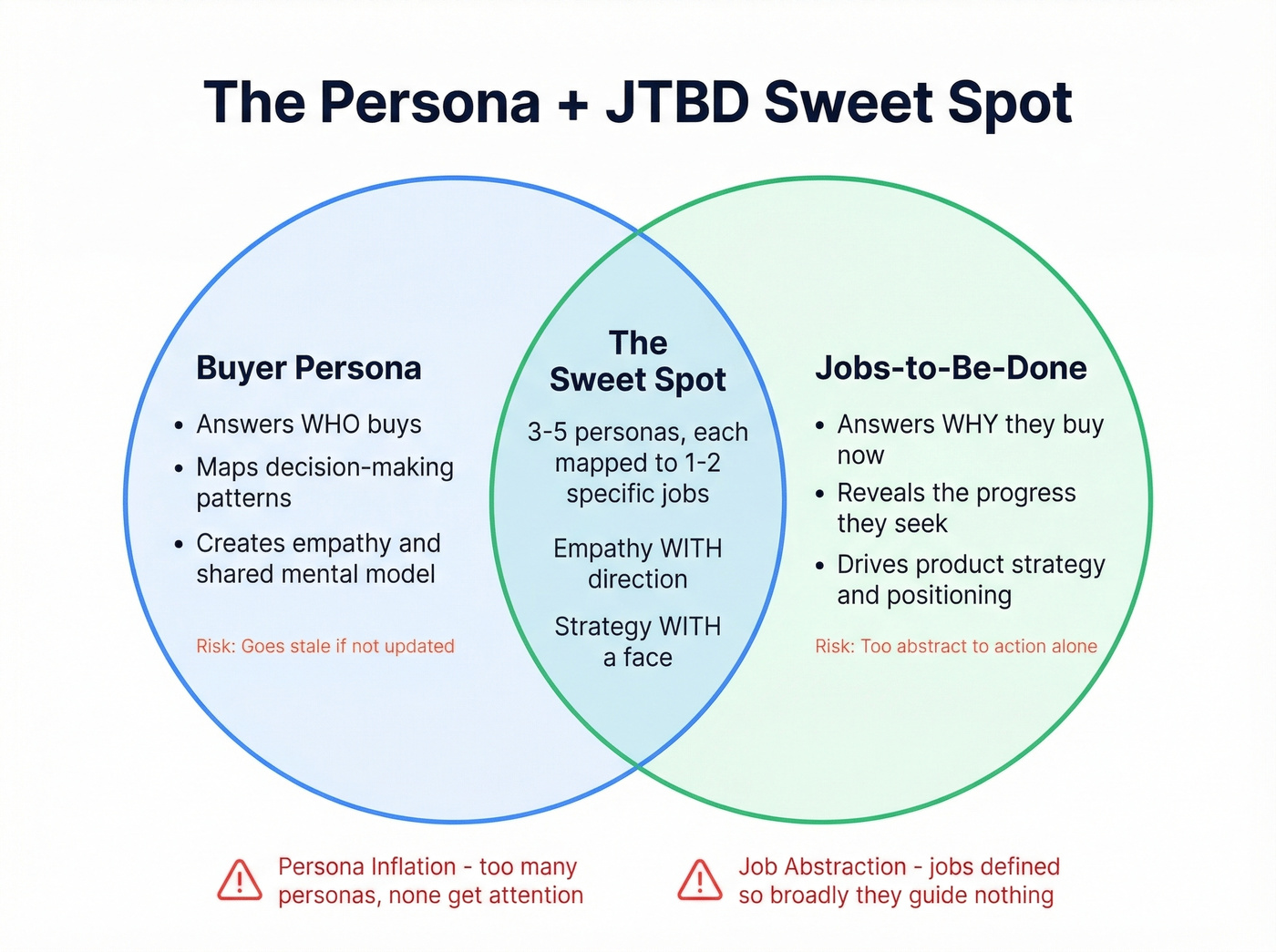
The Jobs-to-Be-Done framework, popularized by Clayton Christensen, focuses on the why behind a purchase. What progress is the buyer trying to make? What circumstance triggered the search? Personas, by contrast, focus on the who - the role, the context, the decision-making patterns.
| Framework | Answers | Strengths | Weaknesses | Best For |
|---|---|---|---|---|
| Buyer Persona | Who buys, how they decide | Empathy, shared mental model | Can go stale; demo-heavy | Messaging, content, enablement |
| JTBD | Why they buy, what progress they seek | Causal clarity, innovation focus | Abstract; hard to action alone | Product strategy, positioning |
The smartest teams pair them. A persona without JTBD produces empathy without direction - you know who the buyer is but not why they're buying now. JTBD without a persona produces strategy without a face - you know the job but can't picture who's hiring you to do it.
Two warnings from practitioners who've tried the hybrid approach: watch for "persona inflation" (creating so many personas that none get adequate attention) and "job abstraction" (defining jobs so broadly they don't guide actual decisions). Three to five personas, each mapped to one or two specific jobs - that's the sweet spot.
Fields That Actually Matter
Forget "favorite social media platform." Forget hobbies. Here's what belongs in a B2B persona, adapted from Revella's 5 Rings of Buying Insight:
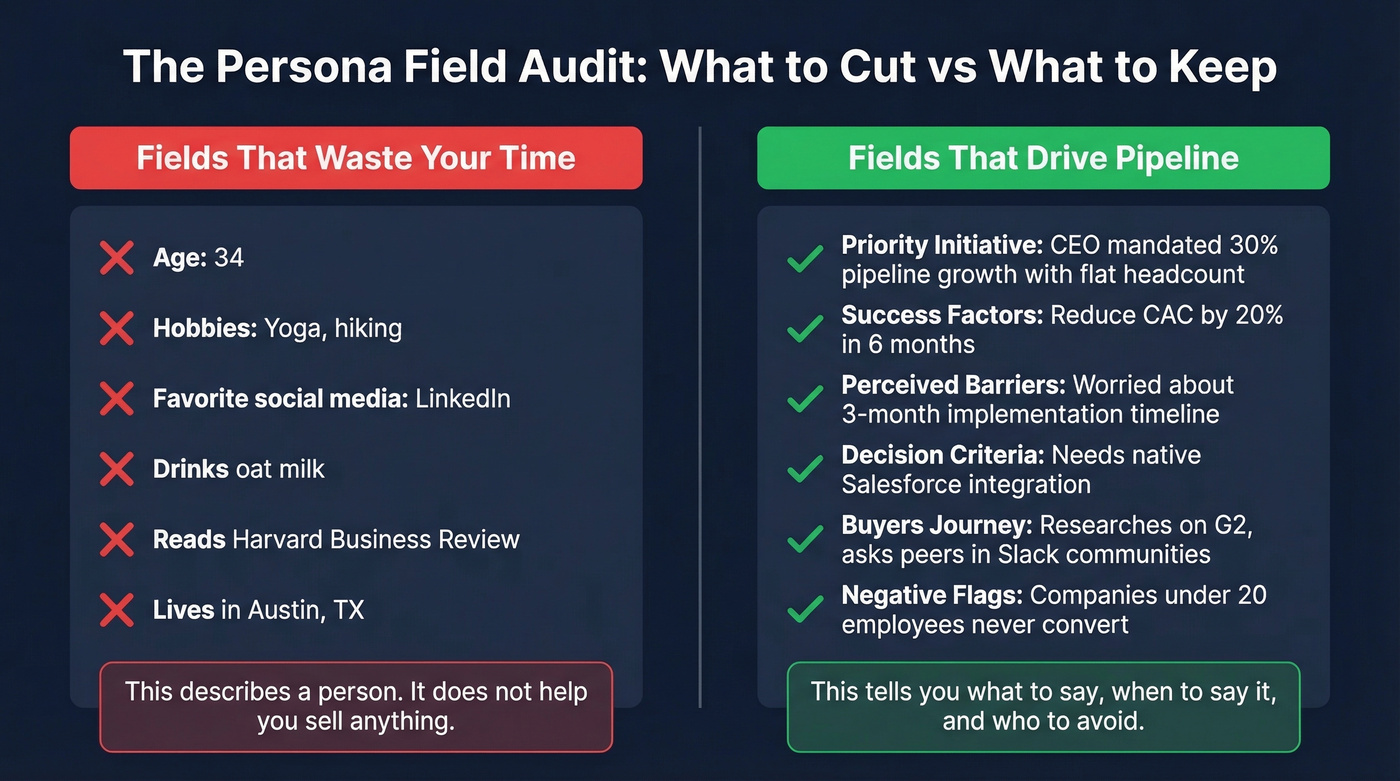
- Priority Initiatives: What triggered this buyer to start evaluating solutions now? A new mandate from leadership? A failed tool? A growth target they can't hit with current resources? (If you want to operationalize triggers, see how to track sales triggers.)
- Success Factors: What does "winning" look like for this buyer? Not your product's features - their expected outcomes.
- Perceived Barriers: What fears, concerns, or past experiences make them hesitate? What keeps them stuck on the status quo?
- Decision Criteria: What specific capabilities do they evaluate? What's on their scorecard when comparing vendors?
- Buyer's Journey: How do they research, evaluate, and decide? Who else gets involved? What content do they consume, and when?
- Negative Persona Flags: Who do you explicitly not want? Students, competitors, discount-only shoppers, companies outside your serviceable market. Defining who's out saves your team from wasting cycles on leads that'll never close.
The difference between "VP of Marketing, 38, lives in Austin" and "VP of Marketing evaluating marketing automation because their CEO just mandated 30% pipeline growth with flat headcount" is the difference between a persona that collects dust and one that shapes your next campaign.

Great personas without real contact data are just art projects. Prospeo turns your buyer personas into actionable prospect lists with 30+ filters - job title, buyer intent, technographics, headcount growth - across 300M+ verified profiles. 98% email accuracy means your outreach actually lands.
Stop describing your persona. Start reaching them.
How to Create a Buyer Persona in 5 Steps
Step 1 - Mine Internal Data First
Start with the people who talk to buyers every day. Interview your sales reps, CS managers, and account managers. Ask them what questions prospects always ask, what objections come up in every deal, and what makes a customer stay or churn. Then pull CRM data: win/loss reasons, deal cycle length by segment, common objections logged in notes. If your CRM is messy, start by tightening your contact management basics.
Step 2 - Interview 10-15 Real Buyers
This is the step most teams skip, and it's the one that matters most. Analytics tell you what buyers did. Interviews tell you why.
Recruit recent buyers - both won and lost deals. Lost deals are often especially valuable because those buyers will tell you exactly where your pitch fell apart. Don't interview your sales team or your CEO as proxies. They'll tell you what they think buyers care about, which is usually wrong.
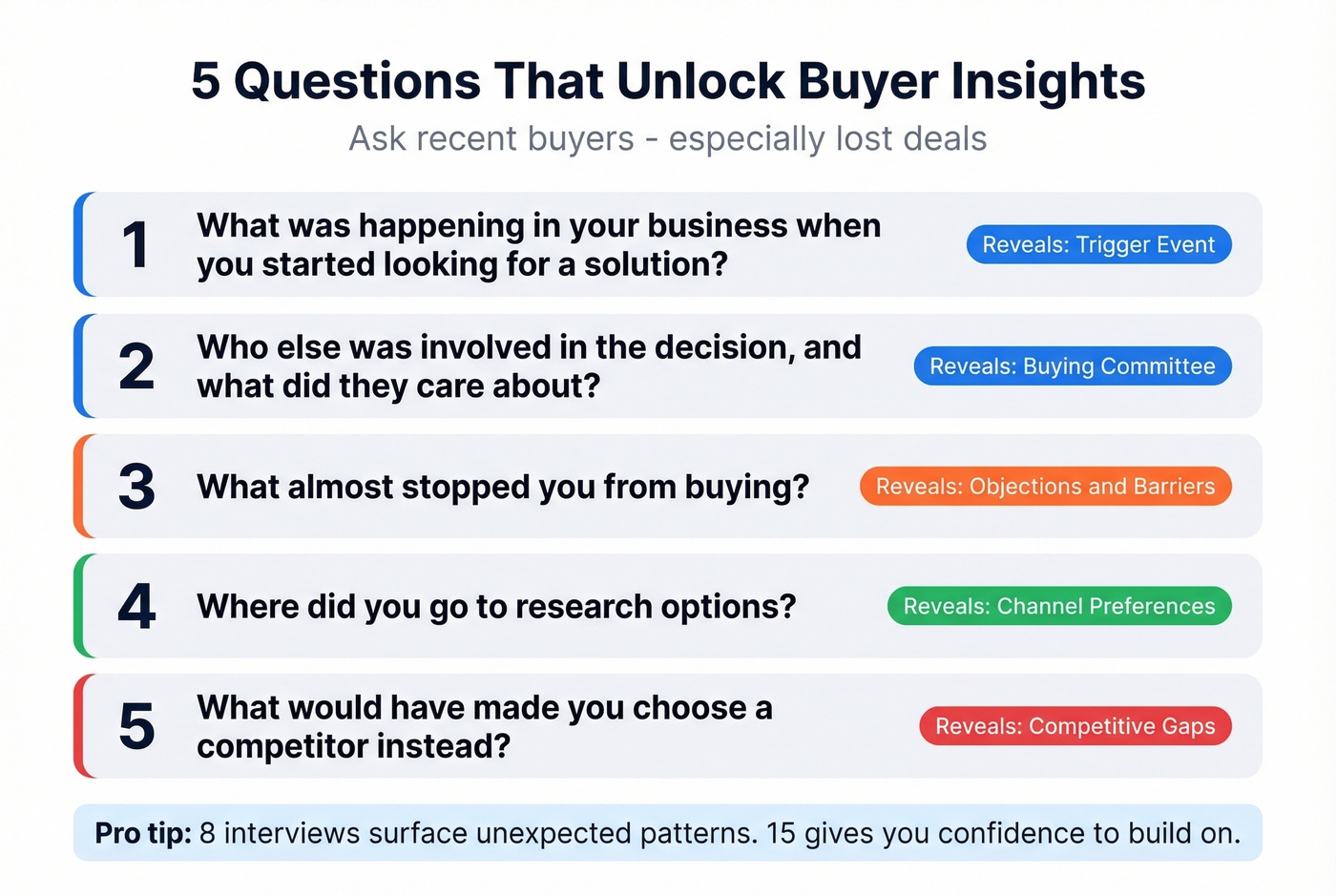
We've found that even 8 interviews surface patterns you didn't expect. Fifteen gives you enough confidence to build on. Five questions that consistently produce the best insights:
- "What was happening in your business when you started looking for a solution?"
- "Who else was involved in the decision, and what did they care about?"
- "What almost stopped you from buying?"
- "Where did you go to research options?"
- "What would have made you choose a competitor instead?"
HubSpot's full question bank is a solid starting template if you want more.
Step 3 - Spot the Patterns
Cluster interview responses by recurring themes, not by demographics. You're looking for shared triggers ("our old tool couldn't scale past 50 users"), shared objections ("we were worried about implementation time"), and shared decision criteria ("we needed native Salesforce integration"). When three or four buyers independently mention the same concern, that's a persona-defining insight.
Step 4 - Build 3-5 Personas
Use the decision-focused template from the section above. Give each persona a name and role, but spend 80% of the space on buying insights, not biographical details. Most companies need between three and five. If two personas buy for the same reasons, they're the same persona. Consolidate ruthlessly.
Don't forget to build at least one negative persona - the buyer archetype you explicitly want to exclude. This saves marketing from generating leads that sales will never close and keeps your cost-per-opportunity honest.
Step 5 - Activate and Validate
A persona that lives in a Google Doc nobody opens is worthless. Map each persona to specific content pieces, email sequences, and sales talk tracks. Share them with sales in a format they'll actually reference - a one-page cheat sheet beats a 20-slide deck every time. (If you need a starting point for sales messaging, use sales battle cards.)
Then validate against real data. Enrich your CRM contacts with tools that return 50+ data points per record so you can backfill key firmographic and stack-related fields that either confirm or challenge your persona assumptions. Set a quarterly refresh cadence. Markets shift, buying committees change, and a persona that was accurate in Q1 can mislead you by Q3. If you're evaluating vendors, start with these data enrichment services.
Buyer Persona Examples
B2B SaaS - User, Supervisor, Executive
For most B2B SaaS companies, you can cover the entire buying committee with three personas. We've seen this framework work for SaaS companies from 20 to 2,000 employees.
The User is the day-to-day person who'll actually live in your product. They're your internal advocate - or your biggest blocker if the tool makes their life harder. They care about ease of use, workflow fit, and whether it'll actually save them time or just add another tab to their browser.
The Supervisor is the manager who owns the budget and the decision. They care about ROI, team productivity, and how this fits into their existing stack. This is who your ROI calculators, buyer's guides, and case studies should target.
The Executive is the sponsor who signs off - and the layer where Legal, IT, and Finance can kill the deal. They care about risk, compliance, and strategic alignment. Your job is to equip the Supervisor to sell the Executive internally.
Here's a filled-out Supervisor example using decision-focused fields:
- Role: VP of Marketing, 50-200 employee SaaS company
- Priority Initiative: CEO mandated 40% pipeline growth; current tools can't scale outbound
- Success Factors: More qualified meetings booked per rep per week; shorter ramp time for new hires
- Perceived Barriers: "We tried a data tool before and the bounce rates killed our domain reputation" (If this is happening, fix your email bounce rate first.)
- Decision Criteria: Email accuracy above 95%, native CRM integration, no annual lock-in
- Buyer's Journey: Reads G2 reviews, asks peers in Slack communities, runs a 2-week trial with 3 reps before committing
B2C - A Quick Contrast
B2C personas lean harder on demographics because purchase decisions are more individual. A D2C skincare brand's persona around "Emma, 28, urban professional, spends $120/mo on skincare, follows dermatologists on Instagram, triggered to buy by seasonal skin changes" - that demographic detail is actually useful there because it drives channel selection and creative. Skip this approach for B2B. The fields that matter are fundamentally different.
Five Mistakes That Kill Personas
1. Building fairytale personas. Personas built by marketers who don't talk to customers become fiction. The fix: commit to 10-15 interviews before you build or refresh anything.
2. Creating too many. Ten personas means none of them get adequate content, messaging, or sales enablement. Consolidate to 3-5. If two personas buy for the same reasons, they're the same persona.
3. Stuffing in demographics, skipping decisions. Knowing your buyer is 38 and lives in Denver tells you nothing about how to win the deal. Use the 5 Rings framework. Every field should help you write a better email or build a better deck.
4. Building the aspirational persona instead of the actual buyer. This one's sneaky. Teams build personas around the buyer they wish they had - enterprise VPs with unlimited budgets - instead of the buyer who actually shows up. Base every persona on interviews with people who recently bought (or didn't buy) your product, not on your ideal customer fantasy.
5. Never updating. A persona built two years ago reflects a different market. Buyers' priorities, objections, and information sources shift constantly. Quarterly reviews fed by fresh interview data and CRM analysis are non-negotiable. And if sales and CS never see the personas, you've built an internal artifact, not a go-to-market tool - so build persona cheat sheets for sales, include them in onboarding, and reference them in deal reviews.
Turn Your Persona Into a Prospect List
Most persona guides stop at the template. But you've built a beautiful, decision-focused persona - now you need to find 500 real people who match it.
Map your persona's attributes directly to B2B data filters. Your Supervisor persona - VP of Marketing at 50-200 employee SaaS companies evaluating marketing automation - translates into searchable criteria: job title, company size, industry, tech stack, and buying intent signals. Tools like Prospeo let you layer intent data across 15,000 topics on top of firmographic and technographic filters, so you're finding prospects actively researching the problems your persona cares about - not just people who match a job title. For more ways to source lists, see these sales prospecting techniques.

The resulting list isn't theoretical. Verify contact information before outreach and you turn a static archetype into a live, reachable list you can work this week. If you're building lists at scale, a structured lead generation workflow helps keep it repeatable.
You've mapped the triggers, objections, and decision criteria. Now you need the direct line. Prospeo gives you 125M+ verified mobile numbers and 143M+ verified emails - refreshed every 7 days so your persona data never goes stale, just like your personas shouldn't.
Turn living personas into live conversations for $0.01 per email.
AI Tools for Building Personas
A few tools can accelerate persona creation - though none replace actual buyer interviews.
| Tool | Price (early 2026) | Best For | Key Feature |
|---|---|---|---|
| HubSpot Make My Persona | Free | First-time builders | Guided wizard with shareable output |
| UXPressia | ~$15-30/mo | Team workshops | Visual builder with stakeholder sharing |
| Delve AI | Free tier; paid ~$100/mo+ | Data-driven validation | Google Analytics integration for behavior-based personas |
Never built a persona before? Start with HubSpot's free tool. It walks you through every field and gives you something shareable within 30 minutes. It's limited in depth, but it forces the right conversations.
Need to workshop personas with your team? UXPressia earns its price with a visual, collaborative canvas that produces polished outputs for stakeholder presentations. It's the tool you want when the persona needs to survive a leadership review.
Want to validate personas against real behavior? Delve AI is the most interesting option here. It pulls from your Google Analytics data to generate personas based on actual site visitor patterns. The free tier is limited to one persona, but that's enough to gut-check whether your interview-based persona matches your real traffic. Paid plans unlock multiple personas and deeper segmentation.
The selection criteria that matter: does the tool accept inputs beyond demographics - motivations, objections, triggers? Does it support collaboration? Can it pull from real data sources, or is it just a fancy form?
Buyer Persona FAQ
How many buyer personas do I need?
Three to five for most companies. More than seven means you're slicing too thin and none will get adequate attention. B2B SaaS teams can start with the User/Supervisor/Executive framework and expand only if interviews reveal genuinely distinct buying patterns.
How often should I update them?
Quarterly at minimum. Trigger-based updates matter too - when you enter a new market, launch a new product, or see conversion patterns shift unexpectedly, that's a signal your personas need a refresh before the next scheduled review.
What's the difference between a buyer persona and an ICP?
An ICP defines the ideal company - firmographics like industry, size, revenue, and tech stack. A buyer persona models the ideal person within that company - their role, decision process, triggers, and objections. The ICP tells you where to fish; the persona tells you what bait to use.
Can I use AI to create a buyer persona?
AI tools can draft a solid starting point and structure your research, but personas built entirely from prompts without real interviews are fairytale personas - plausible-sounding and functionally useless. Use AI to synthesize and format. Use interviews to generate the actual insights.
How do I find prospects who match my persona?
Map your persona's attributes - job title, industry, company size, buying triggers - to a B2B data platform's search filters. Layer intent data on top of firmographic and technographic filters so you find prospects actively researching the problems your persona cares about. Verify contact information before outreach and turn a static archetype into a live, reachable list you can work this week.