

How to Identify Buyer Persona Pain Points That Actually Drive Revenue
Your CMO asks why the last campaign underperformed. You pull up the persona doc - 18 months old, built from one workshop. The buyer persona pain points section says "wants to save time and money." That's not a pain point. That's a platitude. And it's why your messaging sounds like everyone else's.
Why Most Personas Fail
Only 44% of B2B marketers actually use buyer personas. The rest tried, got burned, and moved on. The reason is always the same: teams build demographics-first documents that read like dating profiles for fictional people. Practitioners on r/b2bmarketing call these "fairytale personas" - and they're right.
We've watched companies pay agencies $30-40k to run a few interviews and still deliver slide-deck stereotypes. If your persona has a favorite coffee order but no documented pain points, it's fiction. The fix isn't better templates. It's starting with pain.
What Are Pain Points in a Buyer Persona?
Buyer persona pain points are specific, recurring problems your prospect experiences that your product can solve. Not goals ("grow revenue"). Not demographics. Not vague frustrations. Concrete blockers - the thing making someone's job harder than it should be.
Starting with pain instead of demographics changes everything. 82% of companies using buyer personas improved their value proposition, but only when those personas were built around real problems rather than invented archetypes.
A Better Pain Point Framework
Most articles give you the standard four buckets:
| Category | What It Covers | B2B Example |
|---|---|---|
| Financial | Budget, ROI, waste | "We're paying for 3 tools that overlap" |
| Process | Workflow, friction | "Handoffs between SDR and AE lose context" |
| Support | Service, responsiveness | "Our vendor takes 48 hrs to respond" |
| Product | Fit, features, usability gaps | "It doesn't integrate with our CRM, so reps work in spreadsheets" |
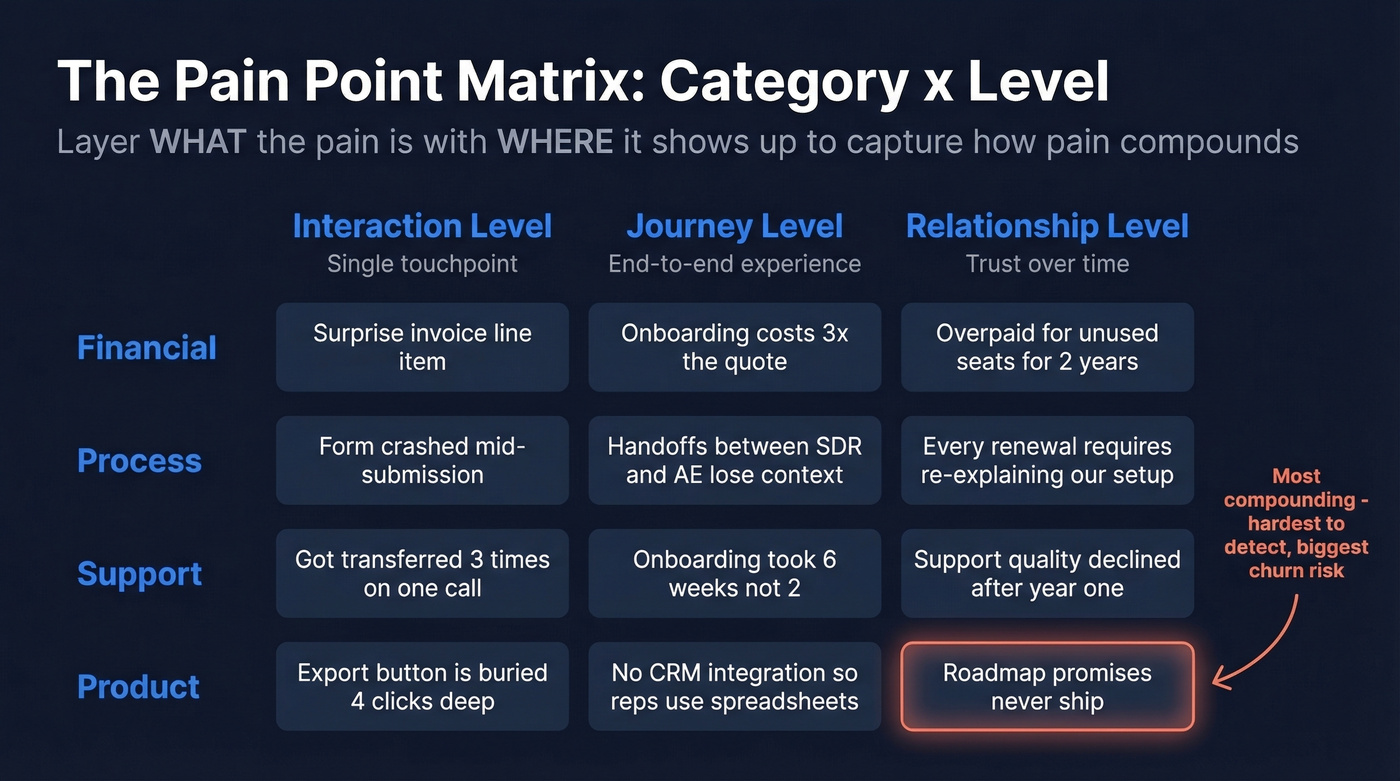
This model still misses an important dimension: where the pain shows up.
NN/g's three-level taxonomy adds the depth most teams skip. Interaction-level pain hits a single touchpoint ("I got transferred three times"). Journey-level pain breaks the end-to-end experience ("Onboarding took 6 weeks, not 2"). Relationship-level pain erodes trust over time ("We've overpaid for 2 years and nobody noticed").
Layer these levels on top of the four categories and you capture how pain compounds. A financial frustration at the relationship level - say, realizing you've been paying for unused seats for two years - hits very differently than a one-time billing error at the interaction level.
How to Discover Real Pain Points
Stop building personas in workshops. A 2-hour meeting produces stereotypes, not insight. In our experience, if your persona wasn't built from real conversations, it's a guess in a PowerPoint.
If you want a repeatable system, treat this like a lead generation workflow: consistent inputs, consistent outputs.
Build a negative persona too - knowing who you're not selling to prevents wasted outreach and keeps your team focused.
Here's what actually works:
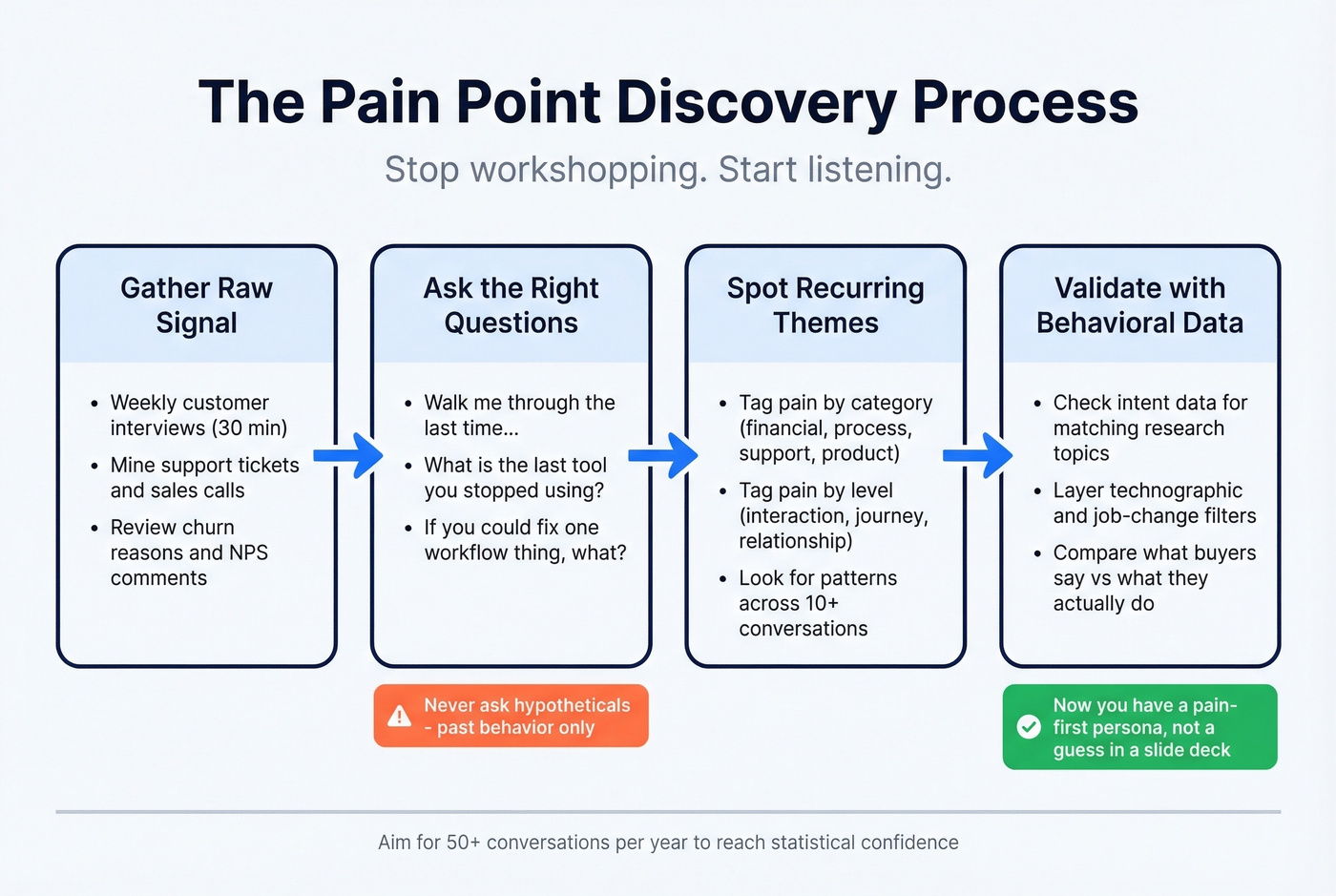
Run weekly customer interviews. Even 30 minutes a week gives you roughly 50 conversations a year, which is enough to spot recurring pain themes. Bring engineers and leadership to "watch parties" so the whole team hears it firsthand.
Ask about past behavior, not hypotheticals. "Walk me through the last time you evaluated a new vendor" beats "Would you use a tool that does X?" every time. Past behavior doesn't lie. Mine support tickets and sales calls too - your CX team already knows the top complaints.
Use discovery questions that invite specifics. "What was the greatest struggle during the buying process?" or "What's the last tool you stopped using, and why?" or "If you could fix one thing about your current workflow, what would it be?" These surface the real blockers that generic discovery calls miss. (If you need a tighter list, start with these discovery questions.)
Intent data also helps validate what you're hearing. If interviews keep surfacing "compliance risk" as a pain point, you can check whether prospects are actually researching compliance solutions - tools like Prospeo's intent data track 15,000 topics via Bombora, so you can see if the signal matches the story.

You just read about validating pain points with intent data. Prospeo tracks 15,000 intent topics via Bombora - so you can confirm whether prospects are actually researching the problems your interviews surface. Layer that with 30+ filters for job role, headcount growth, and technographics to build persona-accurate prospect lists, not fictional ones.
Stop guessing which accounts feel the pain. See the signal.
Pain Points vs. Jobs to Be Done
JTBD asks "What is the customer trying to accomplish?" Personas ask "Who is the customer?" These aren't competing frameworks - they're complementary. The JTBD statement format makes this concrete: "When [situation], I want to [motivation], so I can [desired outcome]."
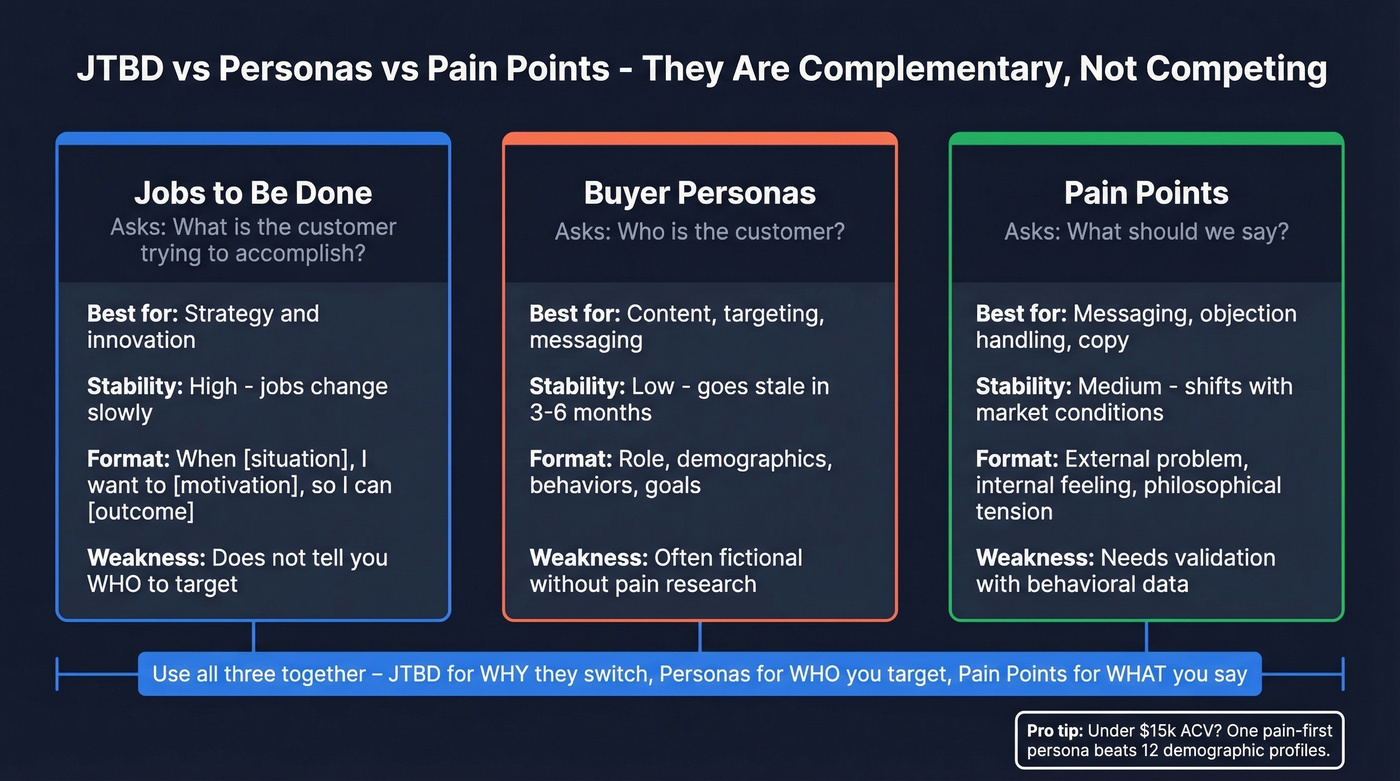
JTBD is more stable over time; jobs change slowly while personas go stale. It's better for strategy and innovation. Personas are better for execution - content, targeting, messaging. Pain points bridge the two. Use JTBD to understand why people switch. Use personas to know who you're talking to. Use pain points to know what to say.
Here's the thing: if you're selling a product under $15k ACV, you probably don't need a 12-persona framework. One well-researched, pain-first persona will outperform a dozen demographic profiles every single time.
A Pain-First Persona Example
Here's what a useful persona looks like when you lead with pain:
Role: VP of Sales, B2B SaaS (50-200 employees, Series B)
Pain Point 1 - Reps waste hours per day on manual prospecting. External: Pipeline coverage is too low. Internal: Feels like they're failing when reps miss quota. Philosophical: "My team should be selling, not doing data entry." (If this is your reality, start with proven sales prospecting techniques.)
Pain Point 2 - Contact data bounces at double-digit rates. External: Sequences underperform; domain reputation degrades. Internal: Anxiety about pipeline numbers they don't trust. Philosophical: "Paid data should work." (This is also an email bounce rate problem, not just a copy problem.)
Pain Point 3 - No visibility into which accounts are in-market. External: Team sprays outbound across cold accounts. Internal: Frustration that competitors reach buyers first. Philosophical: "We should be smarter than this." This is where identifying buying signals matters.
JTBD: "When pipeline coverage drops, I want to give my reps accurate, prioritized prospect lists so I can hit the board's revenue target without adding headcount."
Turning Pain Points into Messaging
The StoryBrand challenge model makes pain points copy-ready. Every pain point has three layers: the external problem, the internal feeling, and the philosophical tension.
If you want to operationalize this across campaigns, it helps to treat it as B2B brand positioning, not just copywriting.
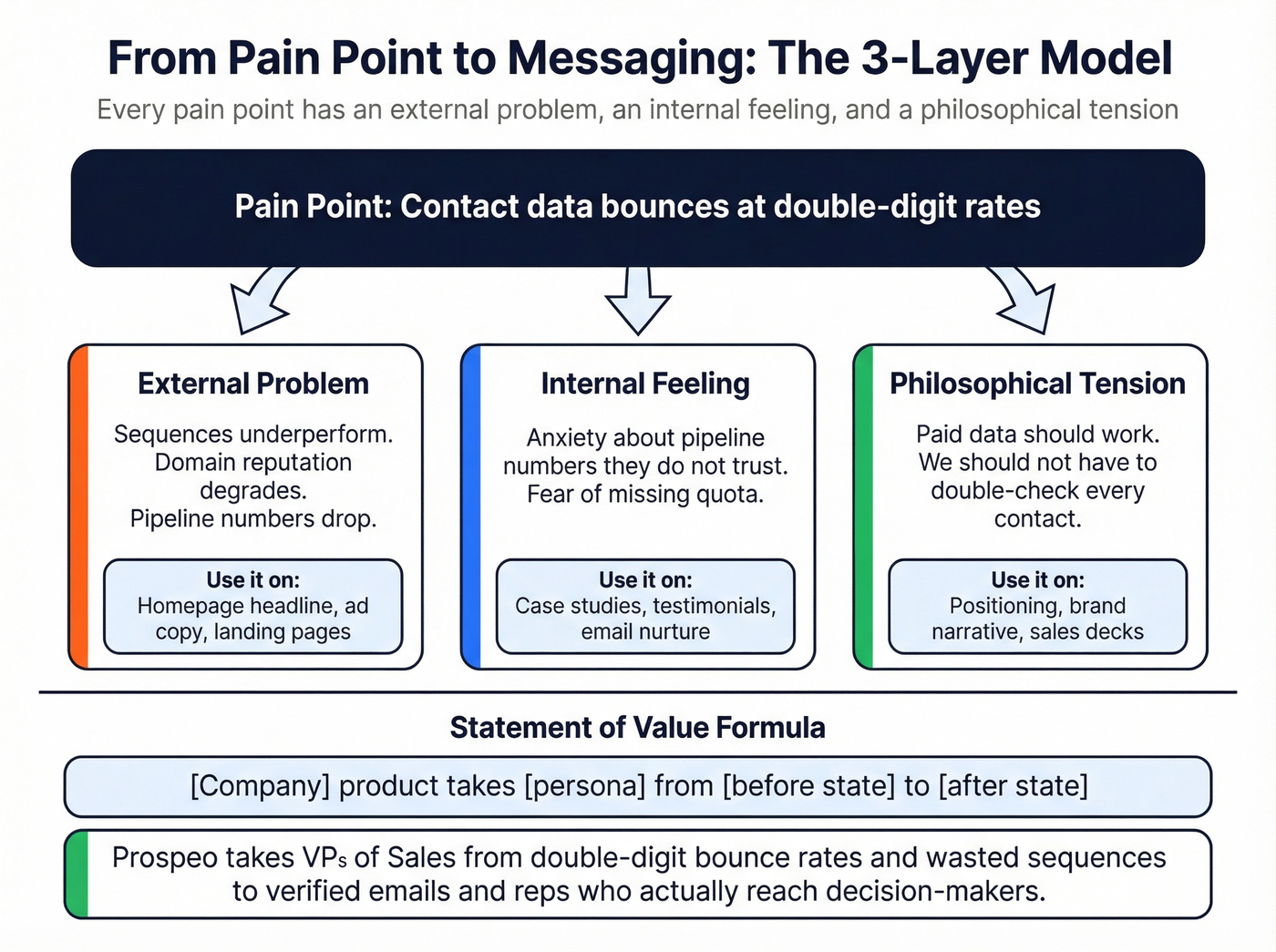
Look at pain point #2 from our persona. The external problem is bounced emails. The internal feeling is anxiety about pipeline numbers. The philosophical tension is "paid data should work." Your homepage headline addresses the external. Your case study addresses the internal. Your positioning addresses the philosophical.
Then apply the Statement of Value formula: "[Company]'s [product] takes [persona] from [before state] to [after state]." For our example: "Our platform takes VPs of Sales from double-digit bounce rates and wasted sequences to verified emails and reps who actually reach decision-makers." That's a sentence you can test on a landing page tomorrow.
Handling Objections Your Persona Surfaces
Well-documented pain points don't just fuel marketing - they prepare your sales team for pushback. When you map the objections your persona research surfaces, reps can anticipate resistance before a call even starts.
If your persona's top pain is "paid data should work," the predictable objection is "How is your data any different?" Pre-build talk tracks around each pain point so reps address the objection with proof, not platitudes. (A simple way to standardize this is with talk track examples.) We've seen teams cut their average sales cycle by weeks just by having pain-aligned objection responses ready before the first discovery call.
Validate with Behavioral Data
Every pain point in your persona doc is a hypothesis until you validate it with behavioral signals. Interviews tell you what people say. Intent data tells you what they actually do.
Let's say your persona research surfaces "compliance risk" as a top concern. You can filter for companies actively researching compliance solutions, then layer on technographic and job-change filters to build a live prospect list grounded in real buying behavior - not assumptions from a six-month-old slide deck. (This is essentially intent based segmentation applied to personas.)
Skip this step if you're selling to a tiny niche where you already know every buyer by name. For everyone else, behavioral validation is what separates a persona that drives pipeline from one that collects dust.
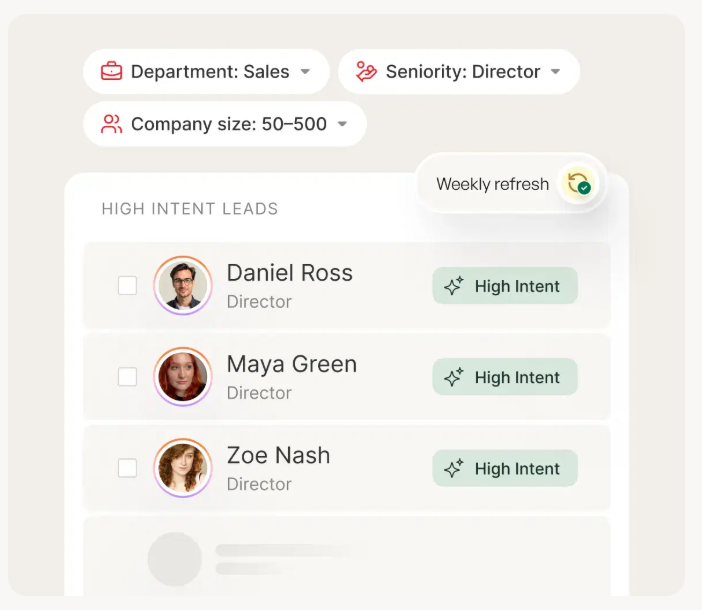
Pain point #2 in that persona example - double-digit bounce rates destroying domain reputation - is the exact problem 15,000+ companies solved with Prospeo. 98% email accuracy. 7-day data refresh. Under 4% bounce rates across customers like Snyk and Meritt. Your personas deserve data that actually works.
Paid data should work. At $0.01 per email, Prospeo's does.
FAQ
How many buyer personas should a B2B company have?
Two to three for most mid-market teams. If two personas share the same core pain points and buying triggers, merge them. Extra personas create content sprawl without improving targeting.
How often should you update persona pain points?
Quarterly at minimum. A persona you haven't refreshed in six months is already drifting toward fiction. Tie updates to your customer interview cadence - 10-12 conversations per quarter keeps pain points grounded in reality.
How do you validate persona pain points at scale?
Layer customer interviews with intent data. Interviews reveal what buyers say; intent signals show what they're actually researching. The gap between those two tells you which pain points are real and which are performative.
What questions best uncover pain points in sales calls?
Focus on past behavior rather than hypotheticals. "Walk me through the last time this problem cost you a deal" or "What made you start looking for a new solution?" force prospects to share real experiences instead of aspirational answers. Aim for 3-5 open-ended questions per discovery call.