


Clay vs Lusha: Which One Actually Delivers in 2026?
Your SDR burned through Lusha's monthly credits in two days. Now they're asking for an upgrade, and you're staring at a per-user price that scales faster than your pipeline. Meanwhile, someone on the RevOps team keeps saying "just use Clay" like it's a simple swap.
It's not. Comparing Clay vs Lusha is misleading from the start - one's a full kitchen, the other's a microwave.
30-Second Verdict
Pick Clay if you're a RevOps team building custom enrichment workflows and you can invest in setup time.
Pick Lusha if you're a solo rep who needs quick contact lookups from a Chrome extension and simplicity matters most.
Skip both if you just need verified emails and phones without a learning curve or credit shell game. Prospeo delivers 98% email accuracy at ~$0.01/lead with a free tier - no orchestration degree required.
What Each Tool Actually Does
Clay is a data orchestration platform. It doesn't own a contact database - it routes lookups through 150+ third-party providers in a "waterfall" sequence, layering enrichment, AI research agents, and workflow automation. Think of it as middleware between your data sources and your outreach stack.
If you want a deeper walkthrough of how teams do this in practice, see list building and lead enrichment.
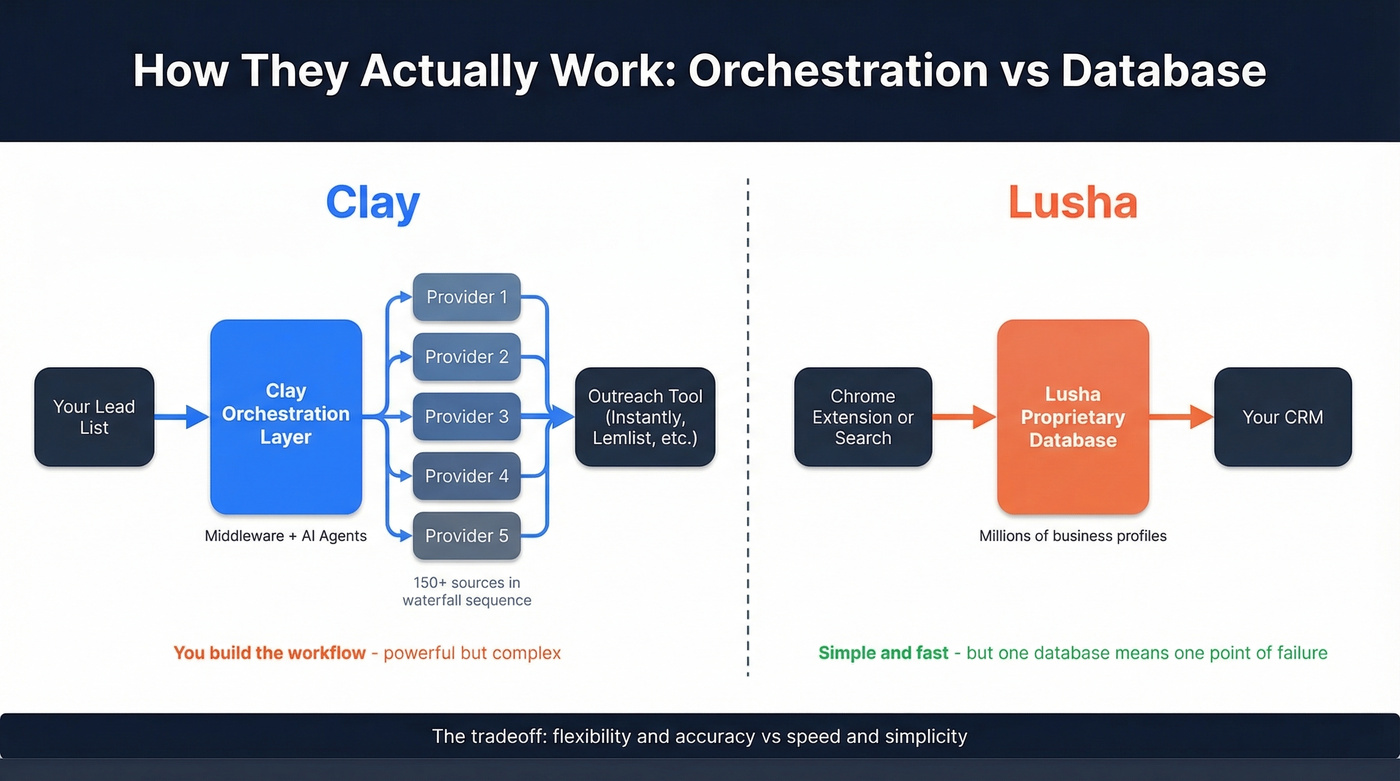
Lusha is a contact database with a Chrome extension. You search for a person, reveal their email or phone number, and push it to your CRM. It covers millions of business profiles, does one thing, and does it without a learning curve. The entire value proposition is speed and simplicity.
Pricing Breakdown
Here's where most comparison articles gloss over the math that actually matters.
If you're evaluating other options in the same category, start with data enrichment services and sales prospecting databases.
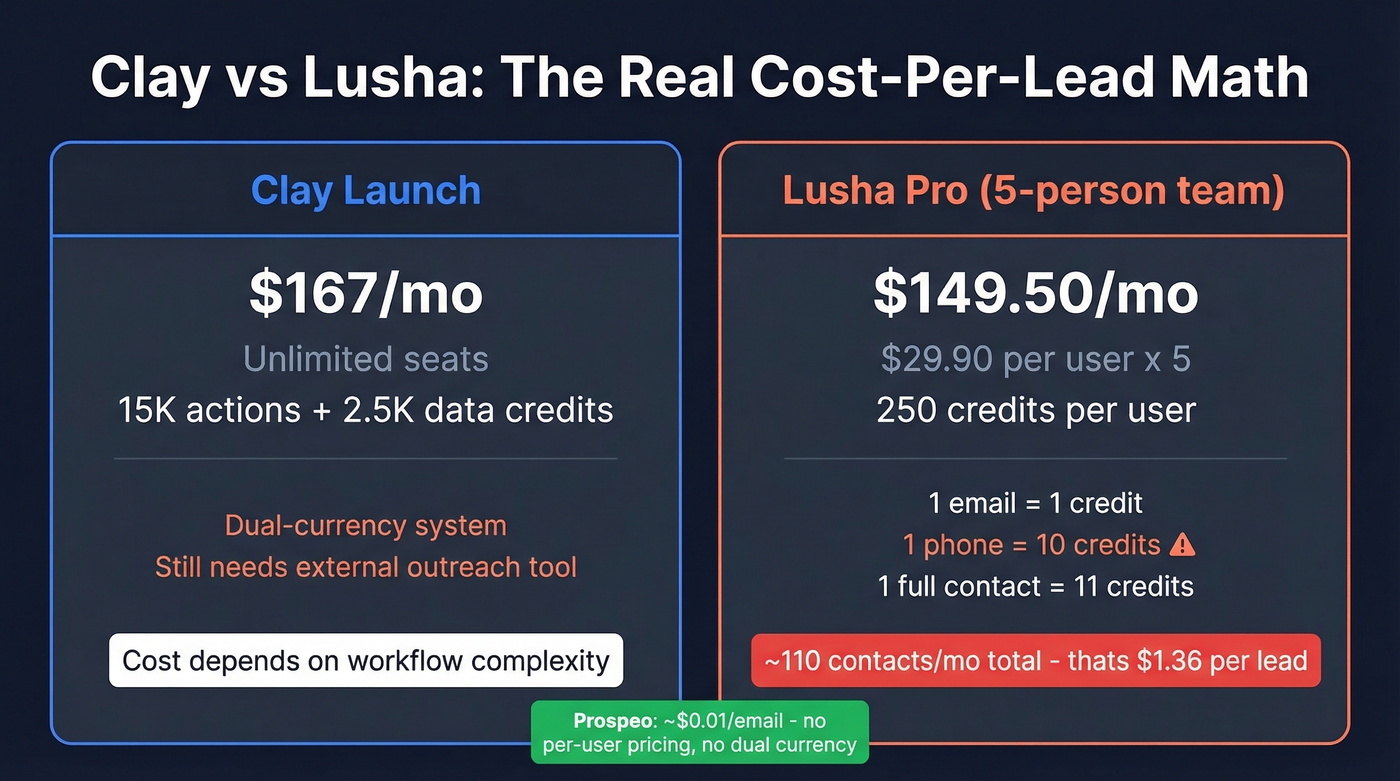
Clay tiers:
| Clay Free | Clay Launch | |
|---|---|---|
| Price | $0 | $167/mo |
| Credits | 500 actions + 100 data | 15K actions + 2.5K data |
| Seats | Unlimited | Unlimited |
| Key catch | Enrichment + orchestration each burn credits | Still needs an external outreach tool |
Lusha tiers:
| Lusha Free | Lusha Pro | Lusha Premium | |
|---|---|---|---|
| Price | $0 | $29.90/user/mo | $69.90/user/mo |
| Credits | Up to 70/month | 250 | 600 |
| Seats | 1 | Per user | Per user |
| Key catch | 70 credits = 7 phones | ~22 full contacts/mo | ~54 full contacts/mo |
Clay runs on a dual-currency model - Actions for orchestration steps, Data Credits for enrichment lookups.
Now the math nobody else does for Lusha. Revealing an email costs 1 credit. Revealing a phone number costs 10. On Pro ($29.90/user/month), you get 250 credits. If you're pulling both email and phone for each contact, that's 11 credits per lead - roughly 22 fully enriched contacts per month. A 5-person team on Lusha Pro pays $149.50/mo for about 110 complete contacts. That's $1.36 per lead before you've even sent an email.
Let's be honest: advertising "250 credits" when a single phone number eats 10 of them is marketing designed to obscure the real cost. Many teams also get hit with extra credit burn for exporting lists and pushing records into a CRM. Monthly plan credits roll over up to 2x your plan limit, but annual credits reset at cycle end - choose accordingly.

Data Accuracy & Bounce Rates
This is where the decision gets real. If bounce is already hurting you, use these benchmarks to sanity-check your numbers: email bounce rate and email deliverability guide.
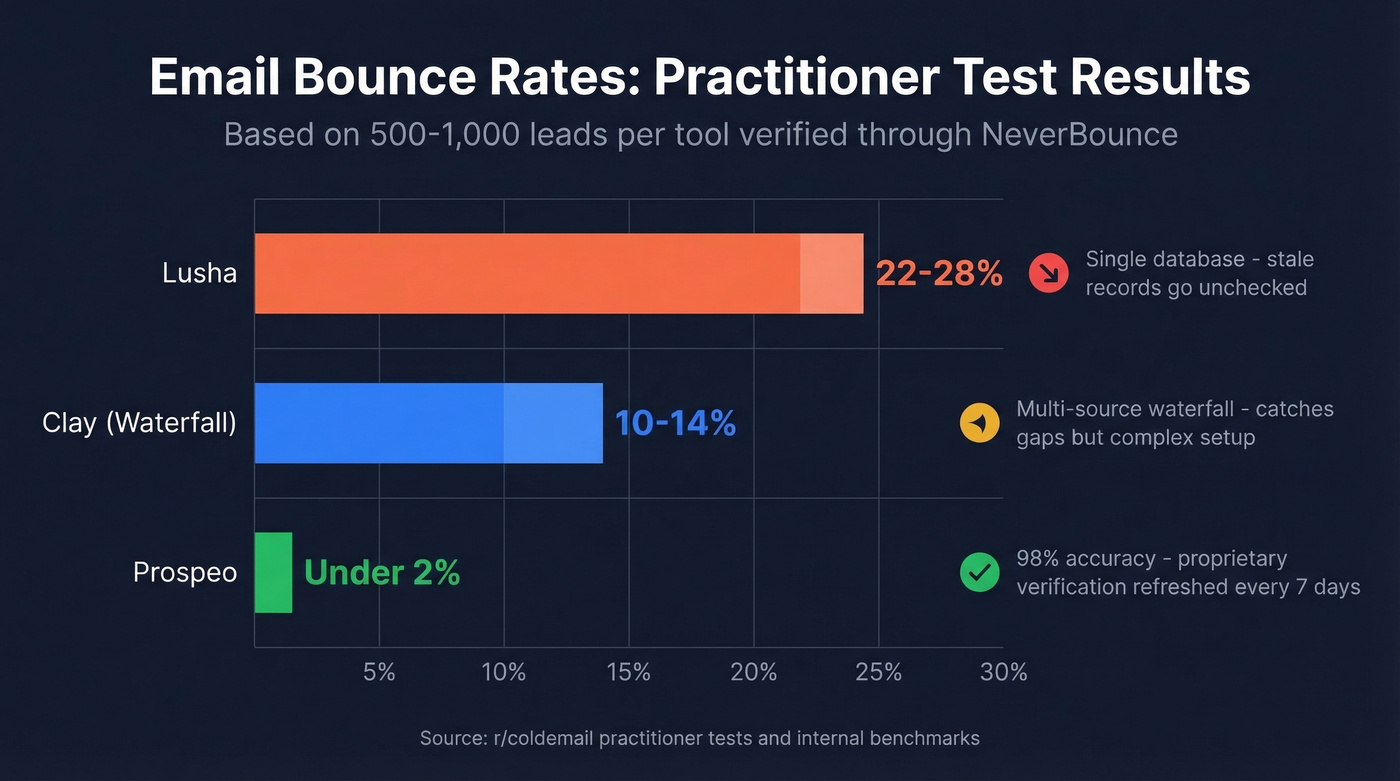
A practitioner test on r/coldemail ran 500-1,000 leads per tool through NeverBounce and then sent test campaigns. Lusha came in at 22-28% bounce. Clay's waterfall approach - stacking multiple providers sequentially - pulled that down to 10-14%. We've seen similar patterns in our own testing across enrichment tools, and the gap tracks with what you'd expect from a single-database product versus a multi-source waterfall.
That gap makes sense. Lusha relies on a single proprietary database. When that database has a stale record, you get a bounce. Clay's waterfall runs each lead through multiple providers, catching contacts that any single source would miss. Individual providers can vary wildly on coverage - some hit ~47% on the low end, others reach ~84% - and the waterfall stacks them to close gaps.
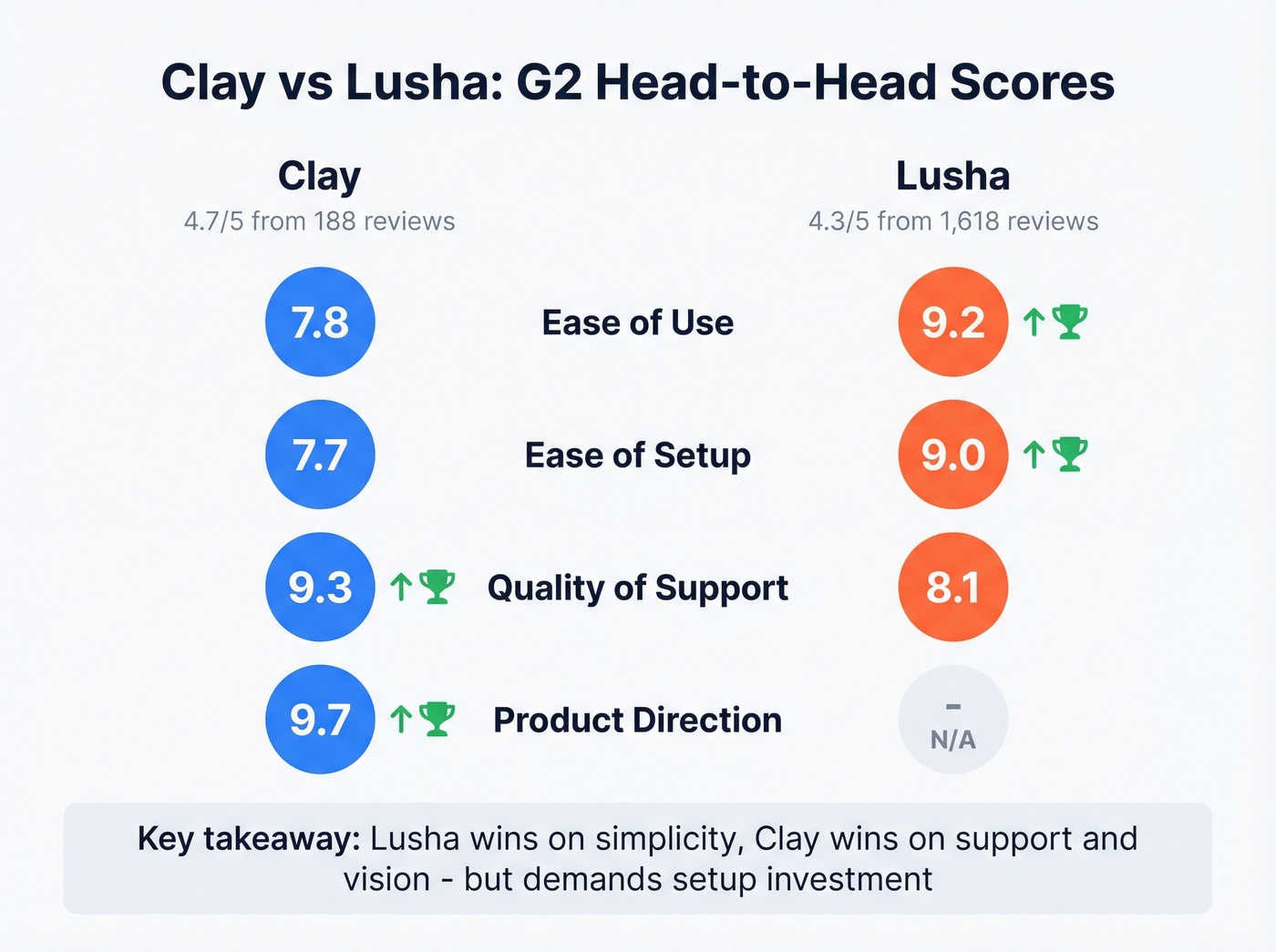
Clay holds a 4.7/5 on G2 from 188 reviews; Lusha sits at 4.3/5 from 1,618 reviews. In Lusha's review themes, "data accuracy" and "ease of use" are the top positives, but "outdated contacts" and "data inaccuracy" show up consistently in the negatives. Good enough most of the time - until it isn't.

Lusha bounces at 22-28%. Clay's waterfall gets you to 10-14% but demands a full-time ops person. Prospeo delivers 98% email accuracy from a proprietary verification pipeline - refreshed every 7 days, not 6 weeks.
Skip the credit shell game and the orchestration tax.
Ease of Use & Integrations
Use Lusha if you want zero ramp time. In G2's head-to-head comparison, Lusha scores 9.2 on ease of use versus Clay's 7.8, and 9.0 on ease of setup versus Clay's 7.7. Install the extension, start revealing contacts. Done.
Skip Lusha if you need reliable CRM sync. One recurring Reddit complaint: Lusha's HubSpot integration is buggy, with contact merges overriding deal ownership. If you're trying to prevent this kind of mess, it helps to standardize your contact management software and tighten your lead generation workflow.
Use Clay if you want power and can handle the learning curve. Clay scores 9.3 on quality of support versus Lusha's 8.1, and 9.7 on product direction. But Reddit threads regularly feature users asking "what's the point?" in their first week. Clay rewards investment - it just demands it upfront.
Here's the thing: Clay is overkill for 80% of sales teams. It also needs an external outreach tool (Instantly, Lemlist, Outreach) since it's an orchestration layer, not an all-in-one. If you don't have someone who genuinely enjoys building Zaps and debugging API calls, you'll never use half of what you're paying for. Skip it and save yourself the frustration.
Intent Data Compared
A Reddit user reported that Lusha's Bombora-powered intent search results didn't change over an entire month, with no timestamps indicating when signals were captured. Intent data without freshness is just noise. If you're building around signals, pair it with a real intent based segmentation approach.
When to Skip Both
One of our customers, Snyk, had 50 AEs prospecting 4-6 hours per week with bounce rates hitting 35-40%. After switching, their bounce rate dropped under 5% and AE-sourced pipeline jumped 180%. That's the kind of difference fresh, verified data makes at scale.
At $1.36/lead, Lusha's "250 credits" disappear before lunch. Prospeo runs ~$0.01/email with 125M+ verified mobiles - no per-user pricing, no dual-currency math, no annual lock-in.
Real pricing transparency for teams tired of doing credit arithmetic.
Final Verdict
Pick Clay if you're a RevOps team that can absorb the learning curve - the 10-14% bounce rates justify the complexity for high-volume operations with a dedicated ops person. (If you're hiring for this, the RevOps Manager role is usually the owner.)
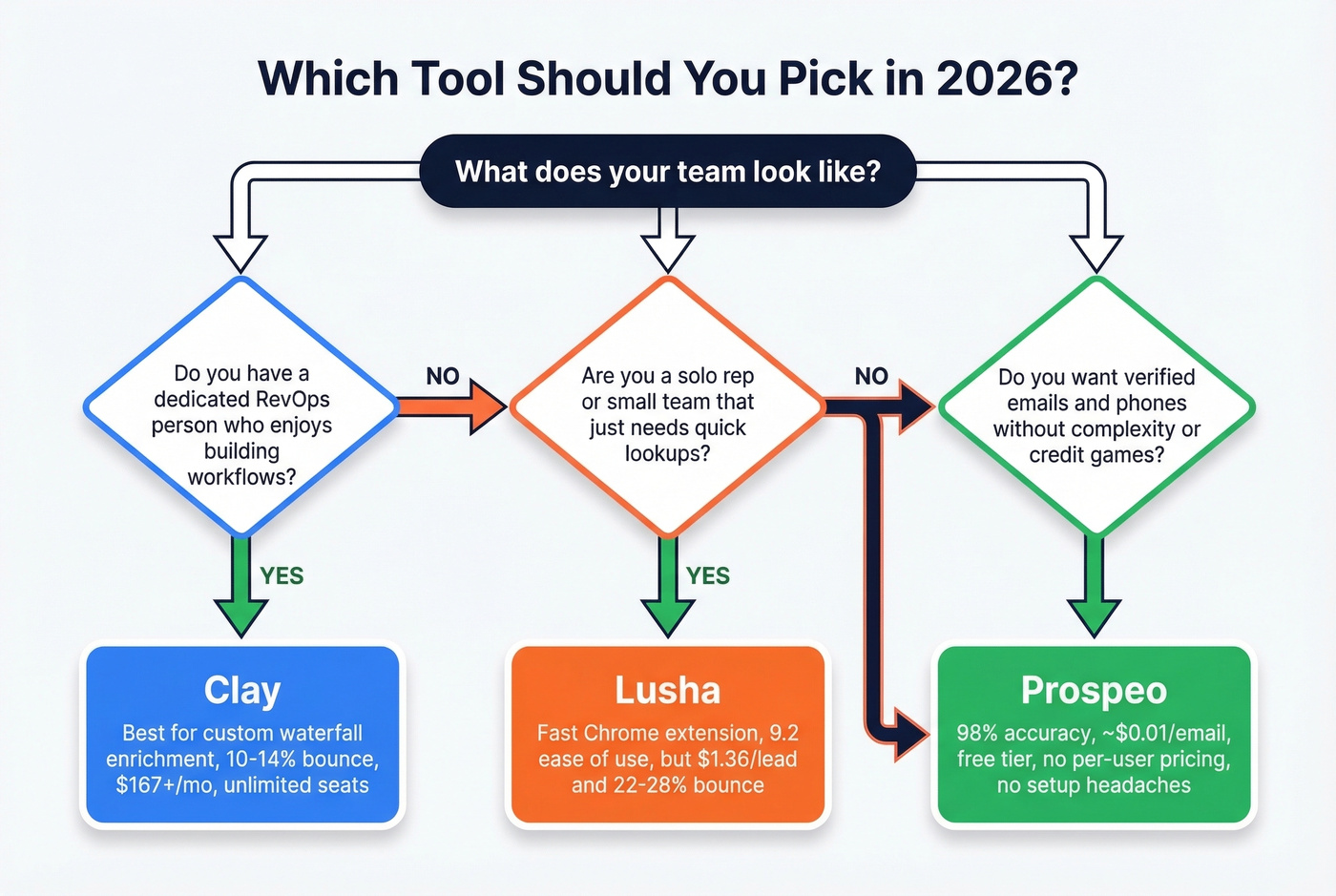
Pick Lusha if you're a solo rep or small team that values speed over depth - just budget for the credit burn and don't expect the "250 credits" to last the month.
For most sales teams weighing Clay vs Lusha in 2026, neither is the right starting point. Verified emails, fresh data, and transparent pricing without the complexity tax or the credit shell game - that's where we'd start.
FAQ
Is Clay or Lusha better for small sales teams?
Lusha is easier to adopt (9.2 ease of use vs. Clay's 7.8), but its credit burn on phone reveals makes it expensive fast - 250 Pro credits yield only ~22 fully enriched contacts per month. For teams under 10 reps, a free tier with 75 emails + 100 Chrome extension credits often covers early-stage prospecting without per-user fees.
Does Clay include its own contact data?
No. Clay routes lookups through 150+ third-party providers in a waterfall sequence. Your results depend entirely on which providers you select and how you sequence them - and each lookup burns data credits on top of action credits.
Why are Lusha bounce rates higher than Clay's?
Lusha relies on a single proprietary database, so stale records go unchecked. Clay's waterfall runs each lead through multiple providers sequentially, catching contacts any single source would miss. In practitioner tests, this cut bounce rates from 22-28% (Lusha) to 10-14% (Clay). The tradeoff is setup complexity and higher cost.