

Click to Open Ratio: What It Really Means in 2026 (And Why Every Benchmark Is Wrong)
If your click to open ratio is nowhere near the 20-30% that every email marketing guide calls "good," your emails probably aren't broken. The benchmarks are. They're built on pre-2021 assumptions - before Apple Mail Privacy Protection turned open tracking into a guessing game and before bot clicks started inflating your numerator. The real post-MPP median CTOR is 6.81%.
Let's unpack why, and what to do about it.
The Short Version
- The real post-MPP median CTOR is 6.81%, not the 20-30% every other guide cites.
- Apple MPP lifted unique open rate by ~25.7%, which pushed unique CTOR down by ~31.4%. Your emails didn't get worse - the denominator changed.
- Between 5% and 63% of your clicks are bots. Check for instant clicks and zero conversions before trusting your numbers.
- Use CTOR for A/B testing creative. Report conversion rate to your CMO.
What Is CTOR?
Click to open ratio measures how compelling your email content is after someone opens it. It isolates the body and CTA from the subject line by only counting people who actually opened.
The calculation is straightforward:
CTOR = (Unique Clicks / Unique Opens) x 100
A worked example: you send a campaign to 10,000 subscribers. 2,000 unique opens, 140 unique clicks. That's 140 / 2,000 x 100 = 7.0% CTOR. Solid by post-MPP standards, even though it would've looked terrible five years ago.
The metric is conceptually sound - it tells you whether the people who bothered to open found something worth clicking. The problem isn't the formula. It's what counts as an "open" in 2026. (If you want the companion metric, see our click rate formula breakdown.)
CTOR vs CTR
These two get confused constantly. Even Mailchimp's own definitions page muddles the terminology, describing click rate with phrasing that blurs the line between the two metrics. If major ESPs can't keep them straight, no wonder marketers struggle.
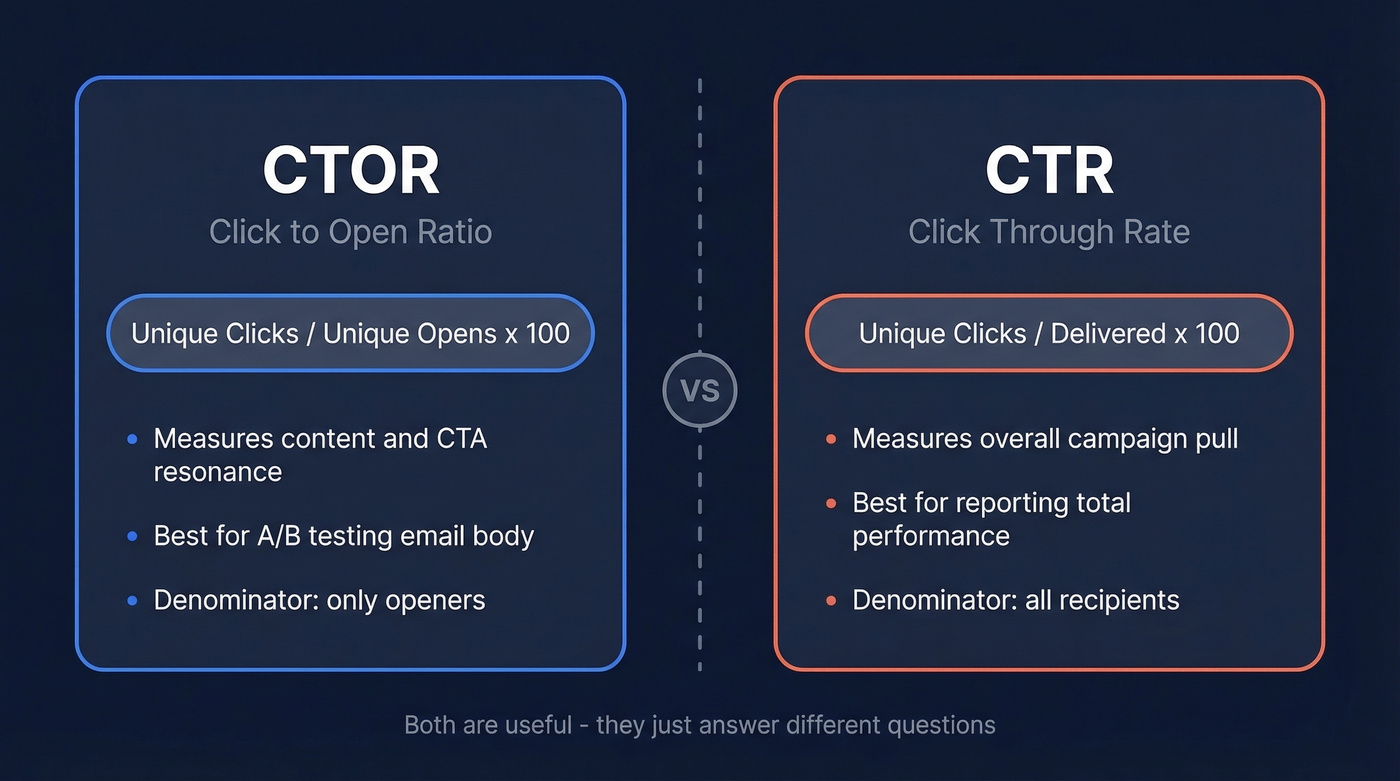
| CTOR | CTR | |
|---|---|---|
| Formula | Clicks / Opens x 100 | Clicks / Delivered x 100 |
| Measures | Content/CTA resonance | Overall campaign pull |
| Best for | A/B testing email body | Reporting total performance |
| Denominator | Only openers | All recipients |
CTR includes everyone - openers and non-openers alike. That means it's influenced by your subject line, send time, and deliverability. CTOR strips those variables out and focuses purely on what happened inside the email. Both are useful. They just answer different questions. (For subject line work, pull ideas from these email subject line examples.)
2026 CTOR Benchmarks
Most guides still cite 20-30% as "good." Here's what the data actually says.
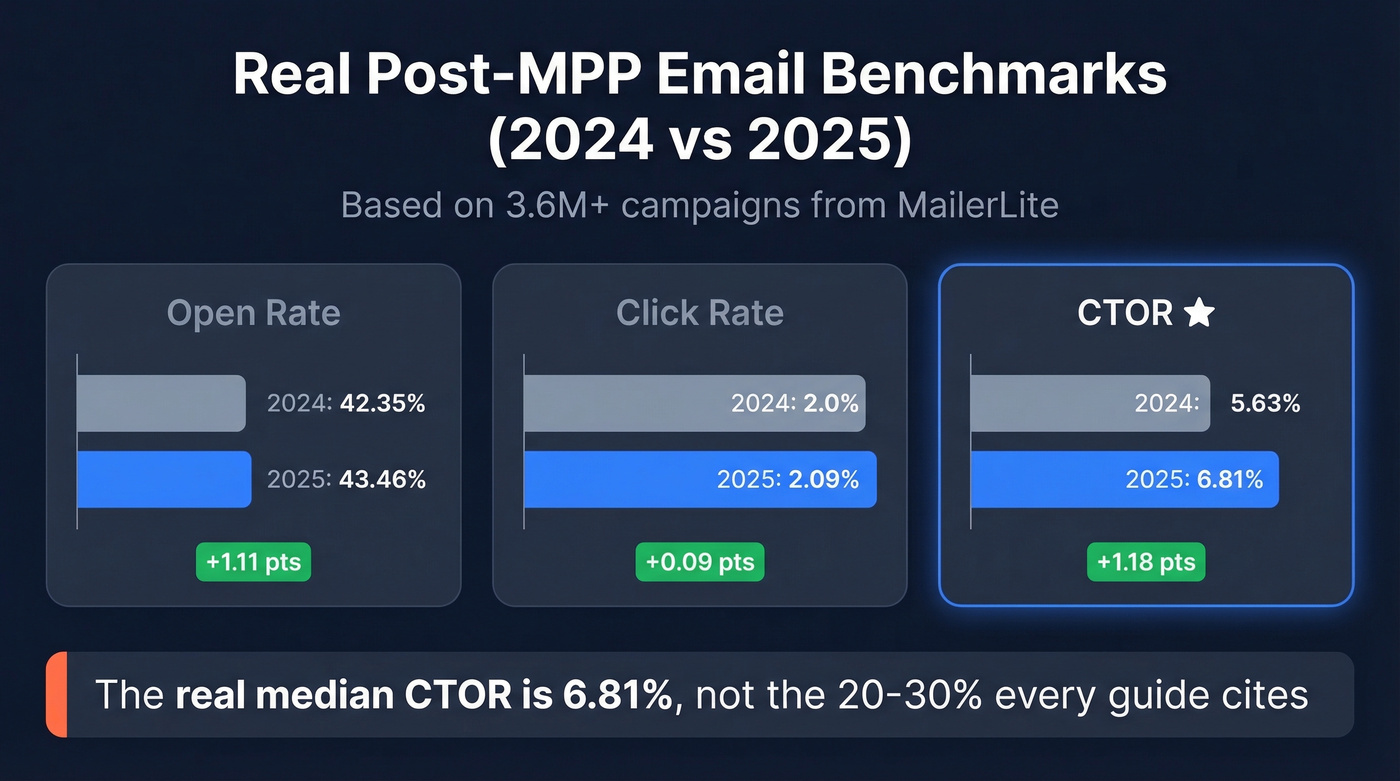
MailerLite's benchmark report analyzed over 3.6 million campaigns from 181,000 accounts. The numbers are medians, not averages, which makes them more resistant to outlier distortion.
| Metric | 2024 | 2025 | Change |
|---|---|---|---|
| Open rate | 42.35% | 43.46% | +1.11 pts |
| Click rate | 2.0% | 2.09% | +0.09 pts |
| CTOR | 5.63% | 6.81% | +1.18 pts |
That 6.81% is the real median in a post-MPP world. Brevo's benchmark report is based on 44 billion+ emails and explicitly accounts for Apple MPP in its methodology. Stripo's trend report places industry CTOR between 5.6% and 12% depending on vertical. Most industries cluster in the mid-single digits.
The year-over-year jump from 5.63% to 6.81% reflects better segmentation practices - and possibly bot clicks inflating the numerator. Which brings us to the two forces distorting every CTOR number you see. (If you’re sanity-checking opens too, compare against a standard email open rate baseline.)

Bot clicks and fake opens wreck your CTOR because you're sending to bad data. Prospeo's 98% email accuracy and 5-step verification mean your campaigns reach real inboxes - so when someone opens and clicks, it's a human, not a security scanner.
Clean data in, clean metrics out. Start with 75 free verified emails.
Why Your Email CTOR Looks Lower Than It Should
Apple Mail Privacy Protection, launched in 2021, is the single biggest reason your CTOR doesn't match the benchmarks you've been comparing against. When MPP is enabled, Apple's proxy servers download the tracking pixel automatically - whether or not the recipient actually reads the email. Every one of those phantom downloads registers as an "open." More opens in the denominator, same clicks in the numerator. CTOR drops. (If you want the technical mechanics, see our guide to the email tracking pixel.)
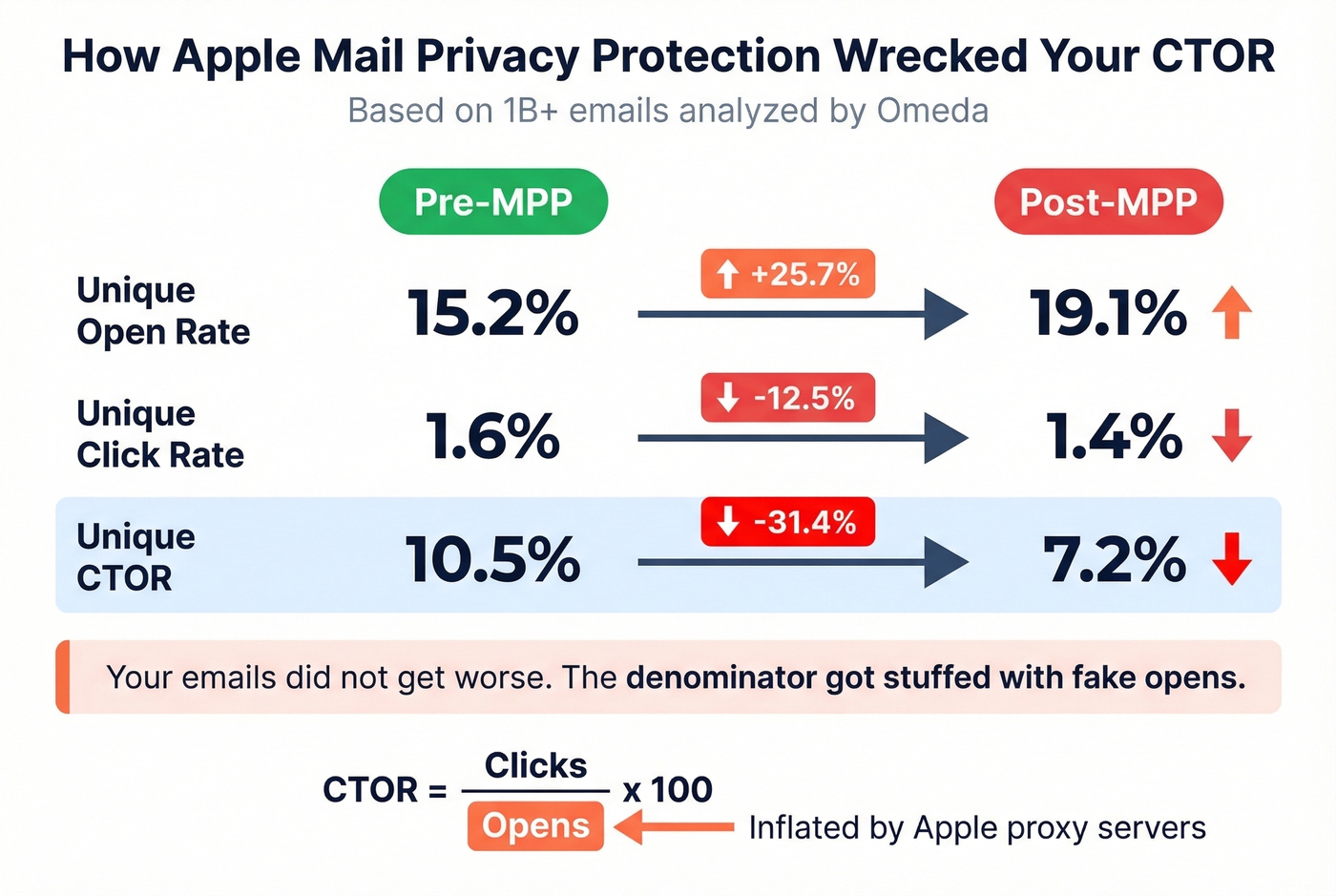
Omeda's analysis of 1 billion+ emails across 40,000+ deployments shows the damage clearly:
| Metric | Pre-MPP | Post-MPP | Change |
|---|---|---|---|
| Unique open rate | 15.2% | 19.1% | +25.7% |
| Unique click rate | 1.6% | 1.4% | -12.5% |
| Unique CTOR | 10.5% | 7.2% | -31.4% |
That's a 31% decline in unique CTOR - not because emails got worse, but because the denominator got stuffed with fake opens. And it's getting more complicated: Apple's Link Tracking Protection can strip UTM parameters in Mail and Safari, so even when someone does click, your attribution breaks. The fact that most email marketing guides in 2026 still don't mention this context is genuinely irresponsible.
Bot Clicks: The Hidden Inflator
If MPP inflates your denominator, bot clicks inflate your numerator. The scale is staggering: estimates range from ~5% of clicks on AWeber to 63% on Omeda. That's not a rounding error. That's a completely different metric.
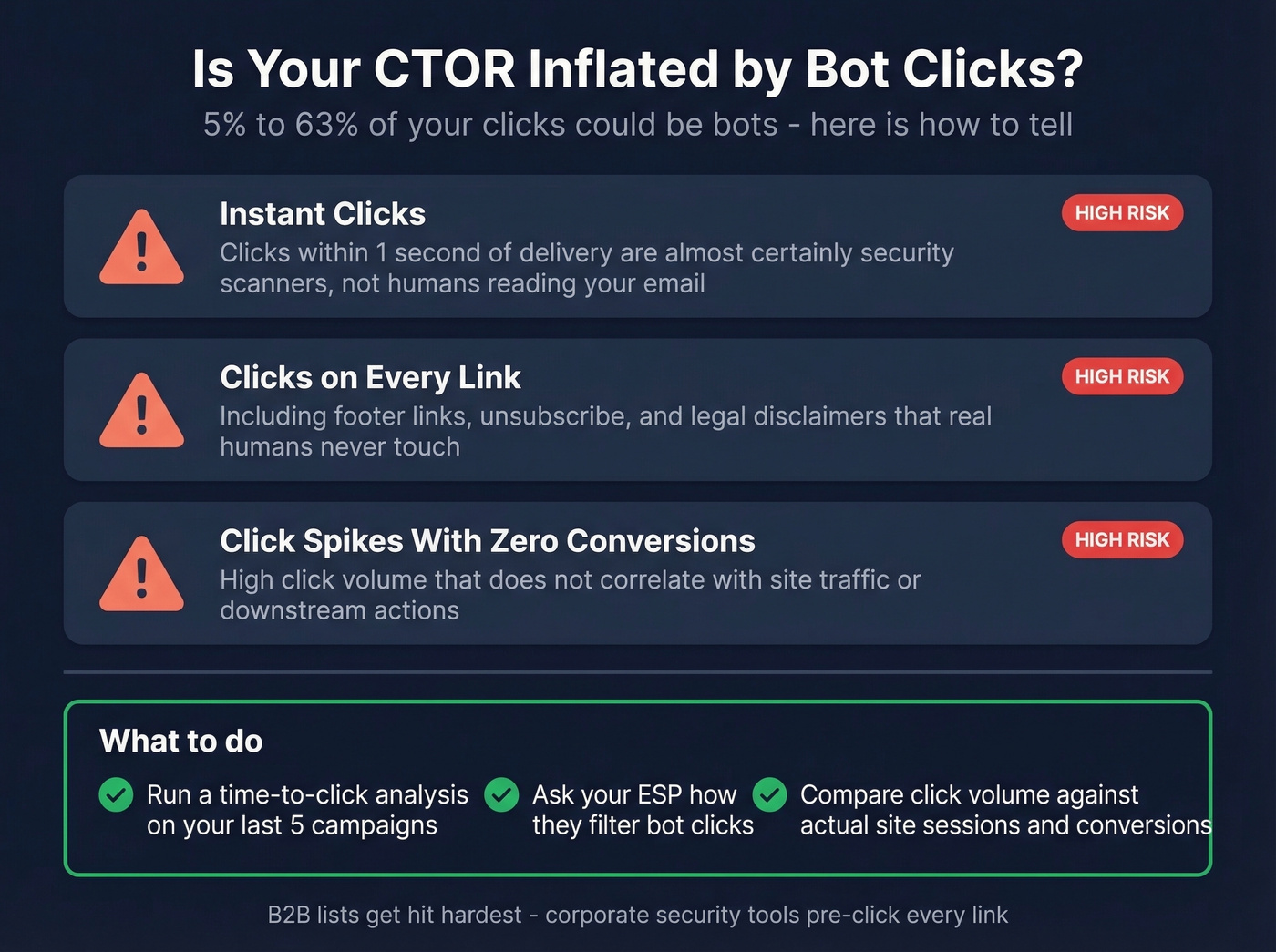
B2B lists get hit hardest. Corporate email security tools and gateways pre-click links to scan for malicious content before the email even reaches the inbox. If you're sending to corporate domains and your click to open ratio looks suspiciously high, a security scanner loved your links - not a human. (This is also why email deliverability and list quality matter more than micro-optimizing copy.)
Here's how to spot bot clicks, per Validity's detection framework:
- Instant clicks - anything within ~1 second of delivery is almost certainly a security scanner
- Clicks on every link - including footer links, unsubscribe, and legal disclaimers that humans never touch
- Click spikes with zero conversions - high click volume that doesn't correlate with site traffic or downstream actions
If your ESP doesn't filter bot clicks automatically, you're measuring fiction. Ask your provider how they handle it, or run a time-to-click analysis yourself.
Is CTOR Still Worth Tracking?
Use CTOR when you're A/B testing email creative. It's still the cleanest signal for whether your body copy and CTA resonate with openers. Braze positions it exactly this way - a content-and-CTA alignment diagnostic, not an absolute performance metric. If you change your CTA button from "Learn More" to "See Pricing" and CTOR jumps 2 points, that's a real signal even in a noisy environment. (For CTA mechanics, see email call to action.)
Skip CTOR when you're reporting campaign performance to leadership. Twilio's guidance is blunt: clicks should be your north star, not opens or open-derived metrics. Replace open-triggered automations with click-based triggers.
Here's the thing: you don't need five email metrics. You need three. One metric to optimize content (CTOR, for A/B tests). One metric for list health (click rate). One metric to report upward (conversion rate). That's it. (If you’re tying email to pipeline, use a funnel metrics view instead of single KPIs.)
For teams where the average deal size is under $10k and you're agonizing over CTOR versus CTR, you're optimizing the wrong thing. Fix your offer, fix your list, and the metrics sort themselves out.
How to Improve Your Click to Open Ratio
Knowing the benchmarks are broken doesn't mean you stop trying to improve. CTOR is still directionally useful - especially for relative comparisons within your own campaigns. Here's what actually moves the needle.
Match Promise to Payload
The fastest way to tank CTOR is a subject line that promises something the email doesn't deliver. If your subject says "2026 salary benchmarks inside" and the email is a product pitch with a salary stat buried in paragraph three, people will open and immediately bounce. We've seen this pattern kill CTOR on campaigns that had perfectly good content - just misaligned expectations. Alignment between subject line and body content is the single highest-leverage fix you can make, and it costs nothing. (If you need a framework, start with subject lines that get opened.)
One CTA Per Email
Every additional CTA dilutes the one you actually care about. We tested this on our own campaigns and found that removing a secondary "follow us on social" link lifted clicks on the primary CTA by double digits. One email, one job. If you need multiple actions, send multiple emails.
A/B Test With Real Samples
Most A/B tests in email are statistically meaningless. You're testing on 500 people, calling a winner after 2 hours, and rolling out to 50,000. Litmus recommends a minimum sample of 10,000 per variant, one variable at a time, and enough time for results to stabilize. Document what you tested and what happened - most teams skip this and end up re-testing the same things six months later. (You can also test email preview text to improve opens without muddying CTOR interpretation.)
Send-Time Optimization Won't Help Here
Send-time optimization affects open rates, which means it changes the CTOR denominator rather than improving the content itself. It's useful for CTR, but if you're trying to improve CTOR specifically, spend that energy on copy and CTA placement instead.
Clean Your List First
None of the above matters if a big chunk of your list is bouncing. Invalid addresses damage sender reputation, which means fewer real inbox placements, fewer real opens, and a CTOR calculated from a smaller and increasingly unrepresentative pool. Prospeo's 5-step verification catches invalid addresses, catch-all domains, spam traps, and honeypots at 98% accuracy - so you're measuring engagement from real recipients, not ghosts. (If you’re troubleshooting, start with email bounce rate and then work backward.)
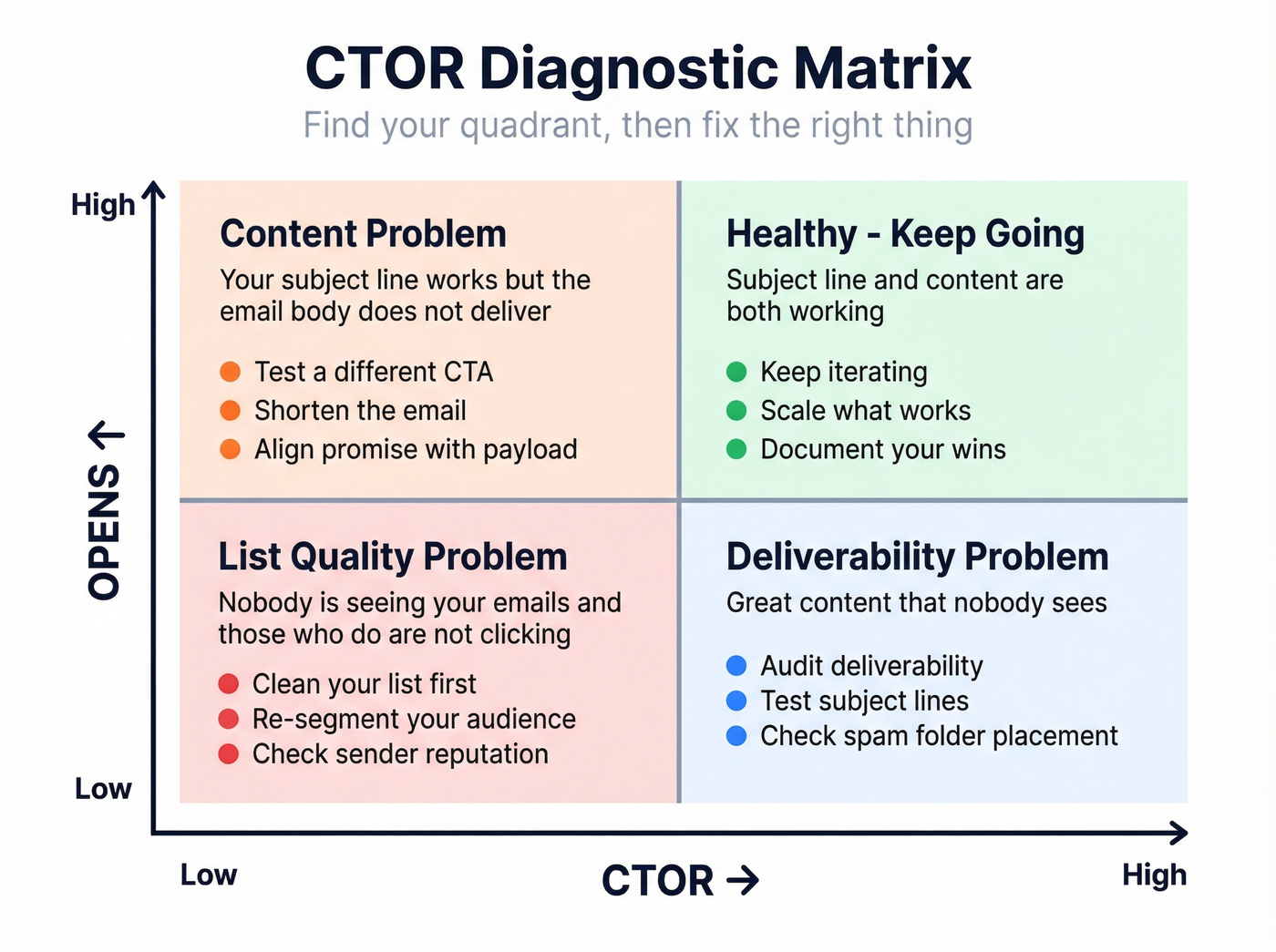
CTOR Diagnostic Matrix
Before you panic about a low CTOR, diagnose what's actually happening. The combination of opens and clicks tells you where the problem lives.
| High CTOR | Low CTOR | |
|---|---|---|
| High opens | Healthy - keep iterating | Content/CTA problem - fix the email body |
| Low opens | Great content nobody sees - audit deliverability, then test subject lines | List quality or relevance problem - clean your data and re-segment |
The "high opens + low CTOR" quadrant is the most actionable. Your subject line is working. Your content isn't. Test a different CTA, shorten the email, or improve the alignment between what you promised and what you delivered.
If you're in the "low opens" row, start with deliverability and list hygiene before touching anything else. The consensus on r/emailmarketing is the same - don't optimize content until you've confirmed people are actually seeing it.
If 35-40% of your emails bounce, your CTOR is built on a fiction - inflated opens from re-sent messages and zero real clicks. Snyk cut bounce rates from 35% to under 5% with Prospeo and generated 200+ new opportunities per month.
Stop measuring ghost engagement. Send to emails that actually exist.
FAQ
What's a good click to open ratio in 2026?
The median CTOR across all industries is 6.81% based on MailerLite's 3.6 million-campaign dataset. Most verticals cluster between 5.6% and 12% post-MPP. If you're consistently above 10%, your content is exceptional - or you should check for bot clicks inflating your numbers.
How does the CTOR calculation work?
The formula is (Unique Clicks / Unique Opens) x 100. Unlike CTR, which divides clicks by total emails delivered, CTOR only counts recipients who actually opened - giving you a cleaner read on whether your content and CTA resonated with engaged readers.
Does Apple Mail Privacy Protection affect CTOR?
Yes - significantly. MPP inflates open counts by having proxy servers download tracking pixels automatically, whether or not the recipient reads the email. This bloats the denominator, making your CTOR appear about 31% lower than it would with only real human opens, per Omeda's analysis of over 1 billion emails.
Should I track CTOR or CTR?
Track both for different purposes. CTOR tells you if email content resonated with openers - ideal for A/B testing body copy and CTAs. CTR measures overall campaign pull including subject line effectiveness. For executive reporting, conversion rate beats both.