

Client Acquisition Definition: What It Really Means (With CAC Benchmarks)
A 10-year agency owner posted on Reddit last month: "Everything has gone quiet." Strong retention, happy clients, but zero new pipeline. Facebook ads weren't converting. Referrals had dried up. That's the client acquisition problem in a nutshell - when the engine stalls, nothing else matters.
The Short Answer
Client acquisition is the full process of identifying, engaging, and converting prospects into paying clients. It's distinct from "customer acquisition" because it implies B2B, relationship-driven, higher-value engagements - think consulting deals, SaaS contracts, and managed services, not one-click purchases. The average B2B client costs $86-$784 to acquire depending on industry. The rest of this piece gives you the exact benchmarks, the funnel stages, and the strategies that are actually working in 2026.
What Is Client Acquisition?
Client acquisition is the combination of marketing and sales activities a business uses to identify, engage, and convert prospects into paying clients. It covers everything from the first ad impression or cold email to the signed contract and onboarding call.
The word "client" matters here. It signals a relationship - ongoing, consultative, high-touch. You don't acquire a client the way you acquire a customer who buys a $29 product once. The process involves multiple stakeholders, longer timelines, and a sales motion that looks more like partnership-building than transaction-processing. When someone says "client acquisition," they almost always mean B2B sales or professional services.
Client vs. Customer Acquisition
These terms get used interchangeably, and that leads to bad strategy. They're not the same thing.
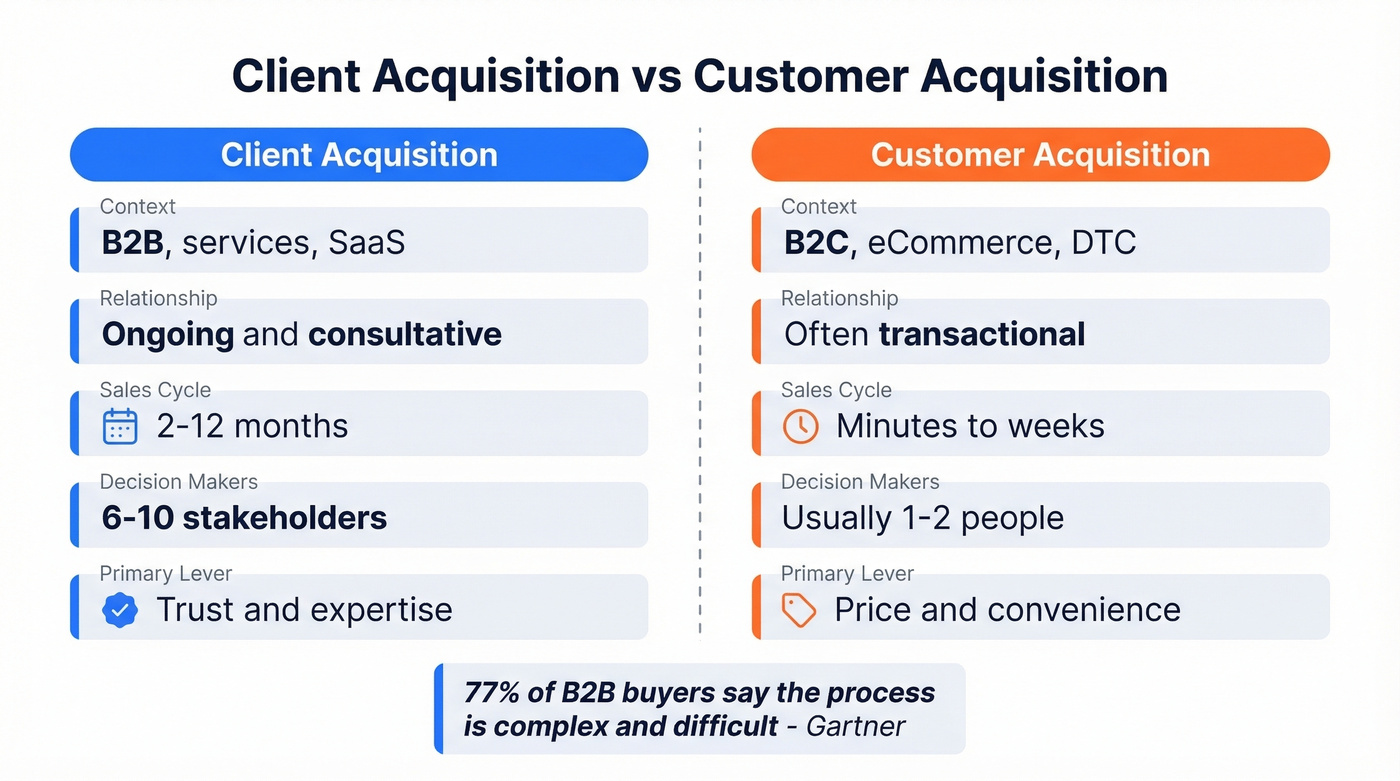
| Dimension | Client Acquisition | Customer Acquisition |
|---|---|---|
| Context | B2B, services, SaaS | B2C, eCommerce, DTC |
| Relationship | Ongoing, consultative | Often transactional |
| Sales cycle | 2-12 months | Minutes to weeks |
| Decision-makers | Multiple stakeholders | Usually 1-2 |
| Primary lever | Trust + expertise | Price + convenience |
Gartner's research puts it bluntly: the typical B2B buying group involves 6 to 10 stakeholders depending on deal complexity, each armed with 4-5 pieces of independently gathered information. 77% of B2B buyers describe the process as complex and difficult. That complexity is what makes acquiring clients a fundamentally different discipline than acquiring customers - you're not optimizing a checkout flow, you're navigating a committee with competing priorities, budgets, and timelines that can shift without warning.
The sales cycle for an average B2B deal runs more than two months; for SaaS, it's closer to 2.5 months. Complex services and enterprise deals often stretch to 3-12 months. If your acquisition strategy doesn't account for that timeline, you're running a B2C playbook in a B2B world.
Why It Matters in 2026
Pipeline doesn't fill itself.
That Reddit post about "everything going quiet" isn't an outlier - we've seen the same pattern across agencies, consultancies, and SaaS companies this year. Retention keeps the lights on, but acquisition is what drives growth. And here's the kicker: 78% of B2B buyers have already narrowed their shortlist to three vendors before they ever talk to a sales rep. If you're not on that shortlist, you don't exist. Winning new clients isn't about generating leads in a vacuum - it's about being visible, credible, and top-of-mind during the buying journey that happens before anyone picks up the phone.
The B2B Acquisition Funnel
The B2B funnel isn't linear, but it's useful as a mental model. Here are the stages and the benchmarks that tell you whether yours is healthy.
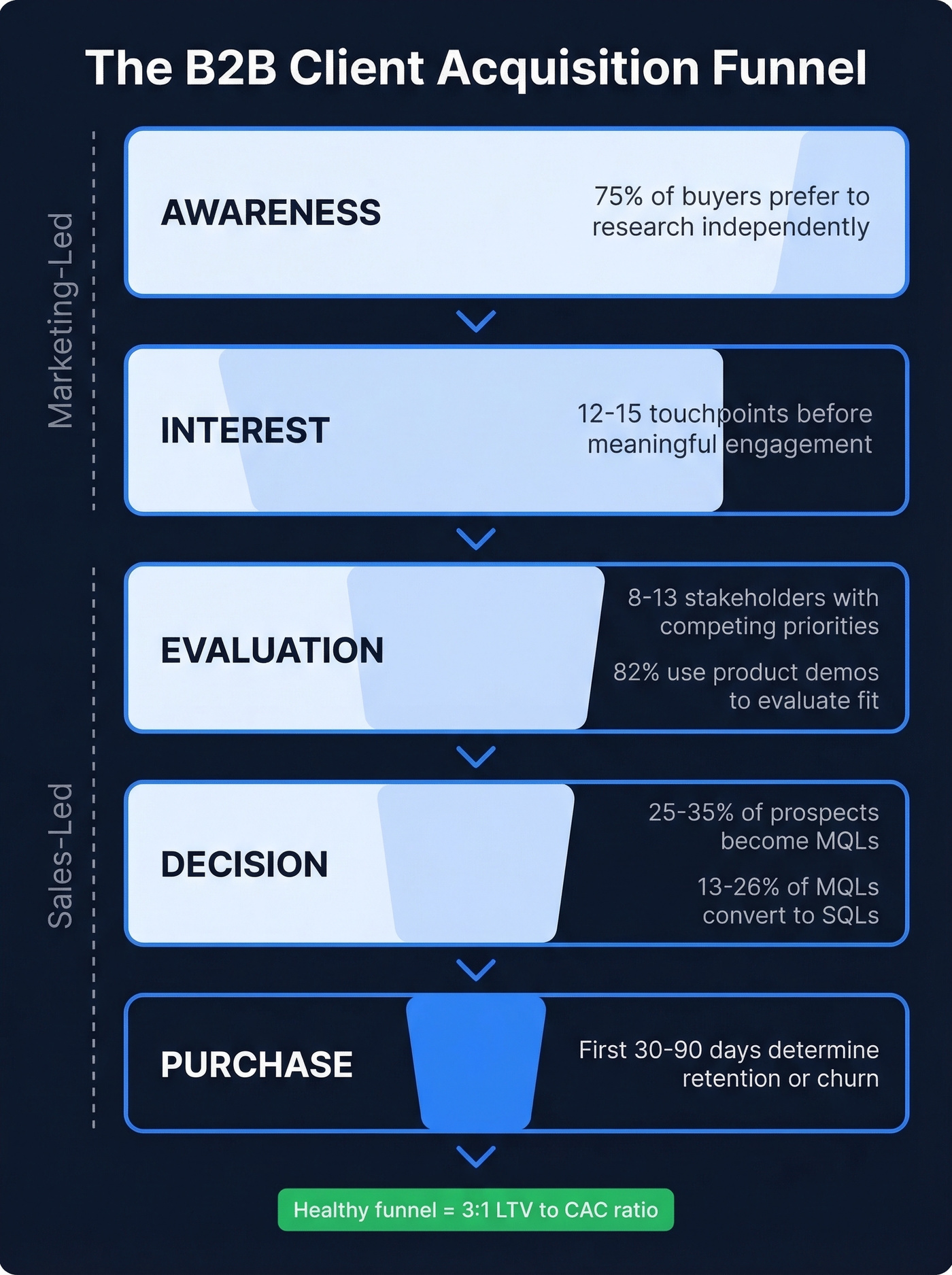
Awareness. Prospects discover you exist through content, ads, referrals, events, or outbound. At this stage, 75% prefer to research independently rather than engage with sales. Your job is to be findable, not pushy.
Interest. They engage - download a guide, attend a webinar, reply to a cold email. Expect 12 to 15 touchpoints before a prospect meaningfully engages. That number has climbed steadily over the past three years.
Evaluation. The buying committee forms. In B2B, that's 8-13 stakeholders with competing priorities. 82% of buyers use product demos to evaluate fit before ever speaking with a rep. This is where deals stall or accelerate. If you want a tighter process here, use a product demo checklist so reps don’t wing it.
Decision. Proposals go out, procurement gets involved, legal reviews the MSA. Your champion is selling internally on your behalf. Conversion benchmarks: 25-35% of engaged prospects should become MQLs, and 13-26% of those MQLs should convert to SQLs.
Purchase. Contract signed. But acquisition isn't done yet. The first 30-90 days of onboarding determine whether this client becomes a long-term revenue source or a churn risk. Onboarding is the last mile of acquisition and the first mile of retention. (If you’re seeing churn early, start with a simple churn analysis before changing your acquisition channels.)

Your CAC inflates every time a cold email bounces. Prospeo's 98% email accuracy and 5-step verification keep bounce rates under 4%, so every dollar you spend on outbound actually reaches a real buyer - not an invalid inbox.
Stop paying to acquire clients you never reach. Start with verified data.
How to Calculate Acquisition Cost
The formula is straightforward:
CAC = Total Sales & Marketing Spend / Number of New Clients Acquired
The tricky part is what counts as "spend." For B2B, you need the full picture: paid ads, content production, trade shows, website costs, lead gen tools, marketing automation, sales salaries and commissions, CRM subscriptions, travel, demos, and training. Most teams undercount by leaving out salaries, which is usually the biggest line item.
A worked example: your company spends $100,000 in Q1 across marketing and sales. You close 25 new clients. Your CAC is $4,000. Whether that's good or terrible depends entirely on what those clients are worth over time.
The benchmark to aim for is a 3:1 LTV-to-CAC ratio. If a client's lifetime value is $12,000 and your CAC is $4,000, you're in healthy territory. Below 3:1, you're spending too much to acquire. Above 5:1, you might actually be underinvesting in growth.
If you want a deeper breakdown of CAC mechanics, see our guide to cost to acquire customer.
2026 CAC Benchmarks
Most acquisition guides don't include a single dollar figure for CAC. That's absurd - how do you know if your $500 CAC is good or terrible without context?
By Industry
Data from FirstPageSage's 2026 report, covering clients from January 2022 through August 2025:
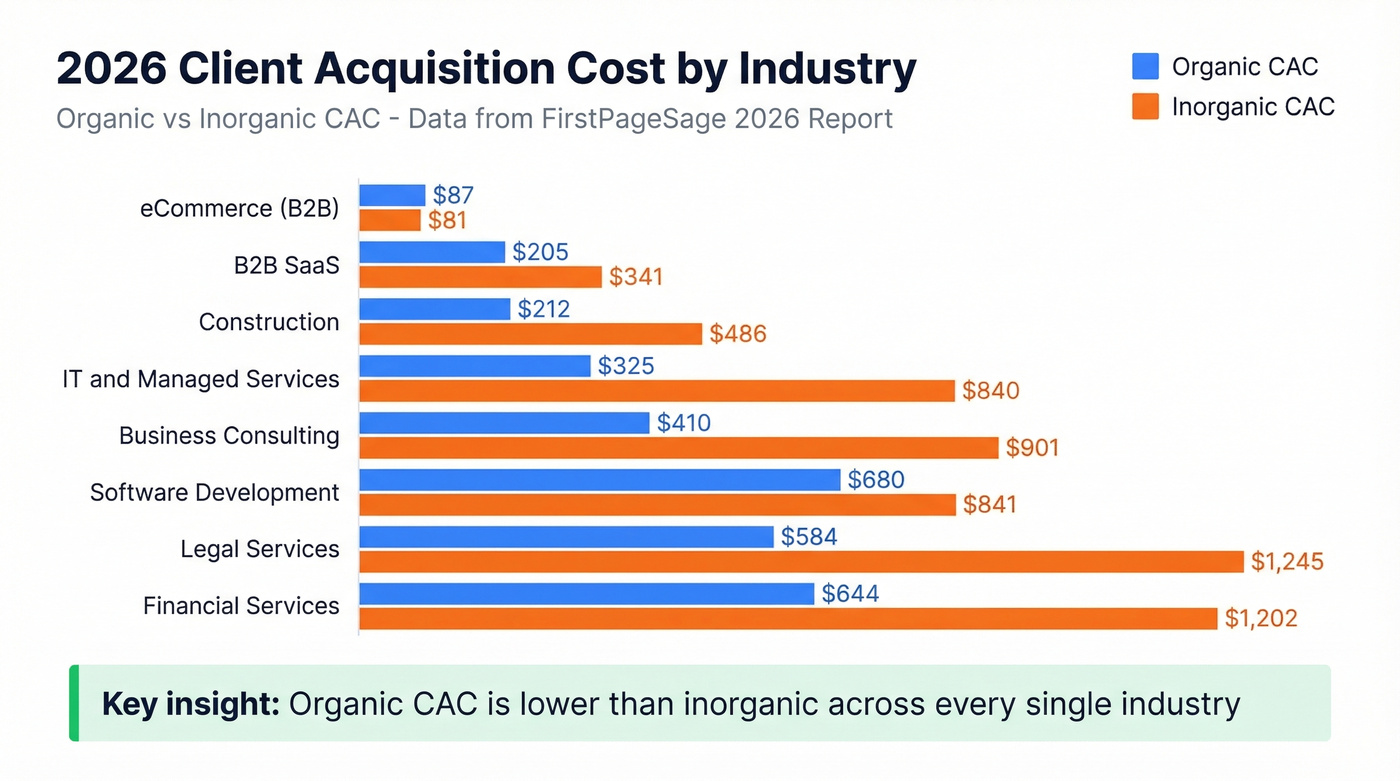
| Industry | Organic CAC | Inorganic CAC | Combined Avg |
|---|---|---|---|
| B2B SaaS | $205 | $341 | $239 |
| Construction | $212 | $486 | $281 |
| IT & Managed Services | $325 | $840 | $454 |
| Business Consulting | $410 | $901 | $533 |
| Software Development | $680 | $841 | $720 |
| Legal Services | $584 | $1,245 | $749 |
| Financial Services | $644 | $1,202 | $784 |
| eCommerce (B2B) | $87 | $81 | $86 |
In our experience, the organic vs. inorganic split is the most underused benchmark in B2B. Organic CAC is lower than inorganic across every industry in this table. That's the long-term argument for SEO and content - but it takes time to compound, which doesn't help if your pipeline is empty today.
By Channel
These are B2B averages across industries:
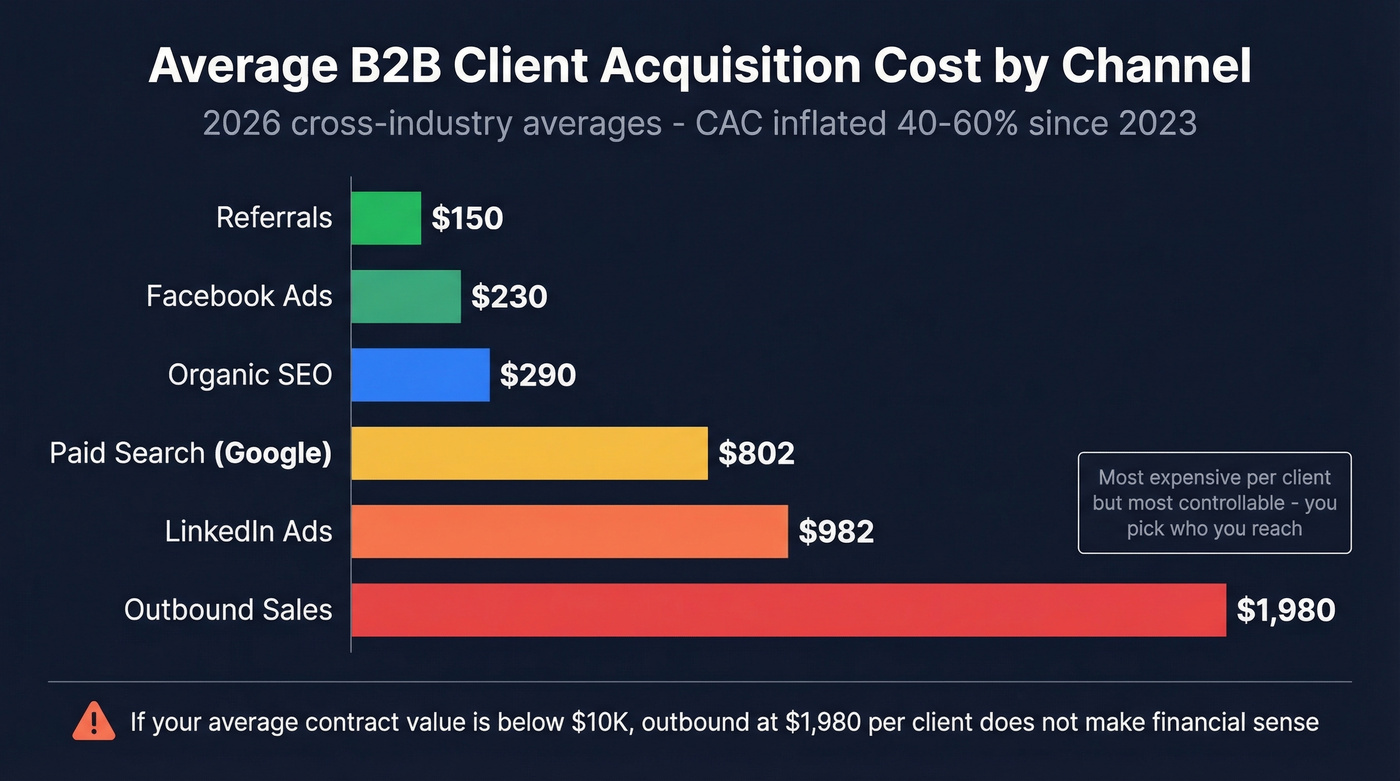
| Channel | Avg B2B CAC |
|---|---|
| Referrals | ~$150 |
| Facebook Ads | ~$230 |
| Organic SEO | ~$290 |
| Paid Search (Google) | ~$802 |
| LinkedIn Ads | ~$982 |
| Outbound Sales | ~$1,980 |
Outbound is the most expensive channel on a per-client basis, but it's also the most controllable - you pick who you reach. The catch: CAC across channels inflated 40-60% between 2023 and 2025, driven by competition, privacy changes, and attribution challenges. If your CAC feels higher than it used to, it probably is.
Here's the thing: if your average contract value sits below $10K, outbound at ~$1,980 per client doesn't make financial sense. You're better off investing in referral programs and organic content until your deal sizes justify the cost of a dedicated outbound motion.
Strategies That Work in 2026
Most acquisition guides list 15-20 tactics. That's a menu, not a strategy. Let's focus on what actually moves the needle.
Go Multichannel - But Earn It
McKinsey's research is clear: 72% of B2B companies selling through seven or more channels grow their market share. Less than 50% grow when selling through just one.
But don't start with seven channels. Start with two or three where you have an unfair advantage - outbound email plus referrals, or content plus LinkedIn. Measure CAC at the channel level, not blended. Kill what doesn't work. We've seen teams ranging from 2-person agencies to 50-seat sales floors make the same mistake: they spread budget across six channels before proving any single one works, and their blended CAC balloons while no individual channel gets enough volume to optimize. The consensus on r/sales and agency subreddits echoes this consistently - founders who focus on two channels and go deep outperform those who spread thin across five or six.
Fix Your Data Before Scaling
Email lists decay by roughly 28% per year. Nearly a third of your contact database goes stale every twelve months as people change jobs, companies rebrand, and domains expire. Email-only campaigns are delivering 29% fewer leads year over year. And 73% of buyers still prefer email as a channel. The problem isn't email. The problem is bad data.
If your outbound team sends 500 emails a week and 30% bounce, you don't have a messaging problem. You have a data problem. That bounce rate damages your sender domain, tanks deliverability for future campaigns, and spikes your effective CAC because you're paying to reach inboxes you'll never hit. If you’re diagnosing this, start with email bounce rate benchmarks and fixes.

This is where data quality tools earn their keep. Prospeo runs a 7-day refresh cycle on 300M+ professional profiles - compared to the 6-week industry average - so the contacts you pull today are current, not stale. With 98% email accuracy and 143M+ verified emails, teams have cut bounce rates from 35%+ down to under 4%.
Skip this approach if you're selling to a hyper-niche market with fewer than 500 total prospects. In that case, manual research and warm introductions will outperform any database.
Common Mistakes
Have real conversations early. Qualify for fit before investing time. Don't build a 14-step automation sequence before you've talked to 10 prospects. One Reddit practitioner put it well - they spent months perfecting email sequences and CRM workflows while neglecting genuine human connection.
If you need a tighter qualification system, use an ideal client profile template and scoring rubric.
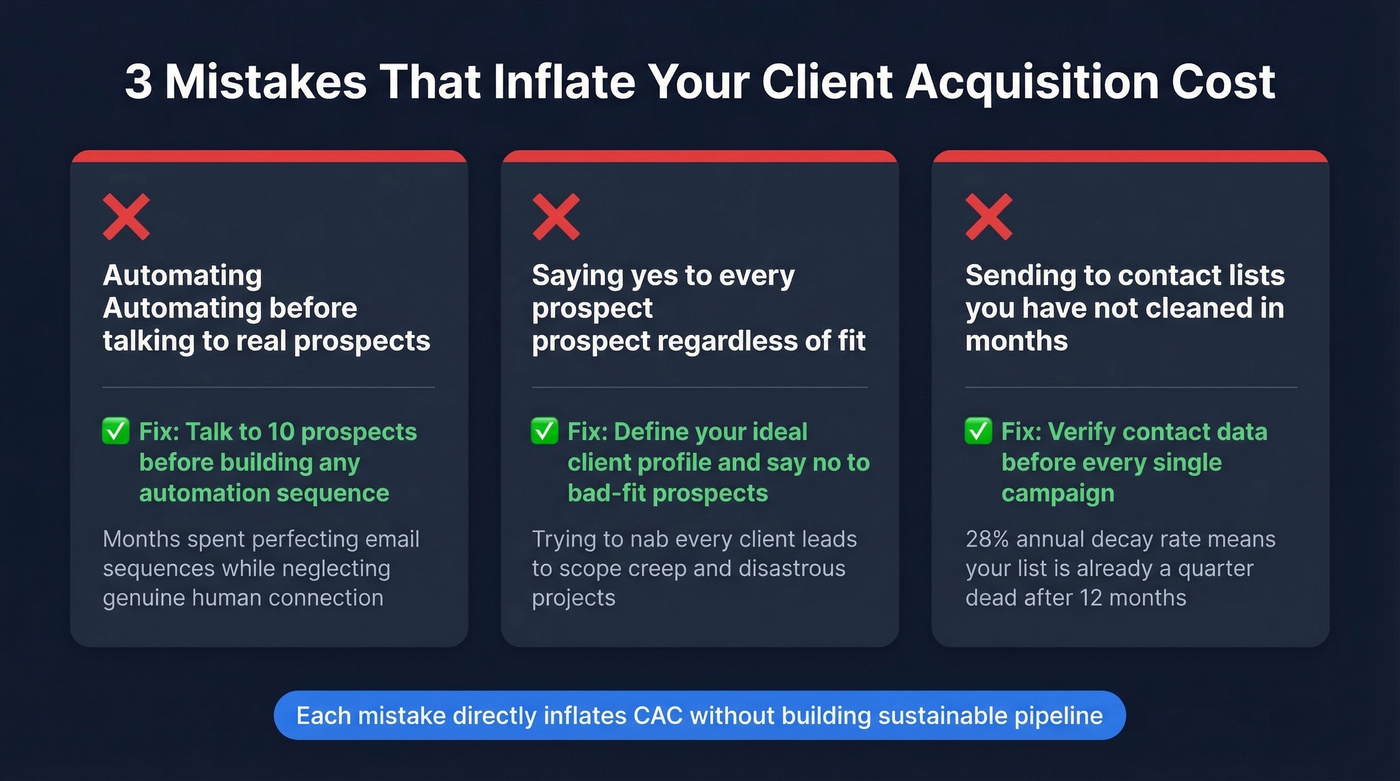
Define your ideal client profile and say no to bad-fit prospects. Trying to "nab every and any client" leads to disastrous projects, scope creep, and wasted cycles that inflate your CAC without building a sustainable book of business.
Verify your contact data before every campaign. Don't send to a list you haven't cleaned in six months. A 28% annual decay rate means that list is already a quarter dead.
Tools for Client Acquisition
Three tools. That's it until you're past $1M ARR.
CRM: HubSpot or Salesforce. Pick one, use it consistently, track CAC by channel. If you’re still deciding, here are examples of a CRM with real pricing.
Sequencing: Instantly, Smartlead, or Lemlist. They're only as good as the data feeding them. If you want to improve replies without changing volume, use proven sales follow-up templates.
Outbound is the most expensive acquisition channel at ~$1,980 per client. Prospeo cuts that cost with 300M+ verified profiles at $0.01/email, 30+ filters to target the right buying committee, and intent data across 15,000 topics to find prospects already in-market.
Acquire clients faster by reaching the 6-10 stakeholders who actually decide.
FAQ
What is client acquisition in simple terms?
Client acquisition is the process of finding and winning new paying clients - from first awareness through signed contract. It includes marketing activities like generating interest and leads, and sales activities like qualifying, proposing, and closing. In B2B, it typically involves multiple stakeholders and sales cycles of two months or longer.
What's a good CAC for B2B?
B2B SaaS averages $239, business consulting runs $533, and legal services hit $749. The number alone doesn't tell you much - what matters is your LTV-to-CAC ratio. Aim for at least 3:1, meaning each client's lifetime value is three times what you spent to acquire them.
How do you reduce acquisition cost?
Focus on three levers. First, verify contact data before outbound campaigns - cutting bounce rates below 4% protects your domain and eliminates wasted spend. Second, track CAC by channel instead of blended so you can double down on what works. Third, qualify harder so you stop investing sales cycles in prospects who were never going to close.
What's the difference between client and customer acquisition?
Client acquisition targets B2B and professional-services relationships with 2-12 month sales cycles and 6-10 stakeholders per deal. Customer acquisition typically refers to B2C or eCommerce transactions with shorter cycles and fewer decision-makers. The strategies, timelines, and cost structures are fundamentally different.