

25+ Client Email Templates for Every Stage (2026)
It's 9 PM on a Tuesday. Your client just sent a message asking for "one more small thing" - the third time this month. You stare at the screen, trying to figure out how to say "that's out of scope and it'll cost extra" without torching the relationship. So you write, delete, rewrite, and eventually send something wishy-washy that solves nothing.
That's what happens without solid client email templates for the hard conversations.
The emails people struggle with most aren't the polite ones - they're the awkward ones: saying no, chasing payment, pushing back on scope. Most template collections give you customer support scripts, not the emails that protect your revenue and your relationships.
Three Templates You Need Most
If you only save three templates today, make it these:
- Scope creep pushback - stops free work before it becomes a pattern. Jump down
- Late payment escalation - a four-step sequence from friendly to firm. Jump down
- Proposal email - structured so the client can say yes without a follow-up call. Jump down
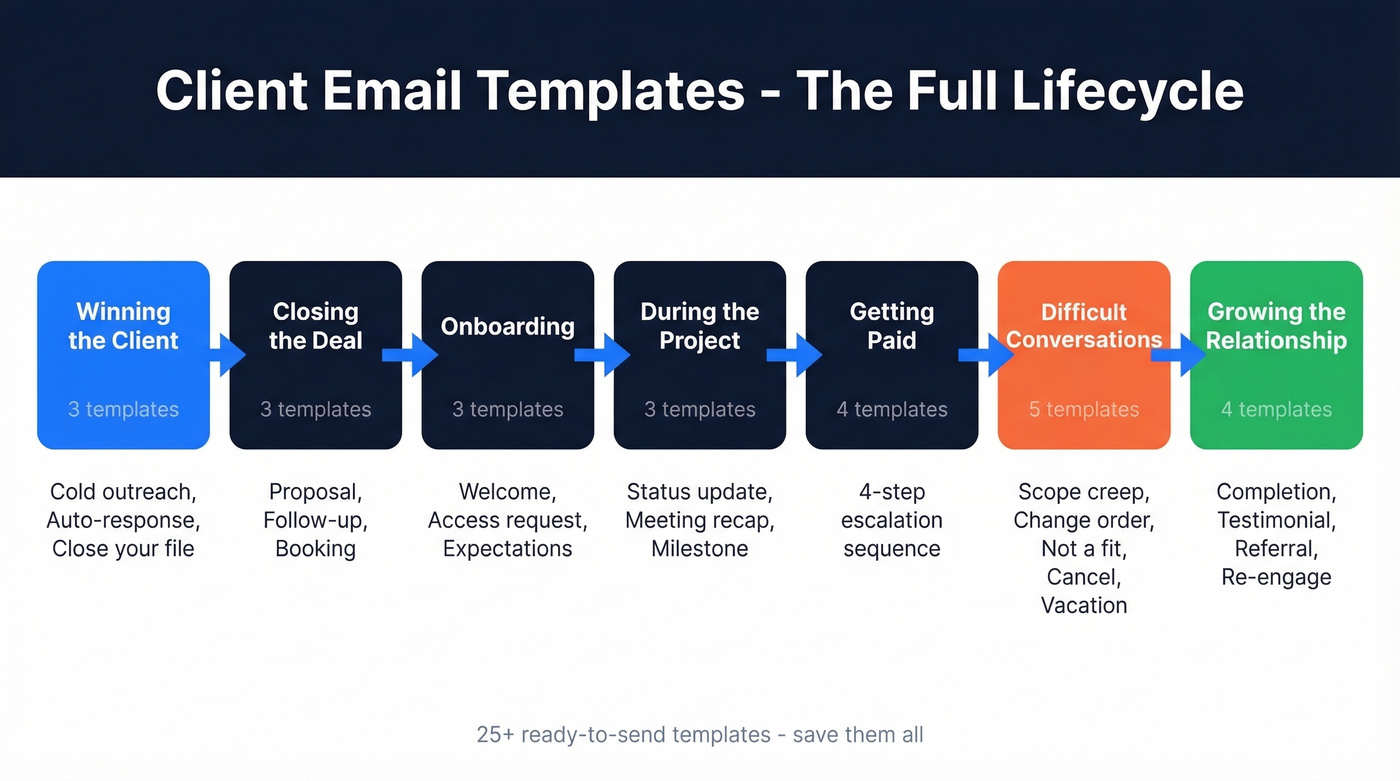
Quick Reference by Stage
| Stage | Templates | When to Use |
|---|---|---|
| Winning the Client | Cold outreach, lead auto-response, "close your file" follow-up | Prospecting and first contact |
| Closing the Deal | Proposal, proposal follow-up, booking confirmation | Converting leads to clients |
| Onboarding | Welcome + kickoff, access request, expectations setting | First week after signing |
| During the Project | Status update, meeting recap, milestone completion | Active project management |
| Getting Paid | 4-step payment escalation sequence | Invoice follow-up |
| Difficult Conversations | Scope creep, change order, not a fit, cancellation, vacation | Protecting your business |
| Growing the Relationship | Project completion, testimonial request, referral, re-engagement | Post-project nurturing |
Winning the Client
Cold Outreach Template
Keep this under 120 words. Lead with their problem, not your availability.
Subject: [Specific outcome] for [Company Name]
Hi [First Name],
I noticed [specific observation about their business - a gap, a recent change, a public initiative]. We helped [similar company/industry] [specific outcome with a number].
Quick example: [link to case study or portfolio piece].
Worth a 10-minute call this week to see if there's a fit?
[Your Name]
Never lead with "I'm looking for new clients" or "I'm available for projects." The client doesn't care about your pipeline - they care about their problems. If you want more structure for outreach, borrow a few ideas from these sales prospecting techniques.
Lead Auto-Response Template
When a lead fills out your contact form, respond within 24 hours. Trust starts before you begin the work.
Hi [First Name],
Thanks for reaching out - I got your message and I'm looking forward to learning more about [project type/need they mentioned]. I'll follow up within [24/48 hours] with some initial thoughts.
In the meantime, here's a look at how we work: [link to services page or portfolio].
Talk soon, [Your Name]
The "Close Your File" Follow-Up
When a prospect goes silent after two touchpoints, this is one of the simplest ways to get a clear yes or no without sounding pushy. Short, pressure-free, and surprisingly effective.
Hi [First Name],
I haven't heard back, so I'm guessing the timing isn't right. I'll close your file for now - but if things change down the road, I'm easy to find.
Best, [Your Name]
This gets replies because it removes pressure. People respond when they feel permission to say no. If you need more options, keep a few sales follow-up templates saved too.
Before you hit send: Roughly 17% of cold emails never reach the inbox due to bounces and spam filtering. Verify every email address before sending - Prospeo checks addresses in real time with 98% accuracy, and you only pay for valid ones. (If deliverability is a recurring issue, this email deliverability guide will help you diagnose the root cause.)

Closing the Deal
Proposal Email
Present your proposal live first - on a call or in person - then send this as the written follow-up. Michael Janda's advice is simple: don't email a proposal without presenting it first.
Subject: Proposal: [Project Name] for [Client Company]
Hi [First Name],
Great speaking with you. Here's the written summary of what we discussed:
Outcome: [What the client gets - the result, not the deliverables] Deliverables: [Specific list] Timeline: [Start date to end date] Revisions included: [Number] Fee: [Amount] Payment terms: A [percentage] deposit is required to book the start date. Remaining balance due within [number] days of completion.
If this looks good, reply with "Approved" and I'll send the contract.
[Your Name]
Proposal Follow-Up
If you don't hear back within 5 business days:
Hi [First Name],
Wanted to check in on the proposal I sent [date]. Happy to answer any questions or adjust the scope. Otherwise, just let me know where things stand.
Booking Confirmation
Once the client says yes, confirm immediately with prep instructions. Don't leave them wondering what happens next.
Subject: Confirmed: [Project Name] Kickoff - [Date]
Hi [First Name],
We're locked in! Here are the details:
Kickoff call: [Date, time, timezone] Meeting link: [link] Before we meet, please have ready: [list - brand guidelines, logins, reference materials, brief answers to 2-3 key questions]
Need to reschedule? No problem - just reply to this email at least 24 hours in advance.
Looking forward to getting started. [Your Name]
Onboarding the Client
Don't send one massive onboarding email. Break it into three. Assign a single point of contact and introduce them within 24 hours of signing - that first impression sets the tone for the entire project. (If you're handing work between team members, keep a handoff email template ready too.)
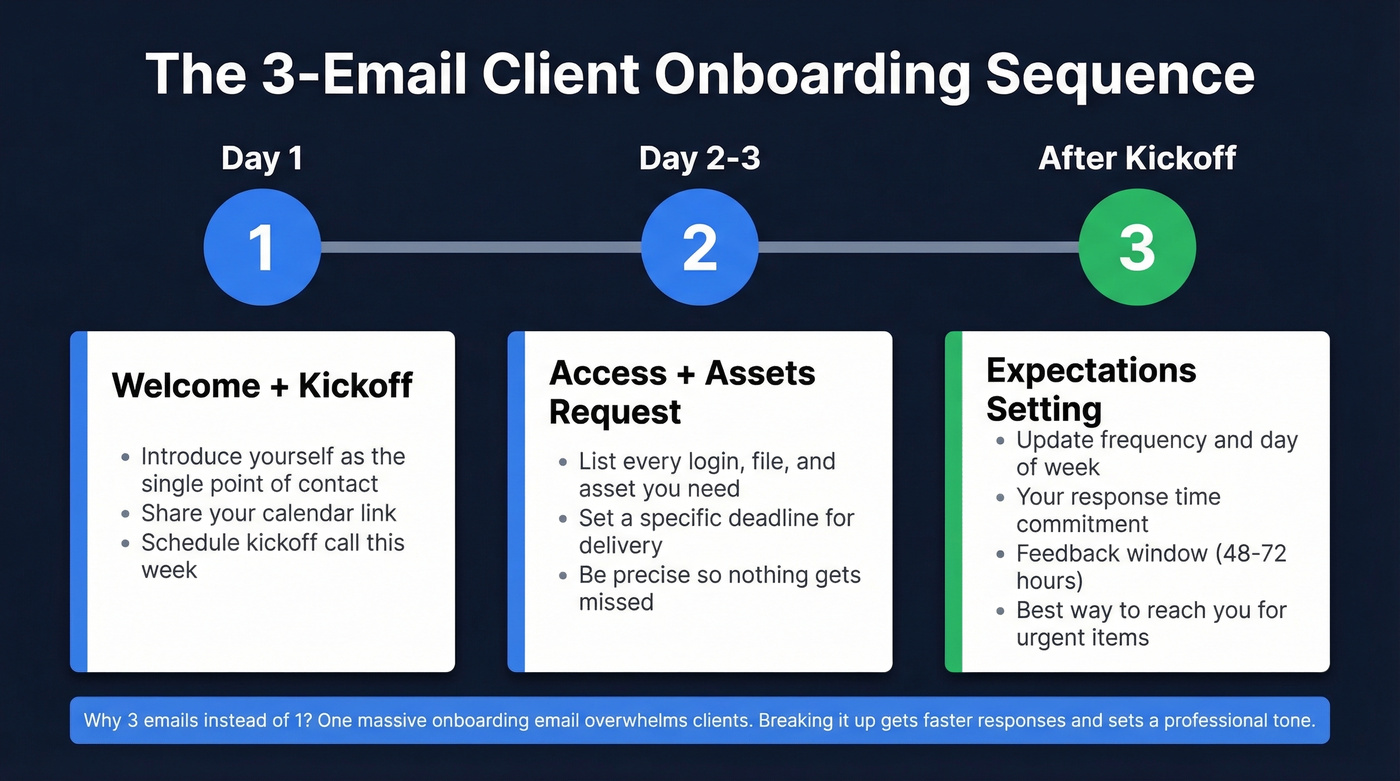
Email 1 - Welcome + Kickoff (Day 1)
Welcome aboard! I'm your single point of contact for this project. Let's schedule a kickoff call this week - here's my calendar link: [link].
Email 2 - Access + Assets Request (Day 2-3)
To get started, I'll need: [list of specific assets, logins, brand guidelines, references, deadlines]. Please send these by [date] so we stay on track.
Email 3 - Expectations Setting (After Kickoff)
Quick overview of how we'll work together:
- Updates: [Weekly/biweekly] via email every [day]
- Response time: I reply within 24 hours on business days
- Feedback process: I'll send work for review with a [48-72 hour] feedback window
- Questions? Email is best. For urgent items, text me at [number].
In our experience, setting communication expectations upfront prevents most of the friction that shows up mid-project. We've seen entire client relationships go sideways because nobody clarified how fast they'd respond to emails. If you're standardizing this across a team, it helps to keep everything in one place with contact management software.

You just spent time crafting the perfect client email. Don't waste it on a dead address. Prospeo verifies emails in real time with 98% accuracy - so your proposals, payment reminders, and outreach actually land in inboxes. At $0.01 per email, you only pay for valid ones.
Send every client email with confidence - verify first.
During the Project
Status Update Template
Subject: [Project Name] - Week [#] Update
Hi [First Name],
Quick update on where things are:
- Completed: [items]
- In progress: [items]
- Blocked/needs your input: [items with deadline]
Next milestone: [what's coming + date]. Let me know if you have questions.
Meeting Recap Template
Hi [First Name],
Quick recap from today's call:
- [Decision made]
- [Action item - owner - deadline]
- [Action item - owner - deadline]
Let me know if I missed anything. Otherwise, we're moving forward on the above.
Milestone Completion Notice
Hi [First Name],
Phase [#] is complete. Here's what was delivered: [brief list or link to deliverables]. Next phase begins [date] - I'll send a detailed plan by [date].
Getting Paid
Use a four-step escalation sequence. Each email gets firmer. Always include the invoice number in the subject line, the amount and due date in the body, and a direct payment link. Having this sequence saved as canned responses removes the emotional weight of chasing money - you're just clicking "send," not agonizing over word choice at 11 PM.
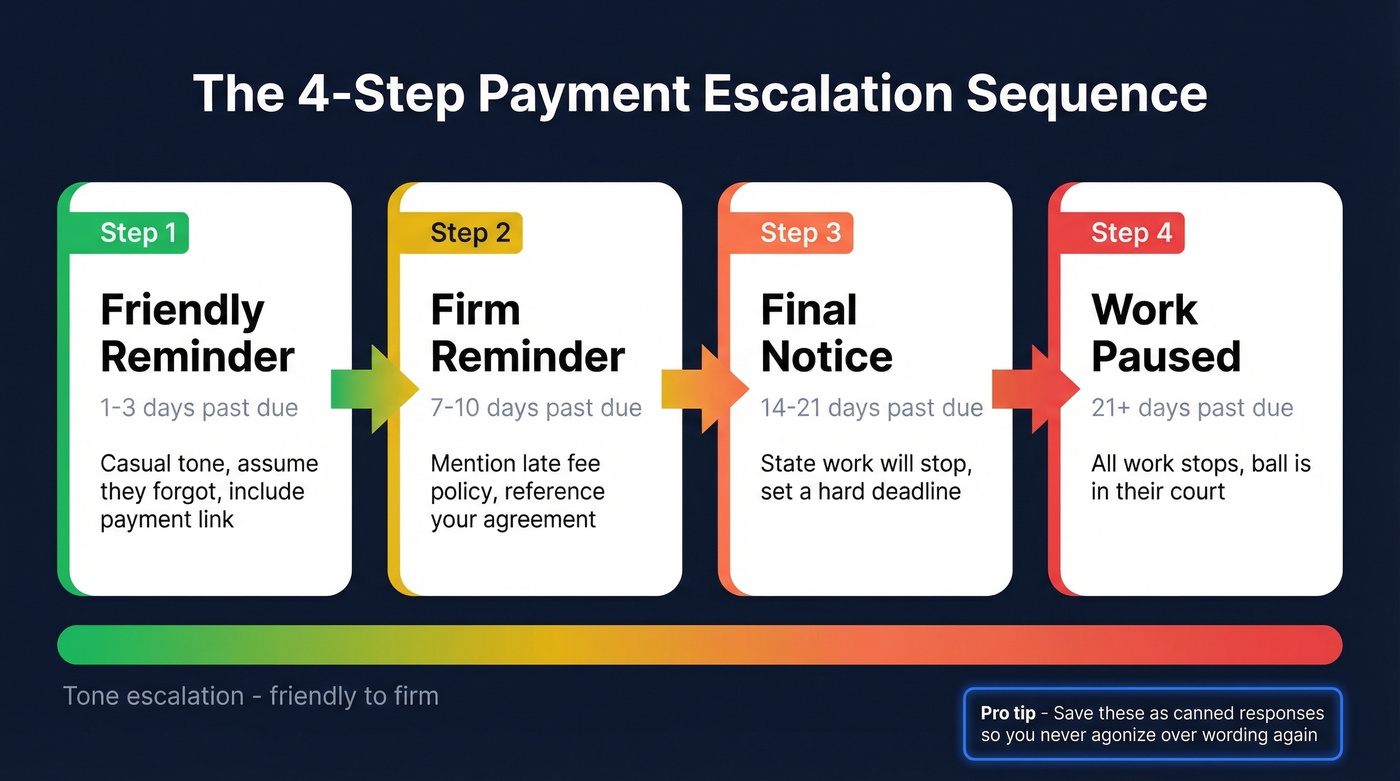
Step 1 - Friendly Reminder (1-3 days past due)
Subject: Invoice #[1234] - Quick Reminder
Hi [First Name], just a heads-up that Invoice #[1234] for [amount] was due on [date]. Here's the payment link: [link]. If you've already taken care of it, please disregard!
Step 2 - Firm Reminder (7-10 days past due)
Subject: Invoice #[1234] - Payment Overdue
Hi [First Name], Invoice #[1234] for [amount] is now [X] days past due. Per our agreement, a late fee of [amount/percentage] applies after [date]. Please process payment at your earliest convenience: [link].
Step 3 - Final Notice (14-21 days past due)
Subject: Invoice #[1234] - Final Notice
Hi [First Name], this is a final reminder regarding Invoice #[1234] for [amount]. Work won't continue until payment is received. Please remit payment by [date]: [link].
Step 4 - Work Pause (21+ days past due)
Subject: [Project Name] - Work Paused Pending Payment
Hi [First Name], as of today, all work on [project] is paused until the outstanding balance of [amount] is resolved. I value our working relationship and want to get back on track - please reach out once payment is processed.
Difficult Conversations
Here's the thing: this is the section most template articles skip entirely. We've seen freelancers lose thousands by not having these ready to go.
Scope Creep Pushback
Hi [First Name],
Love the idea of adding [requested item]. That falls outside the current scope we agreed on, so I want to be transparent: it would require an additional [amount or percentage - 20% of the original fee is a common baseline] and extend the timeline by [duration].
Want me to put together a quick change order, or should we keep the current scope as-is?
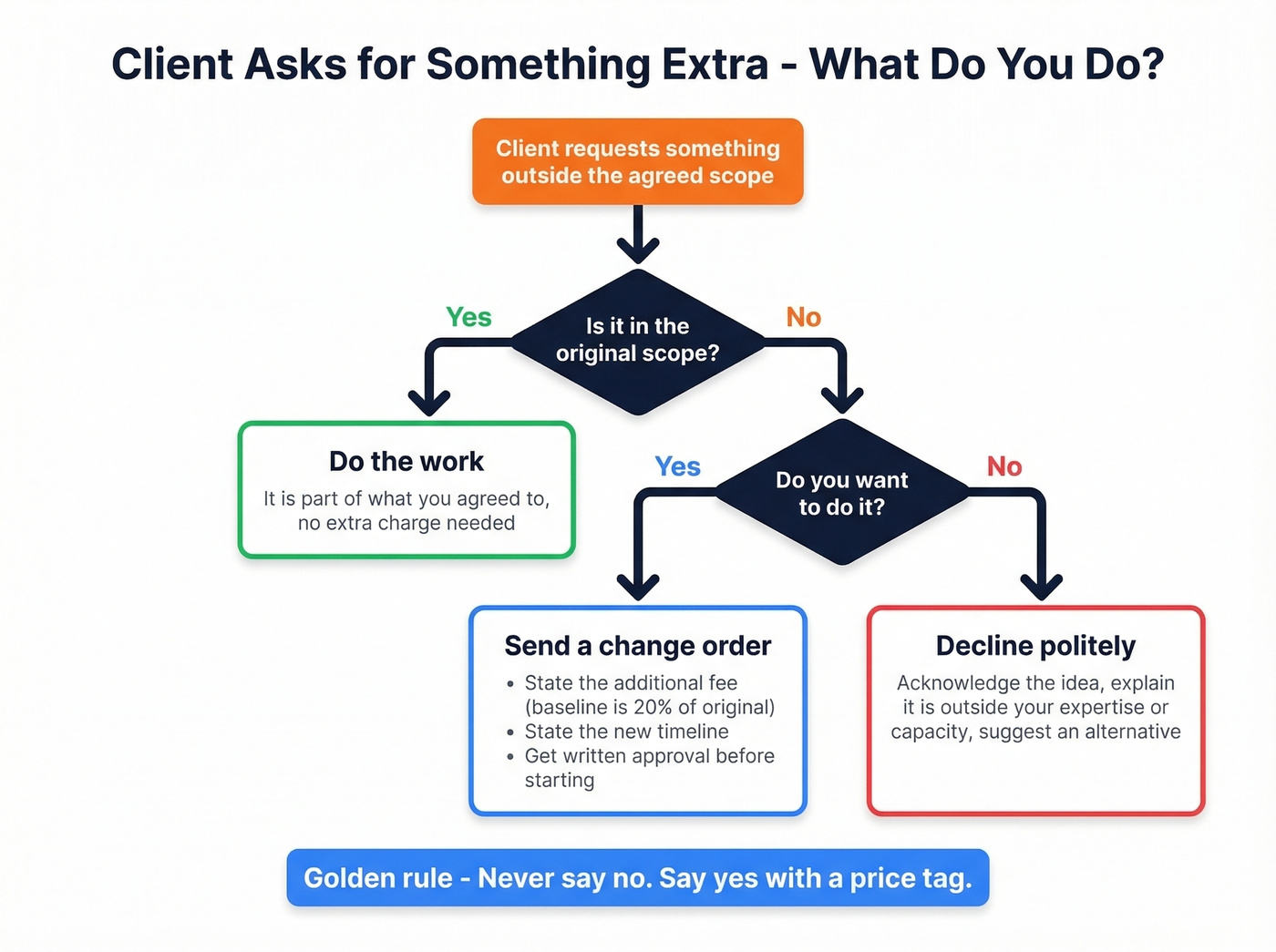
Keep it factual, not emotional. You're not saying no - you're saying yes, with a price tag.
Change Order Request
Hi [First Name],
Based on our conversation about [change], here's an updated scope summary:
Additional work: [description] Additional fee: [amount] New timeline: [updated date]
Reply "Approved" and I'll update the project plan.
Always get scope changes in writing. Even a simple email confirmation protects both sides. If you want a negotiation framework for pricing changes, learn how to use an anchor in negotiation.
Not a Right Fit
This isn't about bandwidth. Sometimes the project, budget, or working style just doesn't align. Be direct.
Hi [First Name],
Thanks for sharing the details on this project. After reviewing the scope and requirements, I don't think I'm the right fit for what you need - and I'd rather be upfront than deliver something that doesn't meet your expectations.
I'd recommend reaching out to [colleague/referral] - they specialize in exactly this kind of work.
Wishing you the best with the project.
Declining Work (Bandwidth)
Hi [First Name],
Thanks so much for thinking of me. I don't have the bandwidth to take this on right now and give it the attention it deserves. I'd rather be honest than overcommit.
I'd recommend reaching out to [colleague/referral] - they do excellent work in this space.
Skip this template if you're just starting out and need every project you can get. It's a luxury for when your pipeline is full.
Project Cancellation
Hi [First Name],
I'm confirming that work on [project] is stopped as of [date], per our discussion. As outlined in our agreement, the deposit of [amount] is non-refundable and covers work completed to date.
I'll send over all deliverables and files by [date]. I wish you the best with the project going forward.
Vacation / Extended Absence
Give clients at least three weeks' notice.
Hi [First Name],
Heads up - I'll be out of office from [date] to [date]. I'm planning to [wrap up X / hand off Y / be available for emergencies at Z] before I leave. If there's anything time-sensitive, let's address it before [date].
Growing the Relationship
Project Completion
Hi [First Name],
[Project Name] is officially wrapped! Here's the final deliverables package: [link/attachment]. Everything outlined in our scope is included. Please review and let me know if you have any questions within the next [5-7 days].
Feedback / Testimonial Request
Wait 1-2 weeks after delivery - long enough for the client to see results, short enough that the experience is fresh.
Would you be open to sharing a quick testimonial about our work together? Even 2-3 sentences would be a big help. Here's a prompt if useful: "What was the project, what was the result, and would you recommend working together?"
Referral Request
If you know anyone who could use similar help, I'd love an introduction. No pressure - just putting it out there.
Re-Engagement (Dormant Clients)
Send quarterly check-ins to past clients. A lot of future revenue comes from people who already trust you, and a simple follow-up template means these check-ins take seconds to send, not minutes to draft.
Hi [First Name],
It's been a few months since we wrapped [project]. How's everything going? I've been working on [relevant new service or capability] and thought of you. Worth a quick catch-up?
Best Practices for Email Templates
Keep emails under 200 words. A Belkins study of 16.5M emails found that 6-8 sentences hit a 6.9% reply rate - the best-performing length bracket. If you're optimizing for opens too, keep a swipe file of email subject line examples.
One CTA per email. Don't ask the client to review a document, schedule a call, and approve a budget in the same message. Pick one action. (This quick guide to an email call to action helps.)
Personalize the first line. Advanced personalization drives reply rates up to 18%, yet only 5% of senders personalize every message. Reference something specific - a recent project, a milestone, a shared connection. If you want a system for it, use this personalized outreach playbook.
Follow up once, then stop. 42% of campaign replies come from follow-ups, but a single email actually produces the highest reply rate. One follow-up after 3-5 business days is the sweet spot - a third email drops response rates by up to 20%. If you need more follow-up angles, these cold email follow-up templates are a good add-on.
Verify every address before sending. Bad data kills deliverability. We've watched entire outreach campaigns tank because 15-20% of the list bounced, dragging the sender's domain reputation into the ground. If you're troubleshooting, start with email bounce rate benchmarks and fixes.
Save templates as canned responses. Use Dubsado or HoneyBook (typically ~$20-$80/month depending on plan), or Gmail's canned responses for free. The goal is one-click access, not rewriting from scratch every time.
Review and refresh quarterly. Your services evolve, your pricing changes, your tone matures. Stale templates create a disconnect between how you work now and how you sound in email.
Let's be honest: if your average contract value is under $2,000, you don't need 25 templates. You need five - cold outreach, proposal, scope creep, payment reminder, and project wrap. Save the rest for when your client load justifies the overhead.
FAQ
How many templates do I actually need?
Fifteen to twenty covering the full lifecycle is the right number for established freelancers and agencies. If you're just starting out, focus on the five that protect your money: cold outreach, proposal, scope creep pushback, payment escalation, and project completion.
How do I follow up without sounding desperate?
Send one follow-up after 3-5 business days referencing a specific detail from your last message. If you still hear nothing, send the "close your file" break-up email - it removes pressure and often triggers a reply. Having a go-to client follow-up template makes this feel routine instead of agonizing.
What's the best way to handle scope creep over email?
Acknowledge the idea, state it's outside the agreed scope, and quote the additional cost - a 20% surcharge on the original fee is a common baseline. Keep it factual, not emotional. You're not saying no; you're saying yes with a price tag.
How do I make sure outreach emails actually reach the inbox?
Verify every address before sending. Set up SPF, DKIM, and DMARC on your sending domain too - without proper authentication, even perfectly written emails end up in spam. The consensus on r/coldemail is that list hygiene matters more than subject lines, and I'd agree.
Templates get you halfway. Reaching the right person gets you the rest. Prospeo's database of 300M+ profiles with 30+ filters helps you find verified emails for decision-makers before you even draft the cold outreach. No bounces, no wasted follow-ups.
Find verified client emails in seconds, not hours.