

Client Retention: Why Great Results Aren't Enough (and What Actually Keeps Clients)
The agency delivered a 5.8 ROAS. CPA dropped 32%. Revenue climbed 40% month over month. The client still canceled. Their parting words, per a DOT & Company case study: "Results were good... but we never felt like we had a partner."
That's the client retention problem in one sentence - performance doesn't guarantee loyalty.
What makes this worse: 44% of businesses don't even calculate their retention rate. They're flying blind on the metric that determines whether revenue compounds or collapses.
What Is Client Retention?
Client retention is the ability to keep existing clients engaged, paying, and expanding over time. Simple enough on the surface. But the word "client" matters more than people realize.
"Customer" is transactional - someone buys a product, uses it, maybe churns. "Client" implies a relationship: ongoing service, strategic guidance, mutual investment. When we talk about keeping clients, we're talking about agencies, consultancies, SaaS companies with high-touch accounts, professional services firms, and managed service providers. The dynamics are fundamentally different from eCommerce retention or subscription box churn.
A customer needs convenience. A client needs partnership. That distinction changes the playbook entirely. If you're running a B2B operation where losing one account means losing a meaningful chunk of revenue, you're in relationship-retention territory - and the playbook looks nothing like a loyalty points program.
Why Retaining Clients Matters More Than Acquisition
79% of micro-recruitment agencies generate at least half their revenue from repeat clients. For most service businesses, retention isn't a nice-to-have. It's the majority of the business model.
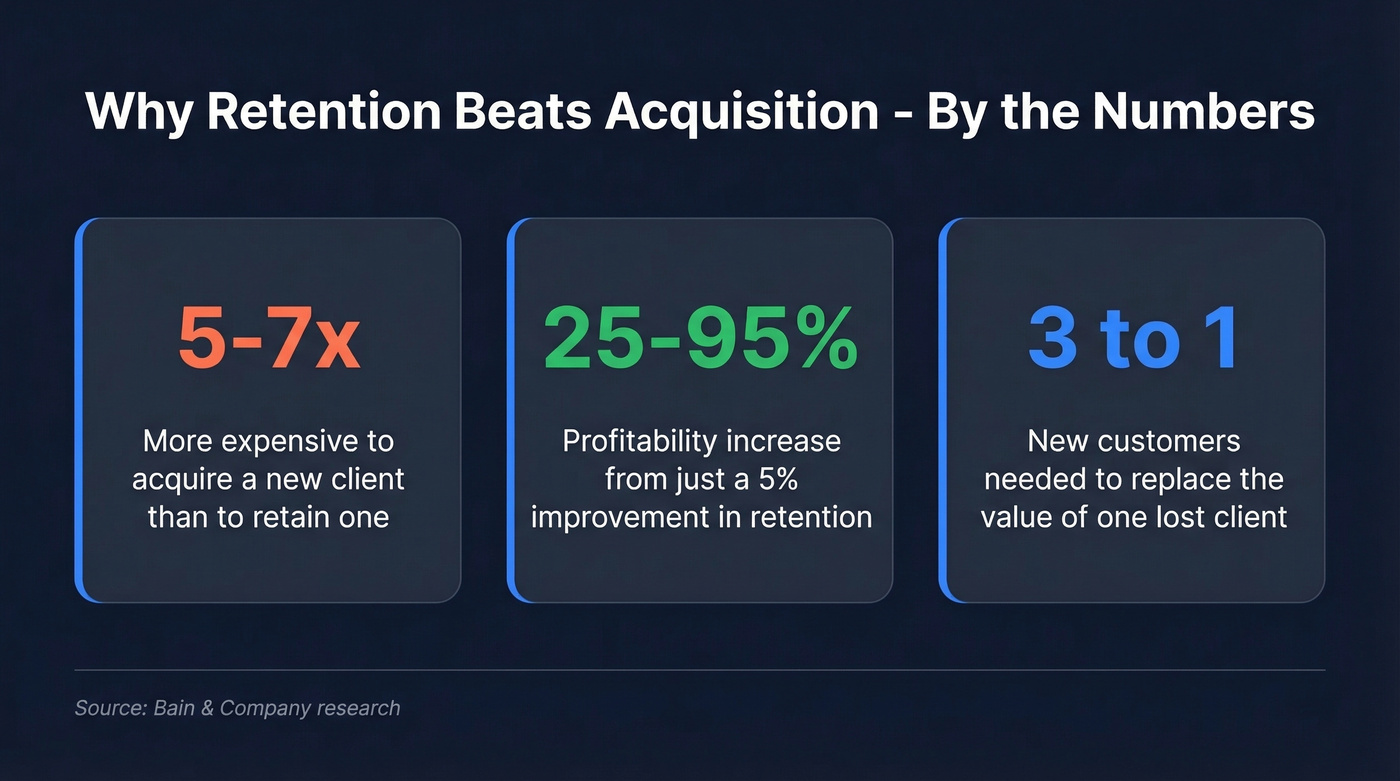
The numbers tell the story clearly. Acquiring a new client costs 5-7x more than retaining an existing one, Bain & Company's widely cited research shows that a 5% improvement in retention can increase profitability by 25-95%, and it takes roughly three new customers to replace the business value of one lost client.
Now consider the concentration risk. If 60% of your revenue comes from three clients - which isn't unusual for agencies under $5M - losing one doesn't just hurt. It threatens payroll. It forces panic hiring for new business development. It derails the quarter.
Here's the thing: most teams know retention matters, yet still allocate 80%+ of their budget and energy toward acquisition. We've seen this pattern over and over. A retained client who expands by 10% annually is worth more than two new clients who churn in 18 months. If your average deal size sits below $50K and you're spending more on new logos than on keeping existing ones happy, you're burning money.
How to Measure Client Retention
You can't improve what you don't track. Here are the metrics that matter, starting with the basics and moving to the ones that actually predict growth.
Retention Rate (CRR)
The formula is straightforward:
CRR = ((Clients at end of period - New clients acquired) / Clients at start of period) x 100
Worked example: you start Q1 with 50 clients, sign 8 new ones, and end Q1 with 52. That means you lost 6 existing clients.
CRR = ((52 - 8) / 50) x 100 = 88%
Track this monthly or quarterly. A single snapshot is meaningless - the trend tells the story. Two consecutive quarters of declining CRR is a red flag that demands investigation, not a dashboard refresh.
Churn Rate
Churn is the inverse of retention. If your CRR is 88%, your churn rate is 12%. But don't just calculate it - analyze the trend. Is churn accelerating? Concentrated in a specific segment? Happening at a predictable point in the lifecycle (month 3, month 12, post-contract renewal)?
Trend analysis turns churn from a lagging indicator into a diagnostic tool. If you want a deeper framework, use a structured churn analysis approach.
Net Revenue Retention vs. Gross Revenue Retention
CRR tells you who stayed. NRR tells you whether your business is growing or dying.
NRR measures revenue kept from existing clients, including expansions, upsells, and cross-sells. It can exceed 100%, which means your existing base is growing even without new logos. GRR strips out expansion - it only measures how much existing revenue you kept. GRR can never exceed 100%.
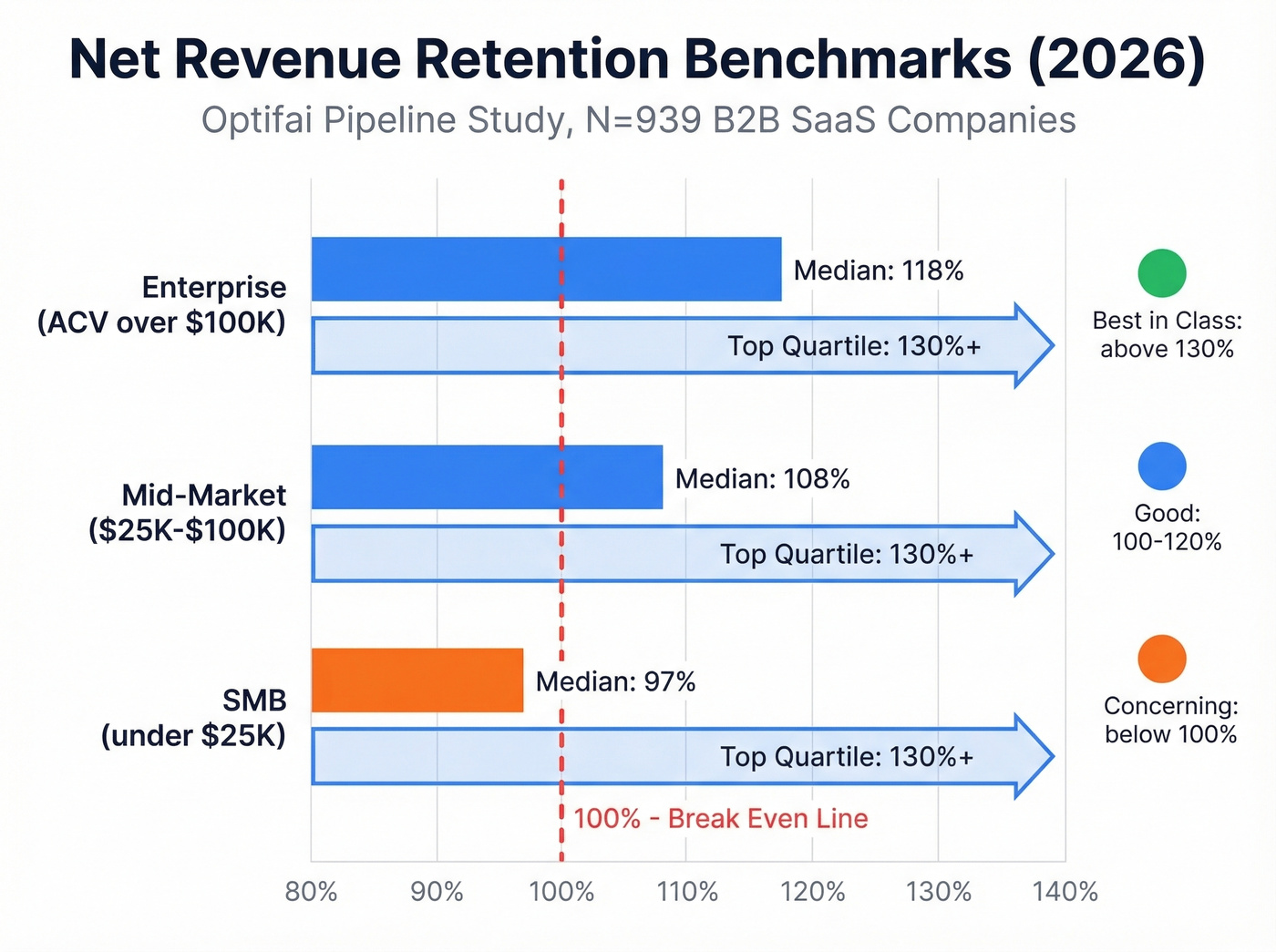
NRR is the single best predictor of sustainable growth. Companies with NRR at or above 110% grow faster than median, and investors treat it as a proxy for product-market fit. Here are the benchmarks, drawn from the Optifai Pipeline Study (2026, N=939 B2B SaaS companies):
| Segment | Median NRR | Top Quartile |
|---|---|---|
| Enterprise (ACV >$100K) | 118% | >130% |
| Mid-market ($25K-$100K) | 108% | >130% |
| SMB (<$25K) | 97% | >130% |
SaaS Capital's 2025 benchmark pegs ACV $25K-$50K at a median NRR of 102%, with top quartile at 111%.
The qualitative thresholds are clear: best-in-class is above 130%, good is 100-120%, and anything below 100% is concerning - you're shrinking from within. If you want a clean breakdown of definitions and edge cases, see Net Revenue Retention vs. GRR.
CLV, Engagement Score, and Time to Value
CLV (Client Lifetime Value) is the total revenue a client generates over the relationship. It's the ultimate retention metric, but it's a trailing indicator - by the time CLV drops, you've already lost.
Customer Engagement Score combines usage signals like login frequency, feature adoption, support tickets, and meeting attendance into a composite health indicator. It's the leading indicator that CLV can't be. Time to Value measures how quickly a new client reaches their first meaningful outcome. Structured onboarding can boost first-year retention by 25%.
Industry Benchmarks for 2026
Let's put numbers to the question everyone asks: "Is my retention rate good?" The answer depends entirely on your industry. Here are the 2026 benchmarks from FirstPageSage, based on data from 10,214 firms:
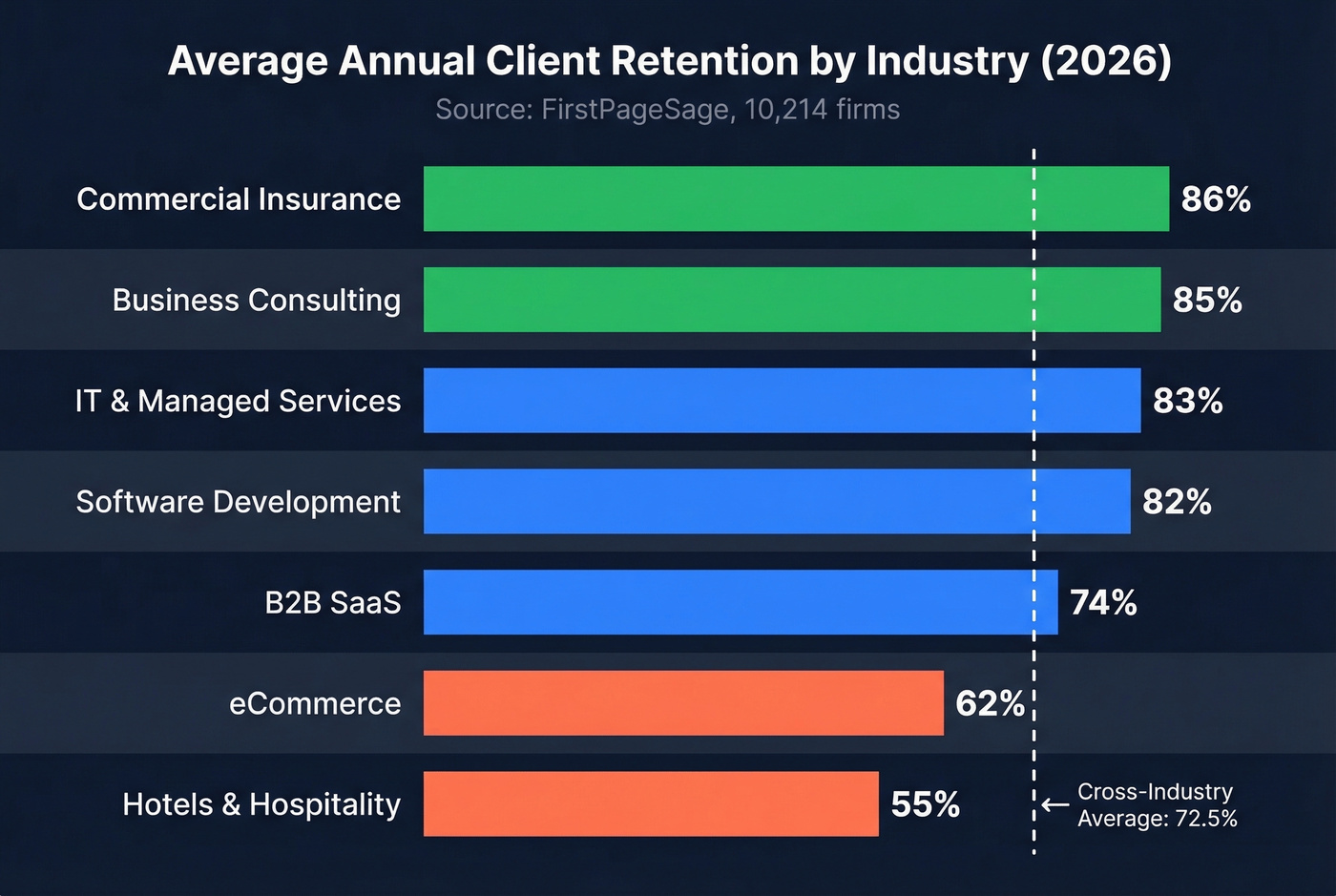
| Industry | Avg. Annual Retention |
|---|---|
| Commercial Insurance | 86% |
| Business Consulting | 85% |
| IT & Managed Services | 83% |
| Software Development | 82% |
| B2B SaaS | 74% |
| eCommerce | 62% |
| Hotels & Hospitality | 55% |
The cross-industry average sits at roughly 72.5%. If you're above that, you're doing better than most. If you're a consulting firm at 75%, you're actually underperforming your peer set by 10 points.
On the flip side, the industries with the highest churn - Financial Services at 26%, Telecom at 25%, Retail at 24% - are sectors where switching costs are low and differentiation is hard. Exactly the conditions that make a retention strategy essential rather than optional.
Don't obsess over hitting a specific number. Benchmark against your actual peer group and track the trend quarter over quarter.

Losing clients is expensive. Replacing them is worse. Prospeo helps you fill your pipeline with high-fit accounts so you're never one cancellation away from a revenue crisis - 300M+ profiles, 30+ filters including intent data, and 98% email accuracy at $0.01/lead.
Stop panic-prospecting after every lost client. Build pipeline that compounds.
Why Clients Actually Leave
Let's go back to that DOT & Company case. The client had a 5.8 ROAS. CPA was down 32%. Revenue was up 40% month over month. By every performance metric, the agency was crushing it. The client still walked.
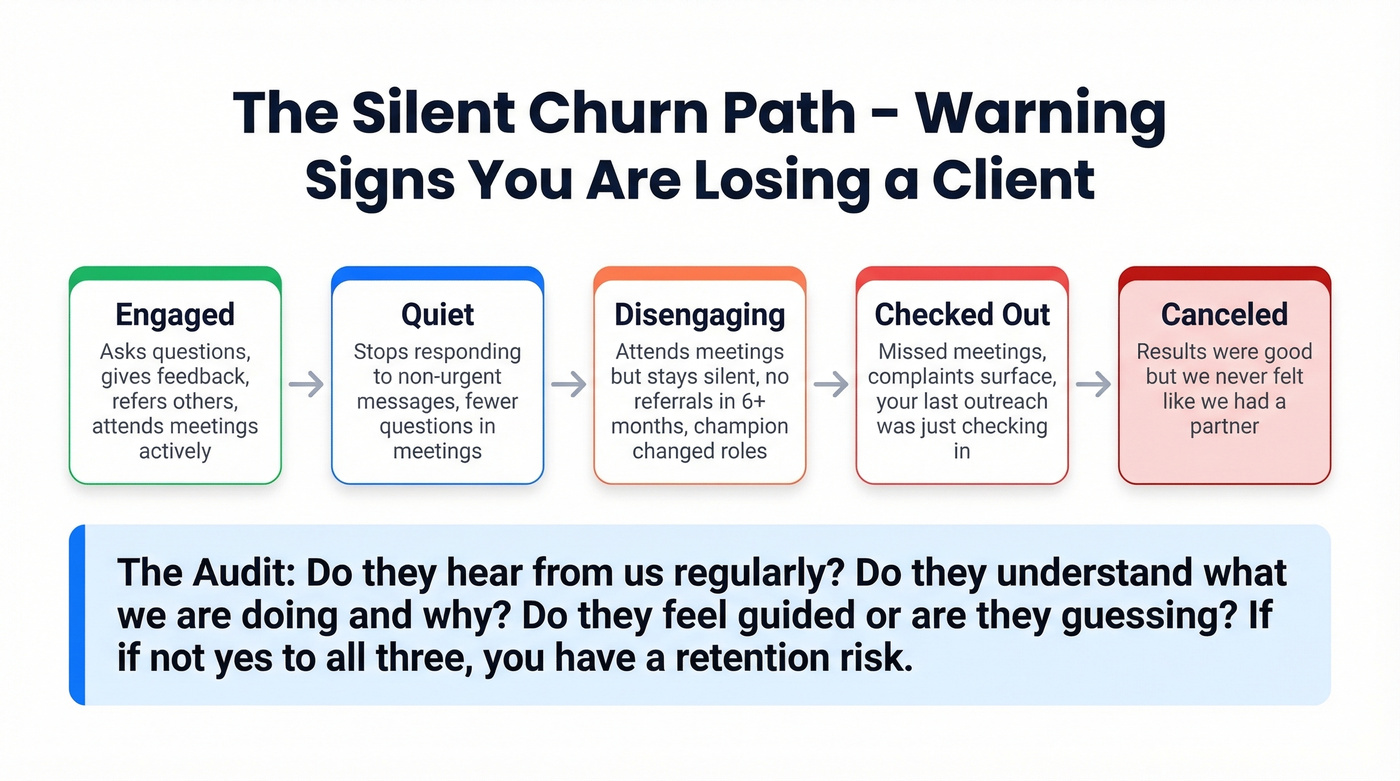
The reason wasn't results. It was the space between results - the silence, the lack of context, the feeling of being managed rather than partnered. "We never felt like we had a partner" is the most dangerous sentence in client services, because it means the relationship eroded while the dashboard looked green.
Communication gaps beat performance gaps as the #1 churn driver. The "quiet client" who stops asking questions, stops pushing back on strategy, stops engaging in calls isn't satisfied - they're disengaging. Here are the warning signs:
- They've stopped responding to non-urgent communications
- They attend meetings but don't ask questions
- They haven't referred you to anyone in 6+ months
- Their internal champion changed roles and nobody re-established the relationship
- Your last proactive outreach was "just checking in"
The audit is simple. Ask yourself three questions about every client: Do they hear from us regularly? Do they understand what we're doing and why? Do they feel guided, or are they guessing? If you can't answer yes to all three, you've got a retention risk - regardless of what the metrics say.
Strategies to Improve Client Retention
The First 90 Days: Onboarding
Most churn is decided in the first 90 days. Not executed - decided. The client forms an opinion about whether this relationship will work, and that opinion hardens fast.
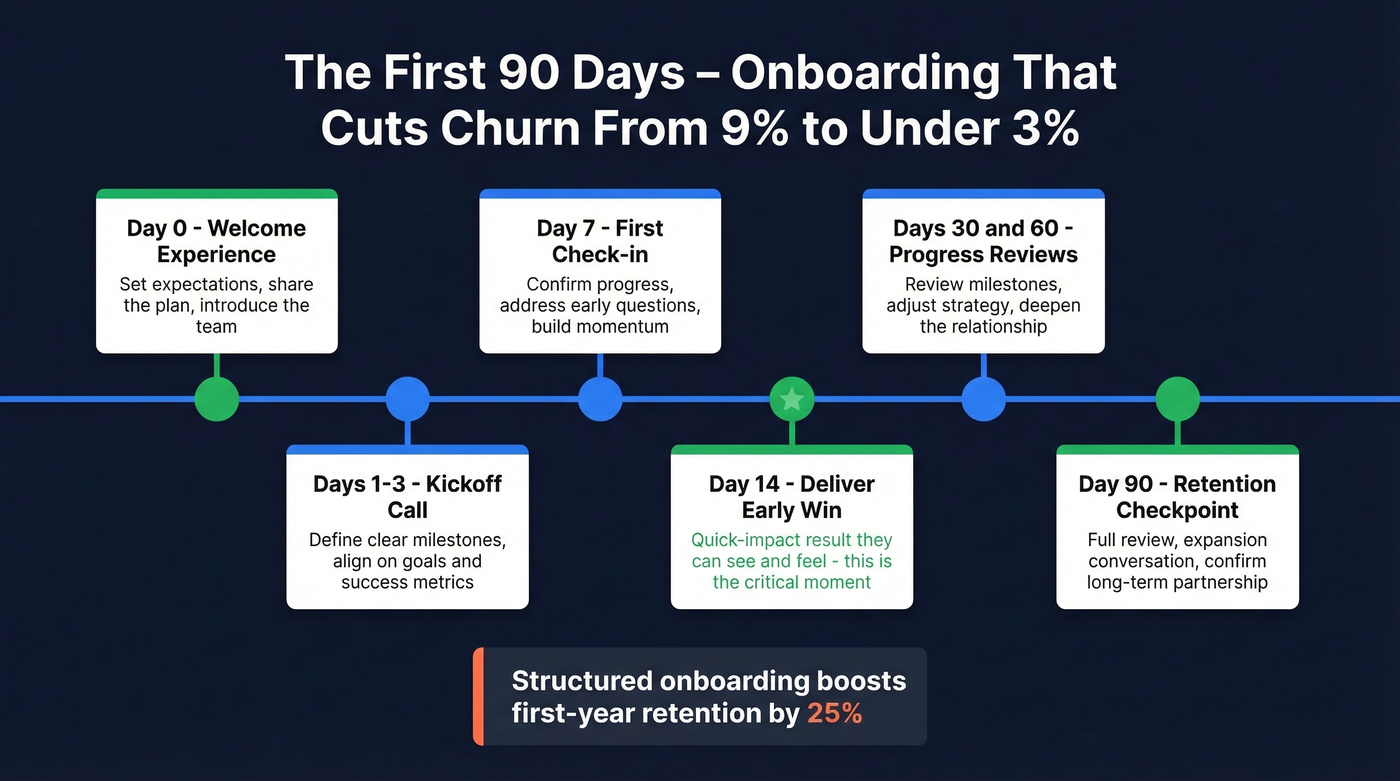
One agency documented their approach to structured onboarding and reduced churn from 9% to under 3%. Their playbook wasn't complicated: a welcome experience that set expectations, a kickoff call with clear milestones, mapped touchpoints at days 7, 14, 30, 60, and 90, and a deliberate focus on delivering an early win within the first two weeks. That early win doesn't need to be transformative - it needs to be visible. A quick-impact campaign, a data insight they hadn't seen before, a process improvement that saves them time. Something that makes the client think, "Okay, this was a good decision."
If you want a simple structure for those early milestones, a 30-60-90 day plan format works surprisingly well for services, too.
Proactive Communication Cadence
Regular reporting isn't communication. Sending a dashboard link every Monday isn't communication.
Real communication means context - explaining not just what happened, but why it happened, what it means, and what you're doing about it. Build a cadence: weekly status updates with narrative context, monthly strategy reviews, and quarterly business reviews that connect your work to their business outcomes. The QBR is where you shift from vendor to partner. Come with data, come with recommendations, come with a point of view on what's next. Don't wait for the client to ask "what should we do?" - tell them.
Client education fits naturally into this cadence. Share relevant industry research, invite clients to webinars, run brief strategic workshops that help them understand the "why" behind your recommendations. Clients who understand your methodology trust it more - and trust is the currency of retention.
One more thing: know when to automate and when to show up personally. Health scoring alerts, weekly dashboards, and status updates can run on autopilot. QBRs, re-engagement conversations, and strategic pivots demand a human in the room. The agencies that confuse these two modes are the ones losing clients to "we never felt like we had a partner." If you want to tighten the narrative and touchpoints, borrow from proven sales communication patterns.
Client Health Scoring
Not every client needs the same level of attention. A health scoring framework helps you allocate effort where it matters most.
Define three bands: Healthy (engaged, expanding, referring), At-risk (declining engagement, slower response times, no expansion conversations), and Critical (missed meetings, complaints, champion departure). Track signals like engagement frequency, NPS responses, feature or service adoption, and response time to your outreach.
A data point that should shape your scoring model: customers using more than 70% of core features are twice as likely to stay. If a client is only engaging with half of what you offer, that's not a cross-sell opportunity - it's a churn signal. Build feature adoption into your health score alongside the engagement metrics. Even a simple red/yellow/green spreadsheet beats gut instinct. (If you want to formalize the scoring logic, a lead scoring rubric is a good template.)
Re-Engaging Quiet Clients
Skip this if all your clients are actively engaged, responsive, and expanding. For the rest of us - which is everyone - here's the playbook.
Clients go quiet for predictable reasons: value isn't being reinforced, priorities shifted internally, the relationship became transactional, or they stopped receiving proactive guidance. The fix isn't a "just checking in" email. If that's your last outreach, you've already lost the thread. If you need better language, use these how to say "just checking in" professionally options.
Q1 is the best time to re-engage because clients are reassessing budgets, goals, and vendors. Come with data, recommendations, and clear next steps. Frame the conversation around their goals, not your services. "Based on your Q4 results, here are three opportunities we see for this quarter" beats "wanted to touch base" every single time.
Expansion and Renewal
The best retention strategy is making yourself more valuable over time. Bundled service packages deepen the relationship and increase switching costs naturally. But timing matters - upsell after you've demonstrated value, not before. A client who just saw a great quarter is receptive to "here's how we can build on this." A client who hasn't seen results yet will hear "here's how we can charge you more."
Referral programs serve double duty: they generate new business and they're a retention signal. Clients who refer you are clients who've internalized your value. If referrals dry up, that's diagnostic information. (If you want to sharpen the mechanics, see cross-selling vs. up-selling.)
Retention for Agencies and Services Firms
For agencies specifically, retention has a structural dimension that pure SaaS companies don't face. 34% of agencies retain clients for 2-5 years, and 26.7% keep clients for over 5 years. Those are strong numbers - but they mask the reality that losing even one major client can crater a small agency's revenue.
Assign a customer success owner, even on a small team. This doesn't need to be a dedicated CSM hire - it can be a senior account manager whose explicit responsibility is keeping clients, not just delivering work. The point is that someone owns the relationship, not just the output.
Client self-service portals reduce the "chasing updates" friction that quietly erodes trust. When a client can log in and see campaign status, deliverables, and timelines without emailing you, they feel informed rather than ignored.

Here's a retention lever that agencies consistently underestimate: data quality. When you're running outbound campaigns for clients, your prospect data is the foundation of everything. Bad contact data leads to high bounce rates, wasted ad spend, and eroded trust. The client doesn't blame the data provider - they blame you.
When outreach campaigns bounce at 15-20%, the client sees incompetence, not a data sourcing problem. Stack Optimize built their agency to $1M ARR using Prospeo, maintaining deliverability above 94%, bounce rates under 3%, and zero domain flags across all clients. That's the kind of operational reliability that keeps clients renewing. If bounce is a recurring issue, start with email bounce rate benchmarks and fixes.
Your data quality is your client's first impression of your competence. Every bounced email, every "this person left the company six months ago" reply, every spam folder landing - it all compounds into a trust deficit that no QBR can fix. The consensus on r/sales and r/coldemail backs this up: threads about agency churn almost always circle back to deliverability and data hygiene as root causes. If you need a systematic fix, use an email deliverability guide to diagnose the stack.
Tools That Improve Retention
The right tools don't replace strategy, but they make execution consistent. Here's what's worth evaluating across three categories.
Data quality is where most agencies and outbound teams have the biggest gap. Prospeo covers 300M+ professional profiles with 98% email accuracy, verified on a 7-day refresh cycle through a proprietary 5-step verification process. The free tier gives you 75 emails per month plus 100 Chrome extension credits - enough to verify a campaign list before it goes live. Paid plans run roughly $0.01 per email with no contracts.
For CRM and client management, HubSpot Service Hub has a free tier, with paid plans starting around $20-$100/month per seat depending on features. Salesforce Service Cloud runs $25-$330/user/month depending on edition and makes sense if you're already in the Salesforce ecosystem. Our recommendation for teams with fewer than 20 clients: HubSpot's free tier handles everything you need. Don't overcomplicate it. If you're still comparing options, start with examples of a CRM to map features to your workflow.
For customer success, ChurnZero typically runs $1,500-$5,000/month depending on customer count and modules - a strong option for SaaS teams serious about reducing churn. Gainsight is the enterprise standard at $2,500-$10,000+/month: powerful, but heavy and expensive enough that you should be managing hundreds of accounts to justify it. Totango has offered a free tier historically, with paid plans starting around $2,500/month, and it's worth considering if you want to test customer success tooling before committing to a larger platform.
| Tool | Category | Starting Price | Best For |
|---|---|---|---|
| Prospeo | Data quality | Free (75 emails/mo + 100 extension credits) | Agencies, outbound teams |
| HubSpot Service Hub | CRM / client mgmt | Free / ~$20-$100/mo/seat | SMB service teams |
| Salesforce Service Cloud | CRM / client mgmt | ~$25-$330/user/mo | Mid-market / enterprise |
| ChurnZero | Customer success | ~$1,500/mo | SaaS retention teams |
| Gainsight | Customer success | ~$2,500/mo | Enterprise CS orgs |
| Totango | Customer success | Free tier available / ~$2,500/mo | Mid-market CS teams |
The best retention strategy? Never stop sourcing new business. Prospeo's intent data tracks 15,000 topics so you find in-market buyers before competitors do - replacing churned revenue before it hits your P&L. Data refreshes every 7 days, not 6 weeks.
Replace churned revenue faster than clients can cancel.
FAQ
What is a good client retention rate?
The cross-industry average is roughly 72.5%, per FirstPageSage's 2026 report covering 10,214 firms. Business consulting averages 85%, B2B SaaS 74%, and eCommerce 62%. Benchmark against your peer group, not a universal number - a consulting firm at 75% is actually underperforming by 10 points.
How do you calculate the retention rate?
CRR = ((Clients at end of period - New clients acquired) / Clients at start of period) x 100. Track it monthly or quarterly and watch the trend over time, not a single snapshot. Two consecutive quarters of decline warrants immediate investigation into segment-level causes.
What's the difference between client and customer retention?
"Client" implies a relationship-based, typically B2B context - agencies, consulting, professional services - while "customer" is broader and often transactional. Clients need partnership and proactive communication; customers need convenience and product reliability. The strategies diverge significantly.
How does data quality affect client retention?
For agencies running outbound campaigns, bad contact data causes high bounce rates, wasted budget, and eroded trust. A 15% bounce rate makes you look incompetent regardless of strategy. Keeping bounce rates under 3% with verified, regularly refreshed data protects both deliverability and the client relationship.
What is net revenue retention?
NRR measures revenue kept from existing clients including expansions and upsells, so it can exceed 100%. Median NRR for enterprise SaaS is 118%, and best-in-class exceeds 130%. It's the single best predictor of sustainable growth because it reveals whether your existing base is expanding or contracting.