

Close Deals Faster in 2026: Benchmarks, Formula, and 8 Levers That Work
Your best rep just lost a deal that sat in "verbal commit" for six weeks. The champion went quiet, procurement ghosted, and a competitor with a faster legal process closed it instead. That's not a fluke - it's the new normal. Sales cycles have lengthened 32% since 2021 (36% for enterprise), and reps spend roughly two hours a day actually selling.
Longer cycles, less selling time, same quota. Books like the Asher Sales Method cover closing psychology, but most teams don't have a closing problem. They have a pipeline quality and cycle-time problem.
Three Things That Matter Most
Build a qualification scoring system. If your win rate is below 50%, that's a qualification problem, not a closing problem.
Use a Mutual Action Plan on every deal above $10K. Deals with MAPs carry a 26% higher win rate, yet only 45% of sellers use them consistently.
Fix your contact data. Bounced emails and disconnected numbers silently inflate every cycle. Reps can't close deals they can't reach.
Sales Cycle Benchmarks
"Faster" means nothing without a number.
| Segment | Avg. Cycle (Days) |
|---|---|
| Software | 90 |
| Financial Services | 98 |
| Manufacturing | 130 |
| Healthcare | 125 |
| Retail | 70 |
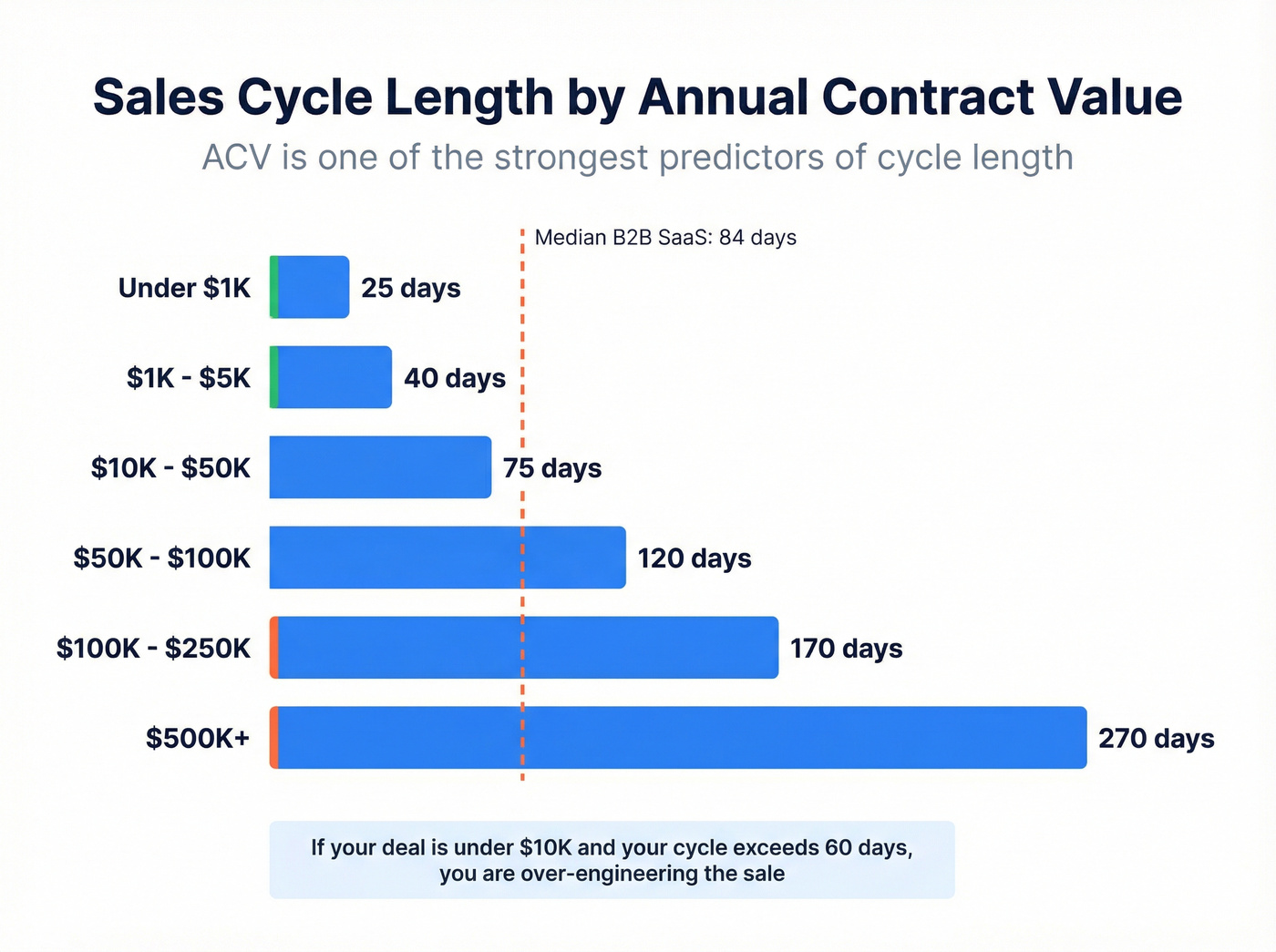
ACV is one of the strongest predictors of cycle length, often outweighing industry entirely:
| ACV | Avg. Cycle (Days) |
|---|---|
| Under $1K | 25 |
| $1K-$5K | 40 |
| $10K-$50K | 75 |
| $50K-$100K | 120 |
| $100K-$250K | 170 |
| $500K+ | 270 |
The median B2B SaaS cycle is 84 days, with an optimal range of 46-75 days. If you're above 84, you've got a structural problem, not "tough buyers."
Here's the thing: if your average deal is below $10K and your cycle exceeds 60 days, you're over-engineering the sale. Simplify the process before optimizing tactics.
Pipeline Velocity Formula
Every RevOps team should have this on a dashboard:
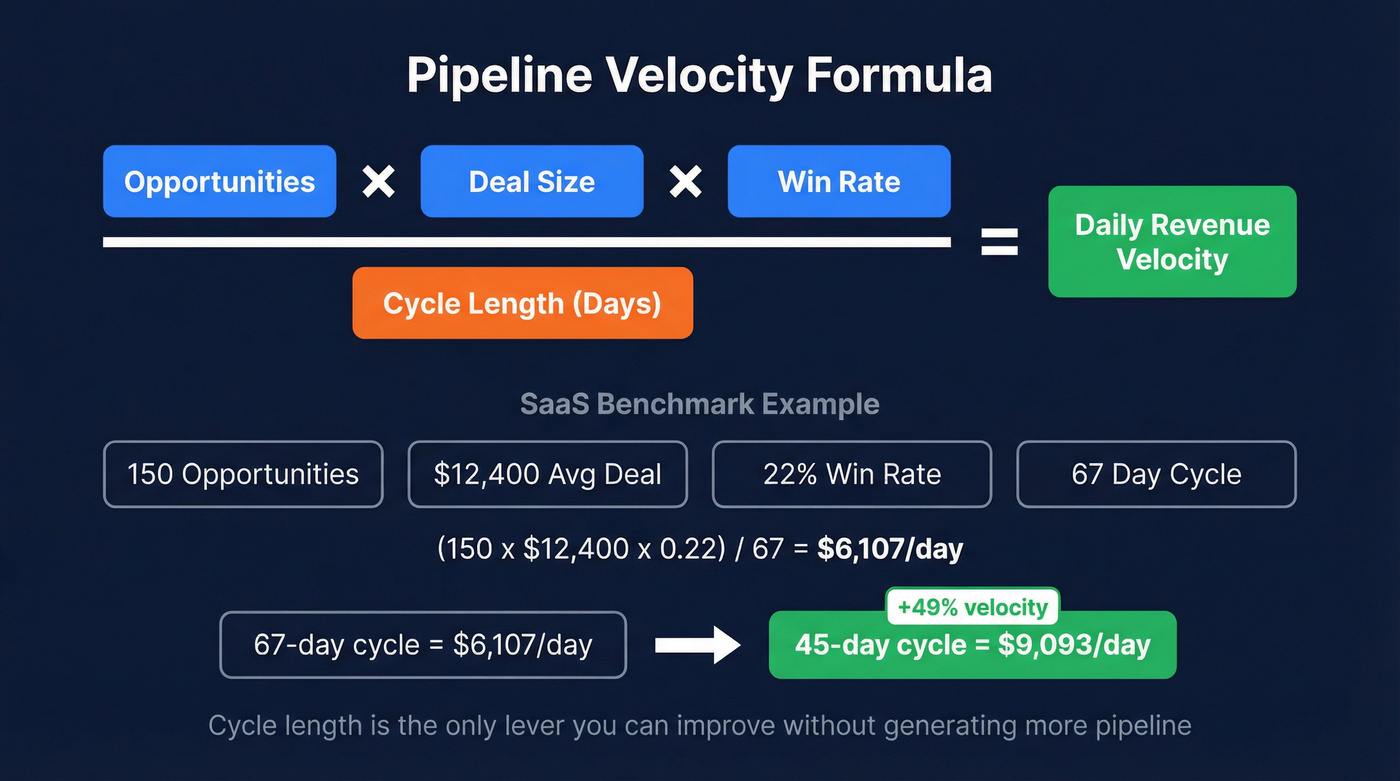
(Opportunities x Deal Size x Win Rate) / Cycle Length = Daily Revenue Velocity
A study of 247 B2B organizations found SaaS companies average $1,847/day in pipeline velocity, with a median deal of $12,400, a 22% win rate, and a 67-day cycle. Cutting your cycle to 30-45 days corresponds to 38% higher velocity versus the 76-90 day baseline.
The denominator is the only lever you can improve without generating more pipeline or changing your product. A shorter time-to-close multiplies revenue without a single extra lead. And teams that track velocity weekly see 34% revenue growth versus 11% for teams that check ad-hoc. Measurement frequency alone moves the number.

Bad contact data is the invisible cycle killer. Every bounced email and disconnected number adds days to your pipeline velocity denominator. Prospeo delivers 98% email accuracy and 125M+ verified mobile numbers on a 7-day refresh cycle - so reps reach decision-makers on the first attempt, not the fifth.
Stop losing deals to data decay. Fix the denominator.
Why Deals Stall Late
Most teams diagnose stalled deals wrong. They blame "the buyer isn't ready" when the real causes are structural. We've watched deals die in "verbal commit" for weeks, and the fix is almost never what reps think.
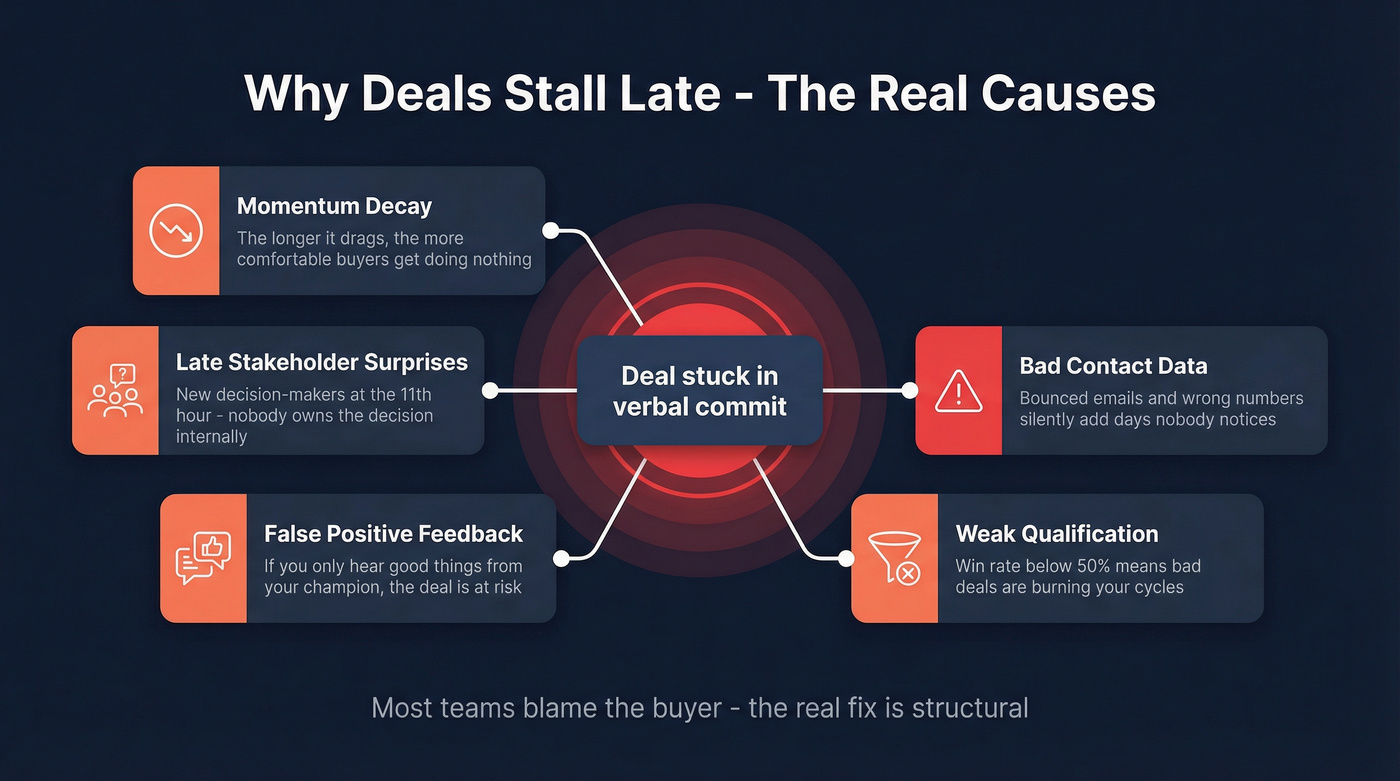
Momentum decay. The longer a deal drags, the more comfortable buyers get doing nothing. As one r/sales practitioner put it, loss of momentum is the single biggest deal killer - not competition.
Late-stage stakeholder surprises. New decision-makers at the eleventh hour signal nobody owns the decision internally. This is a qualification failure that shows up disguised as a timing problem.
False positive feedback. If you only hear positive things from your champion, the deal is at risk. Real champions share internal friction. Generic ROI slides don't help either - unless the numbers are in the buyer's language and tied to their specific priorities, they're wallpaper.
Weak qualification. A win rate below 50% means you're letting bad deals into the pipeline and burning cycles on them.
Bad contact data. This one's invisible. When emails bounce, reps aren't prospecting - they're guessing. Days evaporate without anyone noticing.
8 Strategies to Close Deals Faster
1. Qualify Harder
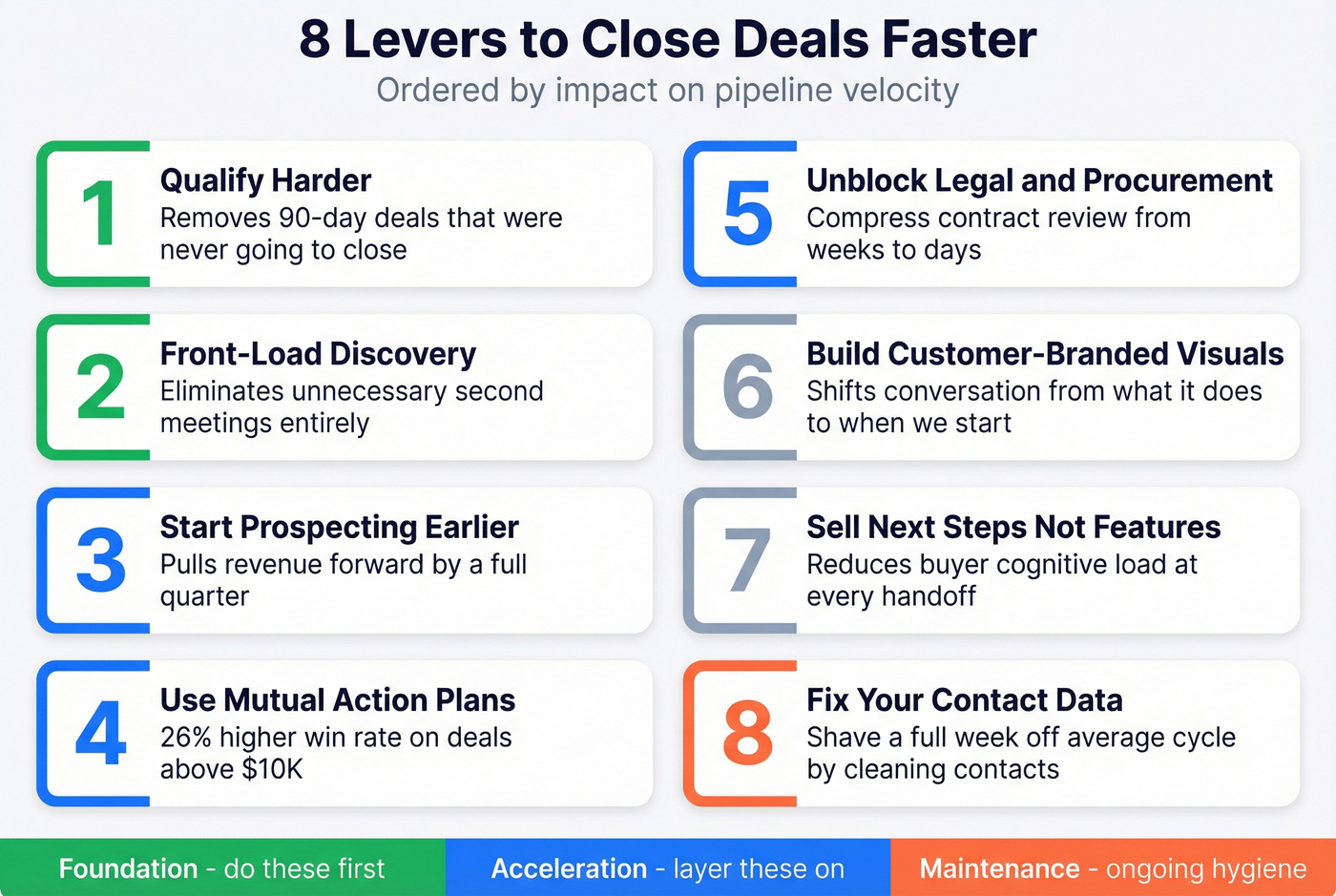
Win rate below 50%? Stop looking at your closing techniques and look at your pipeline entrance criteria. Build an opportunity rating system that scores deals on budget authority, timeline, and technical fit before they consume a single demo slot. The fastest way to shorten your average cycle is to stop counting the 90-day deals that were never going to close.
If you need a starting point, borrow a proven lead scoring rubric and adapt it to your ICP.
2. Front-Load Discovery
Send five targeted questions before the demo. One practitioner on r/sales reports 60-75% of prospects complete them, the demo becomes focused, and the second meeting gets eliminated entirely. This works especially well for deals in the $3K-$5K range, but the principle scales up. If you want to speed up a sales cycle, eliminating unnecessary meetings is one of the highest-impact moves available.
If you want better prompts, use a tight set of discovery questions that map to budget, impact, and timeline.
3. Start Prospecting Earlier
The velocity clock doesn't start until you have an opportunity. If your average cycle is 90 days, creating that opportunity 90 days earlier pulls revenue forward by a full quarter. One Gradient Works customer trimmed account books from 500+ to 150 focused accounts and saw win rates climb from 13% to over 20% in under a year. Fewer accounts, better research, faster closes.
To build more consistent top-of-funnel, pull from these sales prospecting techniques and standardize them across the team.
4. Use Mutual Action Plans
A MAP is a shared roadmap with actions, milestones, owners, and dates. Outreach's data shows deals with MAPs carry a 26% higher win rate - yet only 45% of sellers use them consistently.
Given that buying groups now run 6-10 people, each consulting 4-5 sources, a MAP is the only artifact that keeps everyone aligned. In our experience, deals without a MAP are far more likely to ghost after the second meeting. Build it, co-own it with your champion, update it weekly. Skip this if your average deal is under $5K - a simple email recap with next steps works fine at that price point.
If you're selling six-figure deals, align MAPs to your enterprise B2B sales motion (stakeholders, security, procurement, and rollout).
5. Unblock Legal and Procurement
Deals don't die in boardrooms. They stall in legal reviews. And 69% of buyers complete their research before ever contacting sales, so by the time a deal reaches legal, the decision is already emotionally made. Every day of contract review is a day for doubt to creep in.
Pre-benchmark your contract terms against market standards so legal review focuses only on meaningful deviations. For security questionnaires, automation cuts turnaround from 1-2 weeks to 1-2 days.
6. Build Customer-Branded Visuals
Show the product in the buyer's world. Build a screenshot generator or branded mockup tool, then use it in pre-demo emails and follow-ups. Practitioners on Reddit swear by this - when the buyer sees their logo on your product, the conversation shifts from "what does it do?" to "when can we start?"
This pairs well with a tighter product demo checklist so every rep runs the same high-signal flow.
7. Sell Next Steps, Not Features
End every call with a specific next action. Bold the next steps in your follow-up email. Try: "Based on what we covered, the next step is a 20-minute technical review with your team on Thursday. I'll send the invite now."
The goal is reducing buyer cognitive load. They shouldn't have to figure out what happens next. Speed comes from removing friction at every handoff, not just the final signature.
If your follow-ups are inconsistent, standardize them with a few sales follow-up templates and enforce them in your CRM.
8. Fix Your Contact Data
Bad emails and disconnected numbers silently add days to every deal. Reps send sequences into the void, wait for replies that never come, and the cycle inflates without anyone noticing. We've seen teams shave a full week off their average cycle just by cleaning up their contact lists.
Prospeo verifies emails at 98% accuracy on a 7-day refresh cycle, so reps start every sequence with contacts that actually work. Snyk's 50-person AE team dropped bounce rates from 35-40% to under 5% and grew AE-sourced pipeline 180% - over 200 new opportunities per month. That's what happens when reps stop wasting time on dead contacts.
If you're evaluating vendors, start with a shortlist of data enrichment services and compare refresh rates and verification methodology.
When to Build a Deal Desk
Once you hit 20-30 reps or start selling enterprise, a deal desk becomes essential. The warning signs: inconsistent pricing across reps, approval delays killing momentum, and executives drowning in one-off deal reviews.
A well-run deal desk compresses internal approval from 1-2 weeks to 1-3 days. That's time your competitor is using to close while you're waiting on a Slack thread.
To keep approvals from wrecking your quarter, track pipeline health alongside cycle time and stage conversion.
The Bottom Line
Let's be honest - if you want to close deals faster, stop treating it like a "closing technique" problem. Measure pipeline velocity weekly, tighten qualification, run MAPs on any meaningful deal, and remove the silent killer: bad contact data. Do those three things and most "stalled" deals either move forward quickly or disqualify fast, which is also a win.
If you want a broader framework, map these levers into a full sales process optimization plan so improvements stick beyond one quarter.
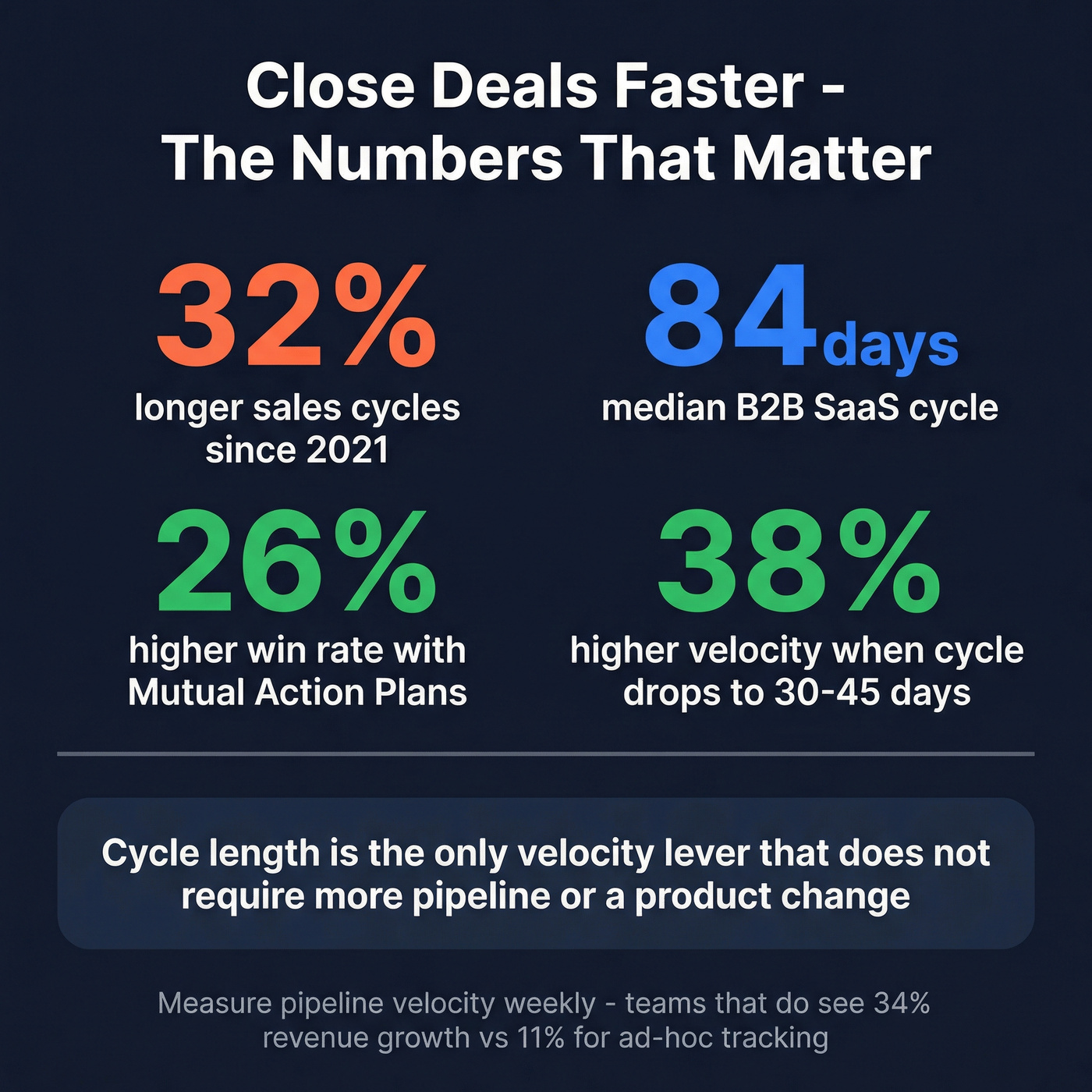
You just read that trimming cycle length is the only velocity lever that doesn't require more pipeline. Prospeo customers like Snyk cut bounce rates from 35% to under 5% and grew AE-sourced pipeline 180% - because reps stopped wasting hours chasing bad numbers and started selling. At $0.01 per verified email, the math is obvious.
Every day your reps can't reach buyers is a day competitors close them.
FAQ
What's a good benchmark if I want to close deals faster?
Under $5K should close in 25-40 days, while $100K+ typically takes 120-170 days. The median B2B SaaS cycle is 84 days - if you're consistently above your ACV benchmark, your biggest levers are qualification discipline and late-stage momentum through MAPs and clean next steps.
Do discounts help close sales deals faster?
Discounts rarely speed up real decisions. They mostly train buyers to wait and create pricing precedent you'll regret. If you need a discount to "create urgency," assume you've got weak qualification or unclear ROI - fix the business case and align stakeholders instead of cutting price.
How does bad contact data slow down deals?
Bad contact data adds 3-10 days of dead time per stage because reps chase bounced emails, wrong titles, and disconnected numbers. A practical target is keeping bounce rates under 5%. If you're above that, prioritize verification and enrichment before you touch messaging or cadence.