

The Cold Call Appointment Setting Script That Actually Books Meetings
69% of B2B buyers accept cold calls. The average cold call appointment setting script converts at around 2.35%. That gap is where your meetings live.
Here's the exact framework, the funnel math, and the follow-up sequence that separates reps booking 12+ meetings a month from reps burning out at three.
Know Your Numbers First
Before you touch your script, run a diagnostic. One Reddit practitioner tracked 820 dials over a month: 124 connects, 32 conversations, 12 booked meetings - roughly 72 dials per meeting. The industry baseline sits around 2.35%, but it varies wildly by vertical.
If you want to pressure-test your math, map it to your full funnel metrics (connect rate → conversation rate → meeting rate).
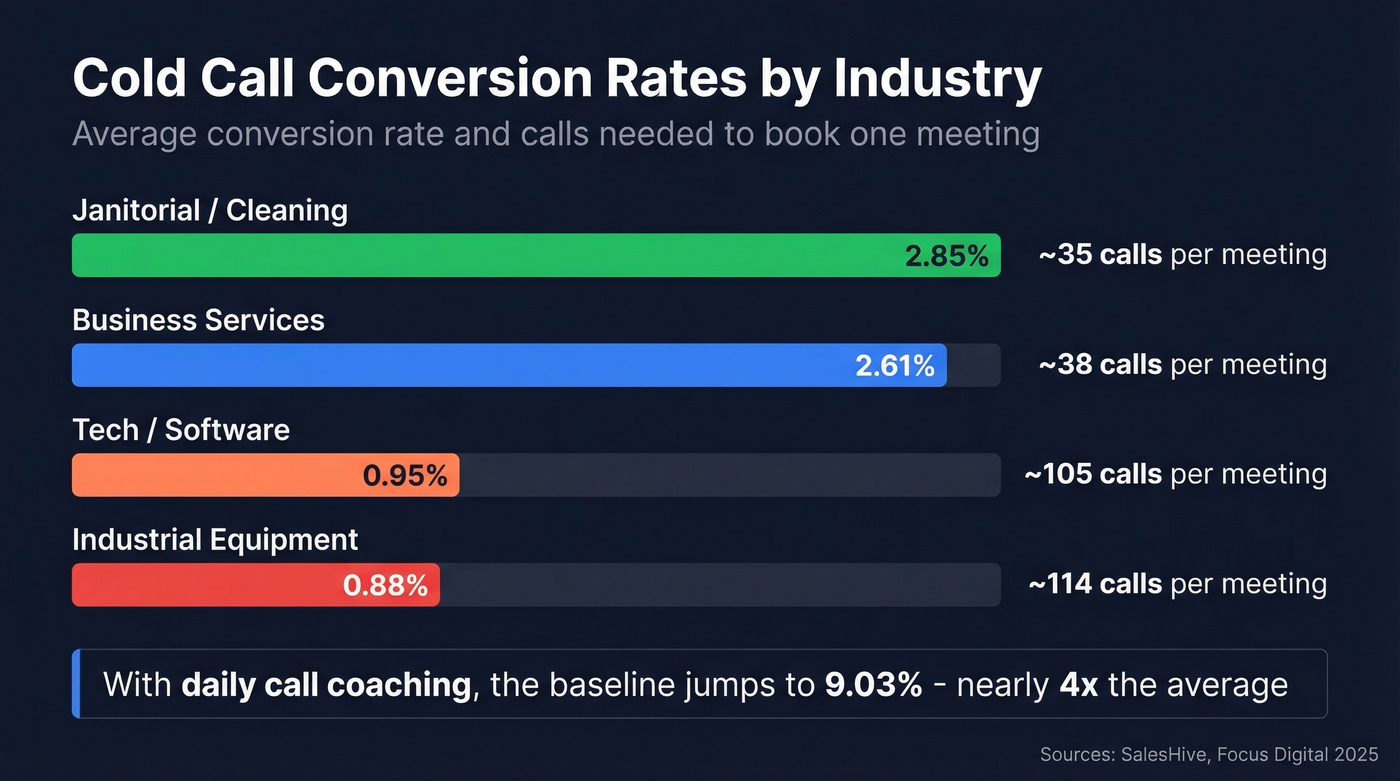
| Industry | Avg. Conversion | Calls per Meeting |
|---|---|---|
| Janitorial/cleaning | 2.85% | ~35 |
| Business services | 2.61% | ~38 |
| Tech/software | 0.95% | ~105 |
| Industrial equipment | 0.88% | ~114 |
Daily call coaching pushes that baseline to 9.03% - nearly 4x the average. It takes an average of 18 dials to reach a single decision-maker, so every connect matters.
If your connect rate is below 10%, the problem isn't your script. It's your data. We've seen teams triple their connect rate overnight just by switching to fresh, verified numbers. Verify your list before each call block - stale numbers are the silent killer of cold call campaigns.
If you're rebuilding your outbound list from scratch, start with a tighter Ideal Customer Profile so you’re not dialing the wrong accounts.
The Sales Call Script for Appointment Setting
You don't need seven scripts for seven scenarios. You need one framework you've practiced 100 times. Reps who master a single talk track outperform reps juggling scenario-specific scripts because they sound natural, not rehearsed. Whether you're cold calling for appointments in SaaS or services, the structure is the same.
If you want more variations without overcomplicating it, pull a few talk track examples and keep the same skeleton.
The Opener (First 15 Seconds)
"Hey [first name], this is [your name] from [company] - I'll be honest, this is a cold call. Give me 18 seconds and you can decide if we keep talking."
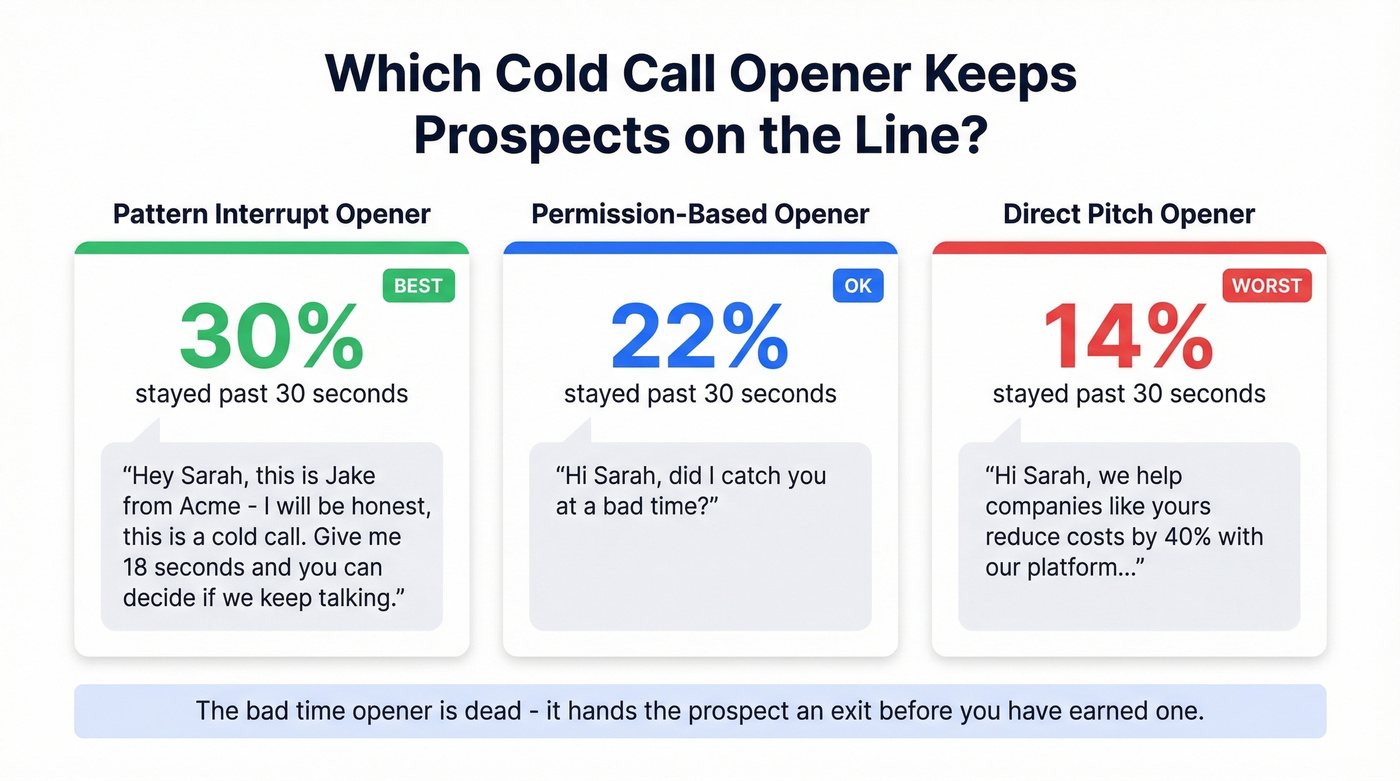
That pattern-interrupt approach kept 30% of prospects on the line past 30 seconds. A permission-based opener ("Did I catch you at a bad time?") held 22%. A direct pitch? Just 14%.
The "bad time" opener is dead. It hands the prospect an exit before you've earned one.
Value Prop + Qualification (20 Seconds)
"We do [coolest feature] for companies in your space like [competitor 1] and [competitor 2] - they use us to [result]."
Two sentences max. Don't pitch features. Name companies they'd recognize and a result they'd want. Then transition: "Is [specific problem] something your team's dealing with right now?" ProSalesConnection's research confirms the biggest mistake is dragging the hook past two or three sentences.
If you struggle to keep it tight, treat it like an elevator pitch: one clear problem, one clear outcome.
The Calendar Close
"The purpose of my call was to set aside half an hour later this week. Does [time] on [day] work?"
Then pause. Two full seconds. Don't fill the silence. That pause forces a response to a specific ask, not a vague "would you be open to chatting sometime?" The goal is to sell the meeting, not the product - your script only needs to earn 30 minutes on a calendar, nothing more. In our experience, asking for 15 minutes instead converts better because it feels low-risk to the prospect.
If you want a broader framework for moving from conversation to commitment, see the steps to close a sale.

It takes 18 dials to reach one decision-maker. Every wrong number kills your momentum. Prospeo gives you 125M+ verified mobile numbers with a 30% pickup rate - refreshed every 7 days so you're never calling stale data.
Stop burning dials on dead numbers. Start connecting.
Handling the 4 Real Objections
Top performers maintain a 40:60 talk-to-listen ratio. When an objection lands, respond with curiosity - not a counter-pitch.
If objection volume is spiking, it’s usually a targeting or messaging issue - use a simple reduce sales objection rate checklist to diagnose.
"I'm not interested."
"Totally fair - you don't have the full picture yet. If I could show you how we help [specific outcome] in 90 seconds, would that be worth it?"
This reframes "not interested" as "not informed." 60% of cold calls hit this objection as a reflex, not a real no. It's the one objection worth pushing through every single time.
"Send me an email."
"Happy to - but can I ask one quick question first? If it's not relevant, I'll send the email and get out of your way."
"I'm too busy right now."
"Completely understand. Could I take 90 seconds to explain why [competitor] made time for this?"
Both of these are stall tactics, not rejections. They buy you 15 more seconds, which is often enough to open a real conversation. Respect the constraint, then give them a reason to stay.
"I'm not the decision maker."
Don't argue. Ask: "Who typically handles [area] decisions?" Collect the referral and move on. That name is gold - 57% of C-level and VP buyers actually prefer phone contact, so the referral often leads to a warmer conversation than your original dial.
Here's the thing: if you're consistently hitting gatekeepers, call before 8:30 AM or after 5:30 PM. Fridays work too - gatekeepers leave early, but executives don't.
If you’re newer to this, a repeatable cold calling system helps you stay consistent across call blocks.
When to Call for Maximum Bookings
ZoomInfo's 1.4M-call dataset and Cognism's State of Cold Calling Report agree on the broad strokes.
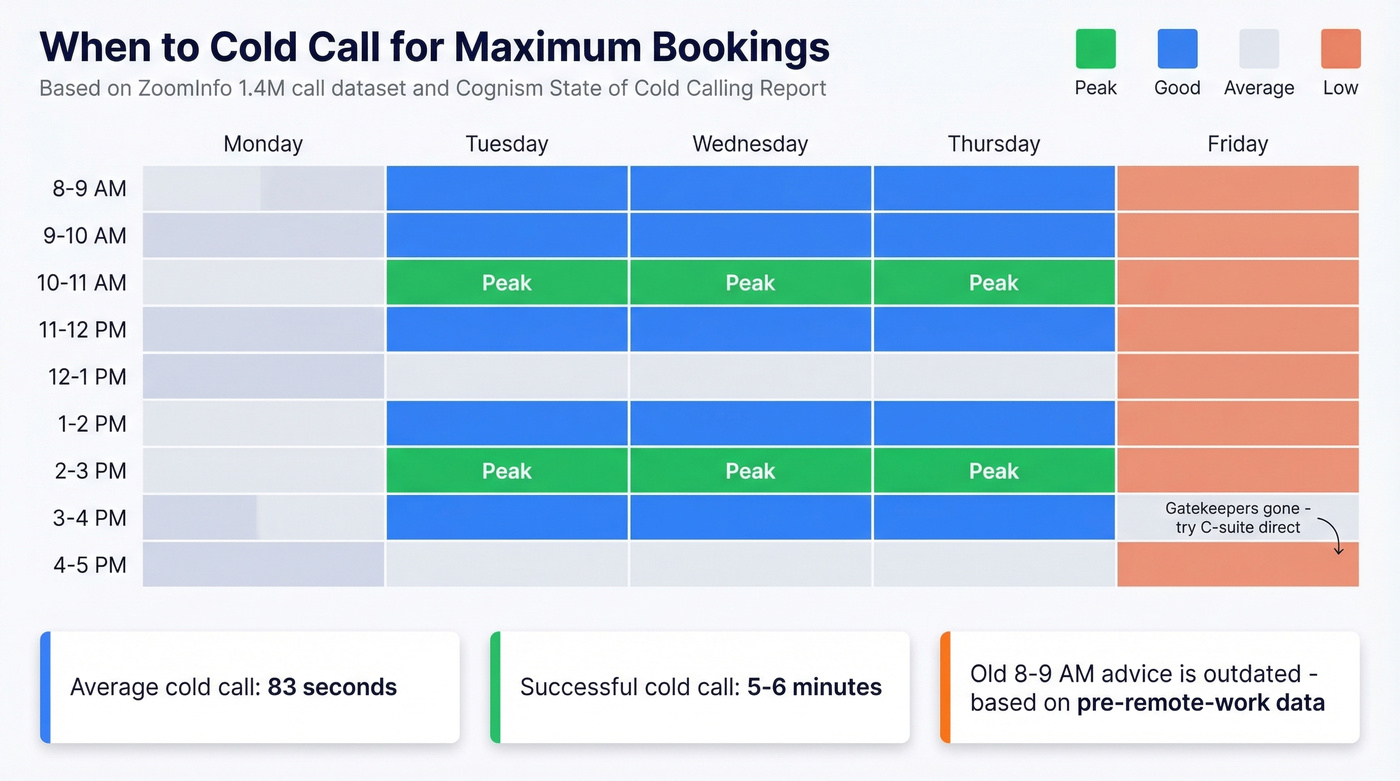
| Day | Demo Conversion | Notes |
|---|---|---|
| Tuesday | Highest | Primary outreach day |
| Wednesday | Strong | Best for follow-ups |
| Thursday | Solid | Decision-maker availability peaks |
| Friday | Lowest | Gatekeepers gone - try C-suite direct |
Best hours: 10-11 AM, then 2-3 PM. The old HubSpot claim that 8-9 AM and 4-5 PM are optimal is based on a recycled KISSMetrics infographic - the underlying data predates modern remote-work patterns. The average cold call lasts 83 seconds. Successful ones run about 5-6 minutes.
To coordinate timing across channels, pair this with the best time to send cold emails.
After the Call: Multi-Channel Follow-Up
Voicemails are a dead end. One practitioner left 310 voicemails and got 7 callbacks - roughly 1%. A message on a professional network sent within 5 minutes pulled a 14% response rate.
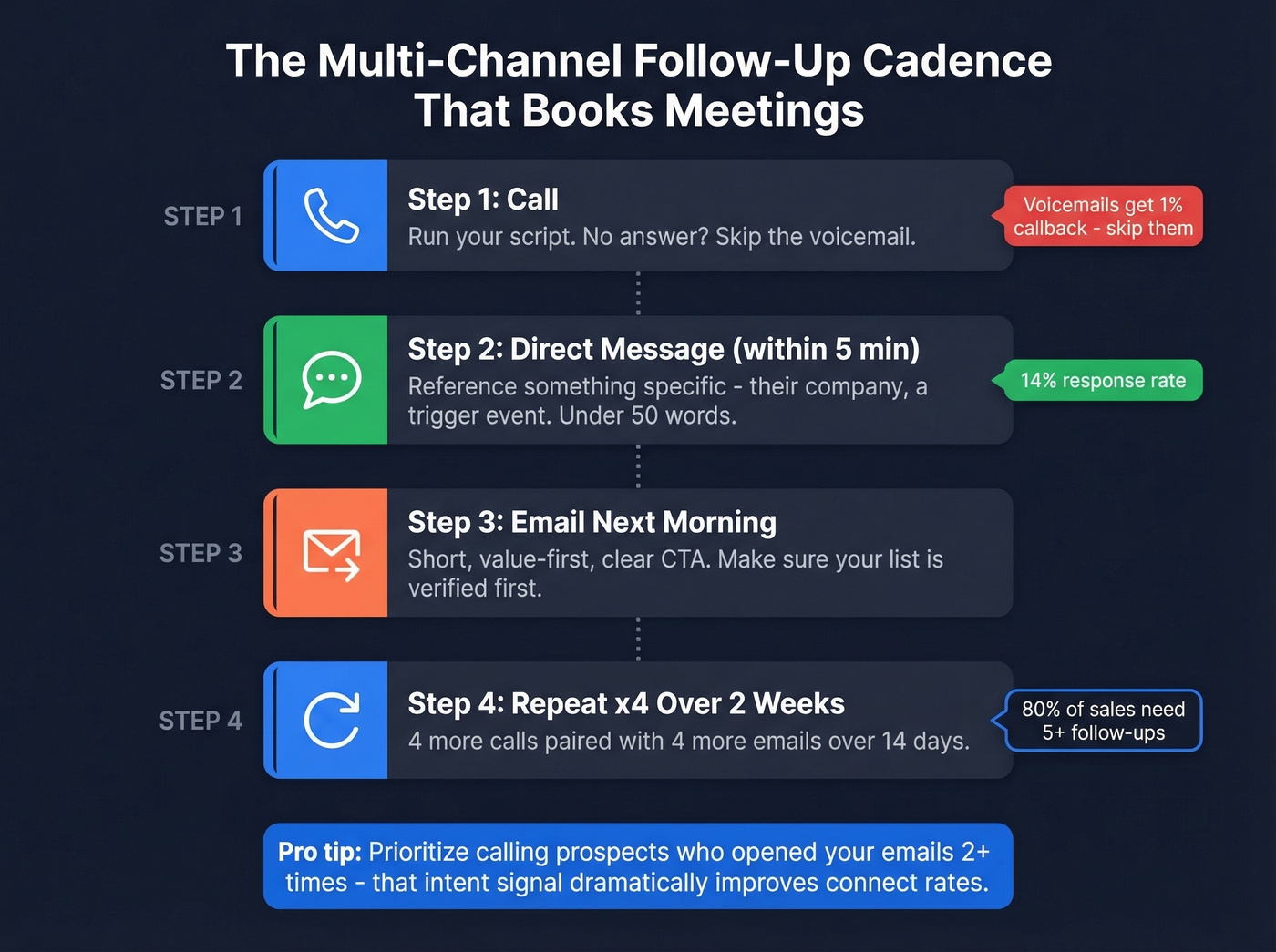
Here's the cadence that works:
- Call. Run your script. No answer? Skip the voicemail.
- Direct message within 5 minutes. Reference something specific - their company, a trigger event, the reason you called. Under 50 words.
- Email the next morning. Short, value-first, clear CTA.
- Repeat 4 calls over 2 weeks, paired with 4 emails. 80% of sales require five or more follow-ups, and 44% of reps stop after one touch.
If you need copy you can paste, keep a few sales follow-up templates ready for each touch.
Prioritize calling prospects who've opened your emails two or more times - that intent signal dramatically improves connect rates. Log every call outcome in your CRM so you're building a feedback loop, not just grinding dials.
And make sure your email list is verified before you start. A 35% bounce rate will wreck deliverability and your entire cadence. One of our customers, Meritt, dropped their bounce rate from 35% to under 4% after switching to Prospeo's verified data - and their pipeline tripled from $100K to $300K per week. That's what clean data does to an outbound motion.
If you’re seeing bounces, start with the basics on email bounce rate and fix deliverability before scaling volume.
Your multi-channel cadence falls apart when emails bounce. Meritt dropped their bounce rate from 35% to under 4% with Prospeo and tripled their pipeline. 98% email accuracy at $0.01 per lead - no contracts, no sales calls.
Fix your data before your next call block.
FAQ
How many cold calls to book one appointment?
About 72 dials per meeting based on practitioner data (820 dials, 12 meetings). The industry average is roughly 43 calls at a 2.35% conversion rate. Your connect rate is the biggest variable - fix your data before you tweak your talk track.
Should I leave a voicemail on a cold call?
No. Voicemails return about 1% callbacks. A direct message sent within 5 minutes gets 14x the response. Skip the voicemail, send a personalized message referencing why you called, then email the next morning.
How do I close for the meeting on a cold call?
Sell the meeting, not the product. Lead with a pattern-interrupt opener, deliver a two-sentence value prop naming a recognizable competitor, then close with a specific day and time. The entire exchange should take under 90 seconds before you ask for the calendar slot. Pause after the ask - silence is your closing tool.
How do I improve my cold call connect rate?
Verify your contact data before calling. Call Tuesday through Thursday between 10-11 AM and prioritize prospects who've opened your emails twice. If you're dialing numbers that haven't been refreshed in weeks, you're wasting half your call block on dead lines.