

The Cold Call Email Playbook: Templates, Timing, and the Multichannel Cadence That Works
A RevOps lead we know ran a bake-off last quarter between two SDR teams - one running email-only sequences, the other combining cold call email touches in a structured cadence. The email-only team pushed high daily volume and burned their sending domain fast. The cold call email team booked dramatically more meetings with far fewer total touches.
Your templates aren't the problem. Your infrastructure and sequencing are. Nearly 20% of cold emails get flagged as spam before a prospect ever sees them, and the average cold email response rate sits at a brutal 5.1%. Most teams try to fix this by rewriting subject lines. That's like repainting a car with a blown engine. The fix starts with your data, your deliverability stack, and the order you sequence your touches.
What You Need First
Before you touch a single template, get these four things right - in order:
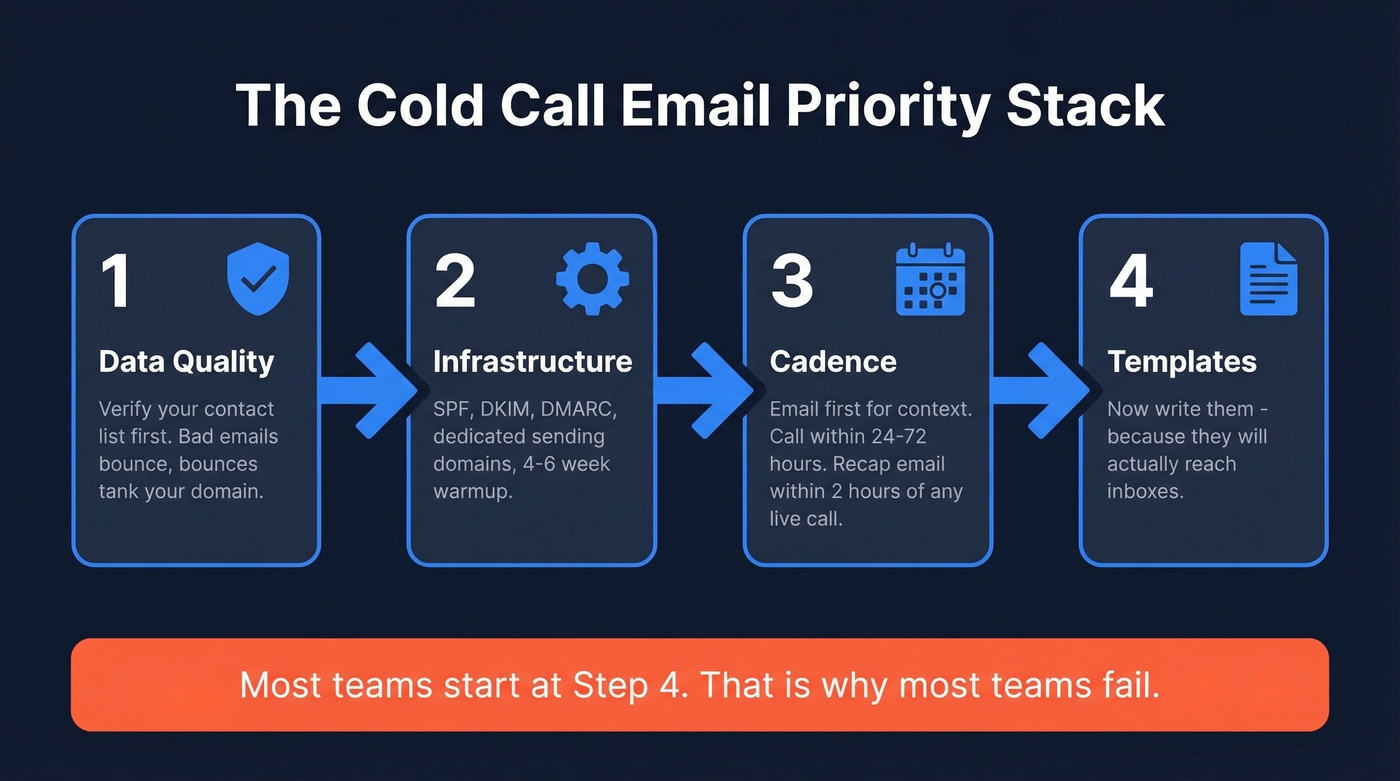
- Data quality. Verify your contact list before anything else. Bad emails bounce, bounces tank your domain, and then nothing lands. (If you're still building lists, start with lead generation tools and then verify.)
- Infrastructure. SPF, DKIM, DMARC, dedicated sending domains, and a 4-6 week warmup. Non-negotiable.
- Cadence. Email first to create context. Call within 24-72 hours. Send a recap email within 2 hours of any live conversation. (If you need a broader framework, use a B2B cold email sequence as your baseline.)
- Templates. Now you can write them - because they'll actually reach inboxes.
Jump to the templates if you're ready, or to the day-by-day cadence table if you need the sequencing.
Cold Call vs. Cold Email
The short answer: use both. Multichannel sequences hit a 6.7% success rate - measured as conversation-to-meeting - roughly 6x what email alone delivers. And 82% of decision-makers have accepted meetings that originated from strategic cold outreach, so the channel isn't dead. Lazy execution is.
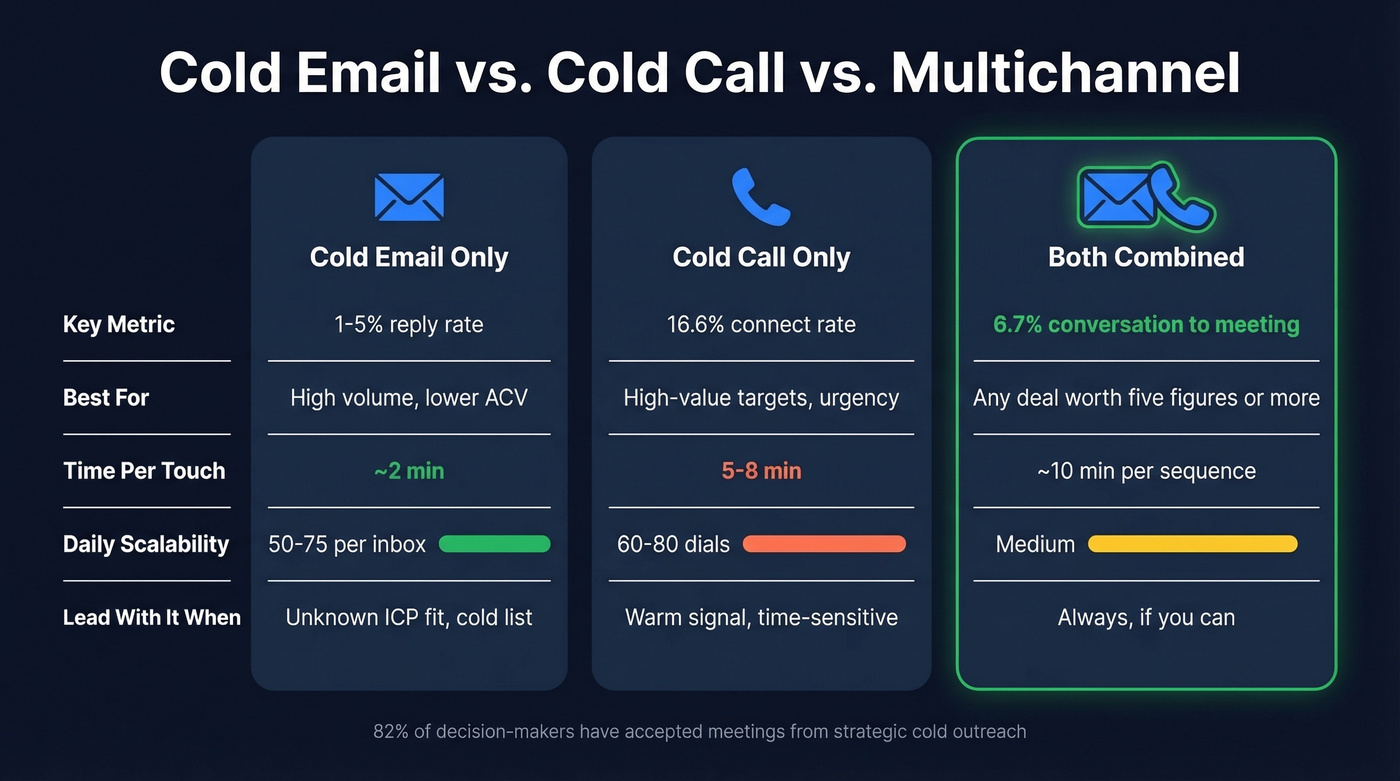
| Metric | Cold Email | Cold Call | Both Combined |
|---|---|---|---|
| Key metric | ~1-5% reply rate | 16.6% connect rate | 6.7% conversation-to-meeting |
| Best for | High volume, lower ACV | High-value targets, urgency | Any deal worth five figures+ |
| Time per touch | ~2 min | ~5-8 min incl. research | ~10 min per sequence |
| Scalability | High (50-75/day/inbox) | Low (60-80 dials/day) | Medium |
| Lead with it when... | Unknown ICP fit, cold list | Warm signal, time-sensitive | Always, if you can |
Cold calls work best in the late afternoon - teams see 71% better results calling between 4-5pm versus the 11am-12pm slot. The average live call lasts just 93 seconds, so you're not asking for a long conversation. You're asking for permission to continue one.
Here's the thing: 81% of decision-makers engage with cold outreach when it's tailored to their company and context. The channel matters less than the relevance. Email creates context, the call creates urgency, and the combination creates meetings. (If your team needs more ways to source conversations, borrow these sales prospecting techniques.)
One caveat: if your average deal size is under five figures, you probably don't need a multichannel cadence at all. A tight email-only sequence with verified data will get you there faster and cheaper. Save the phone work for deals that justify the time.
How to Write One That Gets Replies
The consensus on r/sales and r/coldemail is brutally simple: keep it under 90 words, use 2-sentence paragraphs, include one link max, and ask exactly one question. Everything else is decoration.
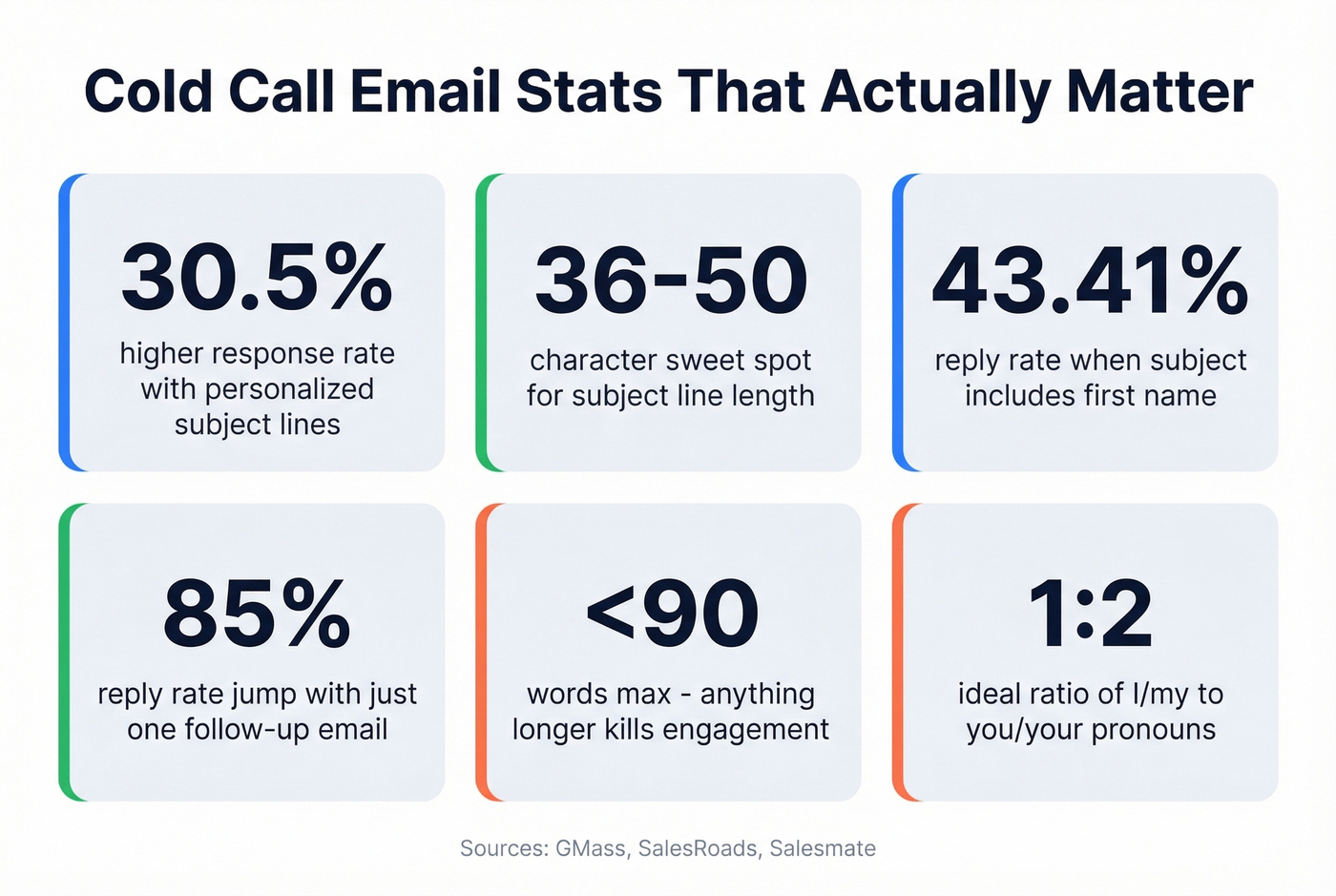
Personalized subject lines increase response rates by 30.5%, and the sweet spot for length is 36-50 characters - that range pulls a 24.6% higher response rate than shorter alternatives. Don't waste characters on "Quick question" or "Touching base." Reference something specific: their company, their role, a trigger event. Subject lines that include the prospect's first name have hit 43.41% reply rates in some studies - nearly 10x the average. (If you want more options, pull from these email subject line examples.)
The body follows the same principle. Structure it using PAS - Pain, Agitate, Solution - or a simple observation-bridge-CTA flow. Open with why you're reaching out in one sentence about them, not you. Bridge to the value in one sentence about the problem you solve. Close with a single, low-friction CTA. (For deeper structure, see our guide to email copywriting.)
A useful heuristic: keep your "I/my" to "you/your" pronoun ratio at 1:2 or better. If you count more first-person pronouns than second-person ones, rewrite. And here's a rule most SDRs ignore - don't ask for a meeting in your first email. Ask a question that qualifies interest. "Is this a priority for Q3?" beats "Can we book 30 minutes?" because it gives the prospect a reason to reply that isn't a calendar commitment.
"Worth a 15-minute call this week?" beats "Would you be available for a 30-minute discovery session at your earliest convenience?" every single time.
Subject Line Swipe File
| Category | Subject Line | Why It Works |
|---|---|---|
| Initial outreach | [First name], quick thought on [pain point] |
Personal + specific |
| Initial outreach | [Company] + [your company] - [one benefit] |
Pattern interrupt |
| Post-call recap | Recap: our conversation about [topic] |
Sets expectation |
| Post-call recap | Action items from today's call |
Implies progress |
| Follow-up | Re: [original subject] |
Thread continuity |
| Follow-up | [Metric] improvement for [Company] |
Value-forward |
| Breakup | Should I close your file? |
Loss aversion |
| Breakup | Not the right time, [First name]? |
Low pressure |
Cold Call Email Templates You Can Steal
Every template below is under 90 words. Adapt the brackets, keep the structure.
Initial Cold Email
Subject: [Company] + [Your Company] - [one benefit]
Hi [First name],
I noticed [Company] is [specific observation - hiring, expanding, using X tool]. Teams in that position usually run into [specific pain point].
We help [similar companies] [specific outcome - e.g., "cut list-building time by 80%"]. [One proof point - e.g., "Snyk's AE team went from 35% bounce rates to under 5%."]
Worth a 15-minute call this week to see if it fits?
[Your name]
Post-Call Recap Email
This is the email you send after the prospect said "send me something." Don't send a brochure. Send a recap that proves you listened.
Subject: Action items from today's call
Hi [First name],
Great speaking with you. Here's what we covered:
- [Pain point they mentioned]
- [How your solution addresses it]
- [Specific next step you agreed on]
I'll [next action - e.g., "send the case study by Thursday"]. If [date/time] still works for a follow-up, I'll send a calendar invite.
Talk soon, [Your name]
Send this within two hours. Momentum dies fast.
Voicemail + Email Combo
Leave a 30-second voicemail, then send this immediately:
Subject: Just left you a voicemail
[One sentence of value - e.g., "We helped [similar company] [result], and I think [Company] could see the same."]
I just tried calling - left a quick voicemail about [one-sentence reason].
Easier to reply here? Happy to share more context over email.
[Your name]
Value-Add Follow-Up
Instead of another "just checking in," give the prospect something they can actually use - a benchmark report, a case study from their industry, a relevant data point. Anything that makes hitting reply feel worthwhile rather than obligatory. (If you need more angles, steal from these sales follow-up templates.)
Subject: [Relevant resource] for [Company]
Hi [First name],
Following up on my last note. Thought this might be useful - [link to relevant content, case study, or benchmark].
[One sentence connecting the resource to their situation.]
Still open to a quick call if the timing works.
[Your name]
Breakup Email
Subject: Should I close your file?
Reached out a few times - sounds like the timing's off. I'll stop following up. If things change, reply to this thread and we'll pick it back up.
[Your name]
Three lines. No guilt trip. The loss aversion in the subject line does the heavy lifting.

You read it above: bad emails bounce, bounces tank your domain, and then nothing lands. Prospeo's 5-step verification delivers 98% email accuracy on 300M+ profiles - refreshed every 7 days, not 6 weeks. Stop rewriting subject lines. Fix the data.
Verified emails at $0.01 each. Your cold call email cadence deserves clean data.
Your Multichannel Cadence (Day by Day)
The 3-7-7 rule gives you a proven email-only framework: follow up 3 days after the initial send, then 7 days later, then 7 days after that. But you're not running email-only. Here's the multichannel adaptation we've tested across dozens of campaigns. (If you're formalizing this across the org, treat it as sequence management, not just "a sequence.")
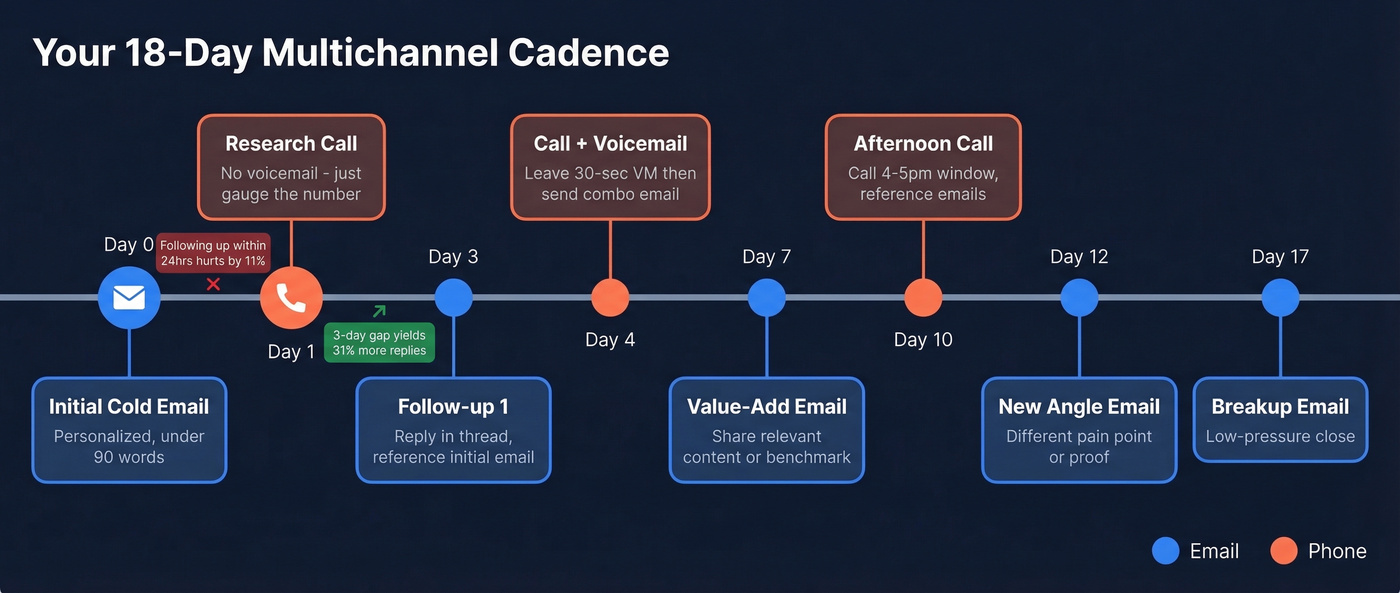
| Day | Channel | Action | Notes |
|---|---|---|---|
| 0 | Initial cold email | Personalized, under 90 words | |
| 1 | Phone | Research call (no voicemail) | Gauge if number works |
| 3 | Follow-up #1 (reply in thread) | Reference initial email | |
| 4 | Phone | Call + voicemail | Leave 30-sec VM, send combo email |
| 7 | Value-add follow-up | Share relevant content | |
| 10 | Phone | Call (4-5pm window) | Reference previous emails |
| 12 | Follow-up #3 (new angle) | Different pain point or proof | |
| 17 | Breakup email | Low-pressure close |
Waiting 3 days for the first follow-up yields a ~31% increase in replies. Following up within 24 hours actually hurts your chances by ~11%. And campaigns with even one follow-up see reply rates jump by 85% versus a single message. Most deals require 5-12 touchpoints before closing, so don't bail after two emails.
The biggest multichannel pitfalls aren't strategic - they're operational. Teams lose interaction history across tools, send inconsistent messaging between channels, and overwhelm prospects with too many touches in too short a window. Running email and call sequences from a single verified data source eliminates the stitching problem entirely. When your verified emails and direct dials live in one platform with a 7-day refresh cycle, your SDRs stop toggling between three tabs and start actually selling.
Fix Your Data Before You Hit Send
Here's the pattern we see constantly: a team spends two weeks perfecting templates, launches a 5,000-contact outbound sequence, and watches their bounce rate climb past 15%. Their sending domain gets flagged. Their deliverability craters. Now even their good emails - the ones going to valid addresses - land in spam. (If you're diagnosing this, start with email bounce rate benchmarks and root causes.)
Bad data is the silent killer of cold outreach. Every bounced email tells Google and Microsoft that you're sending to lists you shouldn't be sending to. Once that reputation damage sets in, it takes weeks to recover. (If you're cleaning lists at scale, use a dedicated email spam checker alongside verification.)
The numbers from real teams tell the story. Stack Optimize built from $0 to $1M ARR using Prospeo data and maintained 94%+ deliverability with under 3% bounce rates and zero domain flags across all clients. Meritt went from a 35% bounce rate to under 4%, tripling their pipeline from $100K to $300K per week. On the phone side, 125M+ verified mobile numbers hitting a 30% pickup rate means your call steps in the cadence above actually connect to real humans - not disconnected lines.
Multichannel cadences need both emails and direct dials. Prospeo gives you 143M+ verified emails and 125M+ verified mobiles with a 30% pickup rate - so your Day 1 email and Day 3 call actually reach the same person.
Build your entire cold call email sequence from one platform.
Email Deliverability Setup
Templates and data won't matter if your emails never reach the inbox. Google and Microsoft have tightened spam filtering aggressively through 2024-2026, making proper authentication table stakes for any outbound program. (For the full checklist, see our email deliverability guide.)
Authentication (do this first):
- Set up SPF, DKIM, and DMARC on every sending domain
- DMARC rollout: start with
p=none, monitor for 2-4 weeks, move toquarantine, thenreject - Never send cold email from your primary company domain - use 3-5 dedicated sending domains
- Keep your HTML-to-text ratio low in email signatures; heavy HTML with images and social icons triggers spam filters more often than plain-text sign-offs
Warmup schedule:
- Week 1: 5-10 emails/day
- Week 2: 10-20 emails/day
- Week 3: 20-35 emails/day
- Week 4: 35-50 emails/day
- Weeks 5-6: 50-75 emails/day
Never exceed 50 cold emails per inbox per day, even after warmup. The r/coldemail community recommends 3-5 mailboxes per domain with 15-25 sends per mailbox once warmed. One thread with 200+ upvotes put it bluntly: "Never turn warmup off, even at full volume. The moment you do, your deliverability starts sliding." A single domain maxes out around 75-125 sends per day across all its mailboxes. (If you're setting safe limits, use an email velocity framework.)
Infrastructure costs are low. Google Workspace through resellers runs $2.50-$3.50 per mailbox. A 3-domain, 9-mailbox setup costs about $23-$32/month and gives you capacity for 200+ sends per day. The 14-day minimum warmup is non-negotiable.
Let's be honest: most deliverability problems aren't technical. They're behavioral. SDR teams sending too much volume too fast from too few inboxes. Fix the math and the deliverability follows.
Cold Email Compliance
Compliance isn't optional, and the penalties aren't theoretical.
| Regulation | Max Penalty | Key Requirements | Opt-Out Deadline |
|---|---|---|---|
| CAN-SPAM | $53,088/email | Real identity, no deceptive subjects | 10 business days |
| GDPR | EUR 20M or 4% of revenue | Lawful basis, data minimization | Without undue delay |
| CASL | $10M CAD | Express or implied consent | 10 business days |
For B2B cold email under GDPR, you're relying on Article 6(1)(f) - legitimate interest. That requires a three-part Legitimate Interest Assessment: a purpose test asking why you're reaching out, a necessity test asking whether email is the least intrusive way, and a balancing test weighing the prospect's privacy against your interest. Document this before you send a single message.
Your compliance checklist:
- Unsubscribe link in every email (one-click preferred)
- Real sender name and physical address
- No misleading subject lines
- Honor opt-outs within 10 business days
- Keep consent and opt-out records - CASL requires 3 years minimum
- Authenticate all sending domains with SPF/DKIM/DMARC
None of this is hard. It's just easy to skip - and the downside of skipping it is catastrophic. A single CAN-SPAM violation at $53,088 per email will make your CFO's head spin.
Putting It All Together
The cold call email playbook isn't complicated. Verify your data so nothing bounces. Set up your infrastructure so everything lands. Sequence your touches so email creates context and calls create urgency. Keep messages under 90 words, focus on the prospect, and follow the cadence so the math works in your favor.
Most teams fail at step one and try to fix it at step four. Don't be that team.
FAQ
Is cold emailing legal?
Yes - cold emailing is legal under CAN-SPAM, GDPR via legitimate interest, and CASL, provided you include an unsubscribe link, use a real sender identity, and honor opt-outs within 10 business days. Document your lawful basis and consent status for every contact. A single CAN-SPAM violation costs up to $53,088 per email.
Should I cold call or cold email first?
Email first to create context, then call within 24-72 hours. Multichannel sequences hit a 6.7% conversation-to-meeting rate versus roughly 1-5% for email alone. The email gives the prospect a reference point, the call creates urgency, and a recap email within 2 hours locks in momentum.
How many follow-ups should I send?
Send at least three follow-ups, ideally five to seven across channels. Campaigns with even one follow-up see reply rates jump by 85%. Most deals require 5-12 touchpoints before closing. Space them using the 3-7-7 framework and mix in calls between emails.
What tools help verify contacts before a cold outreach campaign?
Prospeo verifies emails at 98% accuracy using a 5-step process that catches spam traps, honeypots, and catch-all domains - 75 free verifications, no contract. Other options include NeverBounce and ZeroBounce, though neither includes a built-in leads database or direct-dial verification in the same platform.
What's a good cold email response rate?
The average sits at 5.1%; anything above 8% is strong. Top campaigns with advanced personalization and verified data push past 10%. If you're below 2%, the problem is usually data quality or deliverability - not your copy.