

Cold Calling in 2026: Scripts, Stats, and the System That Actually Works
It's 9:15 AM on a Tuesday. You've got a list of 200 names, a dialer, and a quota that doesn't care about your feelings. By 11 AM, you've burned through 80 dials. Half went to voicemail. A dozen were disconnected numbers. You've had exactly three conversations, and one of those was a wrong number someone hadn't updated since 2023.
The problem isn't cold calling. The problem is that most reps dial into a database that's already half-dead before they pick up the phone. B2B phone data decays at 22.5% per year - one in five numbers on your list right now won't connect to anyone. Fix the data, fix the opener, and this channel still prints pipeline.
The quick version:
- Fix your data first. 22.5% of phone numbers go stale every year. That kills your connect rate before you ever dial.
- Use a tested opener (four below) and learn three objection rebuttals cold.
- Build a lean stack: data provider + dialer + CRM. Total cost under $100/user/month.
What Is Cold Calling?
Cold calling is an unsolicited phone call to a prospect who has no prior relationship with you or your company. No warm intro, no inbound request, no mutual connection doing the heavy lifting. You're calling because you believe they fit your ICP and might have a problem you can solve.
The distinction from warm calling matters. A warm call follows some prior touchpoint - they downloaded a whitepaper, replied to an email, or a colleague made an introduction. A cold call skips all of that. You're starting from zero, which is exactly why the skill ceiling is so high and why most reps avoid it.
That avoidance is your competitive advantage.
Does It Still Work in 2026?
Yes, and the data isn't even close to ambiguous.
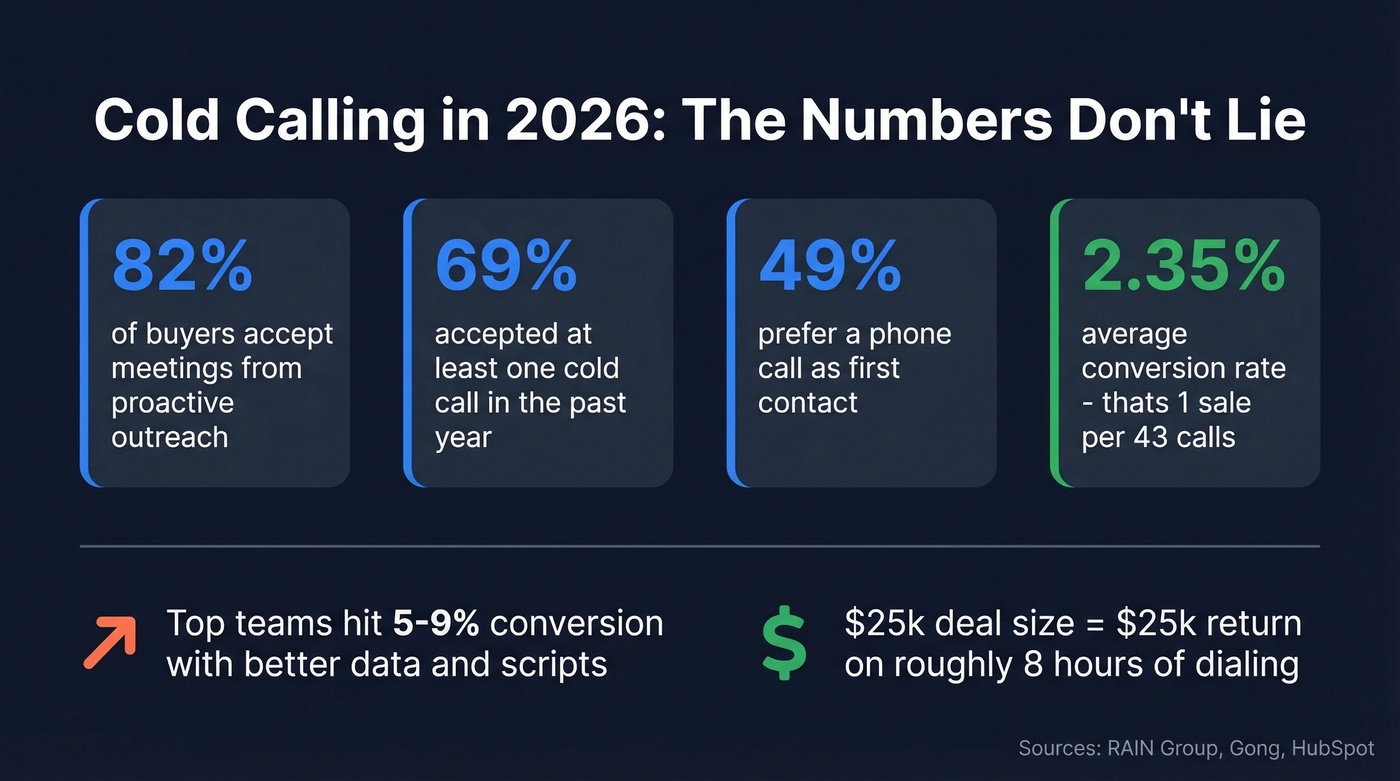
RAIN Group's research shows 82% of buyers accept meetings from proactive outreach. 69% accepted at least one unsolicited sales call in the past year. Nearly half - 49% - actually prefer a phone call as the first point of contact. These aren't fringe numbers. They're the majority.
One HubSpot-featured practitioner documented 11,519 cold calls that produced 335 meetings, a 69.1% SQL rate from those meetings, and $287k in closed revenue at a startup. At an enterprise company, the same system generated $40M. The difference wasn't talent - it was a repeatable process with tracking and A/B testing on every call block.
The average conversion rate sits at roughly 2.35% - about one sale per 43 calls. That sounds low until you run the math on deal size. If your average contract is $25k and you're closing one per 43 meaningful conversations, that's a $25k return on maybe 8 hours of dialing. Find me a marketing channel with that kind of unit economics at the SMB level.
A popular r/sales thread frames it bluntly: cold calling isn't dead, you're just bad at it. The OP cites a workable formula - 5% connect rate, 200+ dials per day, and at minimum one meeting daily if your messaging and objection handling are solid. The issue is almost never the channel. It's the execution.
Top-performing teams hit 5-9% conversion rates through better targeting, fresher data, structured scripts, and daily coaching. The gap between 2.35% and 8% is entirely bridgeable.
Step-by-Step Process
Step 1: Build a Verified List
Everything starts here. A list of 500 contacts with 30% bad numbers means you're wasting a third of your calling block before you say a word. Pull contacts by ICP filters, export direct dials, and don't touch your dialer until the list is clean. (If you want a deeper workflow, see our cold calling system.)
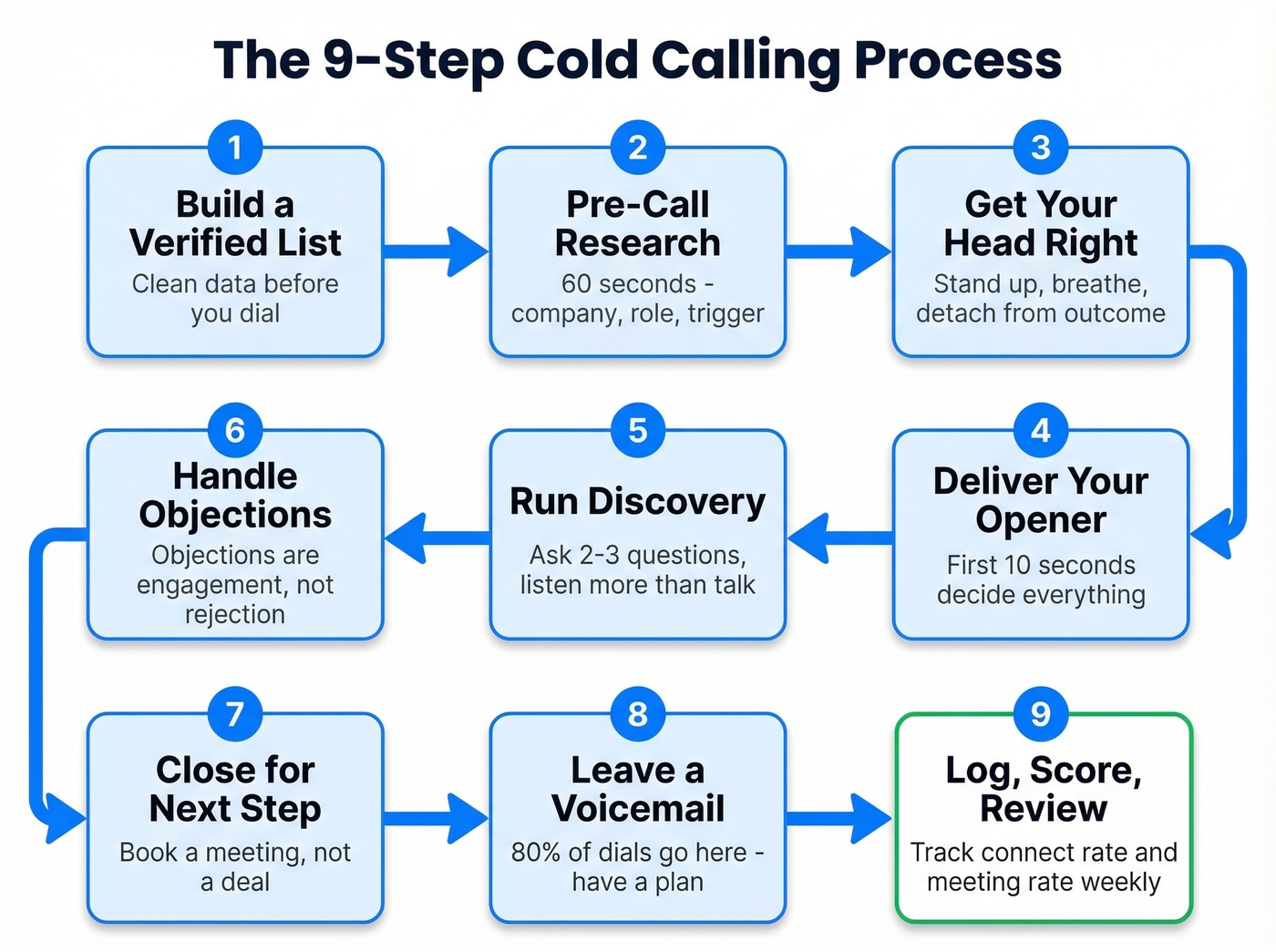
Step 2: Pre-Call Research (60 Seconds)
You don't need a dossier. You need three things: what the company does, what the prospect's role cares about, and one trigger event. Trigger events include recent funding rounds, leadership changes, job postings that signal a new initiative, or earnings calls that mention a relevant pain point. Sixty seconds on their company website and recent news is enough. (More on operationalizing this in how to track sales triggers.)
Step 3: Get Your Head Right
Stand up or sit up straight, smile while you speak (it changes your vocal tone more than you'd think), and take one deep breath before each dial. This is a performance sport. The reps who sound relaxed and confident aren't naturally calm - they've built a pre-call routine that gets them there. Josh Braun calls this "detaching from the outcome." Your job isn't to book a meeting on every call. Your job is to have a genuine conversation and see if there's a fit.
Step 4: Deliver Your Opener
Your first 10 seconds determine whether you get 60 more. Don't wing it. Pick one of the four openers below, practice it until it sounds natural, and commit to it for at least 50 dials before switching.
Step 5: Run Discovery
If the opener lands, shift into two or three discovery questions. The goal isn't to pitch - it's to understand whether this person has a problem worth solving. "How are you currently handling [specific process]?" and "What's the biggest bottleneck in [relevant workflow]?" are reliable starting points. Listen more than you talk. Successful calls average 5 minutes and 50 seconds; failed ones die at 3:14. (If you need a question bank, start with these discovery questions.)
Step 6: Handle Objections
Objections aren't rejection - they're engagement. A hang-up is a dead end. "I'm not interested" means they're still on the line. We cover the three most common objections and exact rebuttals below. (For more scripts, see cold call rejection.)
Step 7: Close for the Next Step
Don't try to close a deal on a cold call. Close for a meeting. "I'd love to show you how [specific outcome] works in practice - do you have 20 minutes Thursday or Friday?" Give two specific time options. Vague asks like "sometime next week" get vague answers. (This maps cleanly to the steps to close a sale.)
Step 8: Leave a Strategic Voicemail
80% of outbound dials go to voicemail. If you don't have a voicemail strategy, you're ignoring 80% of your activity. Keep it under 30 seconds, reference a trigger event, and end with your number spoken slowly twice.
Step 9: Log, Score, and Review
After every call block, log outcomes in your CRM. Tag each call as connected/voicemail/disconnected/meeting booked. Review your connect rate weekly. If it's dropping, your data is stale. If connects are high but meetings are low, your script needs work. (If your CRM setup is messy, use these examples of a CRM to sanity-check your workflow.)
Scripts That Actually Book Meetings
The Pattern Interrupt Opener
Most prospects expect a caller to launch into a pitch. The pattern interrupt breaks that expectation.
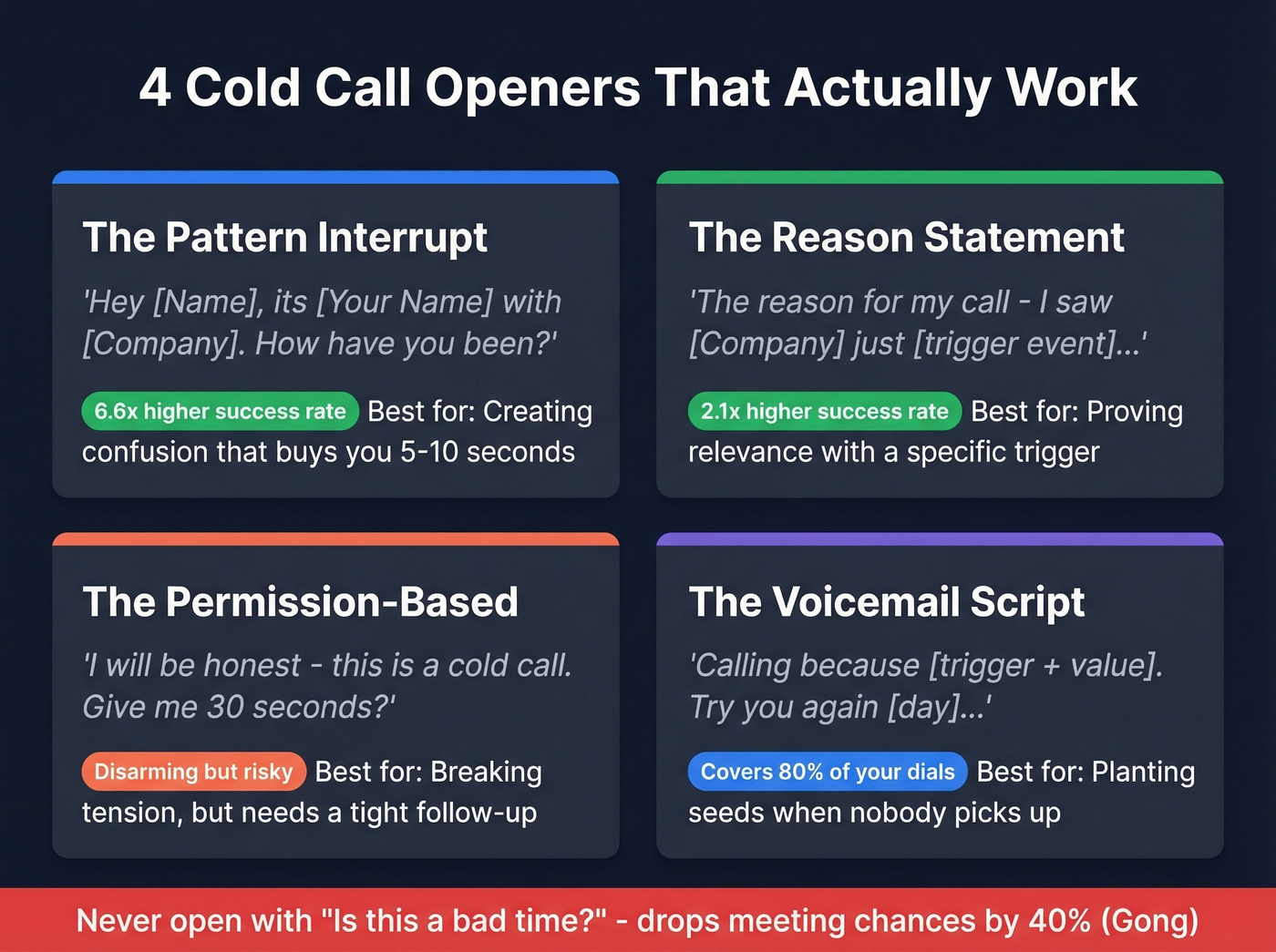
"Hey [Name], it's [Your Name] with [Company]. How've you been?"
This sounds casual - almost like you've spoken before. That moment of confusion buys you 5-10 seconds of attention, and Gong's research shows this phrasing produces a 6.6x higher success rate compared to standard openers. Once they respond (usually with a confused "uh, good?"), pivot immediately into your reason statement. Don't let the pause linger - the opener is a door, not a destination.
The Reason Statement
This is the workhorse opener. Gong's data shows that "the reason for my call is..." produces a 2.1x higher success rate than calls without a stated reason.
"Hey [Name], this is [Your Name] with [Company]. The reason for my call - I saw [Company] just [trigger event: raised a Series B / opened a new office / posted three SDR roles]. We help teams like yours [specific outcome]. Wanted to see if it's worth a quick conversation."
The trigger event is what separates this from a generic pitch. It proves you did 60 seconds of homework, and it gives the prospect a reason to believe the call is relevant to them specifically. Without the trigger, this opener is just another interruption.
The Permission-Based Opener
You've probably seen this one on Reddit and LinkedIn:
"Hey [Name], I'll be honest - this is a cold call. Do you want to hang up, or will you give me 30 seconds?"
It's popular because it's disarming. The transparency lowers resistance, and most people will grant the 30 seconds out of curiosity or politeness. One first-time caller on r/sales shared a version of this that included a full discovery sequence after the opener.
Here's the catch: the opener works, but what comes after it usually doesn't. Beginners tend to cram too many questions into those 30 seconds, or they pivot into a pitch that sounds rehearsed. The permission opener earns you attention - you still need a tight value statement and a single, clear ask to convert that attention into a meeting.
The Voicemail Script
Since 80% of your dials hit voicemail, this script gets more reps than any other.
"Hi [Name], it's [Your Name] with [Company]. I'm calling because [one-sentence trigger + value]. I'll try you again [day], but if you want to grab time before that, I'm at [number, spoken slowly]. Again, that's [number]. Talk soon."
Keep it under 30 seconds. One trigger, one value statement, one callback number repeated twice. That's it. Don't ask them to call you back - just plant the seed and follow up.
One critical anti-pattern: never open a voicemail (or a live call) with "is this a bad time?" Gong's data shows that phrase drops your meeting chances by 40%. It gives the prospect an easy exit before you've delivered any value.
Handling Objections Like a Pro
"I'm Not Interested"
Wrong response: "Okay, sorry to bother you." (You just wasted the dial.)
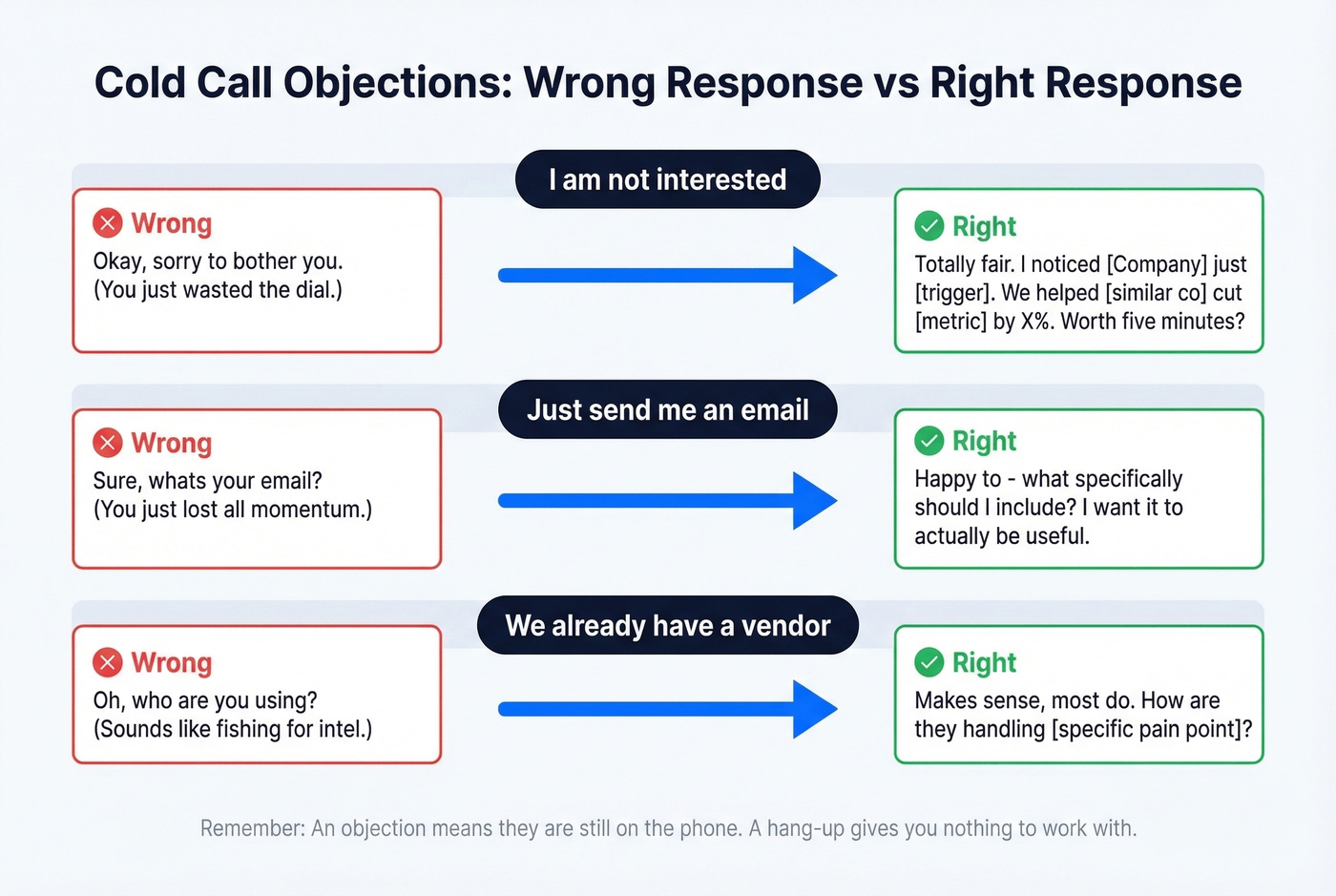
Right response: "Totally fair - most people say that before they hear the specific reason I called. I noticed [Company] just [trigger event]. We helped [similar company] cut [specific metric] by [X%]. Worth five minutes to see if that's relevant?"
Objections are buying signals. A prospect who says "I'm not interested" is still on the phone. A prospect who hangs up without a word gave you nothing to work with. Acknowledge the objection, reframe with a specific trigger, drop a proof point, and ask for a small time commitment.
"Just Send Me an Email"
Wrong response: "Sure, what's your email?" (You just lost all momentum.)
Right response: "Happy to - what specifically would be most useful for me to include? I want to make sure it's relevant and not just another vendor email."
This pivot turns a brush-off into a micro-discovery conversation. Whatever they tell you to include reveals what they actually care about. It also sets context for the email so it doesn't land cold. HubSpot's research confirms 80% of sales require five or more touches - this call just became touch one, and the email becomes touch two with context.
"We Already Have a Vendor"
Wrong response: "Oh, who are you using?" (Sounds like you're fishing for competitive intel.)
Right response: "That makes sense - most of the companies I talk to do. Curious, how are they handling [specific pain point relevant to your product]?"
You're not trying to replace their vendor on this call. You're trying to surface a gap. Most teams have at least one frustration with their current solution, and that frustration is your opening. The question positions you as a peer who understands the space, not a salesperson trying to unseat an incumbent.
Activity Math and Benchmarks
Let's build the math from the ground up so you can set realistic targets.
Start with the 5% connect rate benchmark that practitioners on r/sales cite as realistic. At 200 dials per day, that's 10 live conversations. A conservative 10-15% conversation-to-meeting rate gives you 1-1.5 meetings daily, which is strong. (To pressure-test your targets, compare against these sales activities examples.)
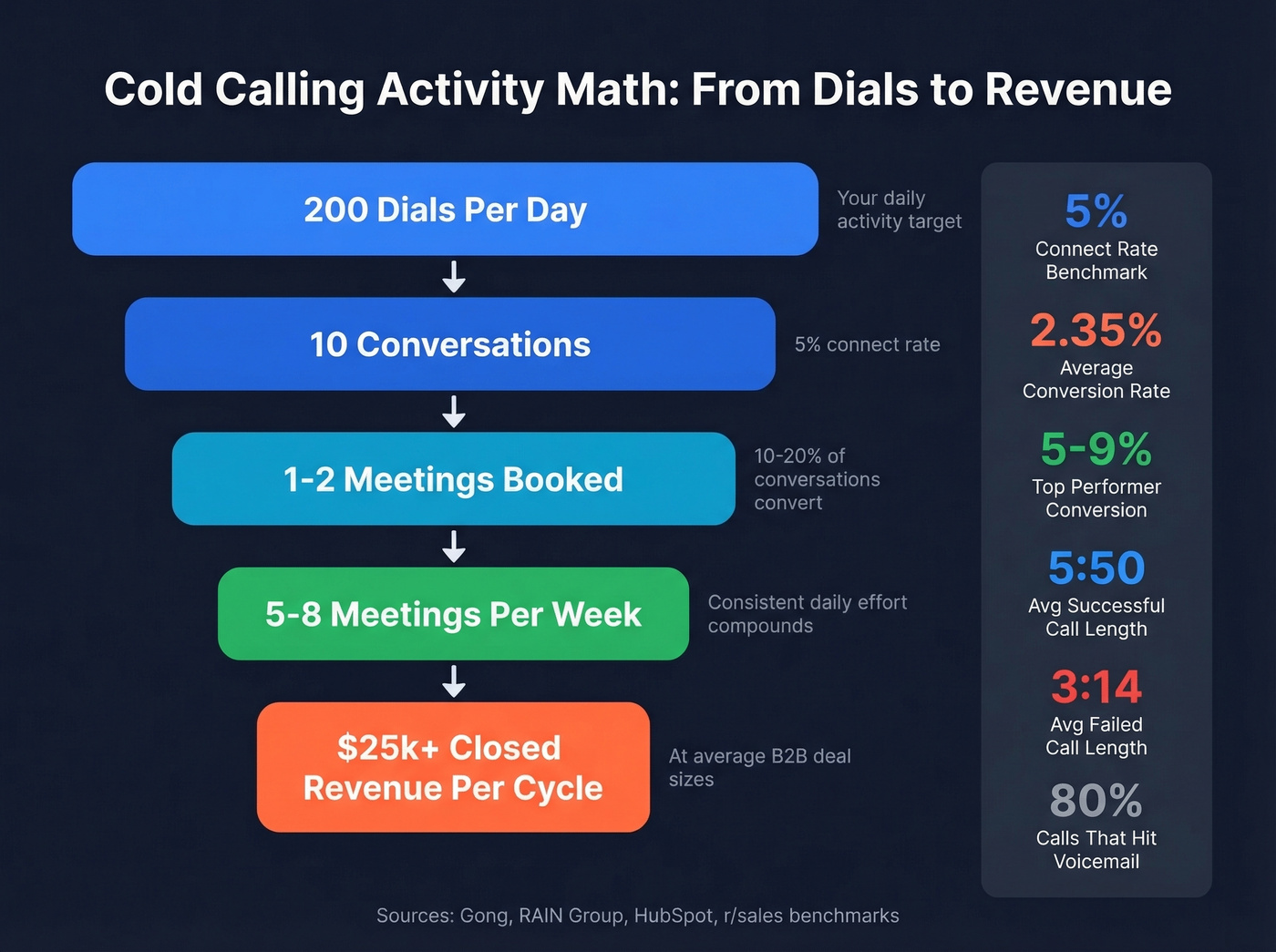
| Stage | Count | Rate |
|---|---|---|
| Dials/day | 200 | - |
| Connects | 10 | 5% |
| Conversations | 6-7 | ~65% |
| Meetings booked | 1-2 | 15-25% |
| SQLs (from meetings) | 1 | ~69% |
The Bridge Group puts the average at 209 calls per appointment. Gartner says it takes 18 calls to reach a single technology buyer. These numbers look daunting until you realize they include all the disconnected numbers, wrong contacts, and reps dialing without pre-call research.
The two biggest levers are data quality (which determines your connect rate) and your script (which determines your conversation-to-meeting rate). A team that moves from 5% to 7% connect rate books 40% more meetings from the same dial volume. That's not a new tool purchase - that's a data hygiene fix.

You just read it: 22.5% of phone numbers decay every year. That's one in five dials wasted before you open your mouth. Prospeo gives you 125M+ verified mobile numbers with a 30% pickup rate - refreshed every 7 days, not every 6 weeks like the rest of the industry.
Stop dialing dead numbers. Start every call block with data that actually connects.
Conversion Rates by Industry
Not all outbound calling is created equal. Your conversion rate depends heavily on what you're selling, who you're selling to, and how big the deal is.
| Industry | Conversion Rate | Calls per Sale |
|---|---|---|
| Janitorial/Cleaning | 2.85% | 35 |
| Business Services | 2.61% | 38 |
| Real Estate | 2.20% | 45 |
| Insurance | 2.12% | 47 |
| Financial Services | 1.54% | 65 |
| Tech/Software | 0.95% | 105 |
| Industrial Equipment | 0.88% | 114 |
Deal size matters just as much as industry. Smaller deals convert at higher rates because the buying process is simpler and involves fewer stakeholders.
| Deal Size | Conversion Rate | Calls per Sale |
|---|---|---|
| $500-$10k | 2.64% | 38 |
| $1M-$5M | 1.16% | 86 |
| $5M-$10M | 0.88% | 114 |
The standout data point: teams that invest in daily call coaching see conversion rates jump to an estimated 9.03%. That's nearly 4x the average. If you're a sales manager reading this, the highest-ROI thing you can do isn't buying a new tool - it's sitting in on call blocks and giving real-time feedback. (If you're building a broader motion, these sales prospecting techniques help round out the channel mix.)
Here's the thing: if your average deal is a few thousand dollars, you probably don't need a $3,000/month data platform or a parallel dialer. A clean list, a single-line dialer, and two hours of focused calling will outperform a bloated tech stack every time. Outbound phone work rewards discipline more than software.
For teams selling enterprise software with seven-figure deal sizes, phone outreach alone won't close the deal. But it'll open doors that email and social selling can't. The multi-touch sequence is what closes - the call is what starts the conversation.
Cold Calling vs Cold Emailing
| Factor | Cold Calling | Cold Emailing | Winner |
|---|---|---|---|
| Success rate | 0.3-2.35% | 1-5% (targeted: 15-25%) | Email (on volume) |
| Personalization | High (real-time) | Medium (templated) | Calling |
| Scalability | Low (1:1) | High (1:many) | |
| Intrusiveness | Higher | Lower | |
| Touches to connect | ~8 attempts | 3-5 emails | |
| Objection handling | Real-time | None | Calling |
| Best for | High-value, complex | Volume, nurture | Depends on ACV |
A study of 6,264 cold calls produced 19 appointments - a 0.3% success rate. Meanwhile, targeted cold emails can hit 15-25% response rates when the list is tight and the copy is relevant. On pure efficiency, email wins.
But a phone call does something email can't: it creates a real-time, two-way conversation. You can handle objections on the spot, read tone, and pivot your pitch based on what you're hearing. Email is a monologue. A call is a dialogue.
The right answer is both in a multi-touch cadence. Call, leave a voicemail, send a follow-up email referencing the voicemail, then call again two days later. Tools like Prospeo give you both verified mobiles and emails for the same contact, so you can run phone and email sequences from one data source without juggling multiple providers. (If you need copy for the email step, use these sales follow-up templates.)
Best Tools for the Job
Data Providers
The foundation of any outbound calling stack is accurate phone data. Your script doesn't matter if the number is dead.
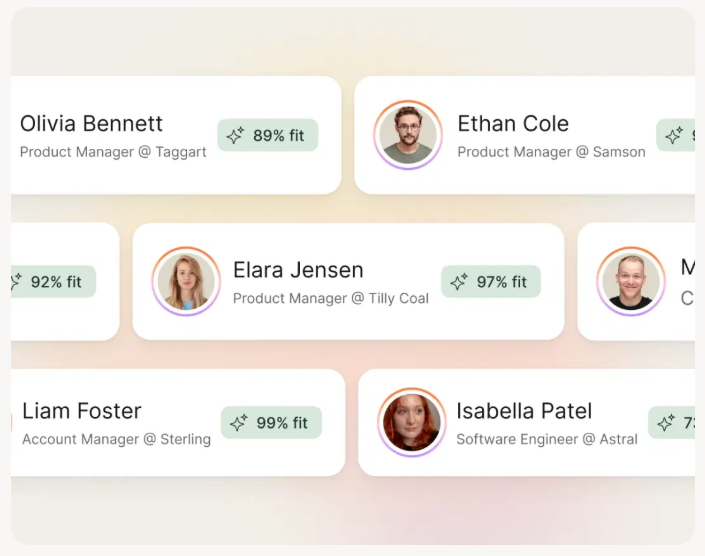
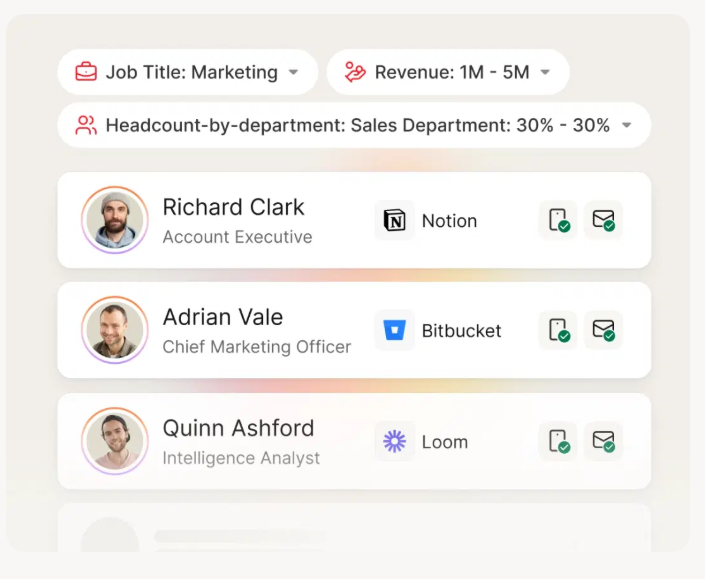
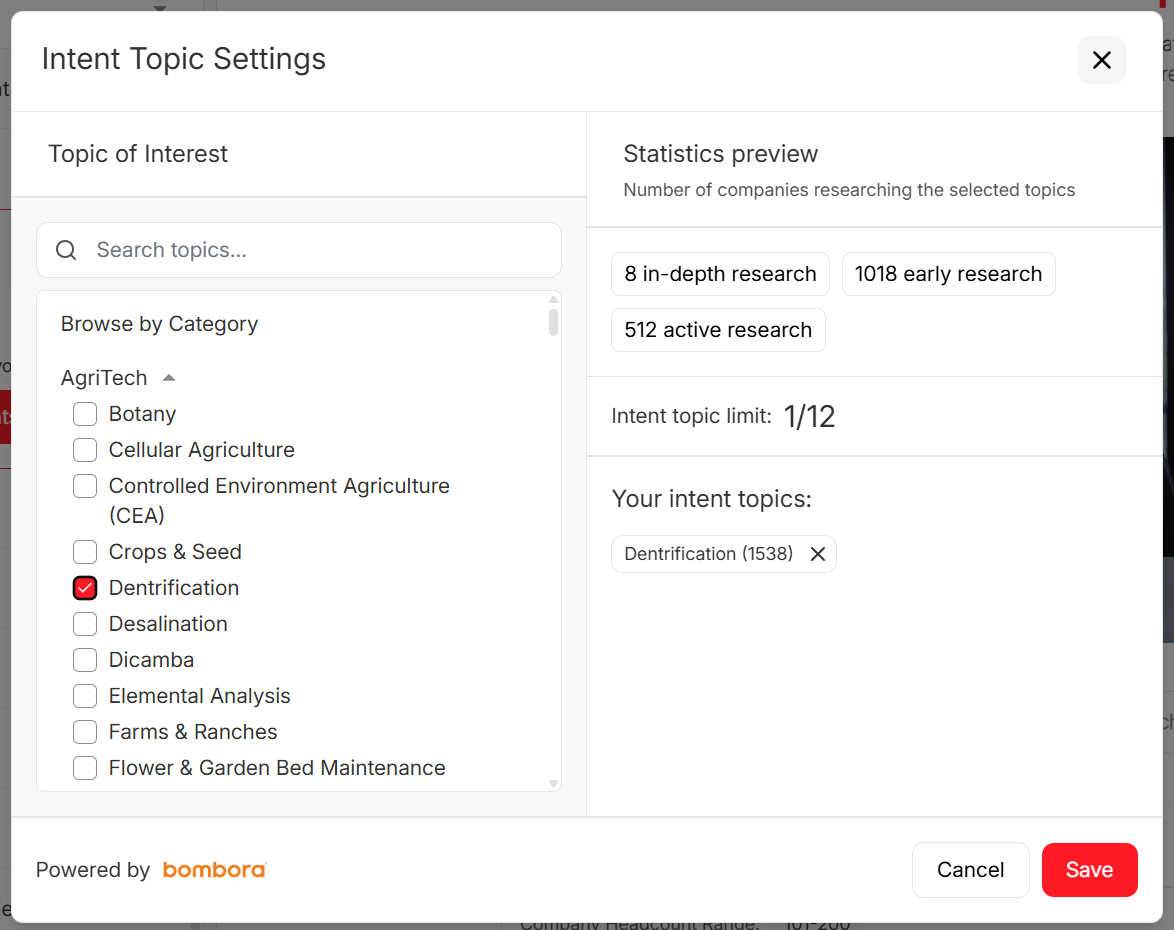
Prospeo is our top pick for a reason we've seen firsthand: the database covers 125M+ verified mobile numbers with a 30% pickup rate - that's the measured connect rate across their user base, not a theoretical number. Every record refreshes on a 7-day cycle, while the industry average sits around 6 weeks. The platform includes 30+ search filters (buyer intent, technographics, job changes, funding events, headcount growth) so you're pulling numbers for people who match your ICP and are showing buying signals. The free tier gives you 75 emails and 100 Chrome extension credits per month to test before committing. Paid plans run about $0.01 per email, with mobile numbers at 10 credits each. One customer, Meritt, tripled their connect rate to 20-25% and grew pipeline from $100K to $300K per week after switching.
Apollo.io offers a free tier and paid plans around $49-$99/user/month. The database is large and the built-in dialer is convenient for teams that want everything in one platform. Accuracy runs lower on mobile data - expect more disconnected numbers - but the all-in-one workflow is genuinely useful for small teams that don't want to manage multiple tools.
Cognism is the go-to for European data. Strong GDPR compliance, solid mobile coverage in EMEA. Custom pricing, typically $1,000-$3,000/month for small teams. Overkill for US-only prospecting, but hard to beat if you're selling into the UK or DACH region. Skip it if your entire pipeline is North American.
Dialers
There are three categories worth understanding. Single-line dialers call one number at a time - simple, compliant, and sufficient for most teams. Power dialers auto-advance through a list, dialing the next number as soon as you hang up. Parallel dialers call multiple numbers simultaneously and connect you to the first person who picks up - highest throughput, but they burn through lists fast and can create awkward pauses when the connection routes.
CloudTalk starts at $25/user/month (annual billing) and covers the essentials: call recording, CRM integrations, and analytics. Best value for SMB teams that need a reliable dialer without enterprise complexity.
Close starts around $49/month and bundles a CRM with a built-in dialer. Neither the CRM nor the dialer is best-in-class individually, but the combination is genuinely efficient for small teams that don't want to manage separate subscriptions.
PhoneBurner starts around $165/month and is built for high-volume power dialing. If you've got a dedicated calling team doing 300+ dials per day, the automation features (voicemail drop, one-click dialing, local ID) justify the price. Skip it if your team dials fewer than 100 calls daily.
Pricing Comparison
| Tool | Category | Starting Price | Best For |
|---|---|---|---|
| Prospeo | Data | Free tier; paid plans credit-based | Verified mobiles + emails |
| Apollo.io | Data + Dialer | Free; ~$49/user/mo | All-in-one SMB |
| Cognism | Data | ~$1,000/mo | European markets |
| CloudTalk | Dialer | $25/user/mo | SMB calling teams |
| Close | CRM + Dialer | ~$49/mo | Small team simplicity |
| RingCentral | Dialer | ~$20/user/mo | Budget-friendly basics |
| JustCall | Dialer | $78/mo | Mid-market teams |
| HubSpot Sales Hub | CRM + Dialer | $90/mo | HubSpot ecosystem |
| Aircall | Dialer | $120/mo | Enterprise integrations |
| PhoneBurner | Dialer | $165/mo | High-volume power dialing |
If I were building a stack from scratch today, I'd pair Prospeo for data with CloudTalk for dialing and HubSpot's free CRM. Total cost: under $100/user/month. That gets you verified mobiles, call recording, and a CRM - everything you need to run a professional outbound operation. (If you're evaluating the broader category, start with these SDR tools.)
How AI Is Reshaping the Workflow
AI won't replace cold callers anytime soon, but it's already reshaping the workflow around the call itself.
Pre-call research is where AI saves the most time. Tools like ChatGPT, Perplexity, and Salesforce's Einstein can synthesize a prospect's recent news, company financials, and job changes into a 30-second briefing. What used to take 60 seconds of manual research now takes 10.
Real-time call coaching is the second big shift. Platforms like Gong and Chorus transcribe calls live and flag moments where a rep talks too long, misses an objection cue, or fails to ask a discovery question. The data from Gong's analysis of 300M+ calls powers many of the benchmarks in this article.
Post-call summarization is the third. AI-generated call summaries auto-populate CRM fields, eliminating the 3-5 minutes of manual logging after every conversation. Over a 200-dial day, that's an extra hour of selling time recovered.
One important caveat: the FCC ruled in February 2024 that AI-generated voices count as "artificial or prerecorded" under the TCPA. If you're using any AI voice technology in outbound calls, you need Prior Express Written Consent. Use AI to prepare for and analyze calls - not to make them.
Why Data Quality Makes or Breaks Results
B2B contact data decays at roughly 2.1% per month. That's 22.5% annually. People change jobs, companies restructure, phone numbers get reassigned. A list you bought in January is missing a quarter of its value by December.
The downstream cost is brutal. Reps lose 27.3% of their selling time to bad contact data - dialing disconnected numbers, reaching the wrong person, updating records that should've been clean in the first place. (If you're fixing this at scale, look at data enrichment services.)
Not all verification is equal, either. Phone-verified mobile numbers are 87% accurate; AI-powered verification pushes that to 98%. The gap between those two numbers is the gap between a connect rate that barely works and one that compounds into real pipeline. We've seen teams go from a 3% connect rate to north of 7% just by switching to a provider with a weekly refresh cycle - no script changes, no new dialer, just cleaner numbers.
Your script doesn't matter if the number is dead. Your objection handling doesn't matter if you're reaching the wrong person. The difference between a 5% connect rate and a 3% connect rate is the difference between booking a meeting every day and booking three per week.
One more thing worth flagging: STIR/SHAKEN caller ID authentication is now standard across major carriers. If your outbound numbers aren't properly registered and authenticated, they'll get flagged as "Spam Likely" before the phone even rings. Clean data paired with authenticated caller IDs is the baseline for getting through in 2026.
Compliance Rules for 2026
The regulatory environment around outbound phone outreach has shifted significantly over the past two years.
Federal baseline rules:
- Calling hours: 8 AM - 9 PM in the recipient's local time zone. No exceptions.
- DNC scrubbing: check your lists against the National Do Not Call Registry at least every 31 days.
- TCPA damages: $500 per violation, up to $1,500 for willful violations. These add up fast on a 200-dial day.
- Prior Express Written Consent is required for autodialed or prerecorded marketing calls to cell phones.
What changed recently:
TCPA litigation surged roughly 95% compared to the prior year. The June 2025 Supreme Court decision in McLaughlin v. McKesson made things more complex: district courts are no longer bound by FCC interpretations in civil TCPA cases, which means enforcement is less predictable.
FCC consent revocation rules took effect in April 2025. Consumers can now revoke consent by any reasonable method - text, email, verbal request on a call, or even a social media message. Some cross-channel provisions are delayed until April 2026, but the core rule is live.
State mini-TCPAs to watch: Texas SB 140 (effective September 2025) expands the definition of solicitation and adds registration requirements. Maine LD 2234 requires using the FCC Reassigned Numbers Database before making sales calls. Connecticut carries penalties up to $20,000 per violation under state law.
Look, this isn't legal advice - talk to your compliance team for your specific situation. But the practical checklist is straightforward: scrub your DNC list monthly, respect calling hours, don't use AI voices without written consent, log consent records, and pay attention to state-specific rules wherever you're dialing.
FAQ
How many cold calls to book one meeting?
The Bridge Group puts the average at 209 calls per appointment, including voicemails and disconnected numbers. Top reps with clean data and tested scripts report one meeting per 40-60 dials when their connect rate runs above 7%.
What's the best time to make outbound calls?
Tuesday through Thursday, between 10-11 AM and 4-5 PM in the prospect's local time zone. Avoid Monday mornings (people are clearing weekend backlog) and Friday afternoons (mentally checked out). Gong's analysis of 300M+ calls supports mid-morning and late afternoon as peak windows.
What's a good conversion rate?
The most recent benchmark is 2.35% across all industries. Top teams with daily coaching and targeted lists hit 5-9%. If you're below 2%, your data or your script (or both) need work. Above 3% means you're outperforming most of the market.
What tools do I need to start?
Three things: a data provider for verified mobile numbers, a dialer like CloudTalk or Close, and a CRM to log outcomes. Budget roughly $75-$100/user/month for the full stack.
Is cold calling legal in 2026?
Yes, with restrictions. The TCPA, National DNC Registry, and state-specific laws all apply. Scrub your list against the DNC registry every 31 days, respect the 8 AM - 9 PM calling window, and get written consent before using autodialers or prerecorded messages. Manual calls to business contacts are permissible under federal law.
Cold calling works when the data is clean, the opener is practiced, and the follow-up is consistent. Get the foundation right and the numbers take care of themselves.
Step 1 of your cold calling process is building a verified list - and it's the step most reps skip. Prospeo's 30+ search filters let you target by buyer intent, job changes, headcount growth, and technographics. Then export direct dials at $0.01/email and 10 credits per mobile. No contracts, no sales calls.
Build a cold call list that doesn't waste a third of your dial block.