

The Practitioner's Guide to Cold Canvassing in 2026
It's 9:15 AM on a Tuesday in a business park off the interstate. You've got a clipboard, a stack of business cards, and a list of 40 companies you pulled from Google Maps last night. By noon, you've knocked on 22 doors, had 6 real conversations, and collected 8 email addresses. You send follow-ups that evening. Four of them bounce. Half your morning's work just evaporated because the data was bad before you ever left the office.
That's the cold canvassing problem nobody talks about - it's not the knocking, it's everything around it.
What You Need Before You Knock
This approach works when it's targeted, not generic. Before you hit a single door, you need three things:
- A verified prospect list so you're not wasting field time on dead ends.
- A 7-second opener script - introduction, hook, qualifying question, and close, rehearsed until it's natural. (Scripts below.)
- A digital follow-up system that connects your door conversations to email sequences and direct-dial calls within 24 hours. (Tools [below](#cold-canvassing-tools - pricing).)
Get those three right and canvassing becomes a pipeline channel, not a random act of optimism.
What Is Cold Canvassing?
Cold canvassing means approaching prospects in person - at their office, storefront, or door - without any prior contact or appointment. It's the in-person cousin of cold calling, sitting squarely in the field sales and outside sales tradition. Where a cold call gives you a voice, canvassing gives you a handshake, eye contact, and the ability to read body language in real time.
On a cold call, you're fighting for 15 seconds of attention against a finger hovering over the "end call" button. At someone's door, you've already cleared a higher bar - they opened it. The context is richer: you can see whether the office is busy, whether the person seems stressed or relaxed, whether there's a "no solicitation" sign you should've noticed on the way in.
That richness is canvassing's core advantage. And in-person outreach goals don't have to be immediate sales - pre-qualifying prospects, gathering intelligence on a new territory, and building name recognition are all legitimate objectives that make your follow-up channels sharper.
If you want a broader menu of outbound options beyond door knocking, start with these sales prospecting techniques.
Does In-Person Prospecting Still Work?
Here's the thing: generic canvassing is dead. Targeted canvassing is thriving.
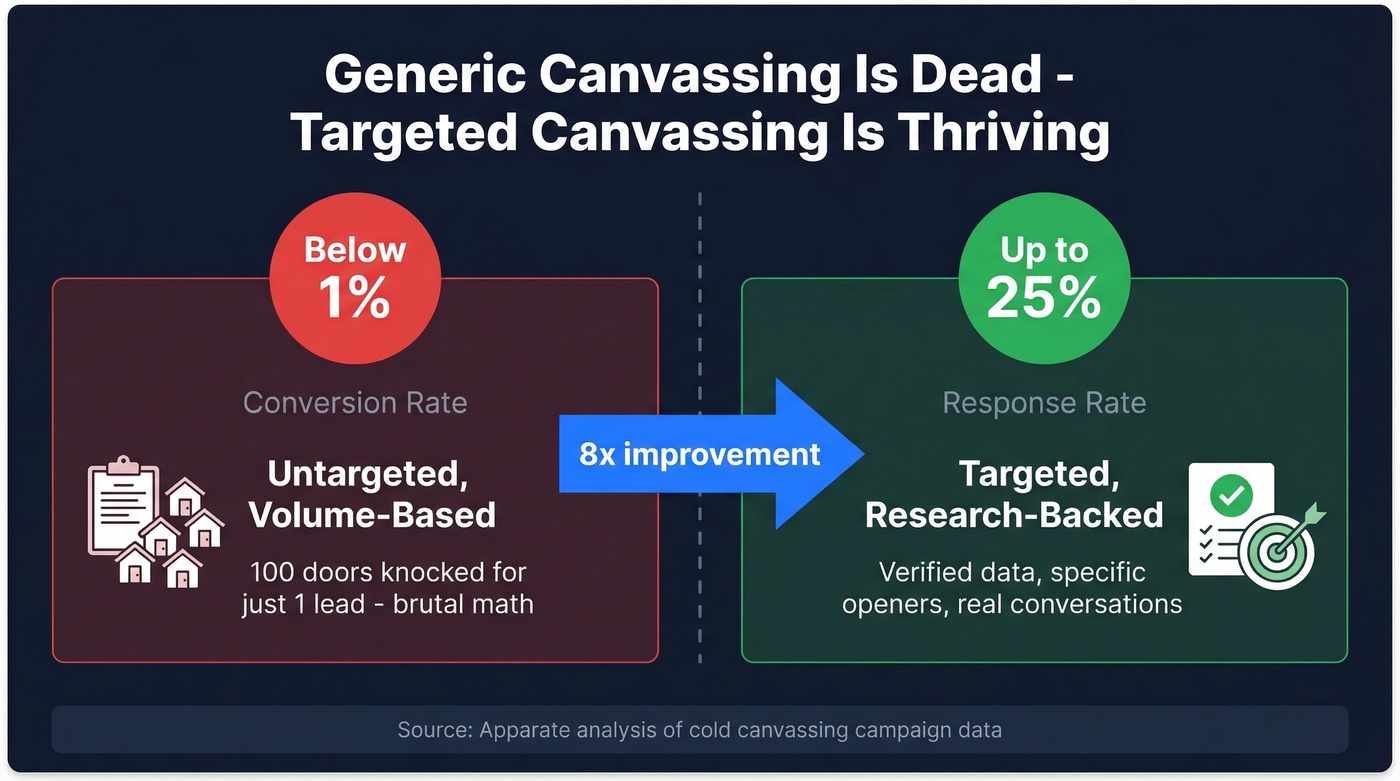
An Apparate analysis found that volume-based, untargeted campaigns produce conversion rates below 1%. That's brutal math - 100 doors for a single lead. But shifting to targeted, research-backed engagement moved response rates from 3% to 25%. That's not a marginal improvement. That's a completely different activity.
Two macro trends are making in-person outreach comparatively stronger in 2026. Carrier spam filtering has gutted cold calling pickup rates - your number gets flagged before it ever rings, and face-to-face sidesteps that entirely. Widespread remote work also means more decision-makers are reachable at home or in smaller offices during business hours, expanding the window for residential and small-business canvassing.
Let's be honest: if your average deal size is under $5,000, cold canvassing is probably the single most underrated channel available to you right now. The math on cold email and cold calling keeps getting worse as filters get smarter. Nobody has built a spam filter for a handshake.
If you're pairing canvassing with outbound email, keep an eye on email deliverability from day one.
How to Run a Canvassing Campaign
Pick Your Territory
Territory selection is the single biggest factor in your results. You want geographic clusters where your ideal prospects are dense enough that you're not driving 20 minutes between doors. For B2B, that means business parks, commercial districts, or industry-specific zones - medical office complexes if you sell to healthcare, restaurant rows if you sell to food service.
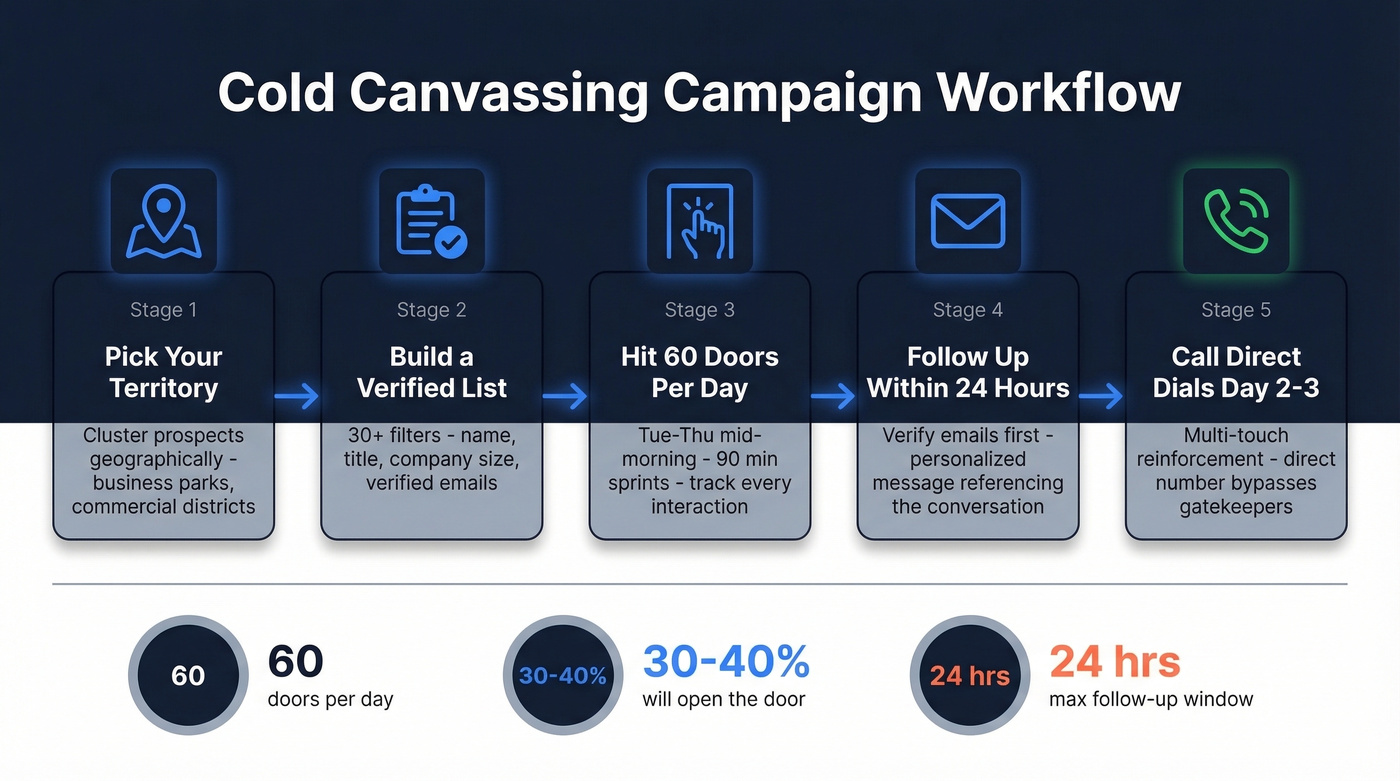
Map your territory before you drive there. Google Maps gets you started, but you need to know more than addresses. You need to know who's inside.
If you're formalizing targeting, build an ideal customer profile before you draw boundaries on a map.
Build Your List First
This is where most canvassers fail. They show up with a territory but no intelligence.
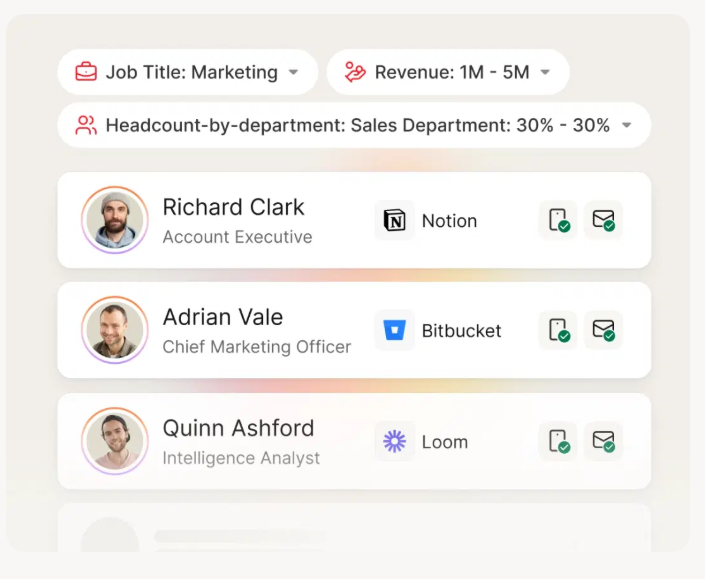
We've seen teams cut their bounce rates from 35% to under 4% just by verifying contact data before heading into the field. Prospeo's database with 30+ filters lets you build a verified prospect list before you leave the office - name, title, company size, and verified contact data for follow-up. Instead of "Hi, is the owner in?" you walk in with "Hi, I'm looking for Sarah - she's the operations manager here, right?" That's a completely different interaction, and it starts with preparation, not luck.
If you're comparing vendors for list quality, see our breakdown of data enrichment services and sales prospecting databases.

Set Activity Targets
A realistic target for a full-time canvasser is 60 doors per day, a benchmark that comes up repeatedly in Reddit's r/InsuranceAgent community. That accounts for travel time, actual conversations, note-taking, and the doors that don't open. Not every door is a conversation - maybe 30-40% will be. Of those, you're aiming to book follow-ups with a third.
For B2B, mid-morning Tuesday through Thursday tends to be the sweet spot. Decision-makers are settled into their day but haven't hit afternoon meeting blocks yet. Block your day in 90-minute canvassing sprints with 15-minute breaks for notes and hydration. Track everything: doors knocked, conversations had, follow-ups booked, cards left. Without numbers, you can't optimize.
If you want a cleaner way to define and track the work, use these sales activities examples as your baseline.
When the prospect isn't in, leave a business card with a handwritten note on the back - something specific like "Stopped by to chat about your client onboarding process. Will follow up Thursday." A handwritten note gets kept. A generic flyer gets trashed.

Four bounced emails from 8 collected addresses means half your canvassing day was wasted. Prospeo's 98% email accuracy and 7-day data refresh means every follow-up you send after a door conversation actually lands. Build your territory list with 30+ filters - industry, location, job title, company size - so you walk in saying "Hi Sarah" instead of "Is the owner in?"
Verify your canvassing list before you leave the office.
Cold Canvassing Scripts That Work
Your door opener needs to land in seven seconds or less. That's introduction, hook, qualifying question, and directional close - compressed into a single breath.
If you want more options to test, pull a few from these sample elevator pitches and adapt them to the door.
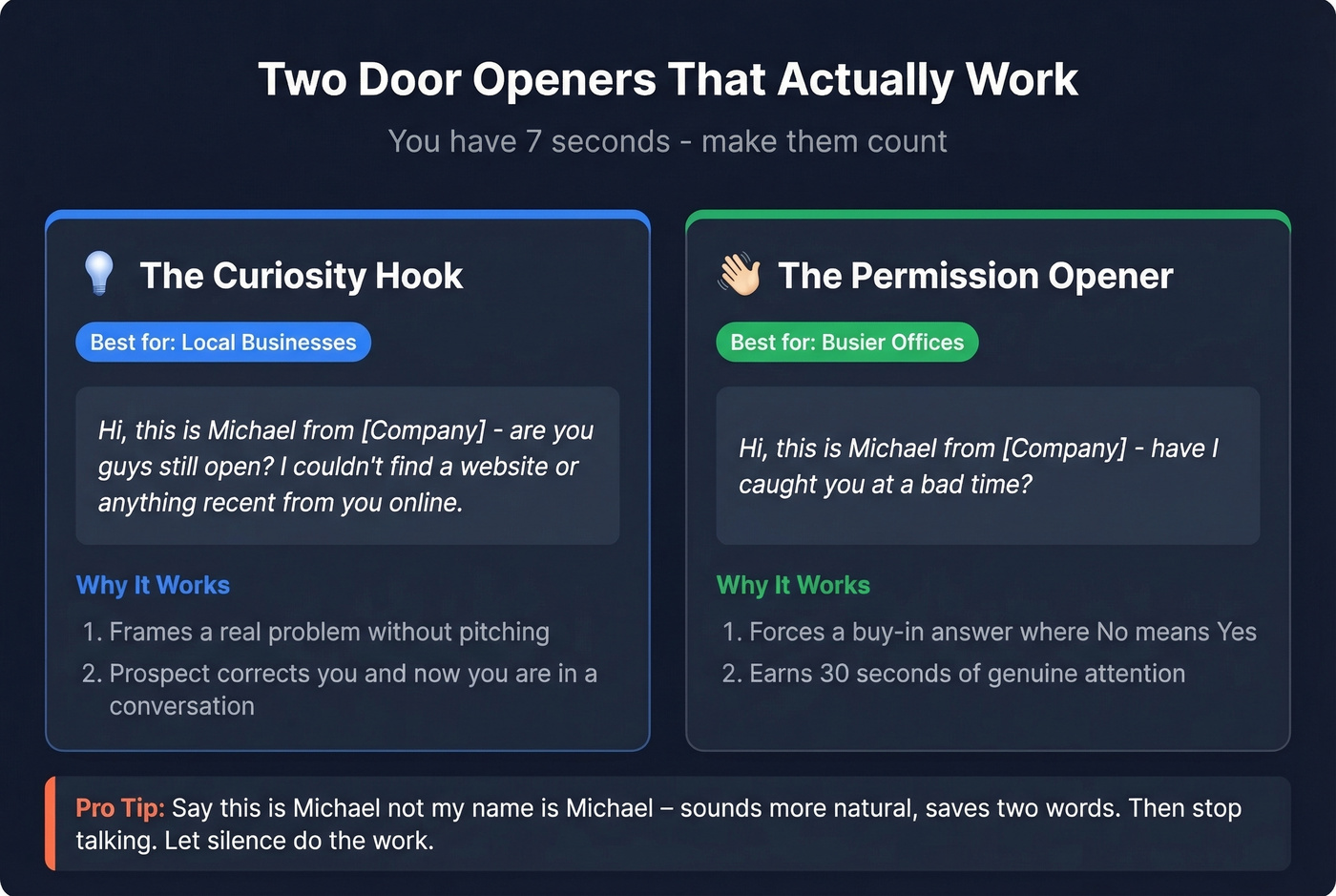
The curiosity hook (best for local businesses):
"Hi, this is Michael from [Company] - are you guys still open? I couldn't find a website or anything recent from you online."
This curiosity hook works because it frames a real problem without pitching. The prospect almost always corrects you - "Yeah, we're open, we just haven't updated the site" - and now you're in a conversation, not a pitch.
The permission opener (best for busier offices):
"Hi, this is Michael from [Company] - have I caught you at a bad time?"
The permission-based opener forces a buy-in answer. "No" becomes the positive response - "No, you're fine, what's up?" - and you've earned 30 seconds of genuine attention.
Two details that matter more than people realize. Say "This is Michael" not "My name is Michael" - it sounds more authoritative and saves two words. And after your reason line, stop talking. Let the silence work. The prospect will fill it, and whatever they say next tells you whether to qualify or gracefully exit.
Common Mistakes to Avoid
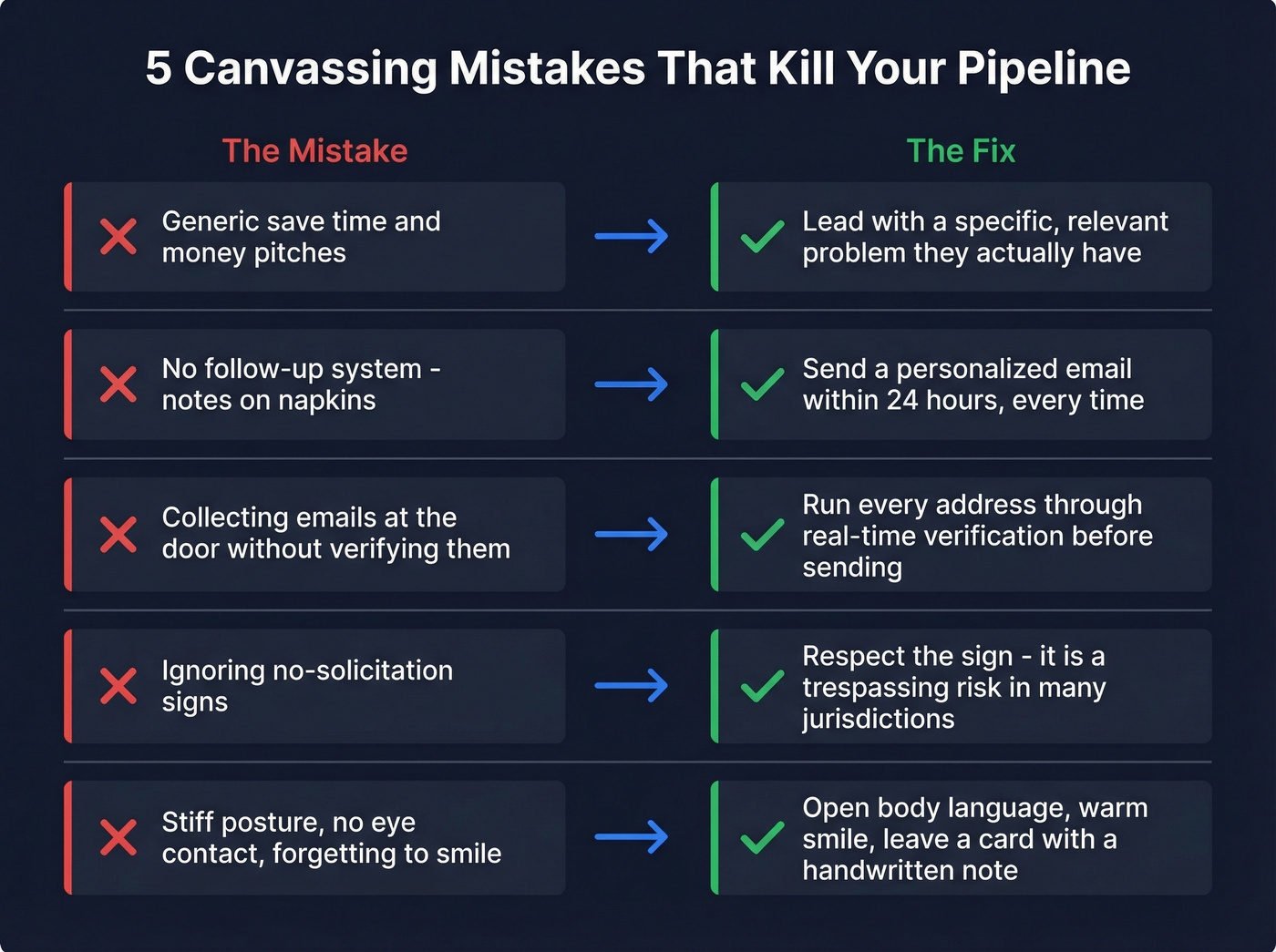
- Generic "save time and money" pitches. The consensus on r/sales is blunt - templated value props trigger hostility, not interest. Lead with a specific, relevant problem.
- No follow-up system. You had a great conversation at the door. Then you drove to the next stop, scribbled a note on a napkin, and never sent the email. Wasted.
- Bad contact data. If you're collecting emails at the door and sending follow-ups without verification, expect bounces that damage your sender reputation fast.
- Ignoring no-solicitation signs. This isn't just rude - it's a trespassing risk in many jurisdictions.
- Forgetting body language. Open posture, steady eye contact, a warm smile, and a business card left behind. Body language does more work than your script ever will.
If bounces are a recurring issue, benchmark against a healthy email bounce rate and fix the root cause.
Turning Door Conversations into Pipeline
The gap between a good field conversation and an actual pipeline opportunity is almost always the follow-up. I've watched reps have five great conversations in a morning and convert zero of them because they didn't send a single email that day.
If you need plug-and-play messaging, keep a set of sales follow-up templates ready before you start knocking.
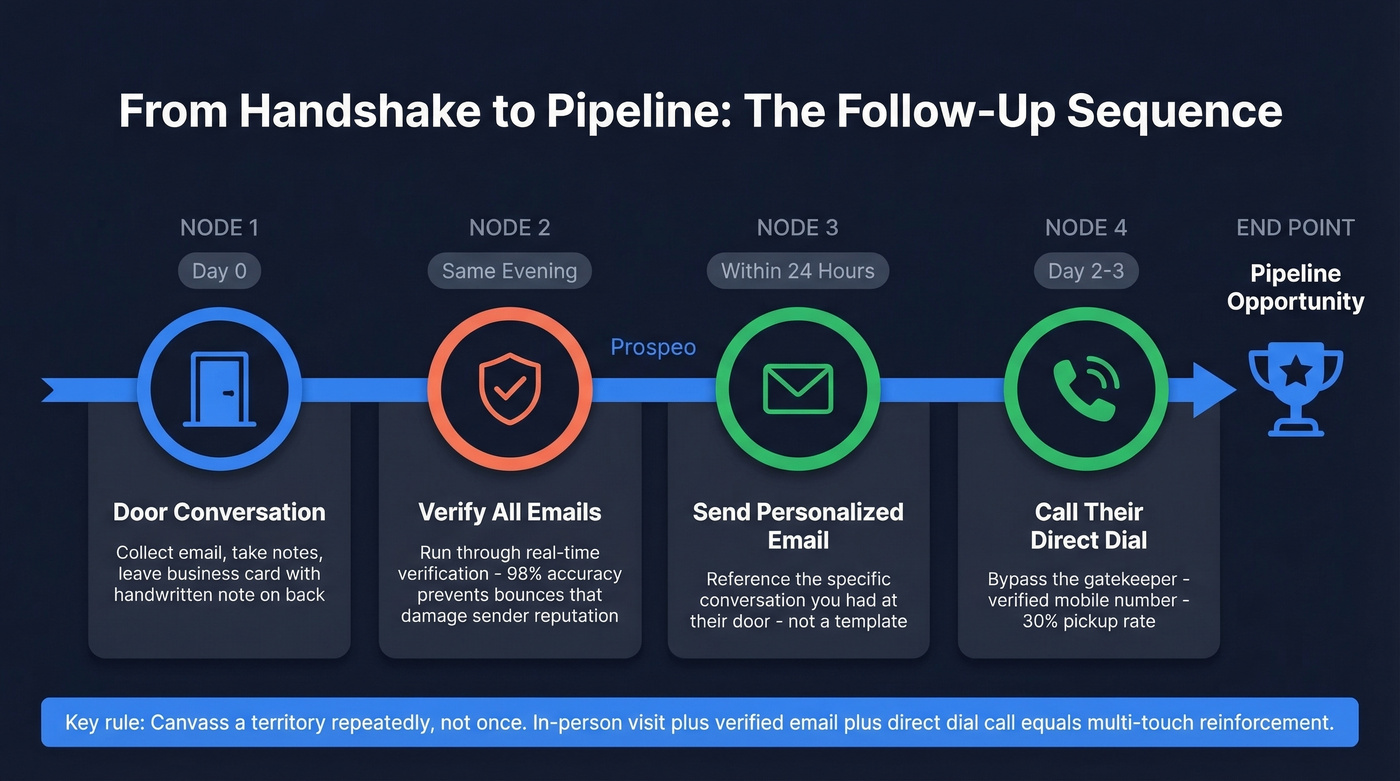
Run every email you collected through real-time verification before sending - 98% accuracy prevents bad addresses from torching your deliverability. For decision-makers who said "email me" but gave you a generic info@ address, a tool like Prospeo's Mobile Finder gives you verified direct dials so you can reach them without going through a gatekeeper.
The workflow is simple: verify the emails, send a personalized follow-up within 24 hours referencing your conversation, then call the direct dial 2-3 days later. Canvassing a territory once and never returning is a common mistake. This isn't a campaign you run once. It's a channel. It works when the in-person visit, the verified email, and the direct-dial call reinforce each other across multiple touches.
The best canvassers don't just leave business cards - they follow up with a direct-dial call the same day. Prospeo gives you 125M+ verified mobile numbers with a 30% pickup rate, so when you can't catch the decision-maker at the door, you reach them on their phone. At $0.01 per email, arming a 60-door-per-day rep costs less than their morning coffee.
Turn every door knock into a multi-channel follow-up sequence.
Cold Canvassing Tools & Pricing
You don't need a dozen tools. You need one for data, one for territory management (if you have multiple reps), and your CRM.
If you're still deciding what to use to store and work leads, compare options in our guide to contact management software.
| Category | Tool | Starting Price | Best For |
|---|---|---|---|
| Data & Verification | Prospeo | Free tier (75 emails/mo); ~$0.01/email | Verified lists + email verification |
| Territory Scouting | Google Maps | Free | Initial territory mapping |
| Territory Mgmt | Ecanvasser | $99-$599/mo | 3+ reps, territory planning |
| Route Optimization | Badger Maps | $58-$135/user/mo | Pre-scheduled B2B meetings |
| D2D Management | SalesRabbit | $195-$245/mo | Lead capture + gamification |
| CRM | Salesforce / HubSpot / Close | $25-$300/user/mo | Follow-up sequences + storage |
A note on Badger Maps: it's positioned for pre-scheduled meetings, not high-volume door-to-door canvassing. For teams with fewer than 5 licenses, CRM integration adds $345-$545/month on top of the per-user cost. Skip it unless you're running a larger field team with pre-booked routes.
In our experience, most solo canvassers or small teams need data plus their existing CRM and nothing else. Add Ecanvasser or SalesRabbit only when you're managing multiple reps across territories and need real-time tracking.
Legal Compliance Checklist
Look, Close.com's claim that "there are no laws to prevent doorstep selling" is dangerously incomplete. The compliance burden isn't on the canvassing itself - it's on the follow-up calls and texts that come after. Get that wrong and the fines dwarf whatever revenue you generated at the door.
If you're adding SMS to your follow-up, read this cold texting compliance breakdown first.
- TCPA fines apply to follow-up calls or texts: $500 per violation, $1,500 if willful. Connecticut goes up to $20,000 per violation.
- Prior Express Written Consent is required before sending automated calls or texts to cell phones. Collecting an email at the door doesn't give you permission to robo-dial.
- DNC scrubbing is required at least every 31 days for phone follow-up. Federal fines run up to $50,120 per illegal call.
- Federal calling hours for follow-up calls: 8 AM to 9 PM in the recipient's time zone.
- FTC three-day cooling-off rule: any sale over $25 made at someone's door must include a cancellation notice and a three-day window to back out.
- No-solicitation signs must be respected - ignoring them creates trespassing liability.
- City and county ordinances vary wildly. Many municipalities require solicitation permits, and some have "Green River" ordinances that ban door-to-door sales entirely. Check local rules before you canvass a new territory.
FAQ
What is cold canvassing and how does it differ from cold calling?
Cold canvassing means approaching prospects in person - at their office or door - without prior contact, while cold calling does the same over the phone. Canvassing gives you richer context through body language and environment but requires significantly more time per prospect than dialing.
How many doors should a canvasser hit per day?
A realistic target is 60 doors per day for a full-time canvasser, accounting for travel, conversations, note-taking, and doors that don't open. Dense business parks let you hit more; spread-out suburban areas fewer. Expect real conversations at 30-40% of doors.
How do I follow up after a canvassing visit?
Verify every email and phone number you collected before sending anything - unverified field data bounces at rates that damage deliverability. Send a personalized email within 24 hours referencing your conversation, then follow up with a direct-dial call two to three days later.
Is door-to-door canvassing legal?
In-person canvassing is legal in most jurisdictions, but many cities require solicitation permits and some ban it entirely via "Green River" ordinances. The bigger legal risk is in the follow-up - TCPA fines start at $500 per violation for unsolicited calls or texts. Always check local ordinances and scrub against the Do Not Call registry.
What's the best time of day for B2B canvassing?
Mid-morning Tuesday through Thursday - roughly 9:30 AM to 11:30 AM - produces the best conversations for B2B. Decision-makers are at their desks but haven't hit afternoon meetings. Avoid Mondays (planning days) and Fridays (checkout mode). For residential, 4 PM to 7 PM catches people after work.