

Cold Email Follow Up: What 16.5M Emails Reveal About Getting Replies
A RevOps lead we work with rebuilt their entire cold email follow-up process over 62 days last year. Reply rates had cratered from 8% to 3% across 18 months - same templates, same ICP, same sequencer. The fix wasn't better copy. It was infrastructure: cleaner data, fewer follow-ups, and a complete rethink of what "persistence" actually means in 2026. Total cost of the rebuilt stack? $420/month. Result? Sixteen qualified leads per month, up from near zero.
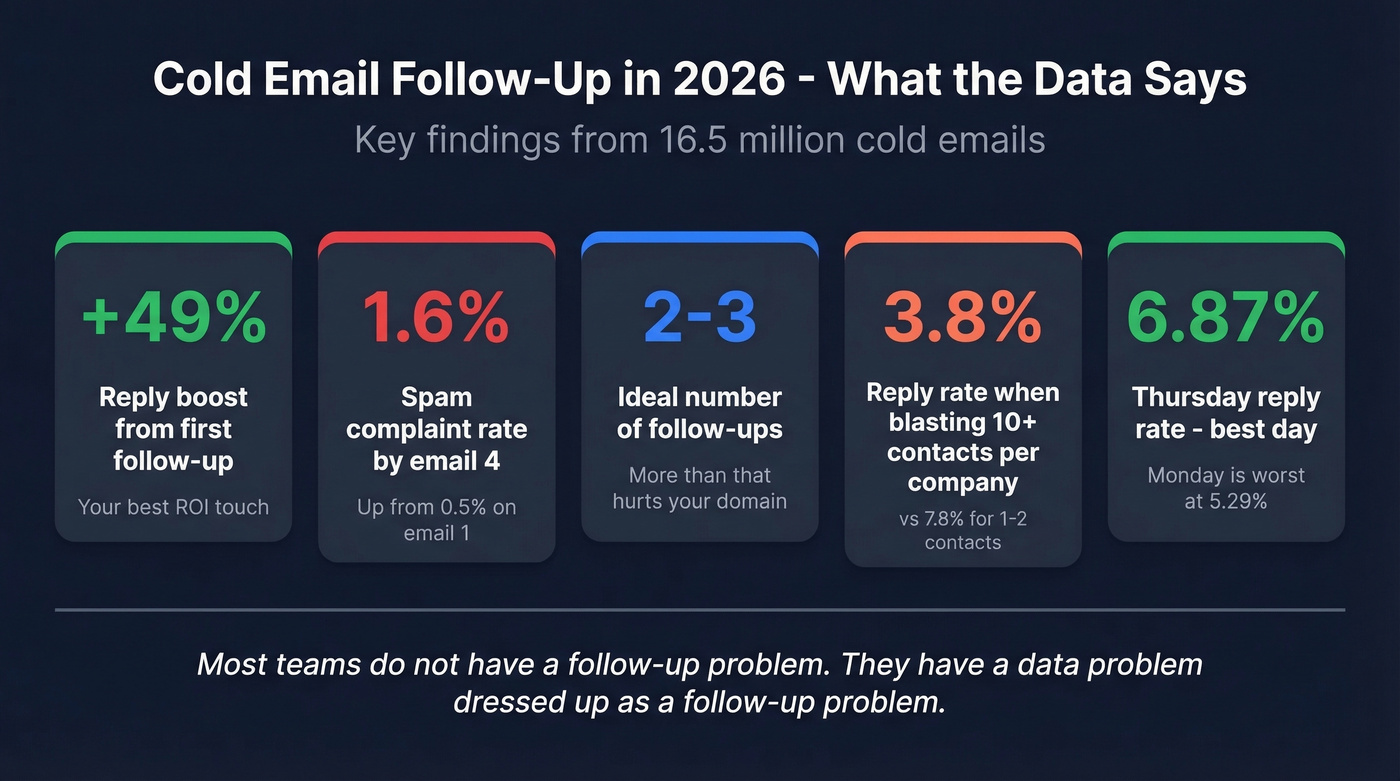
That story tracks with the broader trend. A Belkins study analyzing 16.5 million cold emails across 93 business domains found average reply rates dropped from 6.8% in 2023 to 5.8% in 2024 - a 15% year-over-year decline. Every follow-up guide on the internet tells you to send more emails. The data says the opposite. Most teams don't have a follow-up problem. They have a data problem dressed up as a follow-up problem.
Quick Version
- Send 2-3 follow-ups max. Past that, response rates fall hard while spam complaints and unsubscribes climb fast.
- Use Day 3 / Day 7 / Day 14 spacing with a Day 21 breakup only for high-value accounts. Send Tue-Thu, 7-11 AM in the recipient's timezone.
- Verify your list before you touch a single template. If your bounce rate is above 2%, deliverability takes a hit and your later follow-ups start landing in spam. Prospeo's free tier includes 75 email verifications per month plus 100 Chrome extension credits - enough to test whether bad data is your real bottleneck.
What 16.5M Emails Actually Show About Follow-Up Performance
Here's the thing most follow-up advice gets wrong: it treats every additional touch as free upside. The Belkins dataset tells a different story. Your first follow-up is genuinely powerful - reply rates increased up to 49% in high-performing campaigns. But returns collapse fast, and risk climbs just as quickly.
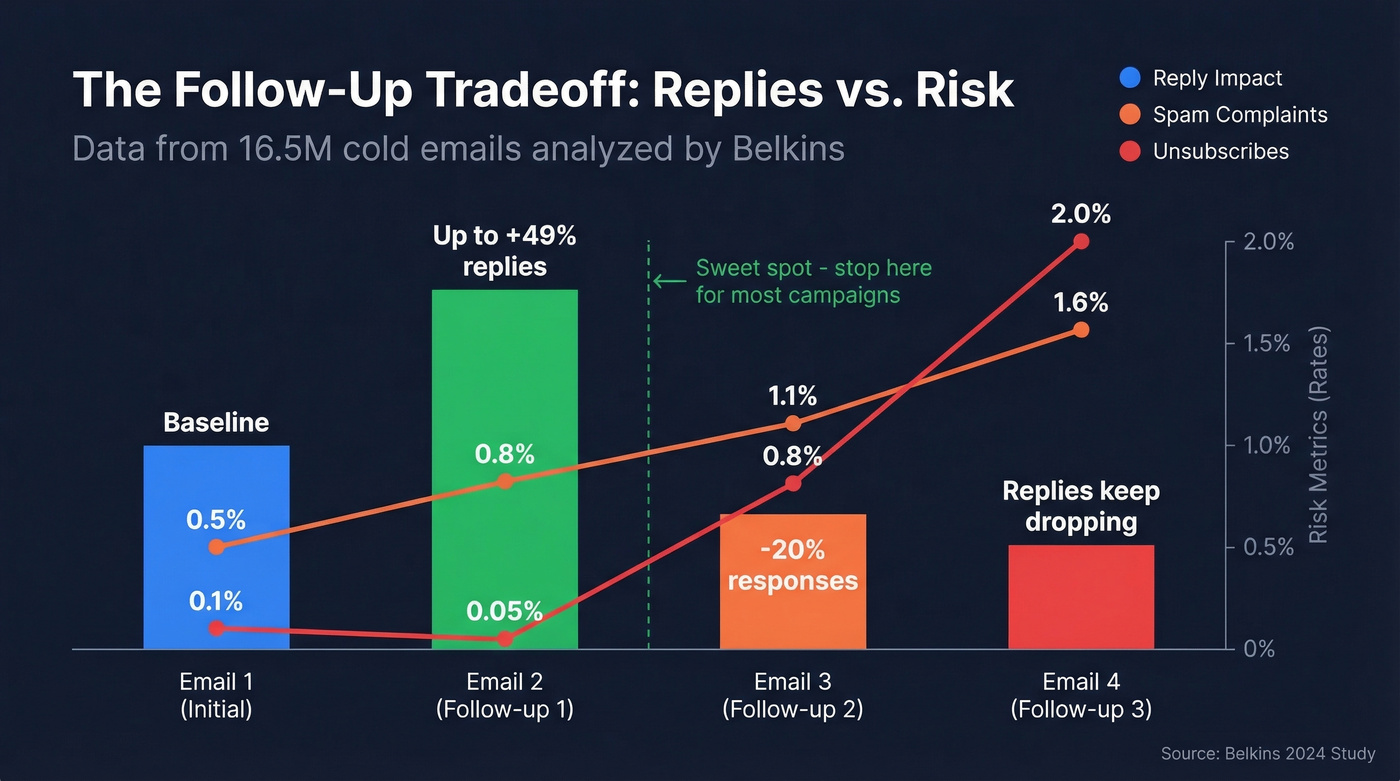
The deliverability cost is clear: spam complaints rose from 0.5% on the first email to 1.6% by the fourth, and unsubscribes climbed to 2% by that same fourth email.
| Email in sequence | Reply impact | Spam complaint rate | Unsubscribe rate |
|---|---|---|---|
| Email 1 | Baseline | 0.5% | 0.1% |
| Email 2 (Follow-up 1) | Up to +49% | ~0.8% | 0.05% |
| Email 3 (Follow-up 2) | -20% responses | ~1.1% | 0.8% |
| Email 4 (Follow-up 3) | Replies keep dropping | 1.6% | 2.0% |
That dip on Email 2 unsubscribes is a known pattern - early follow-ups reach the most engaged slice of your list, so fewer people opt out before fatigue kicks in.
You've probably seen the stat: "80% of sales require 5+ follow-ups." It's cited everywhere and sourced nowhere. The Belkins dataset, which actually shows its work across 16.5 million sends, paints a clearer picture: the first follow-up helps a lot, but later touches drive sharply lower efficiency and sharply higher complaints. That recycled stat likely describes multi-channel touches across an entire sales cycle, not five cold emails to the same inbox. Treating it as email-specific advice will torch your sender reputation.
The other overlooked variable is targeting breadth. Teams contacting just 1-2 people per company averaged 7.8% reply rates. Teams blasting 10+ contacts at the same company? 3.8%. More emails doesn't mean more pipeline - it means more spam complaints and a worse sender reputation.
The Exact Cadence That Works
Stop overthinking this. The cadence that works for most B2B outbound:
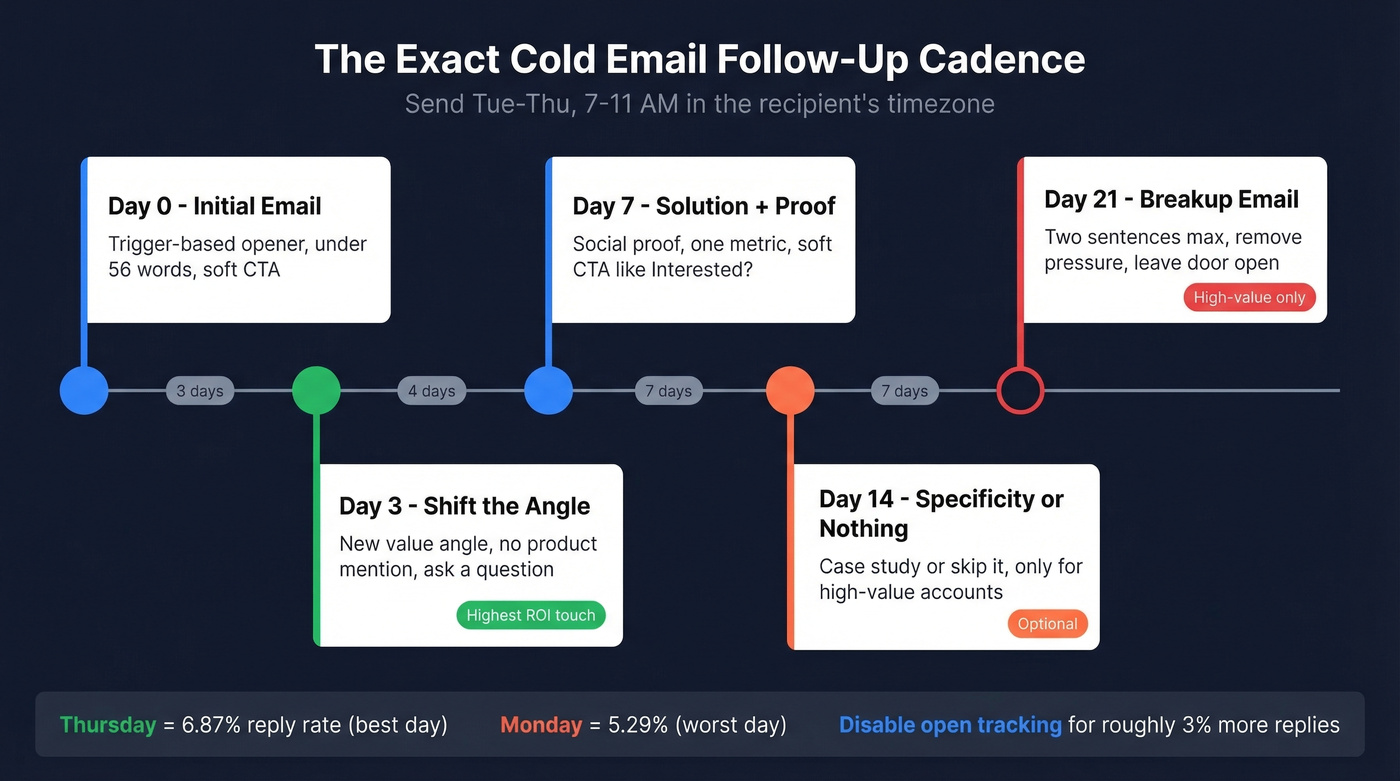
- Day 0: Initial email
- Day 3: First follow-up
- Day 7: Second follow-up
- Day 14: Third follow-up (optional)
- Day 21: Breakup email - only for high-value accounts
Send Tuesday through Thursday. Thursday pulled a 6.87% reply rate, the best day in the Belkins data, while Monday limped in at 5.29%. For time of day, evenings between 8-11 PM in the recipient's timezone peaked at 6.52%, though mornings at 7-11 AM are also strong. After locking sends to Tue-Thu, 8-11 AM recipient timezone, the RevOps practitioner we mentioned saw opens improve by 16%. (If you want a deeper breakdown, see our guide on the best time to send cold emails.)
Now, Instantly's benchmark data claims 4-7 step sequences produce 27% reply rates versus 9% for 1-3 steps. That sounds like it contradicts everything above. It doesn't - Instantly is looking at total campaign replies across all touches, which naturally rises with more sends. Belkins' per-email analysis shows the tradeoff: each additional email earns fewer replies per send while generating more spam complaints and unsubscribes. Efficiency per send is what protects your domain.
One counterintuitive move worth testing: turn off open tracking pixels. Belkins ran an internal experiment and found disabling them yielded roughly 3% higher response rates. Tracking pixels trigger spam filters more often than most teams realize, and the open rate data they provide is increasingly unreliable anyway. Kill the vanity metric, keep the deliverability. (More detail: email tracking pixels.)
Writing Follow-Ups That Earn Their Place
Every follow-up needs to justify its existence in someone's inbox. That means each touch shifts the angle - you're not just bumping the thread with "circling back." The progression that works: trigger, questions, solution, proof, breakup.
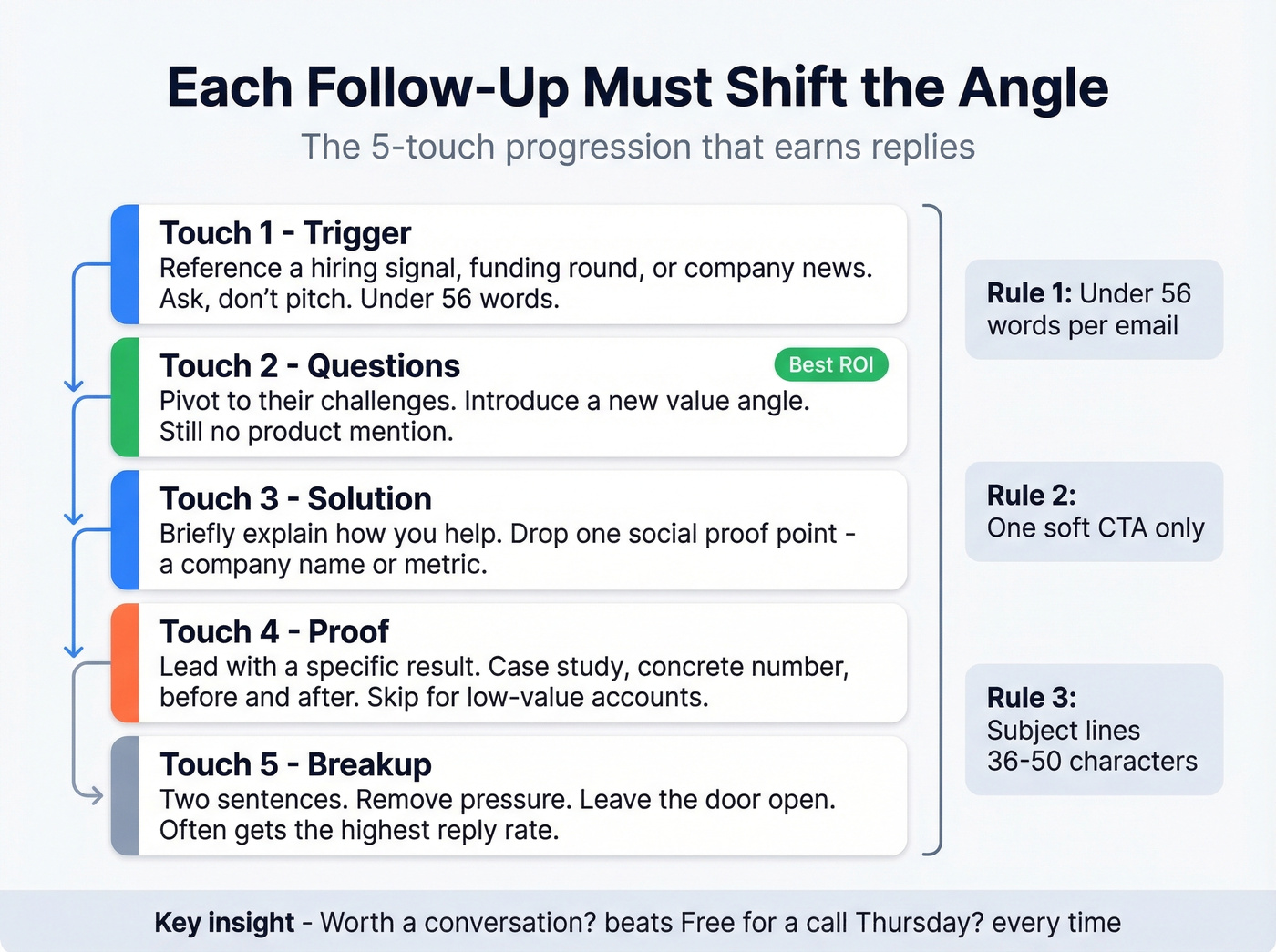
One copy rule matters more than any template: keep it short. The practitioner who doubled their reply rate cut email length from 141 words to under 56. That's three short paragraphs, max. Instantly's benchmarks confirm the pattern - 50-125 words with one clear CTA consistently outperforms longer emails. (If you’re rebuilding messaging, start with the fundamentals of email copywriting.)
For subject lines, "Quick question" pulled roughly 39% opens in practitioner testing. Keep subject lines between 36-50 characters. And always use a soft CTA - "Worth a conversation?" beats "Free for a call Thursday?" every time. For more options, pull from these email subject line examples.
Follow-Up 1 (Day 3): Shift the Angle
Remind them of the context from your first email, then introduce a new value angle. Don't repeat yourself. If your opener was trigger-based - a hiring signal, a funding round - this follow-up should pivot to a question about their challenges. Keep it under 56 words. Don't mention your product yet.
Follow-Up 2 (Day 7): Solution + Proof
Don't rehash your first two emails with "just bumping this up." Do go solution-focused. Briefly explain how you help and drop one piece of social proof - a company name, a metric, a recognizable logo. The soft CTA matters most here. "Interested?" works better than a calendar link.
For teams with engagement data from their sequencer, segment here: prospects who opened your first email get the social proof version, while those who didn't get a completely fresh angle.
Follow-Up 3 (Day 14): Specificity or Nothing
Lead with a specific result. A case study, a concrete number, a before/after. This is your strongest proof point and your last real shot at engagement. If they haven't replied by now, generic value props won't move them. Skip this touch entirely for low-value accounts - it's not worth the deliverability risk.
Follow-Up 4 (Day 21): The Breakup
Two sentences. Let them know you won't follow up again, and leave the door open. Breakup emails often get the highest reply rates in a sequence because they remove pressure.

The Belkins data is clear: follow-ups fail when they hit bad addresses. Every bounce chips away at your sender reputation, pushing your entire sequence into spam. Prospeo's 5-step email verification delivers 98% accuracy - keeping bounce rates under 2% so your Day 3 and Day 7 follow-ups actually reach the inbox.
Fix your data before you fix your templates. Start with 75 free verifications.
5 Templates You Can Steal
Every template below is under 60 words. We practice what we preach. (If you want more variations, see these sales follow-up templates.)
The Audit + Loom (Day 3)
Hey {{firstName}},
Sent a note Tuesday about {{trigger}}. I recorded a 2-min Loom walking through {{companyName}}'s {{specific area}} - spotted {{specific insight}} that might be costing you {{estimated impact}}.
Happy to share it. No strings.
{{yourName}}
This is the highest-converting value-first format we've seen across our clients' campaigns. A quick audit or a Loom walkthrough gives before you ask. Competitor insights and "quick fix" offers work on the same principle - lead with something they can use whether or not they reply. (More on the tactic: Loom video cold email.)
The Social Proof Drop (Day 7)
{{firstName}} - quick follow-up.
{{Similar company}} was dealing with {{same problem}} last quarter. They {{specific result}} within 60 days.
If that's relevant to what you're working on, happy to share how. If not, no worries.
Worth a conversation?
Before/After: What Most People Send vs. What Works (Day 14)
Most follow-up three emails look like this:
"Hey, just wanted to circle back on my last email. I know you're busy but I'd love to find 15 minutes to chat about how we can help {{companyName}} with..." (47 words and counting, zero new information)
Here's what actually gets replies:
Hey {{firstName}},
One number: {{specific metric, e.g., "our clients average a 26% lift in booked meetings"}} after switching to {{your approach}}.
If {{problem}} is on your radar, I think we'd have a good conversation. If not, no worries.
The second version is 40 words, introduces new information, and has a soft CTA. That's the entire formula.
The Breakup (Day 21)
{{firstName}} - I'll keep this short.
I've reached out a few times and haven't heard back, so I'll assume the timing isn't right.
If {{problem}} comes back up, my inbox is open. Wishing you a great Q{{quarter}}.
The Re-Engagement (30+ Days)
Hey {{firstName}},
Noticed {{new trigger - job change, funding round, new hire}}. When we last connected, {{problem}} wasn't a priority.
Curious if anything's shifted. Either way, congrats on {{trigger}}.
Infrastructure That Makes Follow-Ups Land
The best follow-up sequence in the world is worthless if your emails hit spam. Before you write a single template, run through this.
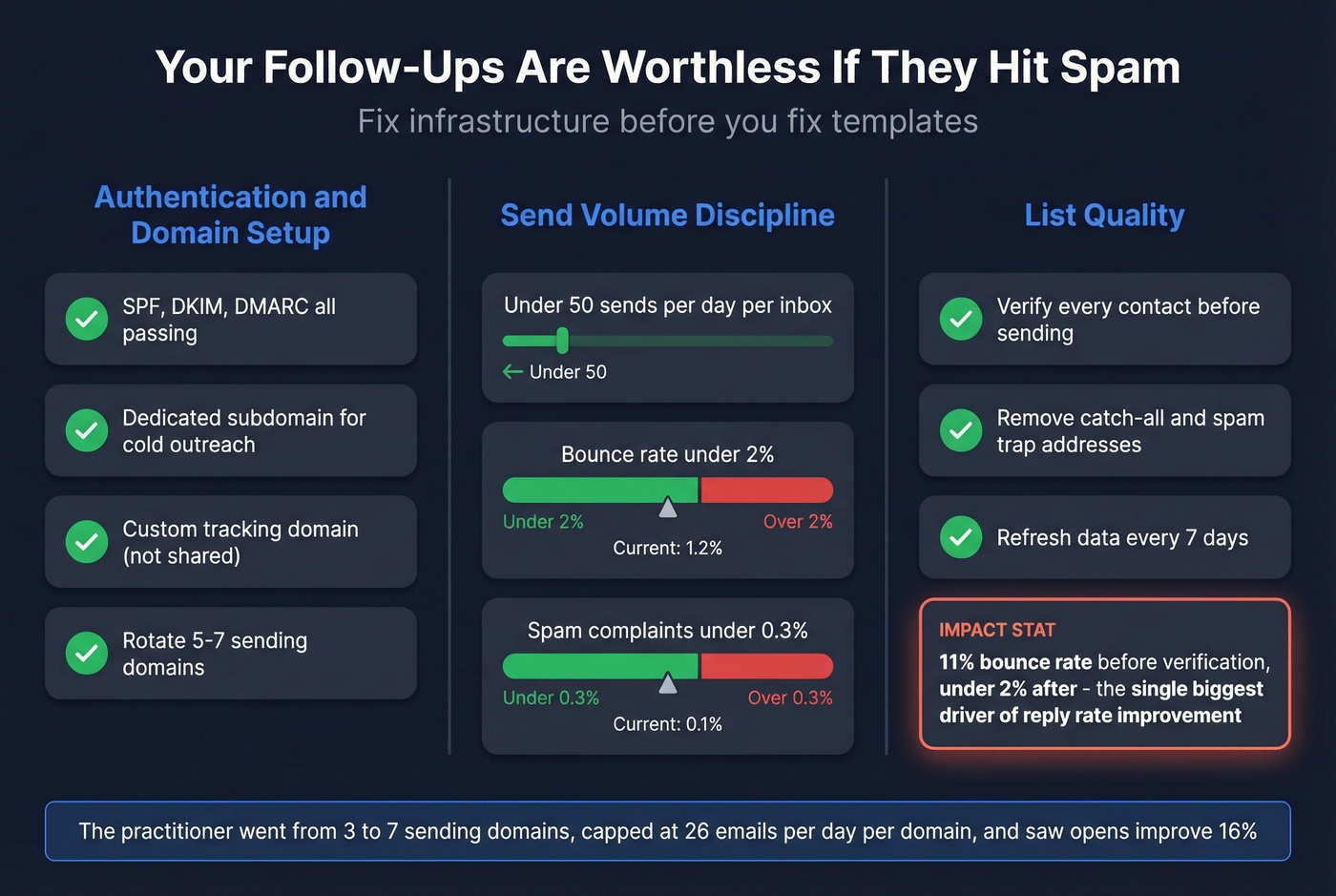
Authentication and domain setup:
- SPF, DKIM, and DMARC configured and passing
- Dedicated subdomain for cold outreach to protect your primary domain
- Custom tracking domain - shared tracking domains are a spam trigger (see: tracking domain)
- Domain rotation: the practitioner went from 3 to 7 sending domains, capping at 26 emails per day per domain
Send volume discipline:
- Under 50 sends per day per inbox when starting out
- Bounce rate under 2%
- Spam complaints under 0.3% (use an email spam checker if you’re troubleshooting)
List quality - the piece everyone skips:
That same practitioner's bounce rate was 11% before they started verifying contacts. After verification, it dropped below 2%. That single change - not copy, not timing, not subject lines - was the biggest driver of their reply rate improvement.
We've seen this pattern repeatedly. Stack Optimize, an outbound agency, went from 35% bounce rates to under 3%, with zero domain flags across all client accounts. If you're wondering how to follow up on cold emails effectively, start here: clean data is the prerequisite, not the afterthought. Prospeo's 5-step verification catches invalid addresses, spam traps, and catch-all domains before they wreck your sender reputation, with a 98% email accuracy rate and a 7-day data refresh cycle. (Related: email deliverability guide.)
Compliance You Can't Skip
CAN-SPAM fines hit $50,120 per violation. GDPR penalties reach EUR 20M or 4% of global revenue. These aren't theoretical - enforcement is increasing.
CAN-SPAM (US): Honor opt-outs within 10 business days. Physical address in every email. Clear sender identification.
GDPR (EU/UK): Document your data sources and legal basis. Provide clear opt-out mechanisms.
Every sequence, regardless of geography: unsubscribe link in every email, stop emailing unengaged recipients after your sequence ends, document where you sourced each contact's data, and segment by geography so you're applying the right rules.
Compliant campaigns actually perform better. Mailforge reports compliant sends see 38% higher open rates and 68% higher click-through rates. When you're transparent about who you are and make it easy to opt out, the people who stay engaged are genuinely interested. That's the whole point.
Following Up Across Channels
Email-only sequences cap your conversion rate. Multi-channel sequences convert 28% higher than email alone. And while the industry loves to say "80% of sales require 5+ follow-ups," that stat - to the extent it's useful - describes touches across channels, not five emails to the same inbox.
A practical overlay:
- Day 0: Initial email
- Day 3: Follow-up email + connection request on social
- Day 5: Phone call
- Day 8: Email with social proof
- Day 10-14: Breakup or value-add email
For the phone touches, you need verified direct dials, not switchboard numbers. Look for providers with verified mobile databases - a 30% pickup rate on direct dials makes the phone step viable instead of a time sink. (If you’re building the broader motion, see sales prospecting techniques.)
Let's be honest, though: if your average deal size is under $10K, you probably don't need a five-touch multi-channel sequence at all. Two emails and a connection request will tell you everything you need to know about whether a prospect is interested. Save the phone calls and the elaborate cadences for deals that justify the time investment.
Teams targeting 1-2 contacts per company hit 7.8% reply rates. But finding the right 1-2 people requires precise data. Prospeo's 30+ search filters - buyer intent, job changes, department headcount - let you pinpoint decision-makers so every follow-up goes to someone who actually matters.
Stop blasting 10 contacts per account. Reach the right one at $0.01 per email.
FAQ
How many follow-up emails should I send?
Two to three. The Belkins 16.5M-email dataset shows spam complaints rising from 0.5% on the first email to 1.6% by the fourth, while unsubscribes climb to 2%. More touches mean more risk to your domain, not more pipeline.
What's the best cold email follow-up cadence?
Day 3, Day 7, Day 14 after your initial send. Avoid next-day follow-ups - they hurt reply rates. This spacing gives prospects time to engage without letting the conversation go cold.
How do I follow up without being annoying?
Shift the angle with every touch - introduce new information like a case study, a relevant metric, or a fresh trigger event. If you're restating your first message, you're not following up; you're spamming. Keep each email under 60 words with a soft CTA.
What's a good reply rate for follow-ups?
Five to ten percent is solid for B2B outbound. Above 15% means you've nailed targeting and offer. Below 3%, check your bounce rate and deliverability before rewriting templates - bad data is the most common culprit.
How do I keep follow-up emails out of spam?
Verify your list before sending - keep bounce rates under 2%. Set up SPF, DKIM, and DMARC. Use a dedicated subdomain and cap sends at 50/day per inbox. Prospeo's free tier lets you verify 75 emails monthly to catch invalid addresses and spam traps before they damage your domain.