

How to Build a Cold Email Outreach Sequence That Gets Replies in 2026
You sent 500 emails last week. Three replies - two were unsubscribe requests. Here's the thing: the problem isn't your copy. Copy is only part of the equation, and honestly it's the part everyone fixates on while ignoring the boring stuff that actually moves the needle - data quality, infrastructure, and timing.
What You Need (Quick Version)
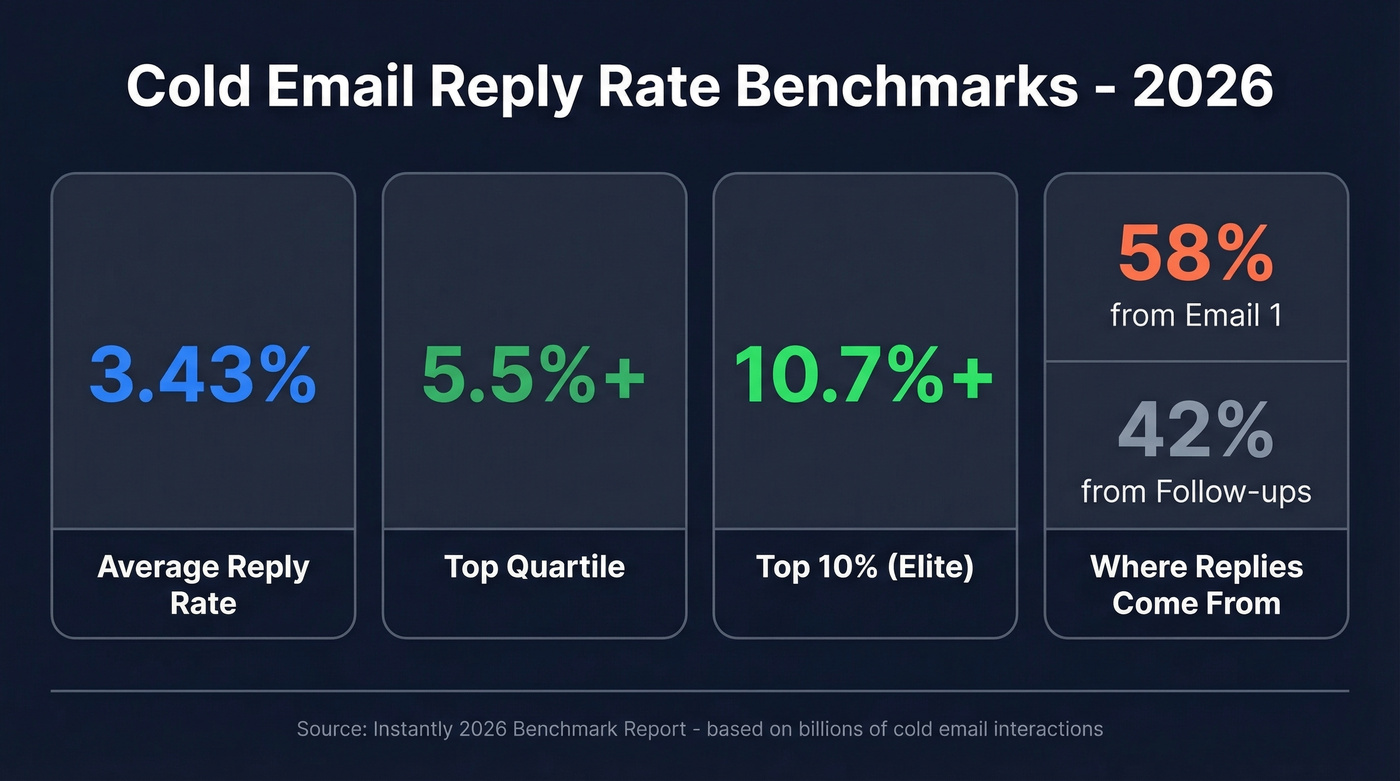
A 3.43% reply rate is average according to Instantly's 2026 benchmark report. Top-quartile senders hit 5.5%+. Getting there comes down to three pillars: clean data, solid infrastructure, and concise copy under 80 words per email.
A strong baseline sequence is 4 emails over roughly 14 days with widening gaps between each touch. The most common failure point isn't subject lines - it's sending without deliverability setup. Fix your data first. Everything else builds on top.
2026 Benchmarks Worth Knowing
Here's what "good" actually looks like, based on billions of cold email interactions:
| Metric | Number |
|---|---|
| Average reply rate | 3.43% |
| Top quartile | 5.5%+ |
| Top 10% (elite) | 10.7%+ |
| Replies from Step 1 | 58% |
| Replies from follow-ups | 42% |
Those 20-30% reply rates you see in case studies? They're not the norm. When you see numbers like that, it usually comes from exceptional targeting, small samples, or cherry-picked campaigns.
A widely shared benchmark in cold email circles is that 2-4% is genuinely good at volume. And stop obsessing over open rates - Apple Mail Privacy Protection inflates opens by 10-15+ percentage points. Reply rate is the only metric that matters.
Fix Data and Infrastructure First
This is where most sequences die before they start. You can write the best email ever crafted, and it won't matter if 11% of your list bounces.
Authentication is non-negotiable. Configure SPF, DKIM, and DMARC on every sending domain. Without these, Gmail and Microsoft are far more likely to throttle or spam-route you. Don't skip this step. Don't "get to it later." Do it before you write a single subject line. (If you want a quick checklist, see our email deliverability setup guide.)
Never send from your primary domain. Set up secondary domains and run 2-3 email accounts per domain at 10-15 emails/day each. To send 400 emails/day, you need 10-12 domains on Google Workspace or Microsoft 365. Keep an eye on safe sending limits and ramping (email velocity matters more than most teams think).
Warm up for 14-21 days minimum. Keep warmup running even after campaigns start. In our experience, teams that skip warmup burn domains fast and then wonder why their reply rates cratered. (Tools and workflows change fast - use this email warmup tools roundup as a starting point.)
Hit these thresholds or stop sending:
- Bounce rate under 2% (see bounce rate benchmarks + fixes)
- Spam complaints under 0.3%
- One-click unsubscribe headers (RFC 8058) on every email
One practitioner on r/Entrepreneur dropped their bounce rate from 11% to under 2% by ditching purchased lists and verifying every address. Their reply rate doubled - from 3% to 6% - over 62 days. That's not a magic trick. That's just what happens when you stop sending to dead addresses.
Verification isn't optional anymore. Prospeo runs every email through a 5-step verification process with catch-all handling, spam-trap removal, and honeypot filtering, delivering 98% email accuracy on a 7-day refresh cycle. Stack Optimize used it to build from $0 to $1M ARR while maintaining 94%+ deliverability, bounce rates under 3%, and zero domain flags across all clients. At roughly $0.01 per email, it's the cheapest insurance policy your domain reputation can buy. (If you're comparing vendors, start with these email verification alternatives.)

Sequence Structure and Timing
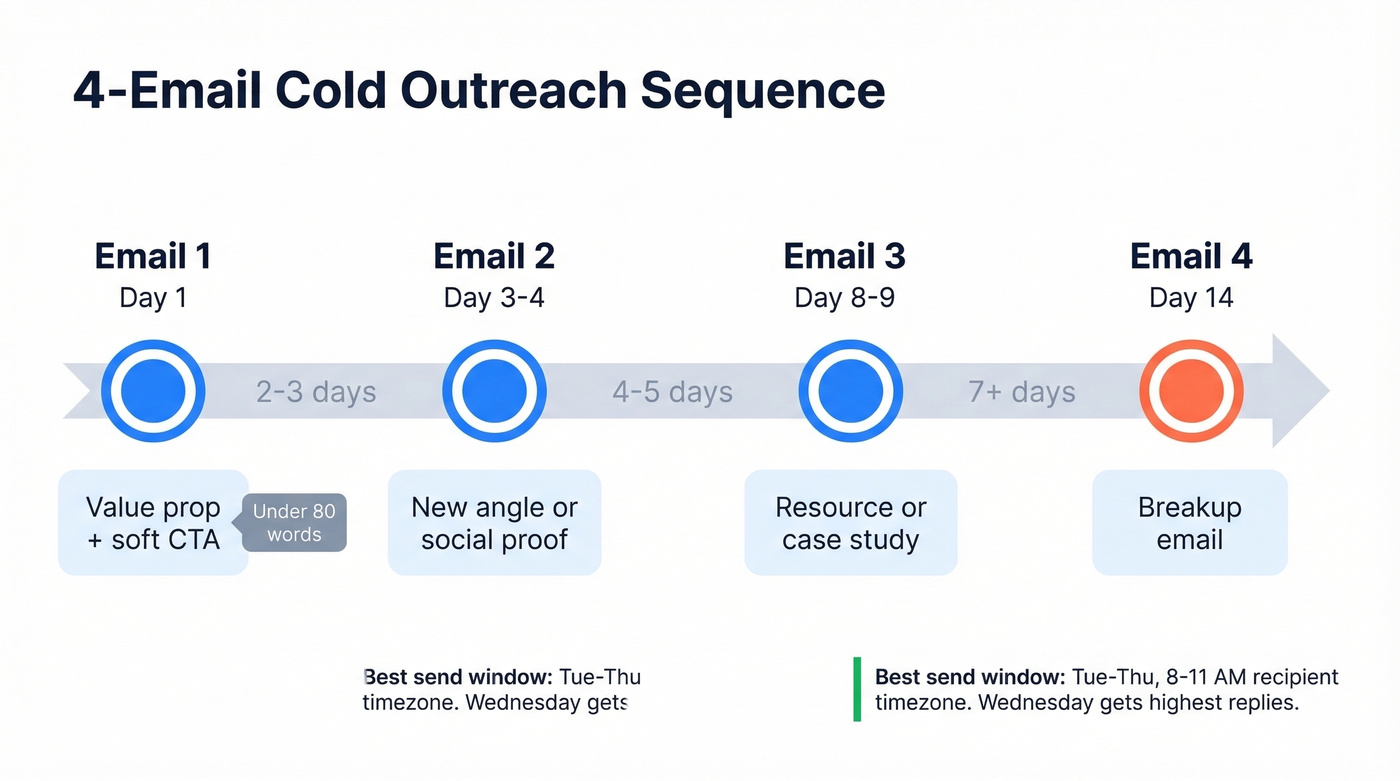
The sweet spot is 4 emails with widening gaps:
| Day | Gap | Purpose | |
|---|---|---|---|
| #1 | 1 | - | Value prop + soft CTA |
| #2 | 3-4 | 2-3 days | New angle or proof |
| #3 | 8-9 | 4-5 days | Resource or case study |
| #4 | 14 | 7+ days | Breakup |
Send Tuesday through Thursday, 8-11 AM in the recipient's timezone. Wednesday consistently shows the highest reply rates. (More data here: best time to send cold emails.)
Keep emails under 80 words. One team saw results recover after cutting their emails from 141 words to under 56. Shorter isn't lazy - it's respectful of your prospect's time. If you're stuck, borrow a few patterns from these sales follow-up templates.

That Reddit poster doubled their reply rate by fixing bounce rates. Prospeo's 5-step verification delivers 98% email accuracy on a 7-day refresh cycle - so every email in your sequence hits a real inbox. At $0.01 per verified email, it costs less than the domain you'll burn sending to bad data.
Fix your data before you write a single subject line.
Two Sequences You Can Steal
4-Email B2B Sequence
This works best for SaaS and professional services selling to mid-market. Adjust the social proof for your vertical.
Email 1 - Compliment + Value Prop | Subject: Quick question
Hi {{first_name}}, saw {{company}} is {{specific observation}}. Impressive growth. We help teams like yours {{one-sentence value prop}}. {{Social proof: "Companies like X use us to Y."}} Worth a 15-min call this week?
Email 2 - Social Proof (Day 3) | Subject: Re: Quick question
{{first_name}}, forgot to mention - {{customer name}} saw {{specific result}} after switching to us. Thought that'd be relevant given {{their situation}}. Happy to share the details.
Email 3 - Resource (Day 8) | Subject: Something useful for {{company}}
{{first_name}}, put together {{resource/guide/free trial}} that might help with {{their challenge}}. No strings - just figured it'd be useful. Here's the link: {{URL}}
Email 4 - Breakup (Day 14) | Subject: Should I close the loop?
{{first_name}}, I don't want to be that person clogging your inbox. If the timing's off, no worries - I'll step back. If things change, just reply and I'll pick it back up.
3-Email CPPC Framework
This one comes from a practitioner who shared real numbers on r/LeadGeneration: 344 recipients, 67.88% open rate, 8 qualified leads from the first email alone. We've tested both approaches, and the CPPC framework consistently outperforms when you have strong context data on your prospects - the kind of deep company-level intel that makes your first line feel like a conversation, not a template.
Email 1 - CPPC: Lead with specific context about their business, name the problem, project what changes if they fix it, soft CTA. Friday 8:30 AM worked for this sender.
Email 2 - PAIB: Restate the problem, agitate the cost of inaction, present the benefit. New angle, same thread.
Email 3 - PAS + no-pressure offer: Reframe the problem, present your solution with a trial or demo. Make it easy to say yes or no.
Skip this framework if you don't have good data on your prospects. Without real context, the "C" in CPPC falls flat and you're better off with the simpler 4-email structure above. (If you need a system for building that context, start with sales prospecting techniques.)
Personalization That Moves the Needle
Generic personalization is dead. The workflow working in 2026: scrape a prospect's recent content, feed it to GPT-4o mini with a prompt that generates a custom first line tied to your value prop, then export the custom_message field to CSV and import into your sending tool. If you want more examples, see our guide to personalized outreach.
Teams running this signal-based approach report roughly 3x response rate lifts versus generic templates. Reference something specific - a funding round, an EMEA expansion, a new hire - and connect it to your offer. Subject lines matter too: "Quick question" pulled 39% opens in one practitioner's test while "Partnership opportunity" landed under 19%. (Need ideas? Use these cold email subject line examples.)
Look, if your average deal size is under $10k, you probably don't need AI-generated personalization at all. A tight ICP list with a strong value prop will outperform mediocre personalization every time. Spend the time on list quality instead (start with an ideal customer profile).
Add Multichannel Touches
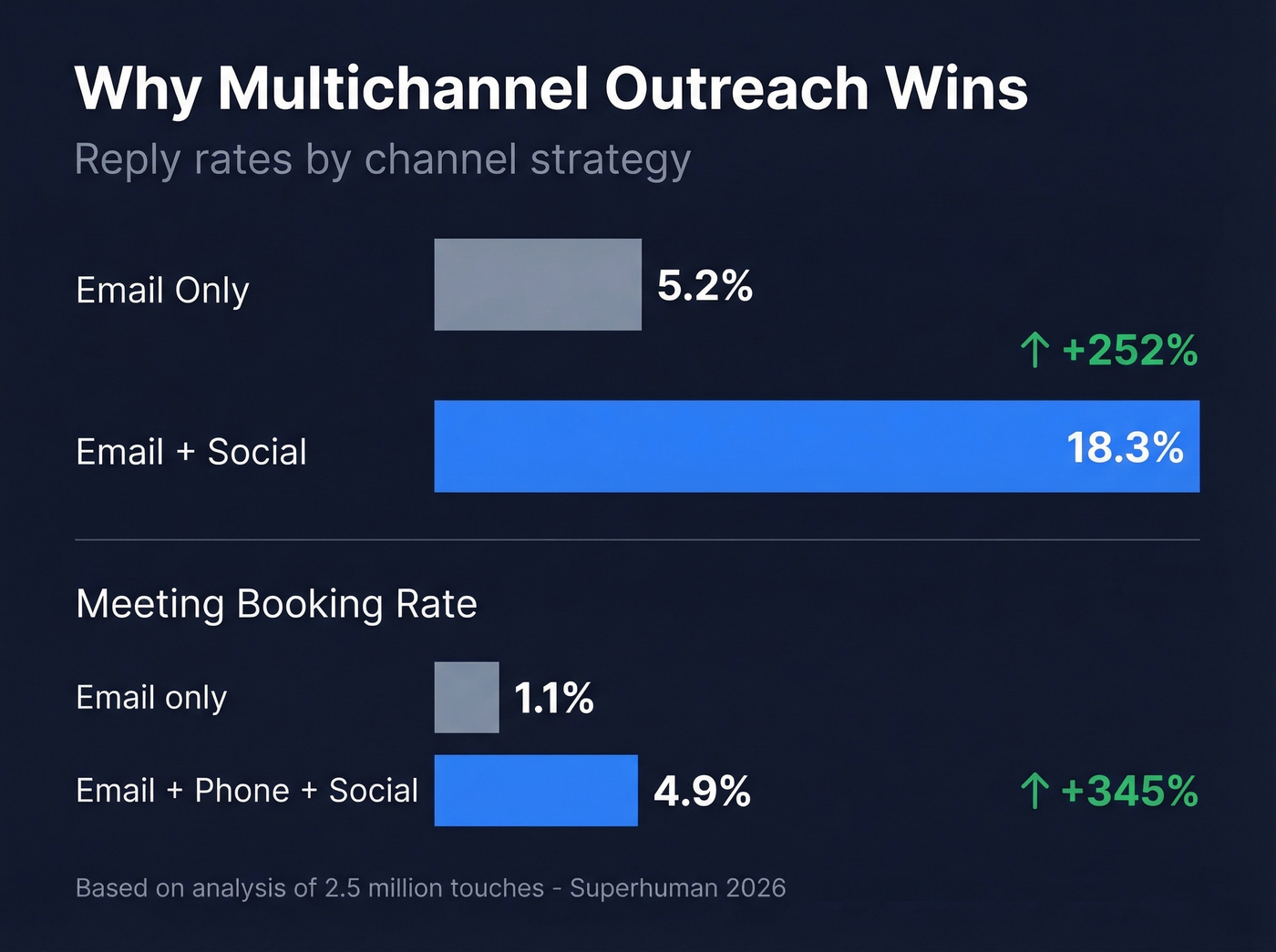
Email alone gets you 5.2% reply rates. Add phone and social touches, and that jumps to 18.3% - based on an analysis of 2.5 million touches. That's the single highest-leverage change most teams ignore because it feels like more work.
| Day | Channel | Action |
|---|---|---|
| 1 | Pain-point email, soft CTA | |
| 2 | Social | Connection request, no pitch |
| 4 | Follow-up, new value angle | |
| 5 | Phone | Call + voicemail referencing emails |
| 7 | Social | Engage with their content |
| 9 | Follow-up #2, different angle | |
| 14 | Breakup |
The jump from email-only to email+social is 125%. Adding phone pushes meeting booking rates from 1.1% to 4.9%. Multichannel only works when your contact data is accurate across channels, though - if you're dialing wrong numbers or emailing dead addresses, you're just wasting time in three places instead of one. (If you're operationalizing this, a sequence management process helps.)
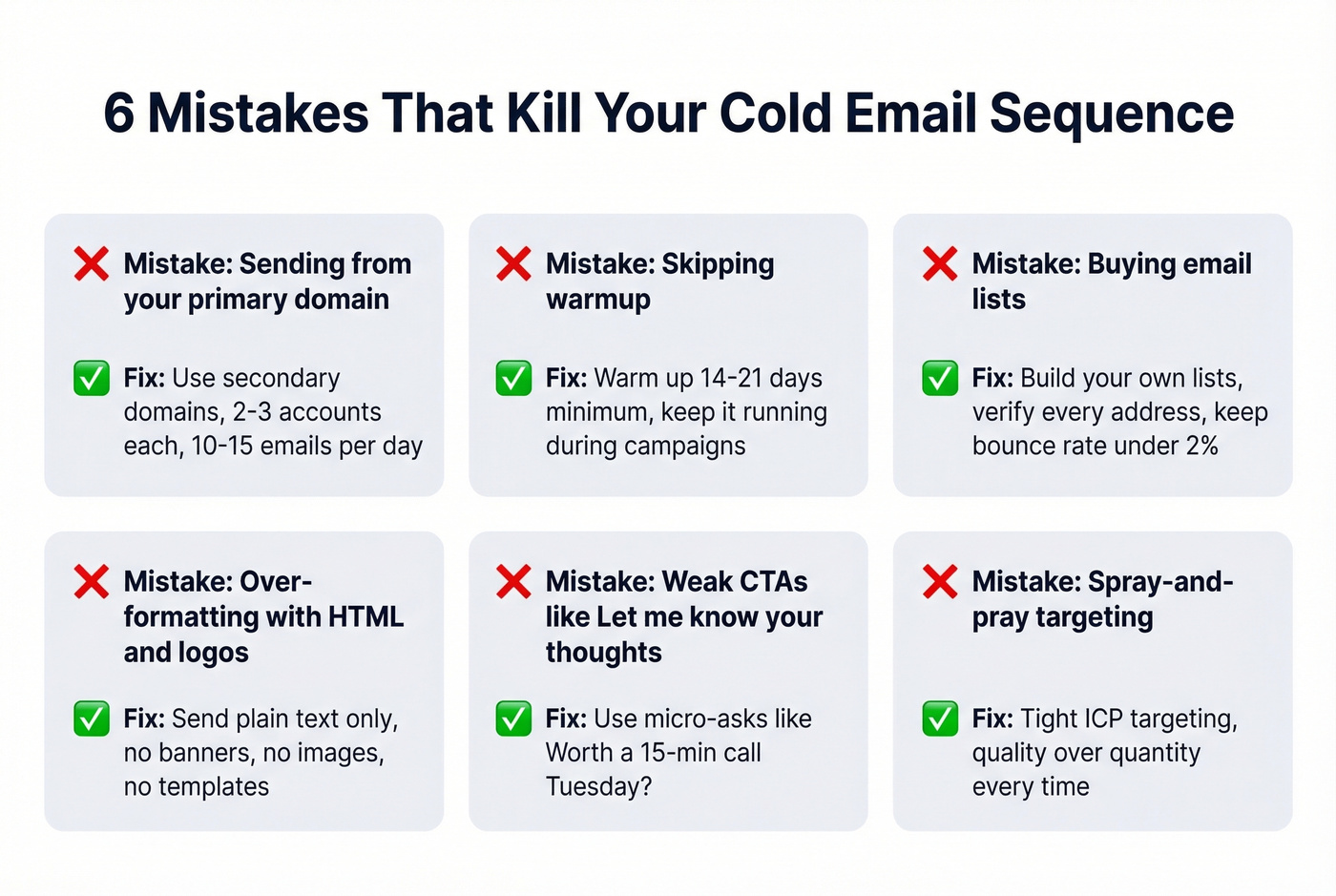
Mistakes That Kill Your Sequence
- Sending from your primary domain. One spam flag and your entire company's email reputation tanks.
- Skipping warmup. New domains need 14-21 days minimum. No shortcuts.
- Buying lists. Purchased lists often bounce in the high single digits to double digits. That's a domain killer.
- Over-formatting. Banners, logos, HTML templates - all scream "marketing email." Plain text wins.
- Weak CTAs. "Let me know your thoughts" isn't a CTA. Use micro-asks: "Worth a 15-min call Tuesday?" (More rules + examples: email call to action.)
- Spray-and-pray targeting. Sending to anyone with a pulse burns your domain. Tight ICP targeting isn't optional - it's the foundation everything else rests on.
The CPPC framework only works when you have deep context on your prospects. Prospeo's 30+ filters - buyer intent, technographics, job changes, funding rounds - give you the specific signals that make your first line feel like a conversation, not a template. Build hyper-targeted lists that turn 3% reply rates into 5.5%+.
Stop guessing. Prospect with real buying signals.
Compliance Quick-Reference
| Jurisdiction | Consent Model | Unsubscribe Deadline | Penalty |
|---|---|---|---|
| US (CAN-SPAM) | Opt-out | 30 days | $51,744-$53,088/email (2026 adjusted) |
| EU (GDPR) | Legitimate interest (common B2B basis) | Immediately | Up to 4% of revenue |
| Canada (CASL) | Consent-first | 10 business days | Up to $10M CAD |
CAN-SPAM requires a physical mailing address, accurate sender info, and truthful subject lines. Using fake "Re:" to mislead recipients can violate CAN-SPAM's deception rules. GDPR applies based on where the recipient is located - document your Legitimate Interest Assessment. CASL requires you to keep opt-out records for a minimum of 3 years. Purchased lists violate both GDPR and CASL outright.
Let's be honest: compliance isn't the exciting part. But a single violation can cost more than your entire outbound program generates in a year.
FAQ
How many emails should a cold outreach sequence have?
Four to seven. Fewer than four gives up too early - 42% of replies come from follow-ups. Beyond seven, returns diminish sharply. Start with four over 14 days and expand based on reply data.
What's a good cold email reply rate in 2026?
Average is 3.43%. Top-quartile senders hit 5.5%+, and the top 10% exceed 10.7%. Anyone promising 20-30% at scale is usually working with exceptional targeting or cherry-picked campaigns. Benchmark against 3-5% and optimize from there.
How do I stop cold emails from going to spam?
Configure SPF, DKIM, and DMARC on every sending domain. Use secondary domains with 14-21 days of warmup. Keep bounces under 2% by verifying every address before sending. Add one-click unsubscribe headers to every message.
What's the best day and time to send cold emails?
Tuesday through Thursday, 8-11 AM in the recipient's timezone. Wednesday consistently shows the highest reply rates across large datasets. Avoid Mondays (inbox overload) and Fridays (mental checkout), though some practitioners have found Friday mornings work for specific audiences.