

=== CURRENT ARTICLE (slug: cold-email-response-rate) ===
Cold Email Response Rate: 2026 Benchmarks and How to Improve
You just ran a 5,000-email campaign. You got 171 replies. That's a 3.43% reply rate - and in 2026, that's exactly average. Two years ago, the same list and the same copy would've pulled double that. The cold email response rate has cratered across the industry, and it wasn't your writing that changed.
The short version:
- The real 2026 average is 3.43% - not the 8.5% you keep seeing cited.
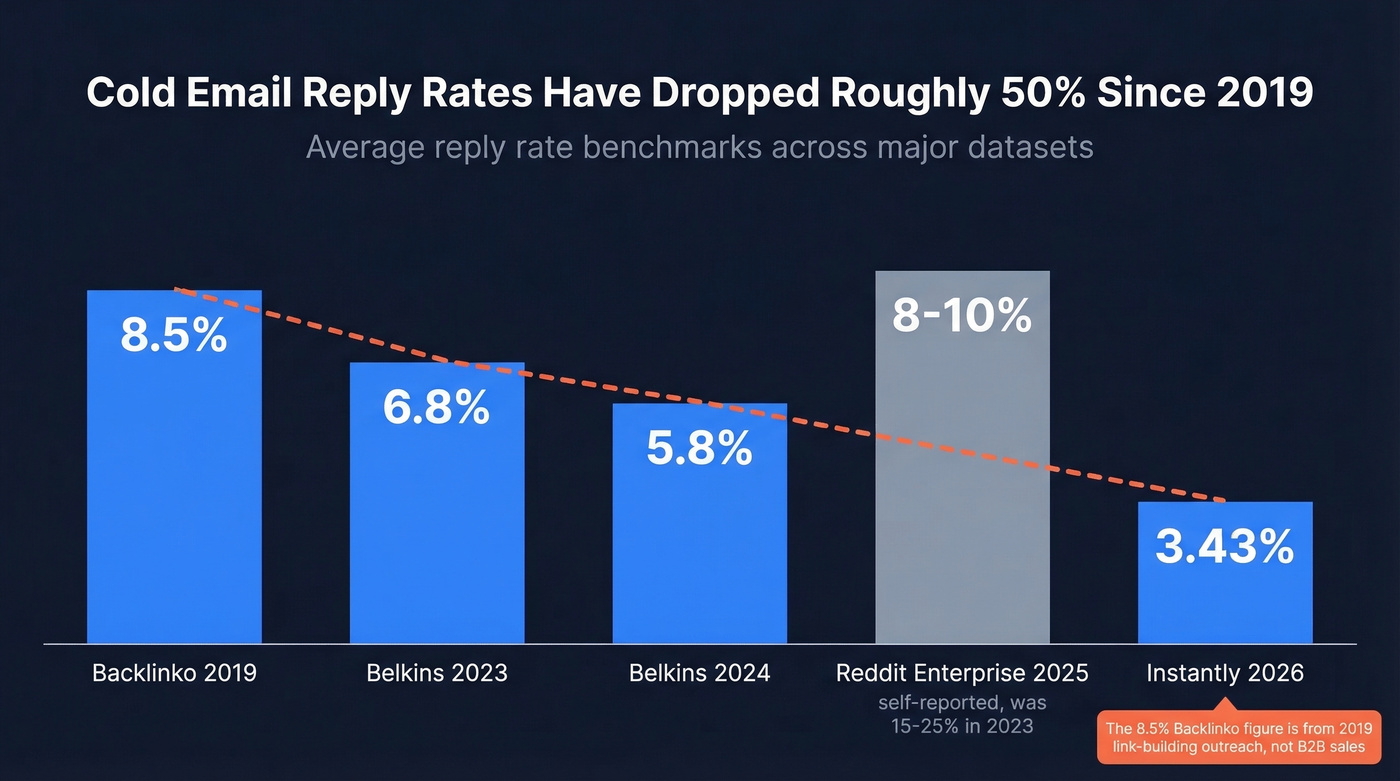
- Reply rates are down roughly 50% since 2023 in the major benchmark datasets. Belkins measured 6.8% in 2023 and 5.8% in 2024, and Instantly's platform-wide 2026 average sits at 3.43%.
- The highest-leverage fix isn't better copy - it's cleaner data and stronger sending infrastructure.
What Counts as a "Reply"?
This metric measures how many recipients respond to your outbound email, expressed as a percentage of delivered messages:
Reply Rate = (Replies / Delivered Emails) x 100
You're dividing by delivered emails, not sent emails. Hard bounces don't belong in the denominator - they never reached an inbox, so they can't generate a reply.
Most teams get sloppy here because they treat all replies as equal. They're not. Instantly breaks replies into a taxonomy every outbound team should adopt: positive (interested), referral (redirected to someone else), objection (not interested but engaged), not now (timing issue), unsubscribe (opt-out), and out of office. The number that actually matters for pipeline is your positive reply rate - the percentage of replies where someone expresses genuine interest. In most B2B cold email programs, only 10-30% of total replies are positive. The rest are OOO messages, polite declines, and unsubscribe requests.
Here's a distinction most guides skip: reply rate and click-through rate aren't interchangeable. If your CTA is a Calendly link instead of a question, you're measuring clicks, not replies. Different funnels, different benchmarks. (If you need the math, see click-through rate.)
And if you're wondering whether open rate is a better metric: it isn't. Apple's Mail Privacy Protection pre-loads tracking pixels on every email, inflating open rates across the board. Reply rate is the only engagement metric you can actually trust in 2026.
Track both total and positive reply rates. Report the positive rate to your team. Use the total rate for deliverability diagnostics. (For the full checklist, use this email deliverability guide.)
2026 Benchmarks: What the Data Shows
Multi-Source Benchmark Table
The problem with cold email benchmarks is that everyone cites different numbers from different eras. Here they are side by side.
| Source | Year | Dataset | Avg Reply Rate |
|---|---|---|---|
| Instantly | 2026 | Billions of emails | 3.43% |
| Belkins | 2024 | 16.5M emails | 5.8% |
| Belkins | 2023 | Same methodology | 6.8% |
| Backlinko/Pitchbox | 2019 | 12M emails | 8.5% |
| Reddit (enterprise) | 2025-26 | Practitioner reports | 8-10% (was 15-25% in 2023) |
That Backlinko 8.5% figure deserves a correction. It's from a 2019 study analyzing link-building and guest-post outreach sent through Pitchbox - not B2B sales emails. It's still cited everywhere as if it's current. It isn't. The Instantly benchmark, drawn from billions of cold email interactions across thousands of active workspaces, is the cleanest 2026 number we have.
If you want a broader view of what “good” looks like across the funnel, compare against the average B2B lead conversion rate.
Performance Tiers
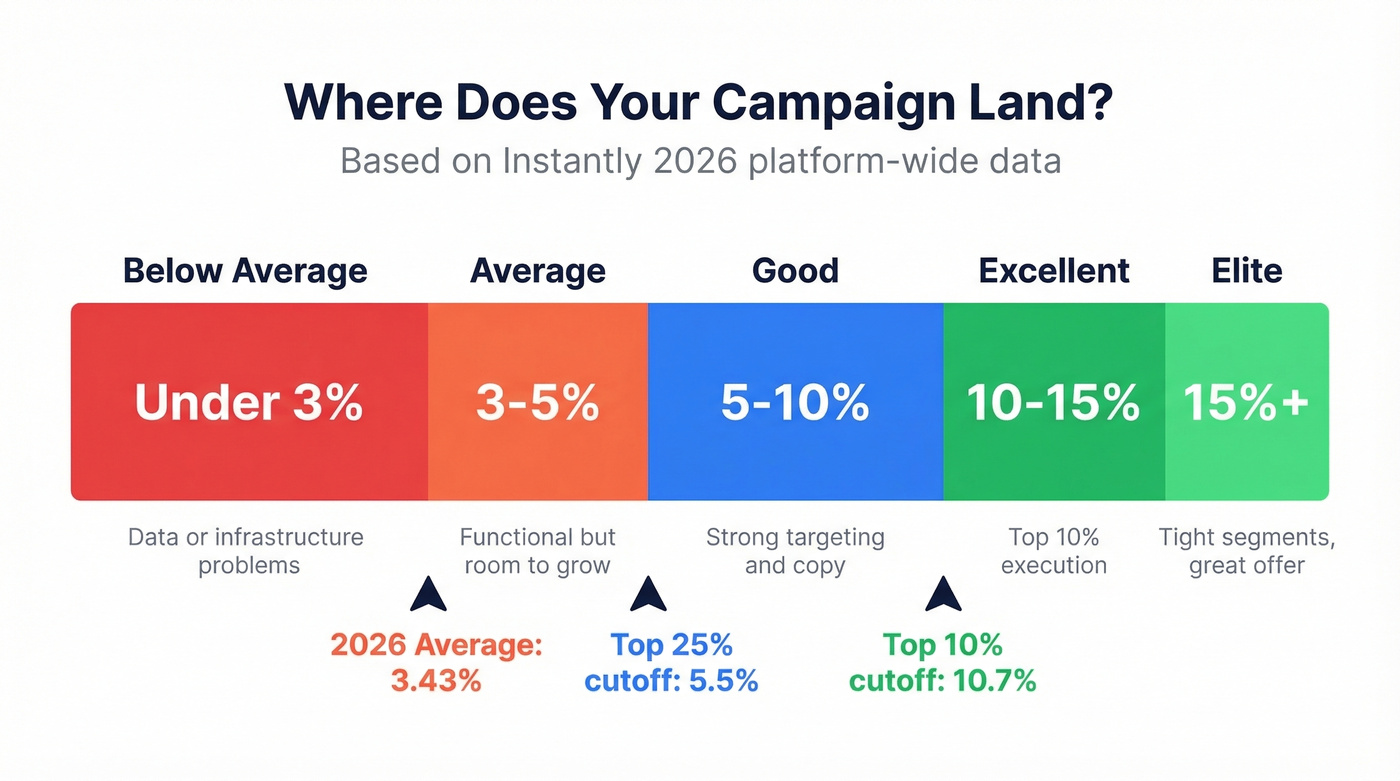
Where does your campaign actually land?
| Tier | Reply Rate | What It Means |
|---|---|---|
| Below average | <3% | Data or infra problems |
| Average | 3-5% | Functional but room to grow |
| Good | 5-10% | Strong targeting + copy |
| Excellent | 10-15% | Top-quartile execution |
| Elite | 15%+ | Tight segments, great offer |
Consistently above 5% puts you in the top quartile of Instantly's user base (their cutoff is 5.5%+). Hit 10.7% or higher and you're in the top 10%. Some tools claim elite campaigns hit 40-50% reply rates - we've never seen that sustained outside of hyper-targeted lists under 100 contacts. At any real scale, 15%+ is genuinely elite.
Why Reply Rates Are Declining
Deliverability Policy Changes
Three major enforcement waves hit in 18 months. Most senders still haven't fully adapted.
In February 2024, Google and Yahoo made SPF, DKIM, and DMARC mandatory for bulk senders (anyone sending 5,000+ emails per day). They also required one-click unsubscribe headers per RFC 8058 and set a hard ceiling: keep spam complaint rates below 0.3% or face junk placement and blocks. In May 2025, Microsoft followed with stricter enforcement - unauthenticated mail now gets error 550 5.7.515, a hard rejection, not a soft bounce. Microsoft also started flagging no-reply sender addresses as low-quality signals.
The real problem: only 16% of domains have implemented DMARC. The other 84% are operating without it, which increases spoofing risk and tanks deliverability under the new rules. (If you’re troubleshooting, start with DMARC alignment and a clean SPF record.)
Inbox Fatigue and Filtering
The policy changes are the visible part. The invisible part is how aggressively M365 and Gmail now filter cold outreach. The consensus on r/coldemail is blunt: "M365 is a killer." Enterprise inboxes running Microsoft 365 are filtering automated outreach far more aggressively than they were in 2023.
Warm-up timelines have stretched from roughly 3 weeks to 6-8 weeks before a domain can handle real volume. Open-tracking pixels are increasingly triggering spam filters - turning off pixel tracking improved reply rates by 3% in Belkins' internal experiment. And the sheer volume of automated outbound has trained recipients to ignore anything that smells like a template. (If you want the technical “why,” see email tracking pixels.)
Here's the thing: if your average deal size is under $5K and you're sending cold email to enterprise M365 inboxes, the economics probably don't work anymore. The infrastructure cost and deliverability overhead eat your margins. Focus on SMBs on Google Workspace, where filtering is less aggressive and decision-makers actually read their own inboxes.

The article says it clearly: the highest-leverage fix isn't better copy - it's cleaner data. Prospeo's 98% email accuracy and 7-day data refresh mean fewer bounces dragging down your denominator and more emails actually reaching inboxes. Teams using Prospeo cut bounce rates from 35%+ to under 4%.
Stop optimizing subject lines on top of bad data.
The Positive Reply Rate Framework
Total reply rate tells you whether your emails are reaching inboxes. Positive reply rate tells you whether they're generating pipeline. Conflating them leads to bad decisions.
One Reddit practitioner sent 147,000 cold emails and reported a 1.2% positive reply rate - roughly 1,764 conversations that led to 40 sales calls. That's a 2.3% call-to-positive-reply conversion, which is a common outcome at scale.
A smaller campaign shows the same math:
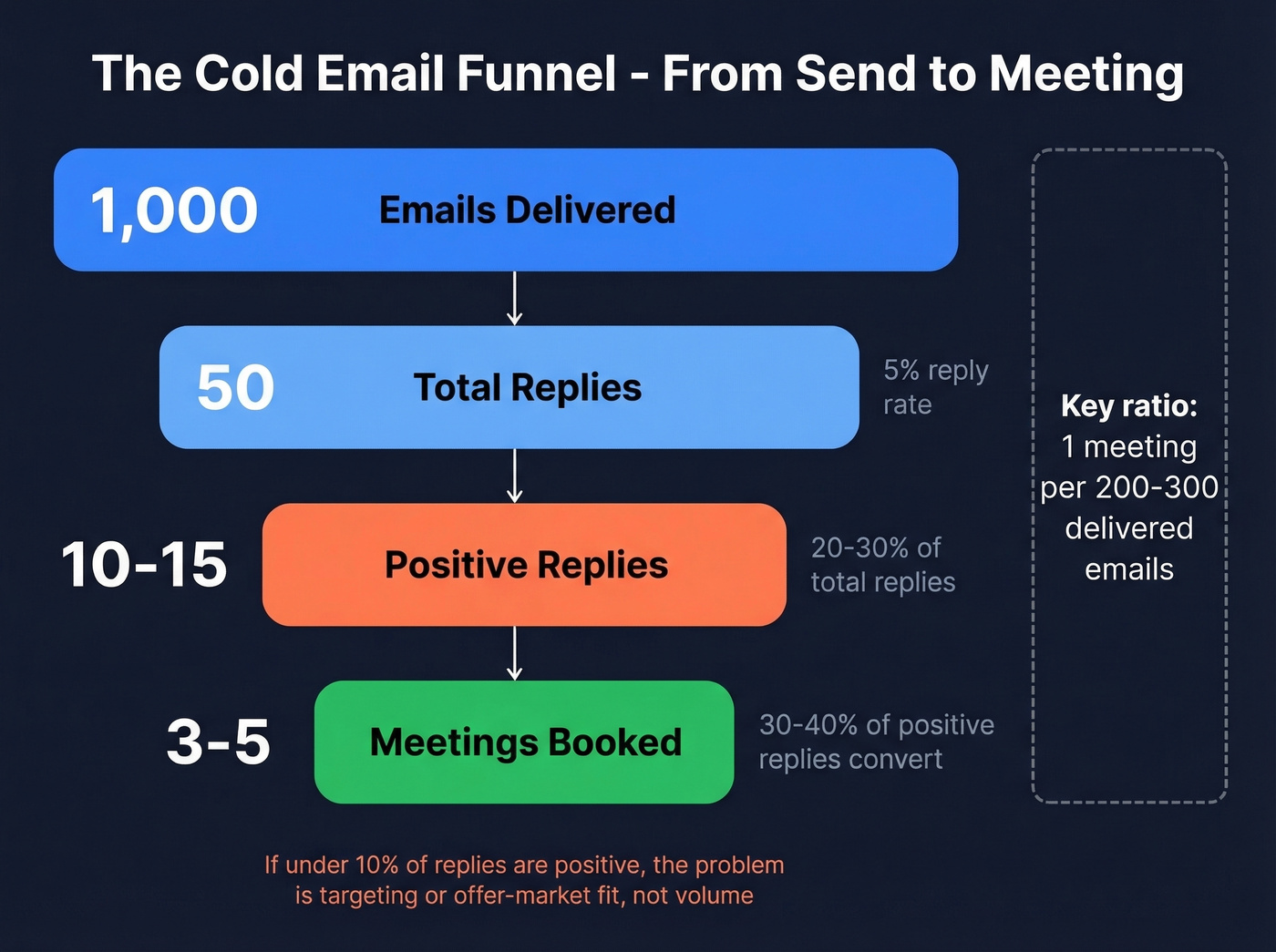
- 1,000 emails delivered
- 50 total replies (5% reply rate - good)
- 10-15 positive replies (20-30% of total replies)
- 3-5 meetings booked (30-40% of positive replies convert)
That's 1 meeting per 200-300 delivered emails. If your positive reply rate is below 10% of total replies, the problem isn't volume - it's targeting or offer-market fit. (To tighten targeting, use an ideal customer profile.)
Reply Rates by Industry
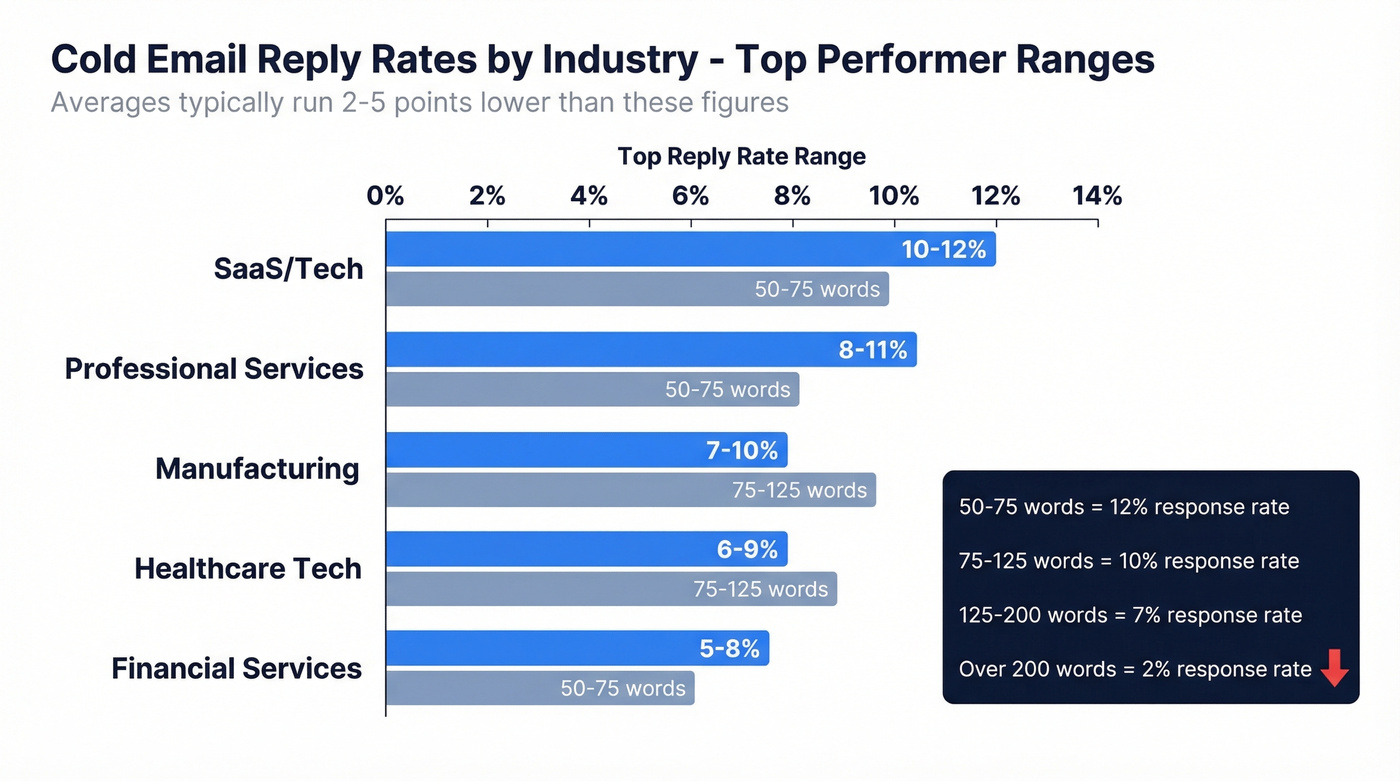
Reply rates vary significantly by vertical. These are top-performer ranges; averages typically run 2-5 points lower.
| Industry | Top Reply Rate | Best Email Length |
|---|---|---|
| SaaS / Tech | 10-12% | 50-75 words |
| Professional Services | 8-11% | 50-75 words |
| Manufacturing | 7-10% | 75-125 words |
| Healthcare Tech | 6-9% | 75-125 words |
| Financial Services | 5-8% | 50-75 words |
The email length data is striking. Emails in the 50-75 word range pull a 12% response rate. The drop-off is steep: 75-125 words still pulls 10%, 125-200 drops to 7%, and anything over 200 words craters to 2%. Brevity isn't a style preference. It's a performance lever.
How to Improve Your Reply Rate
These are ordered by impact. Most teams jump straight to copy tweaks when the real problem is upstream.
Fix Your Data First
Bad email addresses lead to high bounce rates, which damage sender reputation, which lands you in spam folders, which kills replies. If your bounce rate is above 2%, stop sending and clean your list. Everything downstream is wasted effort until you fix this. (Benchmarks + fixes: email bounce rate.)
We've seen this pattern across hundreds of outbound campaigns: teams that verify before sending see immediate deliverability improvements, often within the first week. Prospeo's 5-step email verification catches invalid addresses, spam traps, catch-all domains, and honeypots before they touch your sending infrastructure. At 98% email accuracy, you're starting from a fundamentally different position than teams guessing with unverified lists.
The proof points are consistent. Snyk's 50-person AE team was running bounce rates of 35-40% before switching - they dropped under 5%, and AE-sourced pipeline jumped 180%. Stack Optimize built to $1M ARR while maintaining client deliverability above 94%, bounce rates under 3%, and zero domain flags across all clients.
One data point that doesn't get enough attention: DigitalBloom's analysis found cohorts of 50 contacts or fewer increase reply rates by 2.76x compared to large-blast lists. Tight segmentation forces better targeting, which means cleaner data and more relevant messaging. (If you’re building lists at scale, see how to generate an email list.)
At 3.43% reply rates, every delivered email counts. Prospeo's 5-step verification removes spam traps, honeypots, and catch-all dead ends before you hit send - so your replies-to-delivered ratio reflects real targeting, not inflated sends. Start with 75 free verified emails.
Clean your pipeline at the source for $0.01 per email.
Fix Your Infrastructure
Sending cold email from your primary domain is the fastest way to destroy your company's email reputation. Here's the setup that works in 2026:
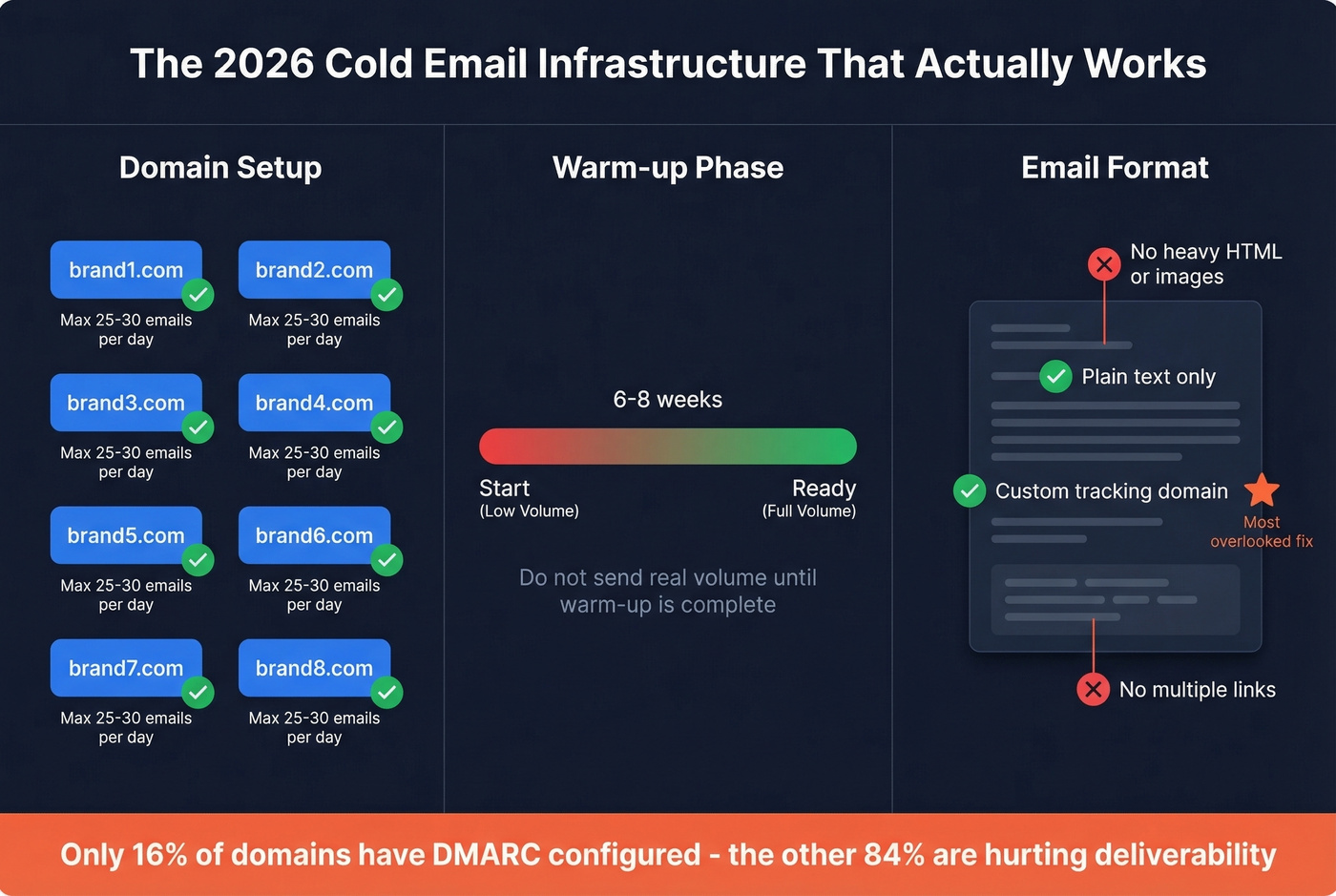
- 5-10 dedicated sending domains, each capped at 25-30 emails per day
- SPF, DKIM, and DMARC configured on every domain - non-negotiable after the 2024/2025 enforcement waves
- Custom tracking domain - shared tracking domains pool your reputation with every other sender on that domain
- Plain-text emails - heavy HTML, images, and multiple links are spam triggers
- 6-8 weeks of warm-up before sending real volume
In our experience, the custom tracking domain is the most overlooked item on this list. Teams spend hours on copy and skip the 10-minute DNS change that actually moves their inbox placement rate. (Setup details: tracking domain.)
Fix Your Copy
Keep it short. The data is unambiguous: 50-75 words outperform everything else. Personalized subject lines correlate with 30.5% higher response rates, and personalized body content with 32.7% higher, per Backlinko's 12M-email outreach study. This isn't "Hey {first_name}" personalization - it's referencing something specific about the recipient's company, role, or situation. (More examples: cold email subject line examples.)
Subject line choice matters more than most people think. "Quick question" pulls 39% open rates. Company-name subjects hit 33%. Salesy lines like "Partnership opportunity" drop below 19%.
One genuinely underused tactic: lead with a timeline hook instead of a problem hook. DigitalBloom's analysis found timeline-based openers ("Noticed you just raised a Series B" or "Saw your team grew 40% this quarter") average a 10.01% reply rate, while generic problem hooks average just 4.39%. That's a 2.3x difference from the opening line alone.
Fix Your Follow-Up Strategy
Follow-ups work - 42% of all replies come from follow-up emails. But there's a hard ceiling. Spam complaint rates triple from the first email (0.5%) to the fourth (1.6%), and unsubscribe rates jump from 0.1% to 2% over the same span.
Let's be honest about what this means in practice: 2-3 follow-ups max, spaced 3-7 days apart. Single-email campaigns actually pulled the highest raw reply rate at 8.4% in Belkins' dataset. More touches help, but only until complaint fatigue kicks in. (If you need copy you can ship fast, use these cold email follow-up templates.)
Fix Your Timing
Tuesday through Thursday tends to outperform other days, though the "best day" depends on the dataset. Instantly's weekday analysis peaks Tuesday-Wednesday, while Belkins' peaks on Thursday at 6.87% versus Monday at 5.29%. For time of day, mornings (8-11 AM) and evenings (8-11 PM) in the recipient's timezone both perform well. (More data: best time to send cold emails.)
Emailing multiple contacts at the same organization correlates with 93% higher response rates versus single-threading. But there are diminishing returns - 1-2 contacts per company yields 7.8%, while 10+ contacts drops to 3.8%. Two to three contacts per account is the sweet spot.
Case Study: 3% to 6% in 62 Days
A team on r/Entrepreneur documented their turnaround after watching reply rates slide from 8% to 3% over 18 months. Here's exactly what they changed.
Infrastructure: scaled from 3 domains to 7, each capped at 26 emails per day. List hygiene: stopped buying lists, switched to manual verification, and dropped bounce rates from 11% to under 2%. Copy: cut email length from 141 words to under 56. Timing: restricted sends to Tuesday-Thursday, 8-11 AM in the recipient's timezone - opens improved 16%.
The total stack cost was $420/month. Within 62 days, they were generating 16 qualified leads per month at a 6% reply rate. That's not a moonshot number. But it's double where they started, and the economics work.
The lesson is consistent with everything we've seen running outbound programs: infrastructure and data quality moved the needle more than any copy rewrite ever has. Skip the subject line A/B test if your bounce rate is above 2% - fix the foundation first. If you're looking for a realistic target, doubling your current cold email response rate through systematic fixes is an achievable 60-day goal.
FAQ
What is a good cold email response rate in 2026?
A good rate is 5-10%. The platform-wide average across billions of emails is 3.43%. Consistently above 5% puts you in the top quartile; 10.7%+ lands you in the top 10% of senders.
How many emails does it take to book one meeting?
Roughly 200-300 delivered emails per meeting. At a 5% reply rate where 20-30% of replies are positive, expect 10-15 interested responses per 1,000 emails - converting to 3-5 booked calls.
Does personalization actually improve reply rates?
Yes. Personalized subject lines correlate with 30.5% higher response rates, and personalized body content with 32.7% higher. Timeline-based openers ("Noticed your team just expanded") outperform generic problem hooks by more than 2x.
Should I track open rates on cold emails?
No - disable open tracking entirely. Turning off pixel tracking improved reply rates by 3% in Belkins' internal experiment. Tracking pixels trigger spam filters in M365 and Gmail, and Apple Mail Privacy Protection inflates the numbers anyway. Reply rate is the only metric worth watching.
How do I keep my bounce rate low enough to protect reply rates?
Verify every email before sending and target bounce rates under 2%. Above that threshold, sender reputation degrades and inbox placement drops. Pair verification with tight list segmentation - cohorts under 50 contacts perform nearly 3x better than large blasts.