

Cold Leads: What They Are & How to Convert Them in 2026
You send 500 cold emails. 100 bounce. Another 100 land in spam. You get 3 replies - one of which is "please remove me from your list." That's not a hypothetical. That's a Tuesday for most outbound teams running on bad data. The average cold email response rate sits at 5.1%, but practitioners on r/LeadGeneration consistently report closer to 2% when list quality is an afterthought.
The gap between "cold outreach works" and "cold outreach works for us" almost always comes down to the quality of the cold leads you're reaching out to, not the cleverness of your subject line.
The Short Version
Cold leads are prospects who haven't interacted with your brand - no hand raise, no inbound request, no buying signal.
Benchmarks: expect 1-5% cold email reply rates and a 2.3% cold call success rate.
The single biggest lever: list quality beats copy, subject lines, and personalization combined. A Reddit operator who's sent over 2 million cold emails was blunt - the time you spend building your list matters more than anything you write in the email itself.
What Are Cold Leads, Exactly?
A cold lead is someone who fits your ideal customer profile but has zero awareness of your company. They haven't visited your site, opened an email, or engaged with your content. You found them. They didn't find you.
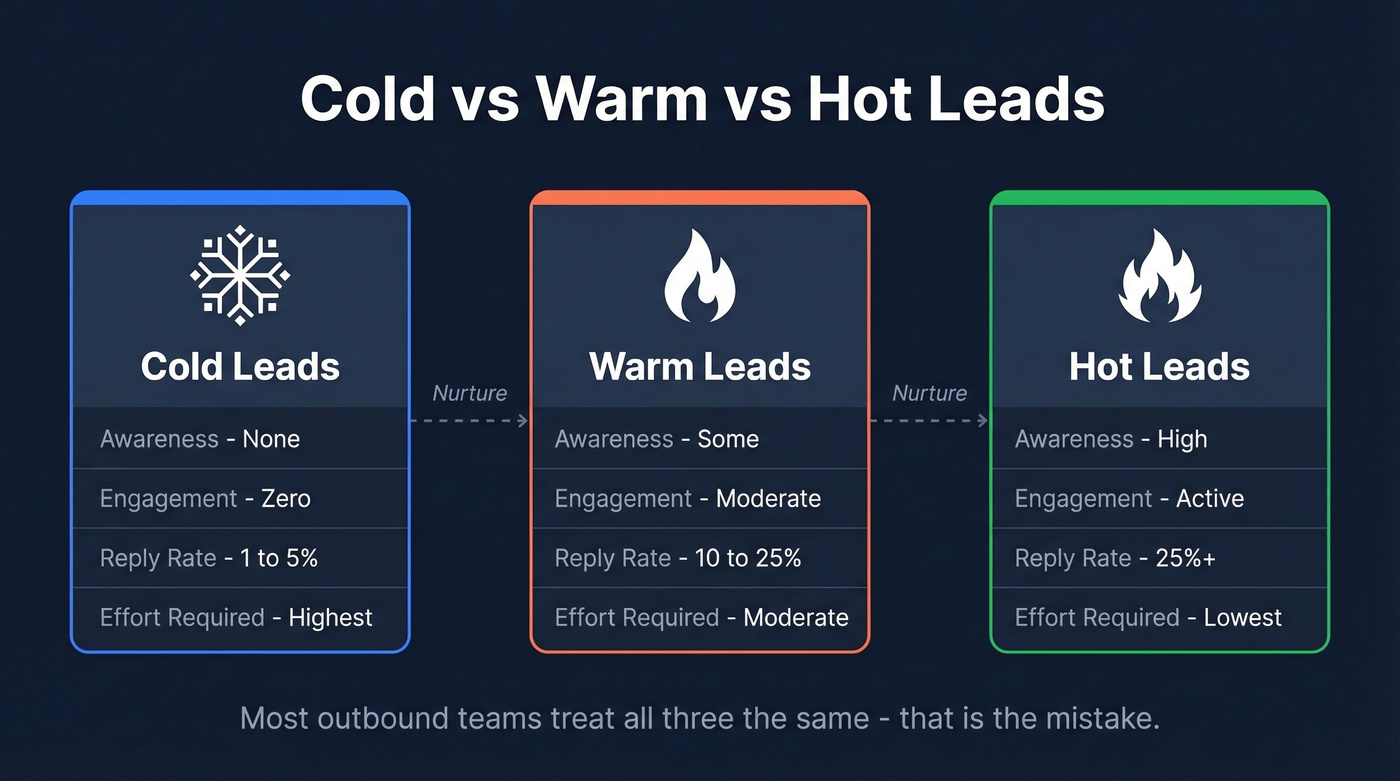
This matters because B2B buyers now engage across roughly 10 channels before making a purchase decision, up from 5 channels in 2016. Cold prospects sit at the very beginning of that journey - before any of those touchpoints have happened.
| Dimension | Cold | Warm | Hot |
|---|---|---|---|
| Awareness | None | Some | High |
| Engagement | Zero | Moderate | Active |
| Conversion | 1-5% | Medium | High |
| Effort | Highest | Moderate | Lowest |
Here's the thing: most teams treat all three the same way. Cold prospects need a completely different approach - you're interrupting someone's day, not responding to their interest. That asymmetry shapes everything from your messaging to your cadence to the tools you use.
2026 Outreach Benchmarks
Let's put real numbers on the problem. These aren't aspirational targets.
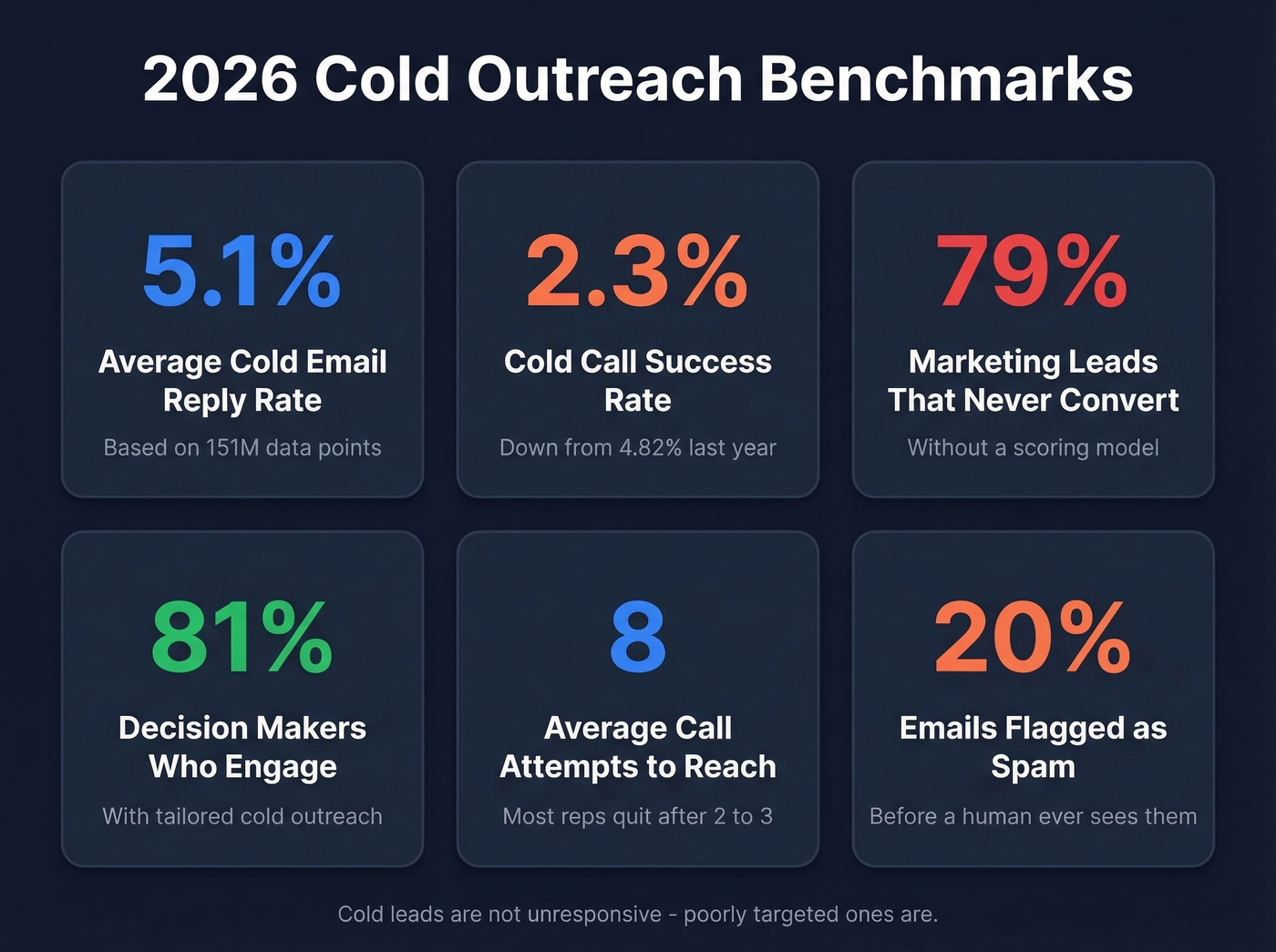
Cold email: The average response rate is 5.1% across 151 million outreach data points. Most campaigns fall between 1% and 5%. Anything above 5% is exceptional. Roughly 20% of emails get flagged as spam before a human ever sees them.
Cold calling: The average success rate dropped to 2.3% in the most recent large-scale data, down from 4.82% the year before. It takes an average of 8 call attempts to reach a prospect. But 49% of buyers still prefer to be contacted via cold call, so the channel isn't dead - it's just harder. (If you're rebuilding your calling motion, start with a repeatable cold calling system.)
The conversion gap: 79% of marketing leads never convert into sales. That stat should haunt every team running outbound without a scoring model.
The counterpoint nobody mentions: 81% of sales and marketing decision-makers still engage with tailored cold outreach. Cold leads aren't unresponsive - poorly targeted ones are.
Lead-to-Opportunity Rates by Industry
These rates from FirstPageSage's multi-year dataset cover all lead sources, not just cold outbound. Pure cold outreach will sit at the lower end of each range.
| Industry | Lead-to-Opportunity |
|---|---|
| B2B SaaS | 6.2% |
| Cybersecurity | 4.1% |
| IT & Managed Services | 3.0% |
| Software Dev | 6.6% |
| Staffing & Recruiting | 3.6% |
| Transportation | 6.7% |
Plan your funnel math accordingly. (If you want more baseline numbers, see average B2B lead conversion rate.)

The article says it clearly: list quality beats copy, subject lines, and personalization combined. Prospeo's 300M+ profiles are verified to 98% email accuracy on a 7-day refresh cycle - so your cold leads actually receive your emails instead of bouncing.
Stop losing cold leads to bad data. Start at $0.01 per verified email.
Where Cold Leads Come From
Every guide tells you to "use lead generation tools" without mentioning that ZoomInfo costs $15K-$40K+/year. That's not helpful for a 5-person sales team with a $500/month software budget.
Don't Buy Pre-Made Lists
Never buy a pre-made email list from a broker. These lists are recycled, stale, and riddled with spam traps. One campaign on a purchased list can tank your domain reputation for months, and in consent-required markets like Canada and Australia, you're breaking the law. Build your own lists from reputable data platforms instead. (If you need the legal nuance, read Is It Illegal to Buy Email Lists?.)
B2B Data Platforms
This is where most prospect lists start. You define your ICP - industry, company size, job title, geography - and the platform returns contacts with emails and phone numbers. The quality difference between platforms is enormous, and it shows up in your bounce rate on day one.
We've tested most of the major players. Prospeo covers 300M+ professional profiles with 98% verified email accuracy and a 7-day data refresh cycle - most competitors refresh around every 6 weeks, which means you're emailing people who changed jobs last month. The free tier gives you 75 verified emails per month plus 100 Chrome extension credits, and paid plans run about $0.01 per email with no contracts.

| Tool | Contacts | Starting Price | Contract | Best For |
|---|---|---|---|---|
| Prospeo | 300M+ | Free / ~$0.01/email | None | Data accuracy |
| Apollo.io | 275M+ | Free / from ~$49/user/mo | Monthly | Database + outreach |
| Lusha | 45M+ | ~$29/mo | Monthly | Quick lookups |
| Hunter.io | 200M+ emails | Free / $0-$499/mo | Monthly | Email finding |
| Seamless.AI | 1B+ | Free / ~$147/mo | Varies | Volume plays |
| Cognism | 400M+ | ~$10K-30K/yr | Annual | EMEA / GDPR |
| ZoomInfo | 100M+ | ~$15K-40K+/yr | Annual | Enterprise GTM |
Fair warning: a tool advertised at $99/month can become $3,452 in year one once you add seats, overages, and annual requirements. Always calculate the real cost before committing. (If you're comparing options, start with best sales prospecting databases or best email list providers.)
Intent Data and Buyer Signals
70% of B2B buyers prefer researching products online before engaging with a salesperson. They're researching your category right now - you just can't see it without intent data.
Third-party intent providers like Bombora track which companies are actively researching specific topics. When you layer intent signals on top of your ICP filters, you're not just emailing someone who fits the profile - you're reaching out to someone whose company is actively in-market. That's still a cold lead by definition, but the timing makes conversion dramatically more likely. (More on this in intent based segmentation.)
How to Convert Cold Leads
This is where most content on this topic falls apart. Everyone says "personalize your outreach" without defining what that actually means at scale.
Relevance Beats Personalization
Stop personalizing your cold emails. Start making them relevant.
A veteran outbound operator put it this way after sending over 2 million cold emails: relevance to a business problem beats personal trivia every time. Mentioning someone's alma mater or recent podcast appearance feels personal, but it doesn't give them a reason to reply. Tying your outreach to a specific business signal - they just raised funding, they're hiring for a role your product replaces, a competitor just switched to your solution - that's relevant.
The difference matters at scale. You can't research every prospect's hobbies when you're sending 500 emails a week. But you can build lists filtered by intent signals, job changes, and technographic data, then write messaging that speaks directly to those triggers. (If you want a broader playbook, see sales prospecting techniques.)
The Cold Email Sequence
The sweet spot is 5-9 emails over 2-4 weeks. A well-tested blueprint runs 6 emails over 23 days:
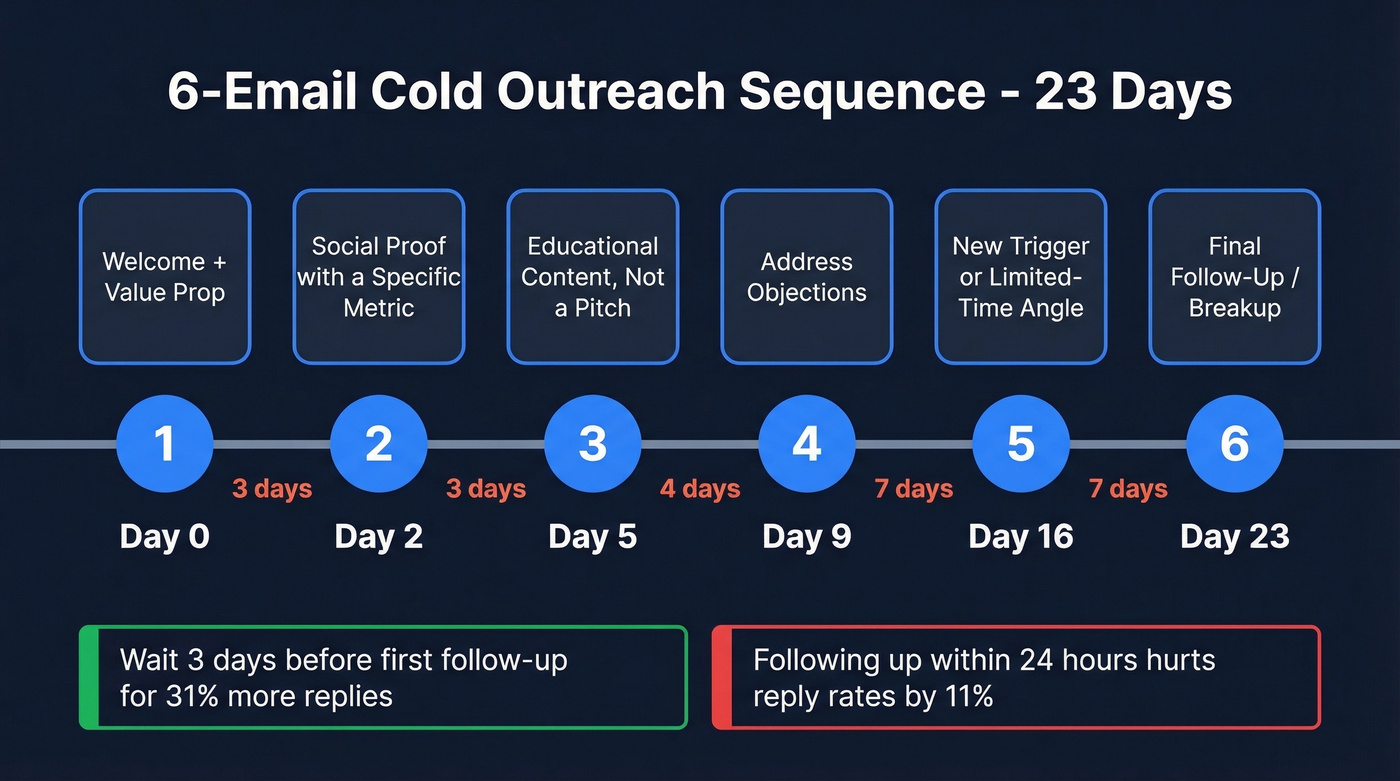
- Day 0: Welcome + value proposition
- Day 2: Social proof with a specific metric
- Day 5: Educational content, not a pitch
- Day 9: Address objections
- Day 16: New trigger or limited-time angle
- Day 23: Final follow-up / breakup
For spacing, the 3-7-7 cadence works well: first follow-up 3 days after the initial email, second follow-up 7 days later, third follow-up 7 days after that. The data backs this up - following up within 24 hours actually hurts your chances by about 11%, while waiting 3 days yields roughly a 31% increase in replies.
Two quick tactical notes that most guides skip. First, 60% of emails are read on mobile, so keep subject lines under 30 characters and front-load the value. Second, use soft CTAs. Asking for a 30-minute call in your first email is like proposing marriage to a stranger on the street. Ask a question. Offer a resource. Make replying easy. (If you need copy, pull from these cold email follow-up templates.)
Before you send anything, verify your list. Getting bounce rates under 4% makes deliverability dramatically easier to manage. (Start with email bounce rate and the email deliverability guide.)
Cold Calling That Works
The 2.3% average success rate sounds brutal, but specific tactics move the needle. Opening with "how have you been?" can push success rates up to 10.01%, per Gong's analysis. Mentioning a shared professional group increases meeting chances by 70%. Simply stating a reason for your call boosts success by 2.1x.
The real bottleneck is reach rate, not conversion rate. It takes 8 attempts on average to get someone on the phone. Most reps give up after 2-3. Once you actually have a qualified prospect on the line, 20% convert into a sale. The math works - if you're willing to do the dials.
Go Multi-Channel
Single-channel outreach gets 5.4% engagement. Multi-channel - email plus phone plus social plus retargeting - hits 18.96%. That's a 3.5x difference from the same list.
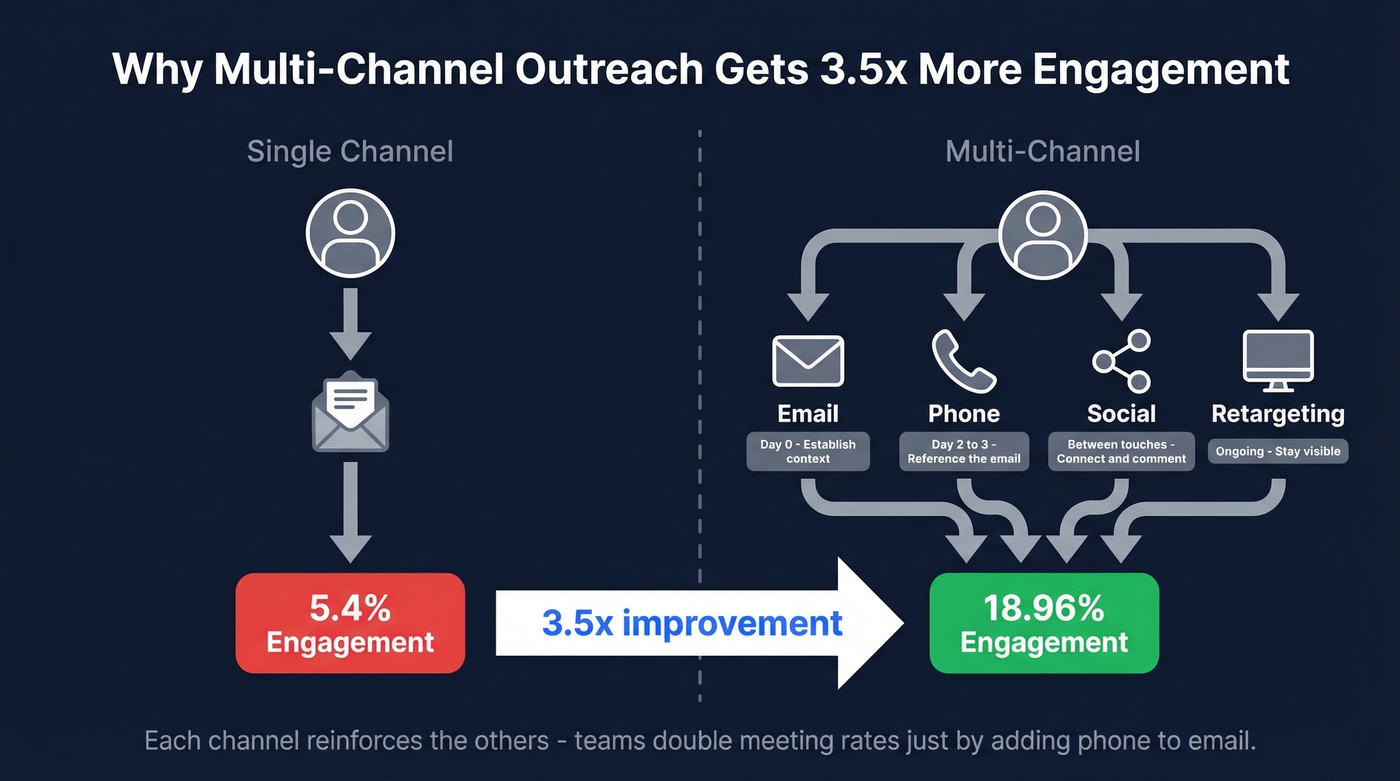
The sequence: email first to establish context, call 2-3 days later referencing the email, engage on professional social between touches with a connection request and a comment on their content, and run retargeting ads to keep your brand visible. Each channel reinforces the others. In our experience, teams double their meeting rates just by adding phone calls to an email-only sequence - even a single prospect who ignores your email may pick up the phone when they recognize your name from a social interaction earlier that week.
Skip the multi-channel orchestration platforms if your average deal size is under $15K. A verified email list, a solid 6-email sequence, and a phone as backup will outperform a bloated tech stack that nobody on your team actually uses.
Infrastructure and Speed
Two practitioner-level details that separate good outbound teams from great ones.
Diversify your sending infrastructure. Don't run every campaign from a single Google Workspace account. Mix Google and SMTP providers, isolate campaigns across domains, and rotate sending accounts. One domain getting flagged shouldn't take down your entire outbound operation. Tools like Clay help with multithreading - enriching leads from multiple data sources and routing them into the right sequences automatically.
Speed-to-lead matters. When a prospect replies, the clock starts. Route replies to mobile notifications, set up triggers in your sequencer to pause follow-ups instantly, and aim to respond within 5 minutes during business hours. Marketing automation applied to outbound workflows can drive a 451% increase in qualified leads - most of that lift comes from faster, smarter follow-up, not more volume.
You don't need a $15K/year contract to reach cold leads with accurate data. Prospeo gives you 30+ filters - including buyer intent powered by Bombora - so every cold lead you contact fits your ICP and is actively researching your category.
Turn cold leads into warm conversations with intent data and verified contacts.
How to Score Cold Leads
Not every unengaged prospect deserves the same effort. A point-based scoring model helps you prioritize who gets a call, who gets nurtured, and who gets dropped. (If you want the full framework, see lead scoring.)
| Action | Points |
|---|---|
| Newsletter subscribe | +5 |
| Whitepaper download | +10 |
| Webinar signup | +15 |
| Multiple site visits/month | +20 |
| Pricing page visit | +25 |
| Product demo request | +30 |
| >5 min on site | +10 |
| Email link click | +5 per click |
| Unsubscribe | -20 |
| No engagement after 30 days | -10 |
| Email bounce | -15 |
Set your thresholds: above 75 points is hot and should route to sales immediately, 50-75 is nurture territory, and below 50 stays cold. Adjust based on your sales cycle - shorter cycles can use lower thresholds.
The stakes are real. 67% of lost sales tie back to qualification failures. And 61% of B2B marketers send all leads directly to sales, but only 27% of those leads are actually qualified. That's a massive waste of rep time.
Beyond scoring, frameworks like BANT give reps a structured way to qualify during conversations. The scoring model tells you who to call. The framework tells you what to ask.
When should you stop pursuing a cold lead? If they haven't engaged after your full sequence - typically 3 follow-ups using the 3-7-7 cadence - send a breakup email and move on. Diminishing returns hit hard after the third follow-up.
Cold Outreach Compliance
Cold outreach is legal in most regions. But the rules vary, and the penalties for getting it wrong are steep.
United States (CAN-SPAM): No prior consent required. You need accurate headers, non-deceptive subject lines, a working unsubscribe mechanism honored within 10 business days, and a valid physical address. It's the most permissive major market.
European Union (GDPR + ePrivacy): Most guides get this wrong. GDPR doesn't require explicit consent for every B2B email. You can use "legitimate interest" as a legal basis - but you need genuine relevance to the recipient's role, a clear opt-out, and your identity and address in the email. The bar is higher than CAN-SPAM, but it's not a blanket ban. Fines run up to EUR 20M or 4% of global annual turnover.
Canada (CASL): Consent is required, and enforcement is active. The CRTC received over 208,000 spam complaints in a recent six-month reporting period alone.
Australia (Spam Act): Consent required. ACMA has collected AU$14M+ in spam-related penalties in recent years.
| Region | Consent? | Key Rule | Max Penalty |
|---|---|---|---|
| US | No | CAN-SPAM compliance | $50K+ per violation |
| EU | Legitimate interest | GDPR + ePrivacy | EUR 20M / 4% revenue |
| Canada | Yes | CASL | C$10M per violation |
| Australia | Yes | Spam Act 2003 | AU$2.2M+ per day |
For teams selling into the EU: don't let compliance fear stop you from doing outbound. Make sure your targeting is relevant, your opt-out works, and you're using a GDPR-compliant data provider.
FAQ
What's a cold lead vs. a warm lead?
A cold lead has zero prior interaction with your brand - no site visit, no download, no engagement. A warm lead has taken action like downloading a whitepaper or attending a webinar. This distinction changes your messaging, cadence, and expected conversion rates entirely.
What's a good cold email response rate?
The average is 5.1% across 151 million data points, but most campaigns land between 1-5%. Above 5% is exceptional and usually signals strong list quality plus relevant messaging. Consistently below 1% means your data or deliverability needs fixing before you touch copy.
How many follow-ups should I send?
Send 2-3 follow-ups using the 3-7-7 framework: first follow-up 3 days after the initial email, then 7 days, then 7 days. Waiting 3 days for the first follow-up yields roughly 31% more replies than following up within 24 hours. After the third, send a breakup email and move on.
Is cold emailing legal?
Yes, in most regions with conditions. The US requires CAN-SPAM compliance but no prior consent. The EU allows B2B cold email under GDPR's legitimate interest basis with demonstrated relevance and a working opt-out. Canada and Australia require consent. Penalties reach EUR 20M under GDPR.
What's the fastest way to build a verified cold lead list?
Use a B2B data platform with real-time verification. Prospeo's free tier gives you 75 verified emails per month at 98% accuracy - enough to test your ICP filters and messaging before scaling. Filter by industry, job title, company size, intent signals, and 30+ other criteria, then export directly to your sequencer.