

Everything You Need to Know Before Hiring a Cold Outreach Agency
Your agency just sent 10,000 emails and booked 4 meetings. Two were no-shows. One was a student. You're $6,000 in and wondering if hiring a cold outreach agency was a mistake.
We've seen this exact movie play out: a shiny proposal, a "proprietary system," and then a month of vague reports while your pipeline stays flat. Let's break down what these agencies actually do, what they should cost, what "good" looks like in 2026, and how to spot the operators who'll burn your domains and blame your offer.
The quick version
Most agencies charge $4K-$8K/month and take 4-6 weeks to launch. At scale, 2-4% reply rates are normal; anyone promising consistent double digits is selling you a fantasy. The single biggest factor in whether your campaign works or fails isn't copywriting.
It's data quality.
What a cold outreach agency actually does
A cold outreach agency runs the outbound email pipeline so your team doesn't have to. That sounds simple until you list the moving parts: list building, enrichment, verification, deliverability setup, sequence writing, sending, reply handling, calendar booking, and weekly optimization.
A competent agency will:
- Build targeted lists against your ICP (not "SaaS companies in the US" - real filters like role, headcount, tech stack, and triggers)
- Enrich and verify contacts so bounce rates stay low (see data enrichment)
- Set up deliverability infrastructure (secondary domains, SPF/DKIM/DMARC, warmup, unsubscribe headers)
- Write and test sequences (subject lines, offers, variants, follow-ups) (use these cold email subject line examples)
- Run the campaign day to day and report on what changed and why
Here's the thing most agencies won't volunteer: their "system" is usually a sending tool like Instantly or Smartlead, an enrichment workflow in Clay, and a data source like Apollo. In other words, a lot of agencies are running the same tools you can run yourself (see Clay list building).
What you're paying for is execution: someone who knows how to keep deliverability clean, how to iterate without guessing, and how to keep the machine running every week without your team babysitting it. That's real value. It's just not magic.
What it costs (and what the proposals really mean)
You're comparing three proposals: one at $3K/month, one at $8K/month, and one at $400/meeting. They all say "proven results." The pricing isn't the story; the incentives are.
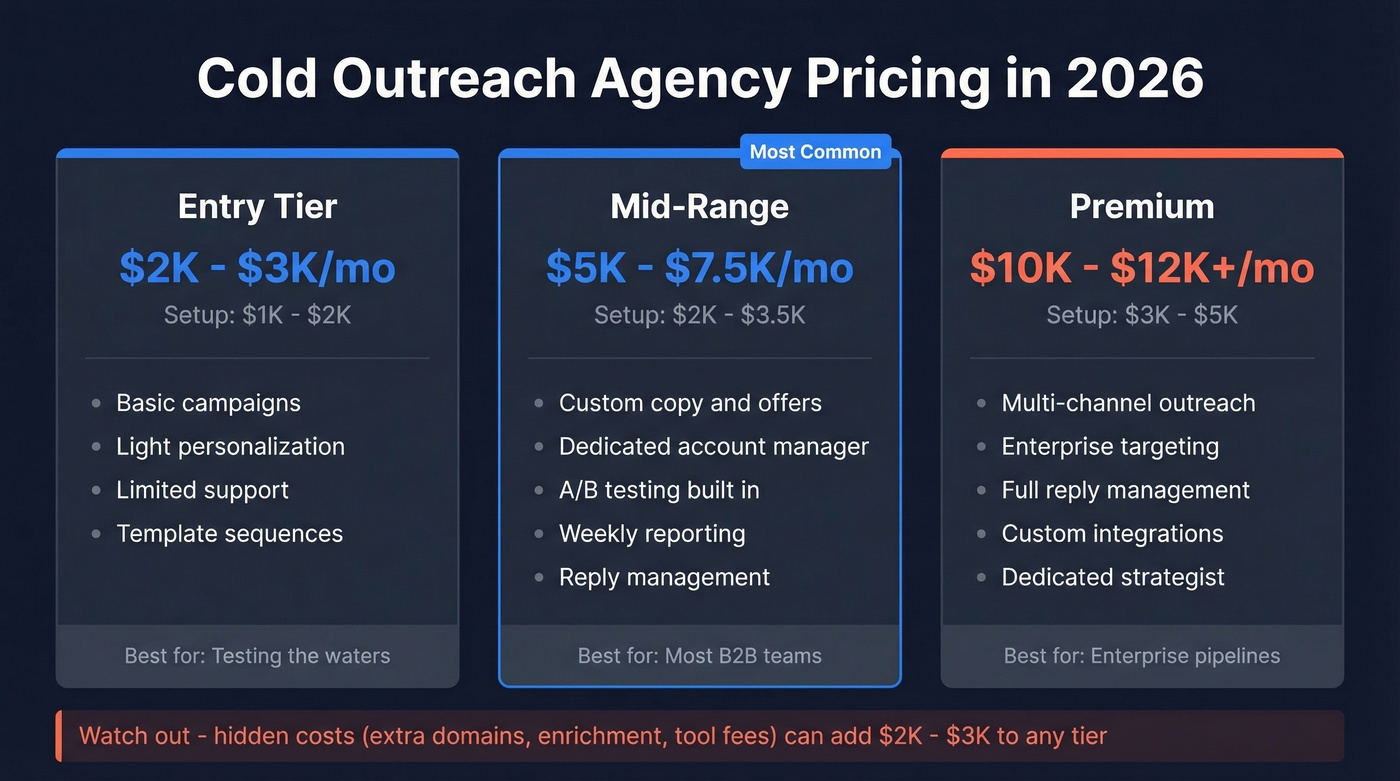
| Tier | Monthly cost | Setup fee | What you usually get |
|---|---|---|---|
| Entry | $2K-$3K | $1K-$2K | Basic campaigns, light personalization, limited support |
| Mid-range | $5K-$7.5K | $2K-$3.5K | Custom copy, dedicated AM, A/B testing, reporting |
| Premium | $10K-$12K+ | $3K-$5K | Multi-channel, enterprise targeting, full reply management |
Setup fees cover domain purchases, inbox configuration, SPF/DKIM/DMARC, warmup tools, and initial strategy. Setup is normal at reputable agencies. If someone skips it, they're cutting corners on deliverability, and you'll pay for it later.
The three pricing models you'll see
Retainer ($3K-$12K/month) Most common. It gives the agency room to test and improve instead of chasing quick wins.
Pay-per-meeting ($300-$1,000 per meeting) Sounds great until you realize the agency's job becomes "get a yes" instead of "get a buyer." If the contract doesn't define "qualified meeting" in painful detail, you're buying calendar noise.
Hybrid (retainer + performance bonus) Often the least-bad incentive structure. You get baseline effort plus upside for outcomes.
One more thing: hidden costs are real. Reachoutly breaks down how agency pricing often balloons once you add extra domains, enrichment, verification, and tool fees that get passed through to you: https://reachoutly.com/cold-email/agency-pricing/
A $5K retainer quietly becomes $7K-$8K once the invoices start stacking.
Do the ROI math before you sign
If an agency books 10 meetings/month and your total spend is $6K, you're paying $600/meeting. If 30% become opportunities and your ACV is $50K, you need roughly 1 closed deal every 2-3 months to break even, assuming your close rate holds and the agency's meetings don't clog your calendar with bad fits (compare against average B2B lead conversion rate).
If your average deal is under $10K, outsourced outbound is usually a bad bet unless your conversion rates are excellent or your sales cycle is unusually short. Real talk: for a lot of SMBs, the "best" agency is a clean list, a decent offer, and the discipline to follow up (use these sales follow-up templates).
If an agency won't share pricing before a sales call, walk away. They're not protecting you from sticker shock; they're protecting themselves from comparison.
What results to expect in 2026
Belkins analyzed 16.5M cold emails across 93 business domains and reported an average reply rate of 5.8% (their 2024 dataset): https://belkins.io/blog/cold-email-response-rates
In practice, the consensus on r/coldemail is less romantic: a solid campaign at scale lands in the 2-4% reply range in 2026, and "we get 10%+ replies consistently" is usually a sign of cherry-picked screenshots, tiny volumes, or questionable targeting.
Benchmarks we use to sanity-check agency reports:
Email length
Belkins found 6-8 sentence emails performed best, with a 6.9% reply rate and a 42.67% open rate. Under 200 words beat longer emails. If your agency is sending novels, that's not "premium copywriting." It's a conversion tax (see email copywriting).
Targeting density
Emailing 1-2 people per company outperformed blasting 10+ people at the same account. Spray-and-pray doesn't just underperform; it trains your market to ignore you.
Follow-ups: where good agencies stop
The first follow-up can drive a big lift. By the fourth follow-up, response rates drop hard and complaints climb. Three follow-ups is usually the sweet spot; four is pushing it unless your targeting is extremely tight and your copy is genuinely relevant (see cold email follow-up templates).
The ramp timeline (what "normal" looks like)
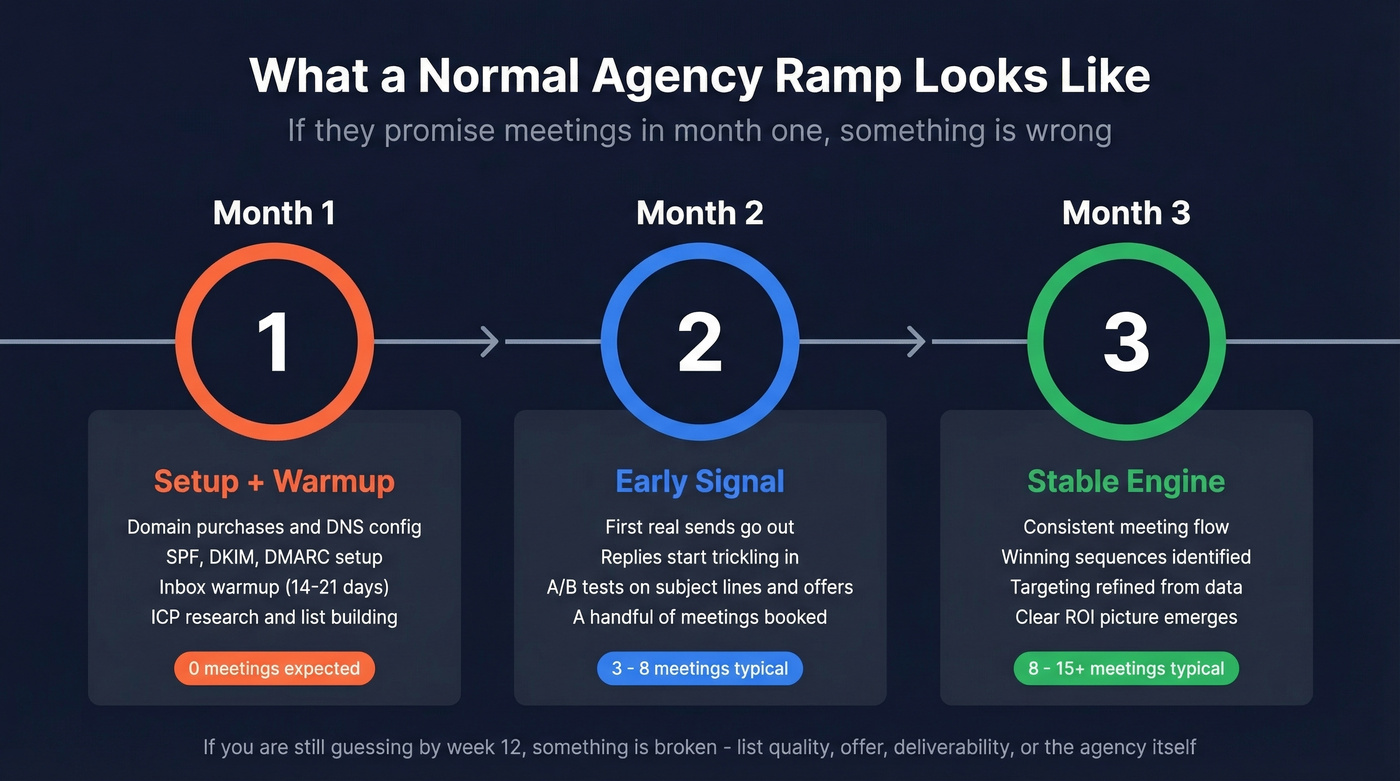
- Month 1: Setup + warmup. Zero meetings is normal. If they promise meetings in month one, they're either skipping warmup or sending from risky infrastructure.
- Month 2: Early signal. Replies start, meetings trickle in. If things are working, expect a handful of meetings while they test targeting and offers.
- Month 3: Stable engine. You should see consistent meeting flow. If you're still guessing by week 12, something's broken: list quality, offer, deliverability, or the agency's ability to iterate.

You read it above: most agencies run Clay + Apollo + Instantly and charge you $6K/month for it. Prospeo gives you 98% verified emails, 125M+ direct dials, and native Instantly and Smartlead integrations - so you can run the same playbook at $0.01/email instead of $600/meeting.
Skip the agency markup. Own your outbound data stack.
Agency vs in-house: the real math
The "should we hire an agency or an SDR?" question isn't philosophical. It's math, timing, and how much control you need.
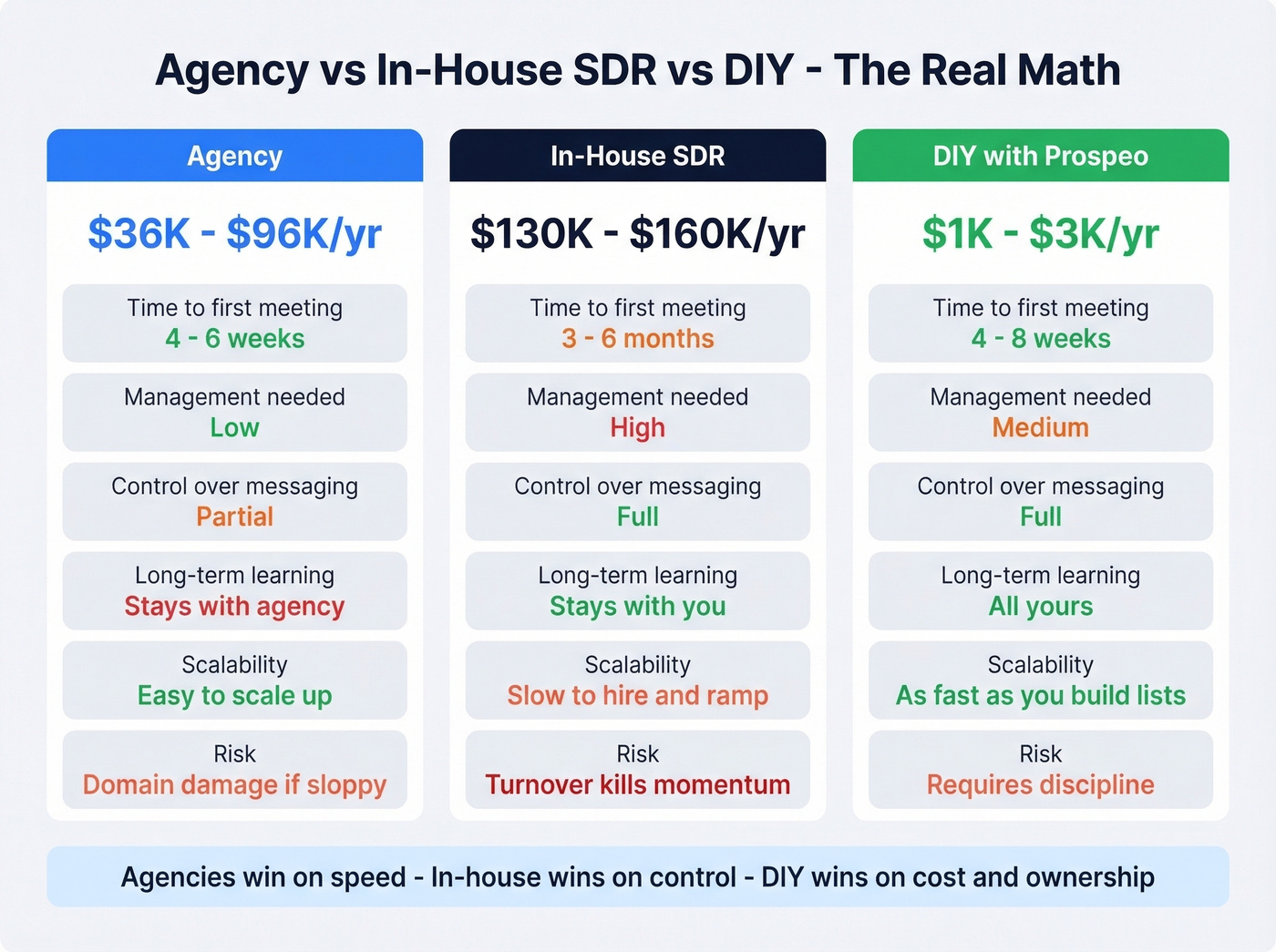
| Cost factor | In-house SDR | Agency |
|---|---|---|
| Year 1 total | $130K-$160K | $36K-$96K |
| Time to first meeting | 3-6 months | 4-6 weeks |
| Ongoing management | You own it | They run it |
| Control over messaging | Full | Partial |
That in-house number isn't just salary. Growleads lays out the fully-loaded costs (salary, taxes, recruiting, training, ramp loss, tools): https://growleads.io/blog/agency-vs-inhouse-sales-cost-2025/ (we're citing the analysis, not the year in the URL). And yes, SDR turnover is brutal; replacing a rep isn't just expensive, it's a momentum killer (see 30-60-90 day plan).
Agencies win on speed. In-house wins on control and long-term learning.
There's also a third option: DIY.
If you've got more time than money, you can build an outbound stack that covers most of what an agency runs. In our experience, the teams that succeed DIY do two things religiously: they keep deliverability boring, and they treat list quality like a first-class problem, not an afterthought (see email deliverability guide).
Prospeo fits well here because it's self-serve and built around accuracy and freshness: 300M+ professional profiles, 143M+ verified emails, 125M+ verified mobile numbers, and a 7-day refresh cycle. You can pull a tight list with 30+ filters (including intent topics and technographics), verify it, and push it straight into tools like Smartlead, Instantly, Lemlist, or Clay without waiting on an annual contract.
Why data quality decides everything
Bad data kills campaigns faster than bad copy. The chain reaction is predictable: unverified emails lead to bounces, bounces hurt domain reputation, reputation sends you to spam, and then the whole campaign "mysteriously" stops working.
Bulk-sender rules from Google, Yahoo, and Microsoft have made this less forgiving. You need low bounce rates, low complaint rates, and one-click unsubscribe support. If your agency shrugs at any of that, you're not hiring experts; you're renting risk.
Whether you hire an agency or run campaigns yourself, verify your list first. Reachoutly's pricing breakdown pegs verification costs in the $0.02-$0.05 per email range for automated tools, which is cheap insurance compared to nuking a domain: https://reachoutly.com/cold-email/agency-pricing/
Most cold outreach fails because of bad data, not bad copy. And yeah, it's frustrating how often this gets ignored because "copy" is easier to sell than "boring operational hygiene."
Prospeo's verification runs a 5-step process that includes catch-all handling, spam-trap removal, and honeypot filtering, and it delivers 98% email accuracy. That accuracy isn't a vanity metric; it keeps bounce rates down so your deliverability doesn't collapse before you even learn what message works (see email bounce rate).
Whether your agency uses Prospeo or you verify lists yourself before handing them off, verification is non-negotiable.
How to vet a cold outreach agency (the stuff that actually matters)
Before you sign anything, run this checklist. If they can't answer clearly, they're not ready to run outbound on your behalf.
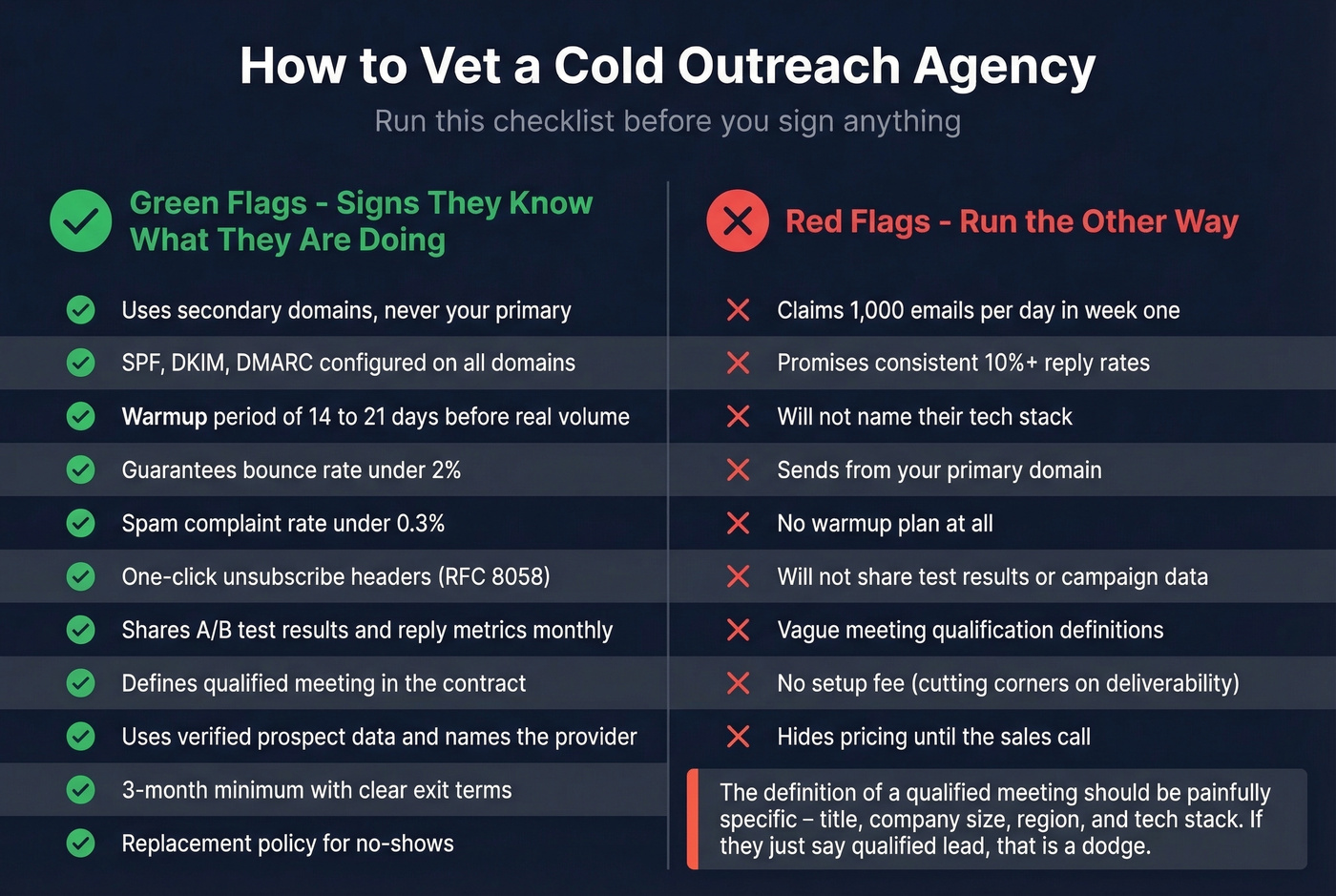
Green flags
- Uses secondary domains (never your primary)
- SPF/DKIM/DMARC configured on all sending domains
- Warmup period of 14-21 days before real volume
- Guarantees bounce rate under 2%
- Spam complaint rate under 0.3%
- One-click unsubscribe headers (RFC 8058) implemented
- Shares A/B test results and reply metrics monthly
- Defines "qualified meeting" in the contract
- Uses verified prospect data and can name the provider
- 3-month minimum with clear exit terms
- Replacement policy for no-shows
Red flags
- Claims 1,000 emails/day in week one
- Promises consistent 10%+ reply rates
- Won't name their tech stack
- Sends from your primary domain
- No warmup plan
- Won't share test results or campaign data
- Vague meeting qualification definitions
Meeting qualification needs to be explicit: "a 30-minute call with a director+ at a company with 50-500 employees in X region using Y tech" is a definition. "Qualified lead" is a dodge.
One scenario we keep seeing: an agency sells "pay per meeting," then books a pile of calls with tiny companies, students, consultants, and vendors because they technically match a loose title filter. Your AE wastes two weeks, your pipeline doesn't move, and the agency points at the calendar as "proof." Don't let that happen. Put the definition in the contract, and put the replacement policy in writing.
Strategy that works (agency or DIY)
The best-performing cold outreach campaigns share three traits: a specific ICP, verified contact data, and short sequences with a clear ask. Everything else is secondary.
Start with an ICP you can actually target: job titles, company size, region, and a reason-now trigger like headcount growth, a new funding round, a tool they just adopted, or a hiring pattern that signals pain. Then make sure the agency's list matches that reality. If they're pulling a generic export and calling it "targeted," you're buying volume, not relevance (see sales prospecting techniques).
And keep the sequence tight. A clean first email, 2-3 follow-ups, and one simple CTA beats a seven-touch saga that reads like a newsletter.
Agencies worth evaluating (and who should skip them)
Not an exhaustive list. These are names that come up repeatedly in practitioner circles, with a quick take on fit.
Belkins (good for benchmarking-driven teams)
Belkins is full-service outbound with a serious data operation, and they publish benchmark data from large-scale analysis. If you want an agency that can talk in numbers and defend decisions with real testing discipline, they're worth a look. Their own benchmark post is here: https://belkins.io/blog/cold-email-response-rates
Cleverly (useful content, annoying pricing opacity)
Skip this if you need pricing upfront. Cleverly doesn't publish rates, which is mildly frustrating for a company that talks a lot about best practices. Still, their deliverability guidance is solid and their outreach best-practices post is worth reading even if you never hire them: https://www.cleverly.co/blog/cold-email-outreach-best-practices
Cold Outreach Systems (performance model, watch the definitions)
This is the performance-based structure: a low monthly tech fee plus a per-meeting charge. It can work if your qualification criteria are strict and enforced. If they're loose, you'll get meetings that look good on a dashboard and go nowhere in the CRM.
SalesHive (multi-channel at scale)
SalesHive is a better fit if you want email plus calling under one vendor and you value operational scale. The tradeoff is that big shops can feel less bespoke, so you need to be clear about ICP and messaging guardrails early.
ColdIQ (for deeper personalization)
ColdIQ positions around deeper personalization based on signals, not just merge fields. If your market is saturated and generic outreach gets ignored, this style can be the difference between "seen" and "deleted."
Agencies in France (GDPR + native-language matters)
If you're targeting French-speaking markets, local specialists like La Growth Machine and Dropcontact are often a better bet than US-first agencies trying to bolt on GDPR compliance after the fact. Regional nuance shows up in both compliance and copy, and it affects reply rates more than most teams expect.
You don't need a $10K/month agency. You need clean data, a good offer, and 3 follow-ups. If an agency can execute that better and faster than you can internally, they're worth the spend. If they can't explain how they'll do it, keep looking.
Bad data is the #1 reason agency campaigns fail. Prospeo's 5-step verification and 7-day refresh cycle keep bounce rates under 2% - the kind of deliverability agencies charge premium retainers to maintain. Stack Optimize built a $1M agency on Prospeo data with zero domain flags.
Stop paying agencies to fix data problems that shouldn't exist.
FAQ
How long until I see results from a cold outreach agency?
Expect zero meetings in month 1 (setup and warmup), first replies and a handful of meetings in month 2, and consistent pipeline by month 3 once targeting and messaging are dialed in. If you're not seeing regular qualified meetings by week 12, change the data, the offer, or the agency.
Can cold outreach damage my domain reputation?
Yes. Sending from your primary domain, using unverified lists, or ramping volume too fast can land you in spam or on blocklists. One bad list with high bounces can hurt deliverability for months. Use secondary domains and verify contacts before sending.
What's the difference between a cold email agency and a lead gen agency?
Cold email agencies focus on email: deliverability, copy, sequencing, and sending operations. Lead gen agencies often add calling, paid ads, or content syndication. For most B2B teams, deliverability depth matters more than channel breadth.
What's a good free alternative to hiring an agency?
Build a simple DIY stack: a data source, verification, and a sending tool like Instantly or Smartlead. Prospeo's free tier includes 75 verified emails per month plus 100 Chrome extension credits, which is enough to test outbound before committing $5K+/month to an agency.