

Cold Outreach Email Templates That Actually Work in 2026
You sent 500 emails this week. Open rate looks decent at 40%. Reply rate? 1.2%. That gap between "opened" and "replied" is where most outbound campaigns go to die - and the data from 16.5M cold emails analyzed by Belkins confirms it. Average reply rates dropped from 6.8% to 5.8% in a single year. The cold outreach email templates everyone copies stopped working because everyone copies them.
Here are 15 templates built on what the numbers actually say, plus the strategy that makes them land.
2026 Cold Email Benchmarks
Ground yourself in what "good" looks like before touching a template. These numbers come from Belkins' analysis of 16.5M emails across 93 business domains, plus a separate 5.5M-email subject line study.
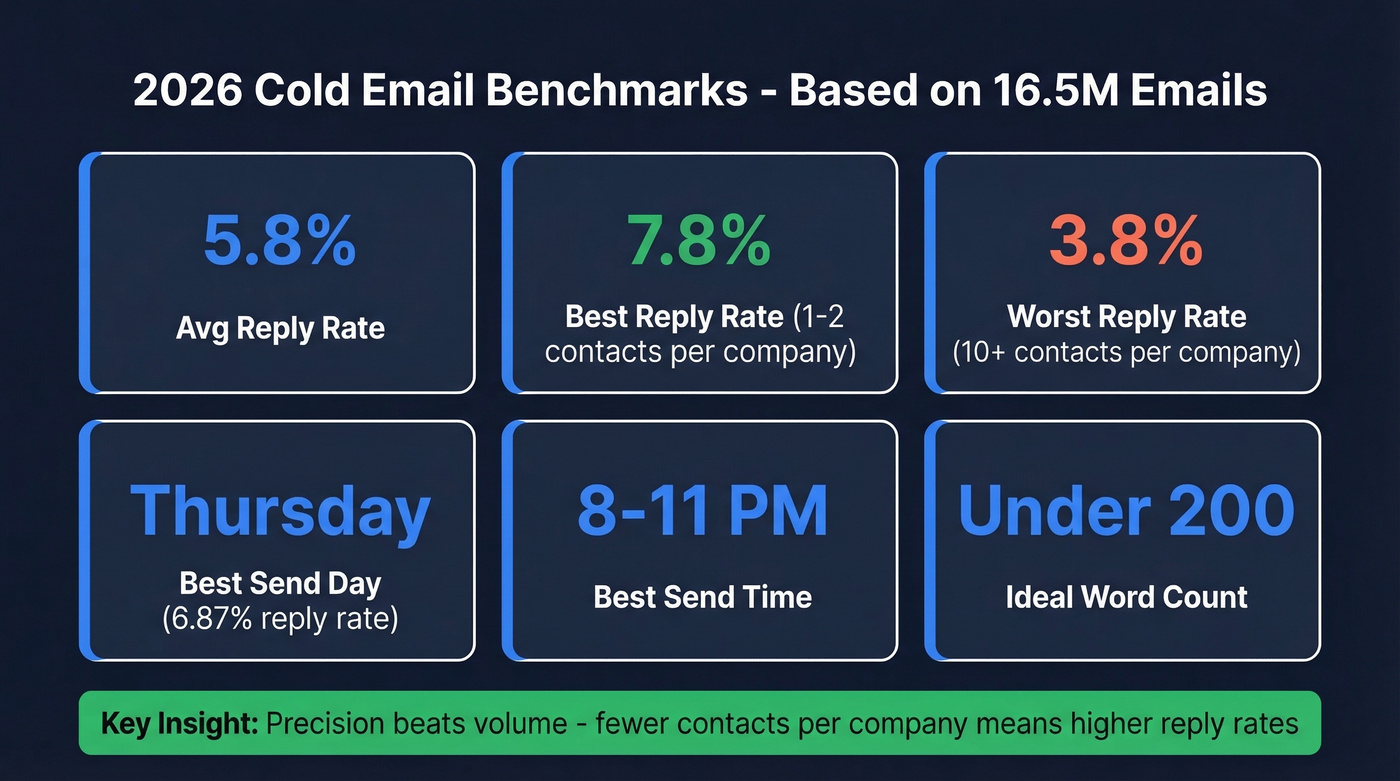
| Metric | Number |
|---|---|
| Avg reply rate | 5.8% |
| Best reply (1-2 contacts/co) | 7.8% |
| Worst reply (10+ contacts/co) | 3.8% |
| Best send day | Thursday (6.87%) |
| Best send time | 8-11 PM |
| Ideal length | Under 200 words |
| Subject line sweet spot | 2-4 words, personalized |
| Bounce threshold | Under 2% |
| Complaint threshold | Under 0.3% |
Here's a counterintuitive finding worth internalizing: targeting fewer contacts per company works better. Teams emailing 1-2 people per account hit 7.8% reply rates. Teams blasting 10+ contacts at the same company? 3.8%. Precision beats volume every time.
The consensus on r/coldemail mirrors this - even senders doing heavy manual personalization report inconsistent results when they spray too wide. Cold email still works. Lazy emails don't.
What Actually Moves Reply Rates
Stop obsessing over templates. Start obsessing over your offer and your data. Three things matter more than any subject line hack.
A specific, valuable offer. "Can we hop on a call?" isn't an offer. "I'll audit your top 3 landing pages and send a Loom with fixes" is. The practitioner consensus on Reddit is clear: low-friction, immediate-value offers crush generic meeting requests. In our experience, the single biggest reply-rate killer is a weak offer, not a bad template.
Verified contact data. Bounces above 2% create deliverability problems fast, and then even great emails land in spam. Verify your list before you send. Prospeo's 5-step verification catches bad addresses at 98% accuracy, and the free tier gives you 75 verifications a month to start. If you want deeper benchmarks and fixes, see our guide to email bounce rate.
Brevity. 40-60 words. That's it. Practitioners consistently report that shorter emails outperform, and the data backs it - shorter emails significantly outperform longer ones, with 95-word emails beating 170-word emails by nearly 6% in CTR. The best outreach emails share one trait: they respect the reader's time.
If your deal size is under $10K, you probably don't need a 7-step sequence with dynamic personalization tokens. A 47-word email with a genuinely useful offer will outperform a hyper-personalized novel every single time.
Subject Line Rules From 5.5M Emails
| Tactic | Open Rate |
|---|---|
| Personalized subject | 46% |
| No personalization | 35% |
| Question format | 46% |
| 2-4 words | 46% |
| 9-10 words | 34-35% |
| Numbers in subject | 27% |
| No numbers | 28% |
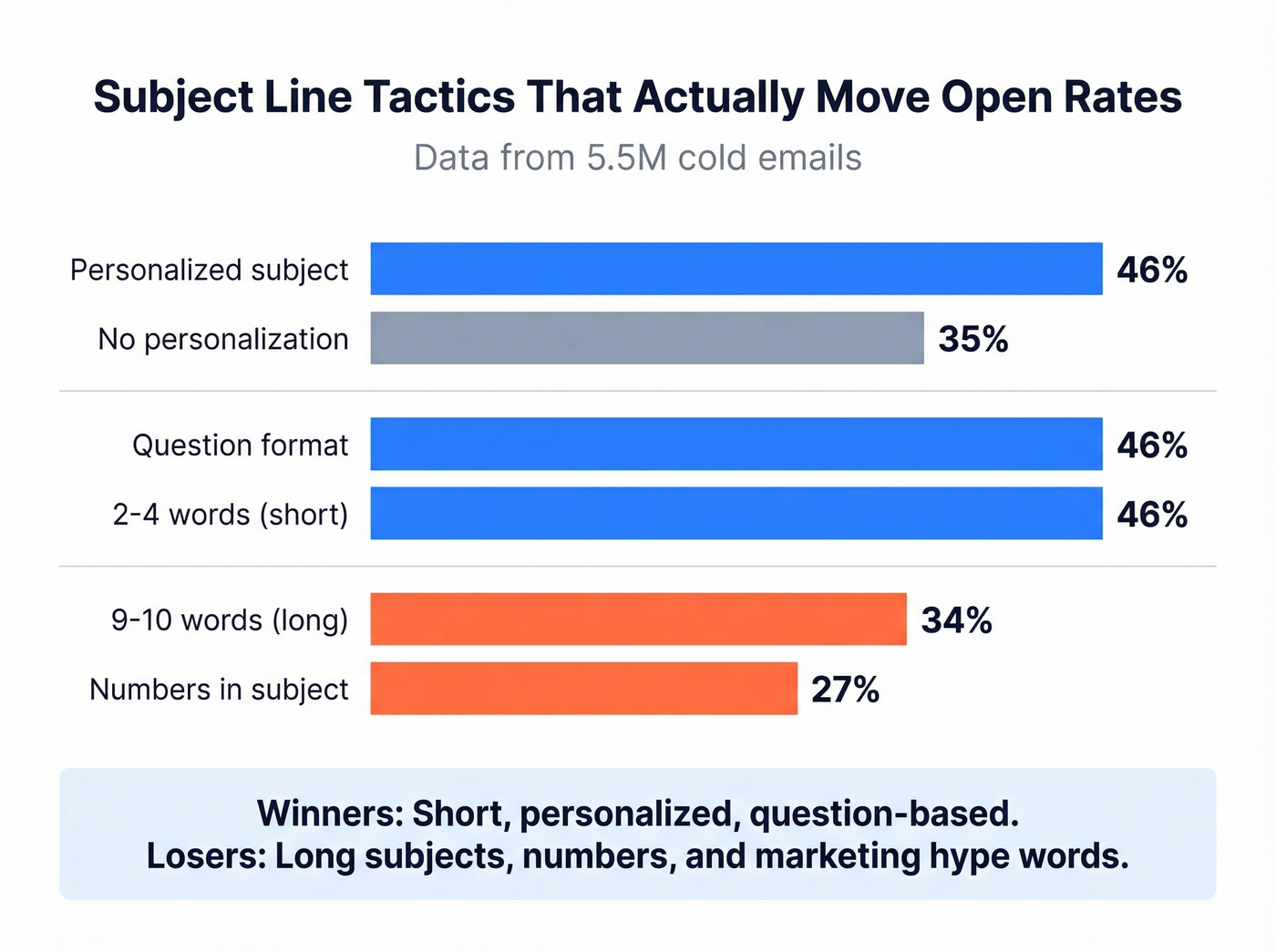
Keep it short, make it personal, ask a question. A Hunter analysis of 20K+ subject lines confirmed that adding even one custom attribute - job title, company name, industry - lifts opens by 7%+. Marketing hype terms like "ASAP" push opens below 36%. For more tested options, pull from these email subject line examples.
Here's the thing: numbers in subject lines actually hurt performance slightly. That "5 tips" or "3 ways" format content marketers love? It signals "mass email" to a B2B buyer's brain. Drop the numbers.
15 Templates That Get Replies
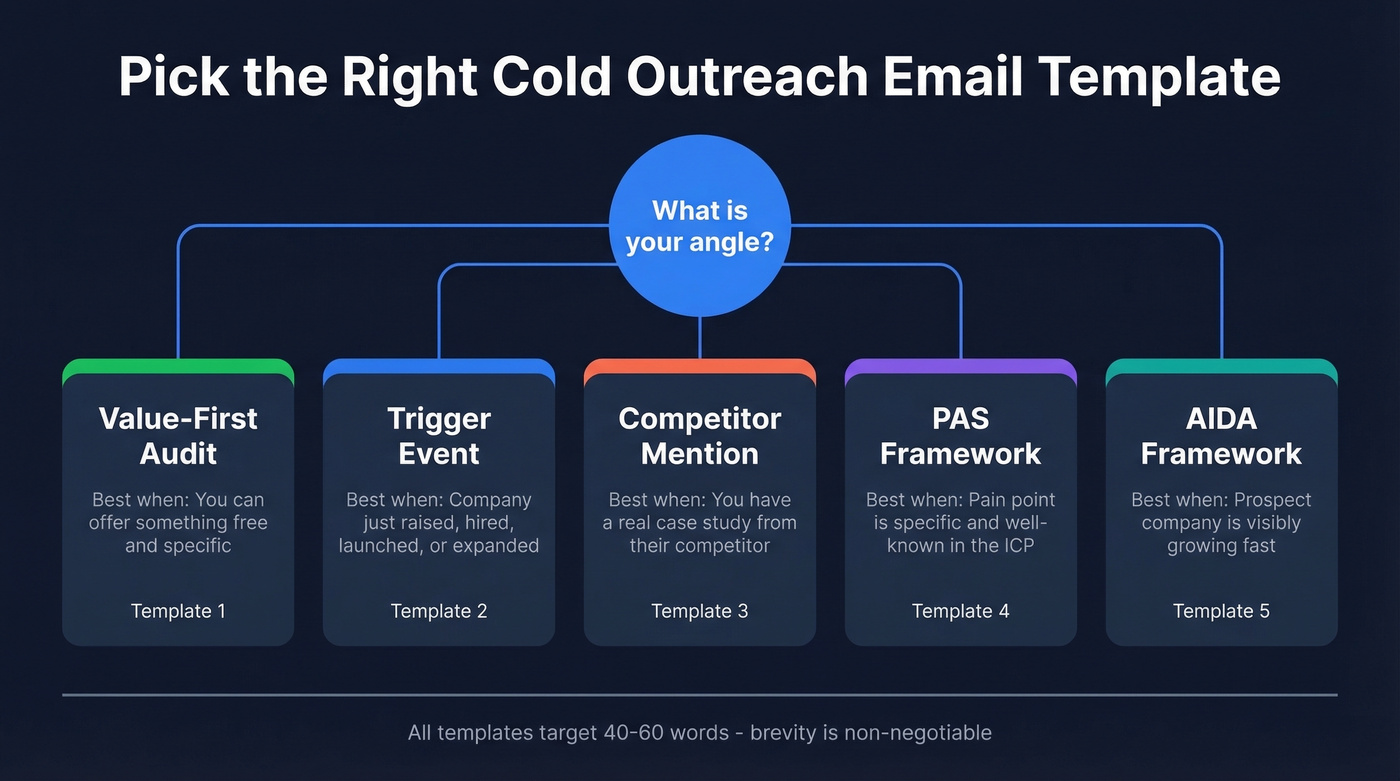
Every template below stays short - around 40-60 words. That matches the brevity standard that both data and practitioners agree on. Aim for a 1:2 ratio of "I/my" to "you/your" pronouns to keep the focus on the prospect.
First-Touch Templates
Template 1: Value-First Audit Offer This follows the format practitioners on r/copywriting report is working in 2026.
Subject: quick question about {{company}}'s site
Hi {{firstName}},
I looked at {{company}}'s top landing pages. There are 3 specific fixes that could improve conversion - I'll record a Loom walkthrough if you're interested.
No pitch, just the audit.
Worth it?
Concrete, free, zero risk for the prospect. This consistently outperforms generic meeting requests because it leads with value before asking for anything. If you want more ways to structure the “value first” angle, see emails that get responses.
Template 2: Trigger Event
Subject: congrats on the raise
Hi {{firstName}},
Saw {{company}} just closed your Series B - congrats. Most teams at this stage start scaling outbound but hit data quality issues fast.
We help {{similar company}} keep bounce rates under 3% while tripling send volume.
Interested in how?
Use quickly after the event. Stale triggers feel like automated scraping. If you’re building this into a repeatable system, use a process for how to track sales triggers.
Template 3: Competitor Mention
Subject: how {{competitor}} handles this
Hi {{firstName}},
{{competitor}} switched to {{your approach}} last quarter and cut their {{metric}} by {{number}}. Thought you'd want to know what they changed.
Happy to share the breakdown - no strings.
Only works with a real case study. Decision-makers always want to know what competitors are doing - this template exploits that instinct.
Template 4: PAS Framework
Subject: {{pain point}} at {{company}}?
Hi {{firstName}},
Most {{job title}}s at {{company size}} companies tell us {{pain point}} is eating 5+ hours a week. It gets worse as the team scales.
We built {{solution}} specifically for this. Takes 15 minutes to see if it fits.
Worth a look?
Problem-Agitate-Solve in a tight format. PAS works best when the pain point is specific to the ICP. If you need to tighten your targeting first, start with an Ideal Customer Profile.
Template 5: AIDA Framework
Subject: {{firstName}}, quick thought
Hi {{firstName}},
{{Company}} is growing fast - your {{department}} job postings jumped 40% this quarter. Teams scaling that quickly usually hit {{bottleneck}}.
We helped {{similar company}} solve that in {{timeframe}}. I can show you exactly how in 10 minutes.
Interested?
One outreach email built from a structured outline achieved a 19.6% response rate. Outline your logic before writing - don't just fill in merge tags. If you want the full funnel context behind AIDA, see the AIDA sales funnel.
Follow-Up Templates
The first follow-up lifts replies by up to 49%. After that, returns drop fast. Three emails total is the ceiling.
Template 6: Day 3 Nudge
Subject: Re: {{original subject}}
Hi {{firstName}},
Just floating this back up. The offer to {{value}} still stands - no call needed, just a yes and I'll send it over.
Template 7: Day 7 Value-Add
Subject: thought you'd find this useful
Hi {{firstName}},
I put together a quick breakdown of {{relevant insight}} for {{company}}'s space. Linked here - no strings.
Still happy to chat about {{original offer}} if timing works.
Leads with new value instead of "just checking in." This is the follow-up approach that separates professionals from spammers. For more variations, use these sales follow-up templates.
Template 8: Breakup Email
Subject: closing the loop
Hi {{firstName}},
I've reached out a couple times - totally understand if the timing's off. I'll leave it here.
If {{pain point}} comes back up, my calendar's always open: {{link}}.
Breakup emails often pull replies from prospects who were "meaning to respond." Removes all pressure.
Template 9: Re-Engagement (60-90 Days Later)
Subject: still relevant?
Hi {{firstName}},
We connected a few months back about {{topic}}. Curious if {{pain point}} is still on your radar or if priorities shifted.
Either way - happy to help if it comes back around.
Scenario-Specific Templates
Template 10: Referral Intro
Subject: {{mutual contact}} suggested I reach out
Hi {{firstName}},
{{Mutual contact}} mentioned you're working on {{initiative}} and thought we should connect. We helped their team {{result}}.
Worth a quick conversation?
The name does the heavy lifting. Skip this one if you don't have a genuine mutual connection - faking it is worse than not mentioning one at all.
Template 11: Executive Outreach
Subject: {{company}} + {{your company}}
Hi {{firstName}},
I'll keep this brief. We work with {{peer company 1}} and {{peer company 2}} on {{outcome}}. I think there's a fit with {{company}}'s {{initiative}}.
Worth 10 minutes this week?
For VP+ prospects, brevity signals respect. Peer company names signal credibility. That's the entire formula.
Template 12: BAB (Before-After-Bridge)
Subject: before and after at {{peer company}}
Hi {{firstName}},
Before: {{peer company}} was {{struggling with X}}. After: {{specific result}} in {{timeframe}}.
The bridge was {{your solution}}. Happy to show you what changed.
Interested?
Works because the "before" hits close to home.
Template 13: Site Observation
Subject: noticed something on {{company}}.com
Hi {{firstName}},
I was on {{company}}'s site and noticed {{specific observation}}. We see this a lot with {{industry}} companies - it usually means {{implication}}.
I can show you a quick fix. Want me to send it over?
Specificity proves you aren't mass-blasting. Generic observations like "great website!" kill this template instantly.
Template 14: SaaS Demo Offer
Subject: 10-min demo, no commitment
Hi {{firstName}},
Most {{job title}}s I talk to spend {{X hours}} on {{task}} every week. Our tool cuts that to {{Y minutes}}.
I can show you in a 10-minute screen share - no commitment, no follow-up if it's not a fit.
Worth it?
"No commitment" and "no follow-up" remove the two biggest objections to taking a meeting.
Template 15: Shared Community
Subject: we both know {{connection/community}}
Hi {{firstName}},
I noticed we're both in {{community/event/group}}. Your post about {{topic}} resonated - we're solving a related problem for {{ICP}}.
Would love to swap notes. Open to a quick chat?
One writing tip that keeps surfacing from practitioners: put your personalization in the P.S. line, not the opener. Reddit users report a +35% performance lift from this simple move. Write at a 6th-8th grade reading level. One CTA per email. No exceptions.

The article says it clearly: bounces above 2% kill deliverability, and then even perfect templates land in spam. Prospeo's 5-step verification delivers 98% email accuracy - keeping your bounce rate well under that threshold. At $0.01 per email, bad data is no longer an excuse.
Fix your data before you fix your templates.
Follow-Up Strategy
Let's be honest: three follow-ups is the ceiling, not the floor.
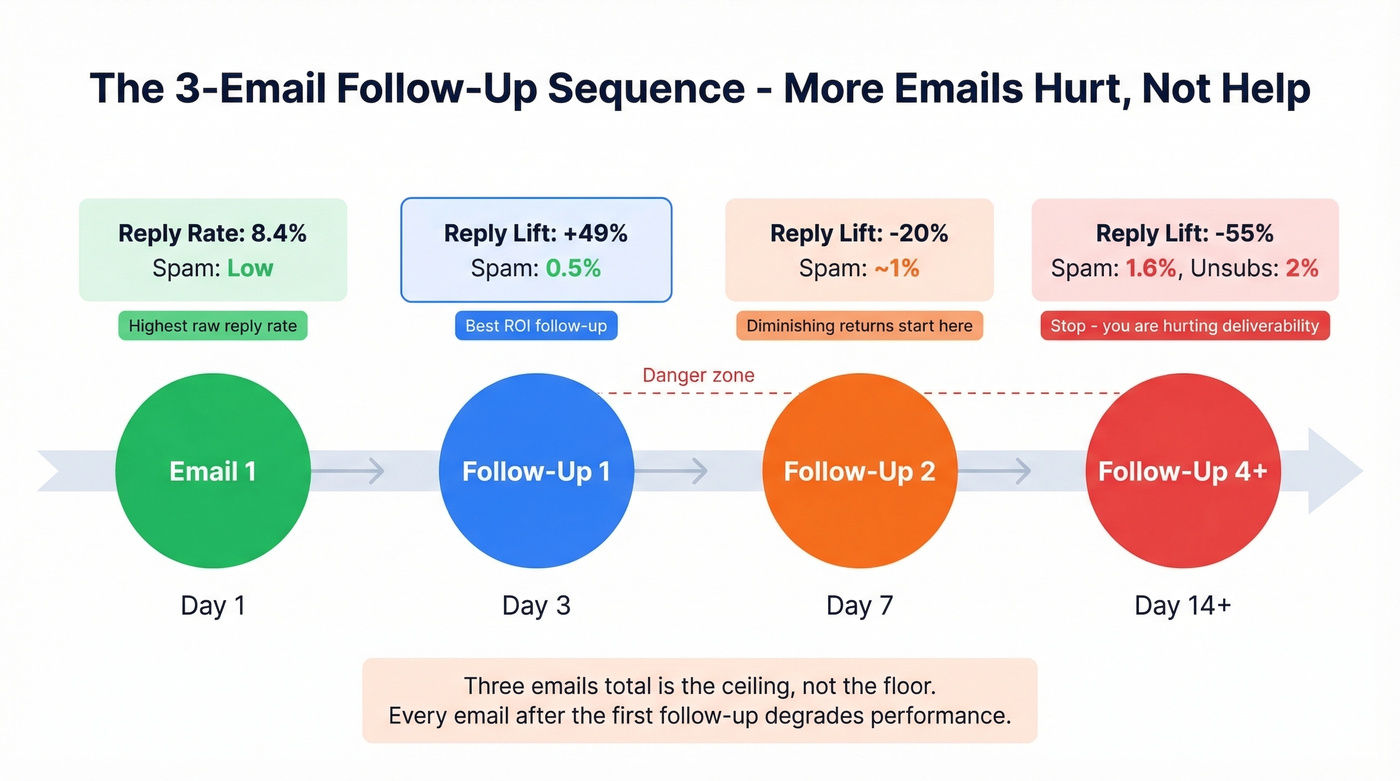
| Follow-Up # | Reply Lift | Spam Complaints | Unsubscribes |
|---|---|---|---|
| 1st follow-up | +49% | 0.5% | 0.1% |
| 2nd follow-up | -20% | ~1% | ~0.8% |
| 4th follow-up (5th email) | -55% | 1.6% | 2.0% |
Single-touch emails actually produce the highest raw reply rate at 8.4%. Every additional email after the first follow-up degrades performance and increases risk. I've watched teams run 7-step sequences and wonder why their domain reputation is cratering - this table is why.
The recommended cadence: Day 1 (first touch), Day 3 (nudge), Day 7 (value-add or breakup). Then stop. If they haven't replied after three well-crafted emails with a strong offer, the problem isn't persistence - it's fit. If you want a full sequence blueprint, use our B2B cold email sequence.
Deliverability Checklist
None of these templates matter if your emails land in spam.
- SPF + DKIM + DMARC on every sending domain. Microsoft started enforcing this for Outlook.com senders exceeding 5,000 emails/day in May 2025. Gmail's been enforcing since early 2024.
- RFC 8058 one-click unsubscribe headers. Required for bulk senders.
- Complaint rate under 0.3%. Cross this and inbox providers throttle you hard.
- Bounce rate under 2%. This is where data quality becomes a deliverability issue.
- Warmup new domains at 5-10 emails/day, ramping over 4-6 weeks.
- Custom tracking domain via CNAME to isolate your reputation.
- Turn off open-tracking pixels. Belkins' experiment showed 3% higher response rates without them. The deliverability benefit is worth losing vanity metrics.
- Plain text emails. One link maximum. No images, no fancy formatting.
To keep bounces under 2%, verify every address before it enters your sequence. Prospeo's 5-step verification - catch-all handling, spam-trap removal, honeypot filtering - delivers 98% accuracy. Customers like Stack Optimize maintain 94%+ deliverability and sub-3% bounce rates across all client campaigns using this approach. For a deeper technical walkthrough, see our email deliverability guide.
Trigger events, competitor mentions, headcount growth - every template above needs real-time data to work. Prospeo refreshes 300M+ profiles every 7 days and gives you 30+ filters including job changes, funding rounds, and department growth signals. Build lists that make these templates actually land.
Send fewer emails to better prospects and watch reply rates climb.
Mistakes That Kill Performance
Using your primary domain. Buy a separate domain. Protect your main brand's reputation. We've seen teams nuke their company's sender reputation in a single week because they didn't bother with a secondary domain - and recovery takes months.
Skipping warmup. A fresh domain blasting high volume on day one gets flagged fast. There's no shortcut here. If you need a safer ramp plan, use email velocity.
Multiple CTAs. One ask per email. "Want to chat? Also, check out our blog" is two asks disguised as helpfulness.
Over-personalizing with a weak offer. "I loved your recent post about Q3 planning" means nothing if your offer is "let's hop on a call." The personalization earns attention. The offer earns the reply. Don't confuse the two.
Running 5+ email sequences. Reply rates drop 55% by the 5th email. You're training inbox providers to flag you.
Deceptive "Re:" subject lines. Faking a prior conversation is a CAN-SPAM violation and an instant trust-killer.
No unsubscribe link. Required by law. Required by inbox providers. Just include it.
Ignoring mobile. 85% of emails are read on phones first. That wall of text looks even worse on a 6-inch screen.
Even the best cold outreach email templates fail when these fundamentals are ignored.
Compliance Quick Reference
CAN-SPAM: Accurate sender info, non-deceptive subjects, valid physical address, functional opt-out honored within 10 business days. Penalties run $51,744-$53,088 per non-compliant email.
GDPR: Cold B2B email is legal under Article 6(1)(f) - legitimate interest. Document a Legitimate Interest Assessment covering purpose, necessity, and balancing. Maximum penalties reach EUR 20M or 4% of global revenue.
CASL: Requires express or implied consent. Implied consent can apply in B2B contexts, including some publicly available business contact details. Honor unsubscribes within 10 business days and retain opt-out records for 3+ years.
FAQ
Is cold email legal in 2026?
Yes. Cold B2B email is legal in the US under CAN-SPAM and in the EU under GDPR's legitimate interest basis. CAN-SPAM penalties run $51,744-$53,088 per email, and GDPR fines reach EUR 20M - so compliance isn't optional. Follow the deliverability checklist above and you're covered.
What's a good cold email reply rate?
The average across 16.5M emails is 5.8%. Anything above 8% is strong. Target 1-2 contacts per company instead of blasting 10+ and you'll land closer to 7.8%. Reply rate depends more on offer quality and data accuracy than template choice.
How many follow-ups should I send?
Three emails maximum - one initial touch plus two follow-ups. The first follow-up lifts replies by up to 49%, but by the third email responses drop 20%. Beyond that, you're increasing spam complaints without meaningful upside.
How do I keep bounce rates low enough for cold outreach?
Verify every email address before sending - bounce rates above 2% damage domain reputation fast. Prospeo's 5-step verification handles catch-all domains, spam traps, and honeypots at 98% accuracy for roughly $0.01 per email. The free tier includes 75 verifications monthly to test your workflow.
Where can I find proven cold outreach email templates?
The 15 templates above are drawn from real frameworks that practitioners report are working in 2026. But no template works in isolation. Pair any template with verified contact data, a specific low-friction offer, and a three-touch sequence to see real results.