

Cold Outreach Lead Generation: The Data-Backed Playbook for 2026
Lazy Outreach Is Dead. Smart Outreach Isn't.
A RevOps lead we know ran a 10,000-email campaign last quarter with a "verified" list from a well-known provider. Bounce rate hit 14% by day three. Two sending domains got flagged. Three weeks of warmup, gone. The list wasn't the strategy - it was the strategy's foundation, and it crumbled.
Cold outreach lead generation isn't dying. But the margin for error has collapsed. A study of 16.5M cold emails across 93 business domains found the average reply rate dropped from 6.8% in 2023 to 5.8% in 2024 - a 15% year-over-year decline. Meanwhile, one Reddit poster put their cold email reply rate around 2%, with connection requests getting ignored entirely. The gap between average and excellent has never been wider, and it's widening because of infrastructure and data quality, not because the channel stopped working.
Here's the thing: if your cost per lead on paid channels is under $50 and your average deal size is below $10k, you might not need cold outreach at all. But if you're selling $30k+ deals into mid-market or enterprise, this is still the highest-ROI channel available.
What Separates 2% From 10%+ Reply Rates
Three things:
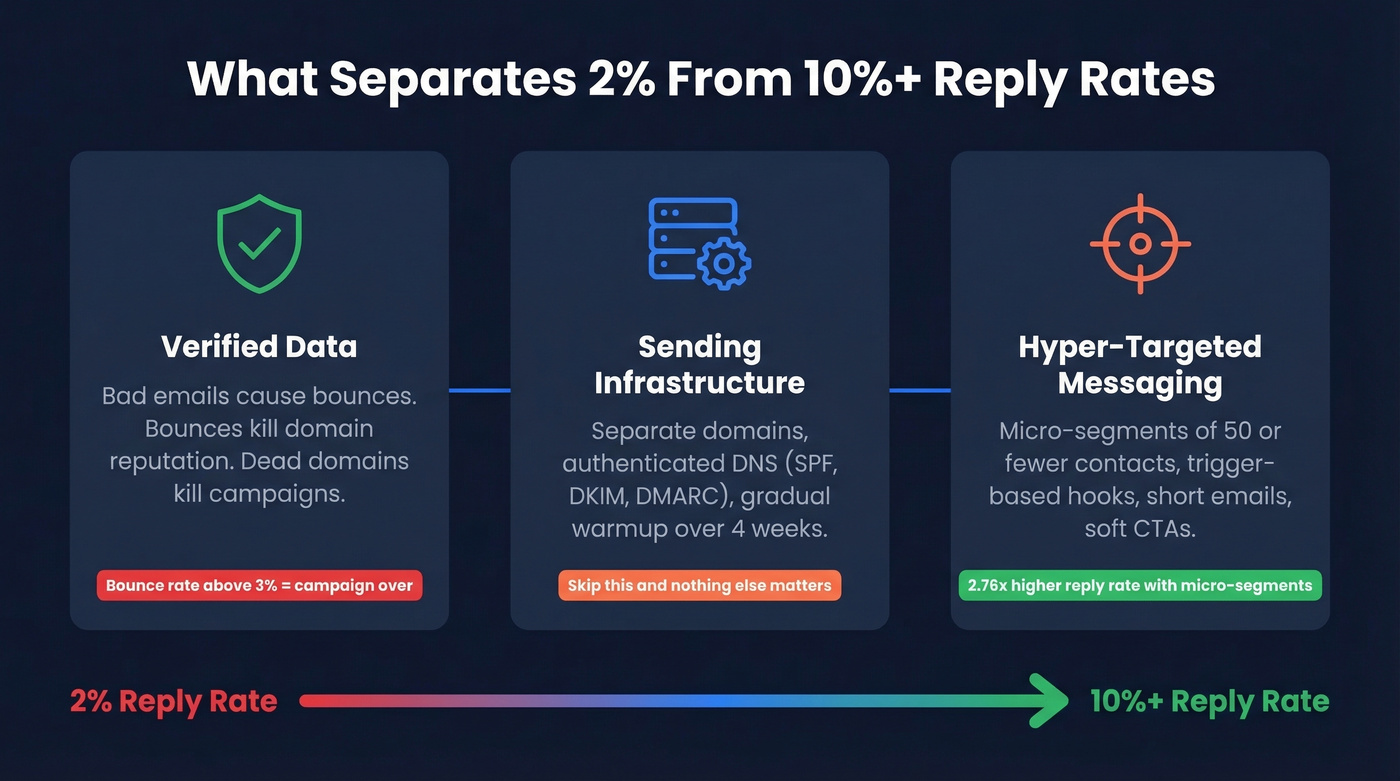
- Verified data - bad emails cause bounces, bounces kill domain reputation, dead domains kill campaigns.
- Proper sending infrastructure - separate domains, authenticated DNS records, gradual warmup. Skip this and nothing else matters.
- Hyper-targeted messaging - micro-segmented lists, trigger-based hooks, short emails with soft CTAs.
2026 Cold Email Benchmarks
Let's ground everything in numbers before getting into tactics. These benchmarks come from the 16.5M-email study, plus widely cited benchmark ranges from Instantly's reply-rate tiers and a commonly referenced ~8.5% response-rate benchmark attributed to Backlinko across millions of emails.
| Metric | Average | Good | Excellent |
|---|---|---|---|
| Reply rate | 5.8% | 5-10% | 10-15%+ |
| Bounce rate | <3% target | <2% | <1% |
| Spam complaints | <0.3% | <0.1% | Near zero |
| Open rate | 31-32% | 35-40% | 45%+ |
A few things stand out. Single-email sequences actually had the highest reply rate at 8.4% - not because follow-ups don't work, but because campaigns disciplined enough to send one perfect email tend to have better targeting. Thursday is the best send day (6.87% reply rate vs. Monday's 5.29%). The 8-11 PM window pulls a 6.52% reply rate, likely because prospects respond when their inbox is quieter.
The most counterintuitive finding: contacting 1-2 people per company yields a 7.8% reply rate. Blast 10+ contacts at the same company and that drops to 3.8%. Precision beats volume every time.
The Unit Economics Argument
Here's why this channel still wins on ROI when your data is clean.
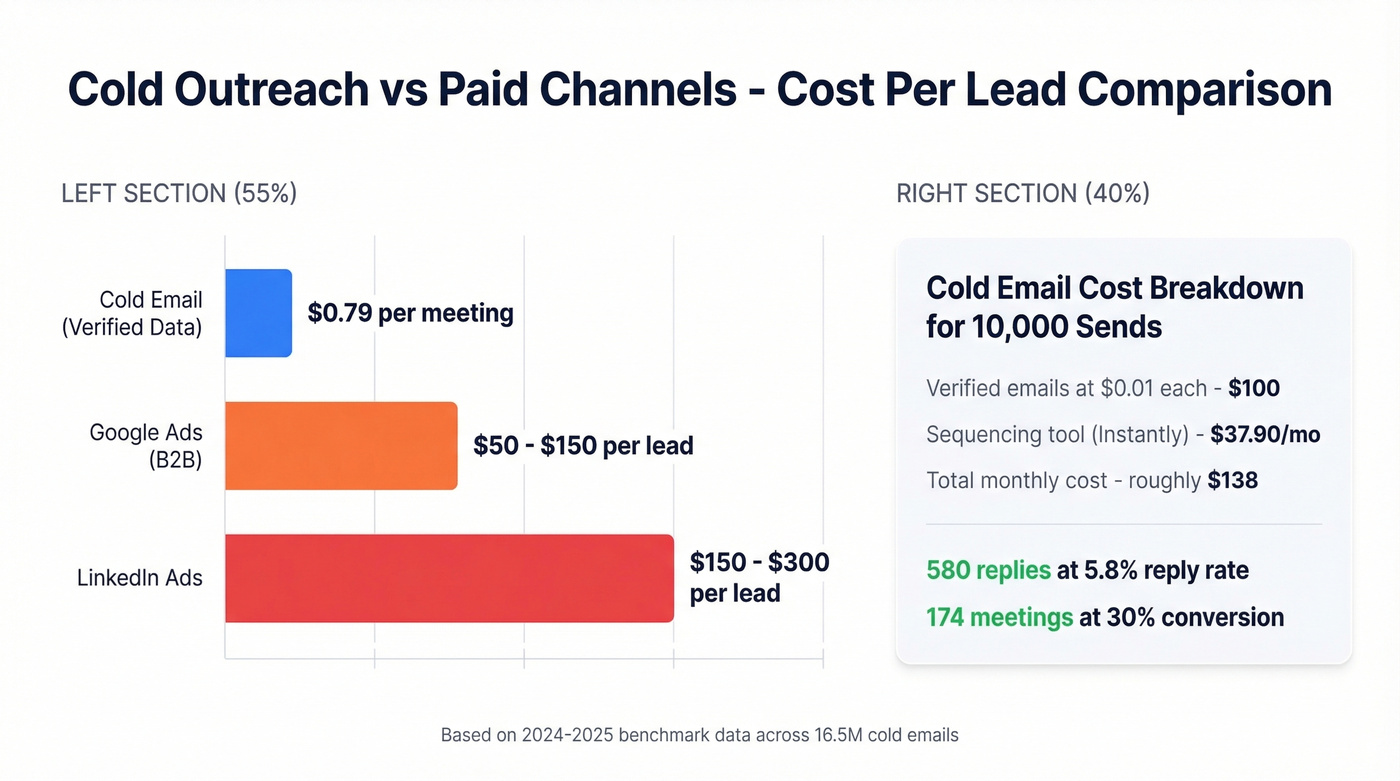
Verified data at ~$0.01/email means 10,000 sends cost about $100 in data. Add a sequencing tool like Instantly at $37.9/month on annual billing and your monthly tooling + data cost for 10,000 sends is about $138. At a 5.8% reply rate, that's roughly 580 replies. If 30% of replies convert to a meeting, that's around 174 meetings - putting you at about $0.79 per meeting before you factor in mailboxes and domains.
Compare that to typical paid acquisition ranges: LinkedIn Ads at ~$150-300 per lead, Google Ads at ~$50-150 CPL in B2B. Email outreach for leads isn't just effective - it's dramatically cheaper when the list is accurate and your infrastructure is healthy. For teams selling $25k+ contracts, no other channel comes close on unit economics.
Build a Verified Prospect List
Every cold outreach guide talks about "building your ICP" and "finding the right prospects." That's table stakes. What actually moves the needle is the intersection of targeting precision and data quality.
Digital Bloom's research found that segmenting prospects into cohorts of 50 or fewer contacts increases reply rates by 2.76x. That's not a marginal improvement - it's the difference between a 4% and an 11% reply rate. Smaller cohorts force you to write messaging that's actually relevant to each group's specific situation, rather than blasting the same generic pitch to a thousand people and hoping something sticks.
But micro-segmentation only works if the underlying data is clean. People change jobs, companies get acquired, email systems get reconfigured constantly. Send to stale data and you're not just wasting sends - you're actively damaging your sending reputation.
A practical guardrail: keep bounce rate under 3%. That's a hard stop. (If you want a deeper breakdown of bounce codes and fixes, see bounce rate benchmarks.)
We've found that a 7-day data refresh cycle makes a real difference here. The industry average is six weeks, which is an eternity in outbound terms. Prospeo's B2B database runs on that weekly refresh with 30+ search filters including buyer intent across 15,000 topics, technographics, job changes, headcount growth, and funding events. Stack Optimize built their agency from $0 to $1M ARR using this exact data workflow - maintaining 94%+ deliverability, bounce rates under 3%, and zero domain flags across all clients.

The practical workflow: build your micro-segments using intent + firmographic filters, export verified contacts, and push them directly to Instantly, Smartlead, or Lemlist via native integrations. Run every list through real-time verification before it touches your sequencer. No exceptions.

The article proves it: contacting 1-2 people per company with precision data yields 2x the reply rate of blasting 10+. Prospeo's 30+ filters - buyer intent, technographics, job changes, funding - let you build micro-segments of 50 or fewer contacts with 98% email accuracy. At $0.01/email, 10,000 verified sends cost $100.
Stop burning domains on bad data. Build your first verified list in minutes.
Set Up Sending Infrastructure
Infrastructure is the unsexy part of cold outreach that determines whether your beautifully crafted emails actually reach an inbox.
Domain and Mailbox Setup
Never send cold emails from your primary domain. If your company domain is acme.com, set up acme-mail.com or getacme.com for outreach. If that outreach domain gets flagged, your company's internal email - the stuff going to customers, partners, and investors - stays untouched.
Set up 3-5 mailboxes per outreach domain. Each mailbox gets its own warmup cycle and sending volume. This distributes risk and lets you scale without hammering a single sender reputation.
SPF, DKIM, and DMARC
These three DNS records tell email providers you're a legitimate sender. Missing or misconfigured authentication is one of the fastest ways to land in spam.
SPF authorizes which servers can send on your domain's behalf. Use v=spf1 include:... -all and watch the 10 DNS lookup limit - exceed it and SPF breaks completely, as if you don't have one at all. (More examples: SPF record syntax.)
DKIM cryptographically signs your emails. Use 2048-bit keys and rotate them annually. Set up a unique DKIM selector for every sending service. (Quick checks: verify DKIM.)
DMARC ties SPF and DKIM together. Ramp gradually: Weeks 1-4 at p=none, Weeks 5-8 at p=quarantine, then p=reject from Week 9 onward. Use relaxed alignment for cold email - strict alignment breaks with subdomains and return-path differences common in outbound setups. (If you want the technical nuance, see DMARC alignment.)
One detail most guides skip: set up List-Unsubscribe and List-Unsubscribe-Post headers. Gmail and Microsoft factor one-click unsubscribe support into sender reputation and deliverability scoring.
Warmup Ramp Schedule
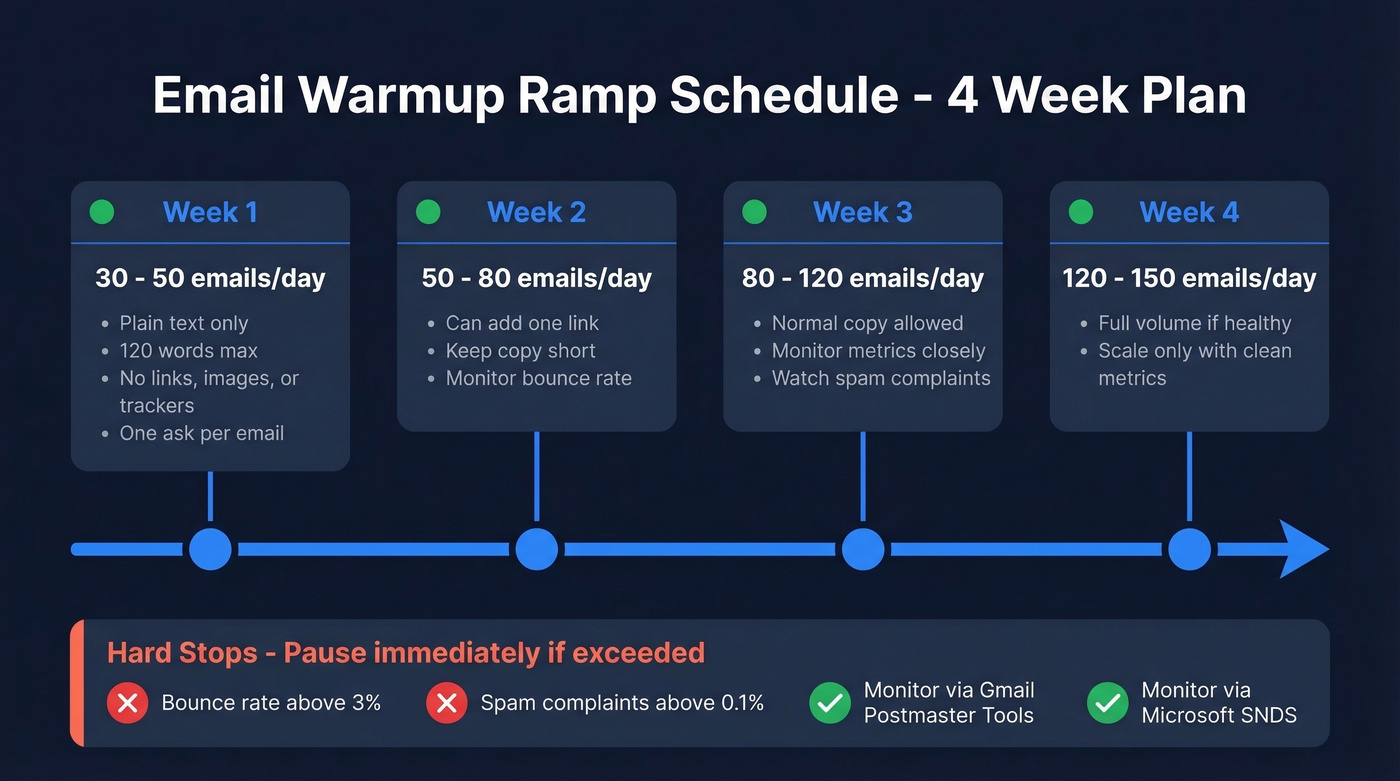
Patience here saves you months of recovery later. EA Partners' framework provides a solid week-by-week ramp:
| Week | Daily Volume | Rules |
|---|---|---|
| 1 | 30-50/day | Plain text only, 120 words max, no links/images/trackers, one ask |
| 2 | 50-80/day | Can add one link, keep copy short |
| 3 | 80-120/day | Normal copy, monitor metrics closely |
| 4 | 120-150/day | Full volume only if bounce <3% and complaints <0.1% |
Those guardrails - bounce under 3%, spam complaints under 0.1% - are hard stops, not suggestions. If you exceed either threshold, pause sending immediately and diagnose. Monitor through Gmail Postmaster Tools and Microsoft SNDS. Both are free and give you direct visibility into how Google and Microsoft view your sending reputation. (More on remediation: improve sender reputation.)
Bounce rates above 3% destroy cold outreach campaigns. Prospeo's 7-day data refresh cycle and 5-step verification keep you under that threshold - Stack Optimize ran zero domain flags across all clients while scaling to $1M ARR. Native integrations push verified contacts straight to Instantly, Smartlead, or Lemlist.
Get 75 free verified emails and see what clean data does to your reply rates.
Write Emails That Get Replies
Subject Lines
Subject lines are the highest-leverage variable in your entire campaign, yet most teams A/B test body copy and ignore the line that determines whether the email gets opened at all.
Keep them under 7 words. Use lowercase - it reads like a real person wrote it, not a marketing automation platform. Personalize with the company name or a trigger event, not the recipient's first name (everyone does that already). Skip exclamation marks and ALL CAPS. (If you need a swipe file, use these email subject line examples.)
Hook Types That Work
Not all opening lines are created equal. Digital Bloom's benchmarking found that timeline-based hooks - referencing a recent trigger event like a funding round, new hire, or product launch - pull a 10.01% reply rate versus 4.39% for generic problem hooks. That's a 2.3x gap on replies. More importantly, timeline hooks convert to meetings at 2.34% versus 0.69% for problem hooks - a 3.4x difference where it actually counts.
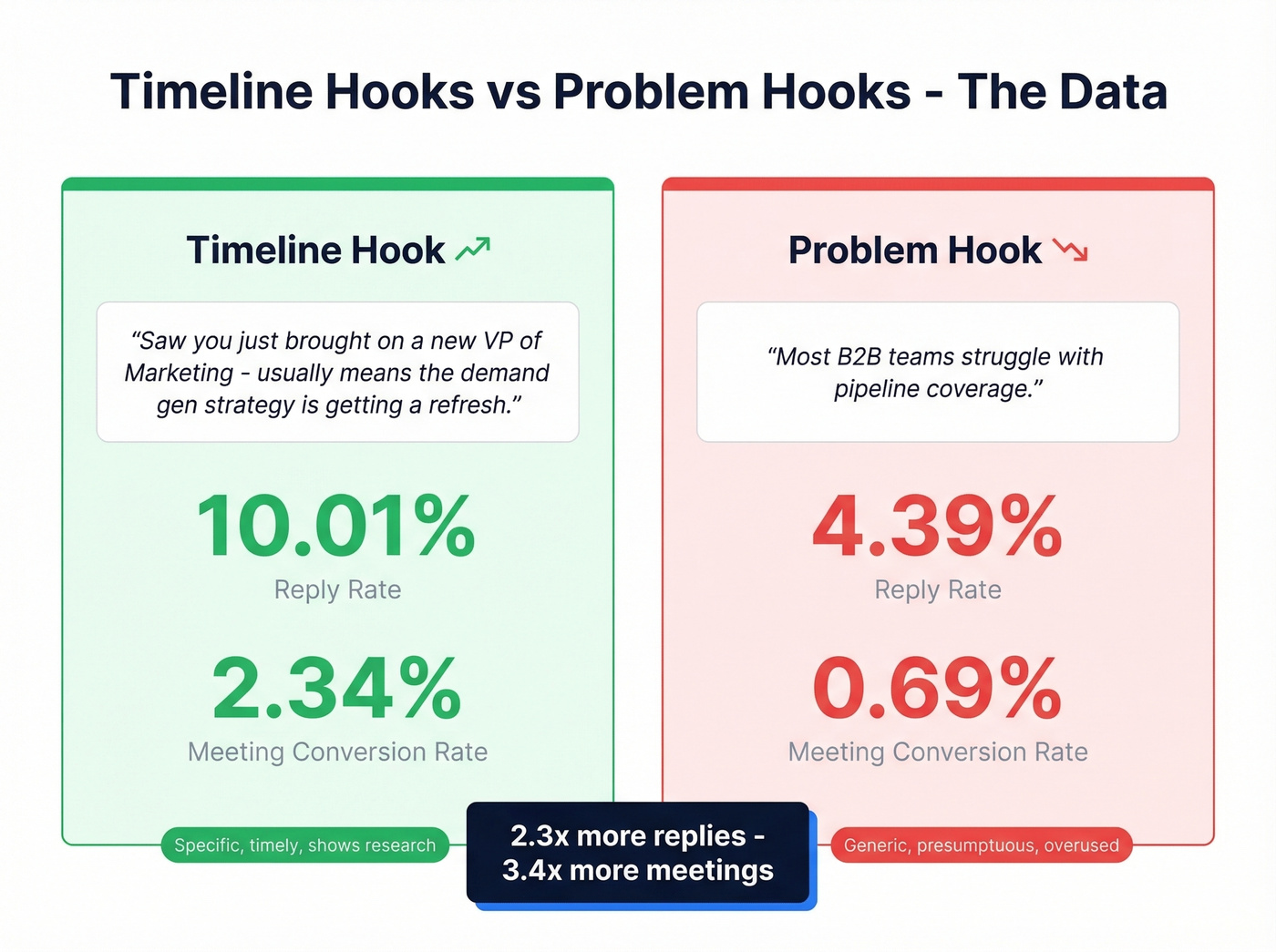
A timeline hook sounds like this: "Saw you just brought on a new VP of Marketing - usually means the demand gen strategy is getting a refresh." It works because it's specific, timely, and signals actual research.
A problem hook sounds like this: "Most B2B teams struggle with pipeline coverage." It's generic, it's presumptuous, and the prospect has read it forty times this month.
Copy and CTA
The 16.5M-email study says 6-8 sentences under 200 words hits the sweet spot at 6.9% reply rate. But a Reddit practitioner makes a compelling case for going even shorter: 40-60 words, offer-first, soft CTA. Brevity forces you to lead with value instead of padding with context nobody asked for. (More CTA patterns: email call to action.)
Here's a ~47-word template:
Saw [Company] just [trigger event]. When teams hit that stage, [specific outcome] usually becomes a priority.
We helped [similar company] [specific result] in [timeframe].
Worth a quick conversation?
"Worth a conversation?" and "Interested?" consistently outperform hard meeting asks like "Can I get 15 minutes on your calendar Tuesday?" The soft ask reduces friction and lets the prospect engage on their terms.
Look - the offer matters more than the copy. A mediocre email with a genuinely valuable offer - a free audit, a custom analysis, a relevant case study - will outperform a perfectly written email pitching a generic demo every single time.
Design Your Sequence
Email-Only Cadence
Digital Bloom's 3-7-7 cadence captures 93% of replies by Day 10:
- Day 0: Initial email with timeline hook + offer
- Day 3: First follow-up, new angle, same thread
- Day 10: Second follow-up with breakup or case study
- Day 17: Final touch, optional - only if metrics are clean
The first follow-up is non-negotiable. It adds 40-50% more replies on its own. But diminishing returns hit fast. The third email drops reply rates by up to ~20%, and by the fourth email, spam complaints jump from 0.5% to 1.6%. Two to three emails is the sweet spot. (Need copy? Use these cold email follow-up templates.)
Multichannel Sequences
Adding a second channel - typically LinkedIn - changes the dynamic. Multichannel isn't just about conversion lift; it's insurance. If email filtering tightens or a social account gets restricted, you've got a fallback channel already warmed. Salesflow's framework recommends choosing your lead channel based on your ICP's behavior: LinkedIn-first for founders, consultants, and recruiters who live on the platform; email-first for traditional executives and IT buyers.
SaaS sequence (4 touches): Day 1 LinkedIn connect -> Day 3 email -> Day 7 LinkedIn message -> Day 10 email
IT services sequence (4 touches): Day 1 email -> Day 3 LinkedIn connect -> Day 6 email with proof point -> Day 10 LinkedIn message with light CTA
Keep LinkedIn's limits in mind: roughly 100-200 connection requests per week, with message limits on top of that. We've seen teams get their accounts restricted for two weeks by pushing connection volume too aggressively - that's two weeks of dead air in your sequence.
Launch, Monitor, and Optimize
Once your sequences are live, track four metrics weekly:
Reply rate - below 3%? Audit data quality and targeting before touching copy. Bounce rate - hard stop at 3%, pause and reverify your list if you're above it. Spam complaints - hard stop at 0.1%, reduce volume and check copy for spam triggers. Meeting rate - the metric that actually matters, so track replies-to-meetings conversion separately from everything else.
When something's off, diagnose in order. Reply rate below 3% with clean bounces? Your targeting is wrong - you're reaching the wrong people, not the wrong inboxes. Targeting looks tight but replies are still low? Test new hooks, starting with timeline-based triggers. Hooks performing but meetings aren't booking? Your offer needs work, not your email.
A/B test one variable at a time: subject lines first since they're highest leverage, then hooks, then CTAs. Run each test for at least 200 sends before drawing conclusions. Review metrics every Monday and make one adjustment per week. Not five.
Running lists through real-time verification before each campaign launch eliminates one of the fastest ways teams wreck deliverability. It takes two minutes and saves weeks of recovery.
Legal Compliance Checklist
Cold B2B outreach is legal in most jurisdictions - but the rules vary significantly, and the penalties for getting it wrong are severe enough to matter.
| Regulation | Region | Key Requirements | Max Penalty |
|---|---|---|---|
| CAN-SPAM | US | Physical address, opt-out in 10 days, no deceptive headers | $50,120/violation |
| GDPR | EU/UK | Legitimate interest basis, transparency, data minimization | EUR 20M or 4% revenue |
| CASL | Canada | Express/implied consent, 60-day unsubscribe window | $10M/violation |
For GDPR specifically, cold B2B email is permissible under the "legitimate interest" basis, but you need to pass a balancing test: is your outreach relevant enough to the recipient's professional role that it justifies the contact? Keep records of how you sourced each contact and why the outreach is relevant. Collect only what you need - name, email, job title, company.
The practical takeaway: include a physical address, make opt-out dead simple, honor unsubscribes within 2 business days (not just the legal maximum), and keep records of your data sourcing rationale. This isn't just legal protection - it's deliverability protection. ISPs track complaint patterns, and sloppy compliance generates complaints.
Recommended Tool Stack
| Function | Tool | Starting Price | Key Strength |
|---|---|---|---|
| Data & Verification | Prospeo | Free (75/mo) + 100 extension credits; ~$0.01/email | 98% accuracy, 7-day refresh |
| Data & Verification | Apollo | Free tier; paid from ~$59/user/mo | All-in-one with sequencing |
| Data & Verification | Hunter.io | Free (25/mo); paid from ~$50/mo | Simple email finder |
| Sequencing | Instantly | $37.9/mo (annual) | Built-in warmup, scale |
| Sequencing | Smartlead | ~$32.5/mo (annual) | Multi-inbox rotation |
| Sequencing | Lemlist | ~$50-60/mo | Personalization features |
| CRM | HubSpot | Free CRM; $90/mo Sales Hub | Ecosystem + reporting |
| CRM | Close | $9/mo (Solo) | Built for outbound teams |
Everything downstream depends on email accuracy. A 2% difference in bounce rate doesn't sound like much until you realize it's the difference between healthy domain reputation and ISP throttling.
Apollo deserves a mention for teams that want data and sequencing in one tool - its free tier is generous and the paid plan includes solid prospecting features. The tradeoff is lower email accuracy at scale (around 79% compared to 98% from a dedicated verification layer), which means more bounces and faster domain degradation when you're sending volume. If you're running fewer than 500 emails a month, Apollo's all-in-one approach works fine. Skip it if you're scaling past that and can't afford deliverability hits.
FAQ
Does cold emailing still work in 2026?
Yes. The 16.5M-email study shows a 5.8% average reply rate, and top-quartile campaigns consistently hit 10-15%+. The difference between average and excellent comes down to data quality, sending infrastructure, and targeting precision - not whether the channel itself has stopped working.
How many follow-ups should I send?
Two to three maximum. The first follow-up adds 40-50% more replies, making it essential. But by the fourth email, spam complaints triple from 0.5% to 1.6%, and reply rates drop ~55% compared to earlier touches.
What's a good cold email reply rate?
5-10% is good, 10-15% is excellent, and 15%+ is best-in-class for tightly targeted campaigns. If you're below 3%, audit your data quality and deliverability setup before changing copy - the problem is almost always upstream of messaging.
Do I need a separate domain for outreach?
Absolutely. Sending prospecting emails from your primary domain risks blacklisting your entire company's email - internal communications, customer support, investor updates, everything. Set up a dedicated outreach domain with proper SPF, DKIM, and DMARC before sending a single cold email.
What's the best free tool for verified prospect emails?
Prospeo's free tier includes 75 verified emails and 100 Chrome extension credits per month - enough to test campaigns before committing budget. Hunter offers 25 free searches monthly, and Apollo has a generous free plan but lower accuracy at 79% vs. 98%. For teams running real outbound, accuracy matters more than volume.