

Contextual Email: What It Is, Why It Breaks, and How to Get It Right
Companies that excel at personalization generate 40% more revenue than average competitors. Email volume is up 13% since 2020. More emails, same inboxes - and the only way to win attention is relevance.
That's the promise of contextual email. Here's the reality: most teams botch it.
Not because the tech is hard, but because the data feeding it is stale, incomplete, or flat-out wrong. Litmus tested five million emails and found 96% had content issues before you even add dynamic layers on top. Let's break down what contextual email actually means, where it falls apart, and how to build campaigns that hold up.
What Contextual Email Actually Is
Most teams think they're doing it because they drop a first name into the subject line. That's personalization - table stakes.
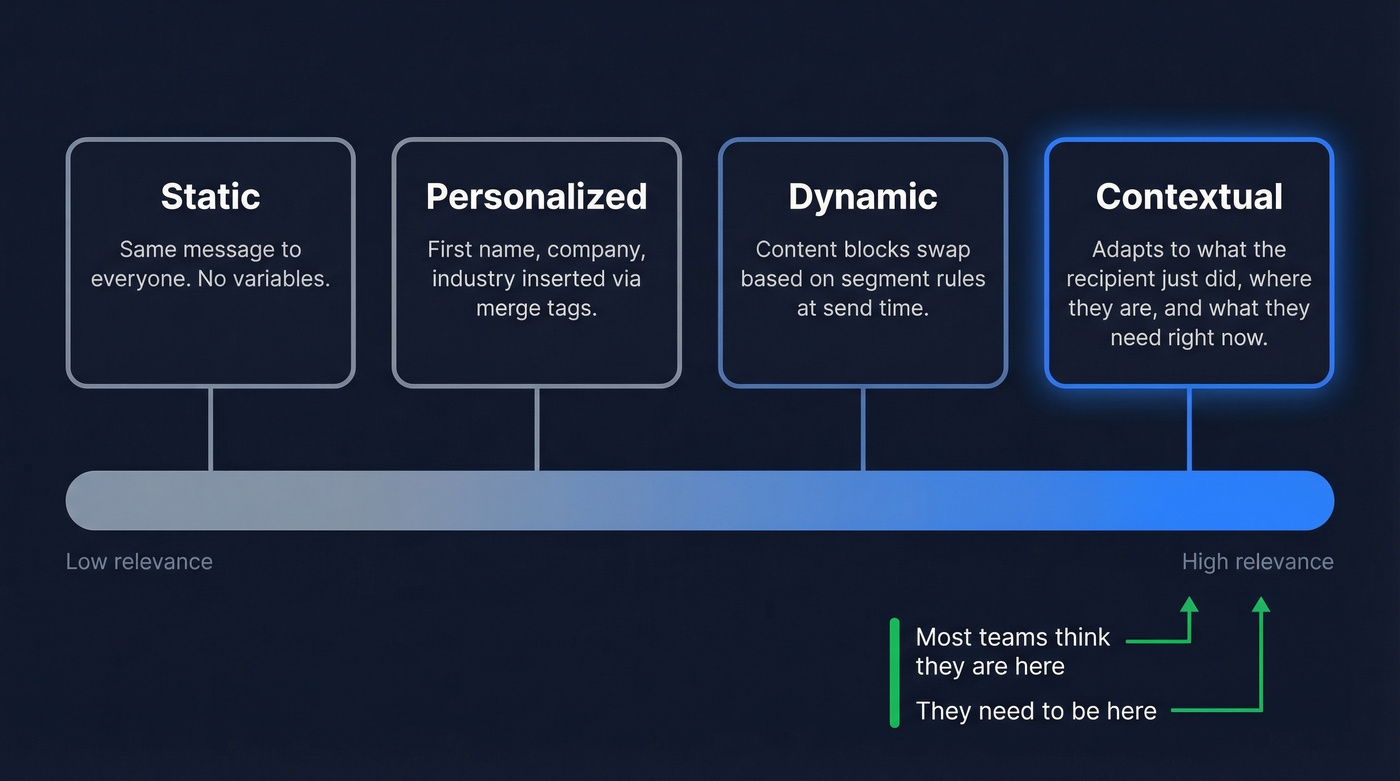
Picture a spectrum. On the left: static emails, same message to everyone. Move right to personalized (name, company, industry). Further right: dynamic, where content blocks swap by segment. At the far end sits contextual - content that adapts to the recipient's current situation: what they just did in your product, where they are geographically, what time they opened, where they sit in their buying journey. Every element serves the reader's needs, not the sender's template.
The Userpilot framework breaks this into four implementation layers: Events (in-app triggers), Tags (segment attributes), Scores (engagement scoring), and JTBD (jobs-to-be-done data). You don't need all four. But you need at least one real context signal beyond static CRM fields.
The Five Context Signals
Behavioral. Pages visited, features activated, items abandoned, support tickets filed. This is the highest-signal data because it reflects intent, not demographics. If you're picking one signal to start with, pick this one.
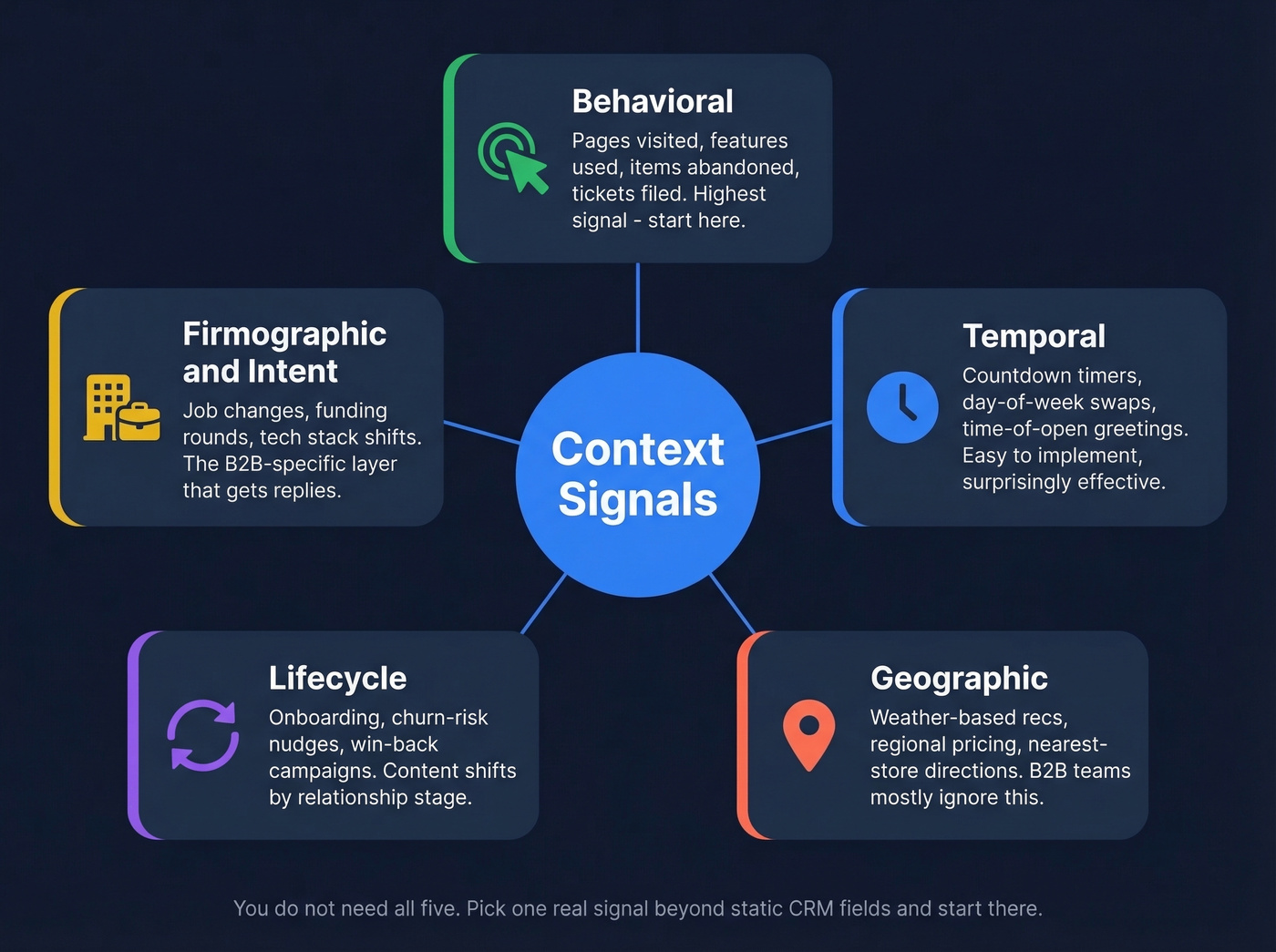
Temporal. Countdown timers for expiring offers, day-of-week content swaps, time-of-open greetings. Simple to implement, surprisingly effective at creating urgency - and you don't need an engineering team to pull it off.
Geographic. Weather-based recommendations, nearest-store directions, region-specific pricing. Retail brands have used this for years; B2B teams mostly ignore it, which is a missed opportunity for anyone selling into multiple markets.
Lifecycle. Onboarding sequences, churn-risk nudges, win-back campaigns. The content shifts based on where someone sits in their relationship with you. (If you're building lifecycle triggers, a simple churn analysis model can help you decide what to send and when.)
Firmographic and Intent. The B2B-specific layer - job changes, funding rounds, technographic shifts, category-level research signals. An SDR referencing a prospect's recent Series B in an outbound email? That's context-driven outreach at its best, and it's the kind of thing that actually gets replies. (For a practical way to operationalize this, see how to track sales triggers.)
How It Works Technically
Three mechanisms power most contextual email campaigns.
Conditional content blocks are the workhorse. Your ESP evaluates rules when the email is generated - if the contact is in segment X, show block A; otherwise, show block B. Every major platform supports this, and trigger-based sends form the operational layer underneath. Nothing exotic here.
Open-time image rendering is where things get interesting. A server generates or selects an image the moment the recipient opens, pulling live inventory counts, countdown timers, or weather data. Movable Ink built its business around this, and Zembula uses dynamic banner modules to personalize emails at the moment of open rather than the moment of send.
AMP for Email allows truly interactive content inside the inbox. The catch: client support is still spotty. For most teams, image and URL-based open-time rendering remains the practical "real-time" approach.
Here's the complexity that trips people up: an email can render in more than 300,000 different ways depending on client, device, and environment. Every dynamic element multiplies the QA surface area exponentially.
Why Most Implementations Fail
A Reddit builder who shipped contextual merge tags for outbound nailed the core problem: the hardest decision wasn't technical - it was UX. How do you surface edge cases and error states without breaking the email?
That 96% content-issue rate from Litmus? That's before you layer in dynamic content pulling from live data sources.

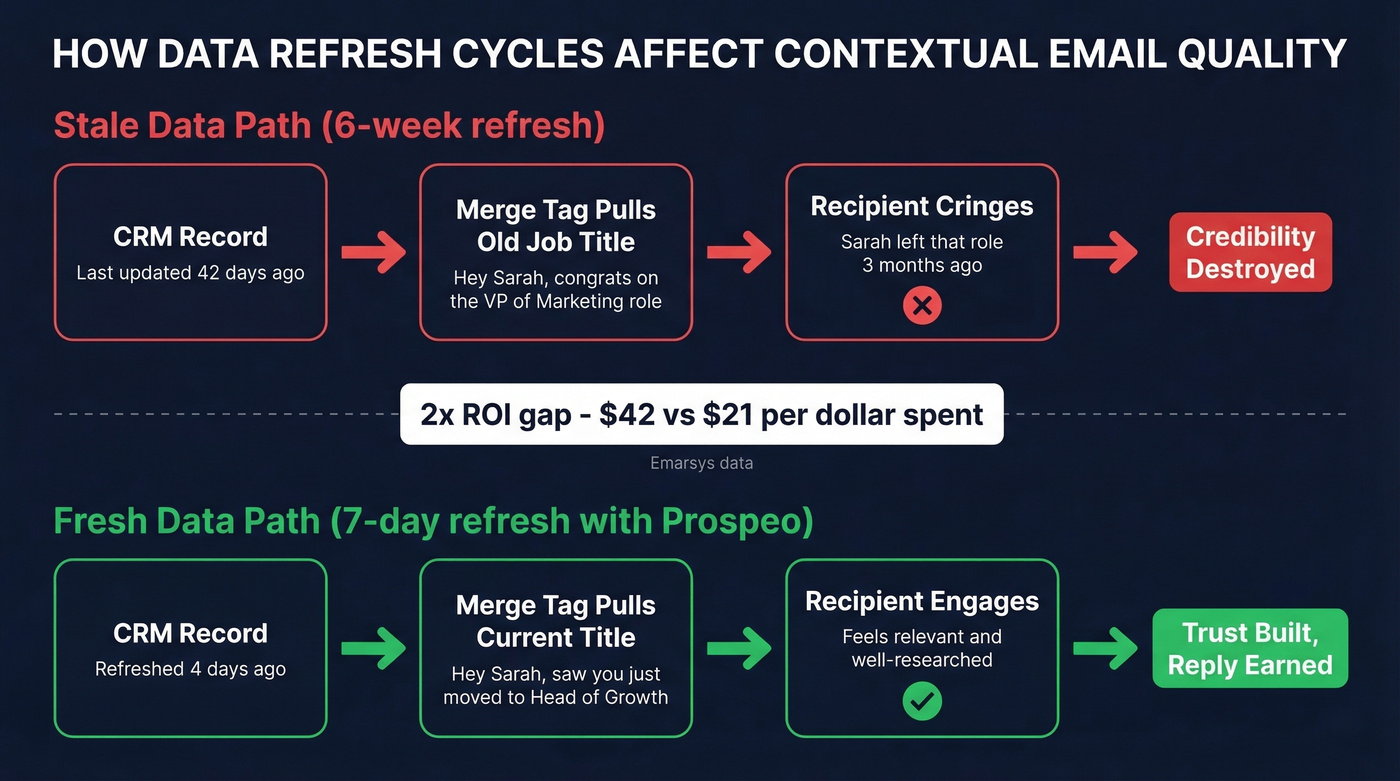
Now picture the SDR scenario. You're sending 200 outbound emails a day with contextual merge tags referencing job title, funding stage, and tech stack. If a meaningful percentage of your contacts have stale job titles - and many providers only refresh around every six weeks - those emails don't just miss the mark. They actively damage credibility. "Hey Sarah, congrats on the VP of Marketing role" hits different when Sarah left that role three months ago.
The fix is upstream: your data provider's refresh cycle. Prospeo refreshes all records on a 7-day cycle, so merge tags pull from current records rather than last quarter's snapshot. That difference between weekly and six-week refreshes is the difference between contextual emails that build trust and ones that erode it. (If you're evaluating vendors, start with a shortlist of data enrichment services.)
In our experience, the teams that struggle most aren't lacking tools - they're working with stale data. Brands using dynamic content see $42 return for every dollar spent on email, compared to $21 for those that never use it. That 2x ROI gap only materializes if the data feeding your dynamic blocks is accurate. (This is also why data-driven selling tends to outperform "best practices" alone.)

Your contextual emails are only as good as the data behind them. Stale job titles, outdated funding info, and wrong tech stacks turn personalized outreach into credibility killers. Prospeo's 7-day refresh cycle and 98% email accuracy mean every merge tag pulls from current reality - not last quarter's snapshot.
Stop sending contextual emails built on stale data.
Results That Actually Happened
Forever 21 partnered with Zembula to deploy personalized "Smart Banners" - abandoned cart reminders combined with low-stock urgency alerts, personalized with the shopper's name, product image, and inventory count. The result: 11x ROAS. The key wasn't the technology. It was stacking two context signals - behavior and scarcity - into a single element.
Back-in-stock alerts, price-drop notifications, and post-purchase follow-ups are contextual by design. They're triggered by inventory or pricing changes, sent only to people who've expressed interest. They consistently outperform batch campaigns because the relevance is baked into the trigger itself.
On the B2B side, we've seen outbound teams lift reply rates 20-40% by weaving company context into templates - referencing a prospect's recent funding round or a technology adoption that creates a use case. One context signal, done well, beats five generic value props every time. (If you want plug-and-play messaging, keep sales follow-up templates handy.)
Building a Conversational Strategy Around Context
Here's the thing: contextual signals are only half the equation. The other half is tone.
A conversational email strategy treats every send as a dialogue rather than a broadcast - asking questions, referencing previous interactions, writing the way a helpful colleague would talk over coffee rather than the way a marketing department writes a press release. When you pair that conversational tone with real-time context signals, reply rates climb because the message feels like it was written for one person. Not blasted to a list of 10,000. (For more on structure and phrasing, see our guide to emails that get responses.)
Skip this approach if your list is under 500 contacts and you can genuinely write each email by hand. At that scale, a good writer beats any automation. But the moment you cross into thousands of sends, you need systems that scale relevance without sacrificing that human feel.
Benchmarks to Beat
| Metric | Latest Average | Contextual Target |
|---|---|---|
| Open rate | 42.35% | Ignore (MPP-inflated) |
| CTR | 2.3% | 3-5%+ |
| CTOR | 5.3% | 7-10%+ |
| Bounce rate | 2.48% | Under 2% |
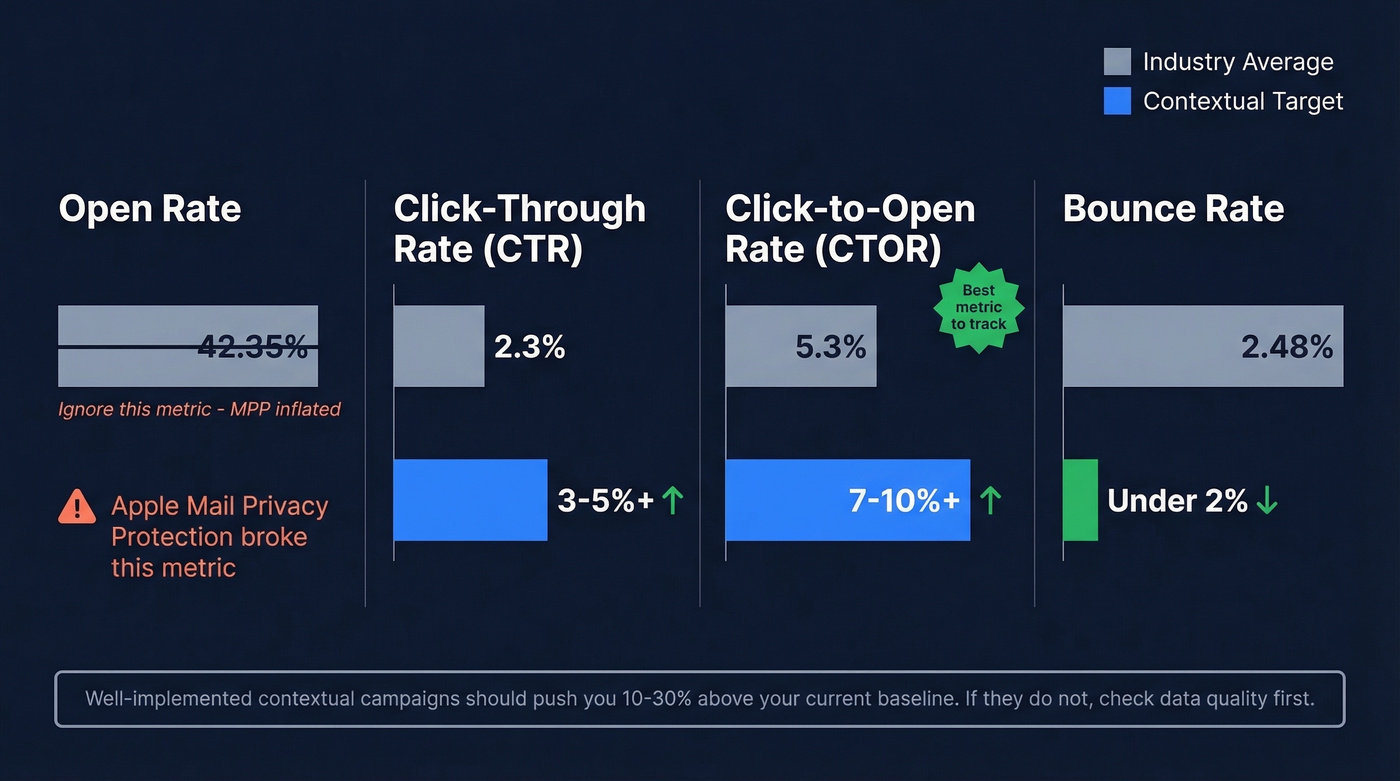
Open rates are broken as a metric. Apple Mail Privacy Protection inflated them by 18 points across 80,000+ accounts studied, and Apple Mail accounts for 46% of email clients. Measure CTOR instead - it captures clicks among actual openers, giving you a cleaner read on content relevance. (If you're tracking performance, use a consistent click rate formula in email marketing.)
Salesforce benchmarks put promotional email CTR at 1-3% and transactional at 5%+. Well-implemented contextual campaigns should push you 10-30% above your current baseline. If they don't, the problem is data quality or fallback coverage, not the concept itself.
Let's be honest: if your deal sizes sit below five figures, you probably don't need open-time rendering platforms. Conditional content blocks in a $20/mo ESP will get you most of the way there. Save the Movable Ink budget for when you've actually maxed out segment-time personalization. (If you're scaling outbound, watch your email velocity so deliverability doesn't become the bottleneck.)
Privacy and Compliance
Contextual email uses more personal data, so compliance is structural, not optional.
GDPR carries fines up to EUR20M or 4% of global revenue and requires clear, affirmative consent - Meta's EUR1.2B penalty proves enforcement is real. CCPA applies if you hit $25M revenue, handle 100K+ consumers' data, or derive 50%+ of revenue from selling personal data. It doesn't require opt-in like GDPR, but mandates notice at collection and transparent privacy policies.
If you're selling into the EU, you need explicit opt-in. US-only? You still need clear unsubscribe paths and data handling transparency. The consensus on r/sales is that compliance isn't just legal protection - it's deliverability protection, because spam complaints from poorly consented lists will tank your sender reputation faster than any technical issue. (If you're seeing inboxing issues, start with an email deliverability guide.)
Tools Worth Knowing
Marketing automation handles segment-based dynamic content out of the box. HubSpot starts at $20/mo, ActiveCampaign at $15/mo, Brevo at roughly $8/mo. Start here before buying enterprise layers.
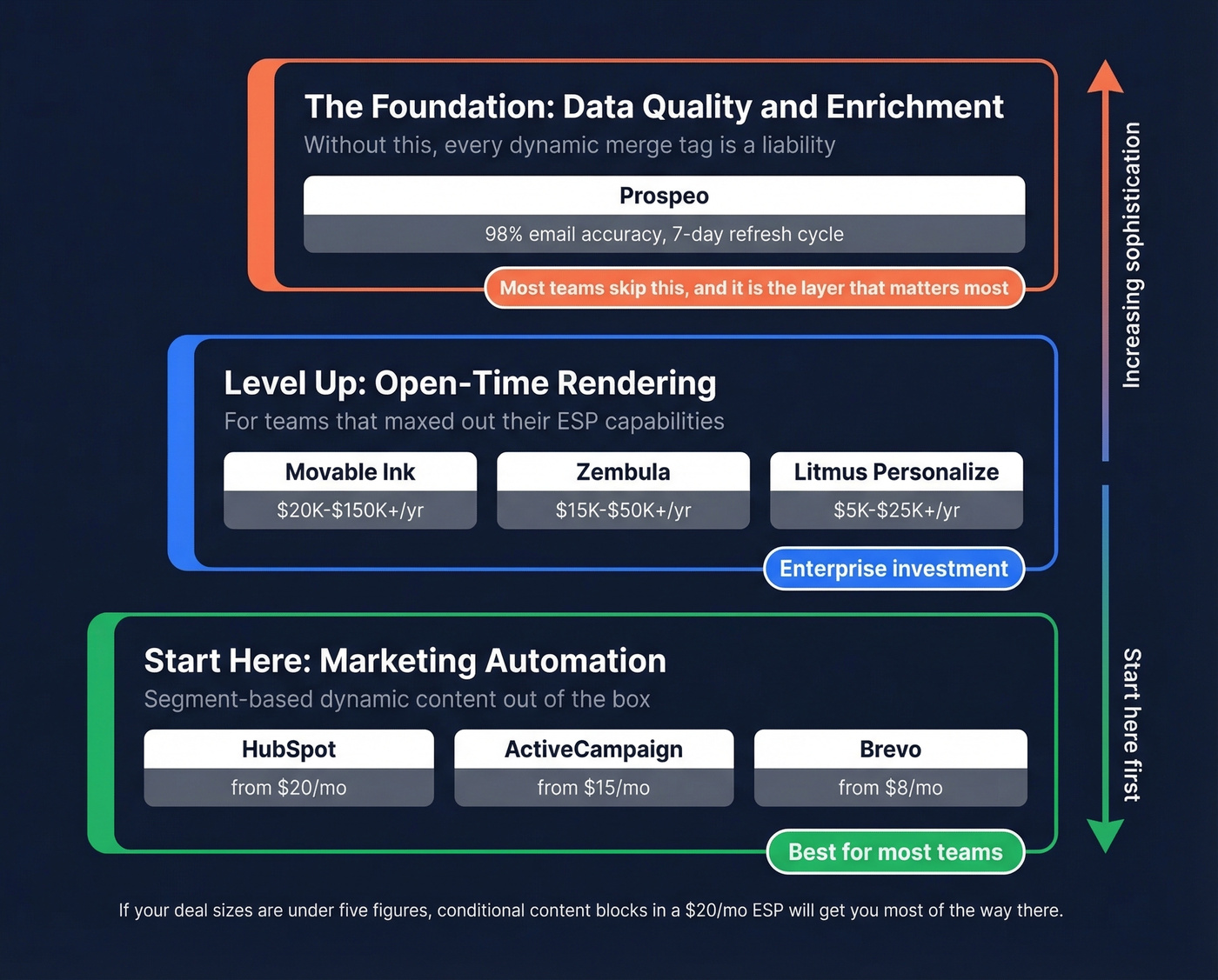
Open-time rendering is for teams that've maxed out what their ESP can do. Movable Ink typically runs $20K-$150K+/yr depending on volume. Zembula sits around $15K-$50K+/yr, and Litmus Personalize falls in the $5K-$25K+/yr range. These are serious investments - make sure you've exhausted the basics first.
Data quality and enrichment is the layer most teams skip - and the one that determines whether contextual campaigns actually work. Without verified contact data, every dynamic merge tag is a liability. Prospeo delivers 98% email accuracy with a 7-day refresh cycle across 143M+ verified emails, which means your contextual elements pull from data that's actually current. (If you're comparing sources, use this overview of B2B company data providers.)
Don't forget the glue: Zapier, Make, and Clay connect your data sources to your ESP so context signals flow automatically. All offer free tiers, with paid plans from roughly $20-$50/mo. Manual data syncs are where contextual campaigns quietly rot.
The teams seeing 20-40% reply rate lifts from contextual outbound aren't using better templates - they're using better data. Prospeo gives you 30+ filters including funding rounds, technographics, and job changes so every context signal in your email is verified and current. At $0.01 per email, accurate context costs less than a single bounced send.
Real context starts with real data - refreshed weekly, verified at 98%.
FAQ
What's the difference between contextual and personalized email?
Personalized email uses static data like name and company. Contextual email adapts to real-time signals - behavior, time of open, location, lifecycle stage. It's dynamic and situational, not just addressed to the right person.
Do I need an enterprise platform to send contextual emails?
No. Conditional content blocks in HubSpot, ActiveCampaign, or Brevo handle most use cases for teams with deal sizes under $15K. Enterprise open-time rendering platforms like Movable Ink make sense only after you've exhausted segment-time personalization.
How do I measure success if open rates aren't reliable?
Use click-to-open rate. Apple MPP inflated open rates by 18 points across 80,000+ accounts. CTOR measures clicks among actual openers - aim for 7-10%+ as your contextual benchmark versus the 5.3% industry average.
What's the biggest mistake teams make?
Launching dynamic content without fallbacks. If contacts have missing first names and you don't build a default greeting, recipients see raw {{first_name}} tokens. Test every edge case - 96% of emails had content issues even before dynamic layers, per Litmus research.
How do I keep contact data fresh enough for contextual outbound?
Use a data provider with weekly refresh cycles. The industry average is six weeks, which means merge tags often pull outdated records. A 7-day refresh cycle keeps contextual elements accurate so your emails reference what's actually true about a prospect today, not what was true two months ago.