

Cross-Selling Techniques: The Playbook for the 10% That Succeed
74% of companies have tried cross-selling. Up to 90% failed. That's not a rounding error - it's a systemic problem, and most advice about cross-selling techniques skips right past it to hand you a list of tactics. Tactics don't matter if the foundation is broken.
The failure rate persists because teams keep optimizing the pitch while ignoring the plumbing: bad data, wrong customers, no ownership. Acquiring a new customer costs 5-25x more than retaining one, which makes cross-selling the highest-leverage growth motion you have - if you stop treating it like an afterthought.
Here's the quick version before we dig in:
- Fix your data before you fix your pitch. CRM enrichment is the prerequisite.
- Start with ONE product pair, ONE segment, 30 days. Don't boil the ocean.
- Own the timing. 24-72 hours post-purchase for ecommerce, QBRs for B2B SaaS. Get this wrong and you'll actively damage the relationship.
Cross-Selling vs. Upselling
Cross-selling offers a complementary product alongside what the customer already bought. Upselling moves them to a higher-tier version of the same thing. Both increase revenue per customer, but they work differently and convert at different rates.
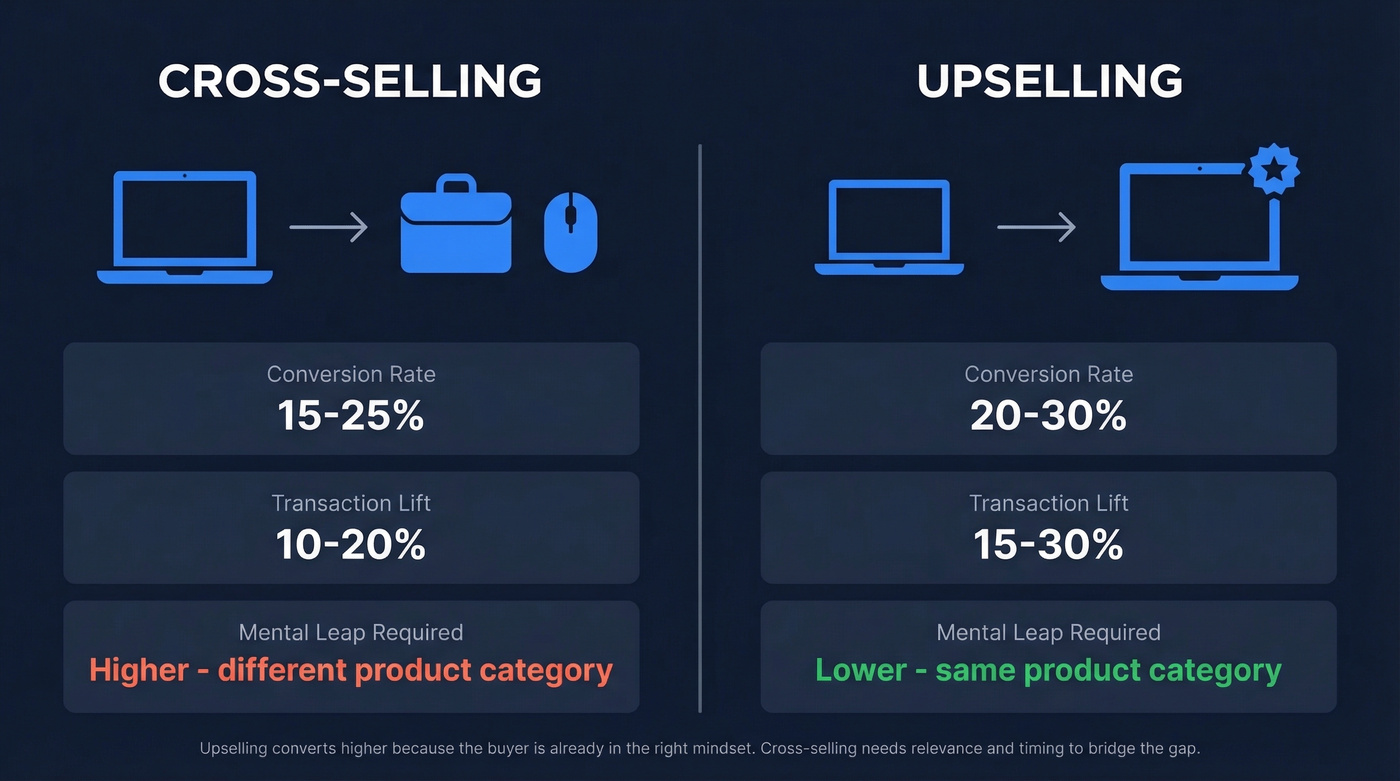
| Cross-Selling | Upselling | |
|---|---|---|
| Definition | Complementary product | Higher-tier version |
| Conversion rate (warm) | 15-25% | 20-30% |
| Transaction lift | 10-20% | 15-30% |
| Example | Laptop → case + mouse | Laptop → Pro model |
Upselling converts slightly higher because the customer's already in the buying mindset for that exact category. Cross-selling requires a mental leap to a different product - which is why relevance and timing matter so much more.
If you want a deeper breakdown, see our Cross-Selling vs. Upselling guide.
Why Most Cross-Sell Programs Fail
Three failure modes kill cross-sell programs before they produce a dollar of incremental revenue.
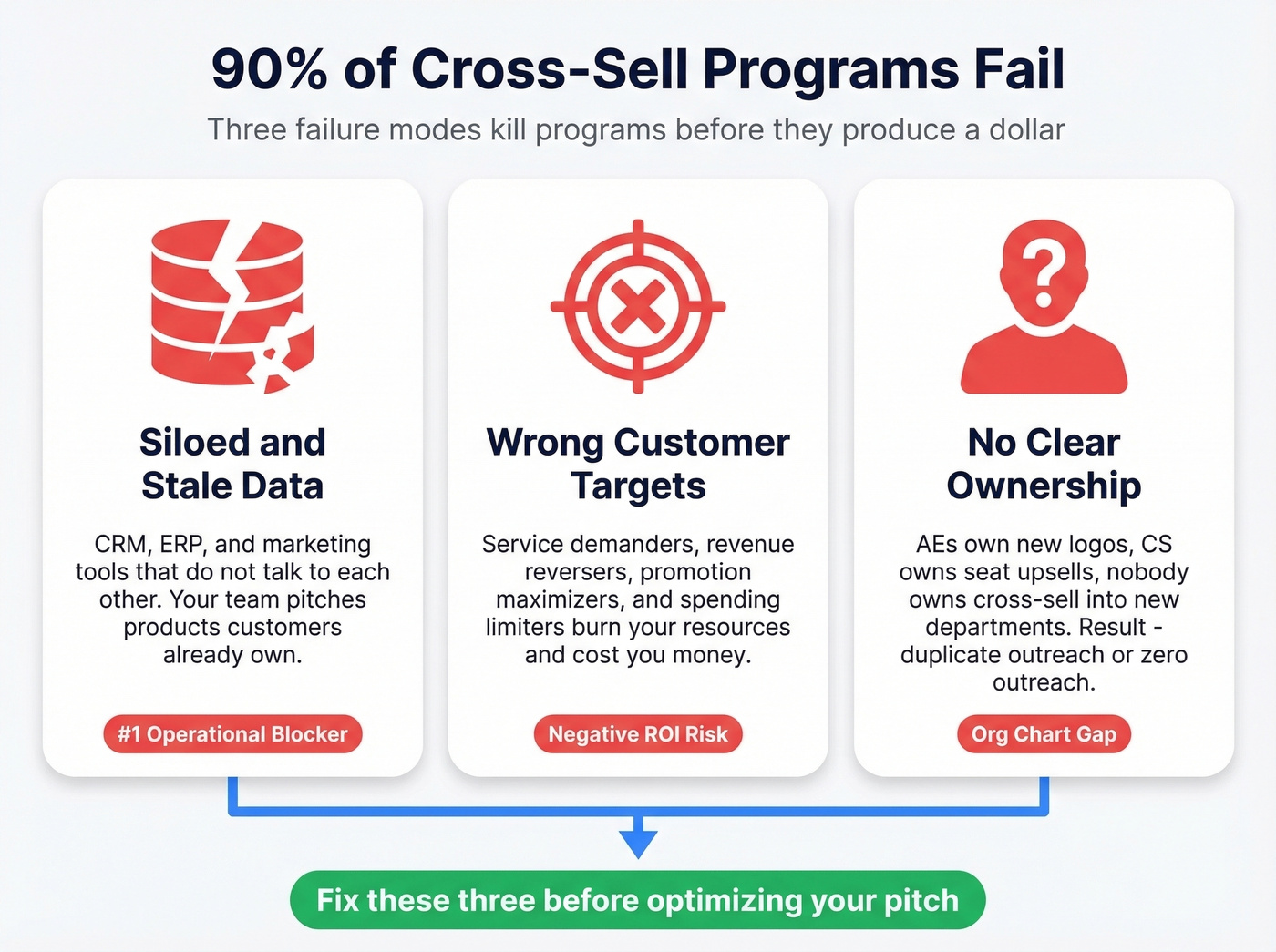
Your data is siloed and stale. Customer information lives across CRM, ERP, marketing automation, and accounting systems that don't talk to each other. The result: your sales team pitches a product the customer already owns, or emails someone who left the company eight months ago. Data silos are the #1 operational blocker for B2B cross-sell motions, and they're dramatically worse post-M&A when parent-child entity relationships get scrambled.
You're targeting unprofitable customers. Not every customer deserves a cross-sell offer. Four archetypes will burn your resources: service demanders who consume disproportionate support, revenue reversers who return everything, promotion maximizers who only buy at a discount, and spending limiters who'll never expand. Cross-selling these segments doesn't just fail - it actively costs you money.
Nobody owns the motion. We see this constantly on r/sales: an enterprise AE transitions from new logos to expansion, CS owns seat-based upsells, and nobody owns the cross-sell into net-new departments. The result is either duplicate outreach or zero outreach. One thread captured it perfectly - an AE who'd been "checking in" with champions for months suddenly needed a repeatable expansion playbook and had nothing. That scenario plays out in every B2B org with more than 20 reps.
There's also a fourth failure mode that doesn't get enough attention: support teams sitting on cross-sell signals and doing nothing with them. Your support reps hear customers describe adjacent problems every day. Without a structured handoff from CX to Sales, those signals evaporate. The best cross-sell programs treat support tickets as intent data, not just cost centers.
And then there's timing. Cross-selling during a support crisis, immediately after a price increase, or before onboarding is complete doesn't just fail - it erodes trust. The customer hears "buy more" when they're thinking "fix what I already have."
10 Proven Techniques With Real Numbers
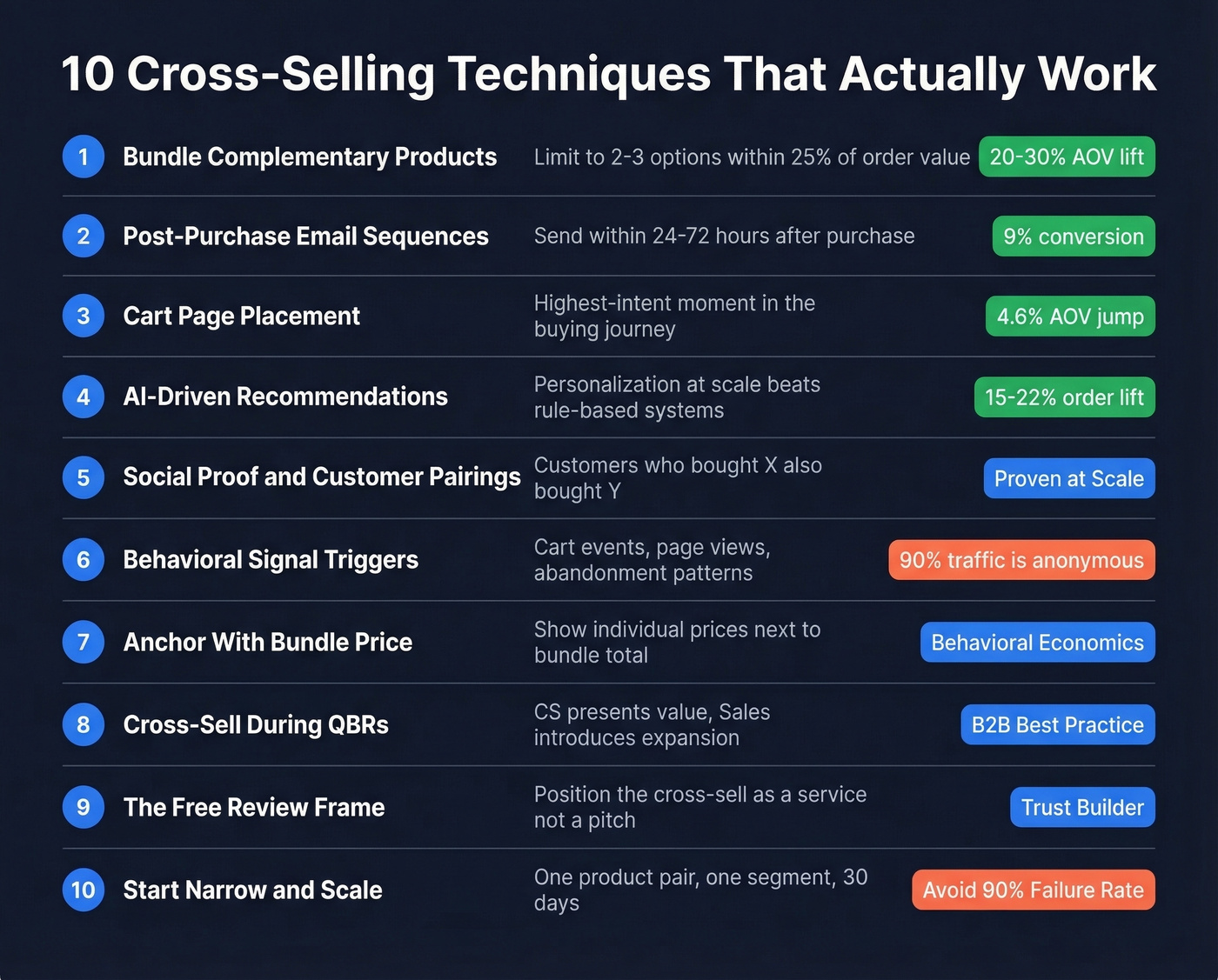
1. Bundle Complementary Products
Bundles lift average order value 20-30% when done right. Limit to 2-3 options and keep suggestions within 25% of the original order value - go beyond that and you trigger choice overload, which actually reduces conversions. Show individual prices next to the bundle total. The anchoring effect does the selling for you.
2. Use Post-Purchase Email Sequences
The window is 24-72 hours after purchase. That's when engagement peaks and the buying mindset hasn't fully faded. Email cross-sell campaigns convert at roughly 9%, which sounds modest until you realize it's pure incremental revenue from customers who already trust you. Triggered emails based on actual purchase behavior outperform generic promotional blasts every time.
If you're building sequences from scratch, use these sales follow-up templates to speed up testing.
3. Place Offers at the Cart Page
A furniture retailer moved a complementary conditioning kit offer to the cart page and saw AOV jump 4.6% ($55) in 41 days - adding $180,000 in monthly revenue. The cart page is the highest-intent moment in the buying journey. If you're only cross-selling on product pages or in post-purchase emails, you're leaving money on the table.
4. Use AI-Driven Recommendations
AI-driven product recommendations raise order value 15-22%, and product recs drive up to 35% of ecommerce sales. This isn't experimental anymore - it's standard practice for any ecommerce operation doing meaningful volume. The lift comes from personalization at scale, something rule-based systems can't match once your catalog exceeds a few hundred SKUs.
5. Use Social Proof and Customer Pairings
"Customers who bought X also bought Y" works because it removes the burden of choice from the buyer. Amazon built a significant chunk of its revenue on this single mechanic. Pair social proof with actual purchase data, not editorial picks - the difference in conversion is measurable and consistent.
6. Trigger on Behavioral Signals
Add-to-cart events, product page view sequences, checkout abandonment patterns - these are your cross-sell triggers. Roughly 90% of ecommerce traffic is anonymous, which means you need strong first-party data collection (email captures, account creation incentives, progressive profiling) before you can personalize at scale. Without it, you're guessing.
For B2B teams, this is the same muscle as identifying buying signals and operationalizing them.
7. Anchor With the Bundle Price
Show the individual item prices, then show the bundle total. The gap between "what it would cost separately" and "what it costs together" is your selling proposition. Tease what they're missing by not bundling, and the customer's curiosity does half the work. This is basic behavioral economics, but we're still surprised how many teams skip it.
If you want to go deeper on the psychology, see Anchor in Negotiation.
8. Cross-Sell During QBRs (B2B)
Quarterly business reviews are the natural cross-sell moment in B2B SaaS. CS presents the value delivered, Sales introduces the expansion opportunity. Here's the thing most teams miss: cross-selling often requires prospecting additional decision-makers, not just pitching your existing champion. The VP who owns the current product isn't necessarily the buyer for the next one.
If you're formalizing the meeting, start with these QBR questions to ask.
9. Use the "Free Review" Frame
Position the cross-sell as a service, not a pitch. "I realized we didn't cover [product] during our last conversation - I'd love to offer a free review to make sure you're not leaving value on the table." This reframes the seller as helpful rather than pushy. It works because it's genuinely true - you probably did miss something, and the customer knows it.
10. Start Narrow and Scale
One product pair. One customer segment. Thirty days. That's your pilot.
The GTM Club's cross-sell playbook puts it bluntly: don't try to win all battles simultaneously. Validate the motion with a controlled test, measure attach rate and customer satisfaction, then expand. Teams that launch broad programs across all segments on day one are the ones contributing to that 90% failure rate.

Stale CRM data is the #1 cross-sell killer. Prospeo enriches your customer records with 50+ data points on a 7-day refresh cycle - so you never pitch a product someone already owns or email a contact who left months ago. 92% match rate, 98% email accuracy.
Fix your cross-sell data before you fix your cross-sell pitch.
Cross-Sell Benchmarks
Pin this somewhere your team can see it.
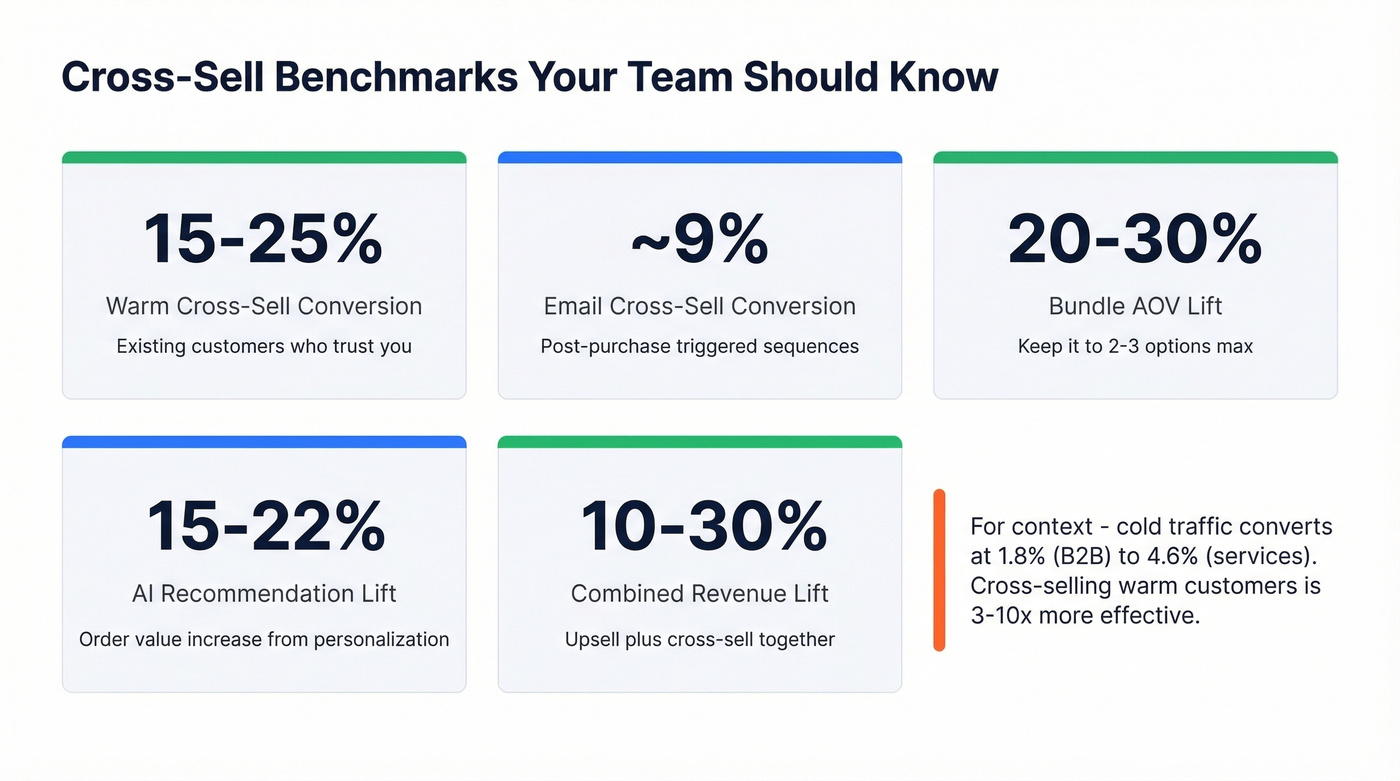
| Metric | Range | Context |
|---|---|---|
| Cross-sell conversion (warm) | 15-25% | Existing customers |
| Email cross-sell conversion | ~9% | Post-purchase triggered |
| Bundle AOV lift | 20-30% | 2-3 options max |
| AI recommendation lift | 15-22% | Order value increase |
| Revenue lift (upsell + cross-sell) | 10-30% | Combined impact |
Baseline conversion rates by industry run 1.8% (B2B ecommerce), 2.1% (B2C), and 4.6% (professional services). Cross-selling to warm customers at 15-25% is dramatically higher than acquiring cold traffic - which is exactly why expansion revenue matters so much. B2B customer acquisition costs run $1,000 to $20,000+. Every cross-sell that lands is a fraction of that cost.
To pressure-test your targets, compare against the average B2B lead conversion rate.
Fix Your Data First
None of the techniques above work if you're pitching the wrong product to someone who left the company. Contact data decays 2-3% per month. A six-month-old CRM is 15-18% wrong. We've seen CRMs where 20%+ of contacts had changed jobs - and the sales team had no idea they were emailing ghosts.
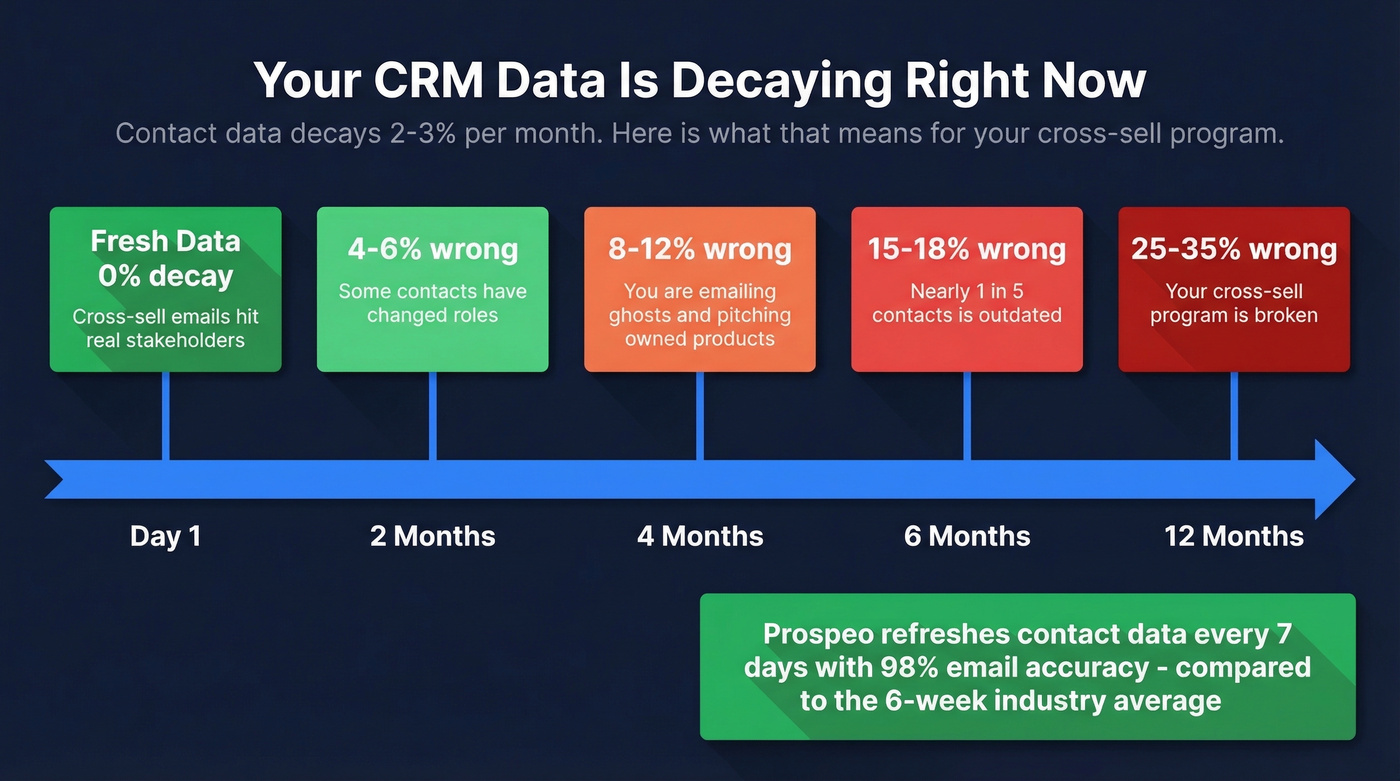
The #1 operational blocker for B2B cross-selling isn't strategy. It's siloed, stale customer data spread across systems that don't sync. You can't cross-sell into a new department if you don't know who runs that department today.
If you're evaluating vendors, start with our roundup of data enrichment services.
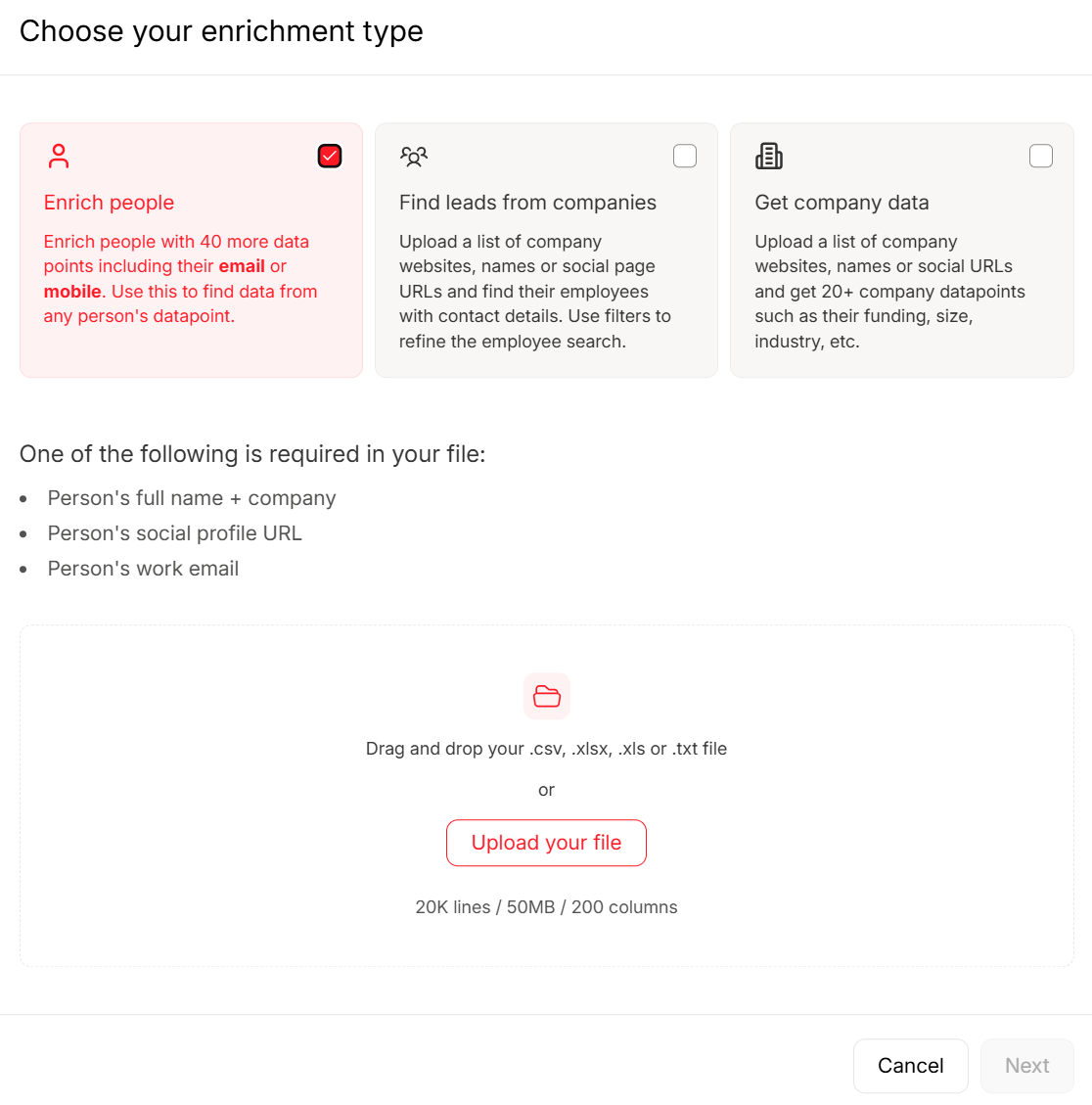
Before you launch a cross-sell campaign, enrich your CRM so you're reaching the right person with the right offer. Prospeo refreshes contact data every 7 days - compared to the 6-week industry average - and returns 50+ data points per contact at 98% email accuracy. When your cross-sell email sequence hits an inbox that belongs to a real, current stakeholder, conversion rates look a lot more like those 15-25% benchmarks.
If you're building the workflow end-to-end, this lead enrichment guide will help.
Let's be honest: most teams don't have a cross-selling problem. They have a data quality problem wearing a cross-selling costume. Fix the data and the techniques become almost obvious.
B2B Cross-Sell Playbook: 6 Steps
Don't skip any of them.
1. Define objectives. Cross-sell revenue, win rates, product penetration rate - pick your KPIs before you pick your tactics. "Increase cross-sell revenue" isn't specific enough. "Attach Product B to 20% of Product A accounts within Q3" is.
2. Segment ruthlessly. Start with one product pair and one customer segment. Later-stage SaaS companies ($25-75M revenue) with the lowest churn cross-sold to roughly one-third of their customers. They didn't get there by targeting everyone on day one. A recent r/SaaS thread asked for real-world bundling techniques and single-vendor positioning strategies - the consensus was unanimous: start narrow, prove the motion, then expand.
If you need a framework for picking the segment, use an Ideal Customer Profile scoring rubric.
3. Build enablement. Value prop messaging, competitive intel, objection handling, role-play. Your reps need to articulate why the second product matters to this specific buyer, not just that it exists.
To systematize this, build Sales Battle Cards for each product pair.
4. Prospect new stakeholders. Cross-selling often means selling to a different buyer within the same account. Use a data enrichment tool to map current stakeholders and track job changes before launching an expansion motion - you need to know who's in the seat today, not who was there when the original deal closed.
5. Test small. Run the pilot for 30 days. Measure attach rate, deal cycle, and customer satisfaction. If satisfaction drops, stop. A cross-sell that damages retention is a net negative - you'll lose more in churn than you gain in expansion revenue.
If you're tracking expansion impact, pair this with a simple churn analysis view.
6. Scale what works. Expand to adjacent segments and product pairs only after the pilot validates. Document what worked, what didn't, and what the reps actually said on calls. In our experience, the teams that skip documentation are the same ones reporting cross-sell failure six months later. Every time.
Cross-selling into new departments means prospecting new buyers - not just pitching your champion. Prospeo's 300M+ profiles and 30+ filters let you find every decision-maker inside accounts you already own, with verified emails and direct dials.
Stop leaving expansion revenue on the table because you can't reach the right stakeholder.
FAQ
What's the difference between cross-selling and upselling?
Cross-selling offers a complementary product alongside the original purchase; upselling moves the customer to a higher-tier version of what they already chose. Cross-sell converts at 15-25% for warm audiences, while upsell runs slightly higher at 20-30%. Both increase revenue per customer through different mechanisms.
When's the best time to cross-sell?
For ecommerce, the optimal window is at the cart page or 24-72 hours post-purchase when buying intent is still high. For B2B SaaS, QBRs and post-onboarding milestones are the natural moments. Never cross-sell during a support crisis or immediately after a price increase.
How many options should I offer?
Two to three. More causes choice overload, which actually reduces conversions rather than increasing them. Keep suggestions within 25% of the original order value to avoid sticker shock and cart abandonment.
Why do most cross-sell campaigns fail?
Stale CRM data, wrong customer targeting, no defined ownership between Sales and CS, and irrelevant product pairing. 74% of companies tried cross-selling and up to 90% failed - mostly because they launched tactics without fixing the operational foundation first.
What tools help keep CRM data clean for cross-selling?
Any enrichment platform that refreshes data frequently and verifies emails before delivery. The key criteria are refresh cycle (weekly beats monthly), match rate, and accuracy. Pair your enrichment tool with your CRM so records stay current automatically - you shouldn't need manual cleanup before every campaign.