

Data-Driven Marketing Strategy: Why Most Fail (and the Framework That Works)
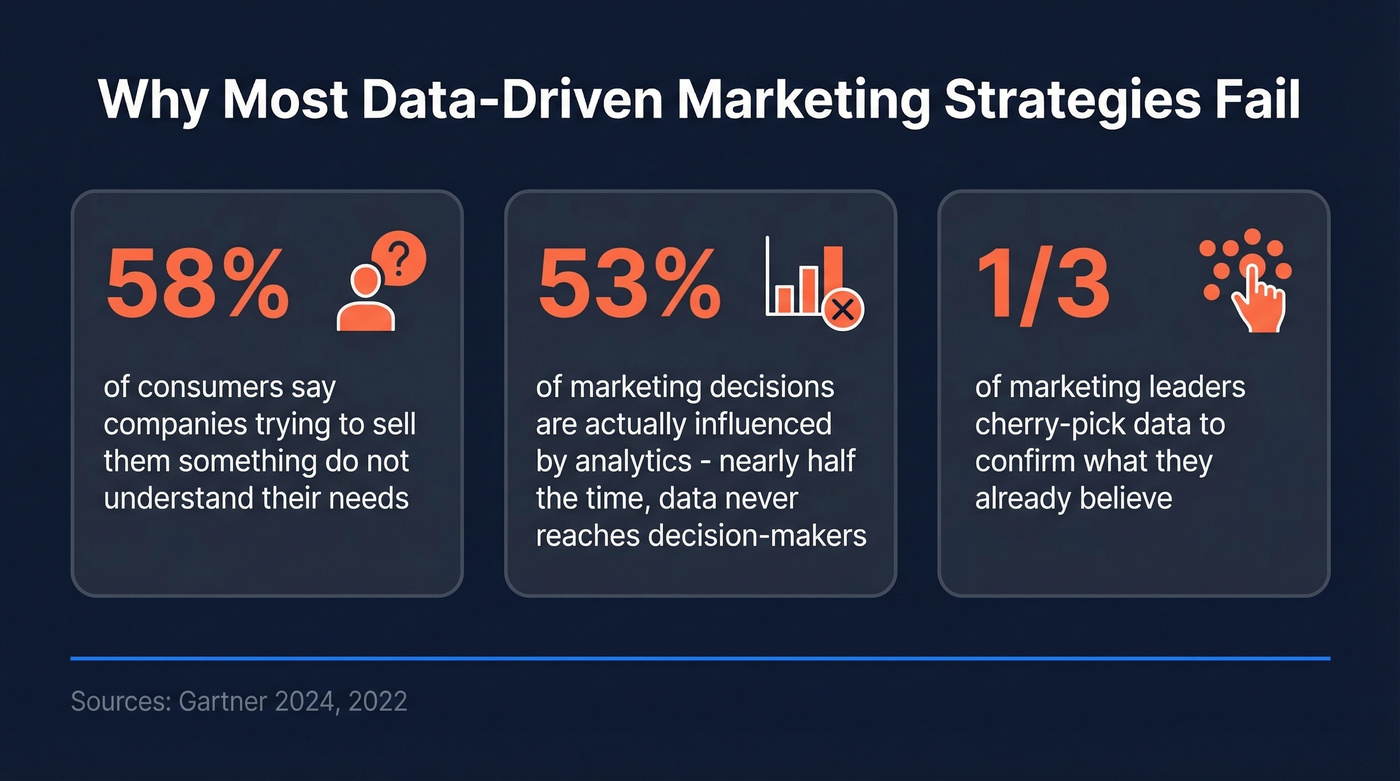
58% of consumers say companies trying to sell them something don't understand their needs. That's after a decade of martech investment, CDP implementations, and "data-driven transformation" initiatives. More data hasn't produced more understanding - it's produced more dashboards nobody opens.
Here's the paradox. Marketing analytics influences only 53% of marketing decisions, per a Gartner survey of analytics practitioners. Nearly half the time, the data you're collecting doesn't even make it into the room where decisions happen. The barriers? Inconsistent data across sources, data that's difficult to access, and - most damning - decision-makers who cherry-pick numbers to confirm what they already believe.
Meanwhile, CMOs are pouring almost 40% of their budgets into transformation activities, and 95% say GenAI investments are a priority. The money is flowing. The understanding isn't. That gap between data investment and actual customer insight is where most strategies go to die.
This isn't another "collect data, analyze it, act on it" article. You've read that one. What follows is the exact framework, benchmarks, and tool recommendations we've used and seen work to make a data driven marketing strategy actually produce revenue in 2026.
What Data-Driven Marketing Actually Means
Data-driven marketing uses customer, behavioral, and market data to guide decisions about targeting, messaging, channel allocation, and spend. That's the textbook definition. The useful one is shorter: making marketing decisions based on evidence instead of assumptions.
But there's a critical distinction most teams miss. Data-driven and data-informed aren't the same thing. Data-driven, taken literally, means data makes the decision. Data-informed means data shapes the decision while leaving room for experience, creativity, and market intuition. The best marketing teams are data-informed - they use data to validate hypotheses and set guardrails without killing creative risk-taking. The moment your team can't launch a campaign without a dashboard blessing, you've crossed from informed to paralyzed.
Why Most Strategies Fail
The failure modes are predictable. We see the same three patterns over and over.
Cherry-Picking and Confirmation Bias
One-third of marketing decision-makers cherry-pick data to fit preconceived opinions. Another quarter reject analytics recommendations outright or rely on gut instincts instead. Your analytics team can produce perfect insights and still watch leadership ignore them. The problem isn't the data - it's the culture around how data gets used.
The Obvious Insights Trap
There's a great thread on r/BusinessIntelligence where an analyst describes the frustration of producing insights that feel obvious - things like "customer satisfaction depends on product quality." No one needs a dashboard to tell them that. When your analytics output reads like common sense, you're not doing evidence-based marketing. You're doing expensive confirmation of things everyone already knew.
The fix is asking better questions. Instead of "what happened?" ask "what should we change?" Instead of "which channel performed best?" ask "which channel performs best for accounts that close above $50K?" Specificity turns obvious into actionable.
Tool Sprawl Without Integration
The martech landscape topped 15,384 solutions by 2025, and the global martech market is projected to grow from $465B to $1.38T by 2030. Marketing teams dedicate 31.4% of their budgets to technology. That's a staggering amount of spend on tools - and most teams can't connect the data between them.
Most teams perform best with five to seven core tools, not 15. Every additional tool that doesn't integrate cleanly with your core stack creates a data silo. Silos produce inconsistent metrics, which produce arguments in meetings instead of decisions.
Data Quality: The Silent Killer
Underneath all three failure modes sits the same root cause: bad data. Stale contacts, duplicate records, unverified emails, outdated firmographics. If your CRM is full of garbage, every downstream decision - segmentation, personalization, attribution, ROI measurement - is built on a cracked foundation. We've seen teams spend six figures on intent data platforms and then route those signals to contacts who left the company two years ago.
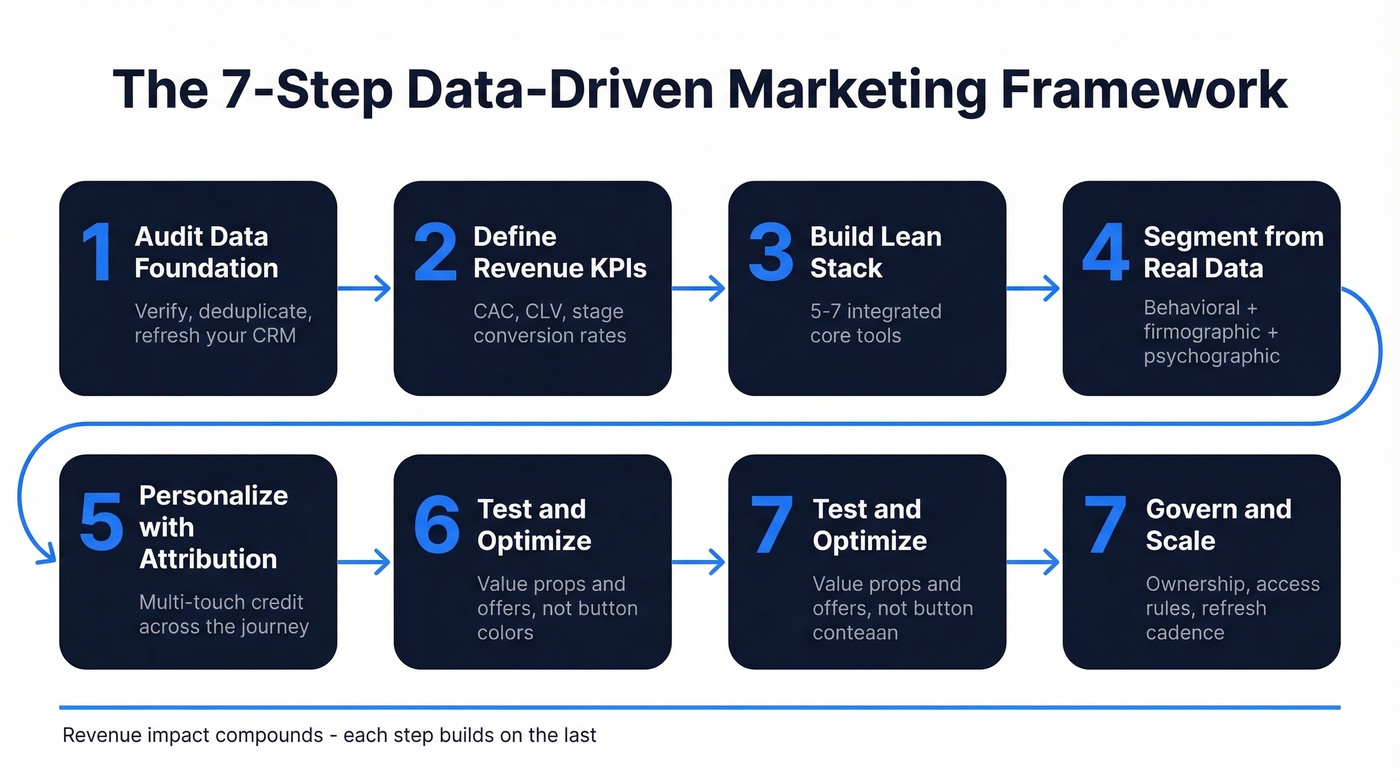
How to Build a Data-Driven Marketing Strategy: 7 Steps
Step 1 - Audit Your Data Foundation
Data quality beats data quantity every time. Before you build dashboards or buy new tools, audit what you already have. Three pillars matter: freshness (how old is the data?), deduplication (how many records are duplicates?), and verification (are these emails and phone numbers actually valid?).
Most teams skip this step because it's unglamorous. That's a mistake. Snyk's sales team was running with a 35-40% email bounce rate before they fixed their data foundation. After switching to Prospeo for verification and enrichment, bounces dropped under 5% and AE-sourced pipeline jumped 180%. That's not a marginal improvement - it's the difference between a pipeline that works and one that wastes rep time. (If you're diagnosing deliverability issues, start with bounce rate benchmarks and root causes.)
Your audit checklist:
- Run your entire contact database through email verification
- Identify and merge duplicate records
- Flag contacts with no activity in 12+ months
- Check firmographic data against current company information
- Establish a refresh cadence (monthly minimum, weekly ideal)
Step 2 - Define Revenue-Tied KPIs
Vanity metrics are the enemy. Impressions, page views, and social followers feel good in reports but don't tell you whether marketing is generating revenue. Tie every KPI to a financial outcome. (If you need a clean definition and calculation, use this CAC guide.)
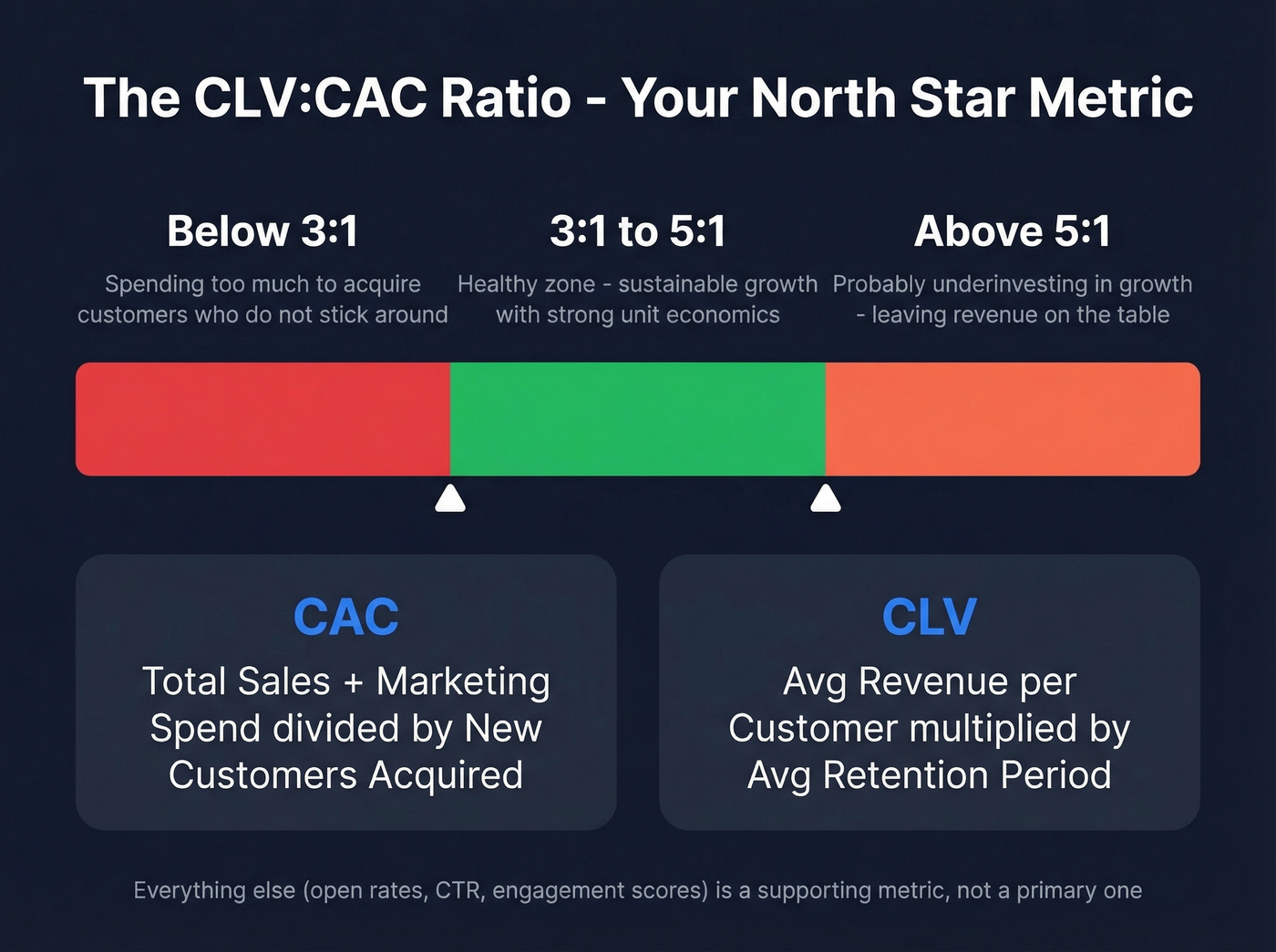
Three metrics matter most. Customer Acquisition Cost (CAC): total sales and marketing spend divided by new customers acquired. Customer Lifetime Value (CLV): average revenue per customer multiplied by average retention period. Conversion rate by stage: what percentage of MQLs become SQLs, and what percentage of SQLs close? (To pressure-test your stage math, compare against funnel metrics benchmarks.)
The ratio between CLV and CAC is your north star. Below 3:1, you're spending too much to acquire customers who don't stick around long enough. Above 5:1, you're probably underinvesting in growth. Everything else - email open rates, click-through rates, engagement scores - is a supporting metric, not a primary one.
Step 3 - Build a Lean Data Stack
You don't need every tool. You need the right five to seven, connected properly. Here's what a practical stack looks like by company stage:
| Category | Startup (Free-~$500/mo) | Mid-Market (~$500-$5K/mo) | Enterprise ($5K+/mo) |
|---|---|---|---|
| Web Analytics | GA4 (free) | GA4 + Mixpanel (~$25+/mo) | GA4 + Amplitude |
| CRM | HubSpot CRM (free) | HubSpot paid (~$20-$800+/mo) | Salesforce (~$25-$300/user/mo) |
| BI / Dashboards | Looker Studio (free) | Looker Studio + Tableau (~$15-$75/user/mo) | Tableau + Power BI ($10+/user/mo) |
| Experimentation | GrowthBook (free tier) | VWO (~$200+/mo) | Optimizely (enterprise pricing) |
| CDP / Pipelines | - | Segment (~$120+/mo) | Segment + Hightouch (~$300+/mo) |
| Automation | Klaviyo (free to 250) | Customer.io (~$100+/mo) | Salesforce Mktg Cloud ($1,250+/mo) |
Most startup stacks can stay under ~$100/month on free tiers. Mid-market stacks commonly land around $1,000-$5,000/month depending on seats and volume. Enterprise stacks run $10,000-$50,000+/month. The point isn't to buy everything - it's to cover each category with one tool that integrates with the others.
Here's the thing: if your average deal size is under $15K, you don't need an enterprise data stack. A free CRM, GA4, Looker Studio, and a solid enrichment tool will outperform a $50K/year martech suite that nobody fully configures. The teams generating the best ROI aren't the ones with the most tools - they're the ones who actually use the tools they have. (If you're evaluating options, start with contact management software and build outward.)
Step 4 - Segment from Real Data
Generic segments produce generic campaigns. Skip this step and your personalization efforts are just expensive guessing.
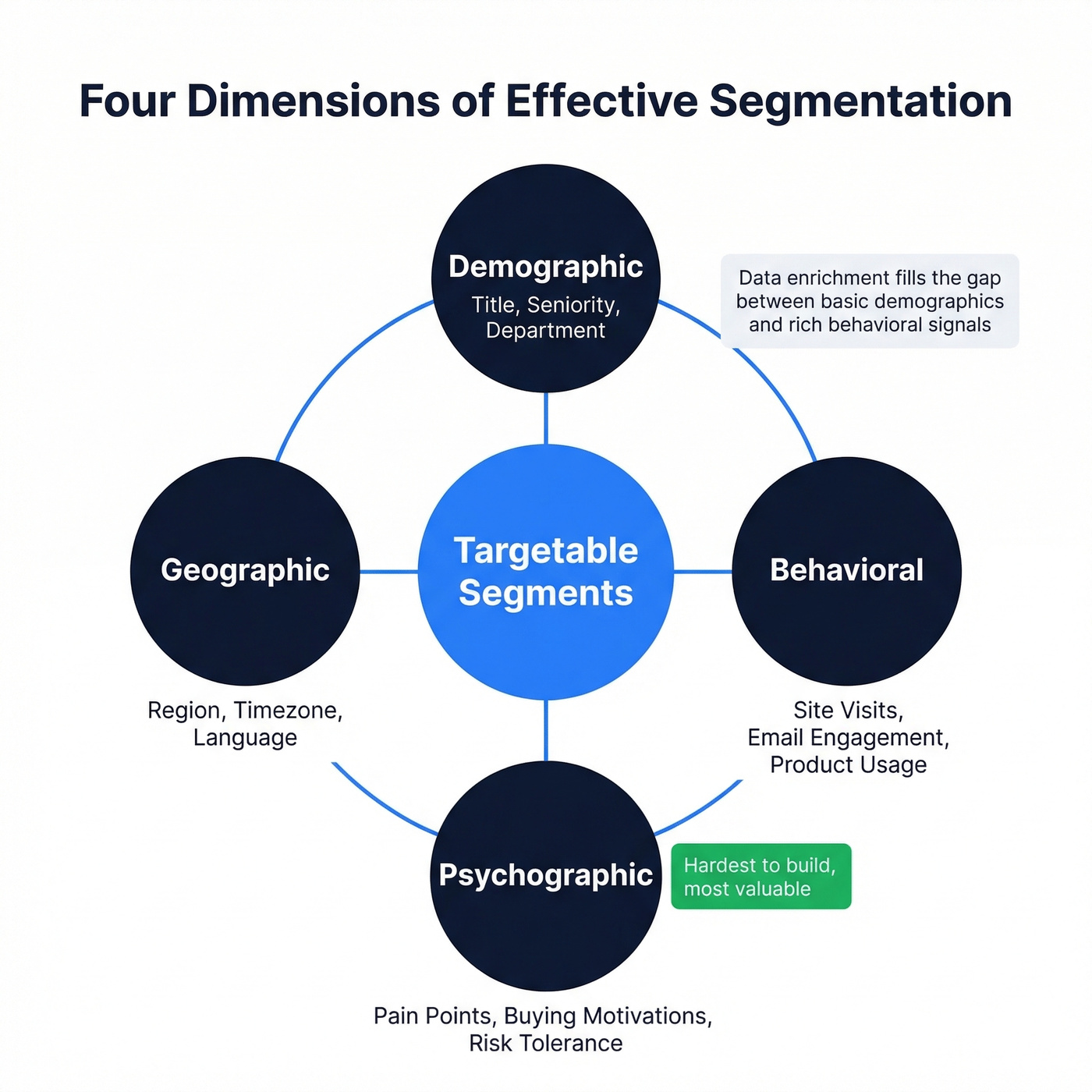
Effective segmentation uses four dimensions working together: demographic (title, seniority, department), behavioral (website visits, email engagement, product usage), geographic (region, timezone, language), and psychographic (pain points, buying motivations, risk tolerance). That last one is the hardest to build but the most valuable.
Most teams have decent demographic data and terrible behavioral data. The gap is usually in the middle - firmographic and technographic attributes that tell you what kind of company someone works at, not just which company. Data enrichment fills these gaps by appending technology stack data, funding stage, headcount growth, and hiring signals to your existing contacts, transforming flat records into targetable segments. (For a deeper breakdown of vendors and use cases, see data enrichment services.) Psychographic signals emerge when you combine technographic data with hiring patterns - a company adopting a competitor's tool while hiring for your product category is telling you something about their pain points without saying a word.
For teams with offline customer data from events, retail, or direct mail, data onboarding bridges the gap between offline interactions and digital targeting. Without it, your richest customer signals stay trapped in spreadsheets. (If you're formalizing this, use an ideal customer profile scoring rubric to keep segments revenue-tied.)
Step 5 - Personalize with Attribution
Personalization without attribution is guessing. You need to know which touchpoints actually influence buying decisions before you can personalize effectively.
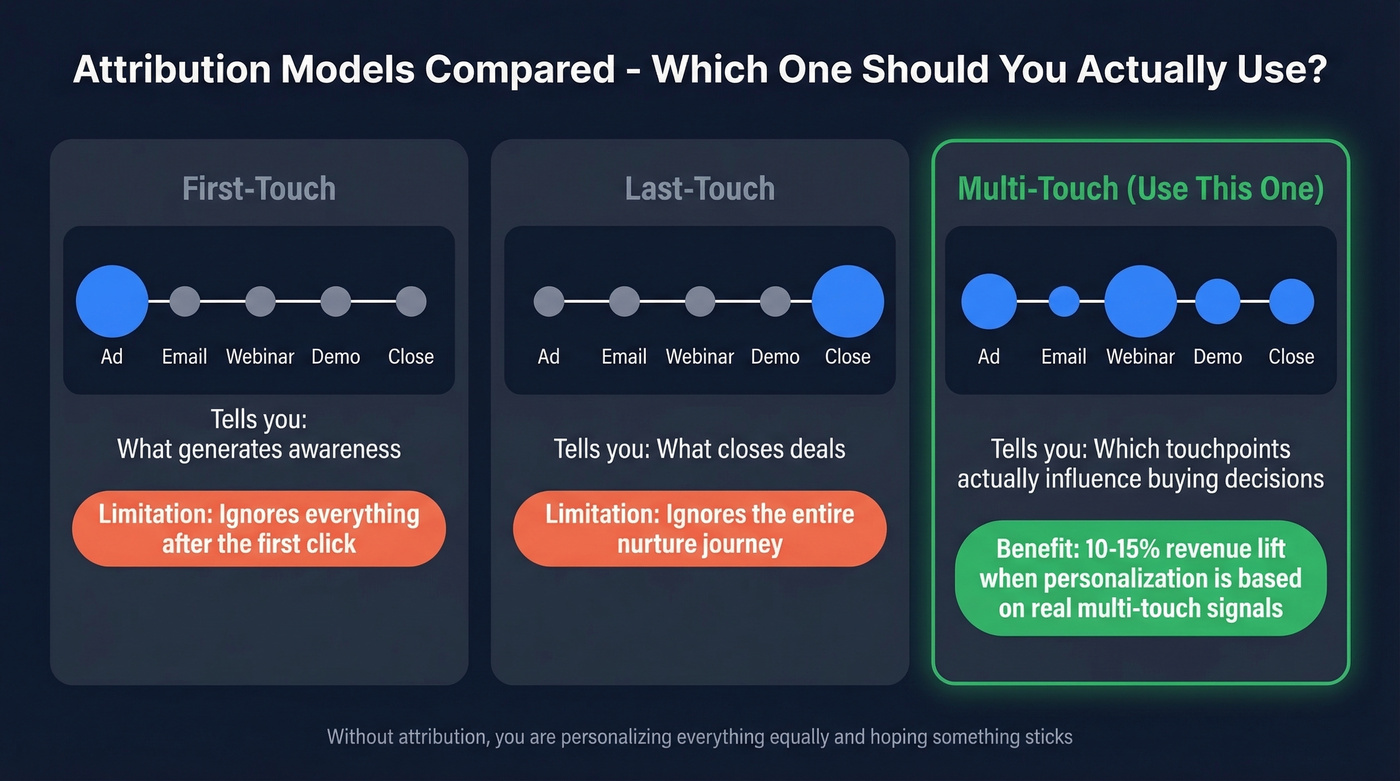
Three attribution models matter. First-touch tells you what generates awareness. Last-touch tells you what closes deals. Multi-touch - the one you should actually use - distributes credit across the entire journey. Companies that personalize based on real behavioral data consistently see 10-15% revenue lifts, but only when the personalization reflects actual buying signals, not just someone's job title. (If you're building scoring rules, start with identifying buying signals.)
The practical application: if multi-touch attribution shows that webinar attendees who also receive a personalized email sequence convert at 3x the rate of cold outbound, you know where to invest. Without attribution, you're just personalizing everything equally and hoping something sticks.
Step 6 - Test, Measure, Optimize
CRO is the second-most-used optimization technique among marketers in 2026, with 50% actively running conversion rate optimization programs. That's encouraging, but most teams test the wrong things.
Don't A/B test button colors. Test value propositions, offer structures, and audience segments. A real example: testing "Start your free trial" against "See pricing for your team size" on a SaaS landing page. The second version will likely convert fewer total clicks but generate higher-quality leads that actually close. That's the kind of test that moves revenue.
Connect your experiments to outcomes by setting up custom events in GA4 that track meaningful actions - demo requests, pricing page visits, feature comparisons - and integrate those events with your CRM. Closed-loop reporting means you can trace a closed deal back to the specific test variant that influenced it.
Step 7 - Close the Loop
This is where most data-driven marketing strategies fall apart. Marketing measures campaigns. Sales measures pipeline. Nobody connects the two. (If you're seeing leakage, map it against a lead generation workflow and fix handoffs first.)
Closed-loop reporting means your sales team knows which campaign generated their last closed deal, and your marketing team knows which leads actually converted to revenue - not just MQLs. Let's be honest: the fact that most organizations still can't answer "which marketing campaign generated the most revenue last quarter" with confidence is genuinely frustrating. It's 2026. The tools exist. The integrations exist. The gap is operational, not technical.
Build a weekly sync where marketing and sales review the same dashboard. Track pipeline sourced by campaign, average deal velocity by lead source, and win rate by channel. When marketing can see that webinar leads close at 2x the rate of paid search leads but take 30% longer, they can adjust both messaging and expectations accordingly. (To keep the conversation grounded, use pipeline health metrics instead of opinions.)
2026 Benchmarks Every Marketer Needs
Numbers without context are useless. Here's where the benchmarks actually stand:
| Metric | Benchmark | Source Year |
|---|---|---|
| B2B top ROI channels | Website/blog/SEO, paid social, social shopping | 2025 |
| B2C top ROI channels | Email, paid social, content marketing | 2025 |
| E-commerce conversion | Under 2% average | 2025 |
| Email conversion (B2C) | 2.8% | 2025 |
| Email conversion (B2B) | 2.4% | 2025 |
| GenAI adoption | 63% of marketers using it | 2025 |
| US paid search spend | $124.59B | 2024 |
| Marketers using zero-party data | Only 16% | 2025 |
The standout number: average e-commerce conversion is still under 2%. That means 98 out of 100 visitors leave without buying. If your strategy isn't focused on understanding why those 98 people bounce, you're optimizing the wrong thing. The biggest ROI gains in 2026 won't come from finding new channels - they'll come from converting more of the traffic you already have.

Snyk cut bounce rates from 35% to under 5% and grew AE-sourced pipeline 180% - by fixing their data foundation first. Prospeo's 7-day refresh cycle and 98% email accuracy ensure every segmentation, personalization, and attribution decision is built on verified contacts, not stale records.
Stop building your marketing strategy on cracked data.
Data-Driven vs Traditional Marketing
Enterprise - F1, Spotify, Duolingo
The contrast between data-driven and traditional marketing shows up most clearly at scale. Formula 1's data-driven content strategy transformed its audience: US female viewership went from 8% in 2017 to 40% in 2024, and global revenue grew from $1.8B in 2018 to $2.6B in 2023. A traditional approach - blanket TV ads and sponsorship deals - would never have identified the specific audience segments and content formats that drove that shift. They analyzed viewing patterns, social engagement, and demographic shifts to create targeted content, with the Netflix docuseries being the most visible execution of that analysis.
Spotify Wrapped drives a 40% increase in social media engagement every December and a 21% lift in app downloads during the first week of the campaign. Duolingo's pivot to YouTube Shorts produced a 430% viewership surge and 300M impressions in Q1 2025. Both are cases where data identified the opportunity and creativity executed it - the hallmark of evidence-based marketing at its best.
Small Business Results
You don't need an enterprise budget. An HVAC company saw a 150% surge in Google Maps calls after implementing data-driven local SEO. A tourism DMO grew Instagram engagement 44% year-over-year without any ad spend - just by analyzing which content types drove the most saves and shares, then doubling down on those formats.
B2B - When Data Quality Drives Pipeline
B2B teams live or die by the quality of their contact data. Meritt's pipeline tripled from $100K to $300K per week after switching to verified contact data, with their bounce rate dropping from 35% to under 4% and connect rates jumping to 20-25%. Yodel Mobile centralized their marketing data in BigQuery and automated reporting into Looker Studio, saving roughly 80% of their team's reporting time. Both cases prove the same point: the data infrastructure matters more than the strategy document sitting in your Google Drive.
Balancing Data with Creative Intuition
There's a recurring thread on r/marketing arguing that over-reliance on data stifles creativity and slows decision-making. Another post describes a business environment where "everything is focused on data, testing, and optimization" and asks how to keep marketing fresh and original. These aren't fringe opinions - they reflect real practitioner frustration.
The framework that resolves the tension: data sets guardrails, creativity fills the space inside them.
Spotify didn't A/B test Wrapped into existence. Duolingo didn't focus-group their unhinged TikTok strategy. In both cases, data identified the opportunity - audience behavior patterns, platform engagement trends - and creative teams ran with it. The data said "this is where attention is moving." The creative team decided how to show up there.
If your analytics-first approach is killing creativity, the problem isn't the data. It's that you're using data as a veto instead of a compass.
Privacy and Compliance Playbook
81% of consumers believe how an organization treats personal data reflects how it respects them as customers. Privacy isn't a legal checkbox - it's a trust signal that directly impacts conversion.
The two major regulatory frameworks differ in fundamental ways:
| Requirement | GDPR | CCPA/CPRA |
|---|---|---|
| Model | Opt-in | Opt-out |
| Max Penalty | EUR 20M or 4% turnover | $7,500/intentional; $2,500/unintentional |
| Consent | Granular, no pre-checked boxes | "Do Not Sell/Share" link |
| Data Rights | Access, erasure, portability | Access, deletion, opt-out |
| Signal Handling | Explicit consent required | Must honor GPC signals |
Over 20 US states now have privacy laws on the books. The patchwork is only getting more complex. Your compliance checklist:
- Consent management: Granular opt-in by purpose, easy withdrawal, no bundled consent
- Audit trails: Log what users were told, when consent was given, and any changes over time
- Data minimization: Collect only what you need, retain only as long as necessary
- GPC compliance: Honor Global Privacy Control signals in browsers
- First-party data strategy: Build owned data assets - email lists, product usage data, survey responses - that don't depend on third-party cookies
That last point deserves emphasis. Only 16% of marketers actively collect zero-party data (information customers voluntarily share, like preferences and purchase intentions). That's a massive missed opportunity. The teams winning in 2026 aren't treating privacy as a constraint - they're treating it as a competitive advantage, building trust that translates directly into higher opt-in rates and better first-party data.
What's Next - AI Agents and Decision Intelligence
By 2027, 50% of business decisions will be augmented or automated by AI agents. Organizations emphasizing executive AI literacy will see 20% higher financial performance than those that don't.
But AI won't fix bad data. It'll scale bad decisions faster. An AI agent optimizing ad spend based on stale CRM data will burn budget more efficiently than a human ever could. The organizations that benefit most from AI in marketing will be the ones that fixed their data foundation first - clean contacts, accurate attribution, integrated systems.
The playbook hasn't changed. It's just gotten more urgent. Get your data right, build a lean stack, close the loop between marketing and revenue. Then let AI accelerate what's already working. That's the core of any data driven marketing strategy worth executing.
A lean data stack starts with clean data. Prospeo enriches your CRM with 50+ data points per contact at a 92% match rate - emails, mobiles, firmographics, intent signals across 15,000 topics. All at $0.01 per email, no contracts required.
Replace tool sprawl with one platform that actually connects to revenue.
FAQ
What's the difference between data-driven and data-informed marketing?
Data-driven treats data as the sole decision input - nothing launches without numbers backing it. Data-informed uses data alongside experience, creativity, and market intuition. Most high-performing teams are data-informed: they let evidence set guardrails without killing creative risk-taking. The distinction matters because pure data-driven cultures often suffer from analysis paralysis.
How do I start with a small budget?
Begin with free tools: GA4 for analytics, HubSpot CRM for contact management, Looker Studio for dashboards, and a free-tier enrichment tool for data verification. Focus on one channel, measure rigorously, and expand from there. A functional stack can stay under ~$100/month if you're disciplined about free tiers.
What are the biggest implementation mistakes?
Cherry-picking data to confirm existing beliefs - one-third of decision-makers do this. Chasing vanity metrics instead of revenue-tied KPIs. Ignoring data quality while investing in expensive analytics platforms. And treating AI as a replacement for strategy rather than an accelerator for decisions already grounded in clean data.
How often should marketing data be refreshed?
Contact data should be refreshed at least monthly, ideally weekly. Industry average refresh cycles are around six weeks, but data decays fast - people change jobs, emails go stale, companies restructure. Teams using weekly refresh cycles report bounce rates under 5% compared to 30-40% on stale databases.
What measurable benefits should I expect?
Expect lower customer acquisition costs, higher conversion rates, more efficient channel allocation, and stronger marketing-sales alignment. Teams with clean, integrated data consistently see 10-15% revenue lifts from personalization alone. Beyond revenue, evidence-based approaches eliminate wasted spend by revealing which campaigns actually contribute to pipeline - and which ones just look good in a slide deck.