

Data Hygiene vs Data Quality: One Is the Work, the Other Is the Scorecard
Your email open rates dropped 15% last quarter. The team rewrote subject lines, tested send times, swapped CTAs. Nothing moved. Then someone audited the list and found 30% of addresses were unreachable - bounced, abandoned, or flat-out wrong.
You didn't have a quality problem. You had a hygiene problem. Understanding data hygiene vs data quality is the first step to diagnosing which one is actually broken, and the fix was simpler than anyone expected.
The Short Answer
Data hygiene is the ongoing process of cleaning, validating, and standardizing your data. Data quality is how you measure whether that process is working - scored across dimensions like accuracy, completeness, and timeliness. Hygiene is the verb. Quality is the scorecard.
Most organizations that think they have a data quality problem actually have a hygiene discipline problem. Fix the routines, and the scores follow. Ignore them, and Gartner's benchmark hits home: poor data quality costs organizations $12.9 million per year.
Definitions: Hygiene and Quality Compared
What Is Data Hygiene?
Data hygiene is the continuous operational work of keeping records clean - deduplication, validation, standardization, and archiving. Think of it as brushing your teeth. Nobody does it once a quarter and expects healthy gums.
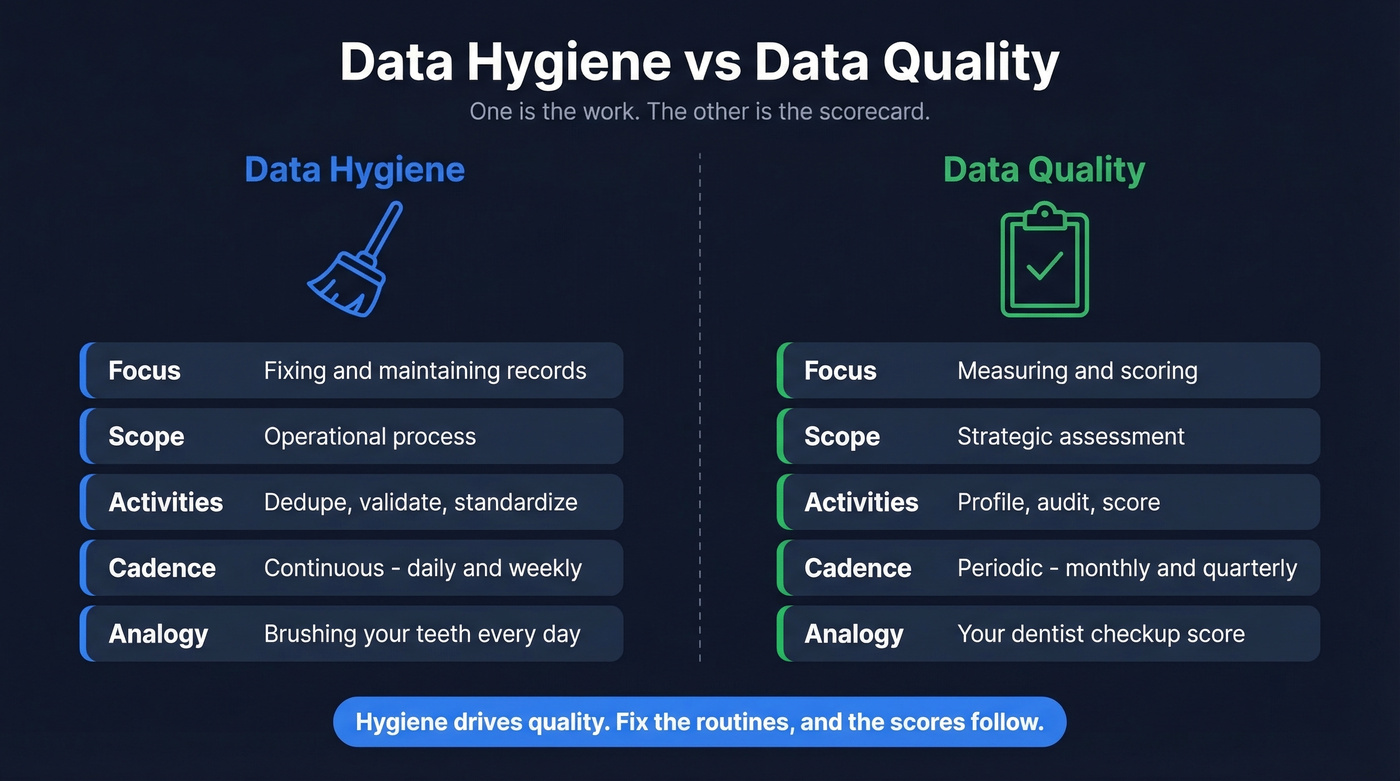
The key word is continuous. A one-time cleanup project fails because errors reintroduce themselves within weeks. New leads come in with typos, reps paste data between fields, integrations map incorrectly. Hygiene isn't a project. It's a capability you build and maintain every single day, or it atrophies fast.
What Is Data Quality?
Data quality is the measurement framework you use to evaluate whether your hygiene efforts are working. IBM defines six core dimensions: accuracy, completeness, consistency, validity, uniqueness, and timeliness. It's your dentist's checkup score - the assessment that tells you whether your daily habits are paying off.
If you're building a modern RevOps tech stack, this is the scorecard that tells you whether your inputs are trustworthy.
| Dimension | Data Hygiene | Data Quality |
|---|---|---|
| Focus | Fixing & maintaining | Measuring & scoring |
| Scope | Operational process | Strategic assessment |
| Activities | Dedupe, validate, standardize | Profile, audit, score |
| Cadence | Continuous (daily/weekly) | Periodic (monthly/quarterly) |
| Outcome | Cleaner records | Decision confidence |
| Analogy | Brushing your teeth | Dentist's checkup score |
Why Both Cost You More Than You Think
The numbers on bad data aren't subtle. Gartner pegs the average cost at $12.9 million per year. MIT research cited by Salesforce puts the revenue loss at 15-25% annually. Separately, 44% of companies estimate they lose over 10% of annual revenue to bad data, and data teams spend 30-40% of their time firefighting quality issues instead of building anything useful. B2B contact data can decay at rates as high as 70.3% annually when you factor in job changes, company moves, and email churn.
If you're sourcing contacts from a B2B database or B2B list providers, this decay rate is exactly why hygiene has to be continuous.
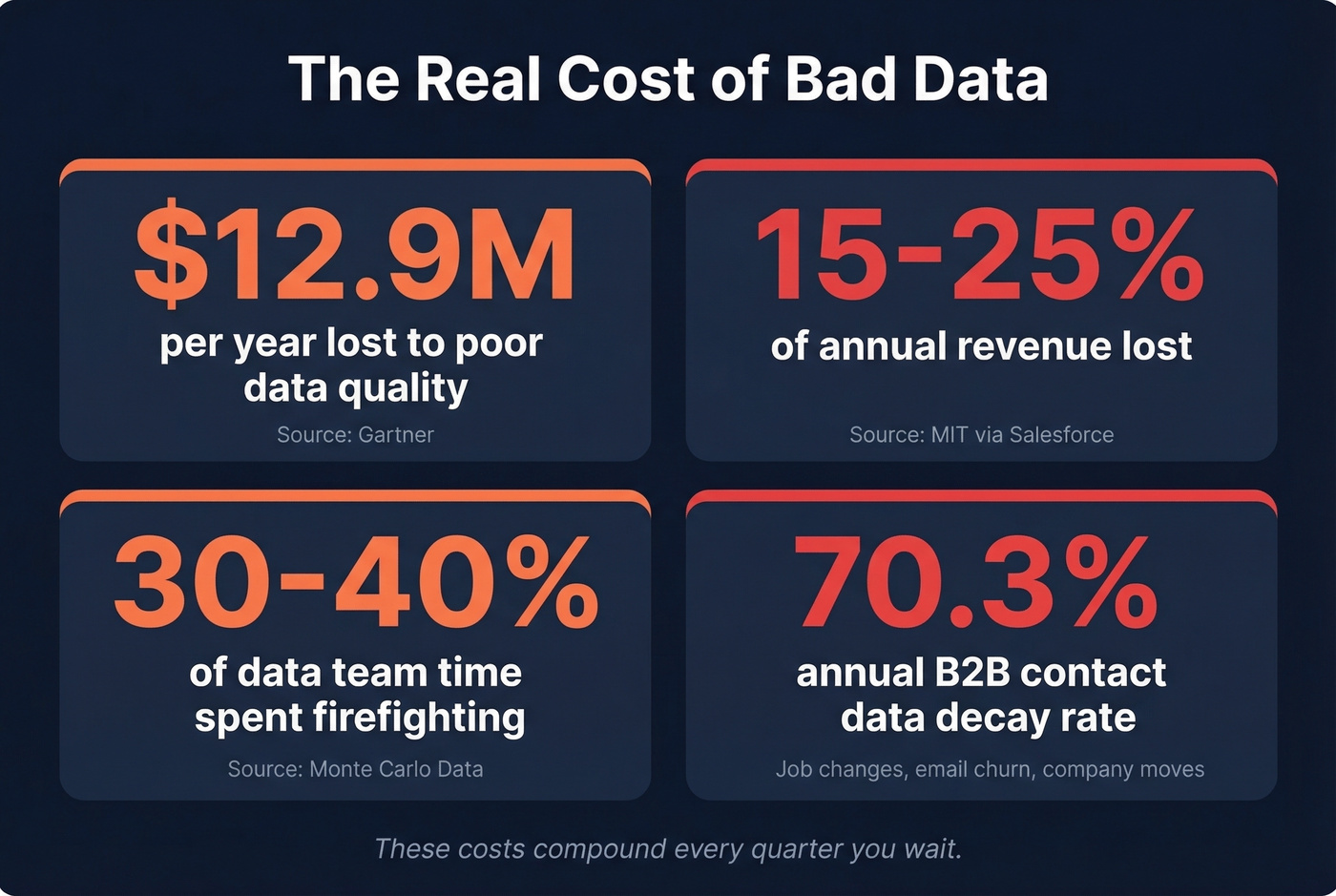
Here's the thing: these aren't one-time costs. They compound. Every stale record that stays in your CRM distorts reporting, wastes rep time, and tanks deliverability. One founder on r/startups put it bluntly - prioritize clean data infrastructure from day zero, because retrofitting hygiene into a messy database is exponentially harder than building the discipline upfront.
If your deliverability is already slipping, start with an email reputation check before you touch copy or cadence.

You just read that bad data costs $12.9M per year. The fastest hygiene fix is eliminating stale emails at the source. Prospeo's 5-step verification delivers 98% email accuracy on a 7-day refresh cycle - not the 6-week industry average. That means fewer bounces, cleaner CRM records, and a quality scorecard you can actually trust.
Stop firefighting bad data. Start with emails that are already clean.
Why This Matters More in 2026
AI amplifies bad hygiene. Models trained on duplicates, stale enrichment, and inconsistent field formats produce outputs that sound plausible but are wrong. With AI spending forecast to surpass $2 trillion in 2026, organizations are pouring money into intelligence layers built on unreliable foundations. Nearly 45% of business leaders cite data accuracy concerns as the leading barrier to scaling AI initiatives.
There's also what I'd call the enrichment paradox: teams layer multiple third-party enrichment sources on top of each other, and conflicting data silently overwrites good first-party signals. If your AI outputs are unreliable, the fix isn't a better model - it's cleaner inputs.
This is also why data enrichment needs governance, not just more vendors.
Most companies spending six figures on AI tooling would get a better ROI from a $500/month data hygiene stack. The model is only as good as the records feeding it.
A Hygiene Checklist That Actually Works
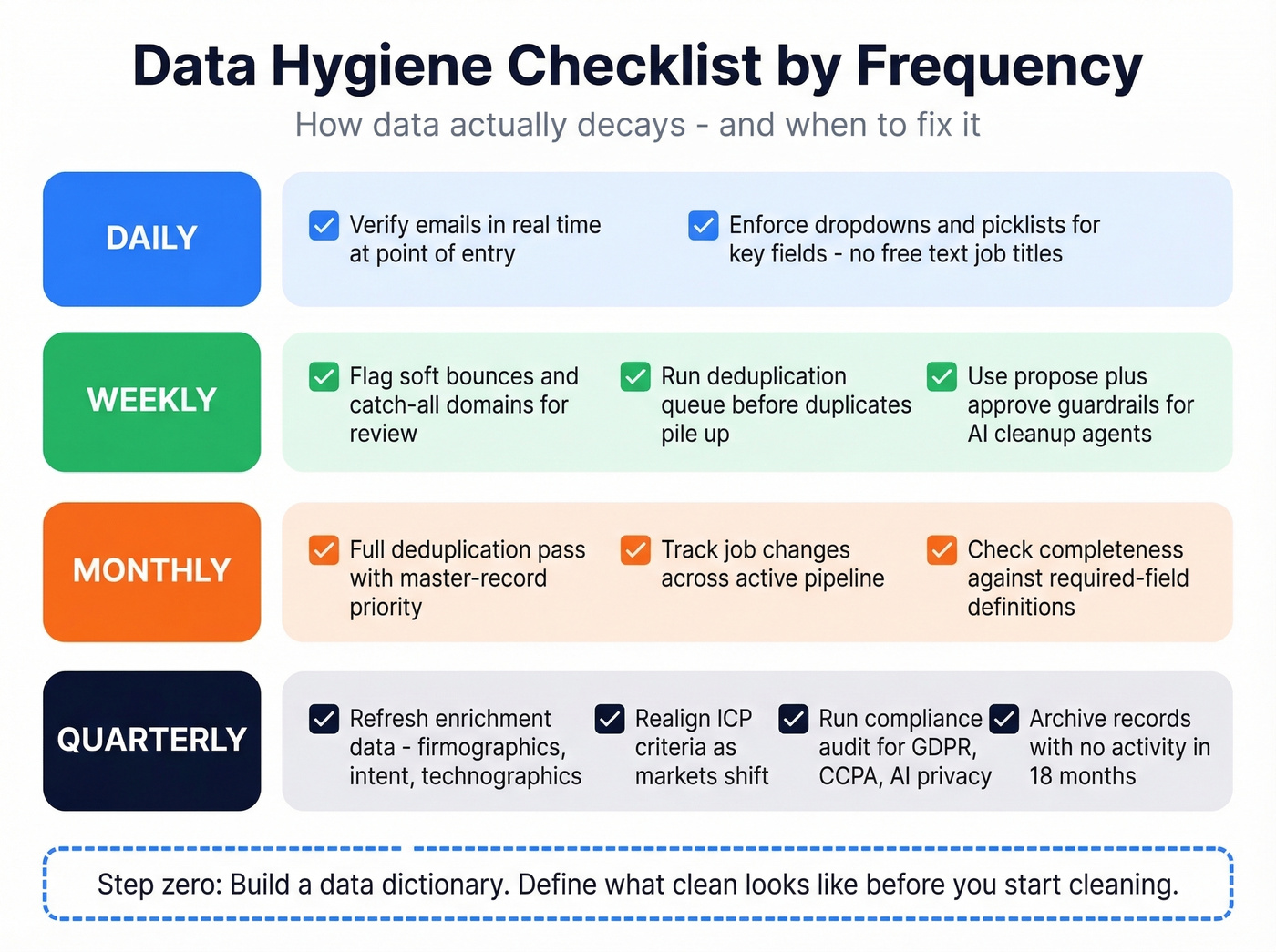
Most hygiene advice is vague. "Clean your data regularly" isn't a plan. Here's a frequency-based framework we've seen work across dozens of teams, mapped to how data actually decays.
If you're evaluating vendors to support this, compare options in our guide to the best data enrichment tools.
Daily
Verify emails in real time at the point of entry. Prospeo's 5-step verification catches invalid addresses, spam traps, and catch-all domains before they ever hit your CRM - at 98% accuracy with a 7-day refresh cycle. That alone eliminates the single biggest source of hygiene debt.
If you want to benchmark tools, start with an email verifier that supports real-time validation.
Enforce dropdowns and picklists for key fields. Free-text job title fields are where standardization goes to die.
Weekly
Flag soft bounces and catch-all domains for review. Run a deduplication queue - don't let duplicates accumulate into a monthly nightmare. Track duplicates per 1,000 records and percentage of records with required fields as your hygiene KPIs.
If you're using AI agents for data cleanup, adopt a "propose + approve" guardrail. Let the agent suggest changes, but a human confirms before writes hit the CRM. A practitioner on r/MarketingAutomation recommended this exact workflow, and we've found it catches the edge cases that full automation misses.
If bounces are creeping up, use a soft bounce rate benchmark to spot issues early.
Monthly
- Run a full deduplication pass with master-record priority
- Track job changes across your active pipeline
- Check completeness against your required-field definitions
If you're automating any of this, CRM automation software can help enforce rules consistently.
Quarterly
- Refresh enrichment data - firmographics, intent signals, technographics
- Realign your ICP criteria (markets shift; your filters should too)
- Run a compliance audit for GDPR, CCPA, and AI privacy requirements
- Archive records with no activity in 18 months
If you're tightening governance, start with a clear Ideal Customer Profile so enrichment and cleanup rules match your targeting.
Before you start any of this, define what "clean" looks like. Build a data dictionary that maps every field - what it should contain, what format it should follow, and who owns it. Skip this step and you'll be cleaning to different standards across teams, which is barely better than not cleaning at all.
Measure Quality After You Fix the Plumbing
Once your hygiene routines are running, use IBM's six quality dimensions as your scorecard: accuracy, completeness, consistency, validity, uniqueness, and timeliness. Score your database against each one quarterly.
If you're diagnosing deliverability impact, pair this with inbox placement tracking so you can connect hygiene to outcomes.
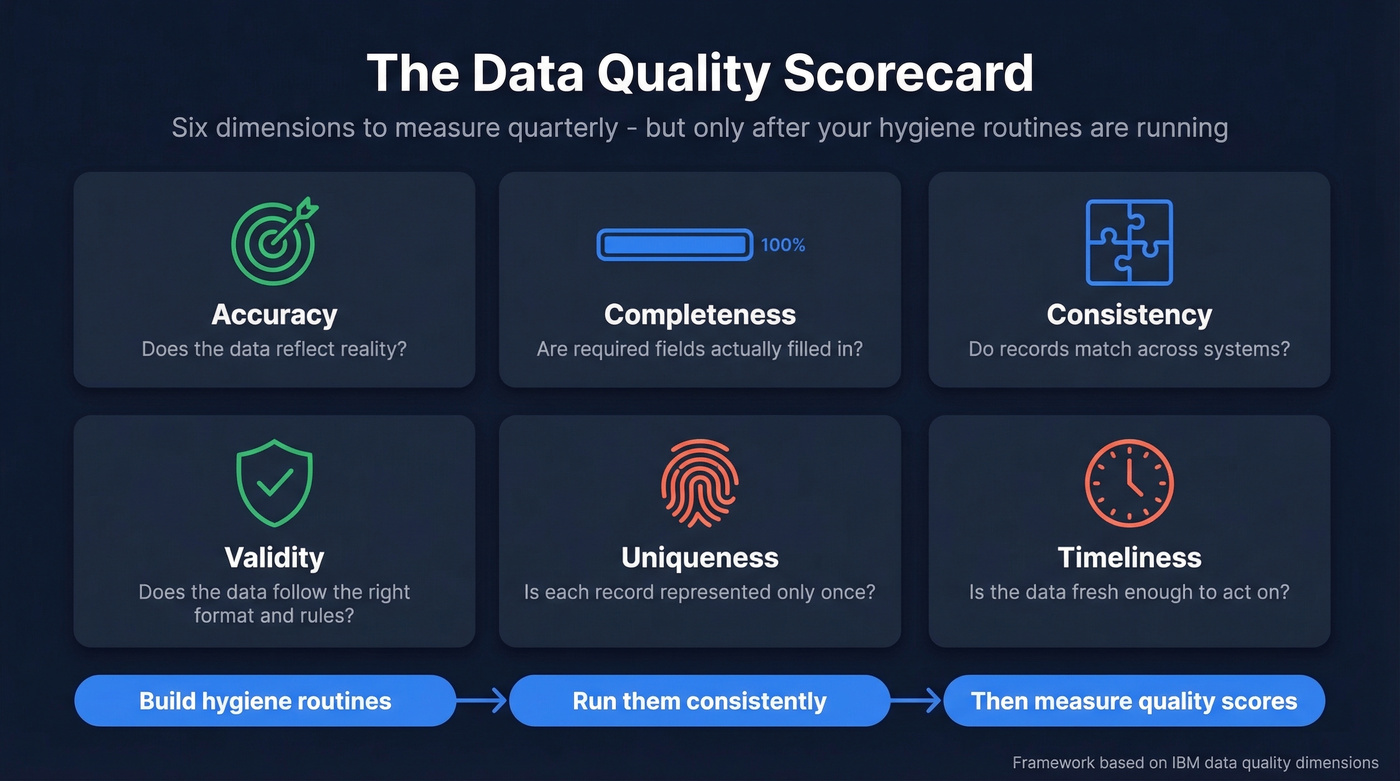
Let's be honest about the order of operations here. Most teams invest in dashboards before they've built the routines that make those dashboards trustworthy. That's backwards. The plumbing comes first. The scorecard comes second.
If you nail the hygiene cadence above, your quality scores will improve on their own. The teams that struggle are the ones treating quality as a reporting problem when it's actually an operations problem. That's the core lesson of data hygiene vs data quality - one drives the other, and the order matters.
Layering enrichment sources creates the exact hygiene nightmare this article warns about - conflicting data silently overwriting good records. Prospeo returns 50+ verified data points per contact at a 92% match rate, with built-in deduplication and catch-all handling. One source of truth, refreshed weekly, for $0.01 per email.
Replace your patchwork enrichment stack with one platform that stays clean.
FAQ
Is data hygiene part of data quality?
They're related but distinct. Hygiene is the ongoing maintenance - cleaning, deduplicating, validating records. Quality is the measurement of whether that maintenance is working, scored across dimensions like accuracy and completeness. Hygiene comes first; quality scores follow.
How often should you clean your CRM data?
Daily for email validation at entry, weekly for deduplication, monthly for completeness audits, quarterly for enrichment refreshes. B2B contact data decays up to 70.3% annually, so quarterly cleanups alone leave most records stale by the time you act on them.
What tools help automate data hygiene?
Real-time email verification at the point of entry prevents bad data from ever reaching your CRM. Automated deduplication rules handle the second biggest hygiene gap. For enrichment, look for platforms with short refresh cycles - the industry average is six weeks, but weekly refreshes exist and make a measurable difference in deliverability and pipeline accuracy.