

Deal Closing: Techniques, Frameworks, and Benchmarks That Actually Work
Your SDR booked 40 meetings. You ran 35 demos. Sent 20 proposals. Closed 4. Your VP wants to know what happened to the other 16 - and "they went dark" isn't an answer anyone accepts anymore.
The gap between pipeline and revenue isn't a closing technique problem. It's a process problem. 69% of sales reps miss quota, and in our experience it's usually not a skills gap - it's a systems gap where deals leak out of a pipeline that was never properly sealed in the first place.
The Short Version
Your biggest competitor isn't the other vendor. It's "no decision." Between 40-60% of lost deals end not with a competitor win, but with the buyer doing nothing at all. Process beats tactics every time: adopt MEDDIC for qualification and a Mutual Action Plan for every deal over $50K. The three highest-leverage improvements you can make right now are following up more persistently (80% of deals need 5+ touches), mapping the decision process early, and verifying your contact data so you're actually reaching the people who sign checks.
What Is Deal Closing?
Deal closing is the final stage of a sales process where a prospect commits to buying - signing the contract, issuing the PO, or verbally agreeing to terms that move into procurement. This term also applies in M&A contexts like acquisition financing and loan agreements, but this guide focuses entirely on B2B sales.
The formula is straightforward: Closing % = (Closed-Won Deals / Total Opportunities) x 100. If you closed 48 out of 200 opportunities, your close rate is 24%.
One distinction worth getting right early: close rate, win rate, and conversion rate aren't the same thing. Close rate measures deals won against all opportunities in the pipeline. Win rate narrows the denominator to deals that reached the proposal stage - a tighter lens on late-stage effectiveness. Conversion rate typically refers to earlier funnel movement: demo-to-opportunity, trial-to-paid, MQL-to-SQL. Mixing these up is how teams end up arguing about numbers that don't mean the same thing.
2026 Benchmarks by Industry
The average B2B close rate sits around 20% lead-to-close, with meaningful variation by industry. Demo-to-close rates run higher - around 25% - since they exclude earlier funnel drop-off.
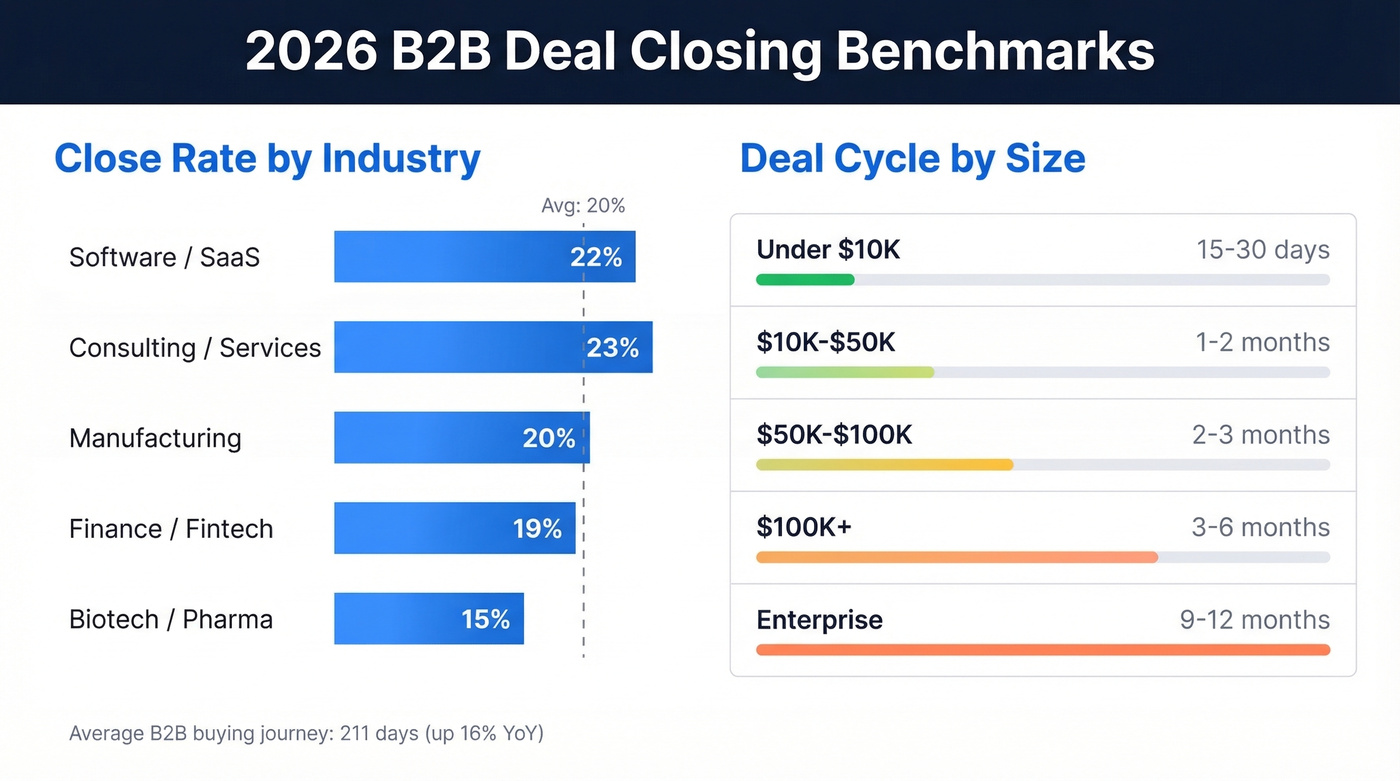
| Industry | Close Rate |
|---|---|
| Software / SaaS | ~22% |
| Consulting / Services | ~22-24% |
| Manufacturing | ~20% |
| Finance / Fintech | ~19% |
| Biotech / Pharma | ~15% |
Deal size drives cycle length more than anything else:
| Deal Size | Typical Cycle |
|---|---|
| Under $10K | 15-30 days |
| $10K-$50K | 1-2 months |
| $50K-$100K | 2-3 months |
| $100K+ | 3-6 months |
| Enterprise | 9-12 months |
The average B2B buying journey now runs about 211 days - roughly seven months - and that number is up 16% year-over-year. Cycles are getting longer, not shorter.
Here's where it gets painful. 80% of deals require five or more follow-ups to close. Yet 44% of reps quit after a single attempt, and 92% give up after four. That gap between persistence required and persistence delivered is the single easiest improvement most teams can make. (If you need copy you can deploy today, use these follow-up templates.)
The other complexity multiplier: buying committees. The average deal involves about five decision-makers, and in many B2B orgs final approval can involve 6-10 people. Enterprise deals? Expect 10-17 stakeholders touching the decision. Every additional stakeholder is another potential veto, another timeline delay, another person you need to reach with the right message.
Why Deals Really Die
Picture this: your champion said "we're aligned" six weeks ago. The contract is sitting in a shared drive somewhere. Your follow-up emails get polite non-answers. Then silence.
The deal didn't explode. It evaporated.
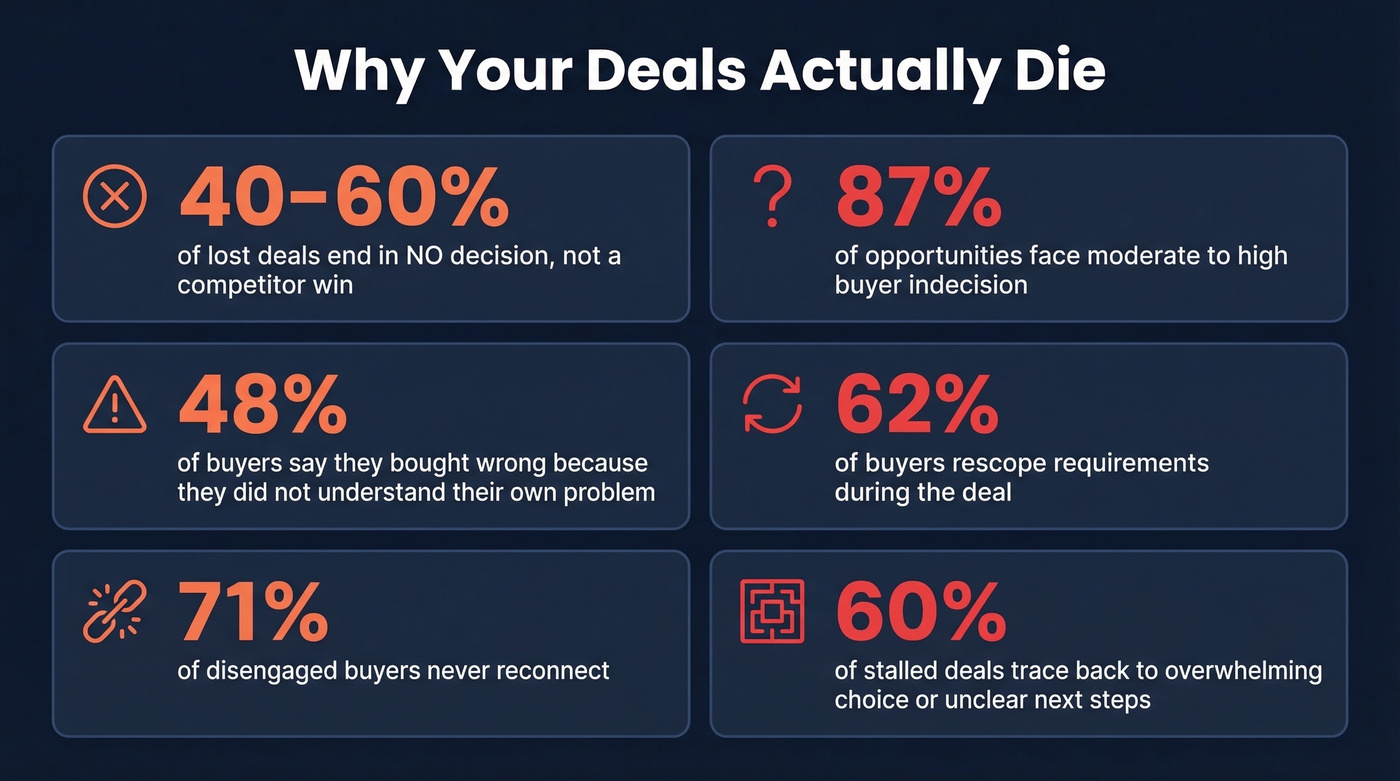
Most sales leaders won't say this out loud: your biggest loss category isn't a competitor. It's inertia. Between 40-60% of "lost" deals aren't lost to anyone - they're lost to no decision. Per HBR research, 87% of sales opportunities face moderate-to-high customer indecision. Your prospect isn't weighing you against a competitor. They're weighing change against the status quo - and the status quo doesn't require a business case, a security review, or a CFO signature.
The root causes are uglier than "bad timing." 48% of buyers say they bought the wrong product because they didn't fully understand their own problem. 47% say the salesperson misunderstood their needs. 37% of deals stall specifically because the salesperson doesn't fully grasp the buyer's challenges. And 62% rescope their requirements during the deal - 13% rescope nine or more times.
When 27% of buyers begin the process without clearly defining the problem, you're building on sand from day one. 60% of stalled B2B deals trace back to overwhelming choice or unclear next steps. And once a buyer disengages? 71% never reconnect. That's not a "nurture them back" situation. That's a dead deal.
Here's a scenario straight from the kind of deal reps vent about on r/sales: the buyer agrees to scope and price, but the PO never materializes. Urgency is low. Budget timing pushes it to next quarter. Then next quarter becomes next year. The deal didn't die in a dramatic objection. It died of neglect.
10 Techniques That Actually Work
Stop collecting closing techniques like Pokemon cards. These work, but only when deployed at the right moment with the right buyer. And here's what most "closing technique" articles miss: the close isn't a single moment. It's a series of micro-commitments throughout the deal - each "yes" to a next step builds momentum toward the final signature.
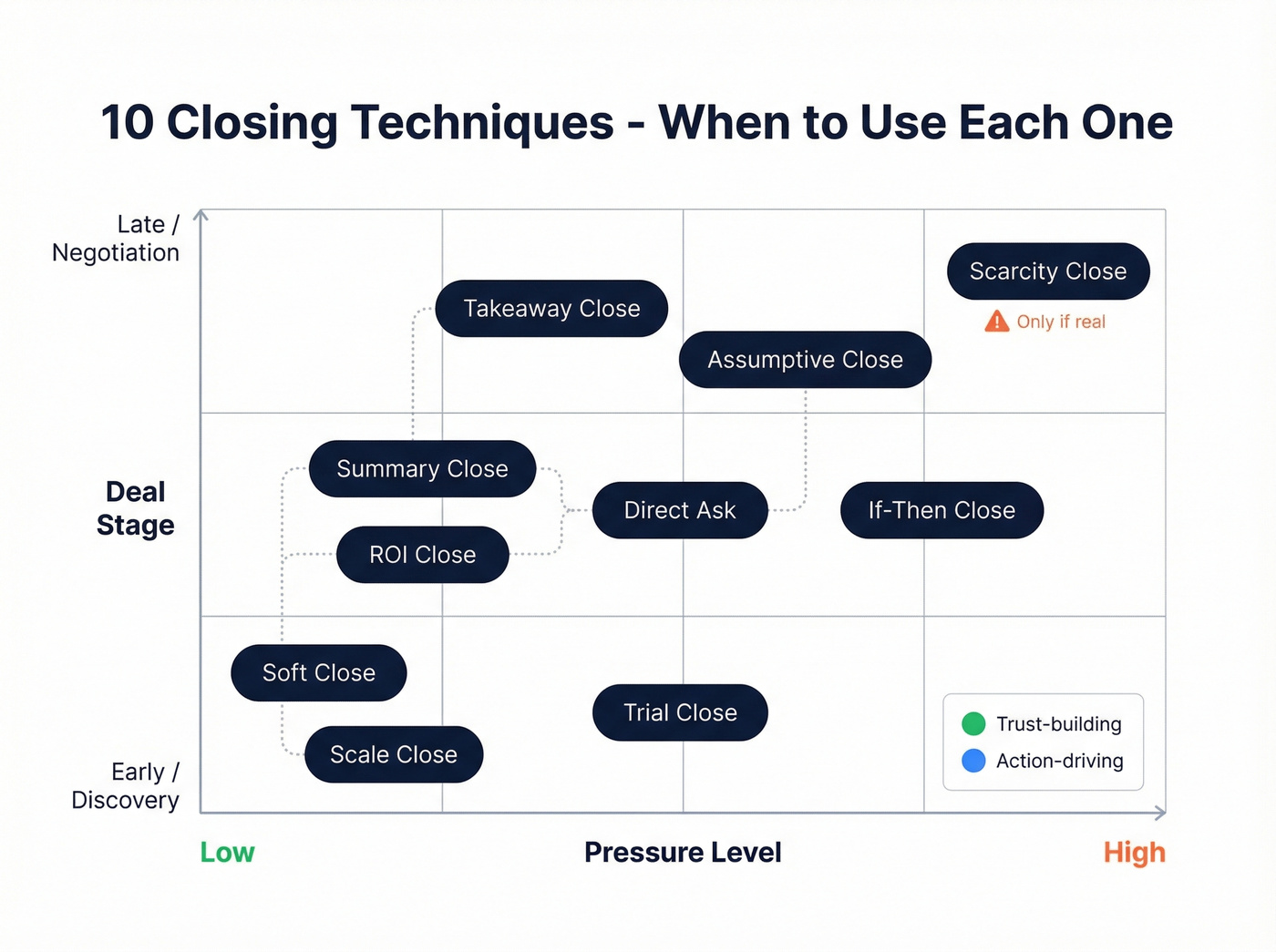
The Assumptive Close
Act as though the decision is already made and move to logistics. "Should we start the onboarding call next Tuesday or Thursday?" Only works when the buyer has confirmed fit, budget, and timeline. Use it prematurely and you'll come across as presumptuous.
The Summary Close
Recap every agreed-upon benefit before asking for the commitment. "So we've confirmed the integration handles your Salesforce workflow, the pricing fits within your Q3 budget, and your team can start onboarding in two weeks. Ready to move forward?" This technique is especially effective when multiple decision-makers need alignment before signing - it gives your champion a script they can repeat internally.
Don't Use the Scarcity Close Unless It's Real
"We have three implementation slots left in Q2, and our onboarding team is booked through July after that." If the constraint is genuine, this accelerates decisions. If it's fabricated, you'll destroy trust the moment the buyer finds out - and they will find out. We've seen reps lose six-figure deals over fake urgency that a buyer verified with a single email to their existing vendor contact.
The Trial Close (Puppy Dog)
Let the product sell itself. "Use it for 14 days. If it doesn't cut your list-building time in half, walk away." This shifts risk entirely to you, which is why it works so well for SMB deals and product-led motions where the product experience is strong.
The Scale Close
You're 45 minutes into a call. The buyer is nodding but not committing. You ask: "On a scale of 1 to 10, how ready are you to move forward?" They say 7. Your next question: "What would make it a 9?"
This surfaces hidden objections without confrontation. I've watched reps uncover budget holds, competing priorities, and stakeholder concerns that would have killed the deal two weeks later - all from this one question.
The If-Then Close
Tie a concession to a commitment. "If we can include the additional training sessions, would you be ready to sign this week?" Gives the buyer a win while locking in a timeline. Best for negotiation-heavy enterprise deals where both sides need to feel like they gained something.
The ROI Close
Quantify the cost of inaction. "Your team spends 12 hours a week on manual data entry. At your blended rate, that's $4,200/month. Our platform eliminates 80% of that. The tool pays for itself in six weeks." Pair this with a one-page ROI model the buyer can forward to their CFO - when you're working with a data-driven buyer, this technique consistently outperforms softer approaches.
The Direct Ask
"We've covered everything. Are you ready to move forward?" No tricks, no framing. Just a clear question. 35% of salespeople say closing is the hardest part of sales - often because they overcomplicate it. Sometimes the simplest approach is the best one.
The Takeaway Close
Removing an option sounds counterintuitive, but it clarifies what the buyer actually values. "Based on what you've told me, the enterprise tier might be more than you need. The mid-tier handles your core use case - want to start there?" This builds trust by showing you're not just upselling. The risk: if the buyer actually wanted enterprise features, you've anchored them lower. Use it when the buyer seems overwhelmed by options, not when they're already leaning premium.
The Soft Close
Low-pressure temperature check. "If we could solve the integration concern, is there anything else standing between us and a partnership?" Keeps the conversation open without forcing a binary yes/no. Best for early-stage enterprise conversations where pushing too hard triggers procurement delays.
MEDDIC: Qualification That Makes Closing Predictable
Closing techniques are the last 5% of a deal. The other 95% is qualification. (If you want a tighter call flow, start with these MEDDIC discovery questions.)
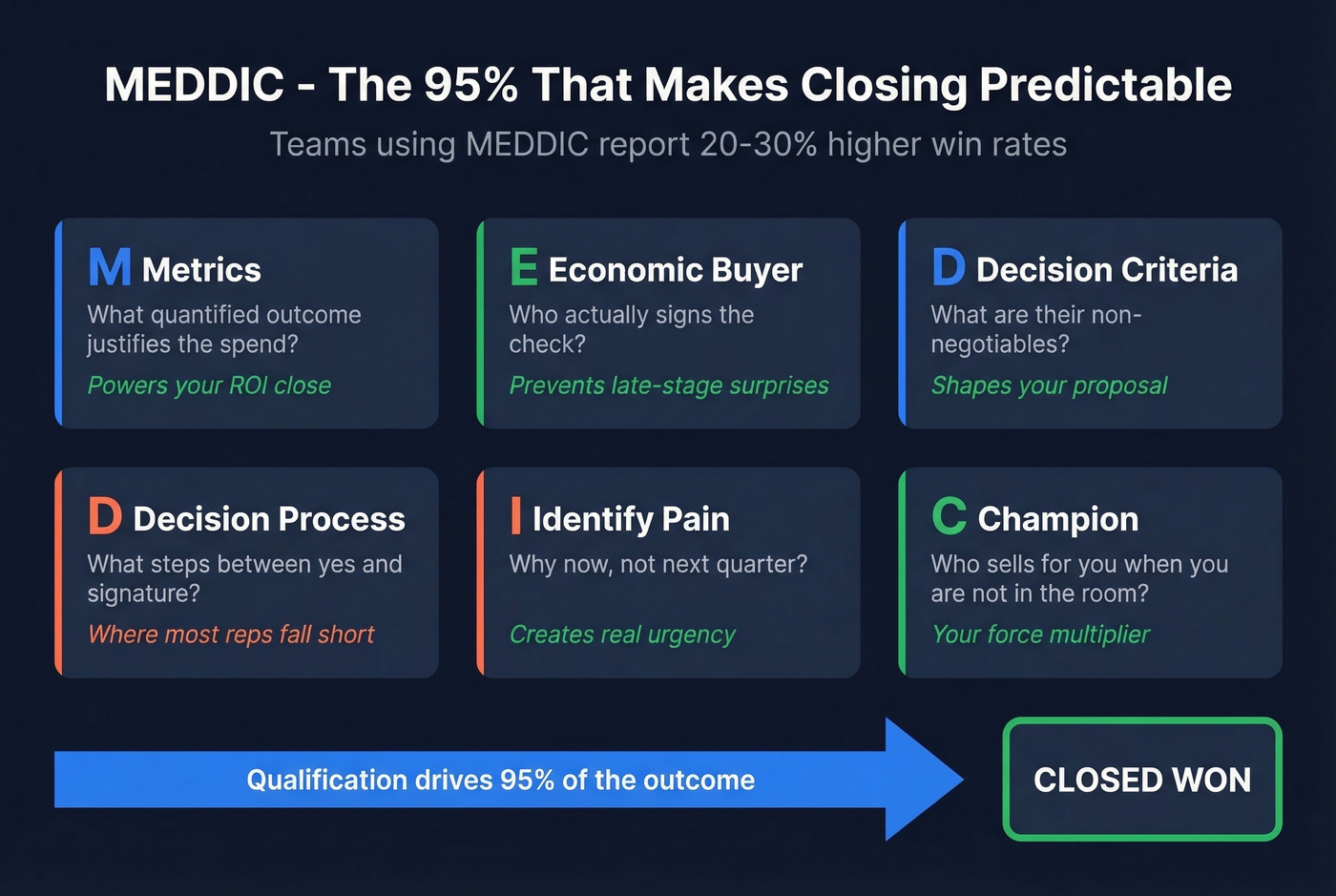
MEDDIC, developed at PTC in the 1990s, is the framework that makes that qualification rigorous enough to predict outcomes. Teams using it report 20-30% higher win rates and 40% more accurate forecasting.
| Element | Question to Answer | Closing Relevance |
|---|---|---|
| Metrics | What quantified outcome justifies the spend? | ROI close ammunition |
| Economic Buyer | Who signs the check? | Prevents late-stage surprises |
| Decision Criteria | What are their non-negotiables? | Shapes your proposal |
| Decision Process | What steps between "yes" and signature? | Prevents timeline surprises |
| Identify Pain | Why now, not next quarter? | Creates real urgency |
| Champion | Who sells internally when you're not in the room? | Your force multiplier |
The Decision Process element is where most reps fall short. It's not just "who approves this." It includes legal review, security assessment, procurement negotiation, and executive sign-off. Deals die when reps don't know a security review takes six weeks and they've promised a go-live in four.
One critical distinction: a Champion isn't just someone who likes you. If they can't answer objections on your behalf in an internal meeting, they're a Coach - helpful, but not powerful enough to drive the deal home. And you can't close a deal with someone who can't sign the check, which is why mapping the full buying committee with verified contact data early in the process matters more than any single technique you'll deploy at the end.

80% of deals need 5+ follow-ups, but those follow-ups only work if you're reaching the right person. With 300M+ profiles and 98% email accuracy, Prospeo ensures every touchpoint lands with an actual decision-maker - not a dead inbox.
Stop losing deals to bad contact data. Start reaching buyers who sign checks.
Mutual Action Plans: Close Faster
A Mutual Action Plan is a co-created document between you and the buyer that maps every step from "we're interested" to "we're live." It includes objectives, milestones, owners, deliverables, status updates, and success metrics. Simple concept, massive impact.
Outreach's internal data shows deals with a MAP have a 26% higher win rate than deals without one. Despite that, only 45% of sellers use them consistently. Another 43% use them sometimes. And 12% never use them at all.
The template structure doesn't need to be complicated. Start with the objective - what success looks like for both sides. Then map milestones with key dates for the demo, security review, legal, and go-live. Assign owners for each step on both sides. Define deliverables each party needs to produce. Track status for each milestone. And agree on success metrics so both sides know whether this worked.
Let's be honest about the most common MAP mistakes: using inconsistent formats across deals, keeping the plan in a spreadsheet disconnected from your CRM, and failing to give the buyer visibility into progress. A MAP that lives in your Notion workspace but never gets shared with the buyer's procurement team isn't a mutual plan - it's a wishlist. (If your stages are messy, fix the upstream sales process optimization first.)
Psychology Behind the Close
Gerald Zaltman's research at Harvard found that roughly 95% of purchase decisions occur in the subconscious mind. Your buyer thinks they're making a rational evaluation. They're not. Understanding the psychological principles at play doesn't mean manipulating people - it means aligning your process with how decisions actually get made.
Social proof is the most powerful lever at the final stage. Case studies, reference calls, and "here's a customer in your exact situation" stories. Don't save these for the demo. Deploy them when the buyer is weighing risk.
Reciprocity works because humans feel obligated to return value. Give something genuinely useful before asking for the commitment - a custom ROI analysis, an implementation roadmap, an introduction to a customer who solved the same problem. The ask feels natural after the give. (More on this in our guide to how to add value in sales.)
Loss aversion is the most misused principle in sales. It's not about fake scarcity or "this price expires Friday." It's about quantifying the cost of inaction. "Every month you delay, your team loses 340 hours to manual processes. That's $28,000 in labor costs." The loss is real. Let the math create the urgency.
Closing Enterprise Deals
It's the last week of the quarter. Your champion said "we're good to go" three weeks ago. The contract is "with legal." You've sent four "just checking in" emails. Nothing.
This is the most common enterprise scenario, and most reps handle it wrong. Late-stage silence usually means the deal has moved to legal or procurement - not that your champion ghosted you. The instinct to send another "checking in" email is understandable but counterproductive. Instead, extend value to the new stakeholders who now control your timeline. (If you’re building a repeatable motion here, see our enterprise B2B sales playbook.)
A practical heuristic from experienced operators: a contract waiting for signature longer than one to two weeks is almost guaranteed to become a lost deal unless you actively intervene. Diagnose the real blocker. Is legal stuck on an indemnification clause? Does procurement need a vendor security questionnaire? Is an executive stakeholder you've never met asking questions your champion can't answer?
"Simplify to win" is the enterprise closer's mantra. Don't introduce new options, features, or pricing structures in the final meeting. Every new variable resets the decision clock. For a $500K deal stalling in procurement, showing up to help draft the internal business case can be the difference between closing this quarter and losing the deal entirely.
Look - late-stage enterprise objections are never about value. They're about risk. The VP signing off is thinking about their career, not your ROI calculator. Meet that with concrete customer references in their industry and genuine empathy, not more pressure.
Mistakes That Kill Deals
1. Using pressure tactics that backfire. Bryan Vasquez at LinkBuilder.io replaced urgency-based CTAs with data-backed proposals and tailored value maps - win rate jumped 20% over two quarters. Lead with evidence, not artificial deadlines.
2. Talking more than listening. If you're doing more than 40% of the talking in a discovery call, you're selling to yourself. Ask one more question before making your next point. (Use a tighter set of discovery questions to stay structured.)
3. Selling price instead of value. The moment you lead with discounts, you've commoditized yourself. Anchor on outcomes and predictive modeling, not line items.
4. Qualifying the wrong person. Buying committees are expanding. If you're pitching to someone who can't approve the spend, you're practicing, not selling. Ask "who else needs to weigh in?" in the first meeting, not the last.
5. Slow response to inbound. As one SaaStr operator put it: "Never seen someone that is slow to respond be great at sales." Same-day response SLA for every inbound lead. No exceptions.
6. Not knowing the competition. If your buyer knows more about your competitor's product than you do, you've lost the positioning battle. Competitive teardown quarterly, battlecard for every rep. (Here’s a practical competitive intelligence strategy to operationalize it.)
7. Quitting follow-up too early. 92% of reps give up after four attempts. 80% of deals need five or more. This is the most fixable mistake on the list. Build a minimum 7-touch follow-up sequence with automated reminders. Reps who close consistently treat follow-up as a system, not an afterthought. (If you want automation options, start with AI sales follow-up.)
Tools That Help You Close
No single tool closes deals - but the wrong stack will kill them silently.
CRM is the foundation. Salesforce Sales Cloud runs ~$25-$330/user/month depending on the edition. HubSpot offers a free CRM, with paid Sales Hub seats starting around ~$20/user/month and scaling to ~$100+/user/month. Skip this section if your deal stages, close dates, and stakeholder maps already live in a CRM you trust - the basics are the basics. (If you’re standardizing your stack, see examples of a CRM.)
Conversation intelligence tools like Gong (~$1,200-$1,800/user/year) and Chorus record, transcribe, and analyze sales calls. They catch the moment a deal went sideways three weeks before it shows up as "closed-lost" in your pipeline. Worth the investment for teams running 20+ demos a week; overkill for a three-person startup.
Contact data quality is the silent deal killer nobody talks about enough. If your emails bounce and your phone numbers are dead, you're not reaching the decision-makers you need. Prospeo addresses this with 98% email accuracy, 125M+ verified mobile numbers with a 30% pickup rate, and a 7-day data refresh cycle. Snyk's 50 AEs cut bounce rates from 35-40% to under 5% and grew AE-sourced pipeline 180% after switching. Starts free at ~$0.01 per email with no annual contracts. (If you’re evaluating vendors, compare data enrichment services.)
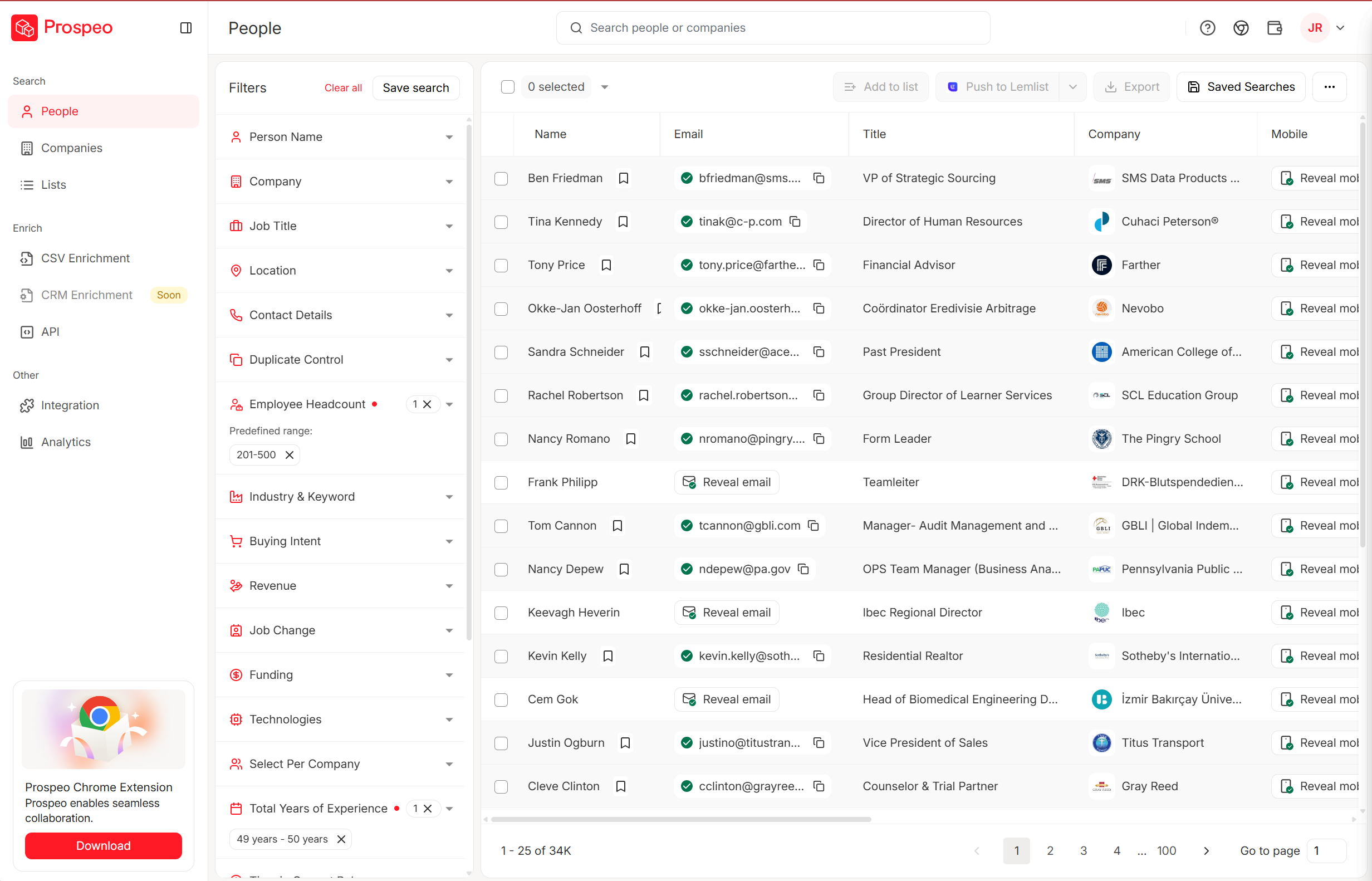
The average deal involves 5-10 stakeholders. If you only have contact data for your champion, you're one reorg away from a dead deal. Prospeo maps entire buying committees with verified emails and 125M+ direct dials - at $0.01 per email.
Reach every stakeholder in the buying committee, not just your champion.
Deal Closing FAQ
What's a good close rate in B2B sales?
The average B2B close rate is approximately 20% lead-to-close. SaaS teams typically hit around 22%, while biotech and pharma hover closer to 15%. Benchmark against your own industry vertical - a 20% close rate in biotech is strong, while the same rate in consulting might signal qualification issues.
How long does it take to close a B2B deal?
The average B2B sales cycle runs about 211 days, up 16% year-over-year. Deals under $10K close in 15-30 days, while contracts over $100K take three to six months. Enterprise agreements routinely stretch to 9-12 months depending on procurement complexity.
How many follow-ups does it take to close?
80% of B2B deals require five or more follow-ups to reach a signed contract. Despite this, 44% of reps quit after one attempt and 92% stop after four. Building a minimum 7-touch sequence is the single easiest improvement - it requires discipline, not new skills.
What's MEDDIC in sales?
MEDDIC is a six-part qualification framework: Metrics, Economic Buyer, Decision Criteria, Decision Process, Identify Pain, and Champion. Teams using it report 20-30% higher win rates and significantly more accurate forecasting. It turns deal closing from guesswork into a repeatable, auditable discipline.
How do you reach decision-makers to close faster?
Map the buying committee early - the average deal involves five stakeholders, and enterprise deals 10-17. Multi-threading across the committee prevents single-point-of-failure risk. Verified contact data for the full committee means your outreach actually lands instead of bouncing, which is why data quality tools have become non-negotiable for teams closing deals above $50K.