

The Difference Between Sales and Marketing (And Why It's Shrinking)
The VP of Sales says the leads are garbage. The CMO says sales never followed up. Both are right, and both are wrong. An Influ2 analysis of 105 companies found that 53% have broken handoffs - meaning sales follows up with fewer than 35% of the prospects marketing actually engaged. That's not a disagreement about the difference between sales and marketing. That's two teams rowing in opposite directions while the boat drifts.
Quick Version
Sales converts demand into revenue through direct, one-to-one interactions. Marketing creates demand through one-to-many channels. Sales operates on weekly and monthly cycles; marketing plays a longer game measured in quarters and years.
The real question isn't how they differ - it's why 53% of companies still can't get them to work together. If you want the side-by-side breakdown, jump to the comparison table below. If you're here to fix alignment, skip to the playbook. And if you're curious how AI is dissolving the boundary entirely, that section's near the end.
Sales vs Marketing at a Glance
| Dimension | Sales | Marketing |
|---|---|---|
| Goal | Close revenue | Generate demand |
| Audience | Individual prospects | Market segments |
| Time horizon | Days to months | Months to years |
| Primary KPIs | Quota, win rate, ACV | CAC, pipeline, MQLs |
| Core activities | Calls, demos, negotiation | Content, ads, campaigns |
| Key tools | CRM, dialer, sequencer | MAP, analytics, CMS |
| Success metric | Revenue closed | Pipeline generated |
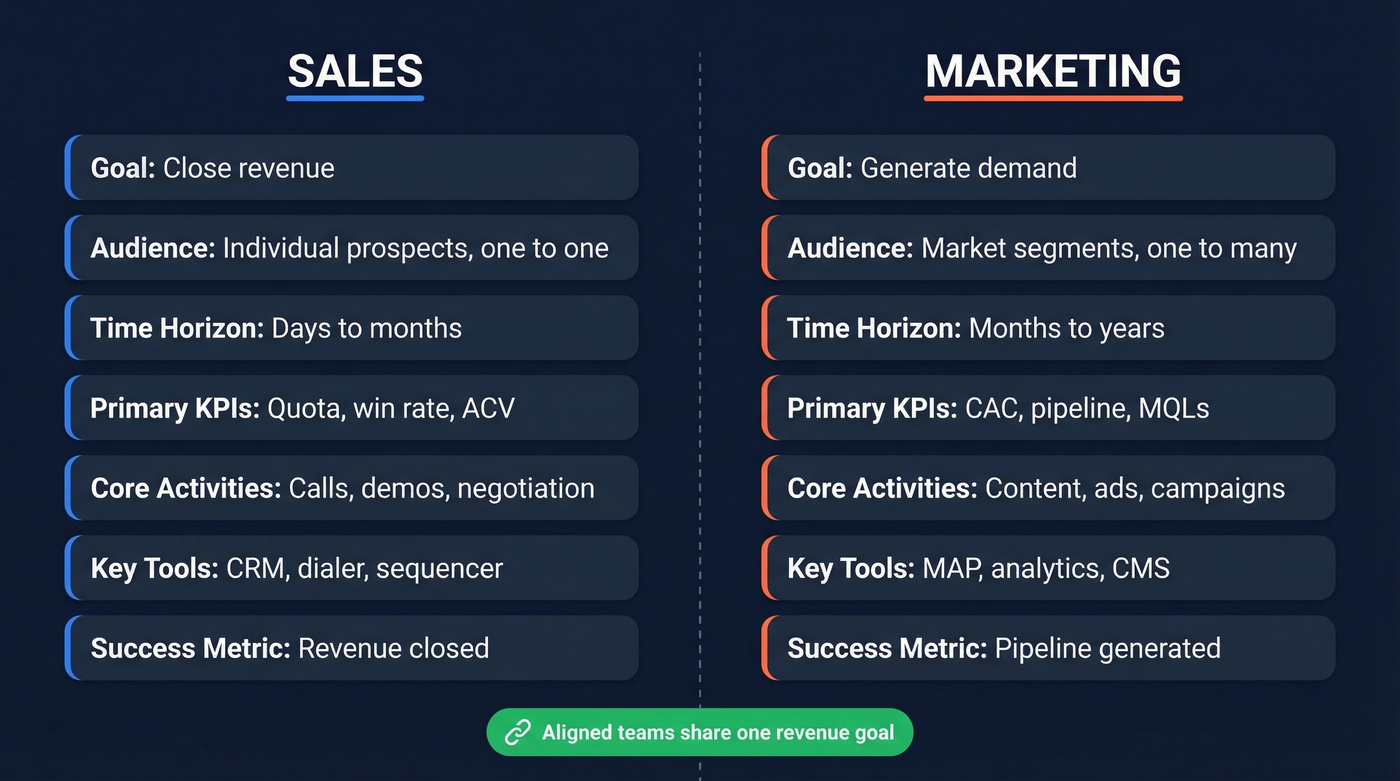
This table captures the textbook distinction. But the textbook is about ten years out of date. The modern buyer has rewritten the rules, and both functions are scrambling to keep up.
You'll still see articles citing Salesforce's claim that the "average B2B buyer is 67-70% through the buying journey before first contact with sales." That number traces back to a 2013 study. Corporate Visions explicitly calls it "ancient history." The updated figure from 6sense's 2025 research puts first contact at 61% of the journey - buyers are actually reaching out earlier than the old stat suggests, pulling outreach forward by roughly six to seven weeks.
How the Modern Buyer Changed the Rules
Even with earlier contact, buyers aren't showing up uninformed. 83% mostly or fully define their purchase requirements before speaking with sales. They've done the research. They've read the comparison posts. They've probably asked ChatGPT.
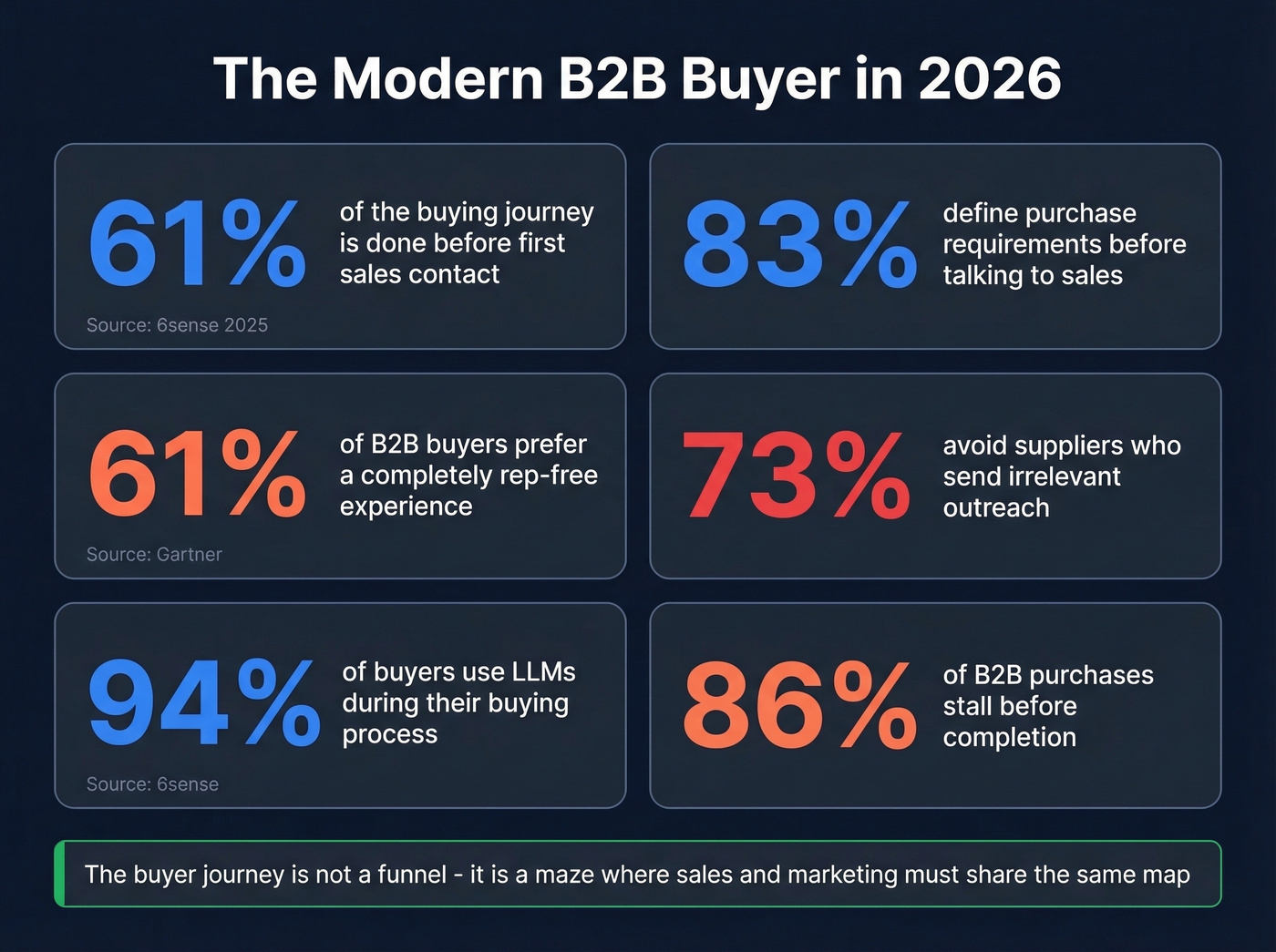
A Gartner survey of 632 B2B buyers found that 61% prefer a rep-free buying experience entirely. That doesn't mean sales is dead - it means the role has shifted from "educate the buyer" to "add contextual value the buyer can't get from a website." Salesforce's own data backs this up: 87% of buyers want sales reps who act as trusted advisors.
Here's where it gets uncomfortable. 73% of B2B buyers actively avoid suppliers who send irrelevant outreach, and 69% report inconsistencies between what the company website says and what the seller tells them. That messaging gap is a direct symptom of misalignment - marketing says one thing, sales says another, and the buyer trusts neither. Even when deals close, 81% of buyers report dissatisfaction with the provider they chose, per Forrester's 2024 research. The rot doesn't stop at the signature.
And 6sense's data shows 94% of buyers use LLMs during their buying process while 86% of B2B purchases stall before completion. The buyer journey isn't a funnel anymore. It's a maze where marketing and sales need to show up at different turns with the same map. When they don't, deals die.
Core Differences Between Sales and Marketing
Goals and Time Horizons
Sales lives in the short cycle. Quota attainment this month. Pipeline velocity this quarter. Close rate on the deals in front of you right now. The feedback loop is tight - you know within days whether an approach is working because the phone either rings back or it doesn't. Methodologies like SPIN Selling and the Challenger Sale exist precisely because reps need repeatable frameworks for these high-pressure, real-time conversations.
Marketing operates on a longer horizon. Brand awareness compounds over quarters. Demand generation campaigns take weeks to mature. CAC optimization requires enough data to be statistically meaningful, which means patience. A marketing leader who gets fired after one bad quarter probably never had a fair shot.
The tension between these time horizons is the root of most sales-marketing conflict. Sales wants leads now. Marketing wants to build the engine that produces leads forever. Both are right. Neither can win alone.
KPIs That Define Each Function
On the marketing side, LeadEnforce's 2025 benchmarks give us concrete targets by industry:
| Metric | B2B SaaS | Ecommerce | Finance | Education |
|---|---|---|---|---|
| CTR | 0.8-1.3% | 1.6-2.1% | 0.9-1.5% | 1.2-1.8% |
| CPC | $2.40-$5.20 | $0.80-$1.40 | $1.60-$3.10 | $0.90-$1.70 |
| CPL / CPA | $45-$95 | $22-$38 (CPA) | $40-$75 (CPA) | $18-$45 |
| Conversion / ROAS | 6-12% | 3.2-4.1 ROAS | 5-9% | 3-6% |
Sales KPIs are harder to benchmark publicly, but common B2B SaaS ranges look like this: average win rates of 15-25% on qualified pipeline, SQL-to-close rates of 20-30%, and average sales cycles of 30-90 days depending on deal size. Pipeline velocity - how fast dollars move through stages - is the metric that matters most to revenue leaders because it captures both volume and speed.
B2B vs B2C: Two Different Games
The contrast between selling and marketing looks completely different depending on whether you're targeting businesses or consumers, and almost nobody covers this well.
B2B sales cycles run weeks to months, involve three to ten stakeholders, and hinge on relationship-building and ROI justification. Marketing's job is to generate qualified pipeline and arm sales with content for each stakeholder. B2C cycles are shorter, often impulse-driven, and emotionally triggered. Marketing does most of the heavy lifting - by the time someone clicks "buy," the sale is essentially closed. The sales function in B2C often looks more like customer service than traditional selling.
This distinction matters because the alignment problem is overwhelmingly a B2B problem. In B2C, marketing and sales are often the same motion. In B2B, they're separate functions with separate leaders, separate budgets, and separate definitions of success. That's where things break.

53% of teams have broken handoffs because sales and marketing work from different data. Prospeo gives both functions one source of truth - 300M+ profiles with 98% verified emails, refreshed every 7 days. When marketing qualifies a lead and sales gets a real phone number that actually picks up, the finger-pointing stops.
Give both teams data worth rowing in the same direction for.
Signs Your Teams Are Misaligned
We've seen this pattern at dozens of companies: the same two complaints, recycled every quarter. "Marketing sends us garbage leads." "Sales never follows up on anything."
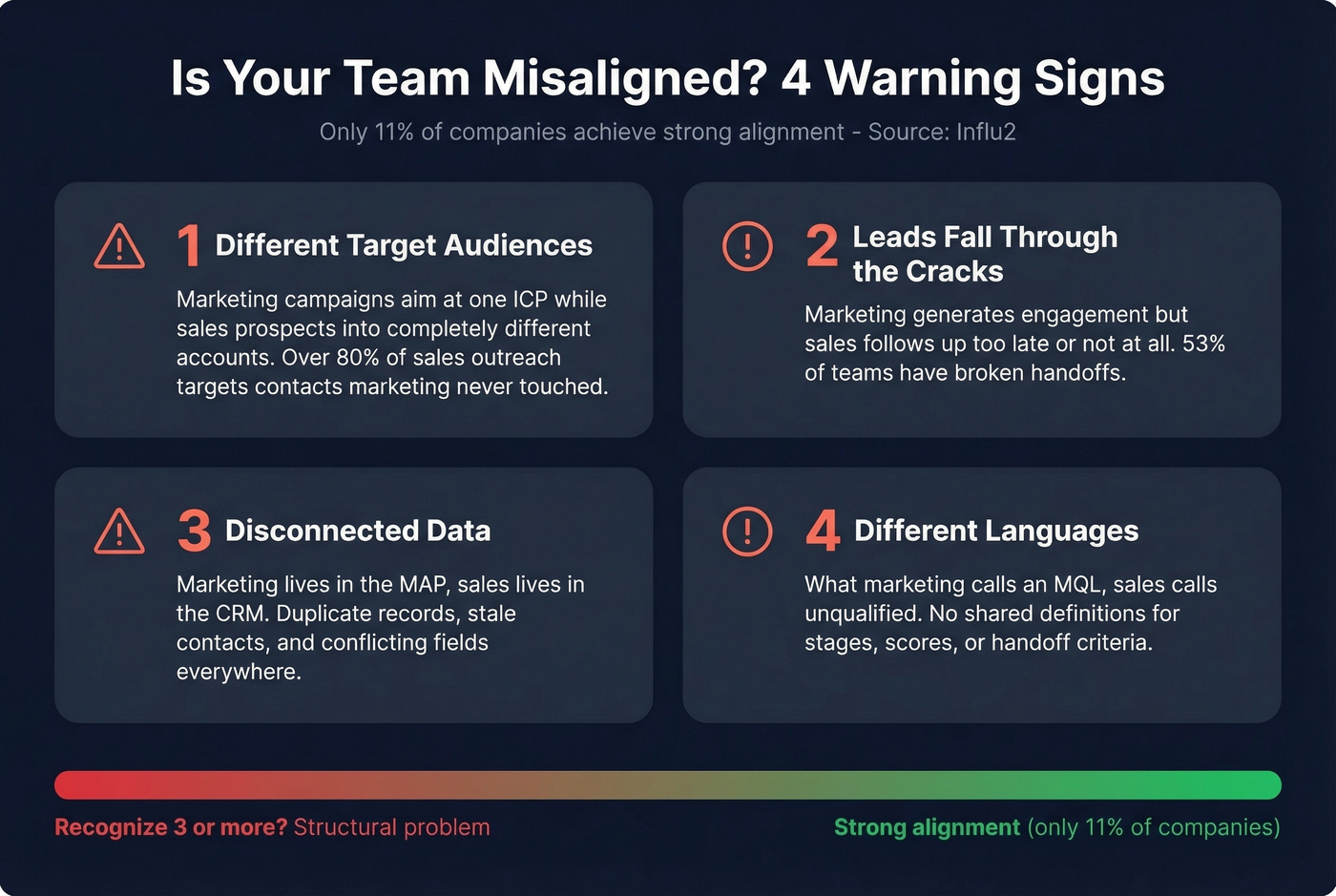
Influ2's alignment playbook identifies four symptoms that show up in nearly every misaligned organization. If you recognize three or more, you've got a structural problem - not a people problem.
Your teams target different audiences. Marketing runs campaigns aimed at one ICP while sales prospects into a completely different set of accounts. In broken-handoff organizations, over 80% of sales outreach targets contacts marketing never touched. That's not collaboration. That's two separate go-to-market motions running in parallel.
Leads fall through the cracks. Marketing generates engagement, but sales doesn't follow up - or follows up too late. The 53% broken-handoff stat isn't about lazy reps. It's about systems that don't surface the right leads at the right time. If you need a concrete process, start with these sales follow-up templates and standardize the first 7 days.
Your data is disconnected. Marketing lives in the MAP, sales lives in the CRM, and nobody trusts either system. Duplicate records, stale contacts, and conflicting fields make it impossible to track a lead from first touch to closed deal. This is exactly where data enrichment and lead enrichment stop being “nice-to-have” and become infrastructure.
Your teams speak different languages. What marketing calls an MQL, sales calls unqualified. What sales calls a hot lead, marketing calls an anomaly. Without shared definitions for stages, scores, and handoff criteria, every conversation becomes a translation exercise. A shared lead scoring model is usually the fastest fix.
Only 11% of companies achieve strong alignment. That's a staggering failure rate for something every GTM leader claims to prioritize.
How to Actually Align Sales and Marketing
Alignment isn't a workshop. It's an operating model. Andrew Kracov's framework - he ran marketing at Lattice - lays out the steps that actually work, and Influ2's research confirms the root fix: a shared revenue goal that both teams own.
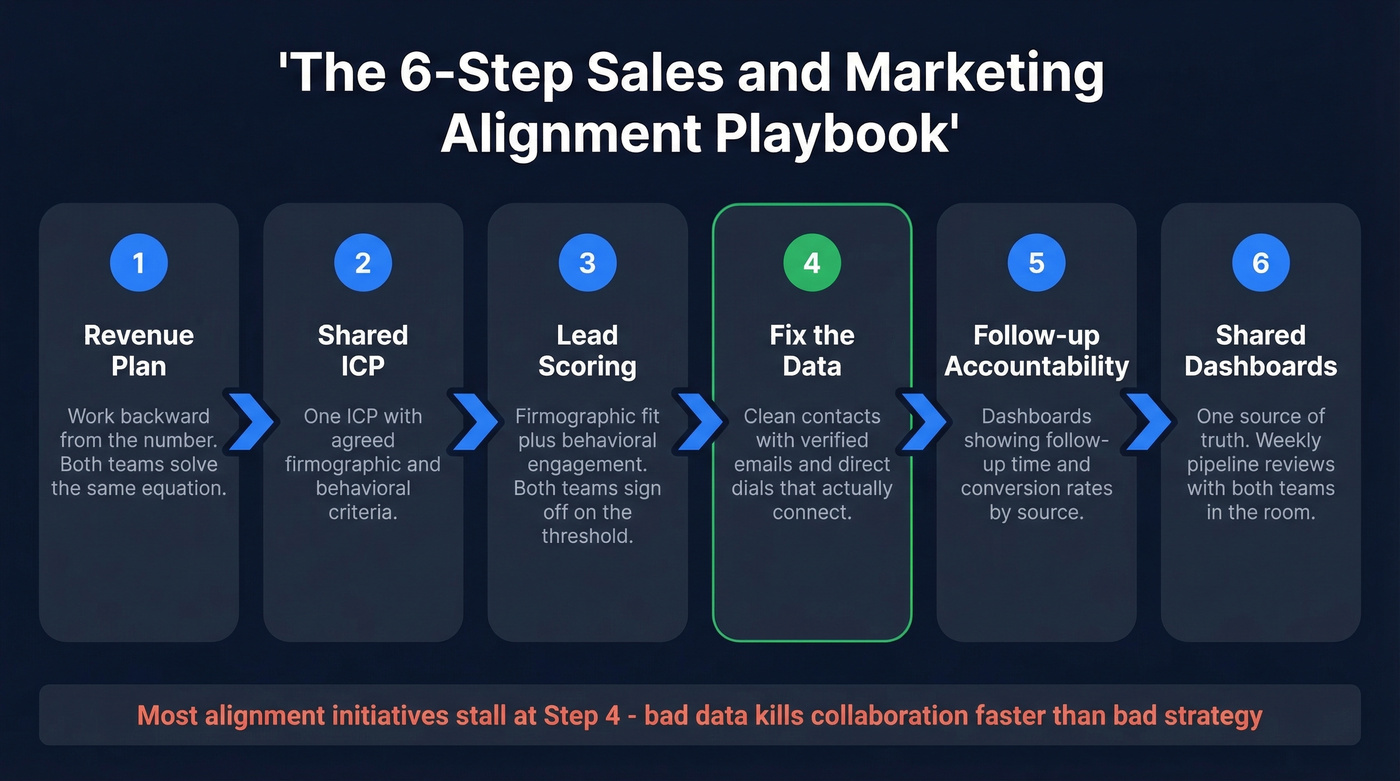
Step 1: Start with a revenue plan. Work backward from the number. What's the revenue target? What's the mix of new business, expansion, and upsell? How many deals does sales need to close, and how many qualified opportunities does marketing need to generate to hit that number? This math forces alignment because both teams are solving the same equation.
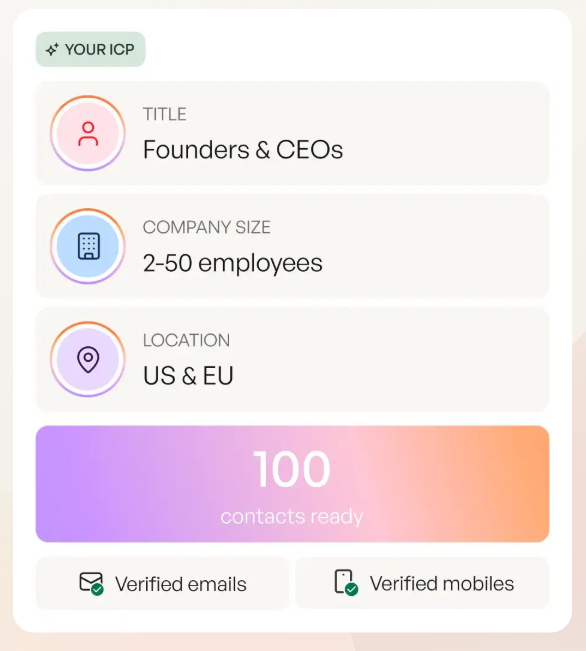
Step 2: Define the ICP together. Not marketing's ICP. Not sales' ICP. One ICP with agreed-upon firmographic, demographic, and behavioral criteria - size, title, geography, industry, intent signals - all codified and operationalized in a lead scoring model both teams trust. If you want a starting point, use an ideal customer profile template.
Step 3: Build a lead scoring model both teams agree on. Firmographic fit plus behavioral engagement equals a score. When the score crosses a threshold, the lead moves to sales. Both teams sign off on the threshold. No more "these leads are garbage" conversations.
Step 4: Fix the data. I've watched more alignment initiatives stall at this step than any other. Alignment breaks when sales calls a number and nobody picks up, or sends an email that bounces. Clean contact data isn't a nice-to-have - it's a structural requirement. Prospeo's 98% email accuracy and 125M+ verified mobile numbers with a 30% pickup rate eliminate the most common source of finger-pointing: bad contact data. When every lead comes with a verified email and a direct dial that actually connects, the "marketing sent us junk" excuse disappears.
Step 5: Create follow-up accountability. Dashboards showing follow-up time, lead movement through stages, and conversion rates by source. Pre-brief sales before campaigns launch. Provide follow-up messaging and reports. The most effective organizations put SDR/BDR teams and demand gen under one leader - this eliminates the handoff entirely because the same person owns both demand creation and demand conversion. If your SDRs need a refresh, use these sales prospecting techniques to standardize outreach quality.
Step 6: Share a dashboard, share a goal. Subordinate team-specific metrics to shared revenue outcomes. Marketing's MQLs matter, but only insofar as they convert to pipeline. Sales' activity metrics matter, but only insofar as they close revenue. One dashboard. One number. Alignment can increase marketing-generated growth by 208% according to a LinkedIn ABM study. That's not a rounding error.
69% of buyers see inconsistencies between what marketing says and what sales tells them. That gap shrinks when both teams pull from the same enriched contact records. Prospeo returns 50+ data points per contact at 92% match rate - so marketing segments accurately and sales walks into calls fully informed.
One platform, one dataset, zero misalignment excuses.
AI Is Blurring the Line
Per McKinsey's 2025 survey, 78% of organizations now use AI in at least one business function, up from 55% in 2023. In the sales versus marketing divide specifically, the boundary is dissolving faster than org charts can keep up.
AI in sales can increase leads by up to 50% and cut customer acquisition costs by up to 60%. A ZoomInfo survey of 1,000+ GTM professionals found that AI users book 60% more demos and meetings, with email response rates improving nearly 90%. Even more telling: 81% of frequent AI users report shorter deal cycles. Gartner predicts that by 2027, 95% of seller research workflows will begin with AI - up from under 20% in 2024. If you're building this into your motion, start with AI sales follow-up and best AI for automating sales follow-ups.
On the marketing side, AI is reshaping how buyers search for information and who makes purchasing decisions, as HBR framed it earlier this year. When 94% of buyers use LLMs during their buying process, the content marketing playbook changes fundamentally. Marketing isn't just competing for Google rankings anymore - it's competing for LLM citations. TrustRadius's 2025 data shows 72% of B2B buyers now encounter AI Overviews in search, and 90% click at least one cited source.
Let's be honest about where this is heading. When an AI SDR can research a prospect, personalize an email, and book a meeting without human intervention - and an AI marketing tool can score leads, trigger nurture sequences, and route hot prospects to sales automatically - the functional difference between the two departments is the budget line they report to. The work itself is converging. Within three years, most mid-market companies won't have separate "sales ops" and "marketing ops" teams. They'll have one revenue team with different specializations.
RevOps: Where It All Merges
The organizational response is Revenue Operations. RevOps is the structural acknowledgment that sales, marketing, and customer success are one revenue engine that needs unified data, processes, and technology. If you're mapping roles and scope, this RevOps manager breakdown is a useful reference.
The RevOps software market is projected to grow from $3.45B in 2024 to $10.25B by 2033, a 13.5% CAGR. The "VP of RevOps" title has grown 300% over the past 18 months. 79% of organizations entering 2026 have a formal RevOps function, and Gartner projects that 75% of high-growth companies will operate with a RevOps model by 2026.
Compensation reflects the strategic importance. Entry-level RevOps managers earn $100K-$160K. Experienced directors can reach $273K in total comp, with a 20-30% premium in San Francisco and New York. If you're a marketing or sales leader wondering where the career path leads, RevOps is increasingly the answer - the person who owns the full funnel, not just one half of it.
Careers and Compensation
Here's a number that surprises almost everyone: marketing managers earn more than sales managers at the median.
| Metric | Marketing Managers | Sales Managers |
|---|---|---|
| Median salary (2024) | $161,030 | $138,060 |
| Employment (2024) | 407,000 jobs | 619,500 jobs |
| Job outlook (2024-34) | 6% growth | 5% growth |
| Annual openings | ~36,400 | ~49,000 |
The common assumption is that sales pays more because of commissions. At the individual contributor level, that's often true - a top-performing AE can out-earn most marketing ICs. But at the management level, marketing managers command a $23K premium at the median. The likely explanation is that marketing management requires a broader skill set spanning analytics, creative direction, technology, and strategy, and the talent pool is tighter relative to demand.
Sales has more total jobs and more annual openings, which makes it an easier field to break into. Marketing has slightly faster growth and higher median pay at the management level. Neither is "better" - they're different career bets with different risk-reward profiles. Skip sales if you hate rejection. Skip marketing if you need fast feedback loops.
FAQ
Is sales harder than marketing?
They demand different tolerances. Sales requires rejection resilience and real-time persuasion under pressure. Marketing requires analytical patience and comfort with ambiguous, long-horizon results. The 86% B2B purchase stall rate suggests both functions face enormous difficulty - just in different forms.
Should a startup hire sales or marketing first?
Marketing first in most cases - you need demand before you need closers. The exception is enterprise deals above $50K ACV where founder-led outreach is the initial GTM motion. There, the first marketing hire comes when outbound alone can't fill the pipeline.
What's an MQL vs an SQL?
An MQL meets marketing's engagement criteria - content downloads, pricing page visits, lead score threshold. An SQL has been vetted by sales for budget, authority, need, and timeline. The handoff between them is where most alignment breaks, which is why 53% of companies have broken handoffs. The consensus on r/sales is that the MQL label itself is becoming meaningless without shared scoring criteria - and we'd agree.
What tools help align sales and marketing?
A shared CRM like HubSpot or Salesforce, a lead scoring model both teams agree on, and verified contact data so leads don't die on handoff. Layer in a shared dashboard and a revenue target both teams own, and you've got the infrastructure for real alignment.