

The Benchmark-Driven Digital Marketing Strategy for B2B in 2026
Most B2B marketing strategies aren't strategies at all - they're channel shopping lists. Pick LinkedIn, add some SEO, sprinkle in Google Ads, spread the budget, hope pipeline shows up. The teams that actually win treat their digital marketing strategy for B2B as a system: ICP first, data foundation second, channels third, measurement always.
Here's the framework, backed by the benchmarks that matter.
Why Most B2B Marketing Strategies Fail
The B2B buying landscape has shifted faster than most marketing teams have adapted. A Google/National Research Group survey of 2,063 senior US business leaders found that nearly three-quarters complete their purchasing journey in 12 weeks or less. Even more telling: 58% of buyers who made a B2B purchase in the past six months also switched vendors during that period.
Twelve-week cycles. Majority vendor switching. That's the environment you're marketing into.
The failure pattern goes like this: a team picks five channels because a competitor uses them, splits budget roughly evenly, runs campaigns for two quarters, then wonders why pipeline didn't move. The problem isn't the channels. It's the absence of a system connecting ICP definition to data quality to channel selection to measurement. We've watched this play out dozens of times across the companies we work with, and the root cause is almost always the same - teams optimize tactics before they've nailed the fundamentals.
Most B2B companies don't have a strategy problem. They have a sequencing problem. They're optimizing LinkedIn ads before verifying whether their contact data is even deliverable. They're running ABM plays without defining which accounts actually matter.
The Short Version
If you're pressed for time, here's the entire approach in six principles:
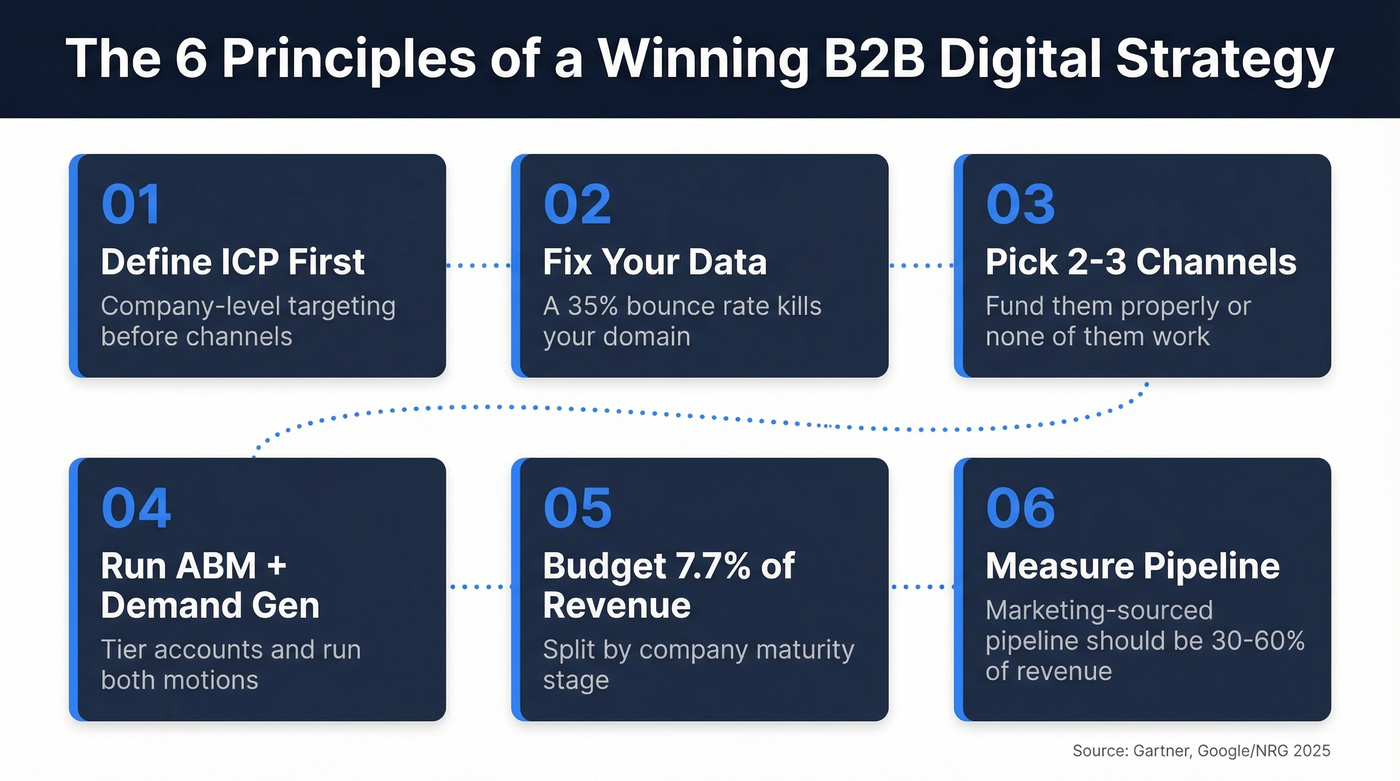
- Define your ICP before choosing channels. Company-level targeting comes first. Channels are delivery mechanisms.
- Fix your data foundation first. A 35% bounce rate will tank your domain reputation faster than any campaign can build pipeline.
- Pick 2-3 channels and fund them properly. Spreading budget across six channels means none of them work.
- Run ABM and demand gen together. The best B2B companies don't pick one - they tier accounts and run both motions simultaneously.
- Budget 7.7% of revenue and split by maturity stage. Early-stage companies lean demand-heavy. Mature companies invest more in brand.
- Measure pipeline contribution, not vanity metrics. If marketing-sourced pipeline isn't 30-60% of revenue targets, something's broken upstream.
The rest of this guide gives you the numbers behind each step.
The B2B Buyer in 2026
Your buyer doesn't follow a funnel anymore. Gartner's research shows 75% of B2B buyers prefer a rep-free sales experience. They want to research, compare, and shortlist without talking to anyone. But here's the nuance most "digital-first" evangelists miss: buyers who use supplier digital tools in partnership with a sales rep are 1.8x more likely to complete a high-quality deal than those going fully self-serve.
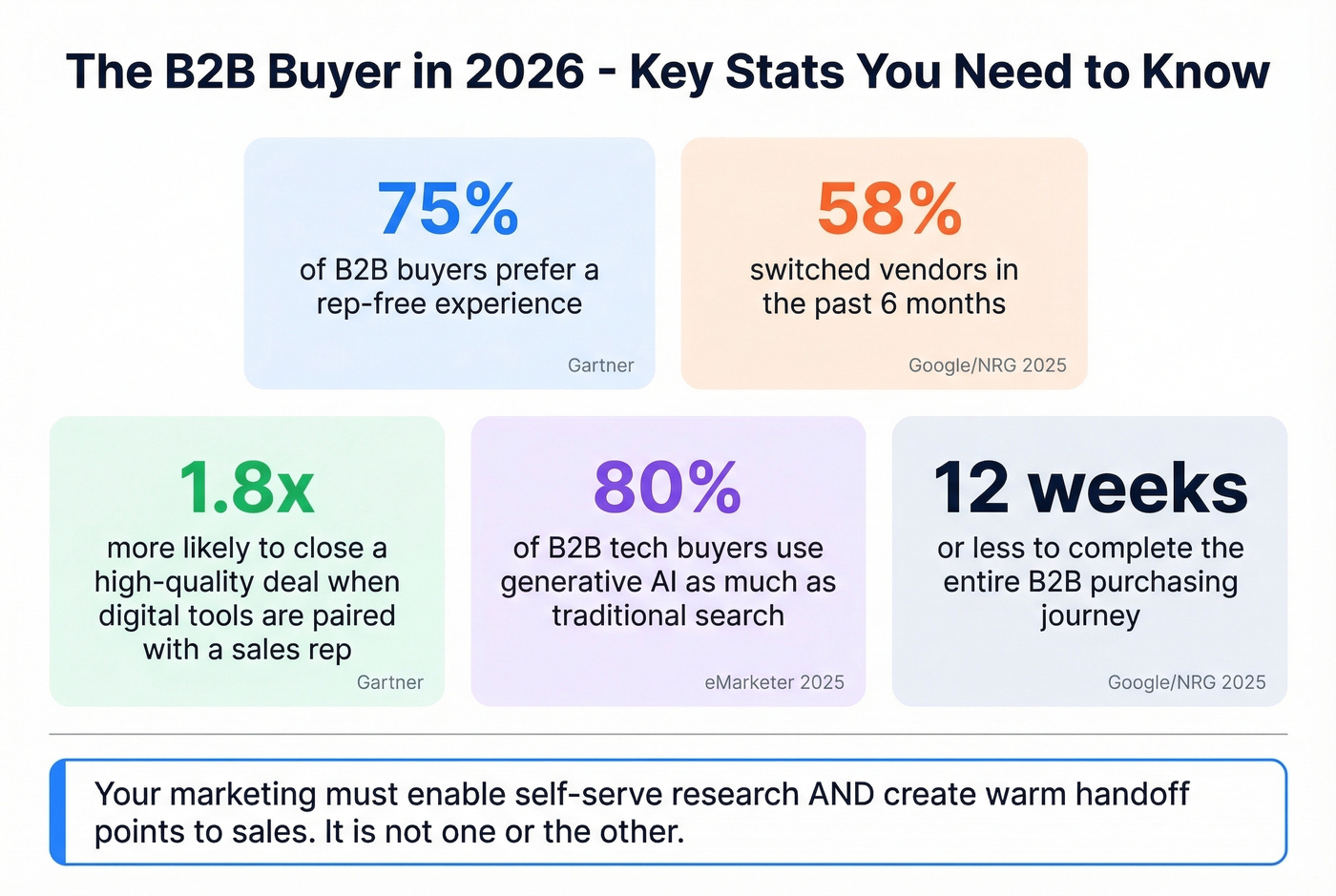
So your online marketing needs to do two jobs: enable self-serve research and create warm handoff points to sales.
Gartner describes the modern B2B buying journey as "looping" - buyers cycle through six buying jobs (problem identification, solution exploration, requirements building, supplier selection, validation, consensus creation), often revisiting stages multiple times. Meanwhile, 80% of global B2B tech buyers now use generative AI as much as traditional search when researching vendors. Your content needs to show up in AI Overviews and chat-based search, not just traditional SERPs.
This isn't a linear funnel. It's a buying committee of 6-10 people looping through research, validation, and consensus - mostly without you in the room.

The article above proves it: bad data kills B2B strategies before they start. Prospeo's 300M+ profiles with 30+ filters - intent data, technographics, headcount growth, funding - let you build ICP-matched lists that actually convert. 98% email accuracy. 7-day refresh. $0.01 per email.
Stop burning budget on bounced emails. Build your ICP list on verified data.
A 6-Step B2B Digital Strategy Framework
Step 1 - Define Your ICP and Personas
Your ICP (Ideal Customer Profile) describes the company - industry, headcount, revenue range, tech stack, growth signals. Your buyer persona describes the individual - the VP of Marketing who signs off, the RevOps manager who evaluates, the CFO who approves budget. Start with the ICP. Without it, every downstream decision is a guess.
A useful ICP includes:
- Firmographics: Industry, company size, geography
- Technographics: Tools they already use - CRM, marketing automation, data platforms
- Intent signals: Are they actively researching solutions in your category? Bombora tracks 15,000 intent topics that reveal which companies are in-market right now
- Growth signals: Recent funding, headcount growth, relevant job postings
The persona layer comes next. Map the buying committee - who initiates, who evaluates, who blocks, who signs. For enterprise deals, you're looking at 6-10 people across 3-4 departments, each needing different messaging and different proof points.
Here's the thing: the biggest bottleneck isn't channel selection. It's ICP clarity. Teams burn six figures on campaigns targeting the wrong companies because nobody locked down the ICP first.
Step 2 - Build Your Data Foundation
Skip this step and everything downstream breaks.
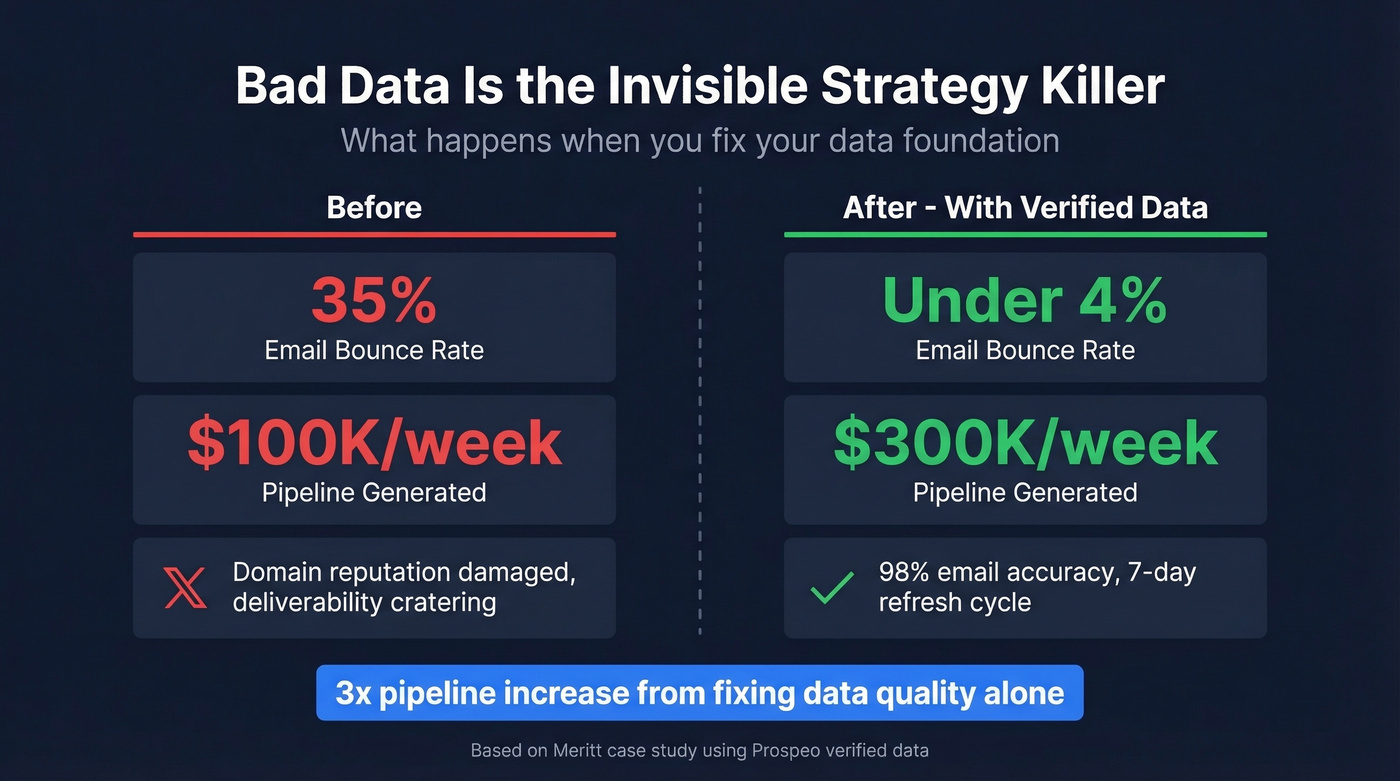
You build a list of 5,000 contacts matching your ICP. You load them into your sequencer. You launch. And 35% of those emails bounce. Your email service provider flags your domain. Deliverability craters. Even the good contacts on your list stop receiving your emails because your sender reputation is destroyed.
That's not a hypothetical - it's the most common failure mode in outbound B2B marketing. Meritt, a B2B sales consultancy running outbound campaigns for clients, hit exactly this wall. Their bounce rate was running 35%. After switching to verified data through Prospeo's B2B leads database, it dropped to under 4%, and their pipeline tripled from $100K to $300K per week. The 5-step verification process - catch-all handling, spam-trap removal, honeypot filtering - maintains 98% email accuracy across 143M+ verified emails, refreshed on a 7-day cycle versus the 6-week industry average.

The invisible strategy killer in B2B marketing isn't bad creative or wrong channels. It's bad data. Any digital marketing plan for B2B falls apart without a clean, verified contact foundation. Fix this before you spend a dollar on ads.
Step 3 - Choose Your Channel Mix
Once your ICP is defined and your data is clean, you can make informed channel decisions. Not "let's try everything" but "let's fund 2-3 channels where our buyers actually spend time, at levels that move the needle."
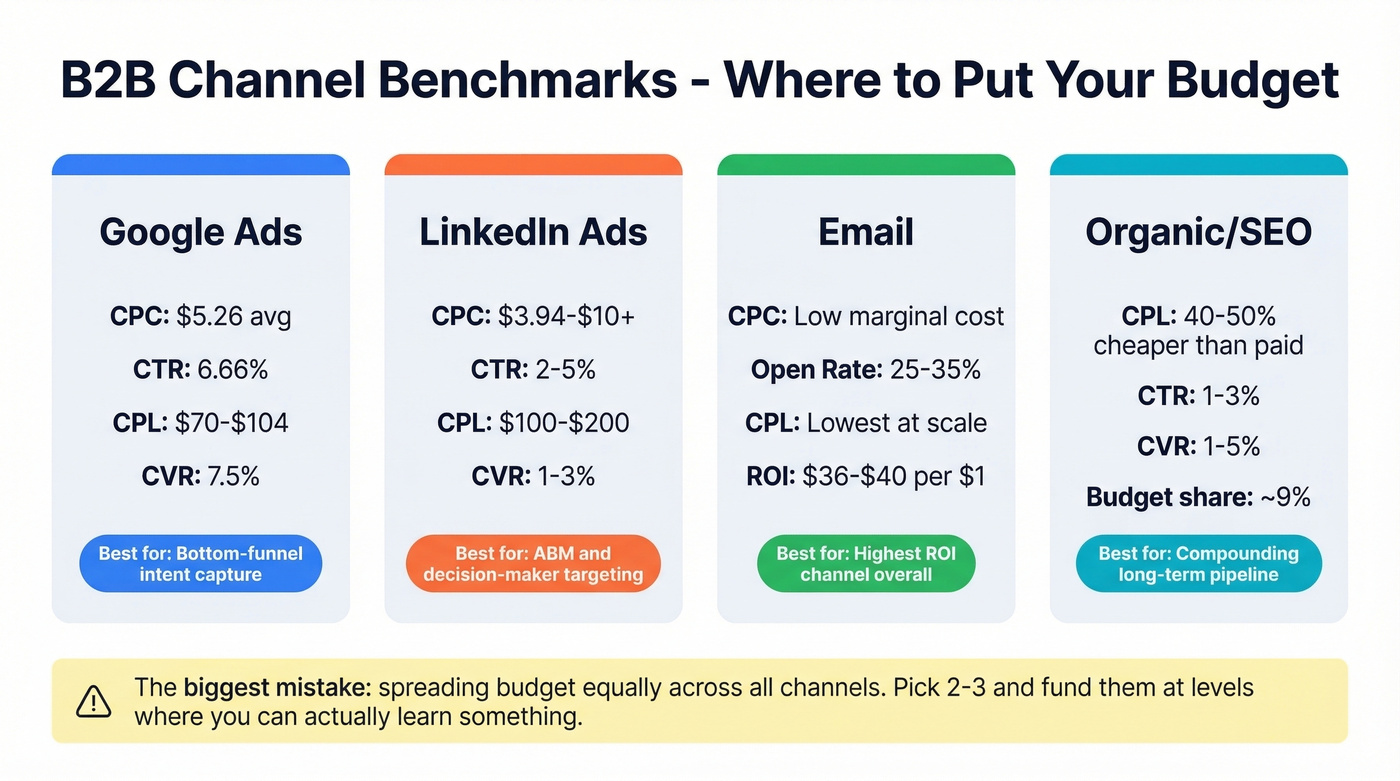
These benchmarks should guide your allocation:
| Channel | Cost Signal | CTR | CPL Range | CVR |
|---|---|---|---|---|
| Google Ads | ~$5.26 CPC | 6.66% avg | $70-$104 | ~7.5% avg |
| LinkedIn Ads | $3.94-$10+ CPC | 2-5% | $100-$200 | 1-3% |
| Low marginal cost | 2-4% click-through; 25-35% open rate | Lowest at scale | $36-$40 per $1 spent | |
| Organic/SEO | Time + content cost | 1-3% CTR | ~45-50% cheaper than paid | 1-3%, up to 5% |
Email remains the highest-ROI channel in B2B - $36-$40 returned for every $1 spent. But that ROI assumes your list is clean and your open rates hit the 25-35% benchmark. A bounce rate above 4% signals bad data and will erode deliverability fast. Keep unsubscribe rates below 0.3%. (If you need a deeper diagnostic, start with email bounce rate benchmarks and fixes.)
LinkedIn is expensive but targeted. A $3.94 median CPC sounds reasonable until you target senior decision-makers in specific industries - then you're looking at $10+ per click and CPLs in the $100-$200 range. Worth it for ABM plays. Less efficient for broad demand gen.
Organic is the long game that pays off. Organic CPL runs 40-50% cheaper than paid across most B2B verticals (B2B SaaS: $164 organic vs. $310 paid). SEO accounts for about 9% of the average digital marketing budget per Gartner's 2025 data, but it compounds in ways paid never will. The B2B companies dominating organic search are publishing comparison pages, technical guides, and webinar landing pages - not vague "thought leadership" posts. Webinar and audit landing pages push organic conversion rates to 5%. If you're investing in SEO without a content calendar tied to buyer intent keywords, you're building a house without a foundation.
Google Ads is the intent capture engine. At a $5.26 average CPC and 7.5% conversion rate, search ads work best for bottom-funnel queries where buyers are actively comparing solutions. Don't use search ads for awareness - that's what content and LinkedIn are for.
The mistake most teams make: spreading budget across all four channels equally. Pick two to start. Fund them at levels where you can actually learn something. Expand once you have data.
Step 4 - ABM and Demand Gen Together
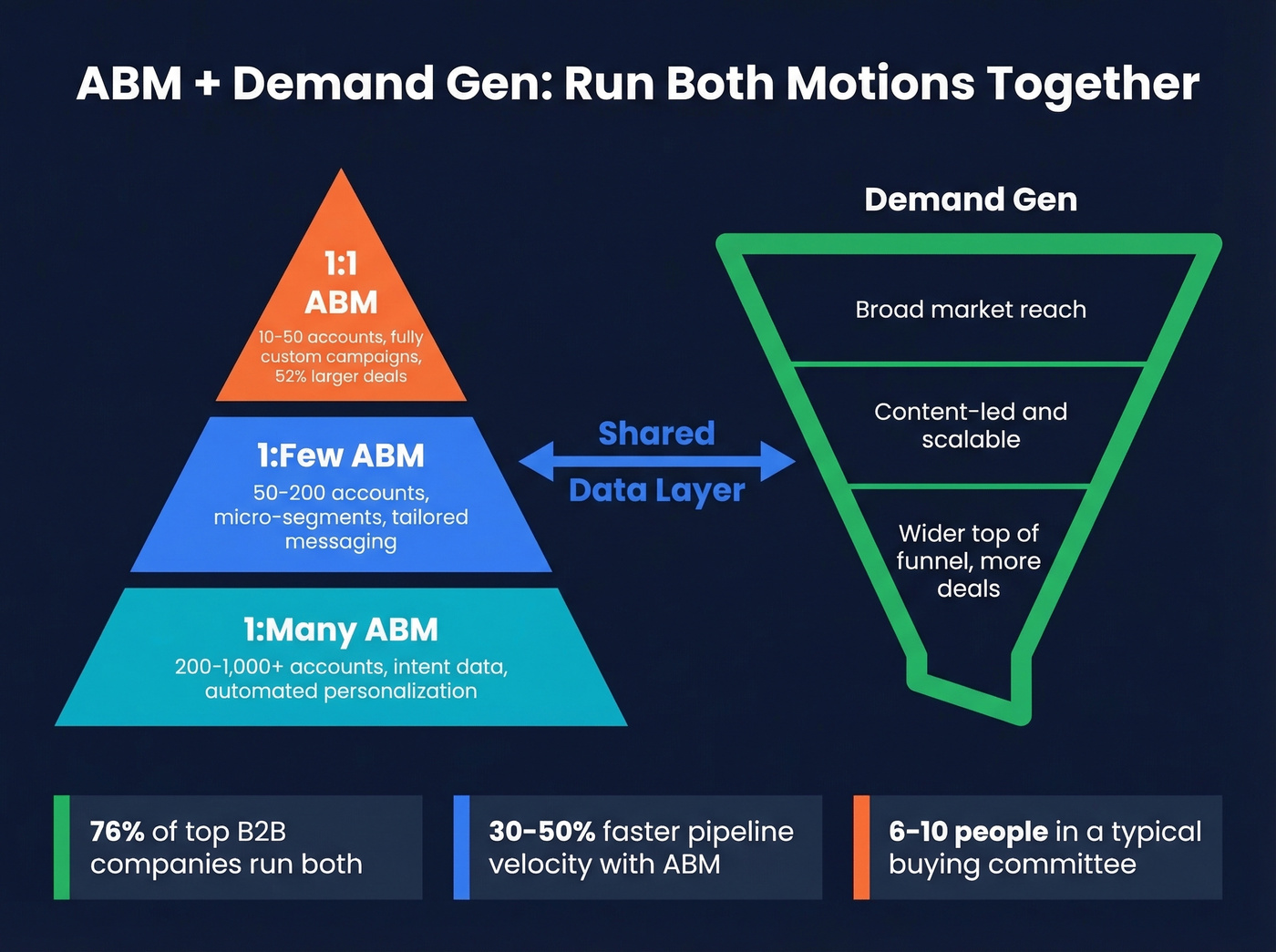
This isn't an either/or decision. 76% of top B2B companies run both motions simultaneously, and the data shows why.
| Dimension | ABM | Demand Gen |
|---|---|---|
| Focus | Named accounts | Broad market |
| Approach | Personalized, multi-threaded | Scalable, content-led |
| Deal impact | 52% larger deals | More deals, smaller ACV |
| Pipeline effect | 30-50% faster velocity | Wider top of funnel |
| Key metrics | Engagement score, pipeline | Leads, CPL, cycle length |
ABM works in tiers. 1:1 ABM targets your top 10-50 accounts with fully custom campaigns. 1:few ABM groups 50-200 similar accounts into micro-segments with tailored messaging. 1:many ABM scales to 200-1,000+ accounts using intent data and automated personalization.
The tiering decision comes down to deal size and buying committee complexity. High-ACV enterprise deals with 8+ stakeholders justify 1:1 investment. Mid-market deals fit the 1:few or 1:many model. Demand gen fills the top of funnel for everything else.
Sales-marketing alignment makes or breaks both motions. The teams that struggle are running ABM without sales input on account prioritization, or demand gen without shared definitions of what qualifies as a lead. Build a shared data layer - same CRM, same lead scoring, same ICP definition - so both teams work from the same reality. In our experience, the companies that get this right see their ABM deals close 30-50% faster because sales isn't re-qualifying what marketing already vetted. (If you want a tighter sales-side motion, use account-based selling best practices to operationalize it.)
Step 5 - Set Your Budget
The Gartner CMO Spend Survey pegged marketing budgets at 7.7% of company revenue - flat from the prior year. Despite that, 83% of B2B marketing decision-makers expect their investments to grow in 2026, with 40% expecting increases of 5% or more. The gap between ambition and funding makes allocation decisions critical.
Brand vs. demand split by company stage:
| Stage | Brand Investment | Demand/Performance |
|---|---|---|
| Early-stage | 10-20% | 80-90% |
| Scaling | 40-50% | 50-60% |
| Mature | ~60% | ~40% |
For tactical allocation, the industry benchmark splits roughly 42% to programs, 35% to personnel, and 23% to technology. The 70/20/10 rule provides a useful guardrail: 70% to proven channels, 20% to growth bets, 10% to experiments.
One number that should alarm you: 60% of MarTech spend is wasted due to underutilization. Before buying another tool, audit what you already have. The hybrid in-house/agency model is gaining traction - 46% of B2B marketing teams now run hybrid setups, up from 36% the year prior.
CPL reality by industry:
| Industry | Paid CPL | Organic CPL | Blended CPL |
|---|---|---|---|
| B2B SaaS | $310 | $164 | $237 |
| IT & Managed Services | $617 | $385 | $503 |
| Financial Services | $761 | $555 | $653 |
| Manufacturing | $691 | $415 | $553 |
These numbers from First Page Sage make the case for organic investment undeniable. In every vertical, organic leads cost roughly half what paid leads cost. If you aren't investing in content and SEO, you're leaving the cheapest pipeline source on the table.
Step 6 - Measure What Matters
Vanity metrics are comfortable. Pipeline metrics are useful. Track these by funnel stage:
Top of funnel: Website traffic, CTR on ads and content, cost per click. These tell you whether your channels are reaching the right audience at a reasonable cost.
Middle of funnel: MQL-to-SQL conversion rate (benchmark: 50%+), content engagement depth, email response rates. If your MQL-to-SQL rate is below 50%, the problem is usually lead quality, not sales follow-up. (To tighten definitions and handoffs, align on lead status and lead scoring.)
Bottom of funnel: Win rate, pipeline velocity, CAC, CLV. Marketing-sourced pipeline should contribute 30-60% of total revenue targets. Below 30%, marketing isn't pulling its weight. Above 60%, you're probably under-investing in sales-sourced pipeline. (For a clean dashboard, use pipeline health metrics.)
One diagnostic that cuts across all stages: if your email bounce rate exceeds 4%, the problem is your data, not your copy. Enrich and verify before you send.
AI's Role in B2B Marketing for 2026
95% of B2B marketers are using AI-powered tools as of mid-2025, and 45% are prioritizing AI tool investment for 2026. The adoption curve is over. The question now is which use cases actually move numbers.
The top applications are practical: generating marketing copy (89% of AI-using marketers) and creating visual/video assets (53%). These are speed upgrades, not strategy shifts.
The bigger shift is on the buyer side. 80% of B2B tech buyers use generative AI as much as traditional search when researching vendors. Your content strategy needs a GEO (Generative Engine Optimization) layer - it's not enough to rank on page one. Your content needs to be structured so AI models can surface it in conversational search results and AI Overviews. Clear, factual content with specific numbers wins over vague thought leadership. Structured data, FAQ schemas, and direct answers to common questions make your content more likely to appear in AI-generated summaries. The teams investing in content that serves both traditional and AI-driven search will have a compounding advantage over the next two years. (If you need a baseline, start with what is B2B content marketing.)
7 Mistakes That Kill B2B Campaigns
Marketing before positioning is clear. If your team can't articulate who you serve and why in one sentence, no ad spend will fix the confusion. (A practical next step: tighten B2B brand positioning.)
Internal jargon driving messaging. Your product team calls it "unified data orchestration." Your buyer calls it "getting clean contact lists." Talk like your buyer.
Not involving sales in strategy. Sales hears real objections daily. Build campaigns without that input and your messaging will miss.
Over-focusing on one channel. All-in on SEO? Great until an algorithm update wipes 40% of your traffic. Diversify.
Skipping data verification. A 35% bounce rate destroys your domain reputation and makes every future campaign less effective. We've seen teams spend months recovering from this. (If you're cleaning lists, start with email deliverability fundamentals.)
Chasing B2C trends. TikTok virality works differently in B2B. Adapt the principle (short-form video, trusted voices), not the tactic.
Only offering "buy now" CTAs. Only 1-3% of your market is ready to buy right now. Build capture paths for the other 97%.
Let's be honest about one thing: if your average deal size is under $10K, you probably don't need a complex multi-channel ABM stack. A clean prospect list, a good email sequence, and one paid channel will outperform a bloated strategy every time. Complexity isn't sophistication. The consensus on r/sales tends to agree - the teams obsessing over tool stacks are usually the ones underperforming on actual pipeline.
Meritt tripled pipeline from $100K to $300K/week by fixing one thing: data quality. Prospeo's 5-step verification, catch-all handling, and spam-trap removal dropped their bounce rate from 35% to under 4%. Your digital marketing strategy deserves the same foundation.
Every channel in your strategy performs better when your contact data is clean.
FAQ
How much should a B2B company spend on digital marketing?
The Gartner benchmark is 7.7% of company revenue, with growth-stage companies often pushing to 10-12% of ARR. Early-stage teams should allocate 80-90% to demand capture; mature companies shift toward a 60/40 brand-to-demand split. Tactical budgets typically break down as 42% programs, 35% personnel, and 23% technology.
What's the difference between ABM and demand generation?
ABM targets named accounts with personalized campaigns tailored to specific buying committees, while demand gen casts a wider net for volume and awareness. The best B2B companies run both simultaneously. ABM deals average 52% larger and close 30-50% faster, but demand gen keeps the top of funnel full.
How do I measure B2B digital marketing ROI?
Track pipeline contribution first - marketing-sourced pipeline should represent 30-60% of revenue targets. Then layer in CAC, CLV, and channel-specific benchmarks like email ROI ($36-$40 per $1 spent). An MQL-to-SQL conversion rate above 50% signals healthy lead quality; below that, revisit your targeting.
What's the best way to build a verified prospect list?
Start with your ICP - firmographics, technographics, and intent signals - then source contacts from a verified database matching those filters. Verify every email before loading into your sequencer; anything above a 4% bounce rate damages deliverability. Tools like Prospeo handle sourcing, verification, and enrichment in one step, with 98% email accuracy and a 7-day data refresh cycle.
Is SEO still worth it for B2B in 2026?
Absolutely. Organic CPL runs 40-50% cheaper than paid across most B2B verticals - $164 vs. $310 in B2B SaaS. But with 80% of buyers now using generative AI for vendor research, you need to optimize for AI Overviews and conversational search alongside traditional rankings. Structured, fact-rich content wins in both environments.