

12 Drip Campaign Examples With Sequences You Can Steal
You set up a welcome email, maybe a follow-up, and call it a "drip campaign." Three months later you're staring at a 0.16% conversion rate wondering what went wrong. The gap between a lazy email sequence and one that actually converts is enormous - Klaviyo's 2026 benchmarks show automated ecommerce flows convert at 2.11% versus 0.16% for one-off campaigns. That's 13x.
Every example below includes timing, subject lines, and copy you can steal today.
Start Here If You're Short on Time
Build these three drip sequences first - they cover the highest-ROI scenarios for almost any business:
- Welcome / onboarding sequence - your highest-open-rate emails, ever. Set the tone, deliver value, move people toward a first action.
- SaaS trial-to-paid sequence - 8 emails over 30 days with per-email benchmarks (full map below).
- Cold outbound prospecting sequence - 3-4 touches, spaced 2-4 business days apart, with full copy templates.
The anchor stat: automated email flows convert at 13x the rate of one-off campaigns. Marketing automation returns $5.44 for every $1 spent, and 70% of marketing leaders plan to increase their automation investment this year. This isn't a trend. It's infrastructure.
What Is a Drip Campaign?
A drip campaign is a series of pre-written emails sent automatically based on a trigger - someone signs up, abandons a cart, starts a trial - or on a fixed time interval. The key distinction from a one-off blast: drip campaigns respond to behavior. Someone downloads a whitepaper, they get a nurture sequence. Someone doesn't log in for a week, they get a re-engagement nudge.
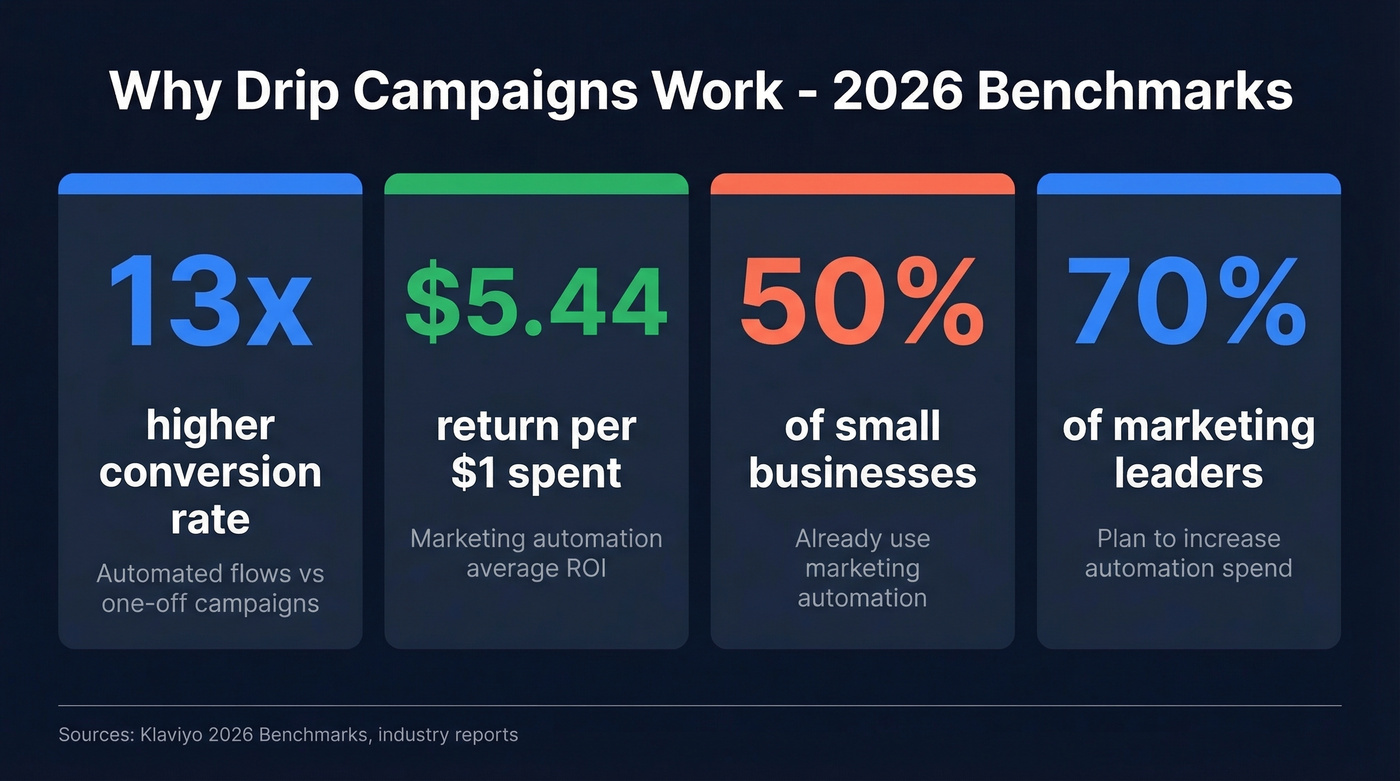
About 50% of small businesses already use marketing automation to run these sequences. Time-based drips send on a schedule (Day 1, Day 3, Day 7). Trigger-based drips fire when someone does something specific. The best campaigns combine both.
If you're building behavior-based flows, it helps to think in terms of targeted email campaigns rather than "newsletters."
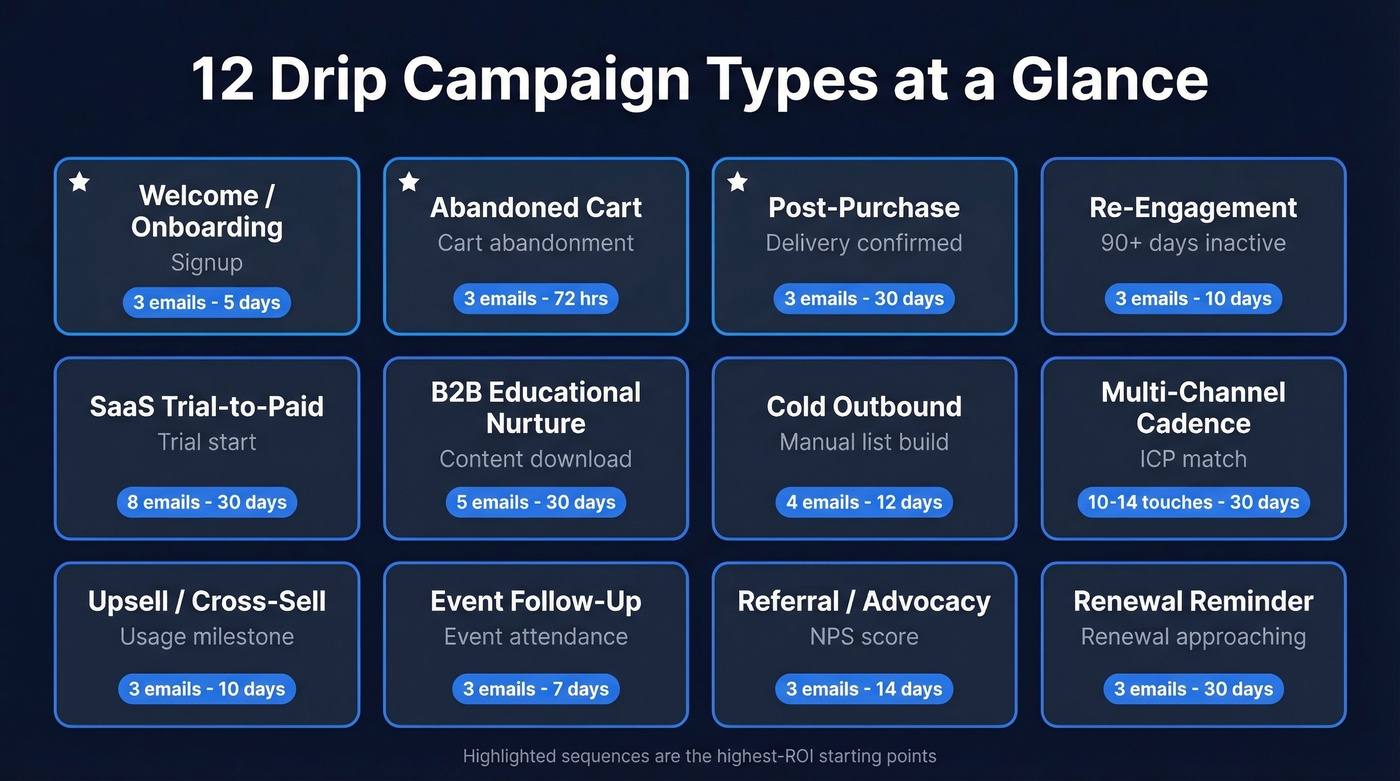
Every Sequence at a Glance
| Type | Trigger | Emails | Timeframe |
|---|---|---|---|
| Welcome / Onboarding | Signup | 3 | 5 days |
| Abandoned Cart | Cart abandonment | 3 | 72 hours |
| Post-Purchase / Feedback | Delivery confirmed | 3 | 30 days |
| Re-Engagement / Win-Back | 90+ days inactive | 3 | 10 days |
| SaaS Trial-to-Paid | Trial start | 8 | 30 days |
| B2B Educational Nurture | Content download | 5 | 30 days |
| Cold Outbound Prospecting | Manual list build | 4 | 12 days |
| Multi-Channel Cadence | ICP match | 10-14 | 30 days |
| Upsell / Cross-Sell | Usage milestone | 3 | 10 days |
| Event / Webinar Follow-Up | Event attendance | 3 | 7 days |
| Referral / Advocacy | NPS score or milestone | 3 | 14 days |
| Renewal / Subscription Reminder | Renewal approaching | 3 | 30 days |
Welcome / Onboarding Sequence
Your welcome emails will get the highest open rates you'll ever see - often 50%+. Don't waste them on a generic "thanks for signing up." Of all the sequences in this guide, this is the one to build first.
3 emails over 5 days:
- Email 1 (immediate): Deliver the promised value + set expectations. Subject line: "Welcome - here's what happens next" or "Your [resource] is inside."
- Email 2 (Day 2): Share your best content or a quick win. Subject line: "The one thing most [audience] miss."
- Email 3 (Day 5): Soft CTA - invite them to take the next step (book a call, start a trial, browse a collection). Subject line: "Ready for the next step?"
If you want more swipeable ideas, pull from these email subject lines and adapt them to your offer.
Brands like Le Sweat and Fishwife nail this by keeping the first email focused on a single action - not dumping every link and social channel into one message. One CTA per email. Always.
Abandoned Cart Sequence
The escalation structure here is everything. You're not just reminding - you're building urgency.
If you're sending at scale, keep an eye on email bounce rate so cart recovery doesn't turn into deliverability damage.
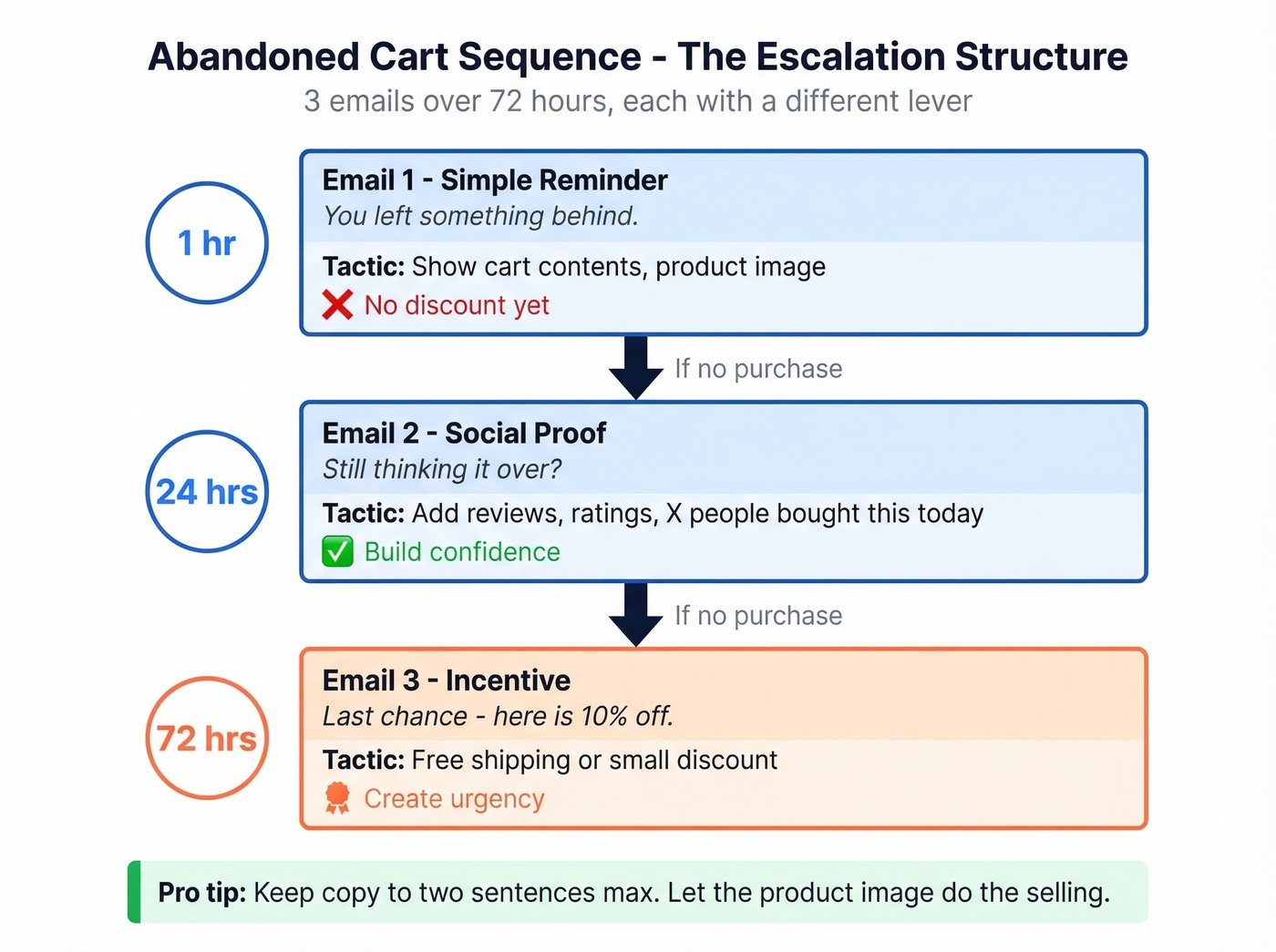
- Email 1 (1 hour after abandonment): Simple reminder with cart contents. No discount yet. Subject: "You left something behind."
- Email 2 (24 hours): Add social proof - reviews, ratings, "X people bought this today." Subject: "Still thinking it over?"
- Email 3 (72 hours): Introduce a small incentive (free shipping, 10% off). Subject: "Last chance - here's 10% off."
Graza does this well by showing the actual product image and keeping copy to two sentences. The cart does the selling.
Post-Purchase Feedback Sequence
Most teams skip this entirely, which is a mistake. Post-purchase emails drive reviews, repeat purchases, and referrals.
- Email 1 (Day 3-5 after delivery): Check in - "How's everything?" Keep it human.
- Email 2 (Day 10-14): Ask for a review. Make it one-click easy.
- Email 3 (Day 21-30): Cross-sell or recommend complementary products based on what they bought.
Re-Engagement / Win-Back Sequence
If someone hasn't opened an email in 90+ days, they're either disengaged or your emails are hitting spam. Either way, you need a plan.
- Email 1: "We miss you - here's what's new." Lead with value, not guilt.
- Email 2 (5 days later): "Last chance to stay on the list." Be direct about what happens if they don't engage.
- Email 3 (10 days later): Remove them. Seriously.
This sequence isn't about saving every subscriber. It's about identifying who's still alive and pruning the rest. A clean list outperforms a bloated one every time, and your deliverability depends on it.
For the deeper mechanics, follow an email deliverability guide before you run win-backs.
SaaS Trial-to-Paid Sequence
This is the one to bookmark. Based on Sequenzy's documented 8-email nurture over 30 days, here's a full sequence map with performance data:
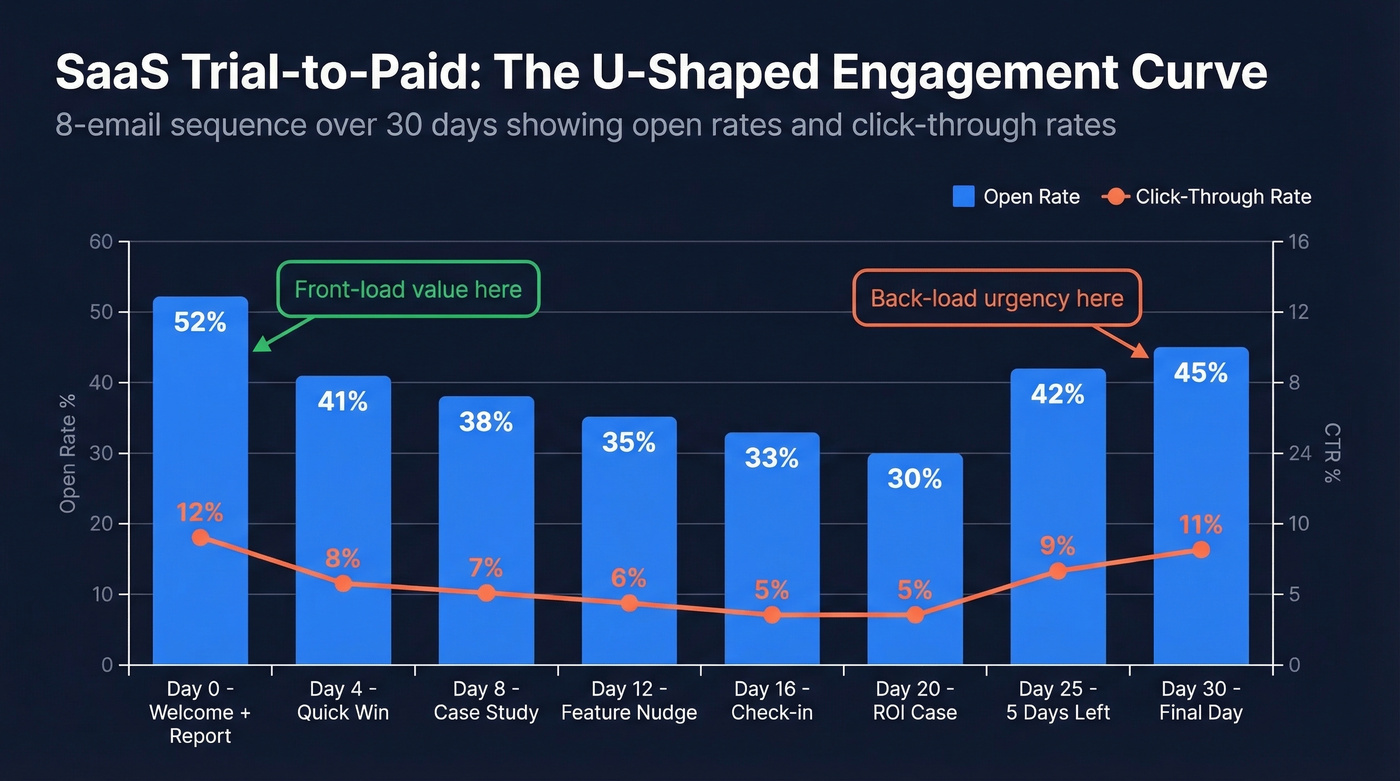
| Day | Subject Line | Open Rate | CTR |
|---|---|---|---|
| 0 | Your report + what most companies miss | 52% | 12% |
| 4 | Quick win: try [feature] today | 41% | 8% |
| 8 | How [company] solved [problem] | 38% | 7% |
| 12 | You're missing this feature | 35% | 6% |
| 16 | Your trial: what's working? | 33% | 5% |
| 20 | The ROI case for [product] | 30% | 5% |
| 25 | Your trial ends in 5 days | 42% | 9% |
| 30 | Final day - here's what you'll lose | 45% | 11% |
Notice the U-shape in engagement - the first and last emails perform best. The urgency emails on Day 25 and Day 30 nearly match the welcome email. Structure your trial sequence to front-load value and back-load urgency.
If you're selling SaaS, it also helps to map this to your SaaS sales motion so the emails match how buyers actually evaluate.
B2B Educational Nurture
As one B2B marketer put it on r/sales, nurturing should be "a system, not just a drip of emails." The best sequences move prospects through education, social proof, and a soft conversion ask - giving your champion the ammunition to sell internally.
- Email 1 (Day 0): Educational resource - solve a real problem. Subject: "The [industry] playbook you haven't seen."
- Email 2 (Day 5): Case study - show results from a similar company. Subject: "How [company] cut [metric] by 40%."
- Email 3 (Day 12): Value recap - summarize what they get. Subject: "What you actually get with [product]."
- Email 4 (Day 20): Problem spotlight - agitate the pain without fear-mongering. Subject: "The hidden cost of [status quo]."
- Email 5 (Day 30): Soft demo invite. Subject: "Worth 15 minutes?"
For longer sales cycles, extend this to 10 emails over 60 days and include tools for internal selling - ROI calculators, readiness checklists, and comparison guides. If your ESP supports AI-powered personalization, use it here to dynamically swap case studies and pain points based on the prospect's industry.
If you need a framework for the content itself, start with B2B content marketing and build your nurture around it.
Cold Outbound Prospecting
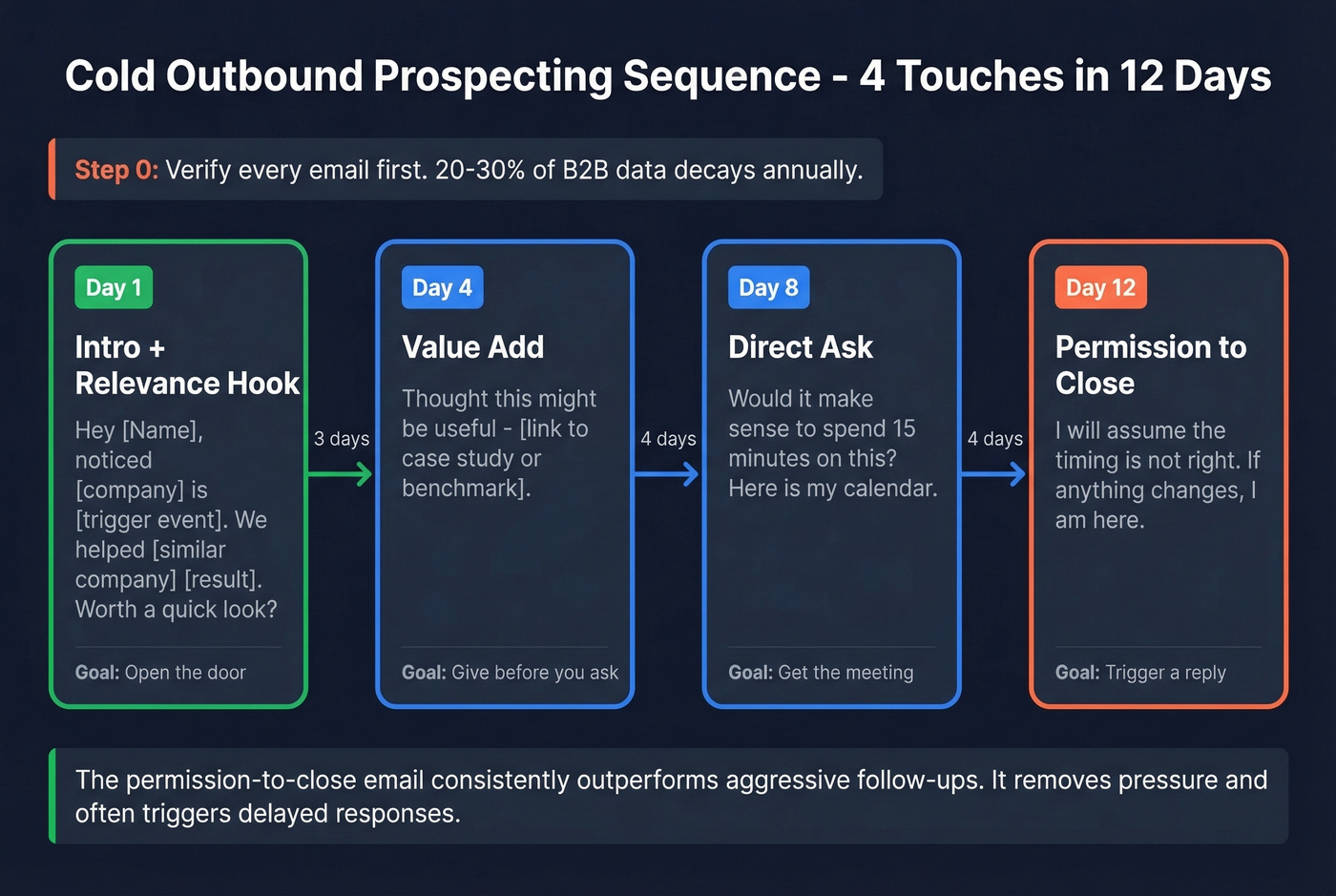
Here's where most automated sequences fall apart - not because the copy is bad, but because the data is bad. 20-30% of B2B contact data decays annually. If you're loading unverified emails into your sequencer, you're burning your domain before the first send.
Verify every email before it enters your sequence. Prospeo handles this with 98% accuracy, catch-all domain verification, and spam-trap removal - at roughly $0.01 per email. The free tier includes 75 email verifications per month plus 100 Chrome extension credits, enough to test your first sequence without spending a dime.

Now, the sequence itself. Based on Instantly's cold email framework, here's a 4-touch structure spaced 2-4 business days apart:
- Email 1 (Day 1): Intro + relevance hook. "Hey [Name], noticed [company] is [trigger event]. We helped [similar company] [result]. Worth a quick look?"
- Email 2 (Day 4): Value add - share a resource, not a pitch. "Thought this might be useful - [link to case study or benchmark]."
- Email 3 (Day 8): Direct ask. "Would it make sense to spend 15 minutes on this? Here's my calendar."
- Email 4 (Day 12): Permission to close. "I'll assume the timing isn't right. If anything changes, I'm here."
Here's the thing: the "permission to close" email consistently outperforms aggressive follow-ups. In our experience, it's respectful, it removes pressure, and it often triggers a response from people who were meaning to reply but kept putting it off.
If you want a full build guide, start with a B2B cold email sequence and then layer in these drip timings.
Multi-Channel Outbound Cadence
Email-only outbound is leaving replies on the table. The 30 Minutes to President's Club blueprint recommends 10-14 touches over 30 days across email, phone, and social - and reports 20%+ reply rates.
Why does this work? Multi-channel buys you more touches without spamming one inbox. Fourteen emails feels aggressive. Five emails, four calls, and five social touches feels like persistence. Each email should have a single theme, and when you change themes, change the subject line. The "bubble-up" technique - replying to your own earlier thread to resurface your best email - is underrated and worth testing.
Social touches aren't about direct selling. They're about making your name familiar so when the email lands, it gets opened.
A note on SMS drip campaigns: 95% of texts are opened within three minutes, making them powerful for appointment reminders, flash sales, and cart recovery. But compliance requirements (TCPA, opt-in rules) are strict. If you're in ecommerce or local services, SMS drip is worth adding to your stack - just make sure you have explicit consent.
If you're operationalizing this, a sequence management process keeps touches consistent across channels.
Upsell / Cross-Sell Sequence
Trigger these based on purchase history or usage milestones - not arbitrary timelines. An upsell email that arrives when someone just hit a usage limit converts dramatically better than one sent on a calendar schedule.
- Email 1 (triggered by milestone): "You've hit [milestone] - here's what teams like yours do next."
- Email 2 (5 days later): Feature spotlight or product recommendation with social proof.
- Email 3 (10 days later): Limited-time offer or exclusive access.
The trigger matters more than the copy. We've seen upsell sequences with mediocre writing outperform beautifully crafted emails that arrived at the wrong time.
If you're unsure how to frame the offer, use this cross selling vs upselling breakdown to pick the right angle.
Event / Webinar Follow-Up
Most teams send one follow-up email after a webinar and call it done. That's pipeline you're losing.
- Email 1 (same day): Replay link + slide deck + any promised resources. Subject: "Your [event name] replay is ready."
- Email 2 (Day 3): One key takeaway, expanded. Subject: "The one thing from [event] worth remembering."
- Email 3 (Day 7): Next step CTA - book a call, start a trial, join the next event. Subject: "Ready to put this into practice?"
Referral / Advocacy
Your happiest customers are a growth channel most teams ignore. Trigger this sequence after a high NPS score, a positive review, or a usage milestone that signals satisfaction.
- Email 1 (triggered by NPS 9-10 or positive review): Thank them genuinely, then make the ask simple. Subject: "You made our day - quick favor?" Include a one-click referral link with a clear incentive.
- Email 2 (Day 5): Remind them of the referral offer and add social proof - "47 customers referred a friend last month." Subject: "Your referral link is still waiting."
- Email 3 (Day 14): Shift to advocacy - invite them to a case study, testimonial, or community. Subject: "Want to be featured?"
Don't ask for referrals from everyone. Ask from people who've already demonstrated they love the product. A targeted referral sequence to your top 10% of customers will outperform a blanket ask to your entire list every time.
Renewal / Subscription Reminder
Churn prevention starts 30 days before the renewal date, not the day the subscription lapses.
- Email 1 (30 days before renewal): Recap the value they've received. Subject: "Your year with [product] - by the numbers." Include usage stats, features used, and outcomes achieved. Make them feel the loss before it happens.
- Email 2 (14 days before): Address common objections and offer a renewal incentive if applicable. Subject: "Quick question about your renewal."
- Email 3 (3 days before): Urgency + clear action. Subject: "Your [product] access expires in 3 days." Make renewal one click.
For SaaS products, the Day 30 email with personalized usage data is the highest-leverage email in this entire sequence. If someone used your product 200 times this year, show them that number. It's hard to cancel something you clearly depend on.

Every drip sequence above falls apart if your emails bounce. Bad data kills deliverability, tanks sender reputation, and wastes every subject line you A/B tested. Prospeo delivers 98% email accuracy with a 7-day refresh cycle - so your welcome, nurture, and cold outbound drips actually land.
Stop writing perfect sequences for addresses that don't exist.
2026 Benchmarks for Drip Campaigns
Let's ground these examples in real numbers. Here's what "good" looks like right now, based on two of the largest datasets available.
Overall email benchmarks - MailerLite's full-year dataset covering 3.6M campaigns:
| Metric | Latest Median | Prior Year |
|---|---|---|
| Open rate | 43.46% | 42.35% |
| Click rate | 2.09% | 2.0% |
| Click-to-open | 6.81% | 5.63% |
| Unsubscribe | 0.22% | 0.08% |
The unsubscribe jump is partly driven by Gmail's one-click unsubscribe button - not necessarily worse content.
Automated flows vs. one-off campaigns - Klaviyo's 2026 benchmarks across 183K+ ecommerce brands:
| Metric | Campaigns (Avg) | Campaigns (Top 10%) | Flows (Avg) | Flows (Top 10%) |
|---|---|---|---|---|
| Open rate | 31% | 45.1% | - | - |
| Click rate | 1.69% | 3.38% | 5.58% | 10.48% |
| Conversion | 0.16% | 0.36% | 2.11% | 4.3% |
The conversion gap is the number that should change how you allocate time. Automated flows don't just perform a little better - they perform an order of magnitude better. If you're spending 80% of your email time on one-off campaigns and 20% on flows, flip that ratio.
One caveat: Apple Mail Privacy Protection inflates open rates across the board. Everyone's affected equally, so the benchmarks are still directionally useful for comparison - just don't treat open rate as gospel.
Mistakes That Kill Drip Performance
We've seen teams build beautiful sequences that underperform because of avoidable structural errors. These are the ones that hurt most.
Too many CTAs per email. Emails with a single CTA increase click-through rates by as much as 371%. Every additional button or link dilutes attention. One email, one ask.
Over-sending. 69% of users unsubscribe because they receive too many emails. B2B teams should aim for 2-4 emails per month, B2C retail 4-8 per month, and ecommerce can push 4-5 per week if properly segmented. Service businesses? 2-3 per month max.
Subject lines that get cut off. Keep them under 50 characters. Over 60% of emails are opened on mobile, and long subject lines get truncated into meaninglessness.
Sending to unverified lists. This is the silent killer. You build a great sequence, load 5,000 contacts, and 800 of them bounce. Your sender reputation tanks, and suddenly even your good emails land in spam. Verify every address before it enters your sequence - a 5-step verification process that catches invalid addresses, spam traps, and honeypots is the minimum bar. At ~$0.01 per email, verification is cheaper than the domain damage from one bad send.
If you want the technical checklist, start with how to improve sender reputation and work backward from bounces.
Never cleaning your list. Even if you verified at the start, B2B data decays 20-30% annually. Clean your list every 3-6 months. Remove non-engagers after 6-12 months (after running a re-engagement sequence first).
Ignoring mobile rendering. If your email looks great on desktop and broken on a phone, you've lost the majority of your audience. Test every email on mobile before it goes live.
Look - if your deal size is under five figures, you probably don't need a 14-touch multi-channel cadence. A tight 4-email drip with verified data and a clear CTA will outperform an elaborate sequence that takes three weeks to build and never gets optimized. Complexity is the enemy of iteration.
That cold outbound prospecting sequence won't book meetings if you're emailing the wrong people. Prospeo gives you 300M+ verified contacts with 30+ filters - buyer intent, technographics, job changes - so every drip starts with a real decision-maker. At $0.01 per email, scaling your sequences costs almost nothing.
Find the right prospects first, then let your drip campaign close them.
Best Tools for Drip Email Campaigns
The tool matters less than the sequence design, but the wrong tool will slow you down. Here's the shortlist, based on Zapier's testing of nearly 100 drip email apps:
| Tool | Best For | Free Tier | Paid From |
|---|---|---|---|
| Mailchimp | Beginners | 500 contacts | $13/mo |
| ActiveCampaign | Automation power users | No | $15/mo |
| Klaviyo | Ecommerce lifecycle | Yes (limited) | $20/mo |
| Omnisend | Fast ecom setup | Yes | $16/mo |
| Brevo | Budget automation | Yes (daily limits) | $9/mo |
| MailerLite | Simple funnels | 500 contacts | $10/mo |
| Kit | Creators | 10K contacts | $39/mo |
| Instantly | Cold outbound | No | ~$30/mo |
If you're doing ecommerce, Klaviyo is the obvious choice - its flow builder and ecommerce integrations are best-in-class. For B2B marketing automation with complex branching logic, ActiveCampaign punches well above its price point. Mailchimp is fine for getting started, but you'll outgrow it fast if you need serious automation.
Skip Kit unless you're a creator selling courses or digital products - it's purpose-built for that use case and awkward for everything else.
For cold outbound, the stack is Instantly for sending and sequencing plus Prospeo for verification - making sure every email in your sequence reaches a real inbox. The two integrate natively, so verified contacts flow straight into your sequences without manual CSV juggling.
If you're comparing options for outbound specifically, see these SDR tools before you commit.
Build Your First Sequence
If you've read this far and haven't built a drip campaign yet, here's the five-step framework:
- Define one goal. Not three. One. "Convert trial users to paid" or "get webinar attendees to book a demo."
- Segment your audience. At minimum, segment by where they entered - lead magnet, trial signup, purchase, or event.
- Map the sequence. Use the SaaS trial-to-paid example above as a starting template. Sketch out emails, timing, and subject lines before you write a word of copy.
- Write the copy. One CTA per email. Keep it short. Write the subject line last - it's the most important line and deserves the most attention.
- Measure and iterate. A/B test subject lines first - they have the highest leverage. Then test send times, then copy.
Don't try to build all twelve sequence types at once. Start with one, measure it for two weeks, optimize, then build the next. We've seen teams double their flow conversion rate in 30 days just by A/B testing subject lines on their top 3 sequences. Speed of iteration beats breadth of sequences every time.
FAQ
How many emails should a drip campaign have?
Most drip campaigns perform best with 3-8 emails. Welcome sequences need 3-5, B2B nurture runs 6-10 over 30-60 days, and cold outbound works best at 3-4 touches. Beyond that, you hit diminishing returns - 69% of users unsubscribe from over-sending.
What's a good open rate for automated email flows?
The most recent full-year median is 43.46% across 3.6M campaigns. Automated flows crush one-off sends on clicks - Klaviyo reports 5.58% click rates for flows versus 1.69% for campaigns. Aim for 40%+ opens on your first email.
How do I keep drip emails out of spam?
Verify every email address before sending - catch spam traps, honeypots, and invalid addresses with a tool that handles catch-all domains at 98% accuracy. Beyond that, authenticate your domain with SPF/DKIM/DMARC, clean your list every 3-6 months, and keep bounce rates under 2%.
What's the difference between a drip campaign and a newsletter?
A newsletter is a single broadcast sent to your list on a schedule you choose. A drip campaign is a pre-built sequence triggered by a specific action, and each subscriber moves through it at their own pace. Drip sequences consistently outperform newsletters on conversion because they're contextually relevant to where the subscriber is in their journey.
How long should a drip sequence run?
Match the sequence length to the sales cycle. Welcome sequences should wrap in 5-7 days, cart abandonment within 72 hours, and SaaS trial sequences should mirror the trial length exactly (14 or 30 days). End the sequence when the next email would add friction instead of value.