

How to Build an Ecommerce Go-to-Market Strategy That Actually Makes Money
You spend $10,000 on ads. You sell 47 units. That's a $62 CAC on a product with $45 contribution margin - you're losing money before you've shipped a single box. U.S. DTC sales hit $213B in 2024, and CAC climbed 40-60% between 2023 and 2025. The brands winning aren't the ones with the best Instagram aesthetic. They're the ones who built their ecommerce go-to-market strategy around unit economics first.
Here's the thing: most ecommerce launches fail at arithmetic, not marketing. You don't need a 20-step checklist. You need five numbers and seven steps.
Your Five-Number Framework
Before anything else, nail these:
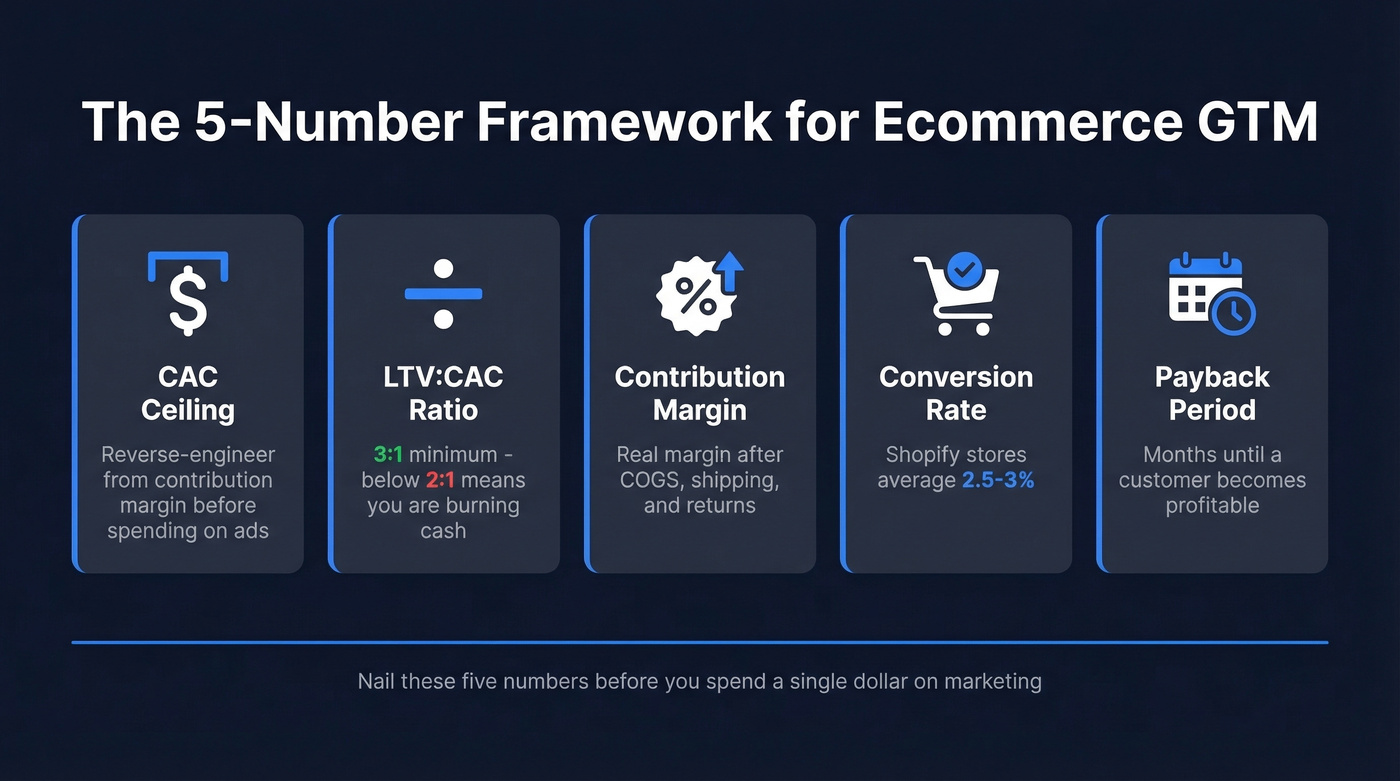
- CAC ceiling - reverse-engineer from contribution margin before spending a dollar on ads (use a CAC Calculator if you want to sanity-check inputs)
- LTV:CAC ratio - 3:1 minimum; below 2:1 means you're burning cash (benchmarks + fixes: LTV CAC Ratio)
- Contribution margin - real margin after COGS, shipping, and returns
- Conversion rate - Shopify stores average 2.5-3%
- Payback period - months until a customer becomes profitable

You just defined your ICP and validated demand. Now you need to reach those buyers. Prospeo's 300M+ profiles with 30+ filters - including buyer intent, technographics, and headcount growth - let you build hyper-targeted prospect lists for your ecommerce launch. 98% email accuracy means your outreach lands, not bounces.
Stop guessing who your buyers are. Find them with verified data.
7 Steps to a Winning GTM Plan
1. Start With the Math
Ecommerce CAC runs $50-$130 per customer depending on channel and category. The target LTV:CAC ratio is 3:1 - above 4:1 and you're probably underinvesting in growth.
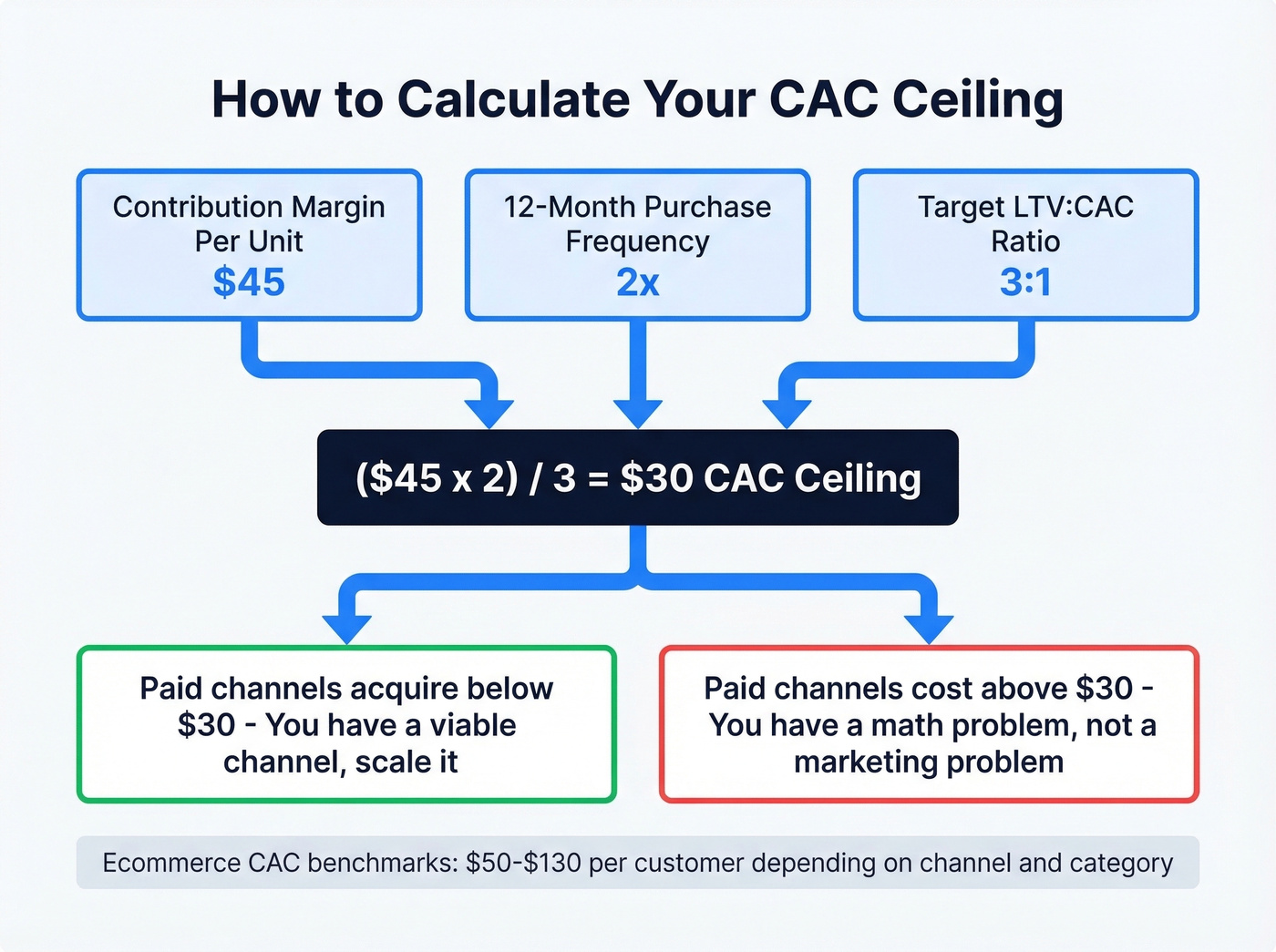
Take your contribution margin per unit, multiply by expected 12-month purchase frequency, and divide by 3. That's your CAC ceiling. If paid channels can't acquire below that number, you've got a math problem, not a marketing problem.
We've seen a $45M consumer brand run this exact exercise before committing to DTC - they discovered their TAM couldn't justify an enterprise platform and pivoted to small-scale testing instead. If you need a tighter way to size demand, use a TAM SAM SOM model. Track everything in Triple Whale or a similar attribution tool from day one so you're never guessing which channel actually drives revenue.
2. Define Your ICP and Validate Demand
Don't build inventory for a market you haven't tested. About 6-8 weeks before your first shipment, you should have demand signals: a "coming soon" page with email capture, a founding-customer offer to your first 50 buyers, and wishlists to gauge interest by SKU.
If 200 people join a waitlist, you've got something. If 12 do, rethink positioning before ordering 5,000 units.
Start narrow. Pick a beachhead segment - one customer type, one use case, one channel - and own it. If you want a structured way to do this, borrow from an ICP Framework. Huckberry is a clean example: they grew from $10K to $1M in 12 months by obsessing over one niche (outdoor-lifestyle men) before expanding into adjacent categories.
3. Choose Your Channel Mix
Marketplaces aren't a backup plan. They're a primary digital growth channel now, driving over 40% of total ecommerce growth in 2024 and projected to hit 53%+ by 2030. Brands selling across Amazon, TikTok Shop, and Macy's averaged 40% YoY growth.
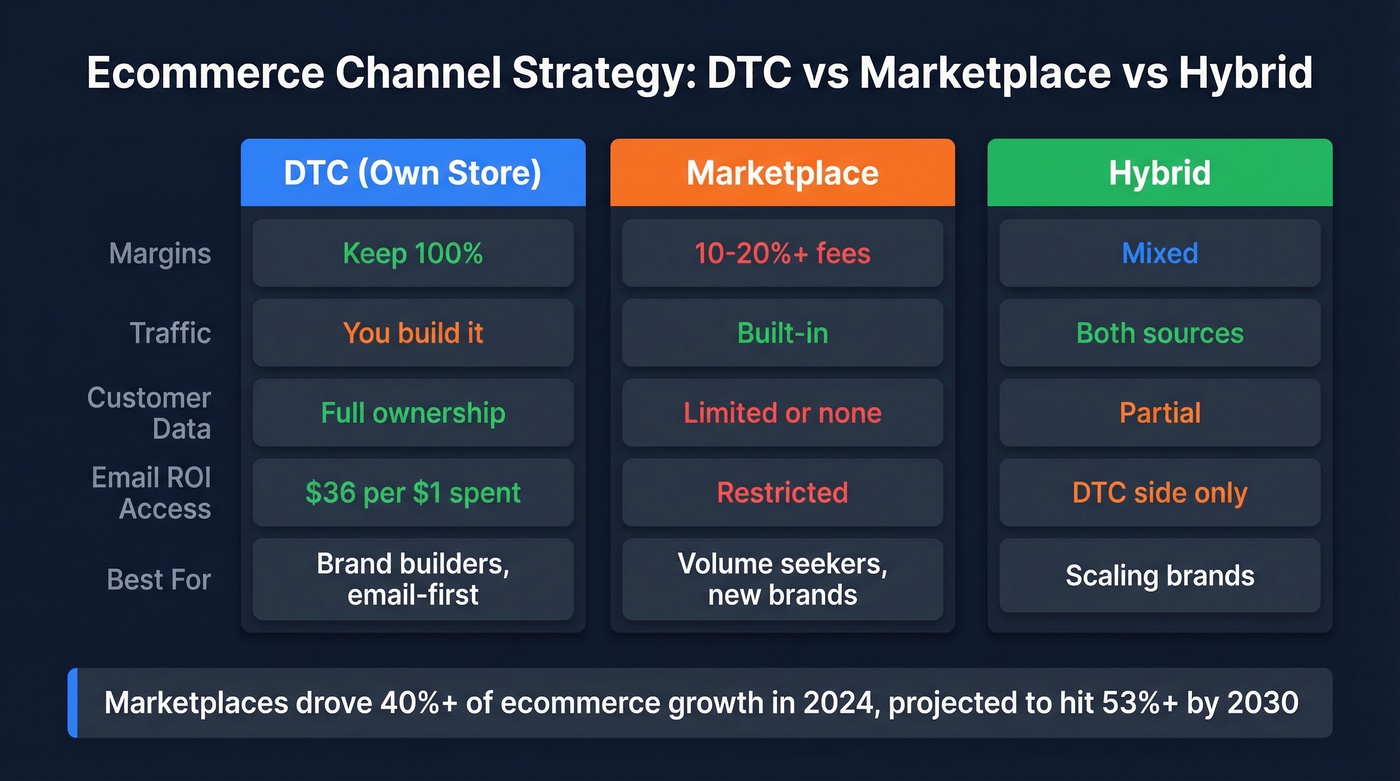
| Factor | DTC (Own Store) | Marketplace | Hybrid |
|---|---|---|---|
| Margins | Higher (keep 100%) | Lower (10-20%+ fees) | Mixed |
| Traffic | You build it | Built-in | Both |
| Customer data | Full ownership | Limited/none | Partial |
| Best for | Brand builders, email-first | Volume seekers, new brands | Scaling brands |
Email delivers $36 for every $1 spent - paid social ROI averages $2-4 by comparison. DTC gives you the data to run email and SMS properly; marketplaces give you volume. Start with one, layer the other within 6-12 months.
Don't sleep on launch-as-a-channel tactics either. Limited drops, raffles, and FCFS releases create urgency that standard launches can't match.
4. Set Your Pricing
Charm pricing (ending in .99 or .97) lifts sales by ~24% compared to rounded numbers. Use it unless your brand positioning demands premium round-number pricing.
Penetration pricing works if you're entering a crowded category and need volume to trigger marketplace algorithms. Skip it if your product has a quality story - low launch prices anchor perception and are brutally hard to raise later. Bundling is the fastest AOV lever: pair a hero product with a complementary item at 10-15% off versus buying separately. And accept Stripe, Apple Pay, and every major payment method. Friction at checkout kills conversions. (If you want a broader pricing lens, map it to a Go-to-Market Pricing Strategy.)
5. Build Your Creative Engine
Creative volume beats creative budget in 2026. Contact 500 micro-influencers, roughly 100 respond, about 30 post organically. You get ~30 creative assets for the cost of product samples - that's your paid social testing library right there.
Frank Body built a $20M brand in two years starting with $5,000 and UGC-first on Instagram. Oatly 10x'd revenue between 2017 and 2018 by turning packaging itself into a creative asset - proof that your creative engine doesn't require a massive production budget.
One thing that's easy to overlook: 40% of online shoppers start with a search, so your product pages need to rank, not just convert.
6. Optimize Mobile and Checkout
Mobile accounts for 73% of ecommerce traffic but converts at just 1.8% versus 3.9% on desktop.
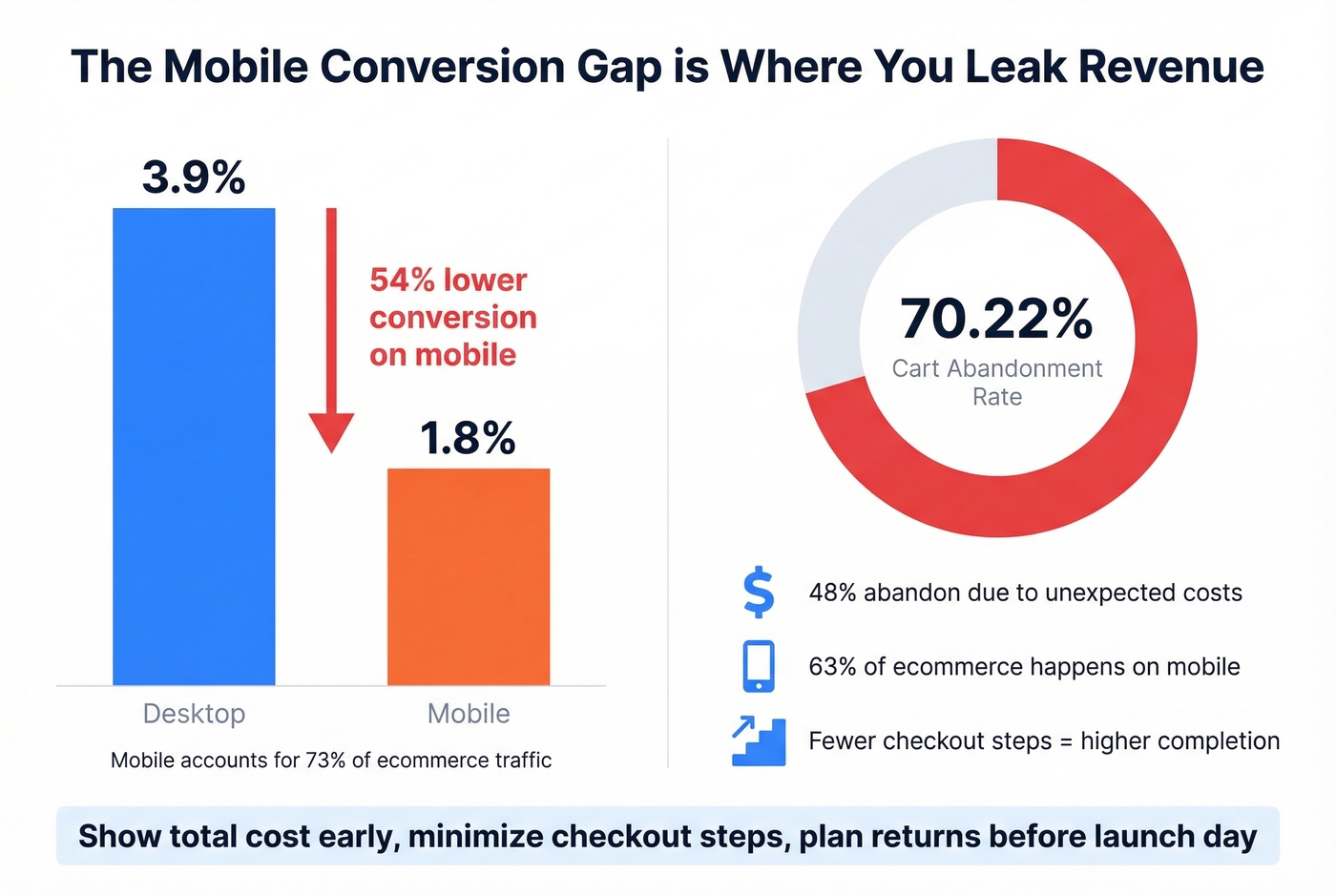
That gap is where most DTC launch plans leak revenue. Cart abandonment sits at 70.22%, and 48% of those abandonments happen because of unexpected costs at checkout. Mobile commerce already accounts for roughly 63% of total retail ecommerce - this isn't a secondary experience, it's the primary one for most of your customers. Minimize checkout steps, show total cost early, and plan your returns process before launch day, not after.
7. Measure Five Numbers
Your CAC benchmarks mean nothing if you're tracking blended averages. Break it down by channel: know what Meta costs versus Google versus email versus organic ($50-$130 range for ecommerce). Your LTV:CAC ratio should sit at 3:1 - below 2:1, stop scaling and fix retention.
Shopify conversion baseline is 2.5-3%, with the top 10% hitting 4.7%+. Below 1.9%? Fix your product page before spending more on ads. Track add-to-cart rate (6.5-7.5% average, 10%+ excellent) and payback period religiously. If you want a cleaner measurement system, build a simple RevOps Dashboard for these five numbers.
Gymshark grew from $108K to $11.8M in four years with 200% YoY growth for three consecutive years. That trajectory comes from knowing exactly which numbers to push - and having the discipline to stop pushing the ones that aren't working.
Launch Mistakes That Kill Ecommerce GTM Plans
Launching before the math works. If your CAC ceiling is $40 and paid channels cost $80, no creative optimization saves you. We've watched teams burn through six figures learning this lesson the hard way.
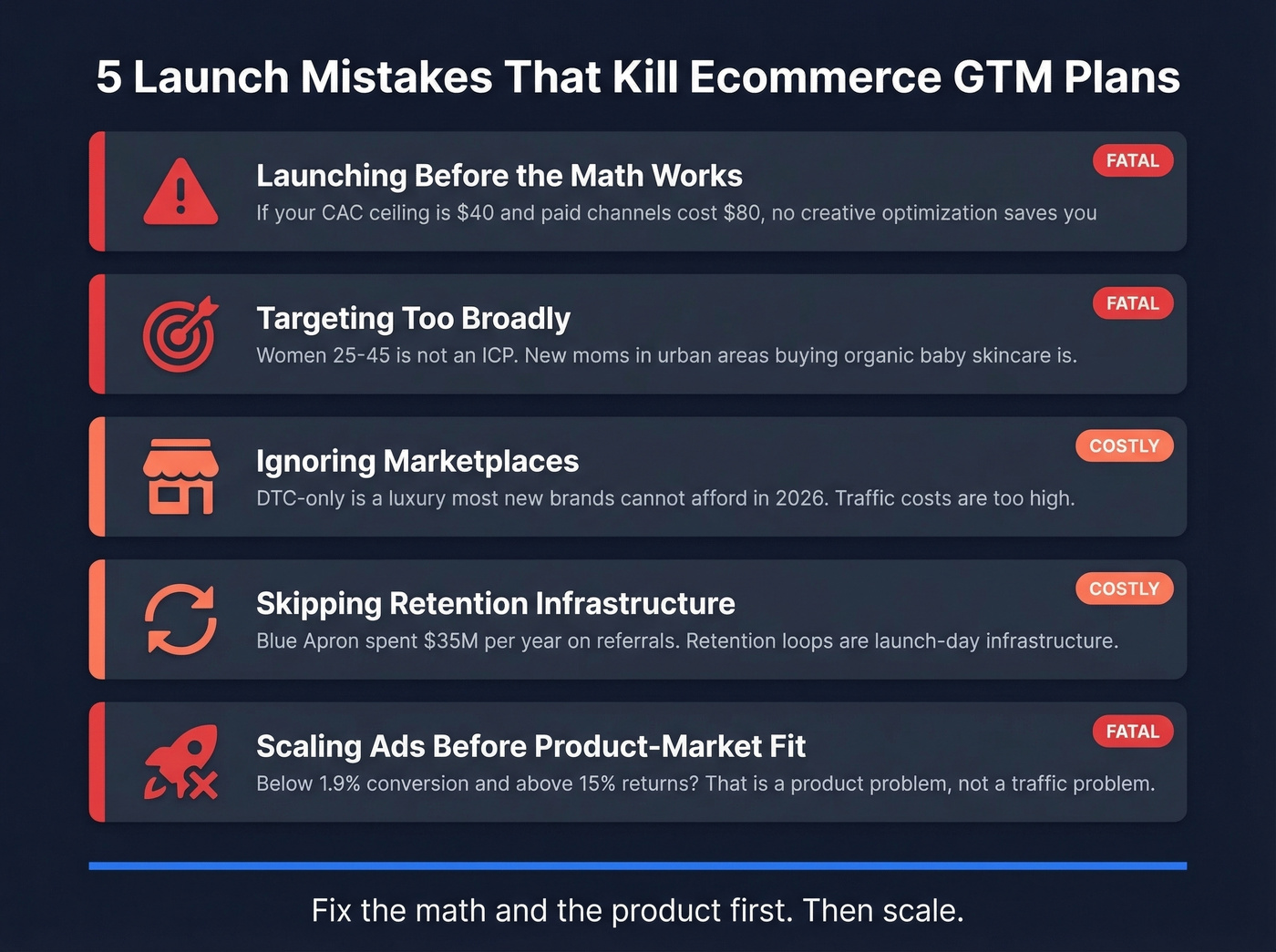
Targeting too broadly. "Women 25-45" isn't an ICP. "New moms in urban areas buying organic baby skincare for the first time" is. The narrower your beachhead, the cheaper your acquisition. If you need options beyond demographics, use these types of customer profiling to tighten targeting.
Ignoring marketplaces. DTC-only is a luxury most new brands can't afford in 2026. Let's be honest - the traffic costs alone make it a tough bet without a secondary channel feeding volume.
Skipping retention infrastructure. Blue Apron spent $35M/year on referrals - referrals made up 34% of their customer base. Retention loops are launch-day infrastructure, not phase two. (Related: Customer Retention vs New Customer Acquisition.)
Scaling ads before product-market fit. Below 1.9% conversion and above 15% returns? That's a product problem, not a traffic problem. Stop spending until you fix it.
If your launch strategy includes outbound to retail buyers or wholesale partners, you need verified contact data. Prospeo's 30+ search filters let you narrow by job title, company size, and industry - the free tier gives you 75 verified emails per month, enough to test your first outreach batch to category buyers at target retailers. If you're building lists from multiple sources, consider an email list cleaning service before you send.
Your CAC ceiling is tight. Every wasted dollar on bad contact data pushes you further from that 3:1 LTV:CAC ratio. Prospeo delivers verified emails at $0.01 each - 90% cheaper than legacy providers - so your outbound channel stays profitable from day one. Real brands have cut bounce rates from 35% to under 4%.
Lower your CAC with contact data that actually connects.
FAQ
What's the difference between a GTM strategy and a marketing plan?
A GTM strategy covers the full launch - pricing, channels, positioning, unit economics, and operations. A marketing plan is one piece of that, focused specifically on promotion and customer acquisition tactics.
How long does an ecommerce GTM take?
Plan for 6-8 weeks of pre-launch work covering demand validation, platform setup, and creative production, assuming inventory is already in motion. Brands that compress this timeline typically overspend on ads to compensate for weak foundations.
Should I launch on a marketplace or my own store first?
Marketplaces offer built-in traffic but take 10-20%+ fees and limit customer data. DTC gives you margins and ownership. Start with whichever matches your capital situation, prove unit economics, then add the other within 6-12 months.
What's a good conversion rate for a new store?
Shopify stores average 2.5-3%, and the top 10% hit 4.7%+. Below 1.9%, fix your product page copy, images, and pricing before increasing ad spend.
How do I find retail buyers for wholesale outreach?
Use a B2B data tool like Prospeo to find verified emails for category buyers at target retailers. The free tier (75 emails/month) is enough to test your first cold outreach batch, and you can filter by job title, company size, and industry to make sure you're reaching the right people.