

Email Address Capture: What Actually Works (and What the Data Says)
Every guide on this topic treats email address capture as a popup problem. It's not. The popup is the last 10%. The other 90% is what you're offering, when you're showing it, whether you're compliant, and whether you're verifying what you collect.
The Short Version
- Delayed popups (20-50s) convert 20-43% better than immediate ones and cut bounce rates by up to 45%.
- Verify every captured email before your first send - list decay runs ~22%/year.
What Is Email Capture?
The term covers two distinct motions. There's inbound capture - popups, forms, and landing pages that collect addresses from people already on your site. Then there's proactive B2B capture - finding verified professional emails for prospects who've never visited your site.
Most guides only cover the first one. This guide covers both, because a complete strategy needs both sides working.
Why It Matters
Email delivers ~36:1 ROI. No other channel comes close at scale. But your list decays at roughly 22% per year. People change jobs, abandon addresses, lose interest. Without always-on lead capture, your list shrinks by a fifth annually - and you're running harder just to stay in place.
The payoff when capture works? Across 3.6M campaigns tracked by MailerLite, the median open rate hit 43.46% and click rate landed at 2.09% in 2026. Apple Mail Privacy Protection inflates open rates by an estimated 15-25 percentage points, so click rate is the more reliable signal - but even by that measure, email crushes every social channel's organic reach. These numbers only matter, though, if you're feeding the list consistently.
Capture Methods Compared
Not all methods perform equally.
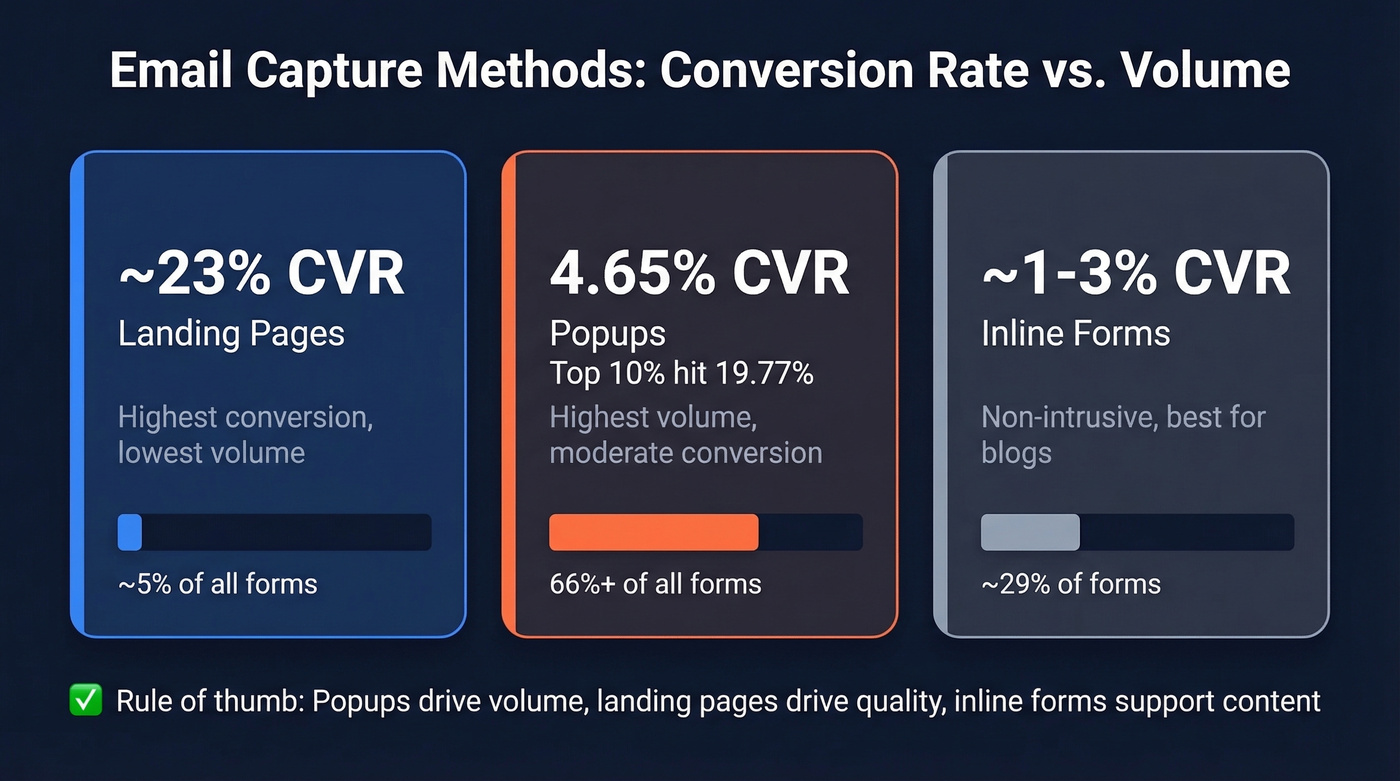
| Method | Avg CVR | Best Use Case |
|---|---|---|
| Landing pages | ~23% | High-intent offers |
| Popups | 4.65% (top 10%: 19.77%) | Volume capture |
| Inline forms | ~1-3% | Content pages, blogs |
Landing pages convert highest because visitors arrive with intent - they clicked a specific link for a specific offer. But they account for only ~5% of all capture forms. Popups dominate volume, making up 66%+ of enabled forms. Inline forms won't blow up your conversion numbers, but they're non-intrusive and work well embedded in high-traffic blog posts.
A practical rule: popups drive volume, landing pages drive quality. Use landing pages for your best lead magnets, popups for site-wide capture, and inline forms on content that already ranks.
Popup Timing and Format
Timing is everything. Across 1B+ popup displays tracked by Wisepops, the patterns are clear:
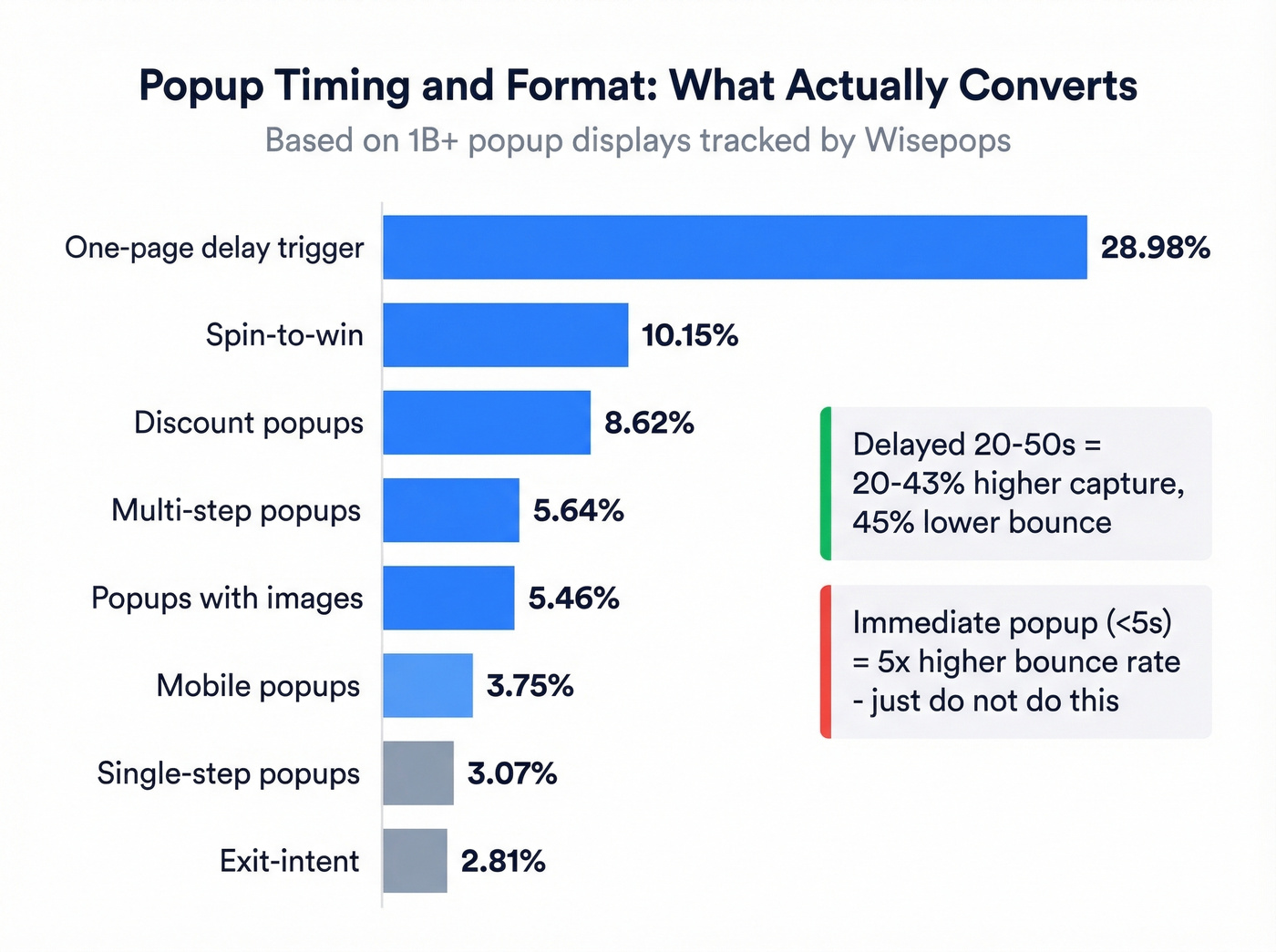
- Delayed popups (20-50 seconds): Up to 45% lower bounce rate and 20-43% higher capture vs. immediate popups.
- Immediate popups (<5 seconds): 5x higher bounce rate. Don't do this.
- One-page delay trigger: Highest CVR at 28.98% - the visitor has shown intent by navigating.
- Multi-step popups: 5.64% CVR vs. 3.07% for single-step. That's an ~84% lift from adding one qualifying step.
- Spin-to-win popups: 10.15% CVR. Gimmicky? Sure. Effective? Undeniably.
- Popups with images: 5.46% vs. 3.22% without - always include a visual.
- Exit-intent popups: 2.81% CVR - lower than other formats, but captures visitors who'd otherwise leave with nothing.
- Mobile vs. desktop: Mobile converts 38% better (3.75% vs. 2.67%).
- Discount popups: 8.62% CVR (top 10% hit 23.61%).
Here's the thing: if you launched a popup two weeks ago and your bounce rate doubled, it's almost certainly a timing problem. We've seen teams cut bounce rates in half just by adding a 30-second delay and a page-scroll trigger. Cap popup frequency too - showing the same opt-in to returning subscribers causes unsubscribes, not signups.

Popups and forms only capture emails from people who already found you. Prospeo flips the equation - find and verify professional emails for prospects who've never visited your site. 300M+ profiles, 98% accuracy, 5-step verification with catch-all handling built in. No separate verification tool needed.
Start capturing outbound emails for free - 75 verified contacts every month.
What to Offer for an Email
Nobody gives up their address for nothing. Over 50% of marketers report higher conversion rates when they invest in strong lead magnets - and the formats that work in 2026 go well beyond the tired PDF ebook.
What's converting now: quizzes, calculators, swipe files, micro-samples, resource vaults, and toolkits. The value angles that drive signups are expert advice, time savings, cost savings, education, problem solving, or early/exclusive access. Forward-thinking teams are also collecting zero-party data through preference centers and polls - this data survives privacy regulation changes that make third-party tracking unreliable.
Stick to email-only for top-of-funnel. Every extra form field adds drop-off. Collect name, company, and phone later through progressive profiling once the relationship exists.
Best Tools for Capturing Emails
| Tool | Starting Price | Best For | Free Tier? |
|---|---|---|---|
| Prospeo | Free / ~$39/mo | B2B email capture & verification | Yes (75/mo) |
| OptinMonster | ~$9-21/mo | Popup A/B testing | - |
| Jotform | Free | No-code forms | Yes |
| Wisepops | $49/mo | Data-driven popups | - |
| Bloom | $89/yr | WordPress sites | - |
| Picreel | Free / $9.99/mo | Small sites (<5K visits) | Yes |
| ConvertBox | $495 lifetime | One-time payment | - |
OptinMonster appears in a lot of listicles - and it's a solid choice for A/B testing different popup designs and triggers. Bloom starts at $89/year, making it the cheapest option for WordPress-only teams. For pure popup conversion optimization, Wisepops has the most detailed public benchmarking dataset behind it. Jotform is the no-brainer free starting point for simple forms.

Let's be honest: if your strategy is only a newsletter popup, you're leaving the outbound side completely untouched. In many B2B motions, proactive email finding drives a huge share of pipeline - yet teams still spend most of their capture budget on onsite popups. Prospeo finds and verifies B2B emails across 300M+ professional profiles at 98% accuracy, starting free at 75 emails/month. Its 5-step verification with catch-all handling and spam-trap removal means you skip the separate verification step entirely.
If you're building outbound alongside inbound, pair capture with a repeatable lead generation workflow and a clear ideal customer profile.
How to Capture Emails From Your Website
Getting the tools right is only half the battle. You also need to collect addresses from website traffic systematically.
Start by auditing your highest-traffic pages and placing contextually relevant opt-ins on each one. A blog post about pricing should offer a pricing calculator, not a generic newsletter signup. Match the lead magnet to the page intent, and conversion rates climb. We ran this exercise on our own blog and saw popup conversions jump from 2.1% to 6.8% just by swapping generic "subscribe" copy for page-specific offers.
Layer your approach: use a timed popup for first-time visitors, an inline form mid-content for engaged readers, and an exit-intent overlay as a last chance. Each touchpoint targets a different stage of visitor attention, and together they maximize the share of traffic you convert into subscribers. Skip the exit-intent layer if your site gets under 1,000 monthly visits - the added complexity isn't worth it at that scale.
If you want a benchmark target, compare against the average B2B lead conversion rate and track subscriber acquisition cost as you iterate.
Compliance Checklist
Getting this wrong is expensive. Here are the penalty ceilings:
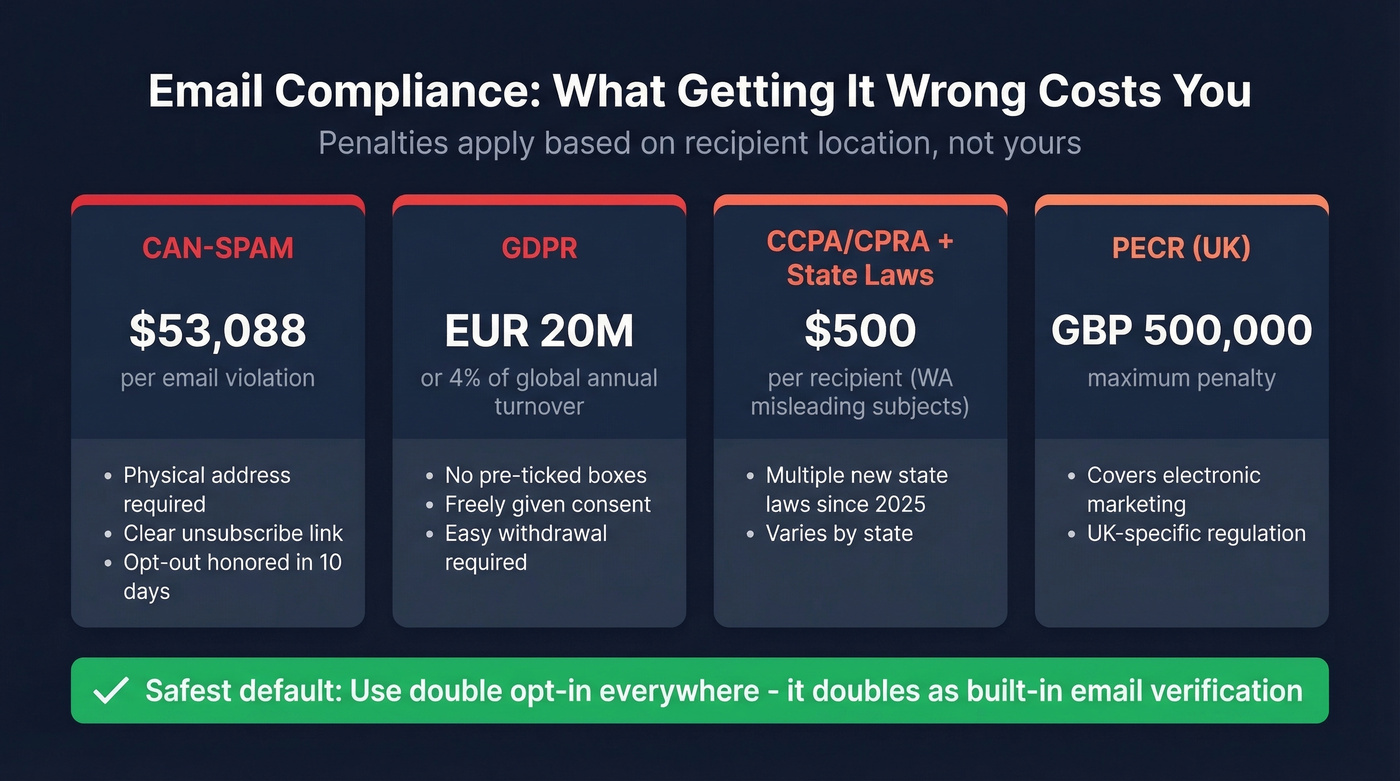
- CAN-SPAM: Up to $53,088 per email violation. Requires a physical address, clear unsubscribe mechanism, and opt-out honored within 10 business days. No misleading headers.
- GDPR: Up to EUR 20M or 4% of global annual turnover. Consent must be freely given - no pre-ticked boxes. Easy withdrawal required.
- CCPA/CPRA and US state laws: Multiple new comprehensive state privacy laws have taken effect since 2025. Washington imposes $500/recipient for misleading subject lines.
- PECR (UK): Up to GBP 500,000.
Rules apply based on recipient location, not yours. If you're emailing someone in Germany, GDPR applies regardless of where your server sits. Double opt-in isn't legally required everywhere, but it's the safest default - and it doubles as built-in email verification.
For outbound teams, it’s also worth understanding is it illegal to buy email lists before you scale.
After Capture: Verify and Clean
You have 3,000 subscribers but your last campaign bounced 15%. Your sender reputation just took a hit that'll drag deliverability down for months.
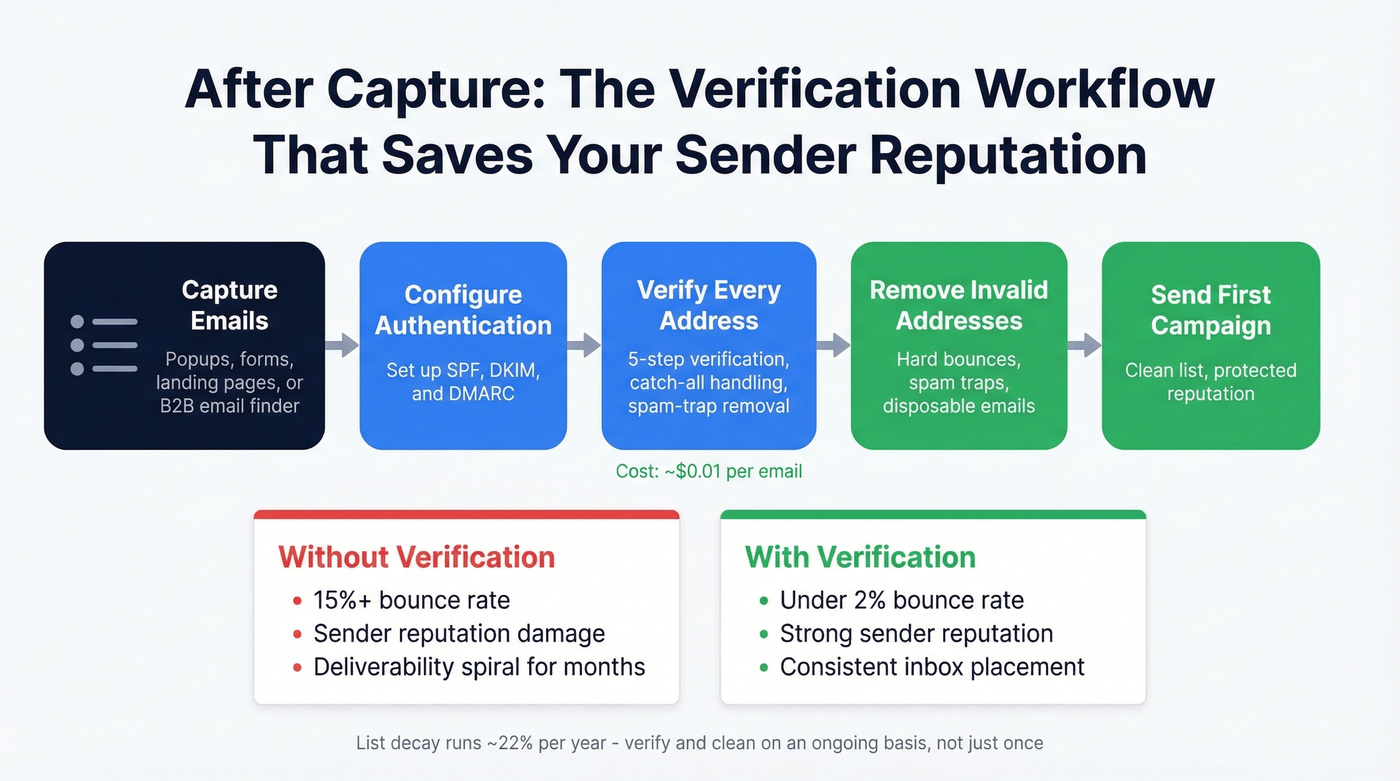
This is entirely preventable.
list decays at roughly 22%/year means addresses go stale fast. Before your first campaign, make sure SPF, DKIM, and DMARC are configured - major inbox providers enforce strict authentication requirements for high-volume senders. Then verify your list. In our experience, running verification before the first send consistently prevents the deliverability spiral that catches most teams off guard.
If you’re troubleshooting bounces and inboxing, start with email bounce rate and then work through a full email deliverability guide.

Run your captured list through an email verification tool before your first send. At ~$0.01/email, verification costs less than a single bounced send costs your sender reputation. Catch-all handling and spam-trap removal are non-negotiable features - without them, you're still flying blind on a significant chunk of addresses. The consensus on r/coldemail is pretty clear: teams that skip verification regret it within the first month, usually after watching their domain reputation tank.
To go deeper on remediation, see spam trap removal and how to improve sender reputation.
Your list decays 22% per year. Popups alone can't outrun that. Prospeo's 7-day data refresh cycle means every email you pull is current - not stale data from six weeks ago. At $0.01 per verified email, replacing annual list decay costs less than a single lost deal.
Stop losing a fifth of your list every year. Start replacing it at scale.
FAQ
What's a good conversion rate for email capture?
The average popup converts at 4.65% across 1B+ displays. Top 10% campaigns hit 19.77%. Landing pages convert at ~23% but account for only ~5% of capture forms. Aim for 5%+ on popups and optimize timing, format, and offer from there.
Do I need double opt-in?
GDPR practically requires it for EU audiences. Even where it's not legally mandated, double opt-in improves list quality, reduces spam complaints, and serves as built-in verification. The slight drop in signups is worth the deliverability gains long-term.
How do I capture B2B emails beyond website forms?
Use a B2B data platform to find verified professional emails proactively - filter by role, company size, intent signals, and technographics across millions of profiles. This complements inbound capture for outbound pipeline building, giving you contacts for prospects who've never visited your site. Pair it with your onsite forms and you cover both sides of the equation.
What's the best free tool for email address capture?
Jotform is the strongest free option for inbound forms - no code required, unlimited submissions on the free plan. For B2B prospecting, Prospeo offers 75 free verified emails per month plus 100 Chrome extension credits, which beats most competitors' free tiers for outbound use cases.