

25+ Email Campaign Examples With Data to Prove They Work
Automated email flows account for just 5.3% of total send volume - yet they generate roughly 41% of all email revenue. That's 18x more revenue per recipient than broadcast campaigns. Even more striking: 48% of flow-driven revenue comes from new buyers, compared to just 16% for campaigns. Flows don't just perform better. They convert first-time customers at triple the rate.
We've spent months collecting examples that actually come with performance context - not just pretty screenshots. Every example here includes the data behind it, the pattern that makes it work, and the benchmarks you should measure against. Twenty-five-plus examples across seven campaign types: welcome sequences, abandoned carts, promos, newsletters, product launches, post-purchase flows, and re-engagement.
The Hierarchy (If You're Short on Time)
Welcome sequences are the highest-open-rate email type, averaging 83.63%. Waste that first impression and you're fighting uphill forever.
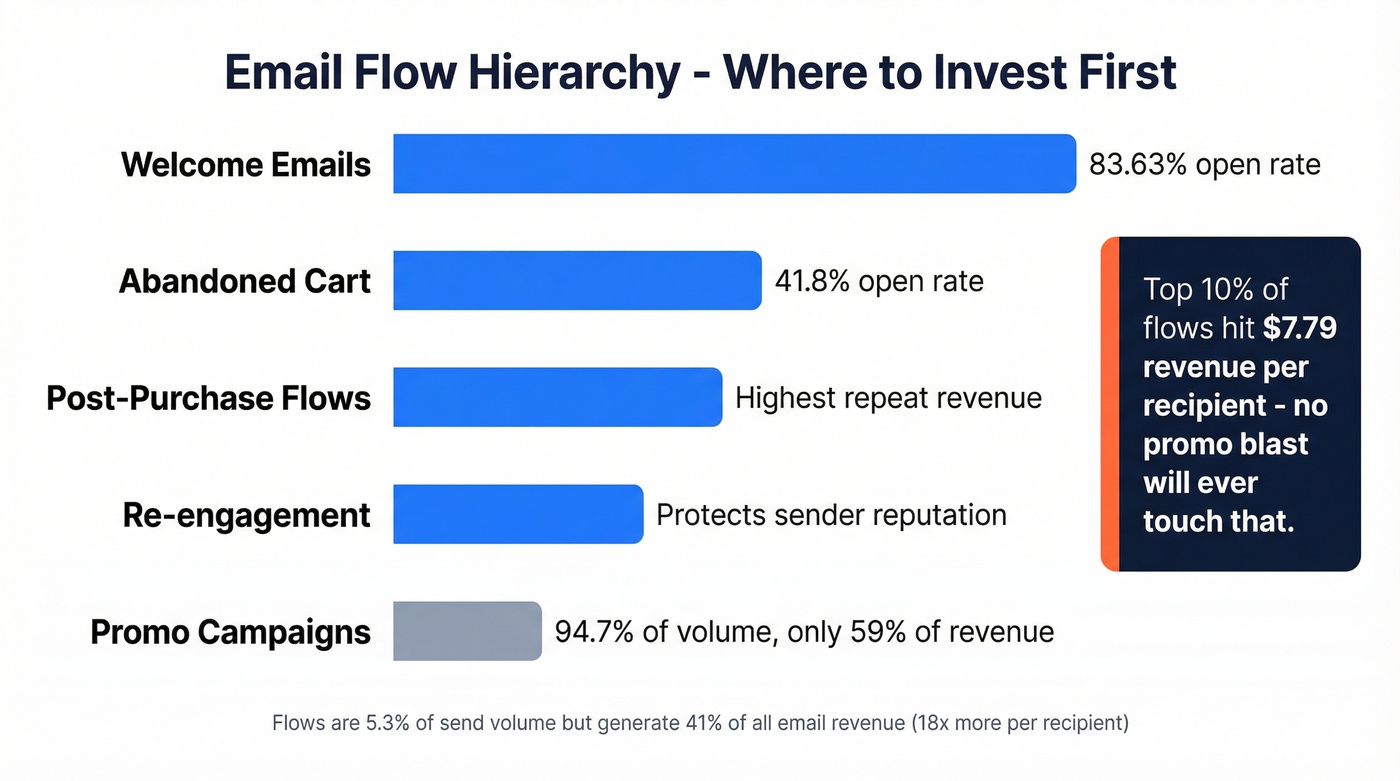
Abandoned cart emails pull a 41.8% open rate across a study of 9.3M addresses, recovering a slice of the $260B lost annually to cart abandonment. Post-purchase flows round out the top three, driving repeat revenue without the acquisition cost.
Here's the thing: most teams spend 80% of their email effort on promotional campaigns and 20% on flows. Flip that ratio. The top 10% of flows hit click rates above 10% and revenue per recipient up to $7.79. No promo blast will ever touch those numbers. If you only build one thing this quarter, build a welcome series.
2026 Email Campaign Benchmarks
Before getting into examples, here's what "good" looks like right now.
ActiveCampaign's 2026 benchmarks - based on campaigns sent January 1 through December 10, 2025 - show a cross-industry average of 39.26% open rate and 6.21% click rate. Mailchimp's benchmark table runs lower at 35.63% open and 2.62% click, though their data was last updated December 2023 and they note that Apple Mail Privacy Protection can skew open-rate accuracy.
| Industry | Avg. Open Rate | Avg. Click Rate | Source |
|---|---|---|---|
| Media/Publishing | 43.16% | 7.32% | ActiveCampaign 2026 |
| Software/Tech | 36.20% | 6.67% | ActiveCampaign 2026 |
| E-Commerce/Retail | 35.66% | 5.07% | ActiveCampaign 2026 |
| All Industries | 39.26% | 6.21% | ActiveCampaign 2026 |
| All Industries | 35.63% | 2.62% | Mailchimp (Dec 2023) |
The gap between those two datasets isn't alarming - it reflects different customer bases, campaign types, and measurement windows. Use ActiveCampaign's numbers as your 2026 baseline and Mailchimp's as a conservative floor.
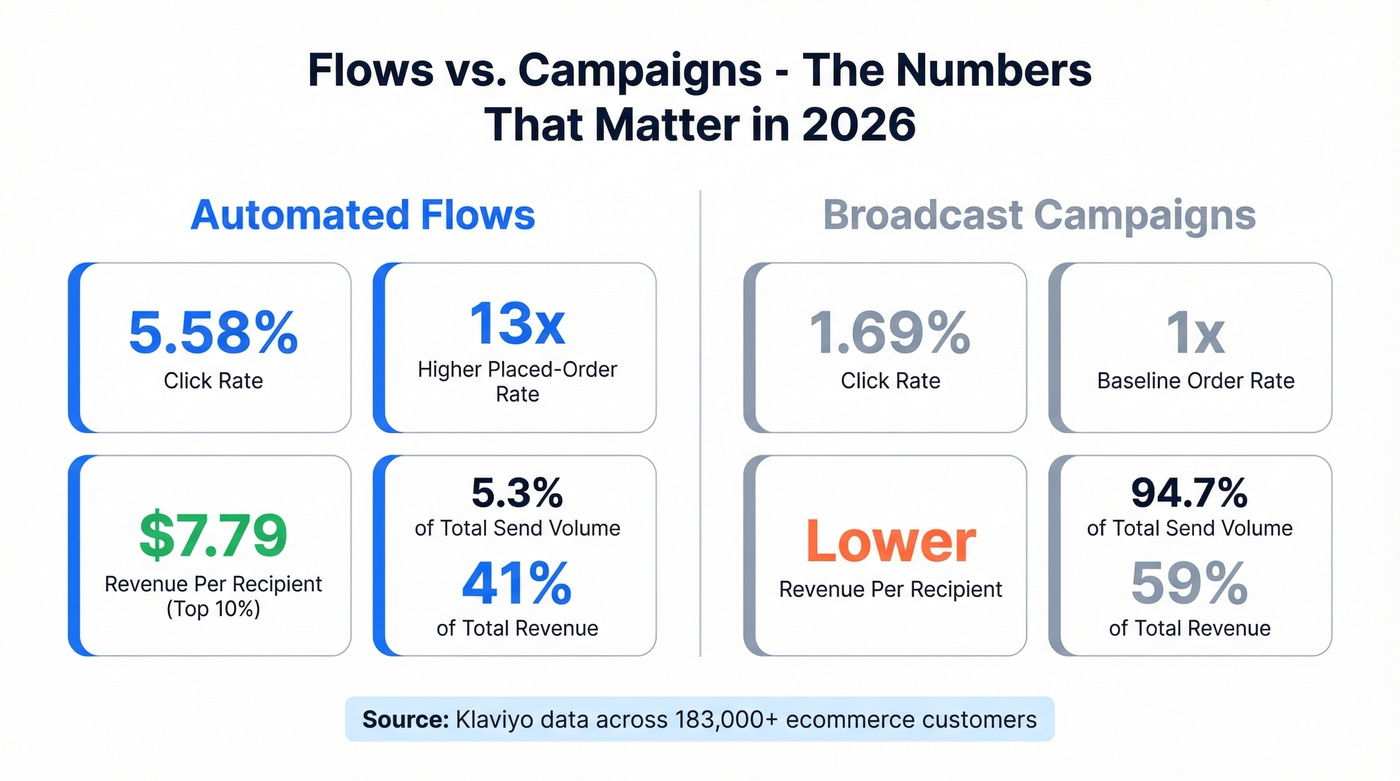
But the real story isn't open rates. It's flows vs. campaigns. Klaviyo's data across 183,000+ ecommerce customers shows flows hitting a 5.58% click rate versus 1.69% for campaigns, with 13x higher placed-order rates. The top 10% of flows reach $7.79 revenue per recipient - a number that should make every marketer rethink their campaign calendar.
Best Examples by Campaign Type
Welcome Emails
Welcome emails average an 83.63% open rate. Nearly everyone who signs up reads your first message. That's an extraordinary window, and most brands squander it with generic "thanks for subscribing" copy.
Airbnb nails the single-email welcome by focusing entirely on the next action: complete your profile, browse homes, become a host. No fluff, no brand story - just clear paths forward. The design is clean, image-heavy, and mobile-first. Every element serves a single purpose: get the user to take one step.
Duolingo leans into personality. The owl mascot, playful copy ("You're about to learn a language. No big deal."), and a single CTA - start your first lesson. The emotional hook is low-commitment encouragement, and it works because learning a language feels intimidating. The email makes it feel like a game.
Glossier uses the welcome email as a brand manifesto - short, visual, loaded with personality. It works because Glossier's audience buys the brand as much as the product.
For B2B, the playbook changes. Slack sends a welcome series that walks new workspace admins through setup, inviting teammates, and integrating tools. Each email has one job. Notion does something similar with a 3-5 email onboarding sequence that moves from "here's what you can build" to "here's a template to start." One email usually isn't enough to drive activation in a product with any complexity.
Adding the recipient's name to subject lines increases open rates up to 39%. That's a free win most teams still skip. (If you want a swipe file, start with these subject lines and adapt them to your segments.)
Abandoned Cart Emails
Cart abandonment runs at roughly 69.99% across ecommerce - seven out of ten potential buyers leave without purchasing. These emails average a 41.8% open rate, making them one of the highest-intent automated flows you can build.
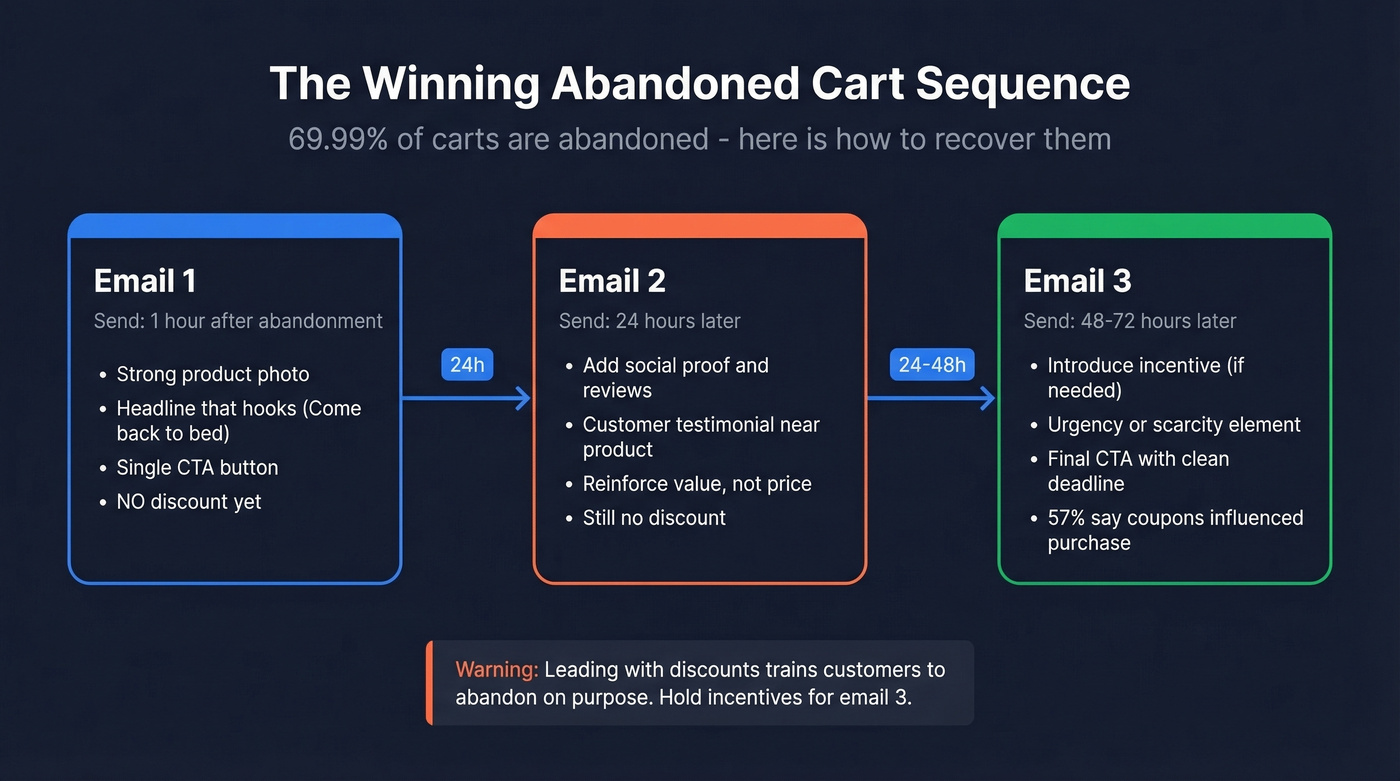
Casper keeps it dead simple: a photo of the mattress you left behind, a headline like "Come back to bed," and a single button. No discount in the first email - save the incentive for email two or three.
The Animal Rescue Site takes a different angle entirely. Their subject line - "We Saved Your Cart" - doubles as a mission statement, and they layer in social proof: 4.8/5 from 20,000+ reviews, $75M raised. When your brand has a cause, lead with it.
Adidas uses urgency and scarcity with cheeky copy and a clear "return to cart" path. Warby Parker includes a customer review directly below the abandoned product - social proof next to the buy button is the pattern that converts.
The winning formula across all of these: strong product visuals, a single primary CTA, social proof, and an incentive held in reserve. 57% of US customers who received an abandoned cart coupon code say it influenced their purchase, but leading with the discount trains customers to abandon on purpose. Don't do that.
Promos and Sales
Promotional emails are the workhorse - high volume, lower revenue per recipient, but essential for seasonal spikes and clearing inventory. Broadcast campaigns make up 94.7% of send volume and generate 59% of revenue. Necessary, but inefficient compared to flows.
Skip this section if you haven't built your welcome, cart, and post-purchase flows yet. Promos should be the last thing you optimize, not the first.
Nike runs flash-sale emails that are almost entirely visual. A hero image, a bold headline ("EXTRA 25% OFF"), and a CTA. No paragraphs. No product descriptions. The brand does the selling. PUMA leans on urgency mechanics with time-bound offers and send-time optimization to improve performance at scale.
Warby Parker flips the script with their "Home Try-On" promotional emails. Instead of discounting, they promote the experience. It's a promotional email that doesn't feel like a sale, and it converts because it removes purchase risk entirely.
Birchbox layers personalization into promos by recommending products based on past subscription boxes. AI-powered product recommendations lift click rates to 3.75% on average, and top performers hit 8.79%. If you're still sending the same promo to your entire list, you're leaving money on the table. A/B test your personalization engine against a generic version - the delta will justify the investment within one send cycle.
Newsletters
Newsletters aren't revenue drivers. They're relationship builders. The best ones earn the open every single time.
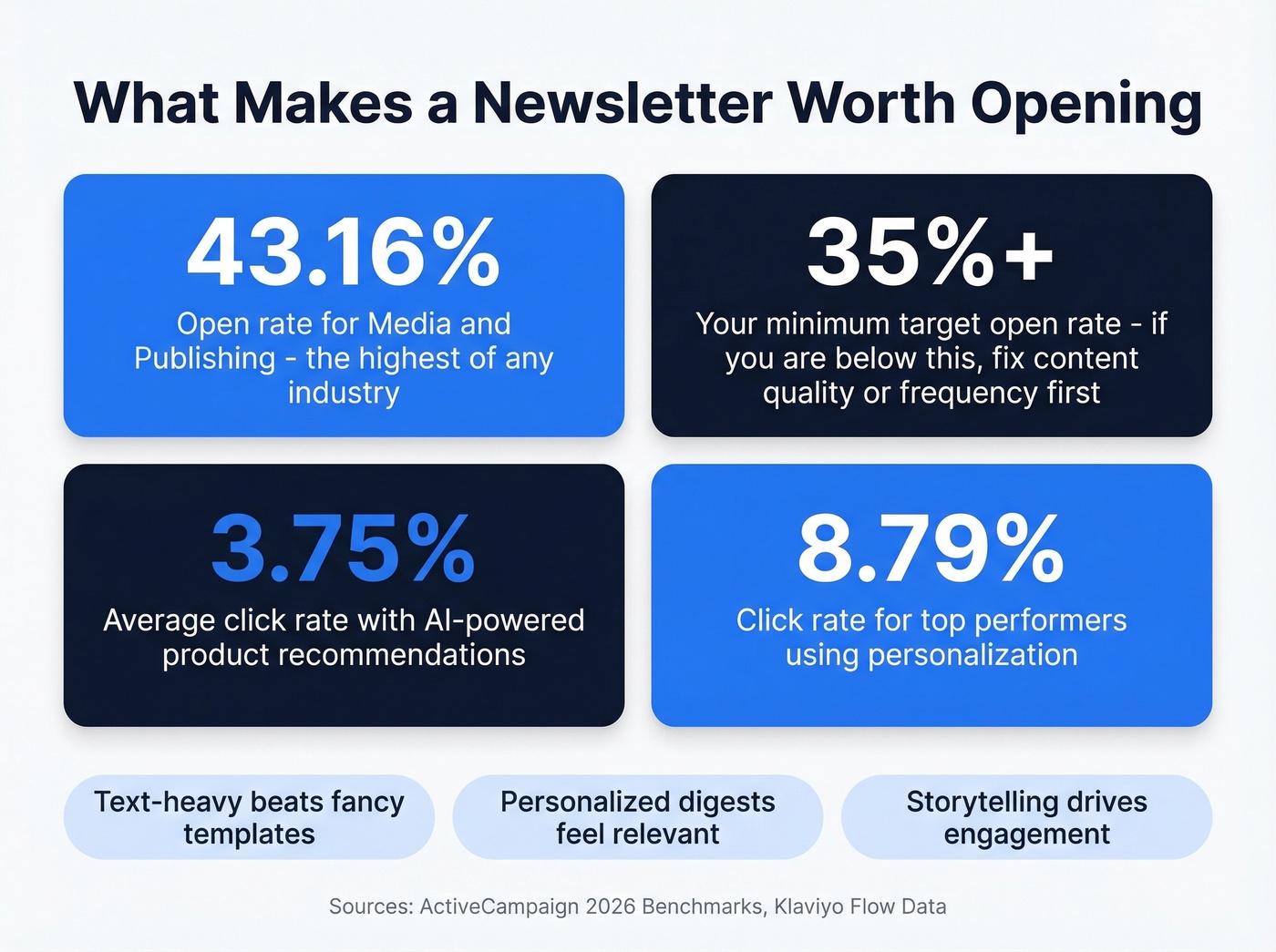
The Hustle built a media company on a daily newsletter. Short, opinionated, conversational. Every issue feels like a smart friend summarizing the business world. The format is text-heavy by design - no fancy templates, no hero images. Just good writing. There's a reason media and publishing leads all industries with a 43.16% open rate.
Medium sends personalized reading digests based on your reading history and followed topics. The email is essentially a curated feed, and the personalization makes it feel relevant rather than spammy. charity: water uses newsletters to tell stories - each email follows a specific community, a specific well, a specific person. It's fundraising through storytelling, and it works because the narrative is genuine.
If your newsletter isn't hitting at least 35%, the problem is content quality or send frequency, not your subject lines.
Product Launches
Product launches live or die on specificity. "Exciting update!" as a subject line is a guaranteed scroll-past.
Figma does this brilliantly. Their launch emails lead with the feature name, show it in action with a GIF or short animation, and link directly to the changelog. No preamble, no "we're thrilled to announce." Just the product doing the thing.
Canva takes a more visual approach - their launch emails are essentially mini landing pages. New template packs, new features, new integrations - each gets a card with a visual preview and a "Try it now" button. Headspace announces new meditation packs with calming design and a single, clear CTA. The email matches the product experience, which is the real lesson: your launch email should feel like using the product.
For B2B, specificity in subject lines ("New: Bulk export with custom fields") beats vague excitement every time. Send during standard business hours. And for the love of your click rate, lead with what the feature does for the user, not what it does for you.
Post-Purchase Flows
Post-purchase emails are the most underbuilt flow in ecommerce. Most brands stop at the order confirmation and leave repeat revenue sitting there.
Amazon is the gold standard for review request emails. Minimal design: product image, star rating selector, and a fast path to leave feedback. The pattern is reducing the review action to a single, low-effort step. Chewy pairs post-purchase communication with real customer delight moments - the email follow-up references the experience, creating a multi-channel touch that drives loyalty in a way that pure discounting never can.
Bellroy sends a check-in weeks later asking how your wallet is holding up. It's not a sales pitch - it's a genuine check-in that reinforces product quality, includes care tips, and links to complementary products. The pattern across all three: timing, relevance, and restraint. Post-purchase emails should feel like customer service, not marketing. (If you're mapping KPIs, use a clean click rate formula so you can compare flows apples-to-apples.)
Re-engagement and Win-backs
Re-engagement campaigns are low-volume but high-impact. They clean your list, protect your sender reputation, and occasionally win back customers you'd written off.
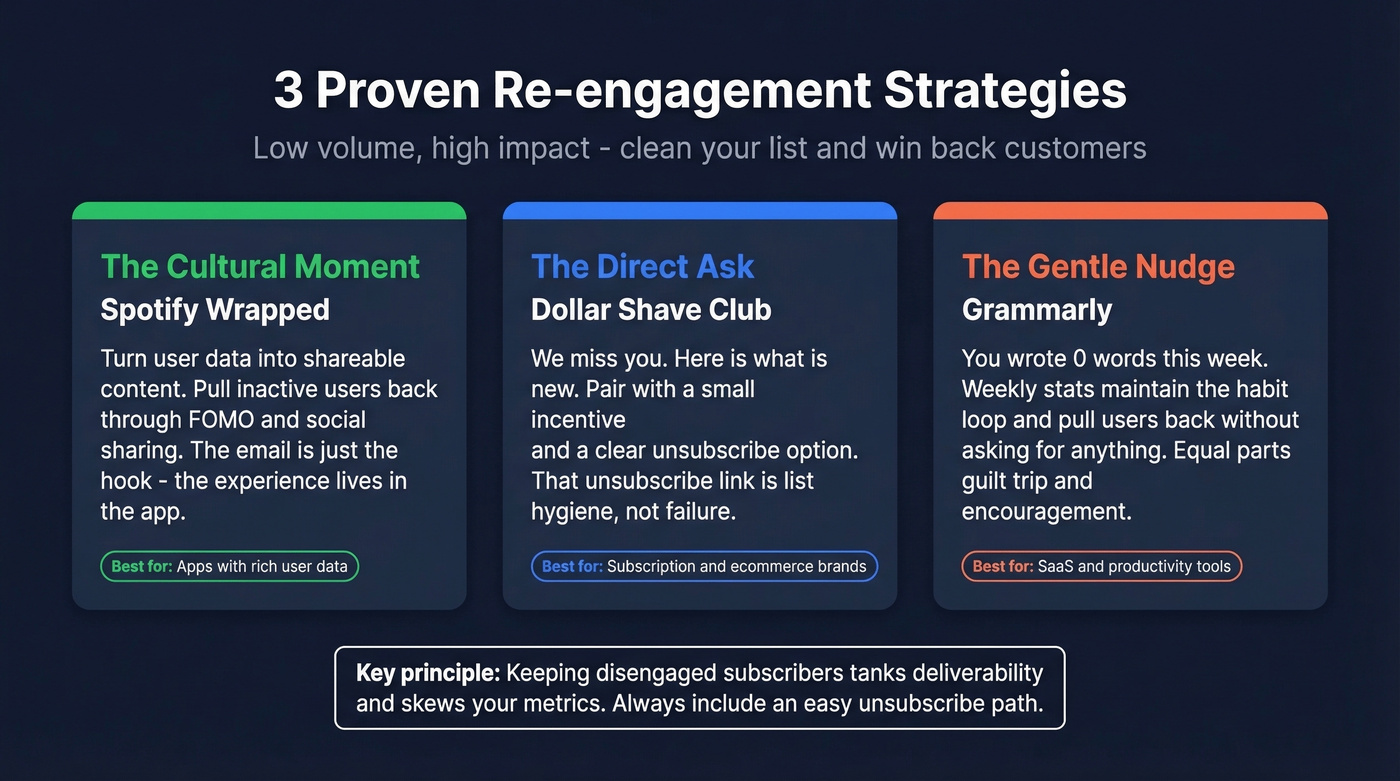
Spotify's year-end Wrapped campaign is technically a re-engagement play disguised as a cultural moment. By turning user data into shareable content, they pull inactive users back into the app. The email itself is just the hook - the experience lives in the app. It's the most brilliant re-engagement campaign ever built, and it doesn't look like one at all.
Dollar Shave Club takes the direct approach: "We miss you. Here's what's new." They pair it with a small incentive and a clear unsubscribe option. That unsubscribe link isn't a failure - it's list hygiene. Keeping disengaged subscribers tanks your deliverability and skews your metrics.
Grammarly sends weekly writing stats even to inactive users - "You wrote 0 words this week" - which is equal parts guilt trip and gentle nudge. The stats email maintains the habit loop and pulls users back into the product without asking for anything.

Your email campaigns are only as good as the data behind them. A 35% bounce rate kills deliverability and tanks every flow you build. Prospeo delivers 98% email accuracy with 5-step verification - so your welcome sequences, cart flows, and promos actually reach real inboxes.
Stop optimizing campaigns that bounce. Start with verified data.
Cold Email Campaigns for B2B
B2B email operates on different physics than B2C. Sales cycles are longer, buying committees are larger, and buyers are 57% through their decision before they ever talk to sales. Email is how you influence that invisible 57%.
The ROI justifies the effort: B2B email delivers 36:1 returns on average. But only if you're reaching the right people with the right message.
The best-performing cold outreach sequences we've seen share a common structure: a personalized opening line that proves you did your homework, a single value proposition tied to the prospect's pain, and a low-friction CTA like booking a 15-minute call. Three emails, spaced 3-5 days apart, with the third being a breakup email that often gets the highest reply rate. We ran this exact structure for a SaaS client last quarter and saw a 12% reply rate on a cold list of 2,000 - well above the 3-5% industry average. (For a full structure, see this B2B cold email sequence breakdown.)
Grammarly's SaaS onboarding series is a masterclass in product-led email. A short sequence over the first couple of weeks, each message focused on a single feature. It's education that drives product adoption, not a sales pitch. HubSpot runs nurture sequences segmented by content topic - download an SEO guide and you get organic growth content; download a sales template and you get pipeline content. The segmentation is the strategy.
Drift (now Salesloft) built webinar invite emails around a single question hook. No agenda dump in the first email. Just the pain point and the promise.
For case study emails, lead with the customer's result ("How [Company] reduced vulnerabilities by 70%"), not with your product name. The customer is the hero.
ABM multi-threading is the most advanced B2B email play. Instead of emailing one contact, you're running coordinated sequences to 3-5 stakeholders at the same account - the champion, the economic buyer, the technical evaluator. Each gets different messaging tailored to their role and concerns. It's complex, but it's how enterprise deals actually close. (If you're building this motion, start with account-based selling best practices.)
The foundation of any B2B campaign is accurate contact data. Prospeo finds and verifies professional emails at 98% accuracy for roughly $0.01 per verified email - cheaper than one bounced message hitting your domain reputation. You can upload a list for bulk verification, search by 30+ filters, or enrich your CRM directly.
Email Design Trends for 2026
Email design is shifting toward privacy-first, mobile-first, and accessibility-first principles. With roughly 3.4B phishing emails sent daily, subscribers are more skeptical than ever. Your emails need to look legitimate, load fast, and render correctly everywhere.
Dark mode optimization is non-negotiable now. If you haven't tested for it, your emails probably look broken for a significant chunk of your list. Use transparent PNG backgrounds, maintain high contrast ratios, avoid pure black (#000000) or pure white (#FFFFFF), and test across Gmail, Apple Mail, and Outlook dark modes. Not all email clients support CSS media queries for dark mode, so design defensively.
Personalization remains the biggest performance lever. Personalized emails hit a 44.3% open rate versus 39.13% for non-personalized - a gap that compounds across every send. This goes well beyond first-name merge tags. Dynamic content blocks, behavior-triggered recommendations, and segment-specific messaging are the baseline now. (If you want a framework, use targeted email campaigns to pressure-test your segmentation.)
Accessibility is both ethical and practical: semantic HTML, alt text on every image, readable fonts at 14px minimum, sufficient color contrast. Screen readers are more common than most marketers realize, and accessible emails perform better for everyone.
Interactive elements like polls, countdown timers, image carousels, and embedded surveys are gaining traction as email clients improve support. They boost engagement, but test carefully. A broken interactive element is worse than a static one.
Mistakes That Kill Performance
We've audited enough email programs to see the same failures on repeat.
Purchased or scraped lists. This is the fastest way to destroy your sender reputation. Spam traps, honeypots, and invalid addresses tank your deliverability within weeks. There's no shortcut - build your list or verify it ruthlessly. (If you're unsure where the line is, read Is It Illegal to Buy Email Lists?.)
Automation without real personalization. The consensus on r/EmailMarketing is that "personalized" product recommendations that don't match actual behavior are worse than no personalization at all. If your automation just swaps a first name and calls it personalized, you're fooling yourself.
Broken mobile experiences. Tiny text, unreadable CTAs, images that don't resize. I still see this constantly in audits, and it's baffling in 2026. Test on a real phone before every send. No exceptions.
Frequency fatigue. Blasting your entire list with the same message three times a week is a recipe for unsubscribes and spam complaints. Segment by engagement level - your most active subscribers can handle more; your least active need less.
Skipping A/B tests. Every email is a data opportunity. Test subject lines, send times, CTA placement, and personalization depth. Even a 5% lift in click rate compounds into significant revenue over a quarter. The teams that test consistently outperform the teams that "go with their gut" every single time.
Ignoring time zones. Sending a "Tuesday morning" email that arrives at 3 AM for half your list isn't a Tuesday morning email. Use send-time optimization or segment by geography.
AI-generated content without editing. AI can draft emails fast. It can also produce generic, tone-deaf copy that sounds like every other brand in the inbox. Edit aggressively or don't use it.
Bad data as the invisible bottleneck. None of the above matters if your list is bouncing at a high rate. Before every campaign, run your list through a verification tool. Prospeo's 5-step verification catches spam traps, honeypots, and catch-all domains at 98% accuracy, which means your sender reputation stays intact. The free tier gives you 75 verifications per month to start, and paid plans run about $39/month. (If you’re troubleshooting, start with email bounce rate benchmarks and fixes, then work through an email deliverability guide.)
B2B email flows need verified decision-maker contacts to hit those $7.79 revenue-per-recipient numbers. Prospeo gives you 143M+ verified emails with 30+ filters - buyer intent, technographics, job changes - so every outbound sequence lands with the right person at the right company.
Emails at $0.01 each. 98% accuracy. Zero domain flags.
FAQ
What are the highest-performing email campaign types?
Welcome sequences, abandoned cart recovery, and post-purchase flows consistently outperform every other type. Automated flows generate 41% of email revenue from just 5.3% of total sends - that's 18x more revenue per recipient than broadcast campaigns. Build these three before anything else.
What's a good open rate in 2026?
The cross-industry average sits between 35-39% depending on the dataset. Media and publishing leads at roughly 43%, while ecommerce typically lands in the 30-36% range. Below 30% usually signals a list-quality or sender-reputation issue, not a subject-line problem.
How many emails should a welcome series include?
For B2C, one to three emails is usually enough - deliver the incentive, introduce the brand, drive the first purchase. B2B welcome series should run three to five emails spaced over one to two weeks, progressing from value delivery to product education to a soft CTA.
Do abandoned cart emails actually work?
They average a 41.8% open rate across a study of 9.3M email addresses, recovering a meaningful share of the $260B lost annually to cart abandonment. Don't lead with the discount - save incentives for email two or three to avoid training customers to abandon on purpose.
How do I keep campaigns from bouncing?
Verify your list before every send. A 5-step verification process that catches invalid addresses, spam traps, and honeypots keeps your sender reputation clean. Let's be honest - if you're sending campaigns on an unverified list, you're gambling with your domain reputation every time you hit send.