

12 Email List Building Strategies That Actually Work in 2026
Your "verified" contact list bounces 23% on the first sequence. You stop trusting the tool. Then you start rebuilding - not just growing your list, but building one that actually performs.
We've spent the last year testing what works and what's just recycled advice from 2019. Here are 12 email list building strategies worth your time, with the benchmarks to prove it.
The Short Version
Optimize your popups. A 6-10 second delay, mobile-first design, and a clear value prop will get you to the 2.1% average conversion rate - and past it if you test well.
Pair every signup source with an automated welcome sequence. Flows generate 41% of email revenue from just 5.3% of sends. The signup is step one; the automation is where money happens.
If you're in B2B, stop waiting for opt-ins. Build verified contact lists proactively instead of hoping the right VP stumbles onto your blog.
Why Email Lists Matter More in 2026
Social media attention is shrinking. GWI's study of 970,000+ consumers flagged declining global social media time back in 2023, and the trend hasn't reversed. The platforms are noisier, algorithms are stingier, and the organic reach you had two years ago isn't coming back.
Email is the channel you own. No algorithm decides whether your message gets delivered. No platform change wipes out your audience overnight. And the economics still hold: email marketing returns $36-$40 for every $1 spent, making it the highest-ROI channel in most marketing stacks. That's why list building remains the foundation of every serious growth program.
But a big list with bad data is worse than a small list with verified contacts. The strategies below focus on building lists that convert, not ones that look impressive in a dashboard.
Benchmarks Before You Start
Before you pick a strategy, you need to know what "working" looks like.
Popup Conversion Bands
| Performance Level | Conversion Rate |
|---|---|
| Underperforming | <1.5% |
| Average | 1.5-3% |
| Good | 3-5% |
| Excellent | 5%+ |
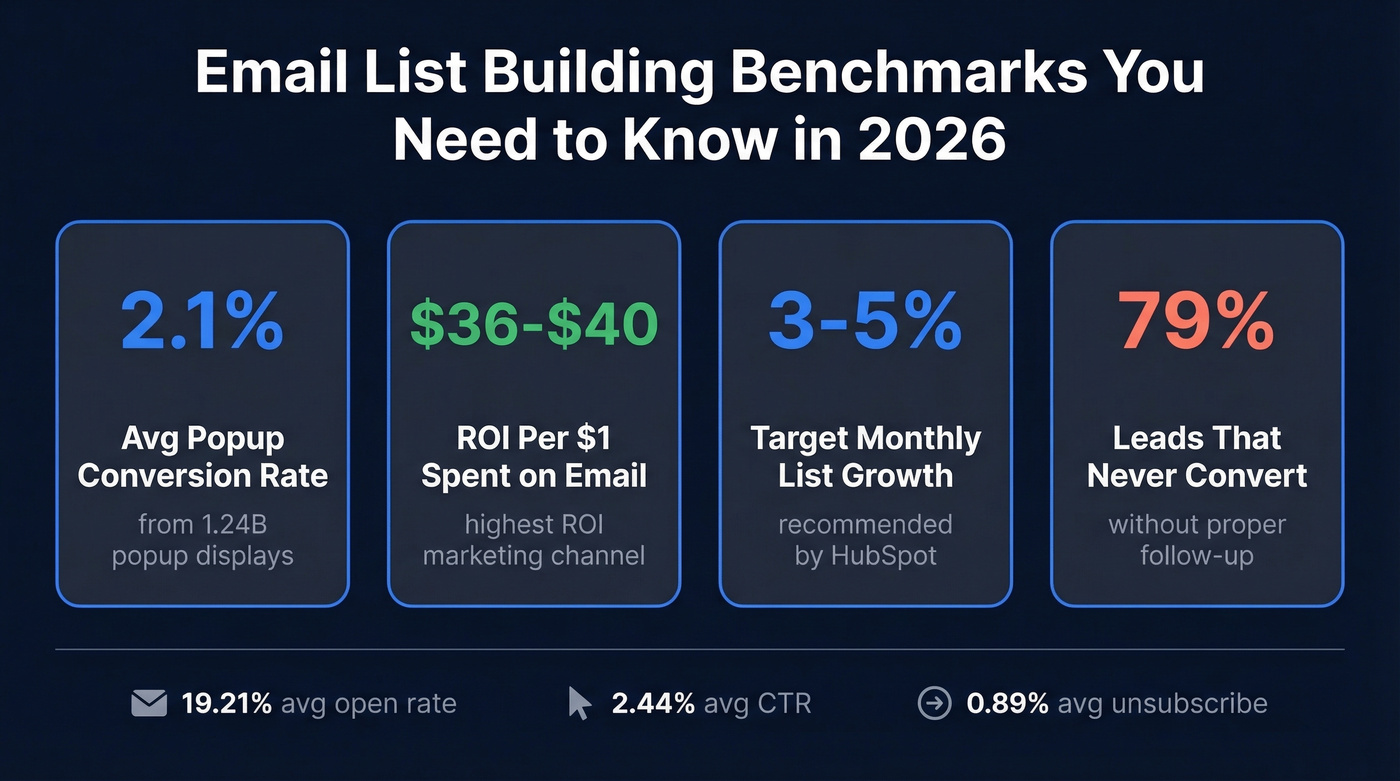
These bands come from Omnisend's dataset of 1.24 billion popup displays. The average across all popups was 2.1%.
Cross-Industry Email Metrics
| Metric | Average |
|---|---|
| Open rate | 19.21% |
| CTR | 2.44% |
| Unsubscribe | 0.89% |
| Bounce | 2.48% |
For list growth, HubSpot recommends targeting 3-5% monthly growth with always-on signup sources. Below that consistently? You've got a leak - either your forms aren't converting or you're losing subscribers faster than you're adding them.
Signup Method Comparison
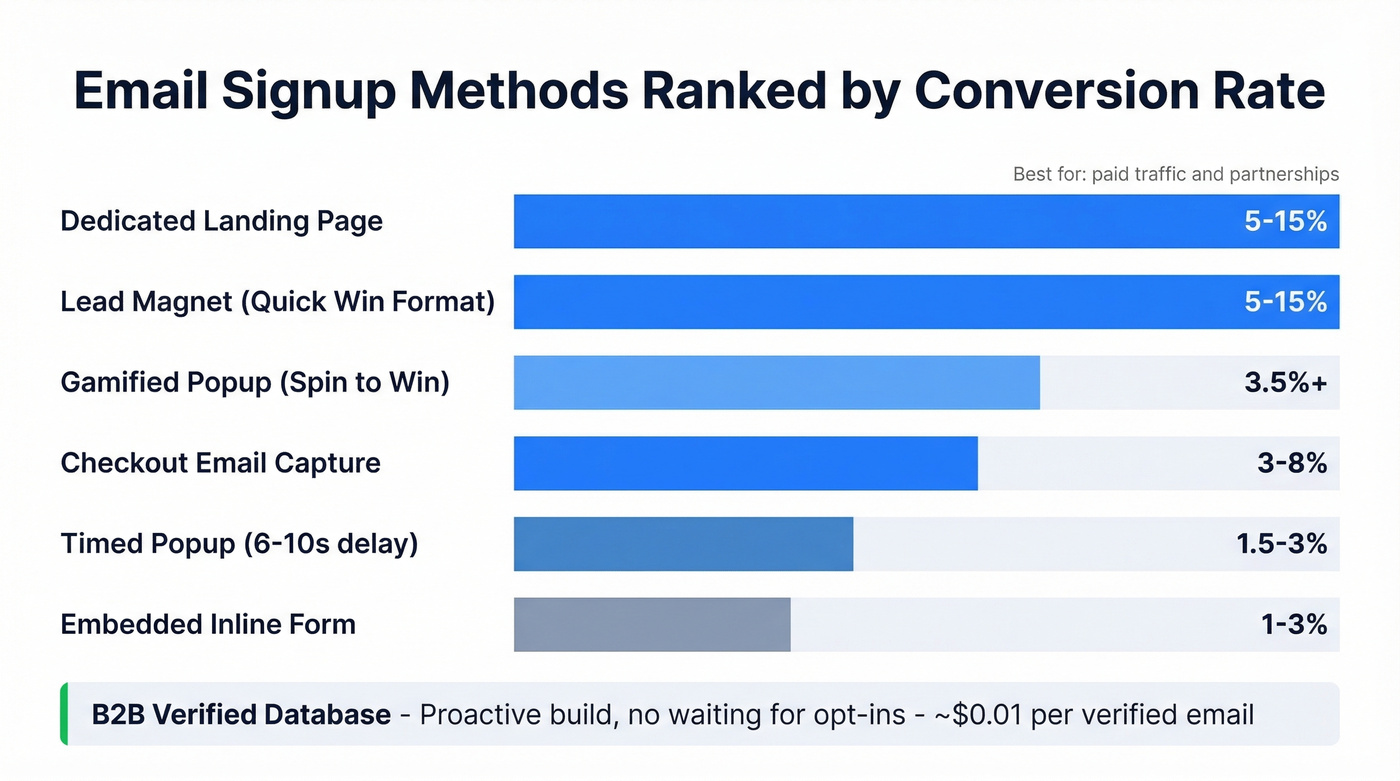
| Signup Method | Est. Conversion | Best For |
|---|---|---|
| Timed popup (6-10s) | 1.5-3% (avg 2.1%) | Any site with traffic |
| Gamified popup | 3.5%+ | Ecommerce, B2C |
| Dedicated landing page | 5-15% | Paid traffic, partners |
| Embedded/inline form | 1-3% | Blog readers |
| Checkout capture | 3-8% | Ecommerce |
| B2B verified database | Proactive build | Sales teams, outbound |
Cost Per Lead by Channel
Here's a comparison most list building guides leave out - what each lead actually costs you:
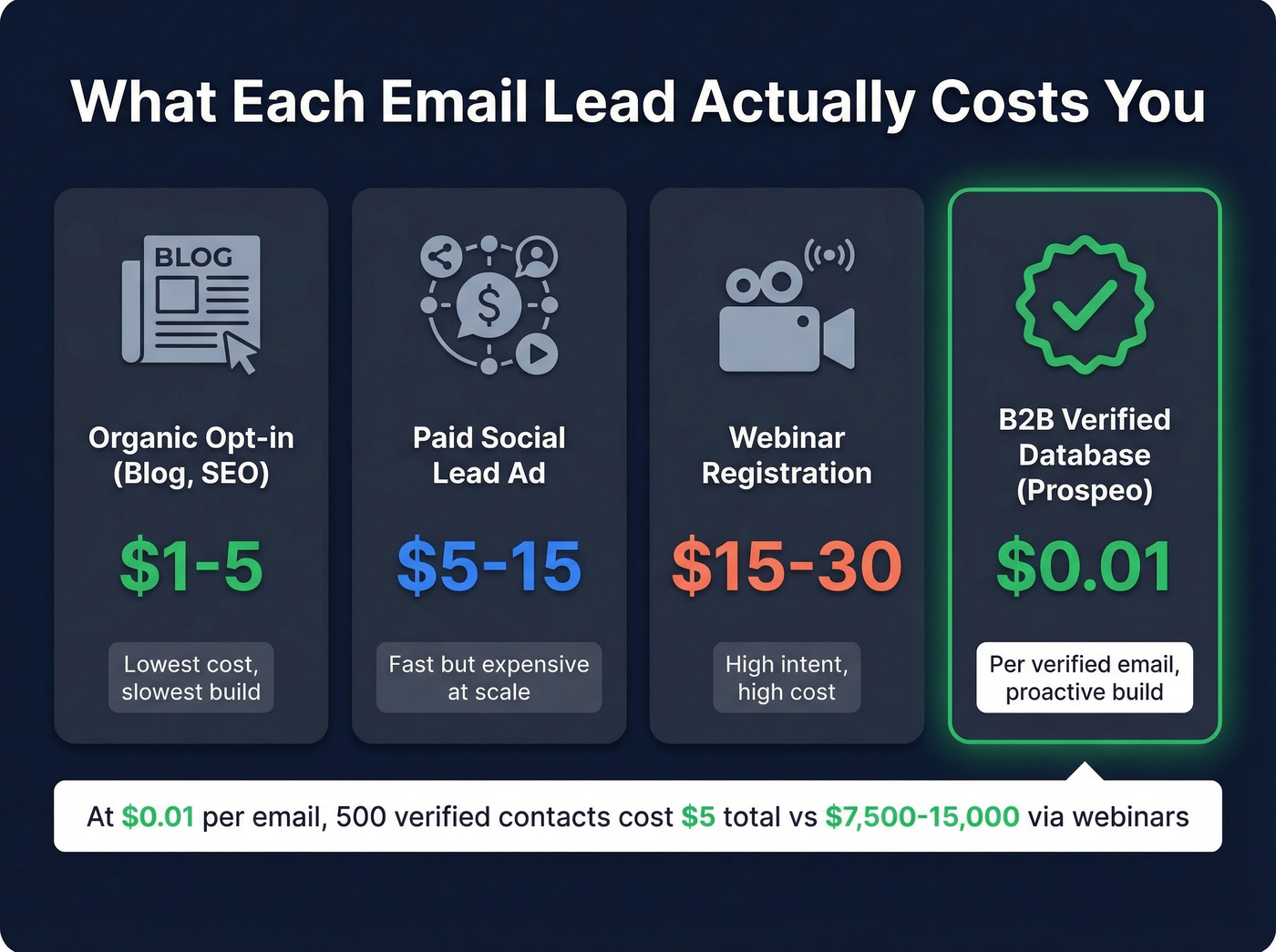
| Channel | Estimated CPL |
|---|---|
| Organic opt-in (blog, SEO) | $1-5 |
| Paid social lead ad | $5-15 |
| Webinar registration | $15-30 |
| B2B verified database | ~$0.01 per email |
That last number isn't a typo. When you're paying per verified email rather than per click, the unit economics shift dramatically. If your average deal size is modest - say under $10k - you probably don't need a $30k/year data platform. But you absolutely need verified contacts, and credit-based pricing makes that accessible.
If you want a more complete view of acquisition economics, track your subscriber acquisition cost alongside conversion rate.

Your blog popups convert at 2.1%. Your landing pages at 5-15%. But verified B2B databases let you skip the wait entirely - 300M+ profiles, 98% email accuracy, and contacts that cost $0.01 each instead of $15-30 per webinar lead.
Build a list that performs from day one, not day ninety.
12 Ways to Grow Your Email List
1. Timed Popups (Not Instant Ones)
Instant popups are a conversion killer. The visitor hasn't even read your headline yet, and you're asking for their email.
The data is clear: a 6-10 second delay is the sweet spot. Mobile matters more than desktop here - mobile-optimized popups convert at 2.2% versus 1.4% for desktop-only designs, and since 60%+ of emails are opened on mobile, your signup experience should be mobile-first. To push past the 3% mark, test gamified formats like spin-to-win wheels and scratch cards. Omnisend's data shows gamified popups hitting 3.5%+ conversion rates consistently.
If you want to go deeper on what to track beyond conversion rate, use a simple funnel metrics dashboard.
2. Dedicated Landing Pages
A standalone landing page with a single purpose - collect an email - will outperform any sidebar form or generic popup. Well-optimized landing pages convert at 5-15%, especially when they're the destination for paid traffic or partnership promotions.
The key is friction reduction. One field. A clear value proposition above the fold. Zero navigation links competing for attention. Every extra form field you add drops your conversion rate, and the best email capture pages remove every obstacle between the visitor and the submit button.
3. Embedded Signup Forms
These are your steady workhorses - sidebar forms, footer signups, and in-content opt-ins that sit within blog posts. They won't blow up your numbers (expect 1-3% conversion), but they capture intent from readers already engaged with your content.
Place them where attention is highest: after the first major section of a blog post, in the sidebar on desktop, and as a sticky footer on mobile.
4. Lead Magnets That Deliver Quick Wins
Long ebooks are dead as lead magnets. Nobody wants your 47-page "Ultimate Guide" sitting unread in their downloads folder.
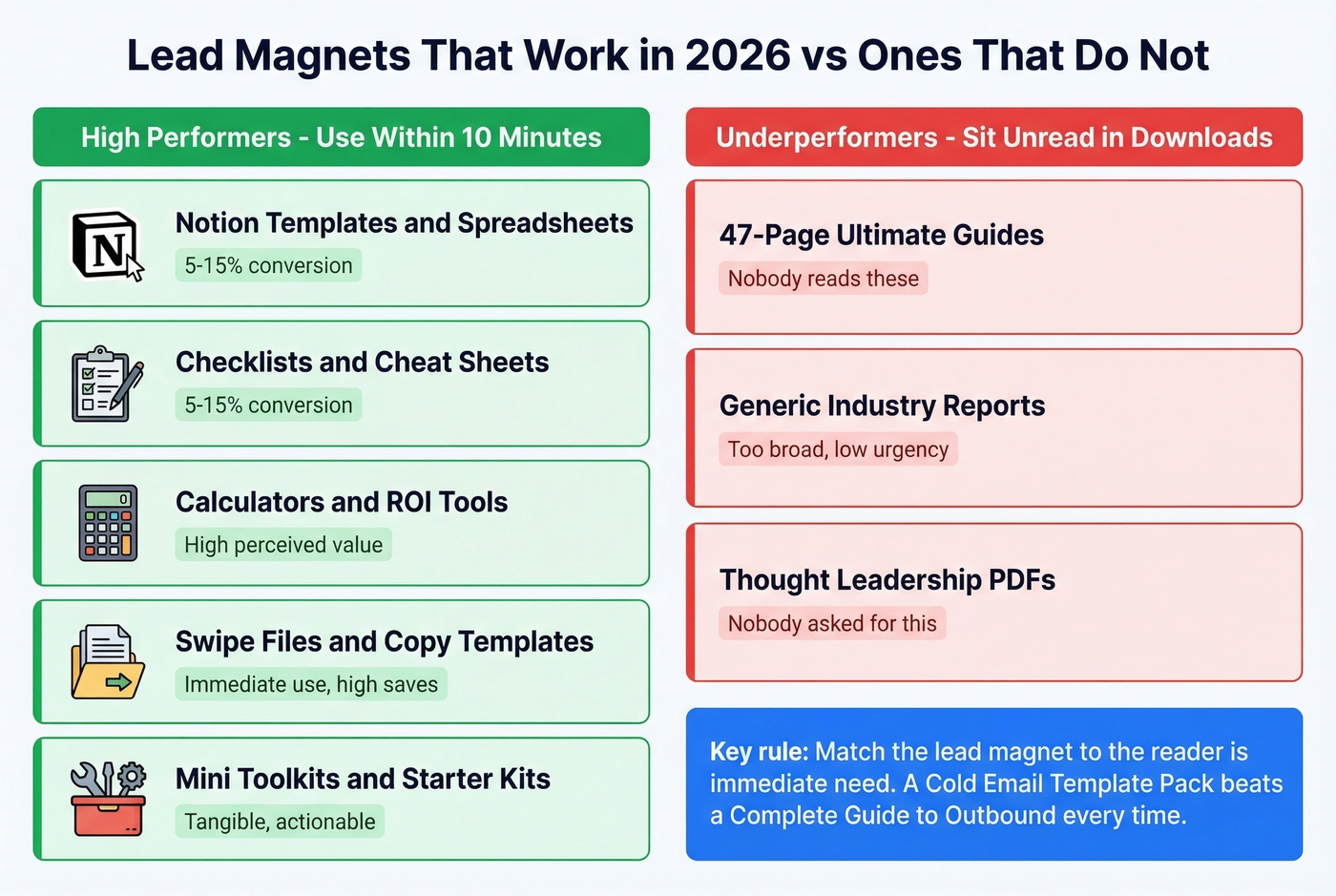
What works in 2026 are quick-win formats: templates, checklists, calculators, swipe files, and toolkits - anything the reader can use within 10 minutes of downloading. Notion templates, plug-and-play spreadsheets, and swipe files convert right now because they deliver immediate, tangible value instead of "thought leadership" nobody asked for.
Optimized lead magnets convert at 5-15%, but only when the offer matches the audience's immediate need. A "Cold Email Template Pack" for sales reps will outperform a "Complete Guide to Outbound Strategy" every time. And here's the stat that should change your behavior: 79% of marketing leads fail to convert without proper follow-up. The lead magnet gets the email; the nurture sequence gets the revenue.
If you need a starting point for the follow-up itself, keep a set of sales follow-up templates ready to adapt.
5. B2B Lead Magnets
B2B buyers need different formats. Whitepapers with proprietary research - not recycled blog content - still work for mid-funnel engagement. Case studies that quantify outcomes ("reduced churn by 34%" rather than "improved customer satisfaction") convert at the bottom of the funnel.
Webinars sit in a unique position. They require a time commitment, which makes registrants higher-intent than PDF downloaders. Expect around a 35-45% registration-to-attendee rate, and treat every attendee as a warm lead worth a personal follow-up. In our experience, webinars are the best bridge from marketing to sales conversations - the intent signal is just stronger than a PDF download.
6. Social Media Cross-Promotion
You're renting attention on social platforms. Every follower belongs to the algorithm, not to you.
The move is converting that rented attention into owned email subscribers through link-in-bio pages, story swipe-ups, and pinned posts with a lead magnet offer. The more specific the CTA, the better - "Get our 2026 cold email template pack" beats "Subscribe to our newsletter" every time.
7. Gamified Opt-Ins
Skip this if you're a B2B SaaS company selling to enterprise buyers. A spin-to-win wheel on your pricing page will tank credibility.
Use this if you're in ecommerce or B2C and a discount code is a natural incentive. Gamified popups convert at 3.5%+ - nearly double the average popup rate. A quiz that recommends a product based on answers ("Which running shoe fits your stride?") captures an email and generates a personalized recommendation. That's a win-win the reader actually enjoys.
8. Referral Programs
Your existing subscribers are your cheapest acquisition channel. A referral program that rewards both the referrer and the new subscriber creates a growth engine that feeds itself. Think "Give 20%, get 20%" or "Refer 3 friends, unlock our premium template library."
The key is making sharing frictionless - a unique referral link, pre-written share text, and a clear reward structure. The consensus on r/emailmarketing is that most referral programs fail not because the incentive is wrong, but because the sharing mechanism is too clunky. Make it one click.
9. Checkout and Offline Capture
For ecommerce, checkout email capture converts at 3-8%. The buyer is already committed - adding an opt-in checkbox for marketing emails is low-friction and high-value.
For offline businesses, QR codes at events, retail locations, and trade show booths connect offline interactions to your email list. A QR code linking to a lead magnet landing page converts far better than a fishbowl full of business cards.
10. Verified B2B Contact Lists
Here's the thing: most list building guides pretend B2B teams should sit around waiting for inbound opt-ins. That's fine if you've got 18 months and a content team of five. Most teams don't.
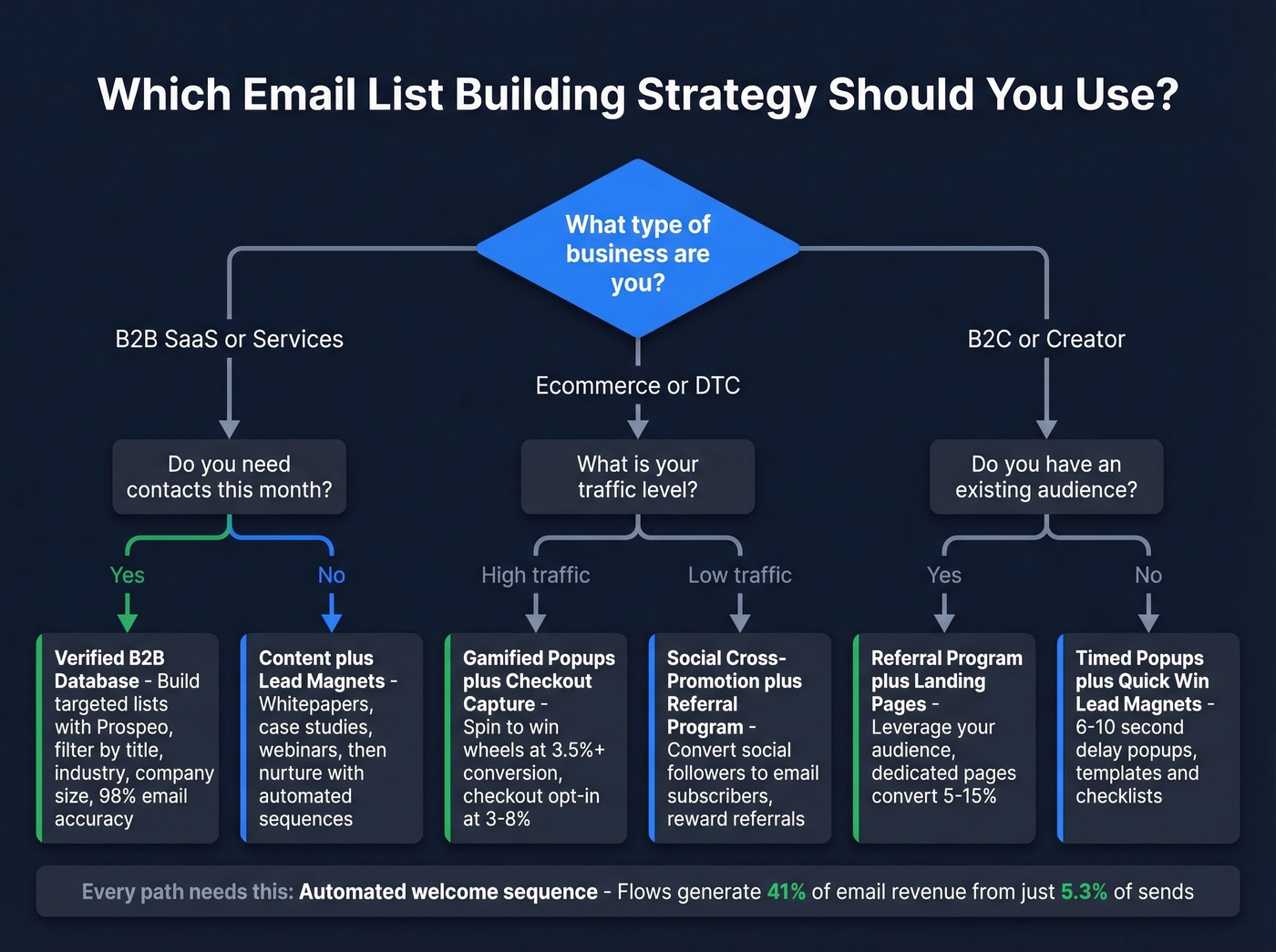
When your sales team needs 500 contacts in a new vertical by next month, popups won't get you there. Neither will blog opt-ins or webinar registrations. You need a proactive approach - filtering by job title, industry, company size, and intent signals to build a targeted list of verified contacts.
If you’re building outbound lists, it helps to standardize your firmographic filters so reps don’t “wing it.”

Prospeo covers 300M+ professional profiles with 30+ search filters, and every email goes through a 5-step verification process that delivers 98% accuracy. The data refreshes every 7 days (the industry average is 6 weeks), so you're not emailing people who changed jobs two months ago. The free tier gives you 75 verified emails per month to test the workflow - no credit card, no sales call.
If you're in B2B and your entire list building strategy is inbound opt-ins, you're leaving pipeline on the table.
To pressure-test your outbound motion, compare it against modern sales prospecting techniques.
11. CRM Enrichment for Existing Lists
You probably have thousands of partial records sitting in your CRM right now - a name and company but no verified email, or an email but no phone number. Enrichment fills those gaps, turning incomplete records into actionable leads. The best enrichment tools return 50+ data points per contact with match rates above 80%, and the ROI is immediate since you're activating data you already paid to acquire.
If you’re evaluating vendors, start with this breakdown of data enrichment services.
12. Intent-Based Targeting
The most sophisticated approach layers intent data on top of firmographic filters. Instead of emailing every VP of Marketing at a mid-market SaaS company, you target the ones whose companies are actively researching your category right now.
This means building lists of in-market buyers rather than cold contacts - and the difference in reply rates is dramatic. Tools tracking intent across thousands of topics let you time your outreach to the moment a prospect is actually looking for what you sell, which is a fundamentally different motion than batch-and-blast cold email.
If you want to operationalize this, use an intent based segmentation model instead of one-size-fits-all lists.
Automate What Happens After Signup
Getting the email is step one. What happens in the next 48 hours determines whether that subscriber becomes revenue or just another row in a spreadsheet.
The data from Klaviyo's benchmark study across 183,000+ customers is striking: automated flows generate 41% of total email revenue from just 5.3% of sends. Revenue per recipient for flows runs 18x higher than campaigns. And 48% of flow-driven revenue comes from new buyers - people who just joined your list.
Your welcome sequence is the highest-leverage automation you'll build. It should fire within minutes of signup, deliver the promised lead magnet or value, and introduce your brand's core offer. Segmented campaigns see 5x higher open rates than batch-and-blast sends, so collect at least one or two extra data points at signup - role, company size, primary challenge - to power that segmentation from day one.
A word on tooling: Klaviyo gets called overpriced outside pure ecommerce, and ActiveCampaign's learning curve is brutal. For most teams, simpler platforms like Brevo (starting around $25/month) or MailerLite get the job done without the complexity tax.
If you’re running multi-step sequences, tighten your sequence management so handoffs don’t break.
Deliverability - The Hidden List Killer
You can build the best list in the world and still fail if your emails land in spam.
Most marketers miss a critical distinction: delivery means the ISP accepted your email. Deliverability means it actually reached the inbox. Litmus reports that 70% of emails show at least one spam-related issue, and marketers who actively monitor deliverability are 22% more likely to report program success.
Your authentication stack is non-negotiable in 2026. Major providers - Gmail, Yahoo, Outlook - all require it, and the adoption gaps are still alarming:
- SPF (approved sending sources): only 55.4% of senders have it configured
- DKIM (cryptographic verification): 58.5% adoption
- DMARC (policy + reporting): just 42.5% adoption
If you haven't set up all three, do it today. It's the single highest-impact deliverability fix you can make.
List quality is the other half of the equation. Every bounced email damages your sender reputation, and reputation damage compounds. Before sending to any list - whether it's opt-in subscribers or proactively built contacts - verify every address. Don't forget compliance either: GDPR requires explicit consent for EU contacts, and CAN-SPAM mandates a working unsubscribe link and physical mailing address in every email. Ignoring either will cost you more than lost deliverability - it'll cost you fines.
If you need a full checklist, follow an email deliverability guide and keep an eye on your email bounce rate.
The article says 79% of marketing leads never convert without follow-up. But what if your list started with verified, direct contacts instead of cold opt-ins? Prospeo's 7-day data refresh means every email you pull is current - not stale data from six weeks ago.
Skip the bounce rates. Start with contacts that are already verified.
Mistakes That Kill List Growth
Even with the right email list building strategies, a few common mistakes can undo your progress.
Over-emailing is the #1 list killer. 69% of users unsubscribe because they receive too many emails. B2B teams should send 2-4 emails per month. B2C retail can push 4-8 per month. Ecommerce can go as high as 4-5 per week, but only with strong segmentation.
Neglecting list hygiene compounds damage over time. Clean your list every 3-6 months. Remove subscribers who've been inactive for 6-12 months - but send a re-engagement sequence first. You'll recover some, and the rest were dragging down your metrics anyway.
Multiple CTAs dilute action. Emails with a single CTA see up to 371% higher click-through rates than those with competing links. Pick one action per email and make it obvious.
Tracking the wrong metric will mislead you. Open rates are unreliable post-Apple Mail Privacy Protection. Focus on CTR instead - 2-5% is the typical range for healthy campaigns, with promotional emails often landing at 1-3%.
FAQ
How fast should my email list grow?
3-5% monthly growth is the benchmark for healthy programs with always-on signup sources. Below 3% consistently means you should audit your forms, offers, and traffic sources for conversion leaks.
What's a good popup conversion rate?
2.1% is the average across 1.24 billion popup displays. Above 3% is good, above 5% is excellent - typically requiring gamification or highly targeted traffic segments.
Should I use single or double opt-in?
Double opt-in produces cleaner lists with higher engagement and fewer spam complaints. Use it unless speed-to-list is critical for time-sensitive promotions where you accept the tradeoff.
How do I build a B2B email list without buying one?
Use a verified contact database to filter by role, industry, and intent signals - with every email verified in real time. This avoids the deliverability damage of purchased lists while giving you proactive control over targeting.
How often should I clean my email list?
Every 3-6 months. Run a re-engagement sequence for inactive subscribers first, then remove non-responders. Hard bounces and spam complaints should be purged immediately after every send.