

Email Marketing Cadence: How to Find the Right Frequency (Without Guessing)
392.5 billion emails will be sent per day in 2026. Your subscribers aren't starving for content - they're drowning in it. The difference between a high-performing email program and one that bleeds unsubscribes isn't what you send. It's your email marketing cadence: the timing, frequency, and sequence logic behind every message.
Get it wrong and you'll watch engagement crater while your unsubscribe rate climbs. Get it right and you'll wonder why you ever debated "two emails or three."
What Cadence Actually Means
Cadence isn't just "how many emails per week." It's the full system - frequency, timing, sequence order, and the mix of scheduled campaigns versus triggered automations. Think of frequency as one dial on a mixing board. Cadence is the whole board.
Most teams obsess over the frequency dial while ignoring the automations running in the background. Those automations are where the real revenue lives.
Quick Starting Points
- B2C: 2-3 emails per week, plus triggered flows (welcome, cart abandonment, browse abandonment)
- B2B: 1-2 emails per week, max 3 email-only attempts before switching channels
- Welcome email: within 5 minutes of signup
- Cart abandonment: first message within 30 minutes
- The big insight: triggered flows generate 18x more revenue per recipient than campaigns - optimize your automations first, campaign frequency second
- Non-negotiable: cadence is wasted if emails bounce. Verify your list before scaling sends.
Why Automations Beat Blasts
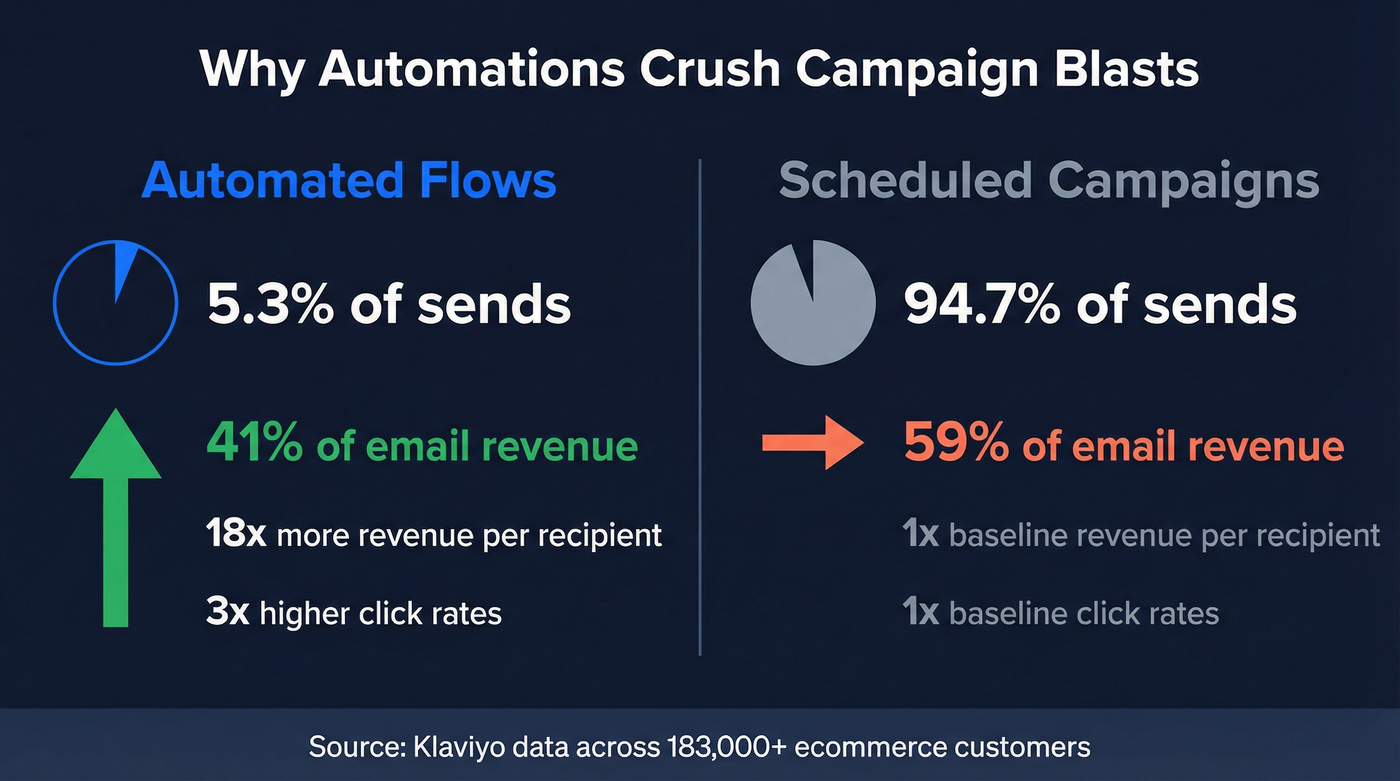
Across 183,000+ ecommerce customers on Klaviyo, automated flows account for just 5.3% of total send volume but drive roughly 41% of email revenue. That's 18x higher revenue per recipient than campaigns, with 3x higher click rates.
Practitioners on r/emailmarketing describe triggered automations - browse abandonment, cart reminders, site revisit triggers - as the quiet revenue drivers that avoid the list fatigue from constant blasts. We've seen the same pattern across every team we've worked with: fix the automations first, and campaign frequency debates become almost irrelevant.
With 69.80% of carts abandoned, every single one is a triggered-flow opportunity no campaign calendar can replicate. That's money sitting on the table.

Automated flows drive 18x more revenue per recipient - but only if those emails actually land. Prospeo's 5-step verification catches spam traps, honeypots, and catch-all domains at 98% accuracy, so your triggered sequences hit real inboxes instead of feeding bounce rates.
Fix your list before you fix your cadence. Start with 75 free verifications.
Cadence by Lifecycle Stage
Not every subscriber should get the same frequency. Segment by journey stage and engagement:

| Lifecycle Stage | Cadence | Goal |
|---|---|---|
| Awareness | Every 2-3 days (short series) | Build familiarity |
| Consideration | Weekly | Educate, don't overwhelm |
| Retention | Monthly or quarterly | Stay top-of-mind |
| Re-engagement | 3-4 messages over 2 weeks | Win back or sunset |
Layer engagement level on top of lifecycle. An active retention subscriber can handle more than a consideration-stage contact who hasn't clicked in three weeks. And let subscribers set their own frequency through a preference center - it's the single easiest way to reduce unsubscribes while keeping engaged readers happy.
How to Test Your Send Frequency
Gut feelings don't scale. Here's a framework that does:
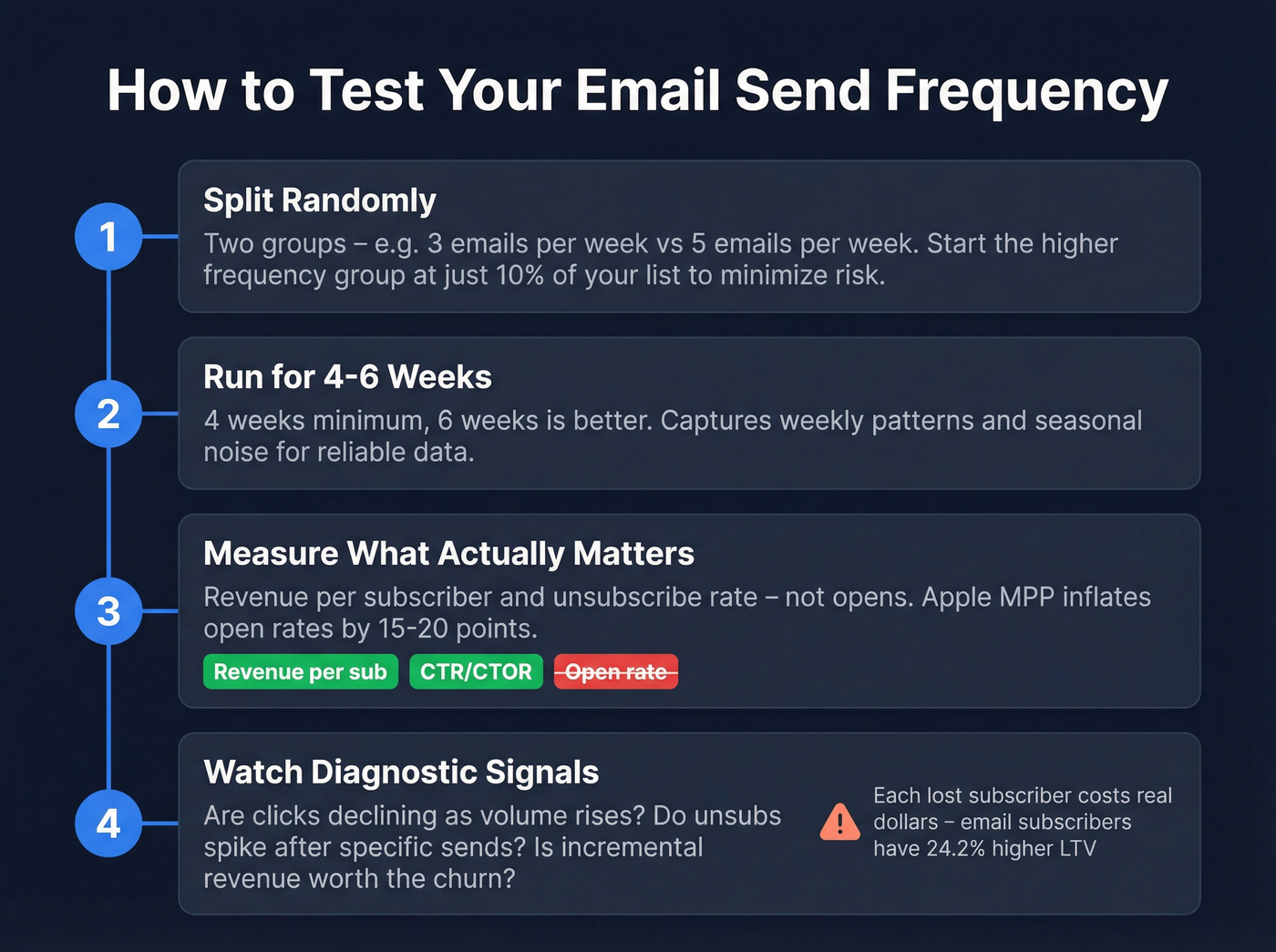
Split randomly. Two groups - say, 3 emails/week vs. 5 emails/week. Start the higher-frequency group at 10% of your list to minimize risk.
Run for at least 4 weeks. Six weeks is better because it captures more weekly patterns and seasonal noise.
Measure what matters. Revenue per subscriber and unsubscribe rate - not opens. Apple Mail Privacy Protection inflates open rates by 15-20 points, so CTR/CTOR and revenue-based metrics are far more dependable for cadence decisions. (If you still need open-rate context, use real benchmarks and treat them as directional.)
Watch diagnostic signals. Are clicks declining as volume rises? Do unsubs spike after specific sends? Is incremental revenue worth the churn? If email-subscribed customers have 24.2% higher LTV, each lost subscriber has a real dollar cost. Let's be honest: most teams skip this math and just eyeball it, which is why they keep making the same mistakes quarter after quarter. (If you want to quantify churn impact, start with a simple churn analysis.)
Deliverability Guardrails
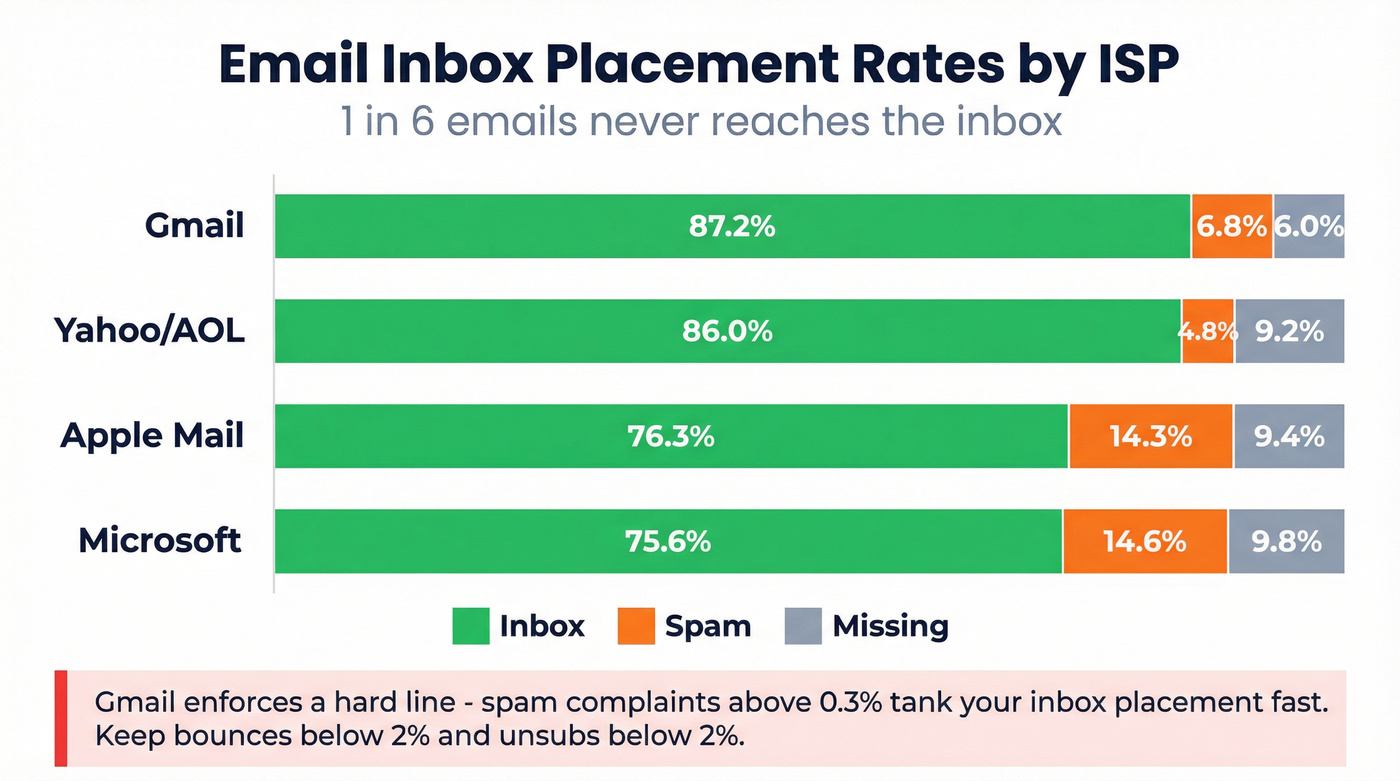
Your cadence strategy doesn't matter if emails never reach the inbox. Roughly 1 in 6 emails miss it entirely:
| ISP | Inbox Rate | Spam Rate | Missing |
|---|---|---|---|
| Gmail | 87.2% | 6.8% | 6.0% |
| Microsoft | 75.6% | 14.6% | 9.8% |
| Yahoo/AOL | 86.0% | 4.8% | 9.2% |
| Apple Mail | 76.3% | 14.3% | 9.4% |
Gmail enforces a hard line: spam complaint rates above 0.3% tank your inbox placement fast. Keep bounce rates below 2% and unsubscribe rates below 2% as baseline guardrails. Only 58% of brands actively monitor Google Postmaster data - if you're not in that group, you're flying blind. (For a deeper fix list, use an email deliverability guide and an email spam checker.)
In our experience, bad data destroys sender reputation faster than any other cadence mistake. Before any frequency change, run your list through a verification tool with catch-all handling, spam-trap removal, and honeypot filtering. Prospeo's 5-step verification hits 98% accuracy, with a free tier covering 75 emails per month - useful for spot-checking before a big ramp. When increasing frequency, warm up gradually over 2-4 weeks, sending to your most engaged contacts first. (If you're troubleshooting bounces, start with email bounce rate and then work on improve sender reputation.)
Here's the thing: if your bounce rate is above 3%, debating whether to send two or four newsletters a week is rearranging deck chairs. Fix the list first. Everything else is downstream.
Common Cadence Mistakes
The most common mistake isn't sending too often - it's blasting your full list at the same frequency regardless of engagement. Your most active subscribers and your least engaged ones need different volumes. Segment or pay the price in complaints.
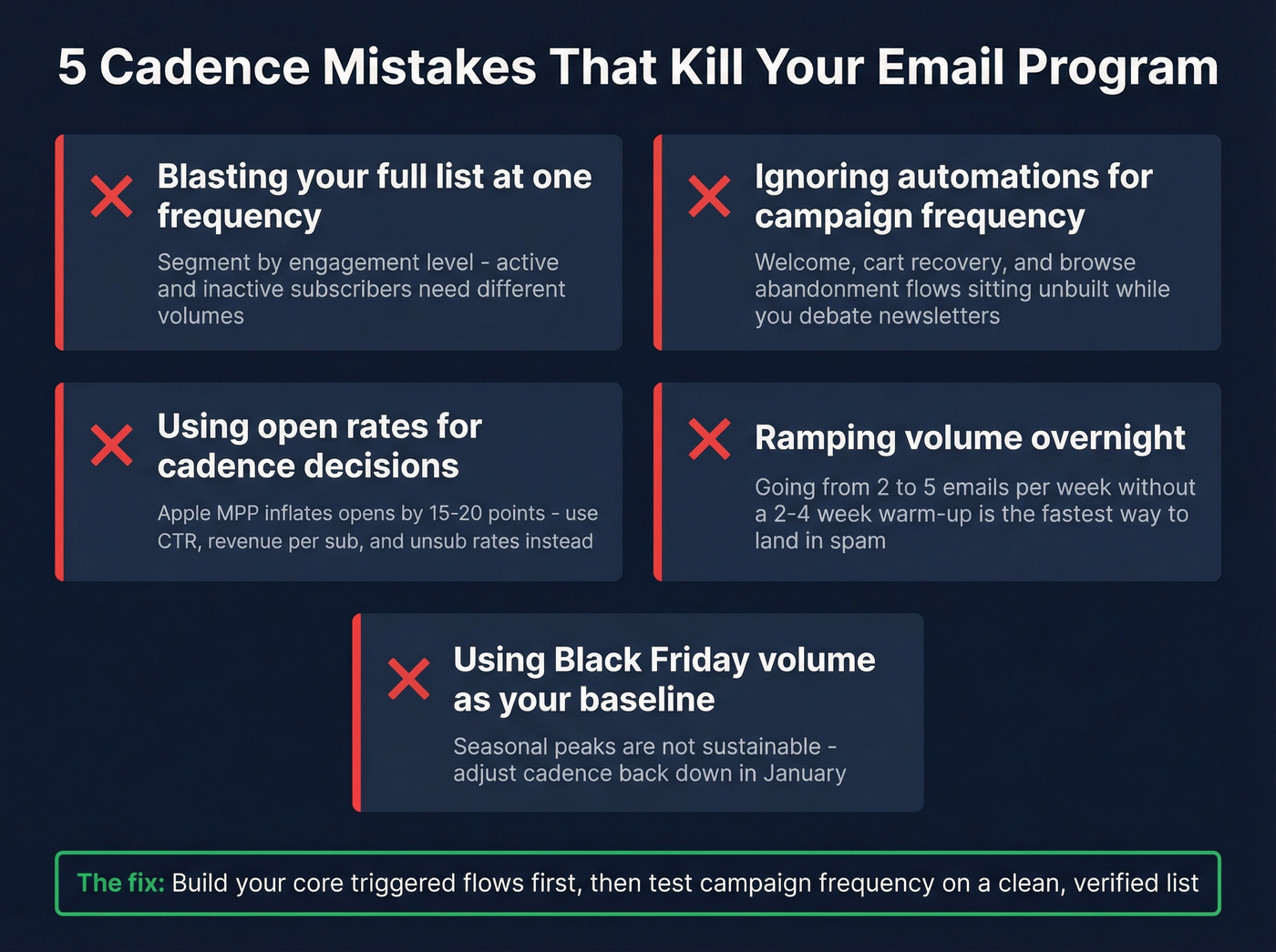
Other mistakes we see constantly: obsessing over campaign frequency while welcome, cart recovery, and browse abandonment flows sit unbuilt. Using open rates to make cadence decisions in a post-Apple MPP world. Ramping from 2 emails/week to 5 overnight without a warm-up period - that's the fastest way to land in spam folders. And don't forget seasonal adjustment; Black Friday volume shouldn't be your January baseline. (If you're sending at scale, keep an eye on email velocity and use targeted email campaigns instead of one-size-fits-all blasts.)
Skip the "perfect cadence" spreadsheet if you haven't built your core triggered flows yet. A mediocre campaign schedule with great automations will outperform a perfectly timed campaign calendar with no flows every single time.
Every cadence test is meaningless if 1 in 6 emails never reaches the inbox. Prospeo refreshes data every 7 days - not the 6-week industry average - so your contact lists stay clean between sends. At $0.01 per email, list hygiene costs less than a single unsubscribe.
Clean data turns cadence strategy into actual revenue. See the difference yourself.
FAQ
How often should I send marketing emails?
B2C programs perform well at 2-3 emails per week plus triggered flows. B2B should start at 1-2 per week. Segment by engagement level - active subscribers tolerate higher frequency. Optimize triggered automations before adding more scheduled campaigns.
What's the difference between cadence and frequency?
Frequency is how many emails you send per week. Cadence covers timing, sequence order, the campaign-versus-automation mix, and how all of those adapt by segment. Frequency is one input; your email marketing cadence is the full strategy governing when, how, and to whom every message goes.
How do I know if I'm emailing too often?
Watch three signals: unsubscribe rates rising above 0.1% per send, click rates declining as volume increases, and spam complaints approaching 0.3%. If revenue per subscriber drops as frequency rises, pull back and test a lower cadence.
Should I verify my list before changing cadence?
Always. Bounces to invalid addresses inflate complaint ratios and damage sender reputation, which skews any test results you're trying to run. Clean your list first, then test frequency changes on solid ground.