

The Email Marketing Sequence Playbook: Benchmarks, Cadence, and What Actually Works
You spent two weeks writing a 5-email nurture sequence. You hit send. Three days later, your bounce rate is 12% and your domain reputation is tanking. The copy was fine. The cadence was reasonable. But nobody told you that the list you imported hadn't been verified since Q3, and 1 in 8 addresses were dead on arrival.
That's the reality most email marketing sequence guides skip - they hand you templates and definitions but not the numbers that determine whether your sequence works or craters your sender reputation. This one has the numbers.
The Short Version
- Start with 2-3 sequence types (welcome, nurture, re-engagement) - not 13. Master those before expanding.
- Use 4-7 emails per sequence. 4-7 step sequences generate 3x the reply rate of 1-3 step sequences.
- Stop relying on open rates as your primary metric. Apple Mail Privacy Protection inflated them by roughly 18 points across 80,000+ accounts. Track click-through rate instead.
- Verify your list before you automate anything. A 10%+ bounce rate tanks your domain faster than bad copy ever will.
What Is an Email Marketing Sequence?
An email marketing sequence is a series of pre-written emails sent automatically based on a trigger - a signup, a purchase, a behavior, or simply the passage of time. The key distinction is between time-based sequences (send Email 2 three days after Email 1, regardless of what the recipient does) and behavior-based sequences (send Email 2 only if the recipient clicked a link in Email 1).
You'll hear "sequence," "drip campaign," and "drip email sequence" used interchangeably. Per Kit's breakdown, drip campaigns lean more heavily on triggers and personalization branching, while sequences can be simpler linear flows. In practice, most modern platforms blend both approaches, and the terminology matters less than the execution.
Here's the number that should convince you to invest in automated sequences over one-off blasts: automated flows outperform campaigns by 3.3x on click rate, based on Klaviyo's analysis of 183,000+ brands. That's not a marginal improvement. That's a different category of performance.
Why Sequences Crush One-Off Campaigns
The data here isn't subtle. Klaviyo benchmarks, side by side:
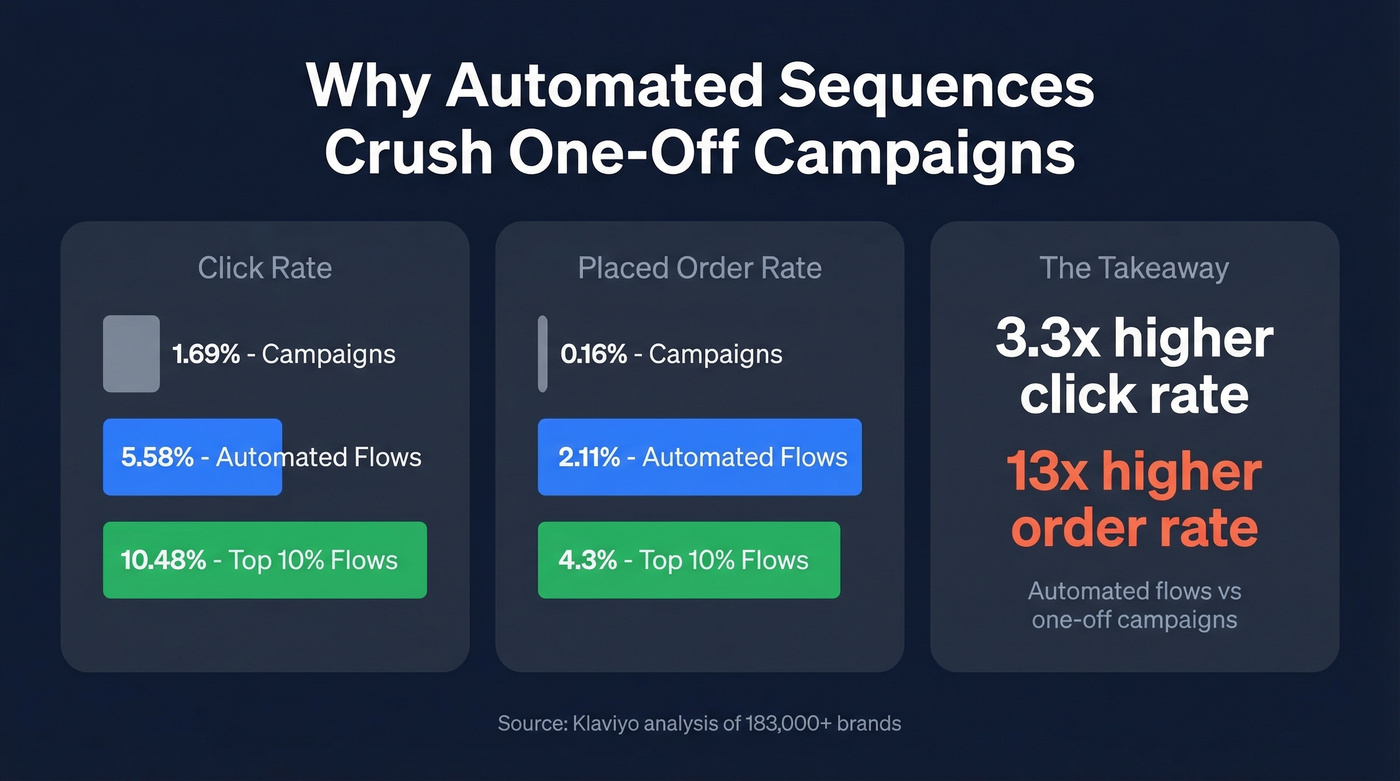
| Metric | Campaign Avg | Automated Flow Avg | Top 10% Flows |
|---|---|---|---|
| Open Rate | 31% | - | - |
| Click Rate | 1.69% | 5.58% | 10.48% |
| Placed Order Rate | 0.16% | 2.11% | 4.3% |
Automated flows dominate on the metrics that actually matter - clicks and conversions. The click rate gap alone is 3.3x. For top-10% performers, it's 6.2x the campaign average.
Why the gap? Two reasons. First, sequences reach people at the right moment - triggered by behavior, not by your marketing calendar. Second, the follow-up is where the money is. 70% of responses come from emails 2-4 in a sequence. One-and-done campaigns leave that revenue on the table entirely.
Essential Sequence Types to Master
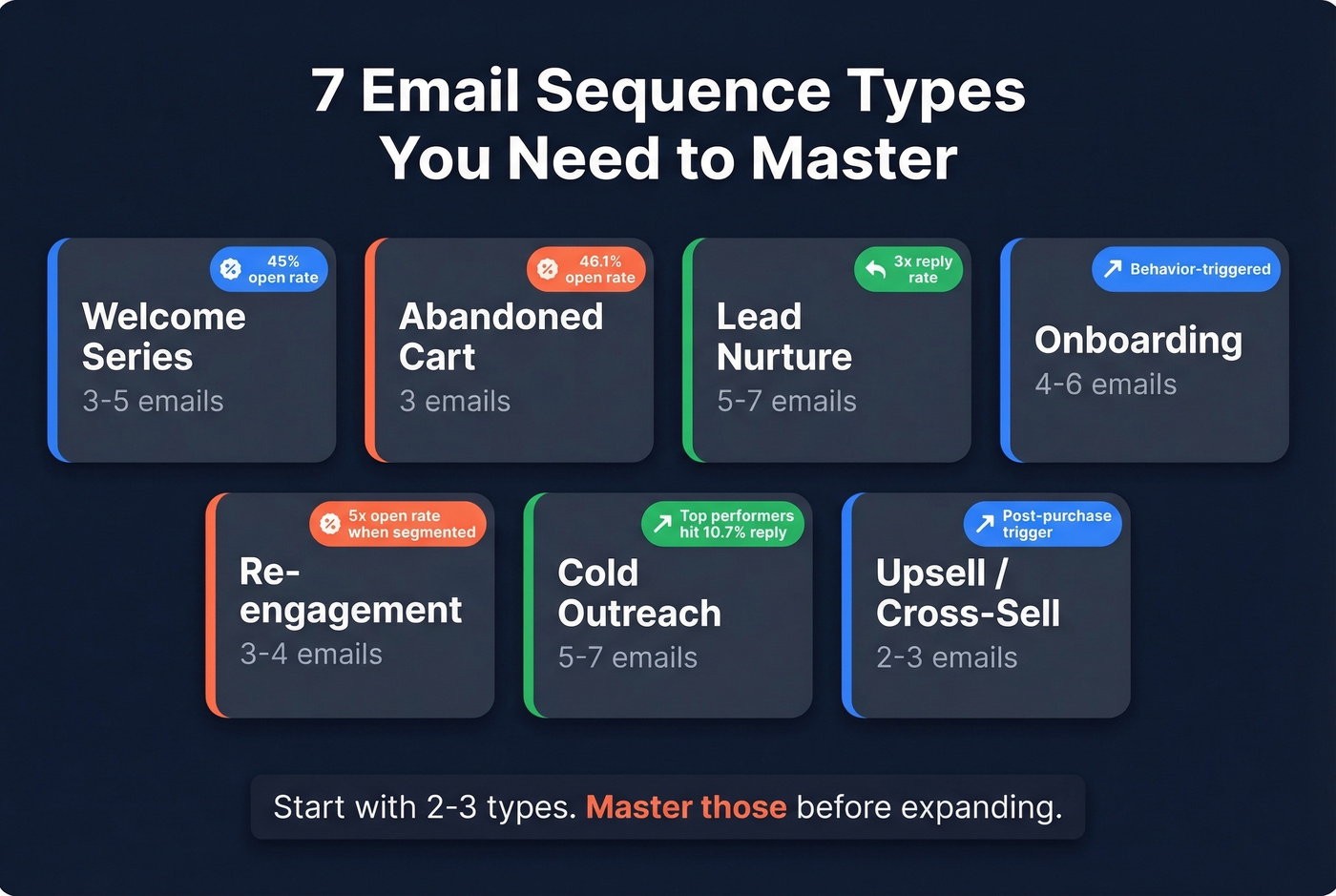
Most guides list 13 sequence types and leave you paralyzed. You need to master 2-3 before you build more. Here are the seven that matter, with specific cadences and the benchmarks behind them.
Welcome Series
Goal: Convert a subscriber into an engaged contact (or buyer) within the first week.
Cadence: 3-5 emails - Day 0, Day 1, Day 3, Day 5, Day 7.
74.4% of subscribers expect a welcome email immediately after signing up. Give it to them. Welcome emails average a 45% open rate - the highest of any sequence type.
Val Geisler's 4-email welcome structure is worth stealing. Email 1 delivers the promise (lead magnet, discount, access). Email 2 tells your origin story - why you exist and who you serve. Email 3 provides unexpected value, something they didn't sign up for but are glad they got. Email 4 makes the conversion ask. This structure works because it earns the sale before requesting it. Don't sell hard in Email 1. You haven't earned it yet.
Subject line examples that pull their weight:
Your [lead magnet name] is inside (+ a quick hello)The one thing most [audience] get wrong about [topic]Here's what happens next
Abandoned Cart
Goal: Recover revenue from abandoned carts (75.5% of shopping carts are abandoned).
Cadence: 3 emails - 1 hour, 24 hours, 72 hours after abandonment.
46.1% open rate, 13.3% click rate, and 35%+ of clickers complete the purchase. Email 1 is a gentle reminder with the cart contents. Email 2 adds social proof or addresses common objections. Email 3 introduces urgency - a limited-time discount or low-stock warning. Keep the timing tight. After 72 hours, the purchase intent has evaporated.
Here's a skeleton for Email 1 you can adapt:
Subject: You left something behind
Hey [Name],
Your [product] is still in your cart. We're holding it for now, but stock moves fast.
[CTA: Complete your order]
Questions? Just reply to this email.
Three sentences, one CTA, zero pressure. That's all Email 1 needs to do.
Lead Nurture Drip Sequence
5-7 emails, spaced 3-7 days apart. This is the workhorse sequence for B2B teams, and the data is unambiguous: 4-7 step sequences generate 3x the reply rate of shorter 1-3 step sequences (27% vs 9%).
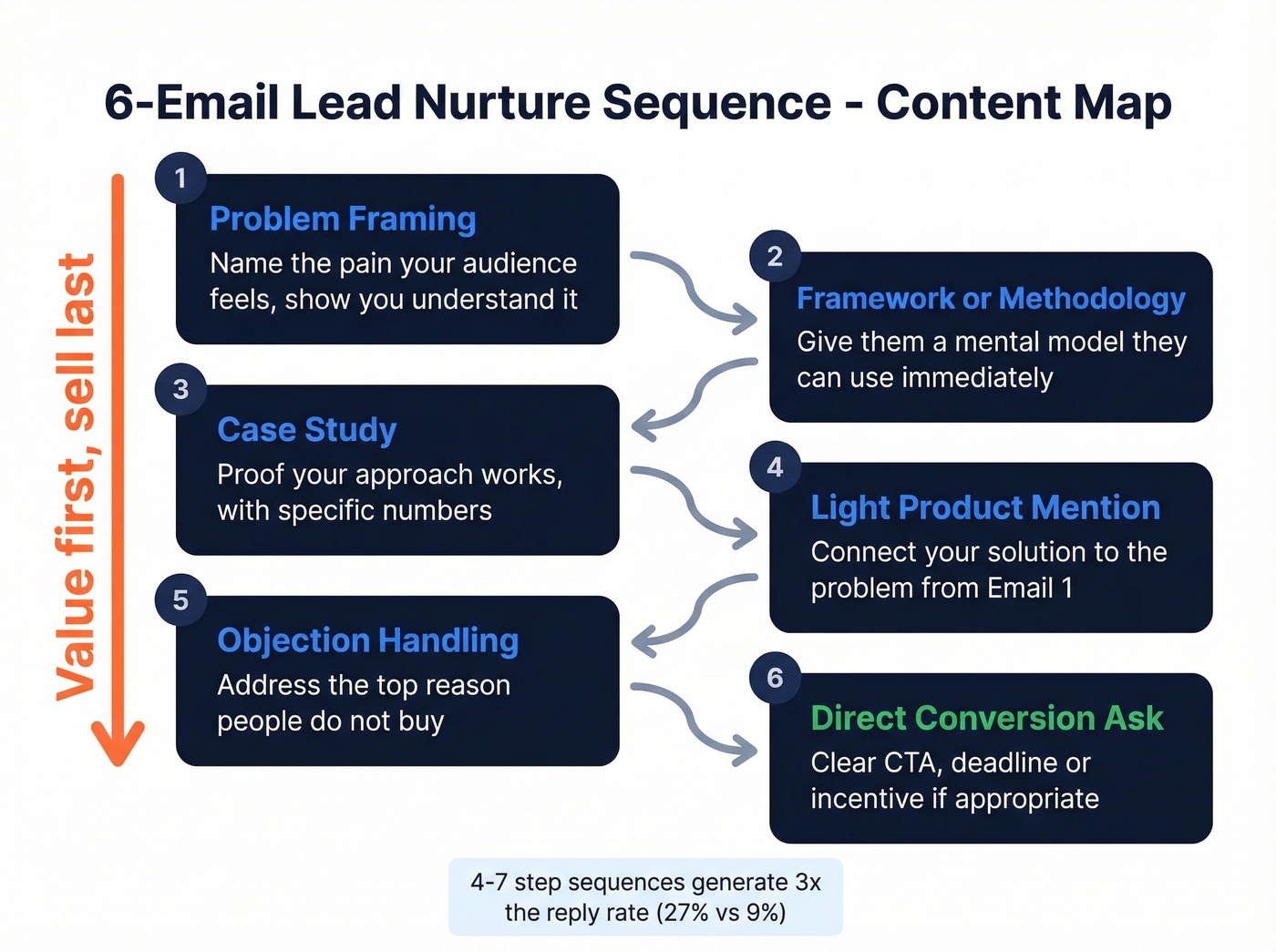
The biggest mistake we see is nurture sequences that are thinly disguised sales pitches. Teach something in every email. Here's a content map modeled after Kit's 8-email nurture structure, compressed to 6:
- Problem framing - name the pain your audience feels, show you understand it
- Framework or methodology - give them a mental model they can use immediately
- Case study - proof that your approach works, with specific numbers
- Light product mention - connect your solution to the problem from Email 1
- Objection handling - address the top reason people don't buy
- Direct conversion ask - clear CTA, deadline or incentive if appropriate
Each email should deliver standalone value. A case study, a framework, a benchmark - not just "checking in." The conversion ask comes at the end because you've earned it.
Onboarding / Trial Conversion
The best onboarding sequences blend time-based and behavior-triggered emails. Time-based emails cover the basics: Day 1 is a setup guide, Day 3 is a key feature walkthrough. Behavior-triggered emails fire when a user completes - or doesn't complete - a critical action.
If someone hasn't connected their CRM by Day 5, that's a different email than if they've already imported 500 contacts. Plan for 4-6 emails total, and build at least two branch points based on feature adoption milestones.
Re-engagement / Win-Back
Segmented campaigns see 5x higher open rates than unsegmented blasts. Don't send the same win-back to someone who opened your last 3 emails but didn't click as you send to someone who hasn't opened anything in 90 days.
Use 3-4 emails spaced at Day 0, Day 3, Day 7, Day 14. Email 1 acknowledges the gap. Email 2 offers fresh value. Emails 3-4 give a clear "stay or go" choice. If they don't re-engage after 4 touches, suppress them. Dead weight on your list hurts deliverability more than a smaller list ever will.
Cold Outreach
Typical cold email reply rates sit around 3%. Top performers hit 10.7%+. The difference isn't magic copy - it's targeting, timing, and persistence. Most reps give up after 1-2 emails, but 70% of responses come from emails 2-4.
Skip this sequence type if your deal size is under $5k and you don't have a dedicated SDR. Cold outreach at scale requires clean data, inbox warmup, and constant monitoring. Without those, you'll burn your domain before you book a meeting.
Use 5-7 emails over 30 days, spacing follow-ups wider as the sequence progresses. Keep each email under 100 words. Personalize the first line to something specific about the prospect's company, not their job title.
Upsell / Cross-Sell
The simplest sequence type. Two to three emails, triggered by purchase with 3-7 day spacing:
- Day 3-5 post-purchase: Recommend complementary products based on what they bought
- Day 7-10: Share a customer story or use case showing the combined value
- Day 14 (optional): Time-limited bundle offer
Keep it short, keep it relevant, and don't send it too soon - let them enjoy what they just bought first.
2026 Benchmarks You Should Actually Track
Let's consolidate the numbers you need. This table combines data from Klaviyo's 183,000+ brand analysis and HubSpot's 80,000+ account study:
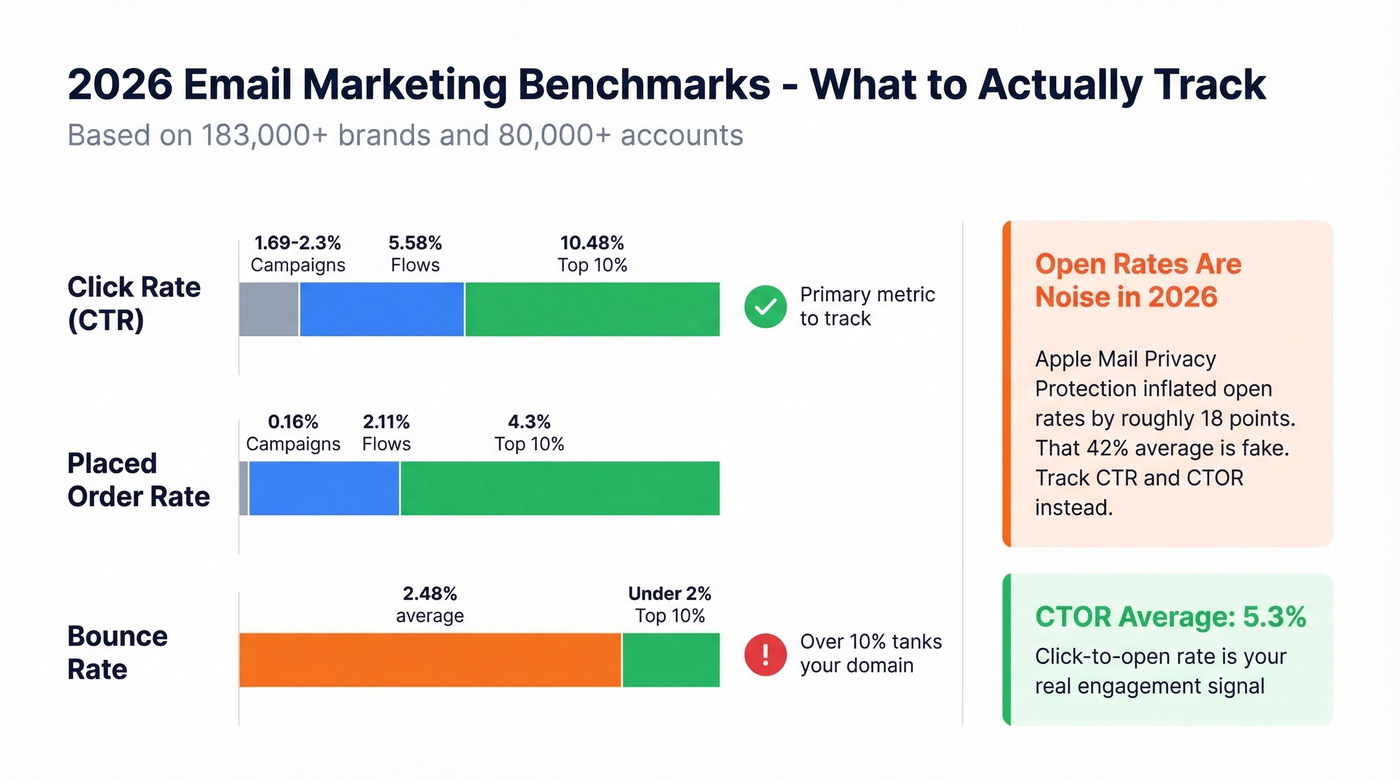
| Metric | Campaign Avg | Flow Avg | Top 10% |
|---|---|---|---|
| Open Rate | 31-42% | - | 45%+ |
| Click Rate (CTR) | 1.69-2.3% | 5.58% | 10.48% |
| CTOR | 5.3% | - | - |
| Placed Order | 0.16% | 2.11% | 4.3% |
| Bounce Rate | 2.48% | - | <2% |
| Unsubscribe | 0.22% | - | - |
Why the open rate range is so wide: Apple Mail Privacy Protection pre-fetches email content, registering "opens" that never happened. Apple Mail accounts for 46% of email clients, and the HubSpot study found open rates jumped roughly 18 points after MPP rolled out. That 42% "average" is inflated. The real number is probably closer to Klaviyo's 31%.
Here's the thing: open rates are a vanity metric in 2026. Track CTR (2.3% average) and CTOR (5.3% average) as your primary engagement signals. If you're reporting open rates to leadership, you're reporting noise. The only open rate worth watching is a sudden drop - that signals a deliverability problem, not an engagement one.

You just read that a 10%+ bounce rate tanks your domain faster than bad copy. Prospeo's 5-step email verification delivers 98% accuracy - so your welcome, nurture, and re-engagement sequences hit real inboxes, not dead addresses. At $0.01 per email, cleaning your list costs less than one bounced send.
Fix your list before you automate another sequence.
Timing and Cadence That Works
The baseline cadence that works across most sequence types:
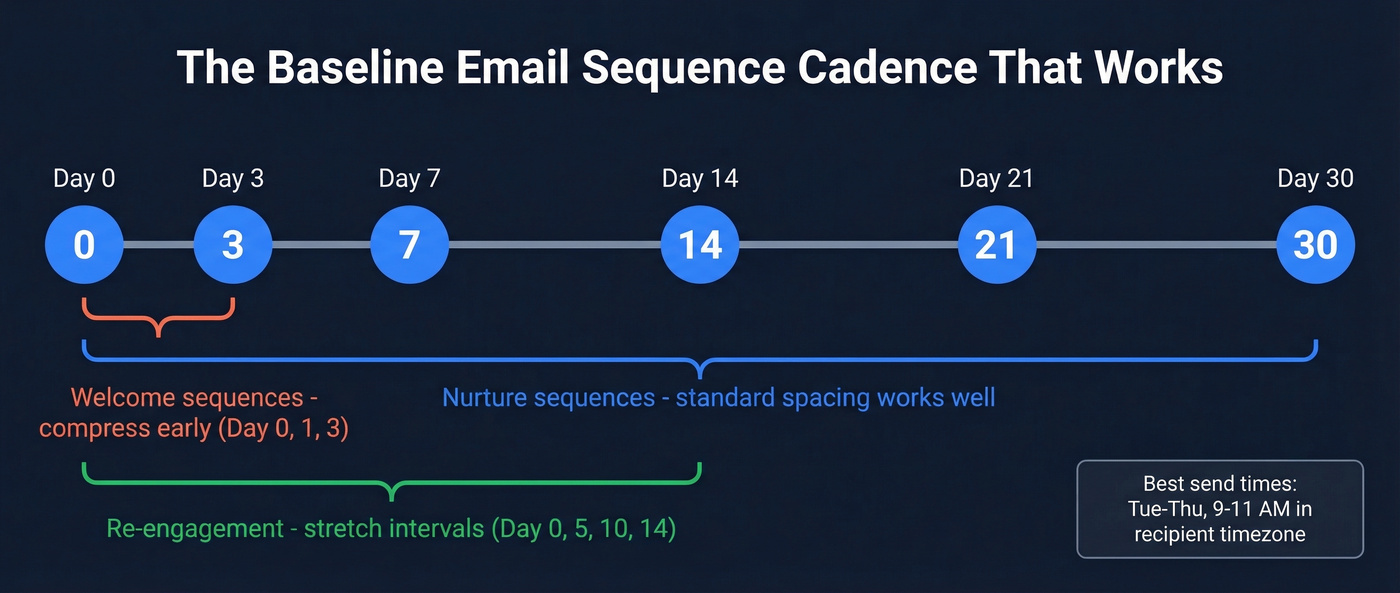
Day 0 -> Day 3 -> Day 7 -> Day 14 -> Day 21 -> Day 30
That gives you six touchpoints over a month with progressively wider spacing. For welcome sequences, compress the early intervals (Day 0, Day 1, Day 3). For re-engagement, stretch them out (Day 0, Day 5, Day 10, Day 14).
Best send times: Tuesday through Thursday, 9-11 AM in the recipient's timezone. This holds across both Instantly's cadence research and Superhuman's analysis. Monday inboxes are too crowded. Friday attention is already gone.
AI-powered send-time optimization is worth enabling if your ESP supports it. Platforms like ActiveCampaign and Klaviyo can analyze recipient behavior to send at the moment each person is most likely to engage, rather than blasting everyone at 10 AM Tuesday.
The most important cadence decision isn't which day - it's how many steps. In our experience, teams build 2-3 email sequences because they're afraid of annoying prospects, then wonder why engagement is low. 4-7 steps generate 3x the reply rate. The follow-up emails are where the conversion happens. Build longer sequences and let the data tell you where drop-off occurs.
Multi-Channel Sequences and Data Quality
Email-only sequences have a ceiling. Superhuman's analysis of 2.5 million touches tells the story:
- Email only: 5.2% reply rate, 1.1% meeting booking rate
- Email + social: 11.7% reply rate (125% increase)
- Email + social + phone: 18.3% reply rate, 4.9% meeting booking rate
Adding channels doesn't just improve results - it transforms them. A 4.9% meeting booking rate versus 1.1% is the difference between a pipeline that works and one that doesn't.
But a multi-channel sequence is only as good as the data behind it. People change jobs, companies get acquired, phone numbers rotate. If your email list is stale, you're not just getting low reply rates - you're actively damaging your sender reputation with every bounce.
This is where data verification becomes non-negotiable. Tools like Prospeo run contacts through multi-step verification - catch-all handling, spam-trap removal, honeypot filtering - before you ever hit send. When your drip sequences span email, phone, and social, every channel's data needs to be clean. Stale data in one channel poisons the whole flow.
Look, if your average deal is under $8k, you probably don't need a 7-channel orchestration platform. A well-built sequence with verified data and one additional channel (phone or social) will outperform a bloated tech stack with dirty data every time. Complexity isn't a strategy. Clean data and good copy are.
Deliverability Checklist
None of your sequences matter if emails land in spam. Here's the operational checklist:
- Authenticate your domain. SPF, DKIM, and DMARC are non-negotiable. If you haven't set these up, stop reading and do it now. (If you want a deeper operational walkthrough, start with our email deliverability guide and SPF record examples.)
- Warm up new inboxes gradually. Follow this ramp: Week 1-2: 5-10/day. Week 3-4: 15-20/day. Week 5-6: 30-40/day. Week 7+: max 50/day per inbox. (Also watch email velocity as you scale.)
- Verify your list before sending. Run every list through verification as Step 1, not an afterthought. Catching invalid addresses, spam traps, and honeypots before they damage your sender reputation is the single highest-ROI action in this entire checklist. (If you're troubleshooting, see email bounce rate and spam trap removal.)
- Monitor the right metrics. Target: reply rate 5%+, bounce rate under 2%, spam complaints under 0.1%. Google's sender guidelines flag domains with spam complaint rates above 0.3%. (For measurement, use the click rate formula.)
- Keep your content clean. Maintain an 80/20 text-to-image ratio. Avoid excessive caps, spam trigger words, and stacking multiple links. One clear CTA per email. (If you need help tightening copy, use our email copywriting guide.)
- Check Google Postmaster Tools weekly. If your domain reputation drops, pause sending and diagnose before you send another batch. (More on remediation: improve sender reputation and email reputation tools.)
Five Mistakes That Kill Results
Mistake 1: Over-automation without personalization. Setting up 12 automated sequences doesn't help if every email reads like it was written for "Dear {First_Name}." The fix: build behavior-triggered branching. Someone who visited your pricing page three times gets a different Email 3 than someone who only opened Email 1. As practitioners on r/EmailWhisperers put it, automation without behavioral relevance produces "personalized" recommendations that feel anything but.
Mistake 2: No segmentation. Blasting your entire list with the same sequence is a 2010 strategy. Segmented campaigns see 5x higher open rates. Segment by behavior - what they clicked, what they bought, how recently they engaged - not just demographics.
Mistake 3: Over-sending. The consensus on Reddit is consistent: sending more "because you can" causes fatigue, unsubscribes, and spam marks. Start with a weekly or biweekly baseline. If your unsubscribe rate climbs above ~0.3%, tighten targeting and reduce frequency.
Mistake 4: Ignoring mobile. 60%+ of emails are opened on mobile devices. Tiny text, broken layouts, and hard-to-tap CTAs aren't just annoying - they're conversion killers. Test every email on a phone screen before it goes live.
Mistake 5: Measuring opens instead of clicks. Apple MPP inflated open rates by roughly 18 points. If your dashboard shows a 45% open rate and you're celebrating, you're celebrating noise. Track CTR and CTOR. Those numbers don't lie.
How to Build Your First Sequence
- Define the goal. One sequence, one objective. "Nurture trial users to paid" is a goal. "Engage our list" isn't.
- Choose the trigger. Time-based (X days after signup) or behavior-based (visited pricing page, abandoned cart). Start with time-based - it's simpler to build and debug.
- Map the flow. Decide on 4-7 emails with specific intervals. Use the Day 0 -> Day 3 -> Day 7 -> Day 14 -> Day 21 framework as your starting point.
- Write the emails. Subject line + body + single CTA per email. Keep cold emails under 100 words. Marketing emails can run longer, but respect attention spans. (If you need ideas, pull from these email subject line examples and sales follow-up templates.)
- Set up automation. Mailchimp for simplicity. ActiveCampaign for advanced branching. MailerLite for budget-friendly automation. Kit for creators. Klaviyo for ecommerce. Pick the one that matches your use case, not the one with the most features.
- A/B test from day one. Test one variable at a time: subject line first, then CTA placement, then send time.
- Monitor and iterate. Track CTR and CTOR after the first 100 sends. If Email 3 has a 40% drop-off from Email 2, rewrite it. Don't optimize what you don't measure.
That's the full loop. Clean data in, tested email marketing sequence out, iterate on what the numbers tell you.
4-7 step sequences generate 3x the reply rate - but only if every email reaches a real person. Prospeo refreshes 300M+ profiles every 7 days, so the contacts you build your nurture sequences around aren't stale Q3 data. Import your list, enrich it with 50+ data points, and launch sequences that actually convert.
Stop sending sequences to addresses that died last quarter.
FAQ
How many emails should be in a sequence?
4-7 emails is the proven sweet spot. Data from Instantly shows 4-7 step sequences generate 3x the reply rate of 1-3 step sequences (27% vs 9%). Start with 5 and cut or add based on where engagement drops off.
How far apart should emails be spaced?
Start with 3-7 day intervals using this baseline: Day 0, Day 3, Day 7, Day 14, Day 21. Welcome sequences can run tighter - daily for the first 3 days. Re-engagement sequences should stretch to 5-7 day gaps between touches.
Are open rates still reliable in 2026?
No. Apple Mail Privacy Protection - used by 46% of email clients - inflates open rates by roughly 18 points. Track click-through rate (2.3% average) and click-to-open rate (5.3% average) instead. Those metrics reflect real engagement.
How do I keep sequence emails out of spam?
Set up SPF, DKIM, and DMARC authentication first. Warm up new inboxes gradually at 5-10 emails per day for two weeks. Verify your contact list before sending - catch spam traps and honeypots before they damage your domain. Keep complaint rates below 0.1%.
What's the difference between a sequence and a drip campaign?
A drip campaign sends pre-scheduled emails on a fixed timeline, while a sequence can branch based on subscriber actions. Modern platforms blend both, so the distinction matters less than execution. Focus on behavior-triggered branching where possible - it outperforms static drips.