

The Email Nurture Sequence Template You Can Actually Copy
A marketer on r/Emailmarketing nailed the problem: they got about 100 signups from a lead magnet, sent the resource, then went silent for two months. By the time they emailed again, the list was cold. That's not a strategy failure - it's a missing nurture sequence. Here's the 8-email template you can copy and launch today.
What You Need Before Starting
Three things before we get into the emails:
- The structure: 8 emails across 30 days, moving from value to conversion. Sequences with 4-7 steps generate 3x the reply rate compared to 1-3 steps, so don't shortchange the count. (If you want to go deeper on cadence and sequencing, see Sequence Management.)
- The cadence: Day 0, 3, 7, 14, 21, 25, 28, 30. Spacing widens as the sequence progresses.
- The subject lines: Personalized, 2-4 word subject lines hit 46% open rates in a 5.5M-email dataset. For more swipeable options, use these email subject line examples.
If your contact data is bad, none of this matters. More on that below.
B2B vs B2C - Pick Your Track
| Dimension | B2B | B2C |
|---|---|---|
| Timeline | Weeks to months | Hours to days |
| Sequence length | 8-12 emails | 3-6 emails |
| Content style | Case studies, guides | Urgency, social proof |
| Trigger logic | Pricing page, demo request | Cart abandon, browse |
This template is built for B2B. If you're running e-commerce, shorten the cadence and lean on urgency triggers. Honestly, if you're B2C and using a 30-day drip, you've already lost the sale.
The 8-Email Nurture Sequence
Expect a natural decay curve - opens typically drop from ~52% on Email 1 to ~28% by Email 8, and CTR falls from ~12% to ~4%. That's normal. You're converting the engaged segment, not keeping everyone opening forever. Send Tuesday through Thursday, 9-11 AM in the recipient's timezone.
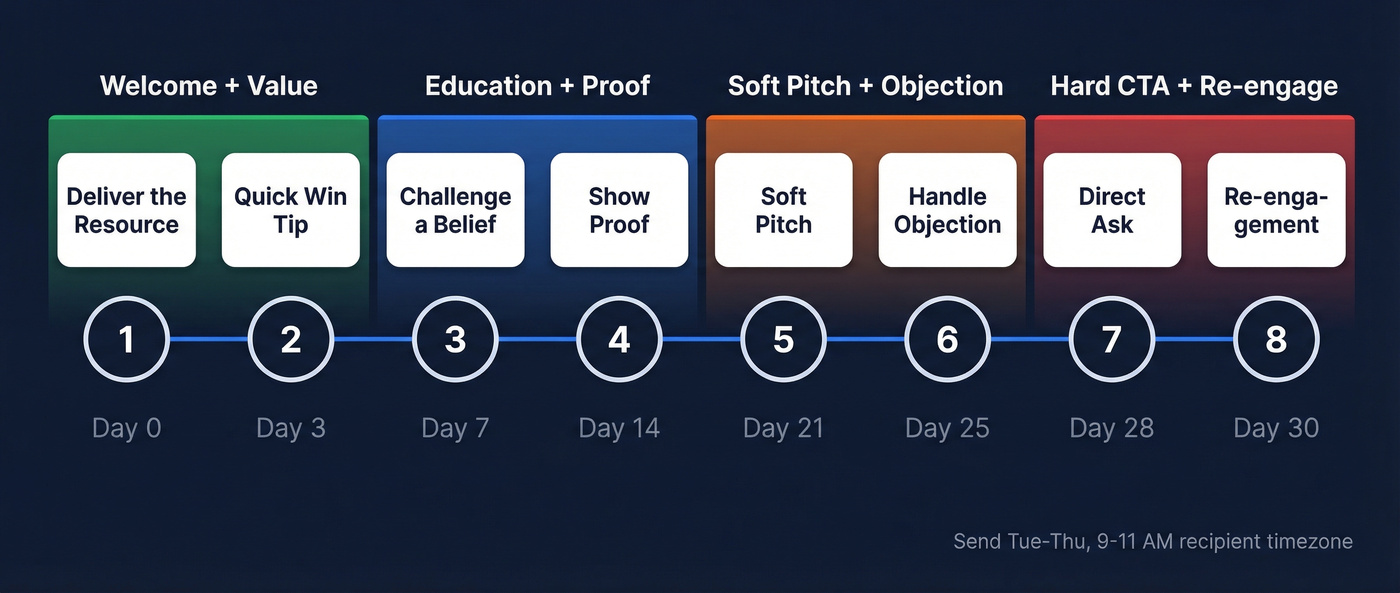
Emails 1-2: Welcome + Value
Email 1 - Day 0: Deliver the goods
Subject: {First name}, here's your [resource]
Deliver what they signed up for. Add one bonus insight that isn't in the resource. CTA: "Download now."
Email 2 - Day 3: Quick win
Subject: One tip from [resource topic]
Pull the single most actionable takeaway and expand on it in 3-4 sentences. Give them something they can use in the next 10 minutes. CTA: link to a related blog post.
Emails 3-4: Education + Proof
Email 3 - Day 7: Challenge a belief
Subject: Why [common approach] doesn't work
Challenge a misconception in your space with data or a specific example. This positions you as an authority. CTA: link to a deeper guide.
Most sequences chicken out here and go straight to pitching. Don't. Email 4 earns the right to sell later.
Email 4 - Day 14: Show proof
Subject: How [company] solved [problem]
One-paragraph case study: problem, approach, result with a specific number. Keep it under 150 words. CTA: "Read the full case study."
Emails 5-6: Soft Pitch + Objection
Email 5 - Day 21: Soft pitch
Subject: A faster way to [outcome]
Introduce your product as the natural next step from the education you've provided. Frame around the outcome, not features. CTA: "See how it works."
Email 6 - Day 25: Handle the objection
Subject: {First name}, quick question
Address the #1 reason people don't buy - price, complexity, switching cost. Name it directly and counter it. CTA: link to a comparison page or ROI calculator. (If you need a tighter framework for this, see How to Reduce Sales Objection Rate.)
Emails 7-8: Hard CTA + Re-engagement
Email 7 - Day 28: Direct ask
Subject: Ready to [desired outcome]?
Clear pitch. Summarize the value, state the offer, add a deadline if it's genuine. CTA: "Start your trial" or "Book a call." If you want more options, borrow from these sales follow-up templates.
Email 8 - Day 30: Re-engagement
Subject: Still interested?
Acknowledge they might not be ready. Offer a lower-commitment action - a resource, a community invite, or a "reply and tell me what's holding you back." CTA: "Reply" or "Grab this resource instead."

You just built an 8-email sequence. Now imagine 6% of those emails bouncing - that's your sender reputation gone and your nurture dead on arrival. Prospeo's 5-step verification catches invalid addresses, spam traps, and honeypots at 98% accuracy, with a 7-day refresh so contacts stay current across your entire 30-day drip.
Verify your first 75 contacts free - before your sequence goes live.
Subject Lines That Actually Work
A study across 5.5 million emails gives us hard numbers:
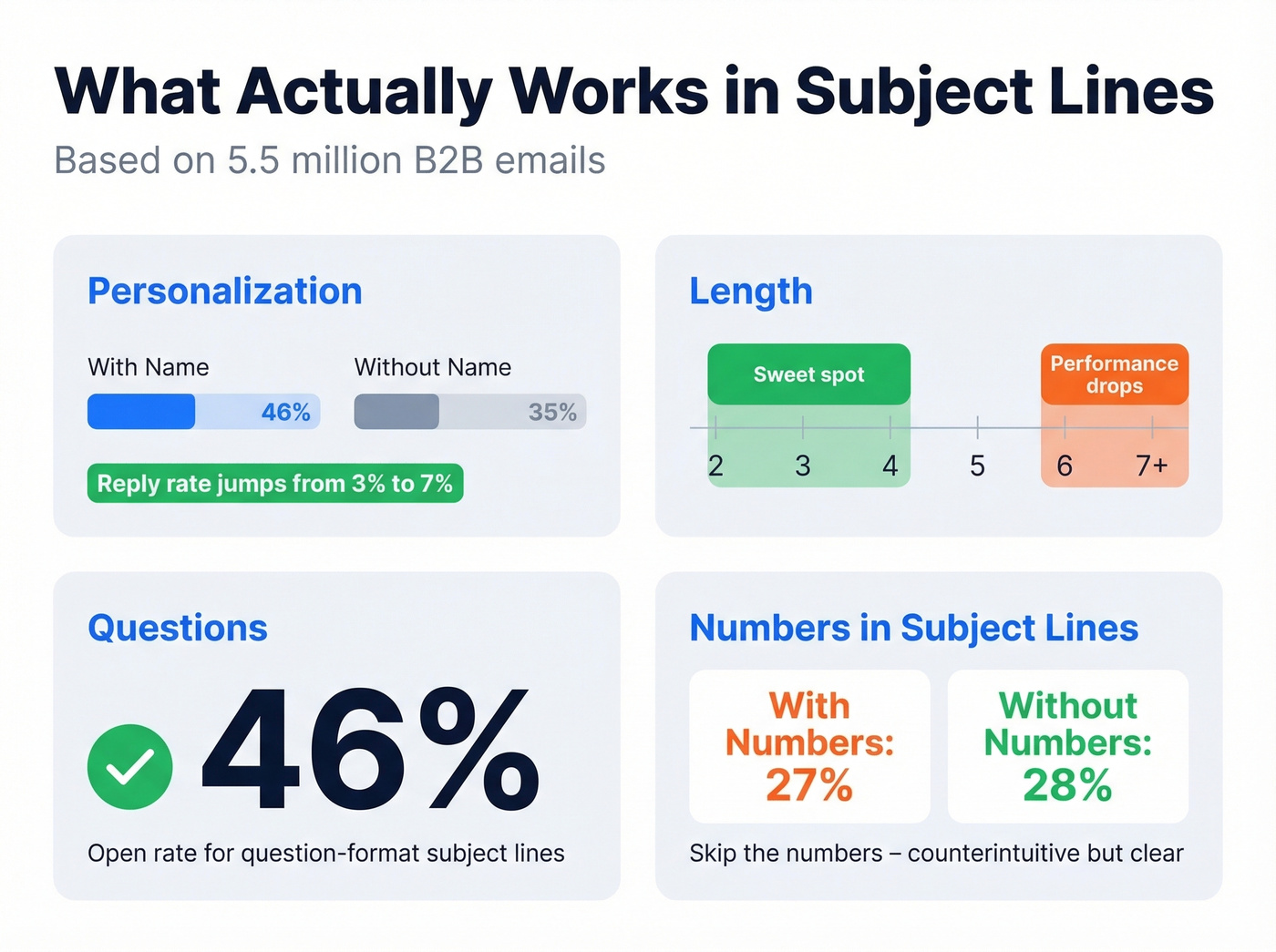
- Personalize. Subject lines with the recipient's name hit 46% opens vs 35% without. Reply rates jumped from 3% to 7%.
- Keep it short. Two to four words is the sweet spot. Performance drops steadily past seven words.
- Ask questions. Question-format subject lines matched that 46% peak.
- Skip the numbers. Subject lines with numbers performed slightly worse - 27% vs 28%. Counterintuitive, but clear.
Behavioral Triggers Beat Drips
Here's the thing: if you're still running pure time-based drips in 2026, you're leaving pipeline on the table. A practitioner on r/b2bmarketing running nurture across 80,000+ contacts reported ~25% improvement in SQL conversion after switching to behavior-based flows.
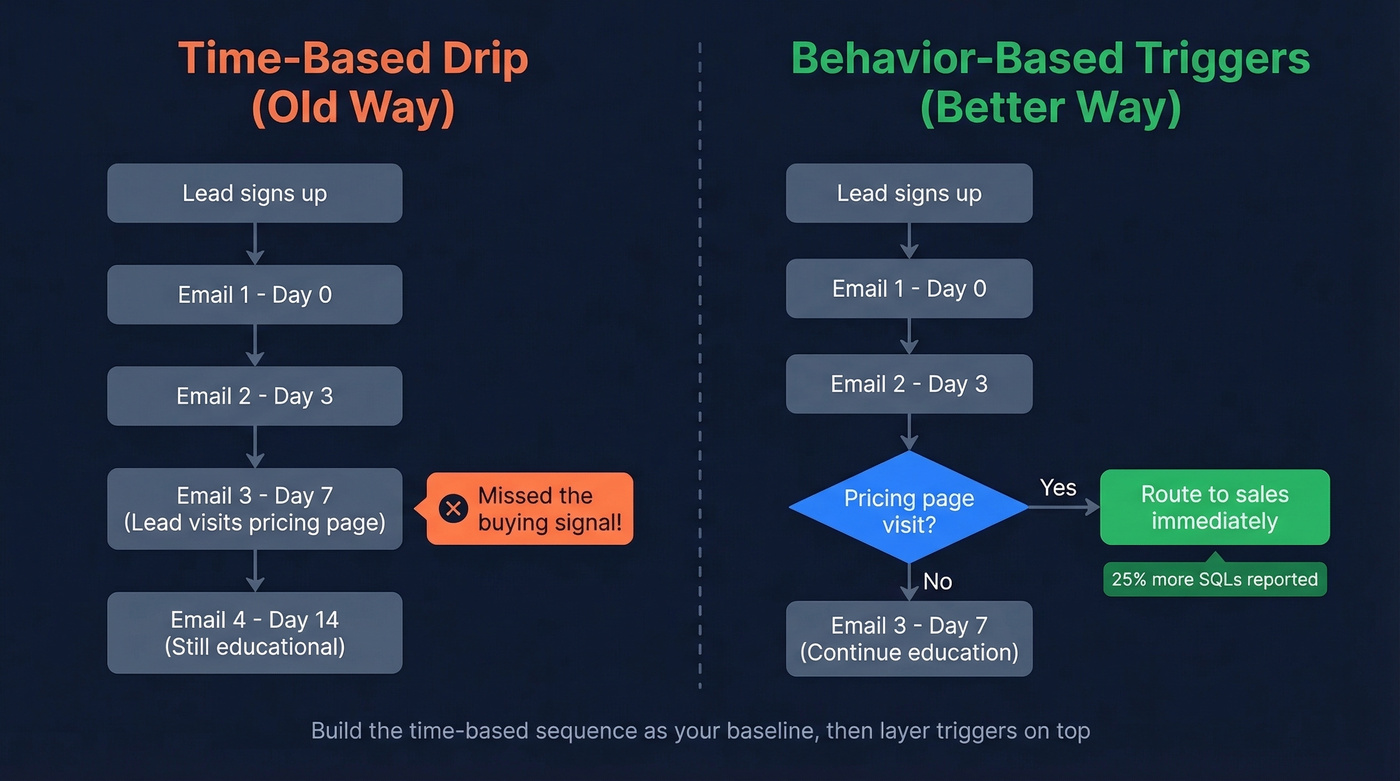
When someone visits your pricing page, they shouldn't get Email 3 of your educational drip - they should get routed to sales immediately. Build the sequence above as your baseline, then layer triggers on top. (To operationalize this, use Identifying Buying Signals and How to Track Sales Triggers.)
Fix Your Data Before You Hit Send
One of the fastest ways to kill a nurture sequence isn't bad copy - it's bad data. We've seen teams torch their sender reputation in a single campaign by skipping list verification. HubSpot's benchmark puts average bounce rate at 2.48% and average CTR at just 2.3%, so you can't afford to waste sends on dead addresses. If you're troubleshooting bounces, start with Email Bounce Rate and then work through an Email Deliverability Guide.
Before activating any sequence, run your list through a verification tool that catches invalid addresses, spam traps, and honeypots. Prospeo's 5-step verification handles this at 98% accuracy with a 7-day data refresh cycle, which keeps contacts current between sends.

Mistakes That Kill Your Sequence
Stage mismatch is the most common killer. I watched a SaaS team send pricing breakdowns to people who'd downloaded a top-of-funnel checklist three days earlier - their unsubscribe rate tripled in one send. Match the email to where the prospect actually is, not where you want them to be.
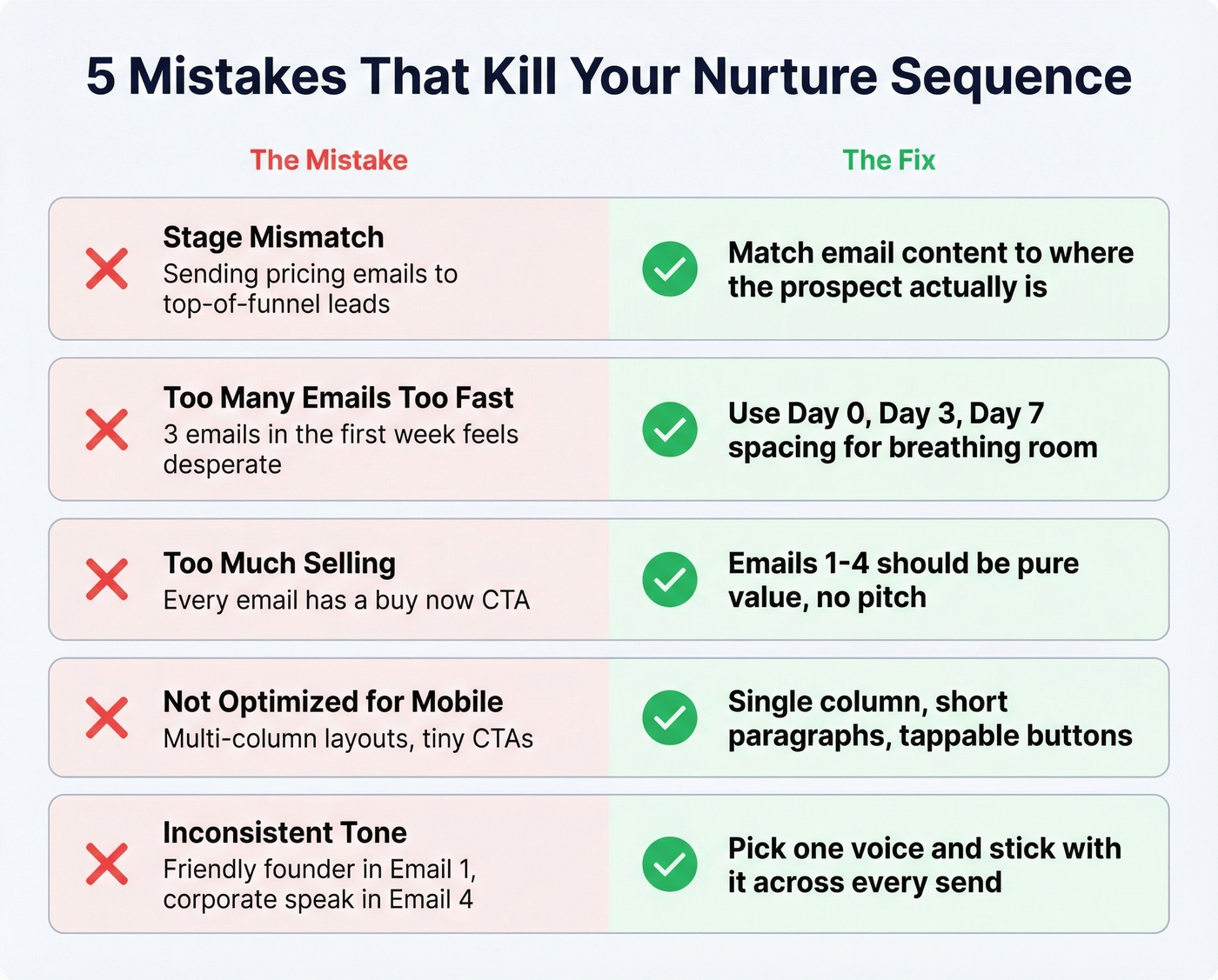
Too many emails too fast. Three emails in the first week feels desperate. The Day 0 / Day 3 / Day 7 spacing gives breathing room without letting momentum die.
Too much selling. If every email has a "buy now" CTA, you're spamming. Emails 1-4 should be pure value.
Not optimized for mobile. Over half your recipients read on their phone. Single-column layout, short paragraphs, tappable CTAs. (For CTA mechanics, see Email Call to Action.)
Inconsistent tone. If Email 1 sounds like a friendly founder and Email 4 reads like a corporate whitepaper, trust erodes. Pick a voice and stick with it across every send.
Behavioral triggers only work when you're reaching real inboxes. Teams using Prospeo's verified data cut bounce rates from 35% to under 4% and tripled their pipeline. At $0.01 per email, cleaning your nurture list costs less than a single wasted send.
Don't let bad data kill the sequence you just built.
FAQ
How many emails should a nurture sequence have?
Four to seven emails is the sweet spot for most B2B sequences. Sequences in that range generate 3x the reply rate of shorter ones. For longer sales cycles like enterprise deals or six-figure contracts, extend to 8-12 over 30-90 days and widen gaps between later sends.
What's a good open rate for nurture emails?
The all-industry average is 42.35%, but Apple Mail Privacy Protection inflates that by roughly 18 points. Aim for 2%+ CTR across your sequence - above 3% and you're outperforming most B2B benchmarks.
How do I keep nurture emails from bouncing?
Verify your list before activating any sequence. Look for a tool that checks for invalid addresses, spam traps, and catch-all domains. Re-verify quarterly, or sooner if a list sits idle for 60+ days.