

Email Prospecting Templates: Fewer Scripts, Better Data, More Replies
A practitioner on r/coldemail spent 15 minutes researching every single prospect - scraping posts, reading 40+ pages of their company site - then sent 30 deeply personalized emails. Three replies. Two ghosted. That's cold email in 2026: even great copy can't save a broken process.
The email prospecting templates below aren't magic scripts. They're frameworks built on data from 16.5 million emails, paired with the infrastructure steps that actually move reply rates.
What You Need Before Writing a Word
- Fix deliverability first. SPF, DKIM, DMARC, domain warming, custom tracking domains - all of it, before you write a single subject line.
- Use a framework, not a script. Intro → Observation → Bridge → Vision → Offer outlasts any copy-paste sales prospecting email template because it forces relevance.
- Verify every email address before sending. Only 23.6% of senders verify lists before campaigns. Don't be the other 76%.
Why Most Prospecting Templates Fail
Every time someone posts a "proven template" on Reddit, 10,000 people copy it. Then it stops working. The pseudo-personalized opener ("Hey {Name}, noticed you {Generic observation}...") was clever in 2021. Prospects spot it instantly now.
Here's the thing: templates optimize for the wrong bottleneck. They optimize for writing speed when the real problem is almost always targeting and deliverability. That practitioner who got a 10% reply rate? Two of those three replies ghosted - the offer and follow-through mattered more than the opener.
Most teams don't need better templates. They need better data and shorter sequences. We've watched teams agonize over copy for weeks while sending to unverified lists on unwarm domains. Fix the plumbing first, then worry about the words. The best cold prospecting emails succeed because of infrastructure, not inspiration.
2026 Cold Email Benchmarks
An analysis of 16.5 million cold emails across 93 business domains sets the baseline your campaigns compete against:
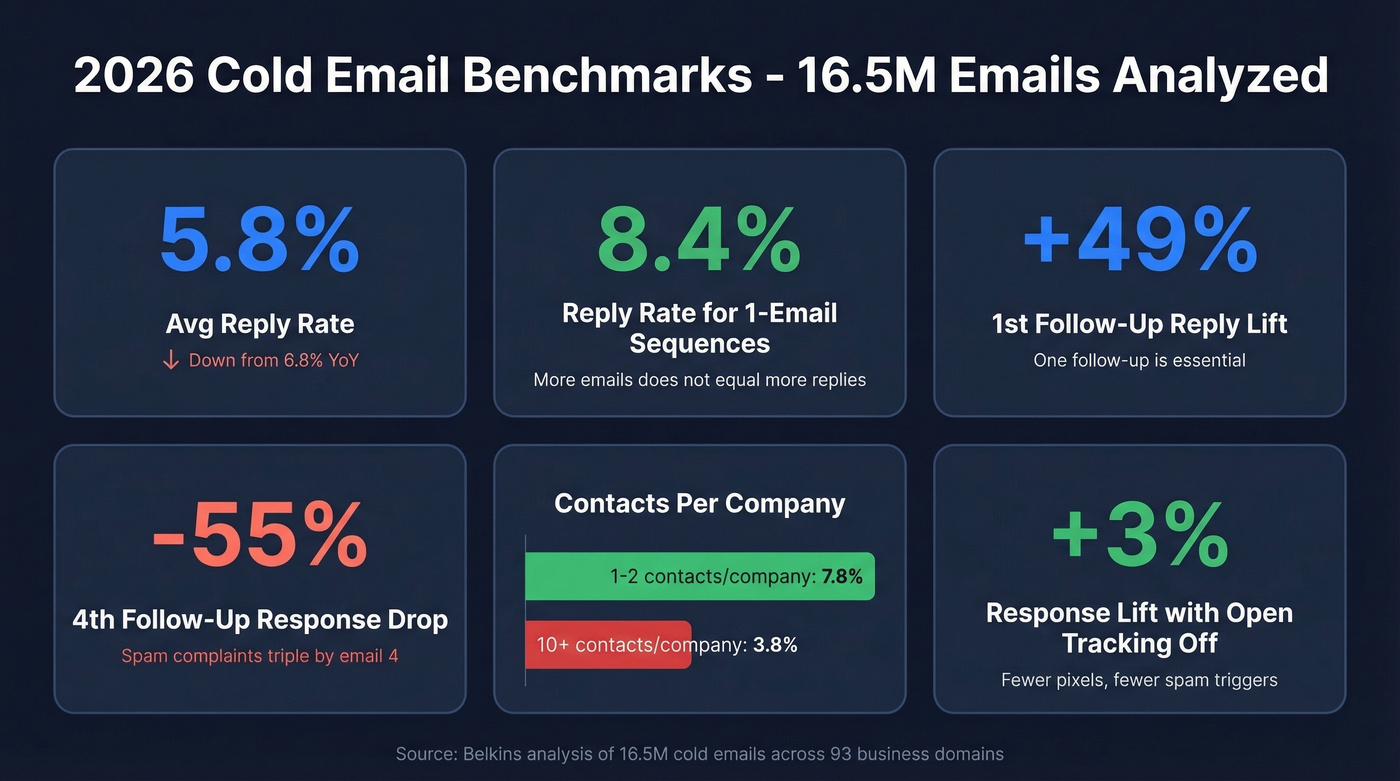
| Metric | Benchmark | Implication |
|---|---|---|
| Avg reply rate | 5.8% (down from 6.8%) | ~15% YoY decline |
| Best email length | 6-8 sentences | Under 200 words wins |
| 1-email sequence | 8.4% reply rate | More emails ≠ more replies |
| 1st follow-up lift | Up to +49% replies | One follow-up is essential |
| 4th follow-up | -55% response rate | Diminishing returns hit hard |
| Spam complaints | 0.5% → 1.6% (1st-4th) | Complaints triple by email 4 |
| 1-2 contacts/company | 7.8% reply rate | Tight targeting beats spray |
| 10+ contacts/company | 3.8% reply rate | Blasting the org chart backfires |
| Open-tracking off | +3% response rate | Fewer pixels, fewer spam triggers |
| Best day / time | Thu 6.87%; 8-11 PM 6.52% | Evening peaks; 7-11 AM also strong |
Two numbers jump out. Contacting just 1-2 people per company yields double the reply rate of blasting 10+. And executives often require around 9 touches before responding, while individual contributors reply after 4 - so adjust sequence length by seniority, not by gut feel.
Deliverability Checklist
This is the section most template guides skip - and it's the one that matters most. Office365 inbox placement dropped 26.7 percentage points year-over-year. If your infrastructure isn't locked down, your templates are landing in spam.
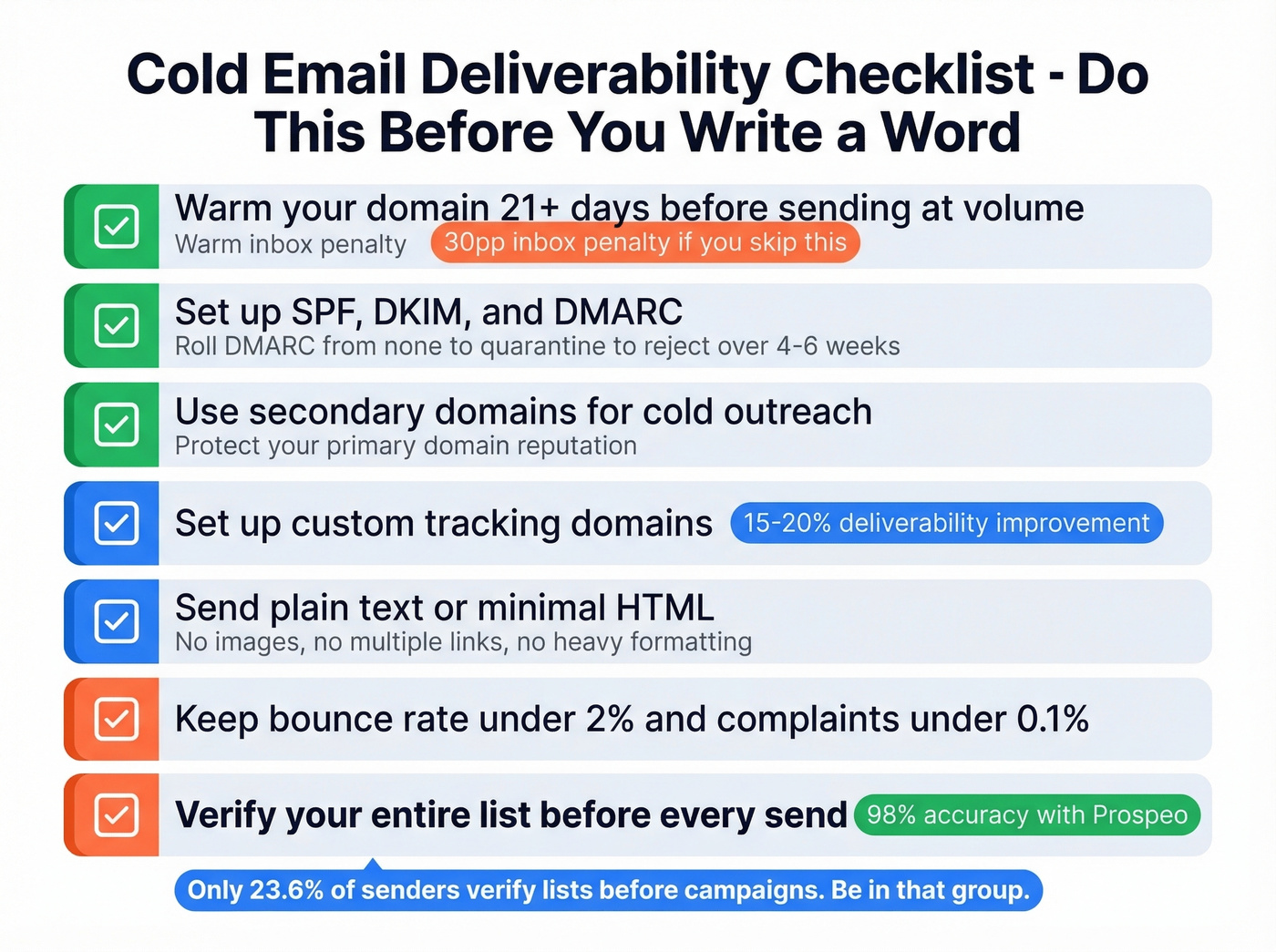
- Warm your domain 21 days before sending at volume. New domains face a ~30 pp inbox placement penalty.
- Set up SPF, DKIM, and DMARC. Roll DMARC from p=none → quarantine → reject over 4-6 weeks. Only 7.6% of domains enforce DMARC - being in that group signals legitimacy. (If you need a deeper technical walkthrough, use this email deliverability guide.)
- Use secondary domains for cold outreach. Protect your primary domain reputation.
- Set up custom tracking domains. Brand-matching tracking domains improve deliverability 15-20% vs shared/generic ones.
- Send plain-text or minimal HTML. Avoid images, multiple links, and heavy formatting - they trigger spam filters. (More on pixels and filtering in email tracking pixels.)
- Keep bounce rate under 2% and complaint rate under 0.1%. If you're troubleshooting, start with email bounce rate.
- Verify your list before every send. (If you're comparing tools, see Bouncer alternatives.)
That last point is where most teams cut corners. Prospeo's 5-step verification catches invalid addresses, catch-all domains, spam traps, and honeypots before they damage your sender reputation. With 98% email accuracy and a 7-day data refresh cycle, you're not sending to stale records from six weeks ago. Stack Optimize built their agency to $1M ARR on that foundation - deliverability stayed above 94%, bounce under 3%, zero domain flags across all clients.


You just read the benchmarks: 5.8% reply rates, deliverability cratering, and spam complaints tripling by email 4. Templates can't fix bad data. Prospeo's 5-step verification delivers 98% email accuracy on a 7-day refresh cycle - so every prospecting email you send actually reaches a real inbox.
Stop writing great emails to dead addresses. Verify your list first.
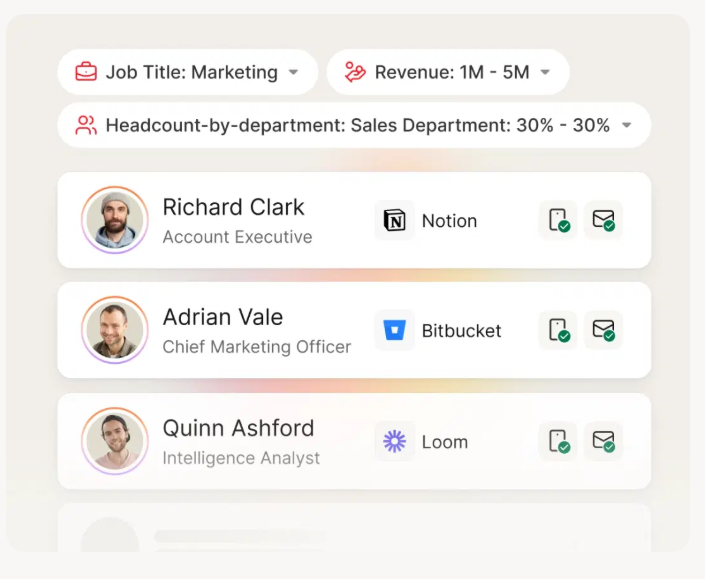
The Intro → Observation → Bridge → Vision → Offer framework only works when you're targeting the right 1-2 contacts per company - not blasting the org chart. Prospeo's 30+ search filters (intent data, job changes, headcount growth) let you find exactly who to write to, with verified emails at $0.01 each.
Find the right prospect, then send the right template. That's the order.
Compliance in 30 Seconds
Cold email is legal. But the penalties for doing it wrong deserve your attention.
| Regulation | Scope | Key Requirements | Max Penalty |
|---|---|---|---|
| CAN-SPAM | US | Physical address, opt-out, honest subjects | $50,120/violation |
| GDPR | EU/UK | Legitimate interest or consent, opt-out | €20M or 4% revenue |
| CASL | Canada | Express/implied consent, 60-day unsub | $10M/violation |
Since 2025, regulators - especially California's CPPA - have been scrutinizing AI-enriched data: job titles, intent signals, enrichment pulled from public profiles. You need to explain how you obtained every contact's data. Segment lists by geography and apply the strictest applicable standard. (If you're unsure about list sourcing, read Is it illegal to buy email lists.)
The Framework That Doesn't Decay
Scripts decay. Frameworks don't.
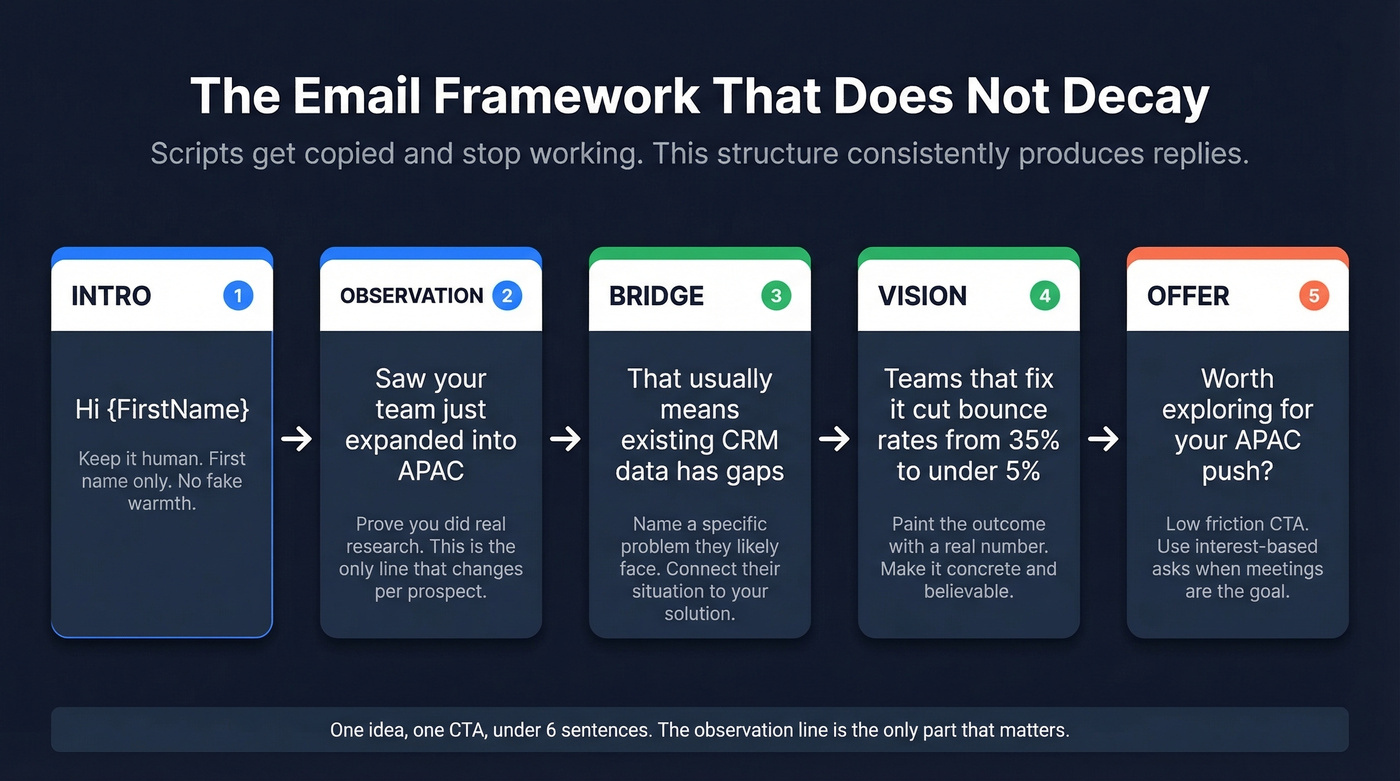
The structure that consistently produces replies: Intro → Observation → Bridge → Vision → Offer. Here's a real example adapted from a converting cold email shared on r/b2bmarketing:
Hi Sarah,
Saw the game changer comment from Beth Fetner about your onboarding redesign - sounds like the team's rethinking the whole first-90-days experience.
Most companies we talk to hit a wall when onboarding data lives in three systems and nobody owns the handoff.
The teams that fix it usually cut ramp time by 30-40% and stop losing new hires in month two.
Worth a 15-min call to see if we can help? Happy to share what worked for [similar company].
The observation proves you did real research. The bridge names a specific problem. The vision paints an outcome. The offer is low-friction - and notice the CTA uses "worth exploring?" rather than "thoughts?" The latter drives replies but weaker meeting intent. Use interest-based CTAs when meetings are the goal. (For more on asks that convert, see email call to action.)
Templates by Scenario
Cold Intro
When to use: First touch to a prospect you've never interacted with. This is the most common outbound scenario, and the one where targeting matters more than cleverness.
Filled example:
Hi Marcus,
Saw Dataline just expanded into APAC - congrats. That usually means the existing CRM data doesn't cover the new region well.
We help B2B SaaS teams fill regional data gaps fast - Snyk's team cut their bounce rate from 35% to under 5% after switching.
Worth exploring for Dataline's APAC push?
Blank version:
Hi {FirstName},
[Specific observation about their company, role, or recent activity.]
We help {similar role/company type} solve {specific problem} - {concrete outcome from a real customer}.
Worth exploring for {Company}?
One idea, one CTA, under 6 sentences. The observation line is the only part that changes per prospect - and the only part that matters. (If you're building segments first, use an ideal customer profile before writing.)
Trigger-Based (Funding, Hiring, Launch)
A public event creates urgency you can't manufacture. These outreach messages outperform cold intros because timing does half the persuasion work.
Hi Priya,
Congrats on the Series B. In our experience, the 60 days after a raise are when outbound teams scale fastest - and when bad data does the most damage.
We helped GreyScout double their sales team post-funding while keeping bounce under 4%. Pipeline went up 140%.
Worth 15 minutes this week?
Blank version:
Hi {FirstName},
Congrats on the {trigger event}. That usually means {specific challenge that follows}.
We helped {similar company} navigate that exact transition - {specific result}.
Worth 15 minutes this week?
Value-First (Resource or Insight Share)
When to use: You have something genuinely useful - not a gated PDF, but a real insight. Skip this if you don't have original data or a strong POV to share. A recycled blog post won't cut it.
Hi {FirstName},
We just published data on {topic relevant to their role} - the finding that surprised us: {one specific stat}.
Thought it'd be relevant given {observation about their situation}. Here's the link: {URL}
No ask - just thought you'd find it useful.
The no-ask close builds trust. The follow-up carries the pitch. This approach works especially well when the prospect isn't actively looking for a solution yet.
Follow-Up #1 (3-5 Days Later)
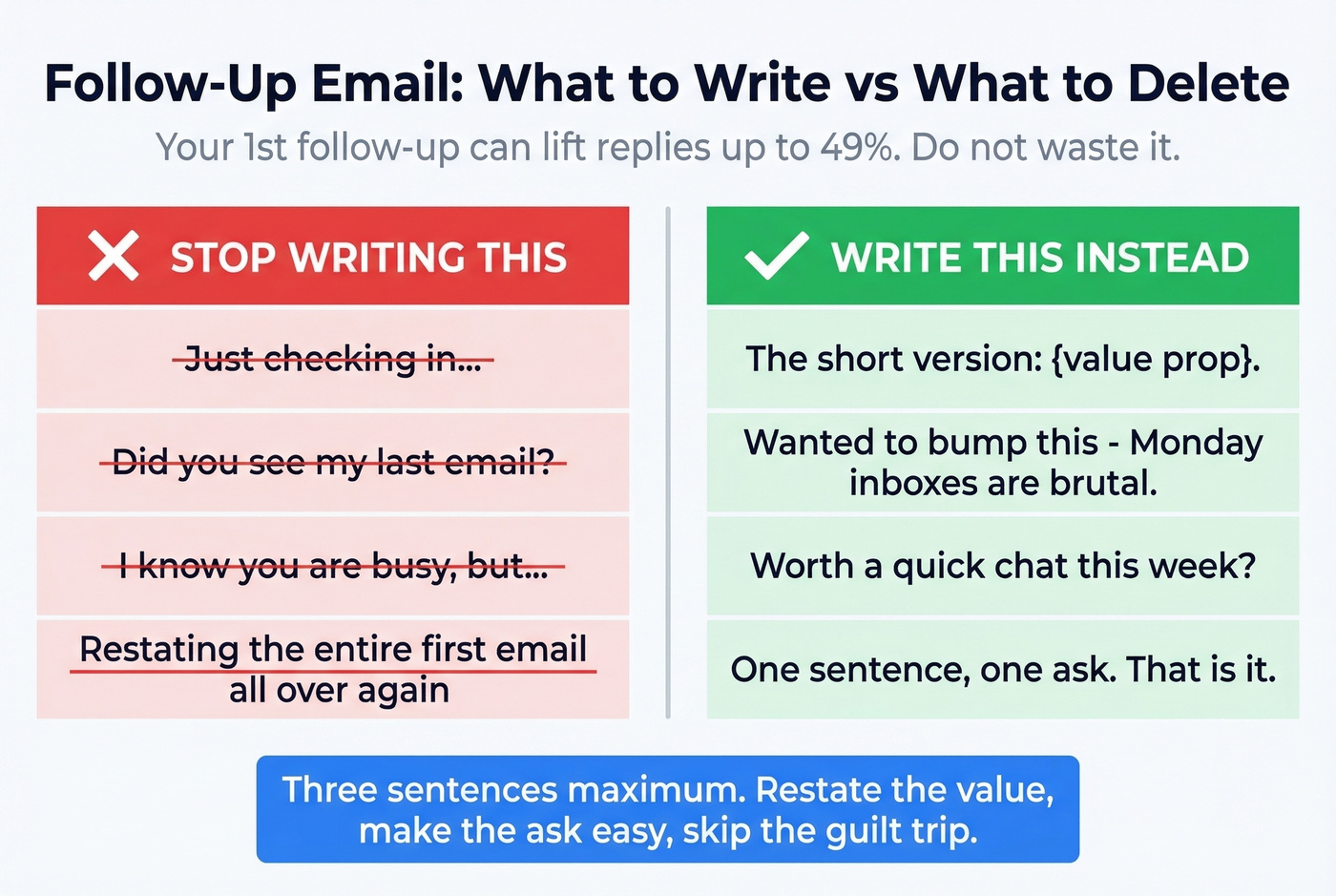
The first follow-up lifts replies up to 49% in high-performing campaigns. Here's what works versus what doesn't:
| Don't write this | Write this instead |
|---|---|
| "Just checking in..." | "The short version: {value prop}." |
| "Did you see my last email?" | "Wanted to bump this - {day} inboxes are brutal." |
| "I know you're busy, but..." | "Worth a quick chat this week?" |
| Restating the entire first email | One sentence, one ask |
Three sentences maximum. Restate the value, make the ask easy, skip the guilt trip. (If you want more variations, use these sales follow-up templates.)
Breakup Email
After 2-3 emails with no response, stop. By the 4th follow-up, response rates drop 55% and spam complaints triple. We've watched teams run 7-email sequences thinking persistence wins. It gets you flagged.
Hi {FirstName},
I'll assume the timing isn't right. If {problem you solve} becomes a priority, I'm easy to find.
Either way - good luck with {specific initiative}.
Short, respectful, no passive aggression.
Subject Line Playbook
A 5.5-million-email subject line study makes the rules clear:
| Rule | Data | Example |
|---|---|---|
| Personalize | 46% opens vs 35% without | "{FirstName}'s onboarding gap" |
| Ask a question | 46% open rate | "Ramp time too long?" |
| Keep it short | 2-4 words = peak opens | "Quick hiring thought" |
| Avoid urgency words | "ASAP" drags below 36% | Skip "urgent" and "act now" |
| Numbers don't help | 27% vs 28% without | Words > digits |
Opens drop to 34% at 10 words, so if your subject line needs a comma, it's probably too long. Aim for a 1:2 ratio of "I/my" to "you/your" across your entire email - subject lines that center the prospect outperform self-referential ones every time. (Need swipeable options? Use these email subject line examples.)
A/B test subject lines on 20% of your list, then roll the winner to the remaining 80%. This simple split-test catches duds before they tank your campaign. Add a personalized PS line while you're at it - practitioners on Reddit report up to 35% performance lifts from PS personalization.
Personalize Without the 15-Minute Spiral
Generic cold emails pull less than 1% response rates. Personalized emails hit 10-15%+. But manual deep personalization doesn't scale past 20 sends a day. That gap is why most prospecting email examples you find online look great in theory but collapse in practice.
Work in three tiers. Level 1 is basic tokens - name, company, title - table stakes, not personalization. Level 2 is research-backed details: recent company news, a specific post they wrote, a hiring signal. This is where the real lift happens, and it's where most teams stall because the research takes too long. Level 3 is AI-powered personalization at scale, where enrichment tools feed context into your templates automatically. (If you're evaluating vendors, start with data enrichment services.)
For openers, rotate between observation-based ("Saw your team just launched X"), signal-based ("Noticed you're hiring 3 AEs"), question-led ("How's the team handling Y after the reorg?"), and problem-led ("Most VPs in your space tell us Z is broken"). Build mini-campaigns around segments - first-time founders get different openers than serial entrepreneurs.
Prospeo's Chrome extension pulls 50+ data points from any company website in one click - job title, department, company size, tech stack - so you can personalize at Level 2 speed without the research spiral.
FAQ
What reply rate should I expect from cold email in 2026?
The benchmark is 5-8%. Tight targeting with 1-2 contacts per company pushes that to 7.8%, and anything above 8% means your targeting, copy, and deliverability are all working together. The campaigns that hit these numbers share one trait: verified data behind every send.
How many follow-ups should I send?
Two to three maximum. The first follow-up lifts replies up to 49%, but by the fourth, responses drop 55% and spam complaints triple. Keep sequences short.
Do personalized subject lines actually work?
Yes - 46% open rate vs 35% without, across 5.5 million emails. Keep them to 2-4 words and frame as a question when possible. Anything over 10 words drops opens to 34%.
Is cold email legal?
Yes, with requirements. CAN-SPAM requires a physical address and opt-out link. GDPR requires legitimate interest or consent. Penalties reach $50,120 per violation in the US or €20M in the EU. Segment by geography and apply the strictest standard.
What's a good free tool for verifying prospect emails?
Prospeo offers 75 free email credits plus 100 Chrome extension credits per month - no credit card required. That's enough to validate a small campaign list with 98% accuracy before you hit send, which matters more than any template tweak.