

12 Email Request Templates Backed by 16.5 Million Emails
You've stared at a blank email for 20 minutes, rewritten the opening three times, and you're still not sure if it sounds too pushy or too passive. You're not alone - 88% of office workers have regretted an email right after hitting send. Poor email communication costs large companies $62.4 million annually, and a lot of that waste comes from unclear requests that create three rounds of back-and-forth when one clear message would've done the job.
These 12 templates fix that. Each one is copy-paste ready, backed by data from an analysis of 16.5 million cold emails, and built around a framework that actually gets replies.
The Quick Version
Every effective request email has seven components: subject line, greeting, context, request, supporting details, CTA, and sign-off.
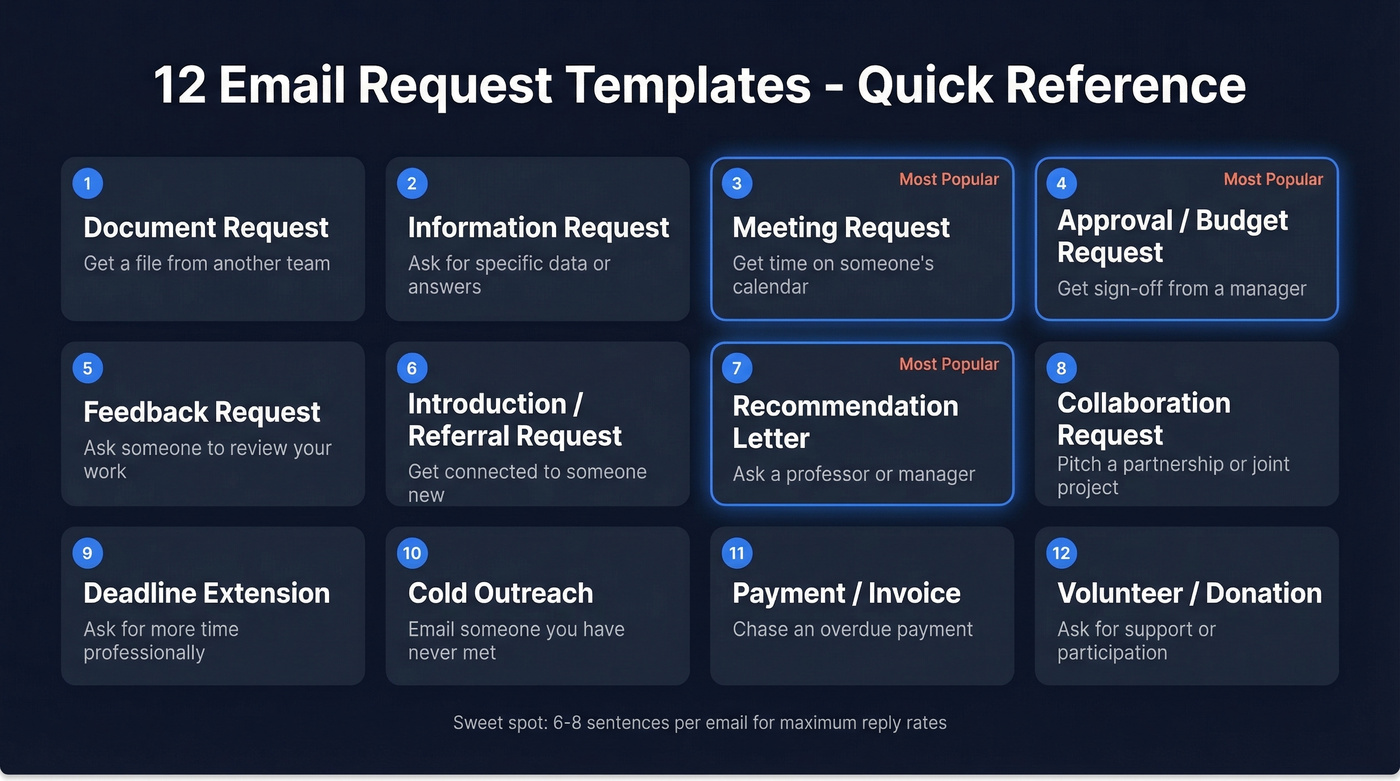
The three templates most people grab first: meeting request (#3), approval request (#4), and recommendation letter request (#7). Short on time? Start there.
One stat to remember: emails between 6-8 sentences hit a 6.9% reply rate - the highest of any length bracket in the 16.5M-email dataset. Shorter feels abrupt. Longer gets skimmed.
Anatomy of a Request Email
Before you copy a template, understand the skeleton underneath it. Every request email - whether you're asking your manager for budget approval or cold-emailing a VP - follows the same seven-part structure.
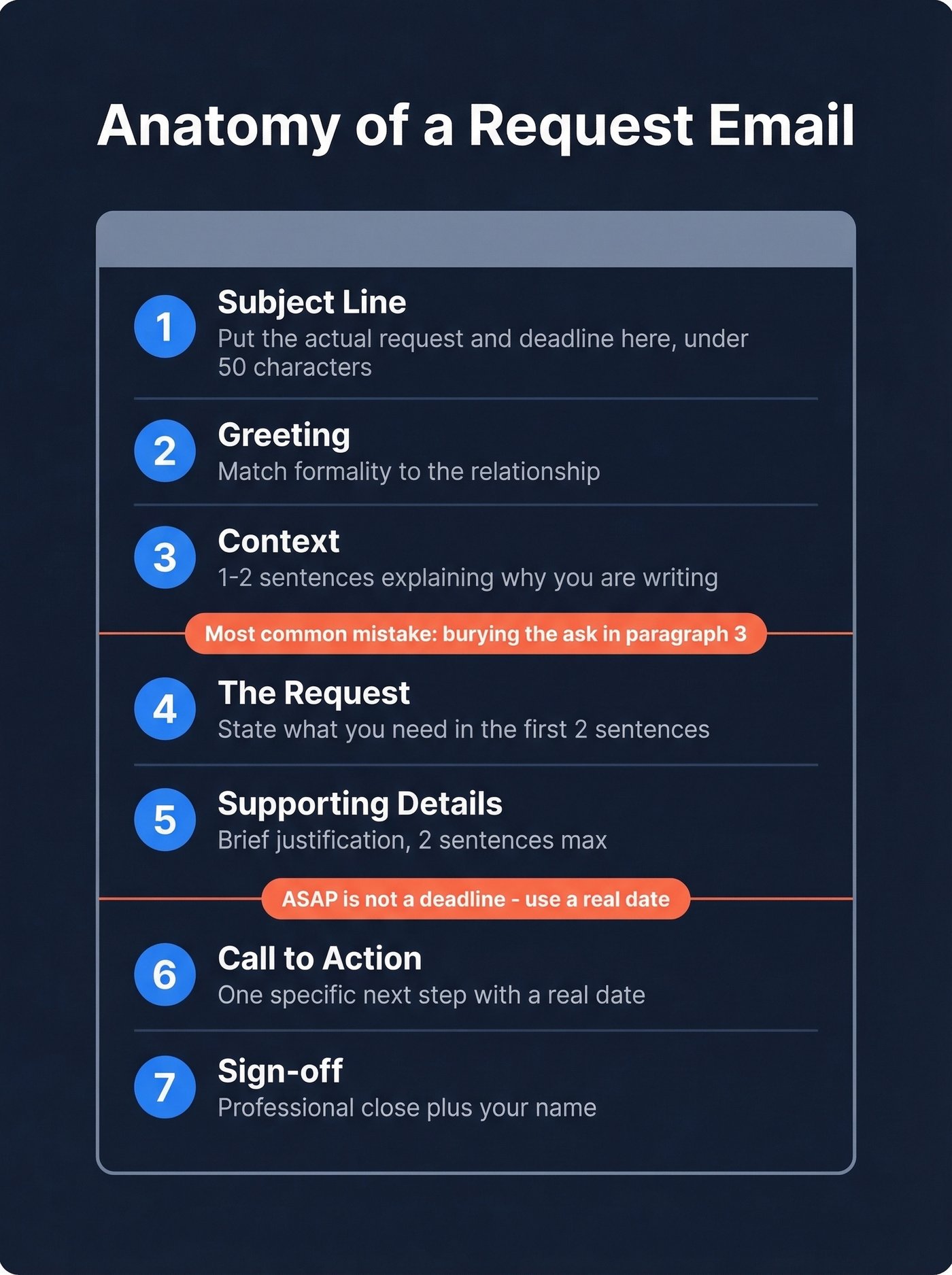
Subject line. Put the actual request and deadline here. "Tax documents needed by March 15" beats "Quick question" every time. Keep it under ~50 characters so it doesn't get truncated on mobile.
Greeting. Match the formality to the relationship. "Hi Sarah" for a colleague. "Dear Dr. Chen" for a professor.
Context. One to two sentences explaining why you're writing. Don't make the reader guess. "Following up on our Q2 planning call last Thursday" gives them instant orientation.
The request. State what you need within the first two sentences of the body. Burying the ask in paragraph three is the single most common mistake in request emails.
Supporting details. Brief justification - why this matters, what it's for, or what happens if it's delayed. Two sentences max.
Call to action. One specific next step. "Could you reply with the signed PDF by Friday, March 14?" is clear. "Let me know your thoughts" isn't a CTA - it's a punt. (If you want more examples, see email call to action.)
Sign-off. Professional close plus your name. "Thanks, [Name]" works for most situations. Don't overthink this part.
Here's the thing: "ASAP" isn't a deadline. It's a way of saying "I don't respect your time enough to figure out when I actually need this." Always use a real date.
What 16.5 Million Emails Reveal
Belkins analyzed 16.5 million emails across 93 business domains from January through December 2024. The dataset is cold outreach, but the patterns translate well to any request email where you need a response from someone who's busy.
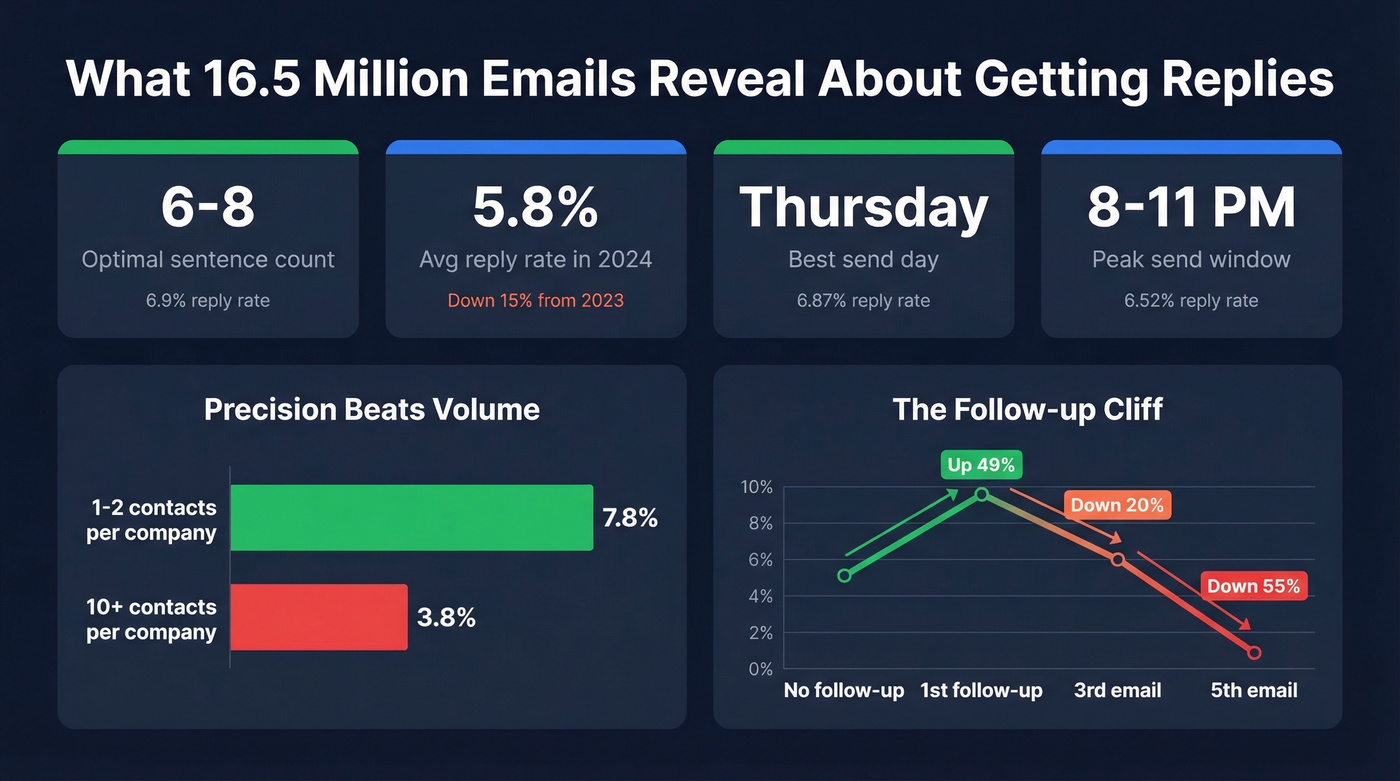
The average reply rate in 2024 was 5.8%, down from 6.8% in 2023 - a 15% year-over-year drop. That means a sloppy request in 2026 has a meaningfully worse chance of getting a reply than the same email two years ago.
Optimal email length? Six to eight sentences, pulling a 6.9% reply rate and a 42.67% open rate. Under 200 words consistently outperformed longer messages. Thursday was the best send day at 6.87%. Monday was the worst at 5.29%. And here's a timing insight most people miss: the 8-11 PM window peaked at a 6.52% reply rate, likely because fewer emails compete for attention in the evening.
One of the most actionable findings: targeting just 1-2 people per company yielded a 7.8% reply rate, compared to 3.8% when blasting 10+ contacts at the same organization. Precision beats volume every time. (If you're building lists, ideal customer profile work helps a lot.)
Follow-ups matter enormously. Reply rates jumped up to 49% after the first follow-up in top-performing campaigns. But there's a cliff: adding a third email drops replies by 20%, and by the fifth email, response rates crater 55%. We've seen this pattern hold across internal requests too - two follow-ups is the ceiling before you start annoying people.
Personalized emails receive more than twice as many replies as generic ones. Even swapping in a first name and company reference makes a measurable difference. (More tactics: personalized outreach.)
12 Copy-Paste Templates
Each template below includes a brief scenario, then the copy-paste email. Replace the bracketed placeholders with your details.
1. Document Request
You need a file from someone on another team - a report, a contract, or a slide deck from a recent meeting.
Subject: [Document Name] needed by [Date]
Hi [Name],
Thanks for the productive call on [Day/Topic]. I'm pulling together [Project/Report] and need the [Document Name] you referenced during our discussion.
Could you share it by [Date]? A PDF or Google Doc link works - whatever's easiest on your end.
Appreciate the help.
Best, [Your Name]
2. Information Request
You need specific data, a clarification, or an answer from someone with expertise you don't have.
Subject: Quick question on [Topic] - need input by [Date]
Hi [Name],
I'm working on [Project] and could use your input on [Specific Question]. You're the person who'd know this best.
Specifically, I need:
- [Detail/data point #1]
- [Detail/data point #2]
Could you get back to me by [Date]? Happy to jump on a quick call if that's faster.
Thanks, [Your Name]
3. Meeting Request
You want time on someone's calendar - internally or externally.
Subject: Meeting request: 15 min on [Topic]
Hi [Name],
I'd like to set up a 15-minute meeting to discuss [Topic/Goal]. I have a few ideas on [Specific Angle] that I think could help with [Their Priority].
Would any of these work?
- [Date/Time Option 1]
- [Date/Time Option 2]
- [Date/Time Option 3]
If none of those fit, feel free to suggest a time that does.
Best, [Your Name]
4. Approval / Budget Request
You need sign-off from a manager or stakeholder before moving forward.
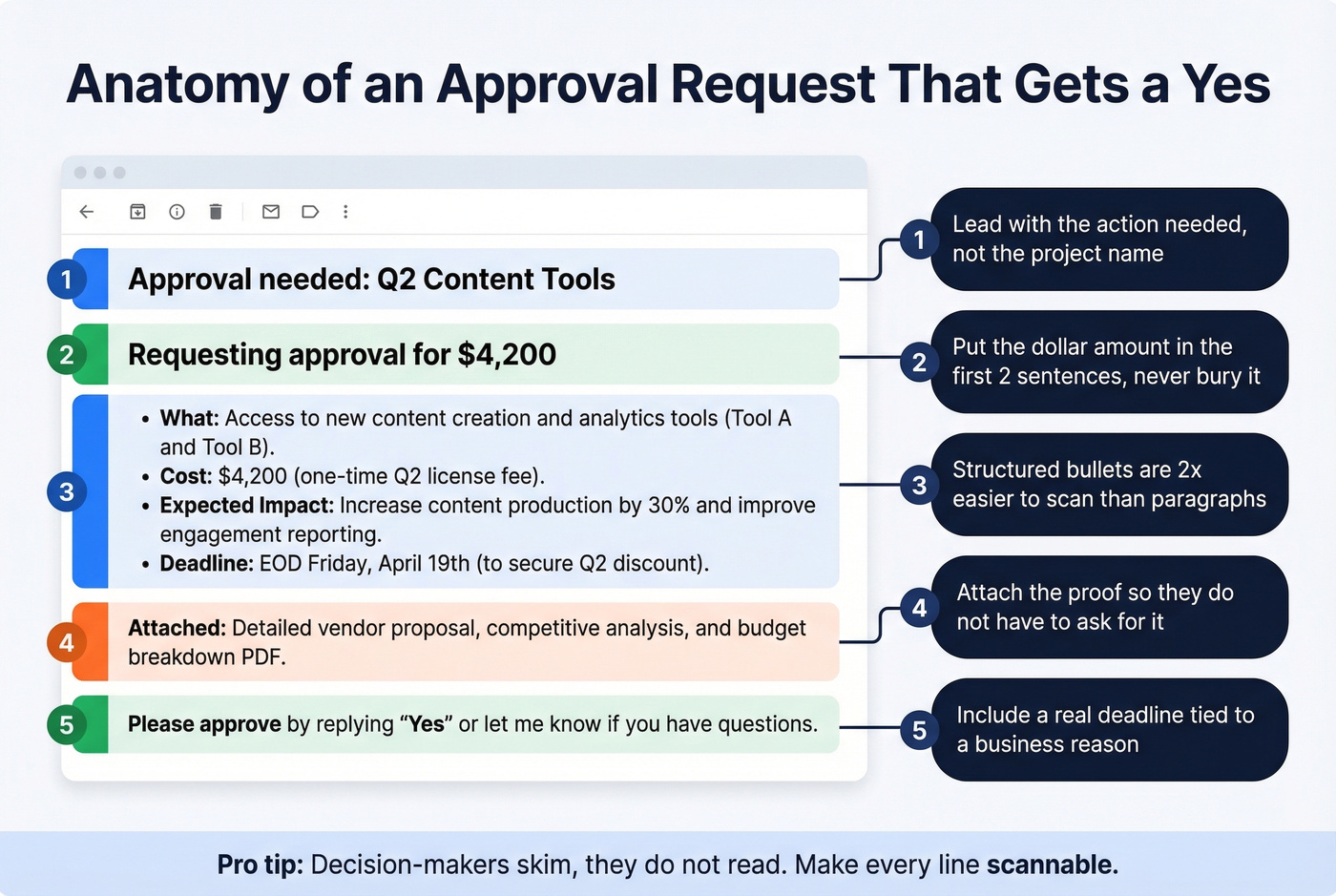
Subject: Approval needed: [Project/Expense Name]
Hi [Name],
I'm requesting approval for [Specific Item - e.g., "$4,200 for Q2 content marketing tools"]. Here's the quick case:
- What: [One-line description]
- Cost: [Amount]
- Expected impact: [Metric or outcome]
- Deadline: I need approval by [Date] to lock in [pricing/timeline/vendor availability].
I've attached [supporting document/proposal] with the full breakdown. Let me know if you need anything else to make the call.
Thanks, [Your Name]
5. Feedback Request
You need someone to review a draft, proposal, or deliverable.
Subject: Feedback on [Document/Project] - due [Date]
Hi [Name],
I've attached the latest draft of [Document/Project]. I'd really value your feedback, especially on [Specific Area - e.g., "the pricing section and the competitive positioning"].
Could you share your thoughts by [Date]? Even quick bullet points would be helpful - no need for a formal review.
Thanks for taking the time.
Best, [Your Name]
6. Introduction / Referral Request
You want someone to connect you with a person in their network.
Subject: Introduction request: [Your Name] → [Contact Name]
Hi [Name],
I noticed you're connected with [Contact Name] at [Company]. I'm [brief context - e.g., "exploring partnerships in the fintech space"] and think a conversation with them could be mutually valuable.
Would you be comfortable making an intro? I've drafted a short blurb below you can forward if it makes things easier:
"Hi [Contact Name], I'd like to introduce you to [Your Name], who [one-line value prop]. They'd love 15 minutes to discuss [Topic]."
No pressure at all - I understand if the timing isn't right.
Thanks, [Your Name]
7. Recommendation Letter Request
This one causes real anxiety. Threads in r/gradadmissions are full of people worried about sounding demanding. The fix is simple: give context, give a deadline, and give them an easy out.
Subject: Recommendation letter request - [Program/Role Name]
Dear [Professor/Manager Name],
I'm applying to [Program/Position] at [Institution/Company], and your perspective on my work in [Specific Course/Project] would carry real weight with the committee.
Would you be willing to write a recommendation letter? The deadline is [Date]. I've attached my resume and a brief summary of the key points I hope the letter might touch on - but of course, write whatever feels honest.
If your schedule doesn't allow it, I completely understand. I'd rather ask and give you the option than assume.
Thank you for considering it.
Sincerely, [Your Name]
8. Collaboration Request
You want to partner with someone on a project, event, or initiative.
Subject: Collaboration idea: [Topic/Project]
Hi [Name],
I've been following your work on [Specific Thing] and think there's a natural overlap with what we're doing at [Your Company/Team] on [Your Project].
Here's what I'm thinking: [One-sentence collaboration pitch - e.g., "a co-authored report on B2B outbound benchmarks that we both promote to our audiences"].
Would you be open to a 20-minute call to explore whether it makes sense? I'm flexible on timing - just let me know what works.
Best, [Your Name]
9. Deadline Extension Request
You need more time. Be direct about it - vague excuses make it worse.
Subject: Extension request: [Project/Deliverable] - new proposed date [Date]
Hi [Name],
I want to flag that I won't be able to deliver [Deliverable] by the original [Date] deadline. [One-sentence honest reason - e.g., "The vendor data I'm waiting on was delayed, and I need it to finalize the analysis."]
I can have it completed by [New Date]. Here's what's already done: [Brief progress summary]. The remaining work is [what's left].
I wanted to let you know now rather than deliver something rushed. Let me know if the new timeline works or if we need to adjust scope.
Thanks for understanding, [Your Name]
10. Cold Outreach Request
You're emailing someone you've never met to request a meeting, a conversation, or a specific action. This is where most request emails fail - the recipient has zero context and zero obligation.
Subject: [Specific Value Prop] for [Their Company]
Hi [Name],
I lead [Your Role] at [Your Company]. We help [type of company] [achieve specific outcome - e.g., "reduce customer churn by 15-20% using predictive analytics"].
I noticed [Company] recently [trigger event - e.g., "expanded into EMEA" / "raised a Series B" / "posted 3 SDR roles"]. That's usually when teams like yours start thinking about [relevant problem].
Would 15 minutes this week make sense to see if there's a fit? If not, no worries - happy to share a quick case study instead.
Best, [Your Name]
Remember the targeting data: reaching out to 1-2 people at a company pulls a 7.8% reply rate versus 3.8% when you spray 10+ contacts. Pick the right person rather than blanketing the org chart. (Related: sales prospecting techniques.)
11. Resource / Equipment Request
You need tools, software, hardware, or other resources from your organization.
Subject: Resource request: [Item/Tool] for [Team/Project]
Hi [Name],
Our team needs [Specific Resource] to [accomplish what]. We've been [current workaround - e.g., "manually exporting data from three different dashboards"], which is costing us roughly [time/money estimate] per week.
The cost is [Amount], and I'd expect it to [specific ROI or time savings]. I've attached a one-page justification with vendor comparisons.
Can you approve this by [Date]? Happy to discuss if you have questions.
Thanks, [Your Name]
12. Follow-Up After No Response
70% of emails need at least one follow-up to get a response. Following up isn't rude - it's expected. The people who worry most about sounding like a nag are usually the ones who write the most polite follow-ups.
Subject: Re: [Original Subject Line]
Hi [Name],
Just circling back on my email from [Day/Date] about [One-Line Summary of Request]. I know things get buried - no worries.
To make this easy: [Restate the specific ask in one sentence]. The deadline is [Date].
If this isn't the right time or I should loop in someone else, just let me know. Either way, appreciate your time.
Best, [Your Name]

A perfect email request template means nothing if it bounces. Prospeo gives you 98% verified email addresses across 300M+ professional profiles - so your carefully crafted request actually lands in the right inbox.
Stop perfecting emails that bounce. Start with verified contacts.
Subject Lines That Work
The subject line decides whether your email gets opened or buried. A common takeaway in this r/coldemail thread is that generic openers like "Quick question" and "Hey [Name]" are increasingly ignored - people have seen them thousands of times. Keep subject lines under ~50 characters and put the actual request in the line.
| Weak Subject Line | Strong Subject Line | Why It Works |
|---|---|---|
| Quick question | Tax docs needed by March 15 | Specific ask + deadline |
| Following up | Approval needed: Q2 budget | States the action required |
| Hey [Name] | Meeting request: 15 min on [Topic] | Clear time commitment |
| Important | Feedback on draft - due Friday | Urgency without vagueness |
| Can you help? | Intro request: [You] → [Contact] | Names the ask |
The pattern is obvious: strong subject lines tell the reader exactly what you need and when. Weak ones force the reader to open the email just to figure out what you want - and busy people won't bother. (More ideas: email subject line examples.)
Follow-Up Rules and Timing
Look, following up isn't rude - not following up is leaving results on the table. Campaigns without follow-ups average a 16% response rate, while adding just one follow-up pushes that to 27%. In our experience, even internal requests see a similar bump.
Wait 2-5 days before your first follow-up. Anything under 48 hours feels impatient. Anything over a week and your original message is already buried under 200 other emails. Send that follow-up in the evening if you can - the 8-11 PM window pulls a 6.52% reply rate, likely because there's less inbox competition. (More detail: best time to send cold emails.)
Here's the follow-up framework:
- Follow-up #1 (Day 2-5): Friendly nudge. Reference the original email, restate the ask in one sentence, add a deadline if you didn't before.
- Follow-up #2 (Day 7-10): Shorter. Add new context or make it easier to respond - "Would a quick call be faster?"
- Follow-up #3 (Day 14+): Final attempt via email. If no response, switch channels - Slack, phone, or ask a mutual contact.
Stop at two to three email follow-ups. The third email drops reply rates by 20%, and by the fifth message you're actively annoying people. If three emails don't get a response, the problem isn't persistence - it's channel or timing.
Match Tone to the Relationship
The biggest tone question people wrestle with - "Do I say 'Hi' or 'Dear'?" - has a simple answer.
| Relationship | Formality | Example Opener |
|---|---|---|
| Manager | Medium-high | "Hi [Name], I wanted to flag..." |
| Peer / Colleague | Medium | "Hey [Name], quick ask --" |
| Client | High | "Dear [Name], I hope this finds you well." |
| Stranger / Prospect | Medium-high | "Hi [Name], I lead [Role] at [Company]." |
| Professor / Mentor | High | "Dear [Title] [Last Name], I'm writing to..." |
When in doubt, start one notch more formal than you think you need. You can always loosen up after the first exchange. Starting too casual with a client or professor is harder to recover from.
Mistakes That Kill Request Emails
60% of office workers say email volume adds stress to their day. Don't contribute to that by sending unclear requests that generate three rounds of clarification. Here are the five fastest ways to get ignored.
Burying the ask. If the reader has to scroll past three paragraphs of context to find out what you want, most won't get there. State the request in the first two sentences.
Using "ASAP" as a deadline. It communicates urgency without specificity. "By end of day Friday, March 14" is actionable. "ASAP" is just stress transferred to someone else's plate.
Over-apologizing. "I'm so sorry to bother you, I know you're incredibly busy, and I hate to ask, but..." - that preamble makes you sound unsure of your own request. Be polite, be brief, be direct.
Skipping proofreading. 48% of professionals judge typos in emails more harshly than in Slack or Teams messages. One typo in a subject line can undermine an otherwise solid request. And 28% of workers say an email has actually hurt their career - don't let a missing comma be the reason. (If you're sending at scale, email copywriting systems help reduce errors.)
No clear CTA. "Let me know your thoughts" isn't a call to action. "Could you reply with the signed PDF by Friday?" is. Every request email needs one specific thing you want the reader to do.
Real talk: if your average request email takes more than five minutes to write, the problem isn't writer's block - it's that you haven't decided what you actually need. Figure out the ask first, then write the email. The template is the easy part.
Pre-Send Checklist
Run through this before you hit send:
- Subject line is under ~50 characters and includes the request
- The ask appears in the first two sentences
- You've included a specific deadline (not "ASAP")
- There's a single, clear CTA
- Tone matches the relationship
- Email is 6-8 sentences / under 200 words
- You've proofread for typos and unclear phrasing
- Recipient's email is verified - especially for external contacts (see email deliverability)
- You have a follow-up reminder set for 2-5 days out
Skip the checklist for quick internal pings to people you email daily. It's meant for requests that actually matter - external contacts, senior stakeholders, cold outreach.
The data is clear: personalized emails get 2x more replies, and targeting 1-2 contacts per company hits 7.8% reply rates. Prospeo's 30+ search filters help you find the exact decision-maker - with a verified email - so every request you send reaches the right person.
Find the right person first. Then send the perfect request.
FAQ
How long should a request email be?
Six to eight sentences, or under 200 words. That length hit a 6.9% reply rate in the 16.5M-email dataset - the highest of any bracket. Go shorter for simple asks, but don't exceed 200 words unless you're attaching supporting context separately.
Is it rude to follow up on a request email?
No. 70% of emails need at least one follow-up to get a response. Wait 2-5 days, keep the follow-up shorter than the original, and restate the ask in one sentence. Most people aren't ignoring you - they're just busy.
What's the best day to send a request email?
Thursday pulled a 6.87% reply rate in the 16.5M-email dataset, making it the top-performing day. Monday was the worst at 5.29%. For non-urgent requests, schedule for Thursday morning or try the 8-11 PM window.
How do I ask for a recommendation without sounding demanding?
Give context about why you're asking them specifically, provide a concrete deadline, and offer an explicit out: "If your schedule doesn't allow it, I completely understand." Removing pressure actually makes people more likely to say yes.
How do I verify an email address before sending a cold request?
Use a verification tool before hitting send - bounced emails damage your sender reputation. Tools like NeverBounce, ZeroBounce, and Prospeo all offer email verification, and most have free tiers to get started. Always verify external addresses you haven't emailed before.