

7 Email Sequence Examples With Templates, Timing, and Benchmarks
Automated emails account for just 2% of total sends - and generate 30% of email-attributed revenue. That's not a rounding error. It's the difference between email as a cost center and email as a pipeline engine.
The sequences below are the ones worth building first, with exact timing, subject lines, and the benchmarks to measure against.
Why Sequences Beat One-Off Campaigns
Klaviyo's 2026 benchmarks across 183,000+ brands tell the story clearly: automated flows hit a 5.58% click rate vs. 1.69% for campaigns. Placed order rate? 2.11% for flows vs. 0.16% - that's 13x the conversion. Omnisend's data pushes the gap further, with automated emails generating $2.87 per send compared to $0.18 for scheduled campaigns, roughly 16x the return.
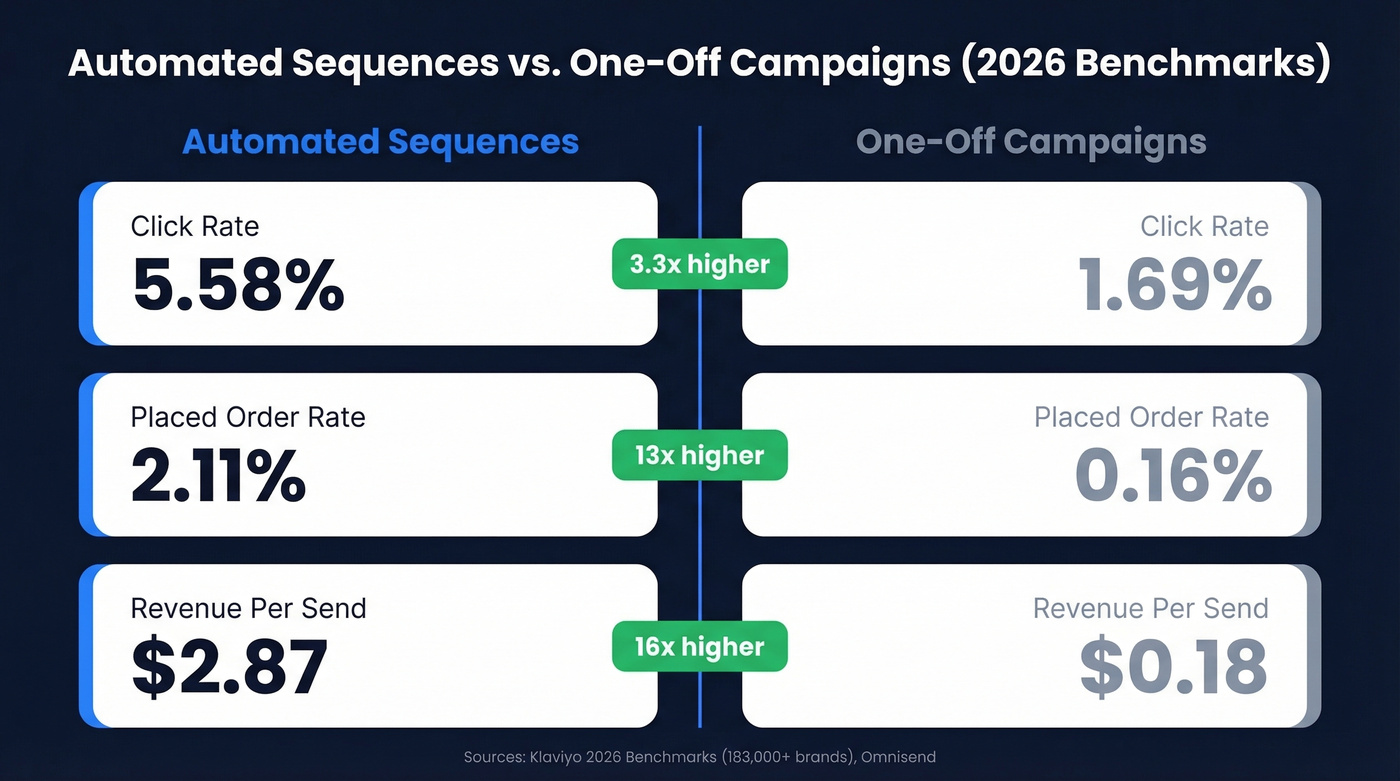
Sequences win because they respond to behavior. A single broadcast sent to your entire list is just noise by comparison.
What You Need (Quick Version)
If you build only three sequences, make them these:
- Welcome email series - captures intent at peak engagement
- Abandoned cart email flow - recovers the highest-value drop-off
- Cold email sequence - fills top-of-funnel for B2B
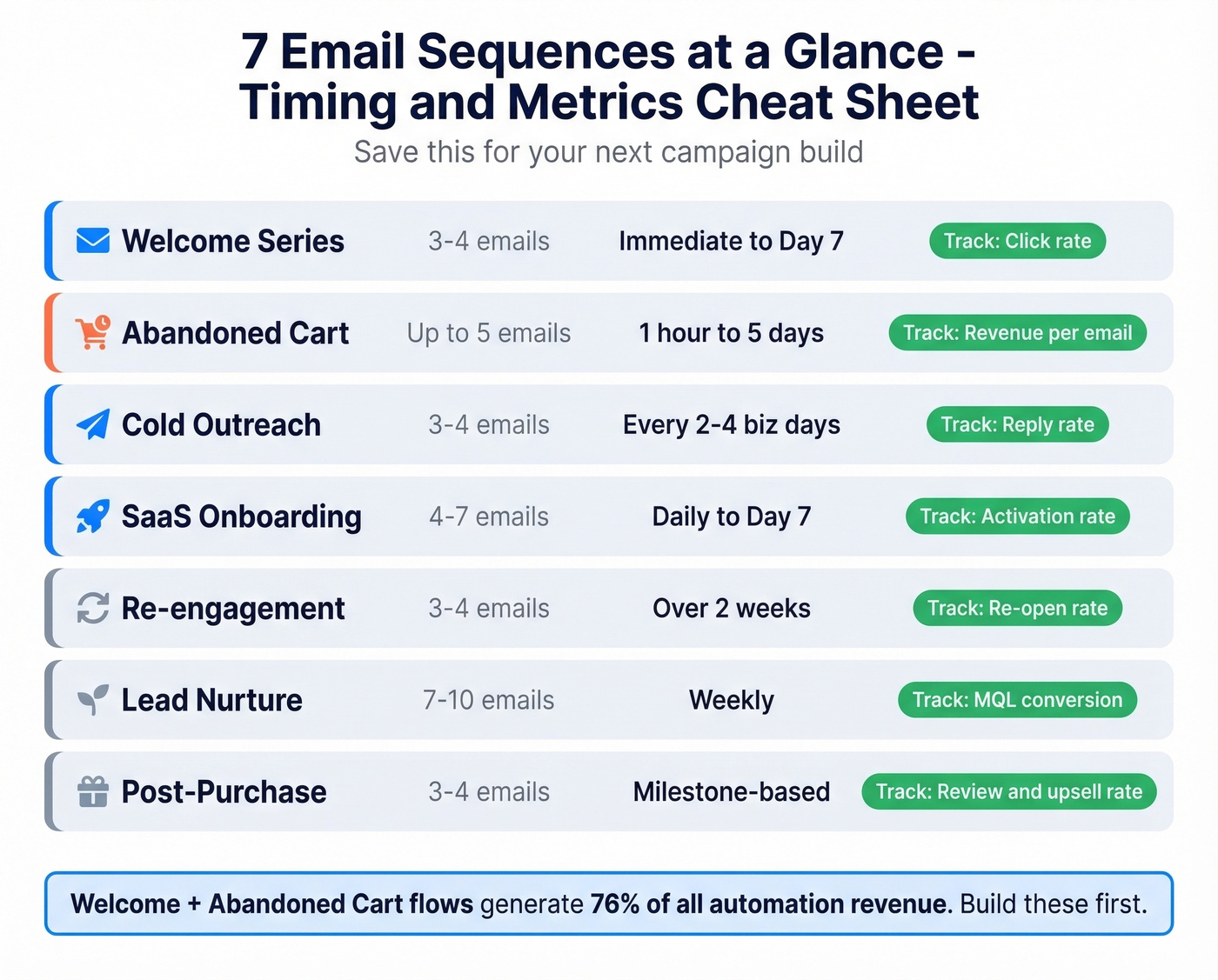
Welcome and cart flows are the biggest revenue drivers. Together they generated 76% of all automation revenue in 2026 benchmarking data.

Cold outreach sequences fail when 30%+ of your list bounces. Prospeo's 5-step verification delivers 98% email accuracy with a 7-day refresh cycle, so every sequence you launch hits real inboxes - not spam traps.
Stop burning your domain on dead contacts. Verify before you send.
7 Best Sequences With Templates
1. Welcome Sequence
Your welcome email gets the highest open rate you'll ever see. Don't waste it on a generic "thanks for signing up." The average popup converts at 3.2% (top 10% hit 8.5%), so every subscriber you capture deserves a sequence that actually moves them toward a purchase.
| Timing | Purpose | Subject Line Example | |
|---|---|---|---|
| 1 | Immediate | Deliver promise + brand intro | "You're in - here's your 10%" |
| 2 | Day 1 | Story / mission | "Why we started [Brand]" |
| 3 | Day 3 | Social proof | "12,000 teams use this daily" |
| 4 | Day 7 | Soft CTA | "Ready to see it in action?" |
Keep email 1 transactional - deliver whatever you promised. Emails 2-4 build trust before asking for anything.
If you want more options, pull from these subject lines and keep testing.
2. Abandoned Cart Sequence
This is one of the highest-ROI automated flows you'll ever build. Benchmarks: 35.75% open rate, $2.54 revenue per email, $168 average recovered order. With ~70% of carts abandoned globally, the math is hard to argue with.
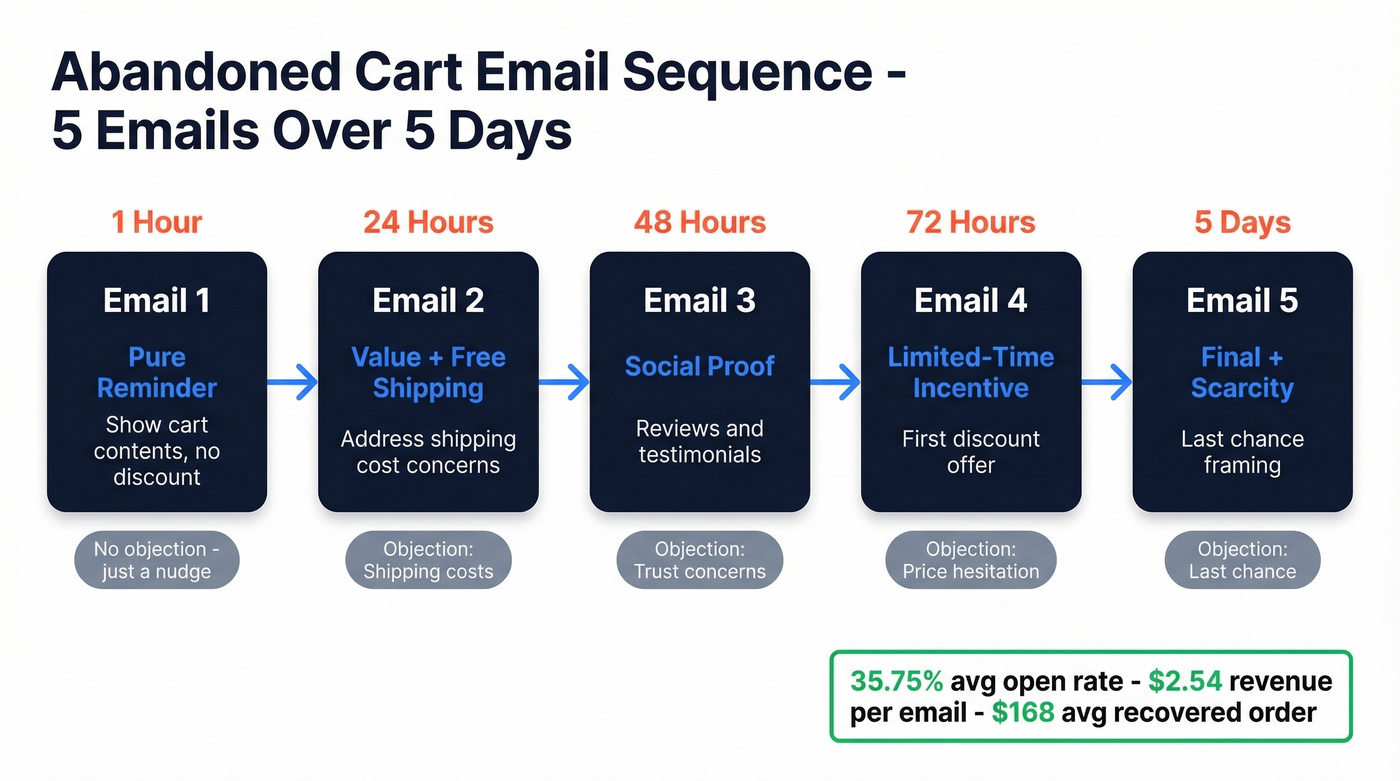
The key is mapping each email to a specific abandonment reason. Baymard's research shows 43% of shoppers were "just browsing," but the rest abandoned for addressable reasons - shipping costs, trust concerns, slow delivery. Your abandoned cart email flow should systematically knock these down.
| Timing | Focus | Objection Addressed | |
|---|---|---|---|
| 1 | 1 hour | Reminder + cart contents | "You left something behind" |
| 2 | 24 hours | Value / free shipping | Shipping costs |
| 3 | 48 hours | Social proof / reviews | Trust concerns |
| 4 | 72 hours | Limited-time incentive | Price hesitation |
| 5 | 5 days | Final reminder + scarcity | Last chance framing |
Email 1 is a pure reminder - no discount. Save incentives for emails 3-4. If they don't convert by day 5, they likely won't. Stop pushing.
3. Cold Outreach Sequence (B2B)
Here's the thing about cold email in 2026: average B2B reply rates sit at 1-5%. Teams hitting 15-25% aren't sending more messages - they're sending fewer, more relevant ones anchored to real business signals like funding rounds, leadership changes, and hiring patterns. Volume is dead.
If you're building this from scratch, start with a tight B2B cold email sequence and iterate from there.
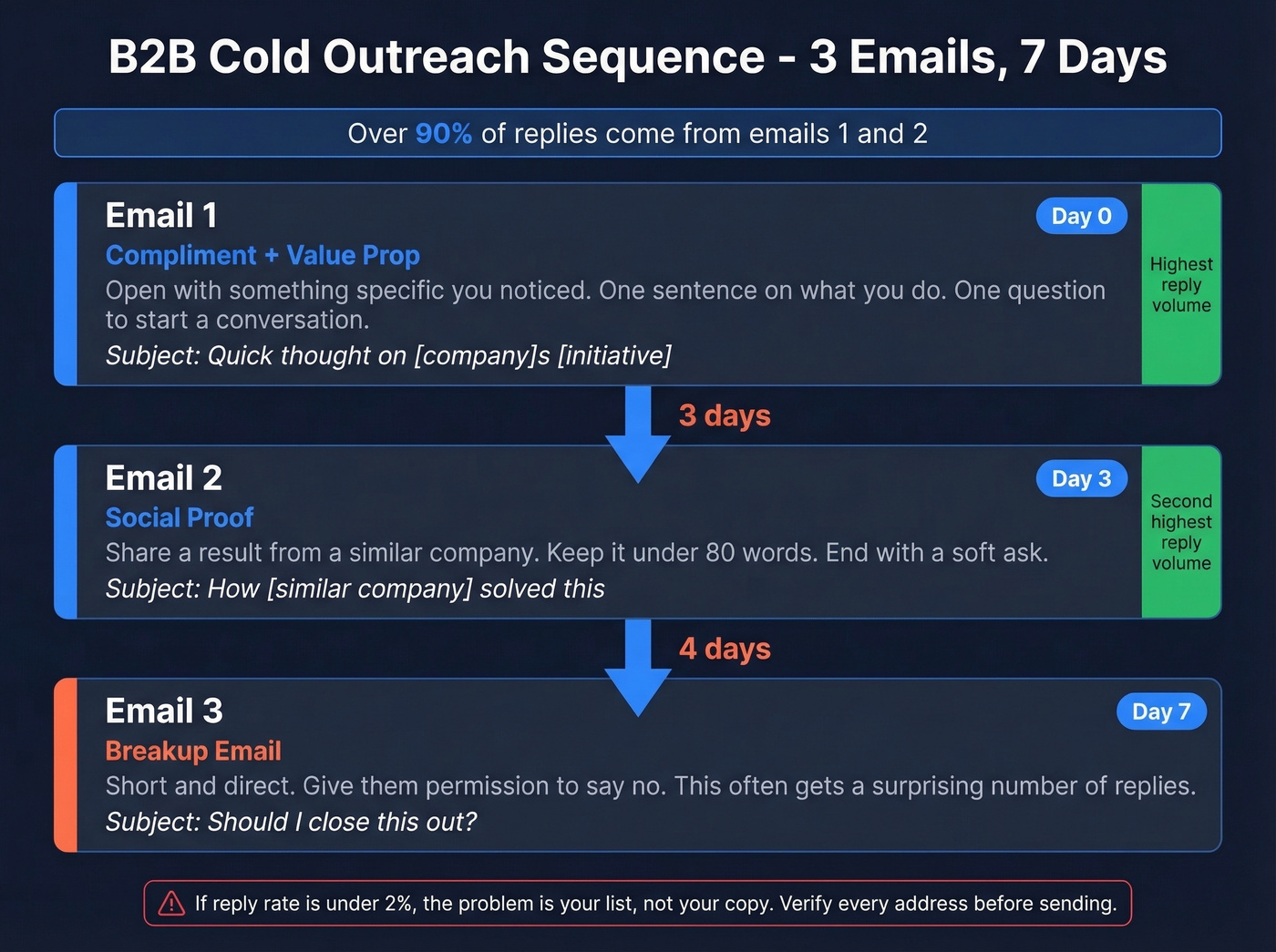
A practitioner on r/DigitalMarketing reported that over 90% of replies came from emails 1 and 2. That tracks with what we've seen across our own outbound campaigns, which means your first two touches carry almost all the weight. Three to four touchpoints spaced 2-4 business days apart is the sweet spot. Here's a proven cold outreach template based on Cognism's framework:
Email 1 (Day 0) - Compliment + value prop
Subject: "Quick thought on [company]'s [initiative]" Open with something specific you noticed. One sentence on what you do. One question to start a conversation.
Email 2 (Day 3) - Social proof
Subject: "How [similar company] solved this" Share a result. Keep it under 80 words. End with a soft ask.
Email 3 (Day 7) - Breakup
Subject: "Should I close this out?" Short. Direct. Give them permission to say no. This often gets the highest reply rate of the sequence.
Let's be honest: if your reply rate is under 2%, the problem almost certainly isn't your copy - it's your list. Bad data wrecks domains fast. If 30%+ of your addresses are dead, deliverability collapses and every email you send for the next month lands in spam. If you need more follow-up options, use these sales follow-up templates to keep touches short and relevant. Subject lines under 7 words perform best for opens. Send mid-week, mornings in the recipient's timezone (see best time to send cold emails). And before you launch, verify every address - Prospeo runs a 5-step verification process with 98% email accuracy and a 7-day data refresh cycle, so you're not burning your domain on stale contacts.
4. SaaS Onboarding Sequence
The gap between average and great onboarding is speed to first value. High performers get users to their "aha moment" within 24 hours and send 4-5 emails in week one. Average companies send 2-3 and wonder why trial conversion is low.
Clay runs a 6-part onboarding sequence with numbered subject lines - "Welcome to Clay! (1/6)" through "Level up your Clay workflows (6/6)." ActiveCampaign takes a behavior-driven approach, nudging users based on what they haven't done yet rather than blasting a fixed schedule. We've found the numbered approach works well for product-led growth because it sets clear expectations, while behavior-triggered emails convert better for complex products with multiple activation paths. Single CTA per email, always. Every message should answer one question: "What should I do next?"
If onboarding performance is lagging, track it like a funnel (see funnel metrics) and fix the biggest drop-off first.
5. Re-Engagement Sequence
Use this if: subscribers haven't opened or clicked in 60-90 days and you want to clean your list before suppressing them.
Skip this if: you're tempted to re-engage people who never engaged in the first place. That's not re-engagement - that's spam.
Send 3-4 messages over 2 weeks. Lead with value, not guilt. "We miss you" emails are lazy. "Here's what you missed" with a genuinely useful resource works better. If there's no response after the final email, remove them. A smaller, engaged list outperforms a bloated one every single time.
If you're seeing persistent bounces, use these bounce rate benchmarks and fixes before you scale sends.
6. Nurture Sequence
Nurture sequences bridge the gap between "interested" and "ready to buy." Awareness-stage leads can handle an email every 2-3 days in a short burst. Consideration-stage leads need weekly touches - too frequent and you're annoying, too sparse and they forget you.
Plan for 7-10 emails mixing educational content, case studies, and light product mentions. The goal isn't to sell in every email. It's to be the first name they think of when budget opens up. In our experience, the best-performing nurture emails don't even mention the product until email 4 or 5 - they just solve a real problem the reader has, and the trust compounds from there.
To keep nurture relevant, lean on sales prospecting techniques like trigger-based segmentation and tighter ICPs.
7. Post-Purchase / Upsell Sequence
Timing matters more here than copy. Send a delivery confirmation immediately, a "how's it going?" check-in 3-5 days after delivery, a review request at the 7-10 day mark, and a cross-sell recommendation at day 14+.
The cross-sell email should feel like a recommendation, not a pitch. "Customers who bought X also grabbed Y" works because it's helpful. "Buy more stuff" doesn't.
If you're deciding between cross-sell and upsell paths, use this cross selling vs upselling breakdown to pick the right motion.
Timing Cheat Sheet
| Sequence | # Emails | Cadence | Key Metric |
|---|---|---|---|
| Welcome | 3-4 | Immediate to Day 7 | Click rate |
| Abandoned cart | Up to 5 | 1hr to 5 days | Revenue/email |
| Cold outreach | 3-4 | Every 2-4 biz days | Reply rate |
| SaaS onboarding | 4-7 | Daily to Day 7 | Activation rate |
| Re-engagement | 3-4 | Over 2 weeks | Re-open rate |
| Lead nurture | 7-10 | Weekly | MQL conversion |
| Post-purchase | 3-4 | Milestone-based | Review/upsell rate |
Data Quality: The Step Nobody Talks About
Look, we've watched this play out dozens of times. You build the perfect cold outreach sequence, assemble 2,000 prospects, launch - and 35% bounce. Now Gmail is throttling your domain, your sequences land in spam, and every email you send for the next month is compromised.
Your sequence is only as good as your list. Before launching any outreach, verify every address. The industry average refresh cycle for contact databases is 6 weeks, and a lot of emails go stale in that window - people change jobs, companies restructure, domains expire. Prospeo refreshes on a 7-day cycle with 98% accuracy across 300M+ professional profiles, which is why teams like Snyk cut their bounce rate from 35-40% to under 5% after switching.
If deliverability is already slipping, start with this email deliverability guide and then tighten your sending speed (see email velocity).

Over 90% of cold email replies come from emails 1 and 2. That means your first touch has to land. Prospeo gives you 300M+ verified contacts with 30+ filters - buyer intent, job changes, funding - so every sequence starts with the right person.
Send fewer emails to better prospects. That's how you hit 15%+ reply rates.
FAQ
How many emails should a sequence have?
Cold outreach works best at 3-4 emails - over 90% of replies come from the first two. Abandoned cart flows can run up to 5 emails within 5 days. SaaS onboarding typically needs 4-7 across the first week. More isn't better; relevance and timing matter more than volume.
What's a good open rate for automated sequences?
Abandoned cart flows average 35.75% open rates, while one-off campaigns average around 31%. If you're consistently below 20%, the problem is likely deliverability or list hygiene - verify addresses before sending so bounces don't tank your sender reputation.
How do sequences differ from drip campaigns?
Sequences are triggered by a specific action: a signup, cart abandonment, or demo request. Drip campaigns are time-based and sent to broader segments regardless of behavior. Sequences outperform drips on every metric because they're contextually relevant - the recipient did something, and you're responding to that specific action.