

Email Subject Lines for Sales: 6 Data-Backed Rules (2026)
Your open rates look fine. Maybe even good. But replies dropped off a cliff last quarter, and the pipeline meeting is getting awkward. Cold email reply rates fell to 5.8% in 2024, down from 6.8% the year before - a 15% drop in twelve months. Meanwhile, Apple Mail Privacy Protection keeps inflating open rates, making the one metric everyone watches essentially meaningless for cold outreach.
Here's the thing: you don't need a swipe file you'll bookmark and never test. You need rules.
If You Only Read This Far
Three subject line styles to test before anything else:
- The 2-4 word relevance hook - short, specific, no filler ("Q3 pipeline gap?")
- The question - forces a mental response ("Scaling {team} this quarter?")
- Company/initiative personalization - not
{first_name}, but a real signal ("{Company}'s hiring push")
Everything below explains why these work, gives you templates by scenario, and lays out a testing plan that doesn't require 5.5M sends.
6 Rules That Drive Replies
These rules come from an analysis of 5.5M cold emails sent between January and December 2024, with mobile truncation thresholds from Twilio and broader open-rate context from MailerLite.
Rule 1: Keep It to 2-4 Words
Subject lines of 2-4 words hit a 46% open rate in the 5.5M-email dataset. Performance drops steadily after that - 7 words lands around 39%, and 9-10 words falls to roughly 34-35%. Single-word subject lines underperform too, at 38%.
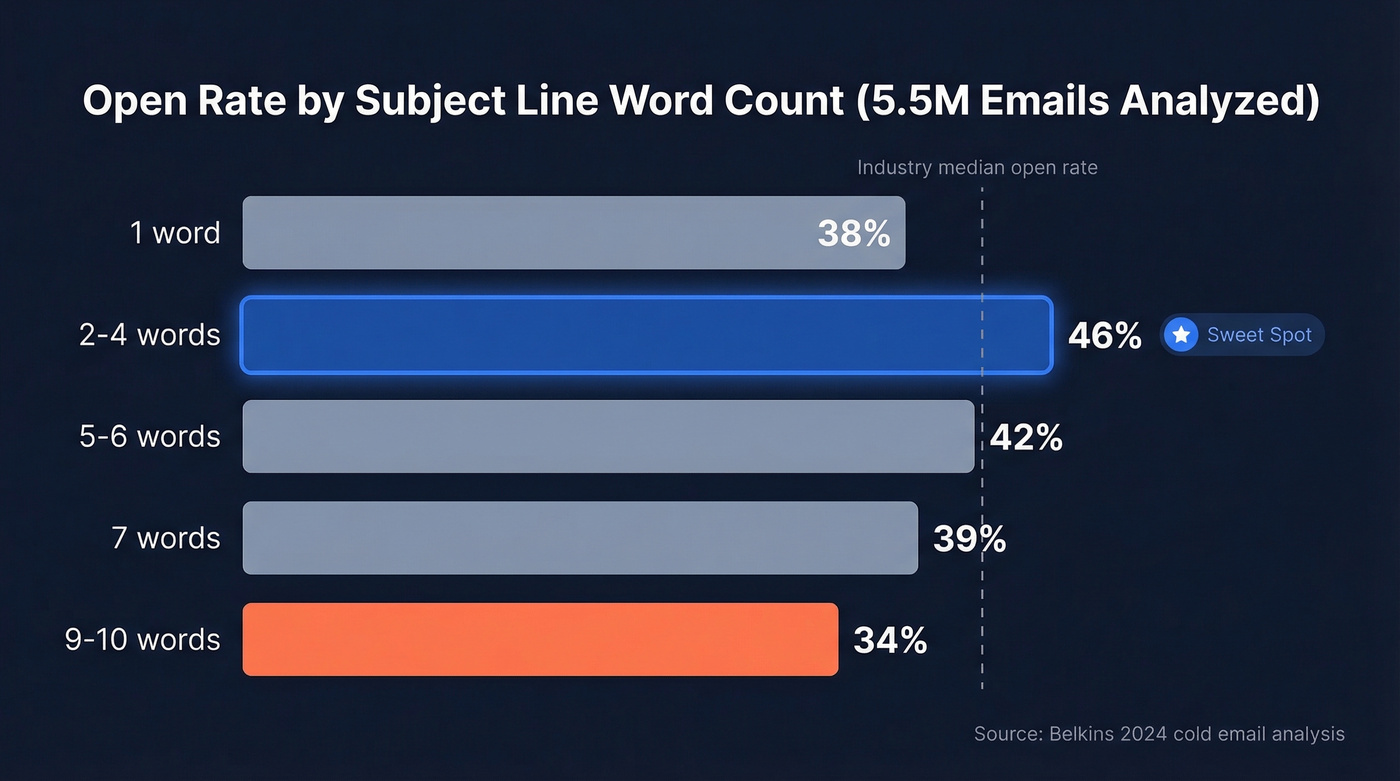
Practitioners on r/sales and r/coldemail have been saying the same thing for years: short, human-sounding lines like "quick check-in" and "this might help" pull roughly 2x the opens of anything that reads like marketing copy. The data backs them up. "Scaling SDR team?" beats "I wanted to reach out about your SDR team scaling plans" every single time.
Rule 2: Ask a Question
Questions also hit 46% opens - tied for the top spot. They create an open loop: your brain starts answering before you consciously decide to engage. Test a question variant against every statement variant you run. This single change can move the needle more than any other tactic we've tested.
Rule 3: Personalize Beyond First Name
| Open Rate | Reply Rate | |
|---|---|---|
| Personalized | 46% | 7% |
| Generic | 35% | 3% |
| Lift | +31% | +133% |
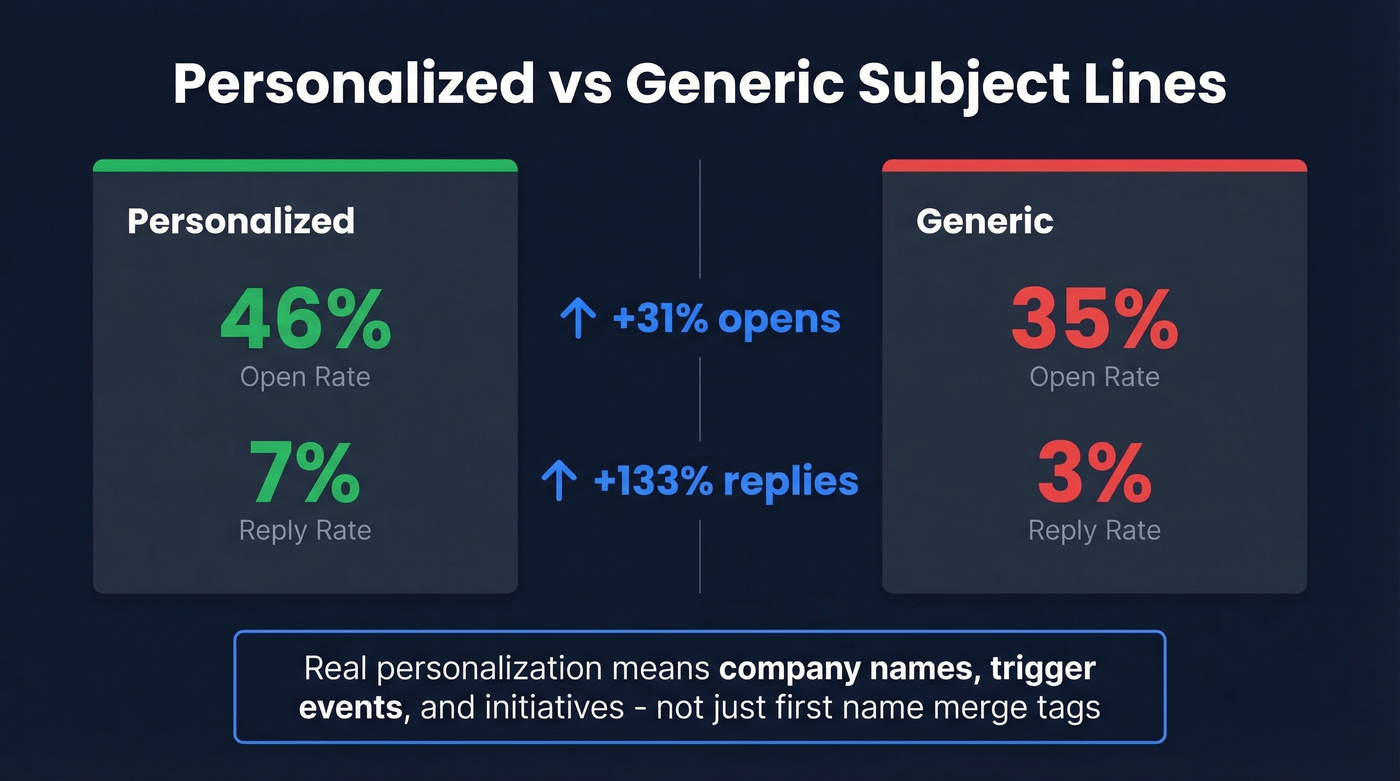
The reply rate gap is the number that matters. And {first_name} isn't personalization anymore - everyone does it. Personalize with the company name, a specific initiative, a trigger event, or a metric. "{Company}'s Series B hiring" tells the recipient you did thirty seconds of research. "Hey Sarah" tells them nothing. If you want a deeper system for this, use Personalized Outreach principles (signals first, tokens second).
Rule 4: Front-Load for Mobile
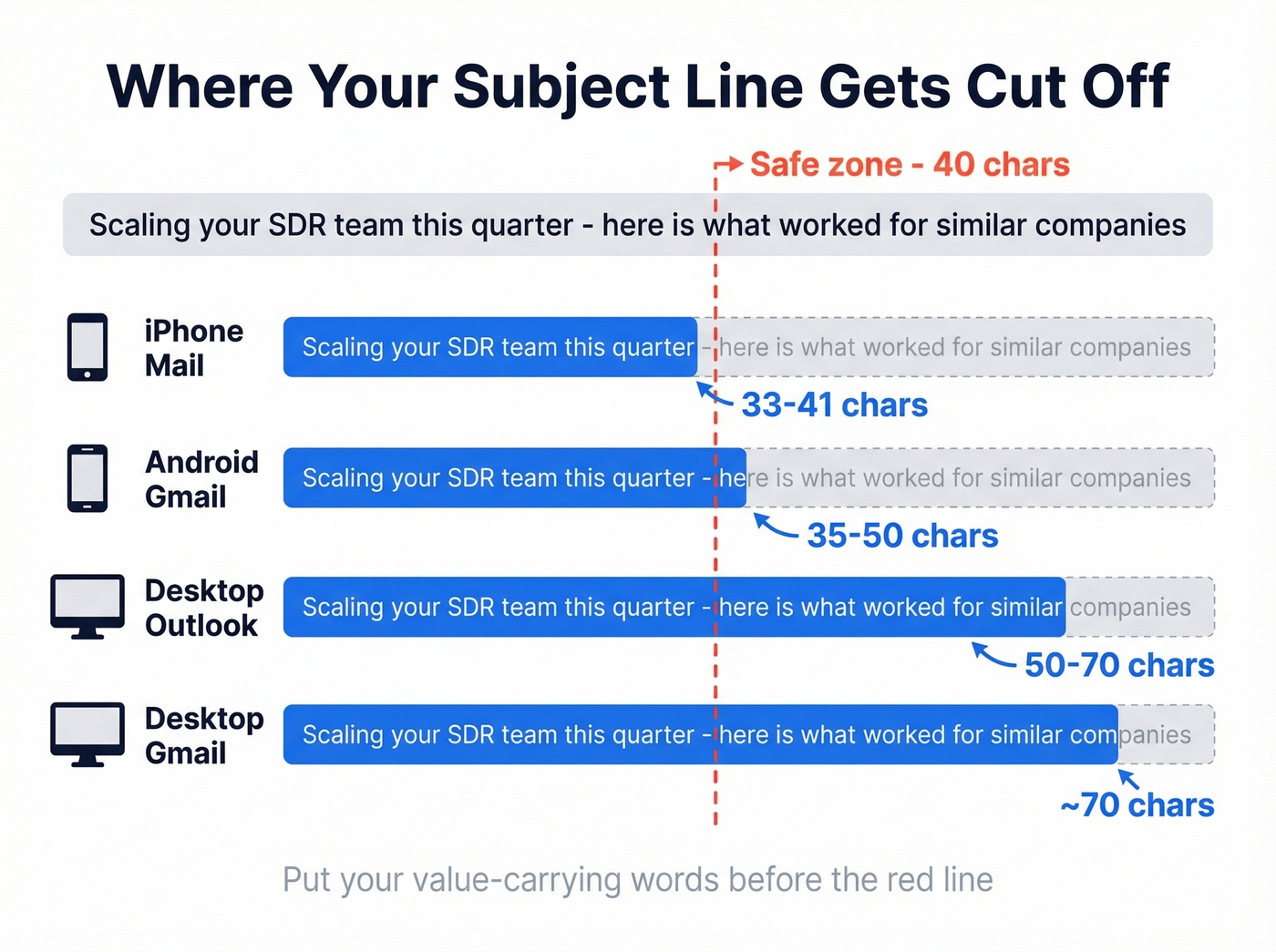
Over half your recipients see your subject line on a phone. Twilio's truncation data makes the math clear:
| Client / Device | Char Limit |
|---|---|
| iPhone (Mail) | 33-41 chars |
| Android (Gmail) | 35-50 chars |
| Desktop Gmail | ~70 chars |
| Desktop Outlook | 50-70 chars |
If it doesn't fit on an iPhone screen, it doesn't exist. Put the value-carrying words first.
Rule 5: Pair With Preview Text
Your subject line and your email's first sentence function as a unit on mobile. Most people ignore this entirely. If you want to test this properly, follow a simple preview text A/B testing workflow.
Before: Subject: "Scaling {team}?" -> Preview: "Hi {first_name}, I hope this email finds you well"
After: Subject: "Scaling {team}?" -> Preview: "Saw you're hiring 3 AEs - here's what worked for {similar company}"
The second version gives the recipient two reasons to open instead of one. We've seen this change alone lift reply rates by 10-15% in our own outreach.
Rule 6: Optimize for Replies, Not Opens
MailerLite's benchmarks across 3.6M campaigns show a median open rate of 43.46%. That number is inflated by Apple Mail Privacy Protection, which pre-fetches emails and registers phantom opens.
Stop obsessing over opens. Measure replies and meetings booked per send. That's the only metric that generates revenue. For a broader view of what “good” looks like, compare against standard email open rate benchmarks.
Sales Subject Lines by Scenario
Cold Outreach (First Touch)
| Example | Why It Works |
|---|---|
{Company}'s Q3 pipeline? |
Company-specific, question, 3 words |
Scaling {team} this year? |
Role-relevant, question, 4 words |
Saw {trigger} - quick idea |
Signal-based, implies research |
{Initiative} bottleneck? |
Specific to their priority, 2 words |
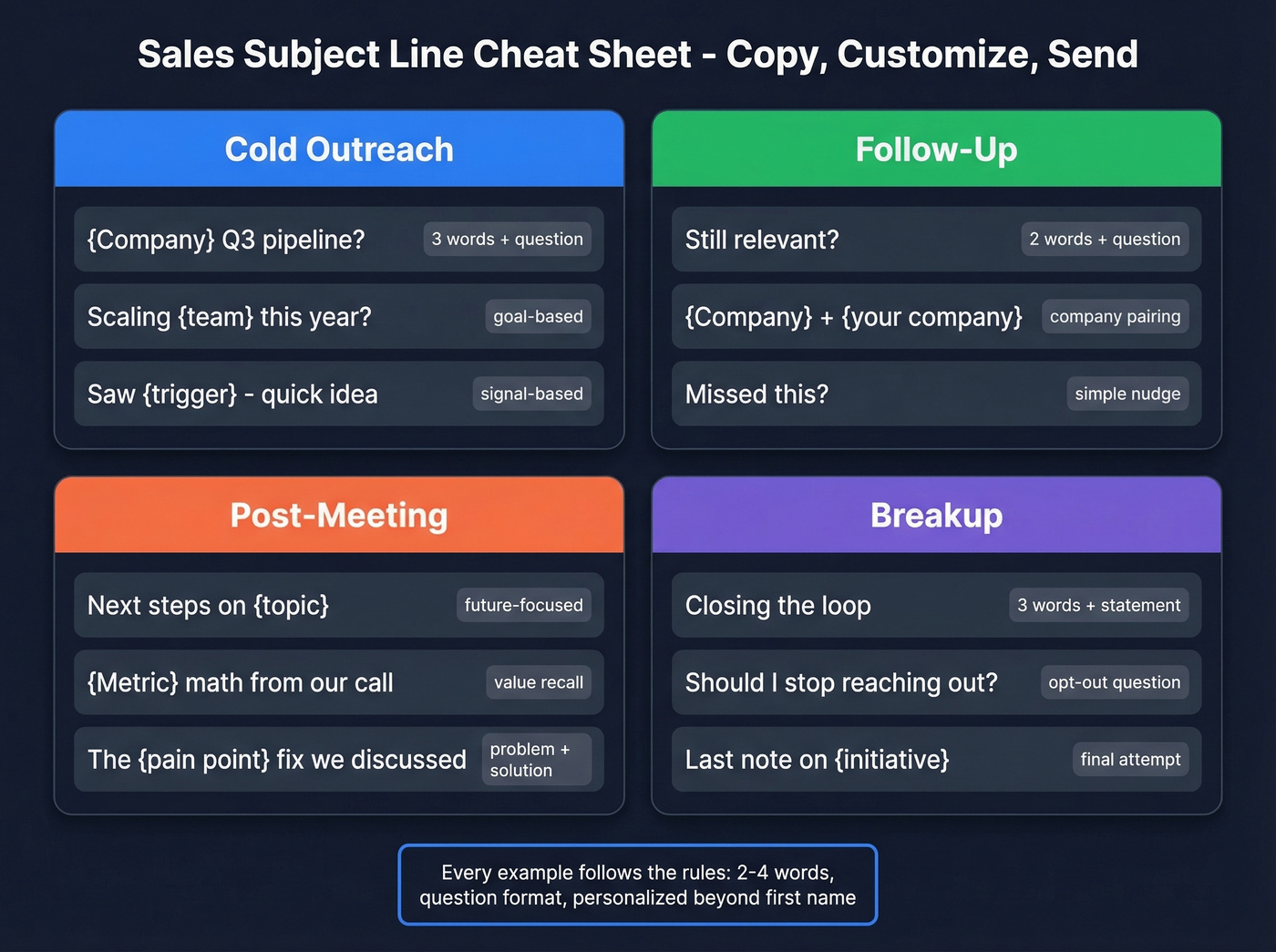
If you want more variations to steal and adapt, pull from these cold email subject line examples and then narrow to the 2-4 word patterns that fit your ICP.
Follow-Up (No Response)
| Example | Why It Works |
|---|---|
| Still relevant? | Ultra-short, non-pushy, 2 words |
{Company} + {your company} |
Pairing names implies fit |
| Missed this? | Curiosity without deception |
Re: {initiative} timing |
Ties back to original context |
For full sequences (not just subject lines), use these sales follow-up templates to keep the body copy as tight as the subject.
Post-Meeting
| Example | Why It Works |
|---|---|
Next steps on {topic} |
Action-oriented, specific |
{Metric} math from our call |
References shared conversation |
The {pain point} fix we discussed |
Anchors to their problem |
If you need a clean structure for the actual follow-up message, start with a sales meeting follow-up email framework.
Referral / Warm Intro
| Example | Why It Works |
|---|---|
{Referrer} suggested we connect |
Social proof, 4 words |
From {referrer} - quick intro |
Clear source, low friction |
{Referrer} said you'd want this |
Curiosity + trust transfer |
Breakup (Final Touch)
| Example | Why It Works |
|---|---|
| Closing the loop | Signals finality, no pressure |
| Should I stop reaching out? | Direct question, gives them control |
Last note on {initiative} |
Ties back to relevance, signals end |

Signal-based subject lines like "{Company}'s Series B hiring" only work when you have the signals. Prospeo tracks job changes, funding rounds, and headcount growth across 300M+ profiles - giving you the trigger events that make subject lines feel personal, not templated.
Stop guessing at personalization tokens. Start with real buyer signals.
Mistakes That Kill Deliverability
The internet keeps telling you to avoid "spam trigger words." Lists of 349+ or 550+ spam words exist, but modern email filters weigh sender reputation and engagement signals far more heavily than any keyword list. That said, certain patterns reliably trigger complaints and erode trust. If you want a practical checklist, start with an email deliverability guide and work outward from authentication + list quality.
| Don't | Do Instead | Why |
|---|---|---|
| Re: Our conversation | {Company}'s Q3 pipeline? |
CAN-SPAM risk + trust loss |
| Quick question for you | Question about {initiative} |
Vague = ignored |
| HUGE SAVINGS INSIDE | Cutting {metric} by 30%? |
Spam triggers + B2C tone |
| Checking in | Saw {trigger} - thought of you |
Generic = deleted |
If your subject line needs deception to get opened, your targeting is the real problem. Fake "Re:" threads, misleading urgency, and clickbait mismatches don't just hurt deliverability - they destroy trust and domain reputation. Once your domain reputation tanks, no subject line rewrite will save you. (If you're troubleshooting this, use a dedicated email reputation tools stack.)
Clean Data Makes Tests Work
You can rewrite subject lines every week, but if 15% of your list bounces, none of it matters.
Bounces and spam complaints from bad addresses poison sender reputation, which means your carefully crafted subject lines land in spam instead of the inbox. Your A/B test isn't measuring copy quality - it's measuring deliverability noise. We watched one team spend six weeks "optimizing" subject lines before realizing 12% of their list was invalid. Once they cleaned it, their original subject lines performed just fine. (If you're diagnosing this, start with email bounce rate benchmarks and causes.)
Turning off open-tracking pixels improved response rates by roughly 3% in the cold email dataset - likely because tracking pixels can hurt deliverability. Prospeo verifies emails with 98% accuracy on a 7-day data refresh cycle, so you're not sending to addresses that went stale three months ago. Clean data doesn't write better subject lines, but it makes sure your tests reflect what's actually working. If you want the technical “why,” read up on email tracking pixels.

A Simple A/B Testing Plan
Test one variable at a time. Question vs. statement. 2-word vs. 4-word. Personalized company name vs. generic. Changing three things at once tells you nothing.
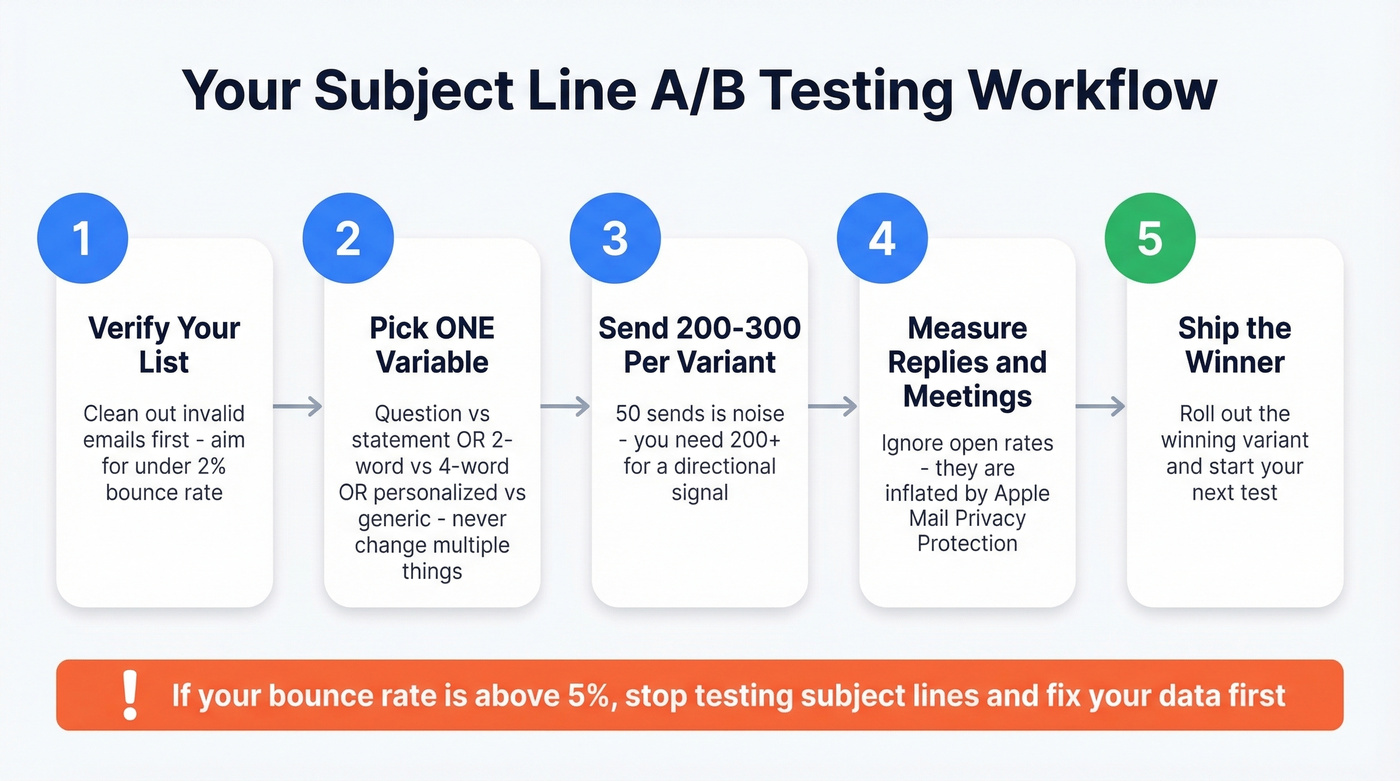
Send 200-300 emails per variant. You don't need 5.5M sends. But 50 sends per variant is noise. Two to three hundred gives you a directional signal worth acting on.
Measure replies and meetings, not opens. Opens are inflated by privacy features and unreliable for cold outreach. Track the metric that generates revenue.
Watch sequence length and verify your list. The dataset found 1-email sequences had the highest reply rate at 8.4% - adding a third email drops replies by roughly 20%. Sometimes the first email just needs a better subject, not more follow-ups. And if bounces are skewing your results, you're optimizing for the wrong thing. Verify before you send. (For a full build, use a B2B cold email sequence playbook.)
Let's be honest about something most "email optimization" content won't say: if your average deal size is under $10k, you probably don't need a 5-email sequence. One great email with a killer subject line to a verified list will outperform a mediocre 7-touch cadence to a stale one. I've watched teams cut their sequence from 5 emails to 2 and see reply rates increase because they stopped annoying people.
You just read how one team wasted six weeks A/B testing subject lines against a 12% invalid list. Prospeo's 5-step email verification delivers 98% accuracy with a 7-day refresh cycle - so your tests measure copy quality, not deliverability noise. At $0.01 per email, cleaning your list costs less than one more wasted week.
Fix the list first. Then your subject lines actually get a fair test.
B2B vs. B2C: Different Playbooks
If you're applying retail email tactics to sales outreach, skip this section and go fix that first. B2B buying groups involve 6-10+ decision-makers, sales cycles average 60-120 days, and 69% of recipients unsubscribe because of excessive frequency. Flash-sale urgency and emoji-laden subject lines work for e-commerce. They actively hurt you in B2B.
B2B subject lines win on relevance and credibility. Plain-text, 1:1-feeling emails consistently outperform polished marketing templates in cold outreach. Your subject line should read like it came from a colleague, not a newsletter - lowercase, short, specific to their business. That's the whole game. If you want to level up the rest of the message (not just the subject), use an email copywriting framework.
FAQ
How long should a sales email subject line be?
Two to four words, or under 40 characters. The 5.5M-email dataset shows 46% open rates at 2-4 words, with steady declines after 7 words. Shorter lines also survive mobile truncation on every major email client.
Do emojis help sales subject lines?
No reliable data supports emojis for B2B cold outreach. They can trigger spam filters and look unprofessional to enterprise buyers. Save them for consumer marketing.
Should I use "Re:" to fake a reply thread?
No. It's deceptive, creates CAN-SPAM compliance risk, and damages trust and domain reputation. The short-term open lift isn't worth the long-term sender score hit.
How do I keep subject line tests valid?
Start with clean, verified contact data so bounces don't skew results. If 10-15% of your list is invalid, your test is measuring deliverability, not copy. A 7-day data refresh cycle keeps your test environment clean so results reflect actual subject line performance.
What makes email subject lines for sales different from marketing emails?
Sales emails optimize for replies from specific people, not clicks across large lists. That means shorter subject lines, no design templates, real personalization based on the recipient's business, and plain-text formatting that feels like a message from a colleague - fundamentally different rules.