

Enterprise Demand Generation: A Data-First Framework for 2026
Your CFO just asked why marketing only sourced 15% of pipeline last quarter. Your AEs are self-sourcing deals because they don't trust the leads coming in - a pattern so common that an enterprise rep on Reddit said their marketing team "don't really do any sort of demand generation."
The real problem with enterprise demand generation isn't your channel mix. It's that buying groups now average 13 internal stakeholders and 9 external participants per deal, and most teams can't reach even half of them with verified contact data.
What You Need (Quick Version)
Enterprise demand gen has shifted from a channel optimization problem to a data quality problem. Three things to get right in 2026:
- A tiered ABM framework anchored to closed-won data
- Buying group enrichment that delivers verified contacts at 98% accuracy on a 7-day refresh cycle
- Self-reported attribution, because automated attribution is broken
Everything else is optimization on top of those fundamentals.
What Enterprise Demand Generation Actually Is
Demand gen creates awareness and preference across the ~95% of your market that isn't actively buying - the 95/5 rule. Lead gen captures the 5% already in-market.
This motion differs structurally from mid-market or SMB plays: sales cycles average around 10 months, buying groups can involve up to 22 people across departments, and contract values are high enough that a single lost deal represents real revenue impact. You need coordinated, multi-stakeholder engagement over quarters, not weeks. For companies selling across borders, global demand generation adds another layer - different regulatory environments, buyer expectations, and channel preferences per region.
The 2026 Reality
Buyers define their purchase requirements 83% of the time before speaking with sales. That first sales contact has pulled forward from 69% to roughly 61% of the buying journey - about six to seven weeks earlier - but buyers arrive more informed and more opinionated. 94% use LLMs during the process. Sales cycles have shortened slightly (11.3 months to 10.1), driven by economic pressure rather than simpler buying.
On the budget side, marketing spend sits at 7.7% of company revenue per Gartner, down from ~10% in prior years. 60% of MarTech spend is wasted on underutilized tools. And 32% of total marketing spend goes to ineffective tactics. That's a lot of budget evaporating.
53% of respondents now identify procurement as a key decision-maker - meaning your champion alone can't push the deal through. Over 60% of enterprise buyers run formal trials before purchasing, and post-trial, only 36% stick with the original vendor. 35% switch. You're not just competing for attention; you're competing through evaluation cycles where the default outcome is losing.
Enterprise Demand Generation Framework
Demand Creation vs. Capture
If 95% of your market isn't buying today, most effort should build preference for when they are. Search drives 45.3% of high-intent demo bookings, social accounts for 19.58%, word-of-mouth handles 18.11%. Display? A rounding error at 0.02%.
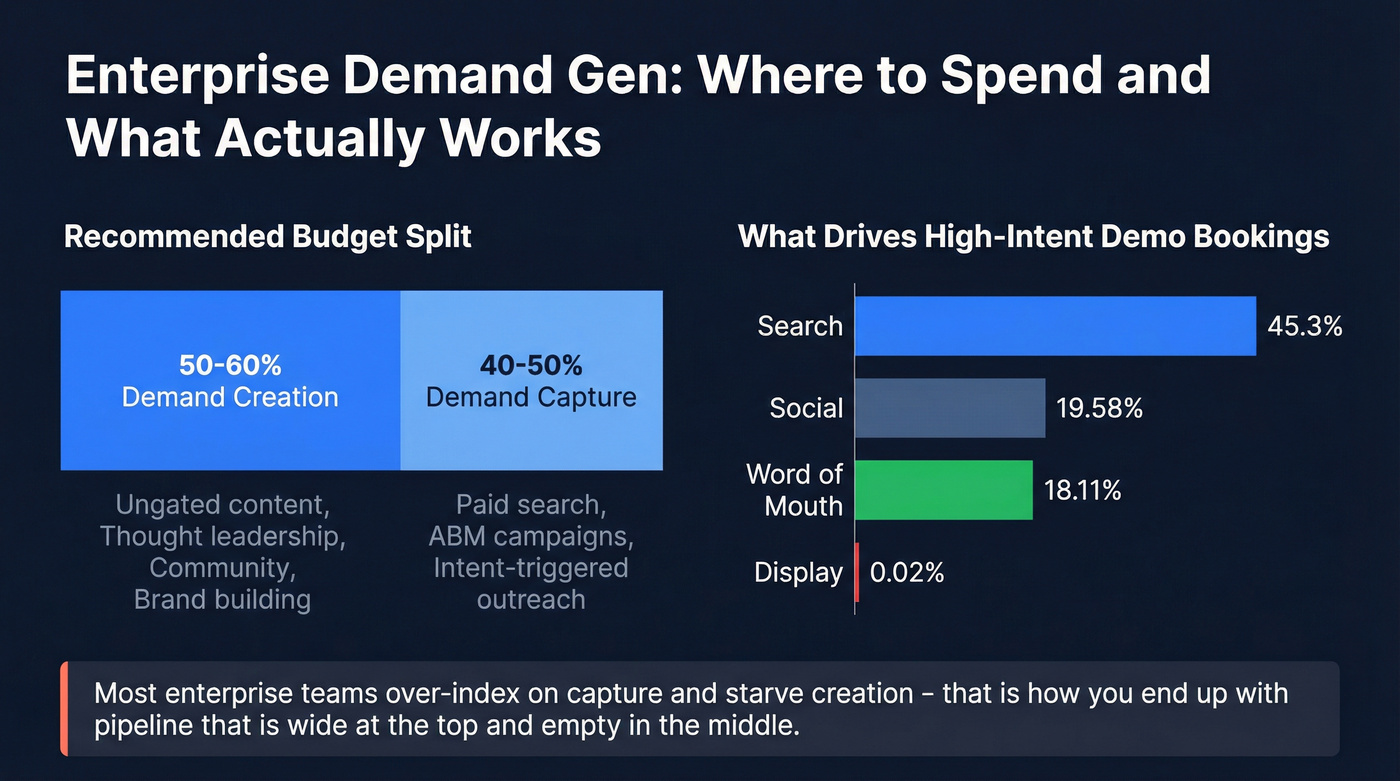
Allocate 50-60% of budget toward brand-building and demand creation: ungated content, thought leadership, community. Put 40-50% toward performance and demand capture through paid search, ABM, and intent-triggered outreach. Most enterprise teams over-index on capture and starve creation. That's how you end up with a pipeline that's wide at the top and empty in the middle.
Tiered ABM
Start with closed-won data. Which accounts converted? What did they look like before entering the funnel? Build your ICP from reality, then narrow your TAM to 1,000-5,000 target accounts (use a clear TAM definition so sales and finance agree).
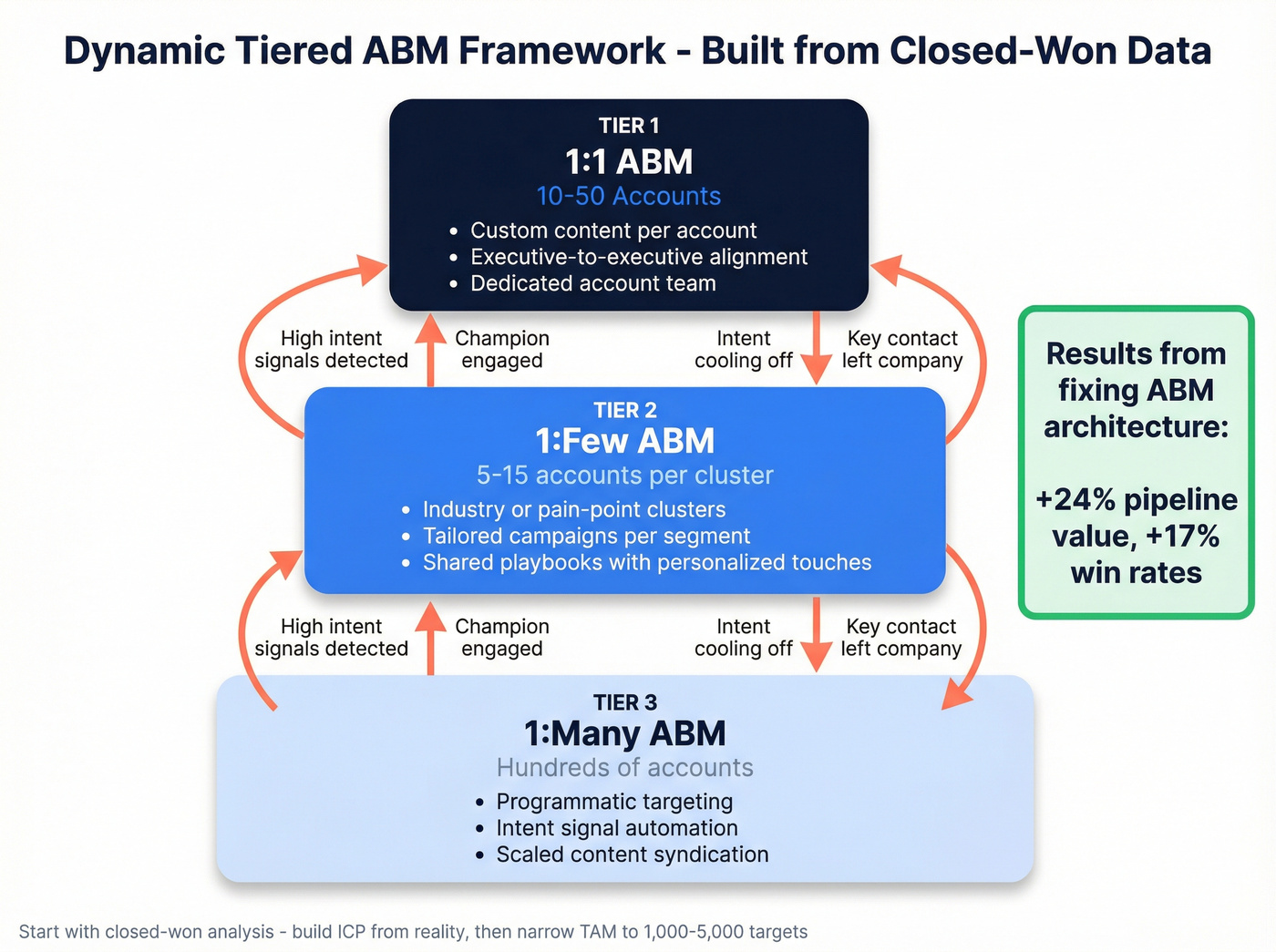
1:1 ABM targets your top 10-50 accounts with custom content and executive alignment. 1:few clusters 5-15 similar accounts per tailored campaign. 1:many runs programmatic ABM across hundreds using intent signals and automation.
The old static triangle is dead. As PwC's ABM leader put it via ITSMA, dynamic tiering based on real-time signals should move accounts between tiers as behavior changes. Companies that fixed common ABM pitfalls saw +24% pipeline value and +17% win rates - proof that the architecture matters more than the tooling.
Buying Group Enrichment
Here's where most programs break down. You mapped 15 people on the buying group - but half the emails bounced and the mobile numbers are disconnected. Data decay is a pipeline killer when the industry average refresh cycle is 6 weeks and people change roles constantly.
We've seen this firsthand. Snyk's 50-person AE team went from a 35-40% bounce rate to under 5% after switching to Prospeo's 7-day refresh cycle and 98% email accuracy, and AE-sourced pipeline jumped 180%. That's not a marginal improvement - it's the difference between a functioning demand gen engine and one that's hemorrhaging sender reputation.
For buying-group coverage at scale, you need verified emails, verified mobiles, frequent refresh, CRM enrichment, and intent signals to prioritize accounts showing in-market behavior. Skip any tool that can't tell you when its data was last verified. (If you want to compare vendors, start with this list of data enrichment services.)

Content That Creates Demand
Gated content is a tax on your audience. Video combined with industry influencer voices is 2.2x more likely to be trusted. Ungated thought leadership builds the brand preference that makes capture work downstream.
Let's be honest: if your "demand gen content" is a gated PDF behind a form that feeds a BDR cadence, you're doing lead gen with extra steps. (If you need a baseline system, align it to B2B content marketing fundamentals.)

Enterprise demand gen breaks when half your buying committee's emails bounce. Prospeo's 7-day refresh cycle and 98% email accuracy turned Snyk's 35-40% bounce rate into under 5% - and AE-sourced pipeline jumped 180%. Enrich entire buying groups with verified emails, direct dials, and intent data across 15,000 topics.
Fix your contact data before you spend another dollar on ABM platforms.
AI in Enterprise Demand Generation
96% of B2B marketers use AI in their roles. The useful framework is three layers: a data layer combining first-party engagement with third-party intent signals, an intelligence layer for propensity scoring and buying-window prediction, and an orchestration layer where AI agents select the next best action.
AI-driven marketing campaigns achieve 20-30% higher ROI, but 18% of marketers cite incomplete data as their biggest barrier. The orchestration layer is only as good as what you feed it (especially your firmographic and technographic data).
Here's our hot take: most enterprise teams will spend $200K+ on AI-powered ABM platforms in 2026 and get less pipeline lift than they would from simply fixing their contact data. The intelligence layer doesn't matter if 30% of your emails bounce.
Measurement That Works
In our experience, automated multi-touch attribution is largely theater for enterprise demand gen. Only 9% of content teams are measured directly on revenue. 71% describe their attribution data as "sort of accurate."
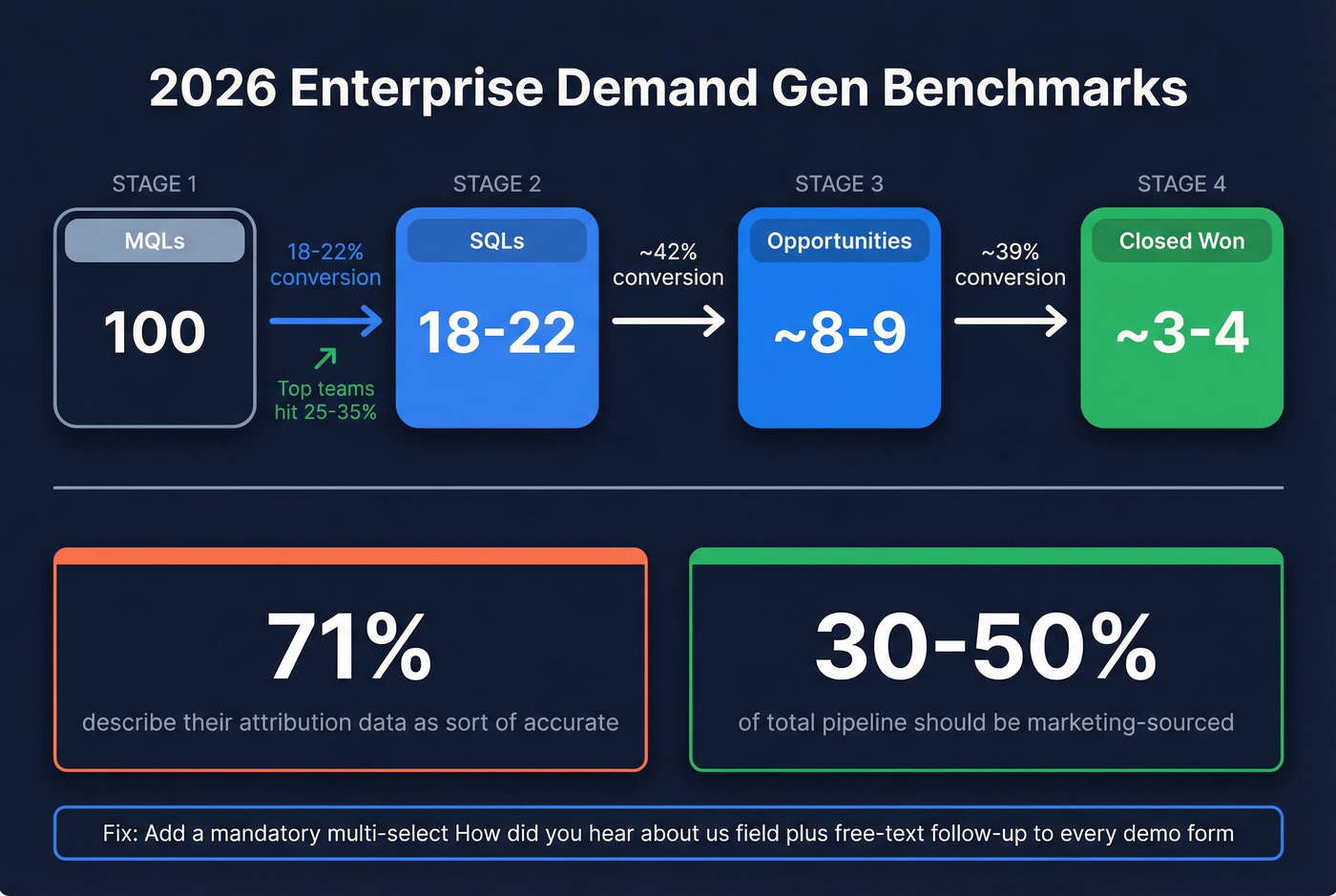
The fix is self-reported attribution. Add a mandatory multi-select "How did you hear about us?" field plus a free-text follow-up to every demo form. It consistently surfaces channels that algorithmic models miss entirely. We started doing this two years ago and it changed how we allocate budget - turns out, podcast mentions were driving 3x the pipeline we'd attributed to them.
For benchmarks: MQL-to-SQL at 18-22% (top teams hit 25-35%), SQL-to-Opportunity at ~42%, Opportunity-to-Close at ~39%. Marketing-sourced pipeline should represent 30-50% of total. (If you want a broader view, track funnel metrics consistently across teams.)
In Practice
Postindustria narrowed from 200 target accounts to 15, built relationships with 7-10 buying group members per account, and generated 9 enterprise qualified opportunities. Three closed at 10x their previous ACV. The playbook was simple in concept: narrow the ICP, tier aggressively, enrich the buying group with verified data, engage with genuine thought leadership. Execution is where it gets hard, and where most teams give up after 90 days because they expected faster results from a motion that compounds over quarters.
Mistakes That Kill Pipeline
Sales/marketing misalignment. When teams disagree on what counts as qualified, misaligned strategies correlate with sales cycles 47% longer than aligned teams. I've seen enterprise orgs where AEs ignore 80% of marketing-sourced leads because they don't trust the data. That's not a "sales follow-up" problem. It's a credibility problem (and usually a lead scoring problem too).
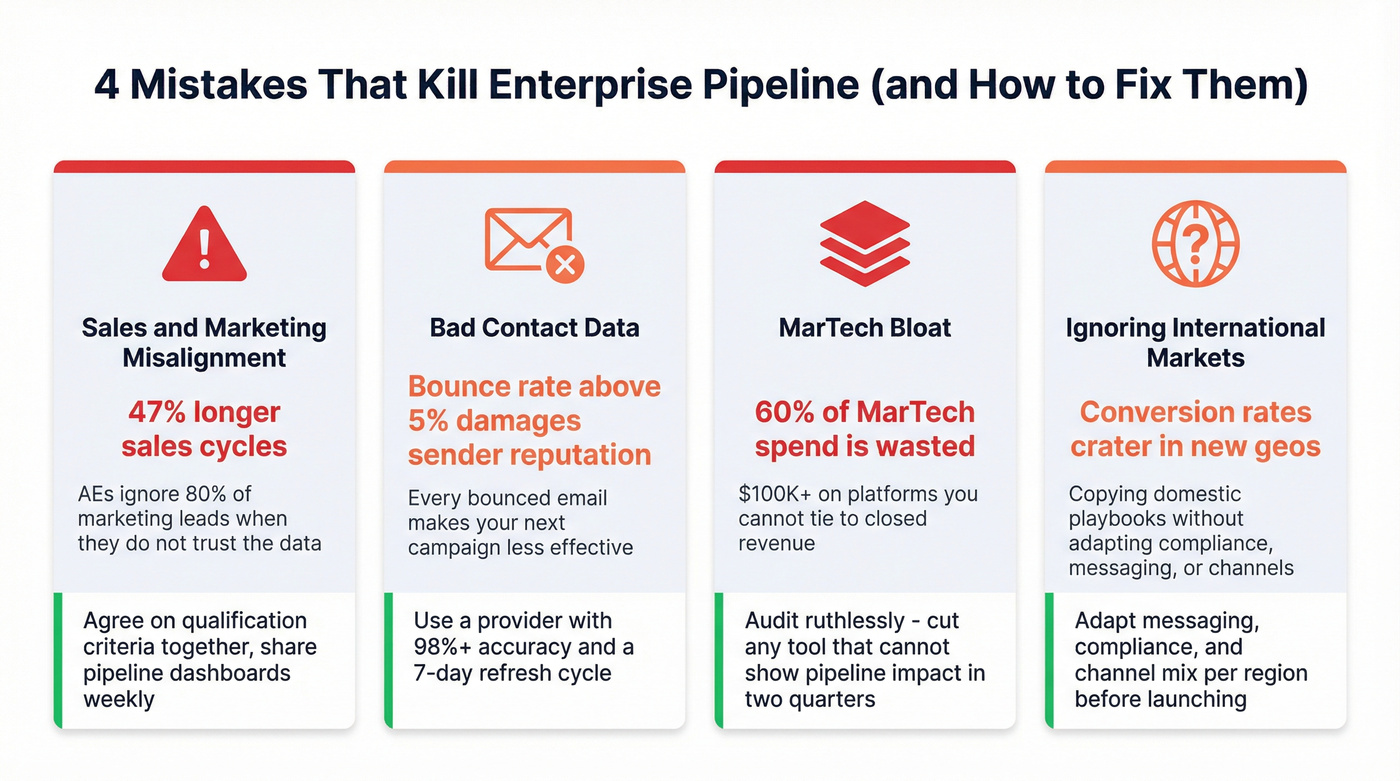
Bad contact data. If your bounce rate is above 5%, you're putting your sender reputation at risk - making every future campaign less effective. This is the single most fixable problem in enterprise demand gen, and the one most teams ignore longest. (Start by monitoring email bounce rate and tightening your email deliverability basics.)
MarTech bloat. If you're spending $100K+/year on an ABM platform and can't tie it to closed revenue, you have an expensive dashboard. Audit ruthlessly. Skip any tool that can't show you a direct line to pipeline or closed deals within two quarters.
Ignoring international markets. Enterprise companies expanding into new geographies often copy their domestic playbook without adapting messaging, compliance, or channel mix - then wonder why conversion rates crater in EMEA or APAC.
You mapped 15 stakeholders per deal but can only reach 7. Prospeo's 300M+ profiles, 125M+ verified mobiles, and 30+ filters - including buyer intent, technographics, and department headcount - let you build complete buying group coverage at $0.01 per email. No contracts. No sales calls.
Cover every stakeholder in the buying group, not just the ones your CRM already has.
FAQ
What's the difference between demand generation and lead generation?
Demand generation builds preference with the ~95% of buyers not in-market, while lead generation converts the in-market ~5% into demos and opportunities. For enterprise, plan on 6-12 months for creation to compound, then use ABM and intent-triggered outreach to convert demand in 60-90 days.
How long does enterprise demand generation take to show results?
Expect 60-90 days to see early pipeline from capture plays like ABM, paid search, and intent-triggered outbound. Creation plays - ungated content, community, thought leadership - take 6-12 months to materially lift win rates and inbound quality. If bounce rates are above 5%, fix data first or timelines slip fast.
How many stakeholders are in an enterprise buying group?
The current benchmark is 13 internal stakeholders and 9 external participants on average, meaning you often need 10-20 verified contacts per target account to run a real multi-threaded motion. If you only have 3-5 reachable people, you're not "running ABM" - you're hoping.
What's a good MQL-to-SQL conversion rate for enterprise?
A solid baseline is 18-22% MQL-to-SQL, with top teams hitting 25-35% when scoring and routing are tight. If you're under 15%, treat it as a scoring and list-quality problem first, not a "sales follow-up" problem.
What tools help with buying-group enrichment?
Prioritize tools that verify emails and mobiles, refresh frequently, and support CRM/CSV enrichment at scale. Look for 98%+ email accuracy, weekly data refresh, high enrichment match rates, and native CRM integrations. Intent data layered on top helps you prioritize accounts showing in-market behavior so you're not spraying outreach blindly.
Summary
Enterprise demand generation in 2026 is less about finding the perfect channel and more about building a system that can reach real buying groups, repeatedly, with clean data. Get the tiered ABM architecture right, enrich contacts on a weekly refresh cycle, and measure with self-reported attribution - then optimize creative, AI, and channels on top of a foundation that actually holds.