

Enterprise SaaS Sales: Benchmarks, Frameworks, and the Playbook Nobody Gives You
Enterprise buyers spend 5-6% of their total buying time talking to any single sales rep. The rest is internal meetings, security reviews, procurement loops, and stakeholder alignment you'll never see. Most enterprise SaaS sales guides are written by marketers who've never sat through a 47-page security questionnaire or watched a "closed-won" deal unravel in legal redlines for six weeks.
This one's built on real numbers, real frameworks, and the operational details that actually determine whether you close.
The Short Version
Selling software to large organizations means $100k+ ACV deals, 11-20 stakeholders per buying committee, at least a six-month cycle (often 6-18 months), and 12-18% win rates. Three things matter most: MEDDPICC qualification rigor, SOC 2 certification before you need it, and verified multi-threaded outreach data so you're actually reaching the right people across that committee.
What Defines Enterprise SaaS Sales?
Enterprise SaaS sales is the process of selling software to large organizations - typically companies with $1B+ in annual revenue and 1,000+ employees. These aren't deals where someone swipes a credit card. They're six- or seven-figure annual contracts that involve procurement teams, security reviews, legal redlines, and buying committees that can run 11 to 20 stakeholders deep.
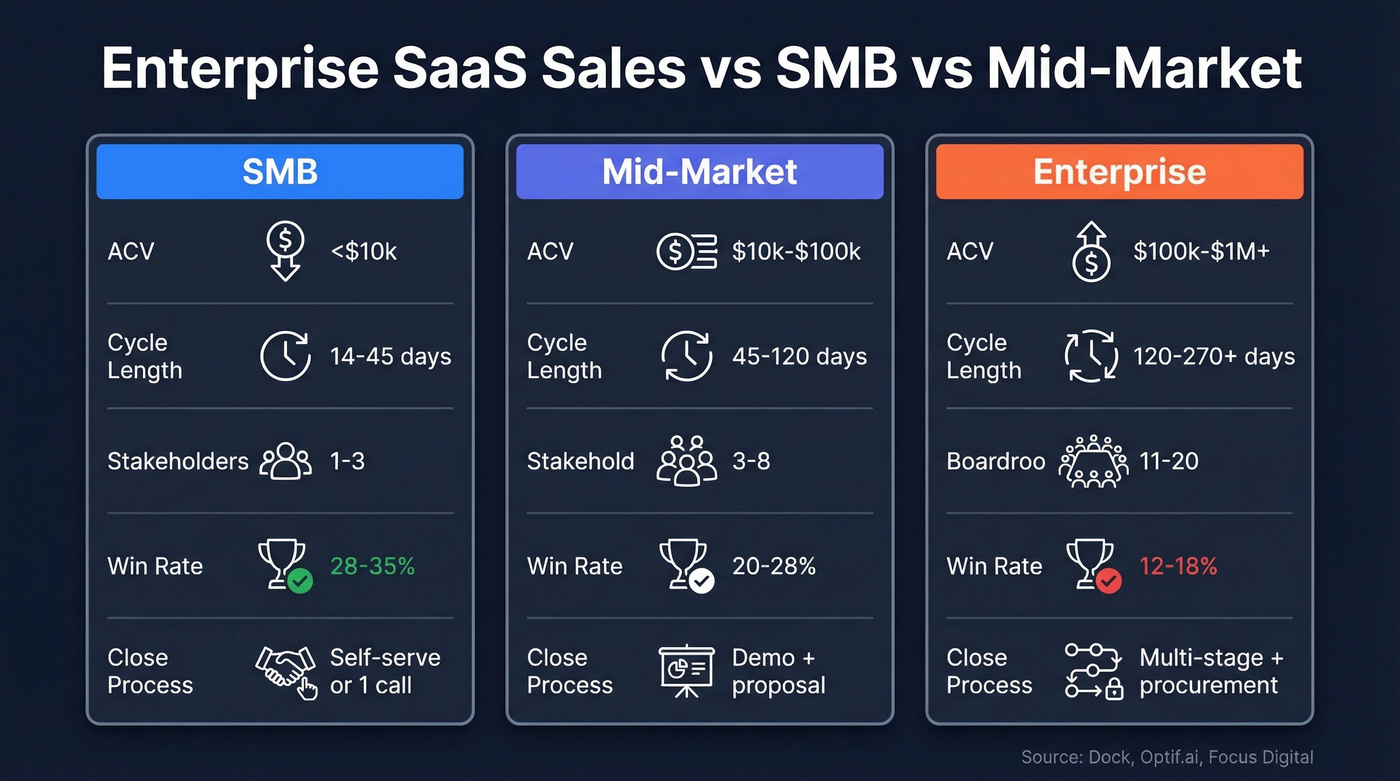
The difference between enterprise and everything else isn't deal size - it's the number of people who can kill your deal. A mid-market deal might involve a VP and a finance approver. An enterprise deal involves the end user, their manager, the CISO's team, procurement, legal, IT, and often a C-suite sponsor who needs internal air cover to push the purchase through.
| Dimension | SMB | Mid-Market | Enterprise |
|---|---|---|---|
| ACV | <$10k | $10k-$100k | $100k-$1M+ |
| Cycle length | 14-45 days | 45-120 days | 120-270+ days |
| Stakeholders | 1-3 | 3-8 | 11-20 |
| Win rate | 28-35% | 20-28% | 12-18% |
| Close process | Self-serve or 1 call | Demo + proposal | Multi-stage + procurement |
One practitioner on r/SaaS put it perfectly: their sales cycle went from 4 days to 4 months, and the buying process went from 1 person to 7. That's not an exaggeration. That's the norm.
The Real Numbers
Most enterprise sales content gives you vibes. Let's do math instead.
Cycle Length by ACV
The single biggest planning mistake is underestimating cycle length. The data across ACV tiers tells a clear story:
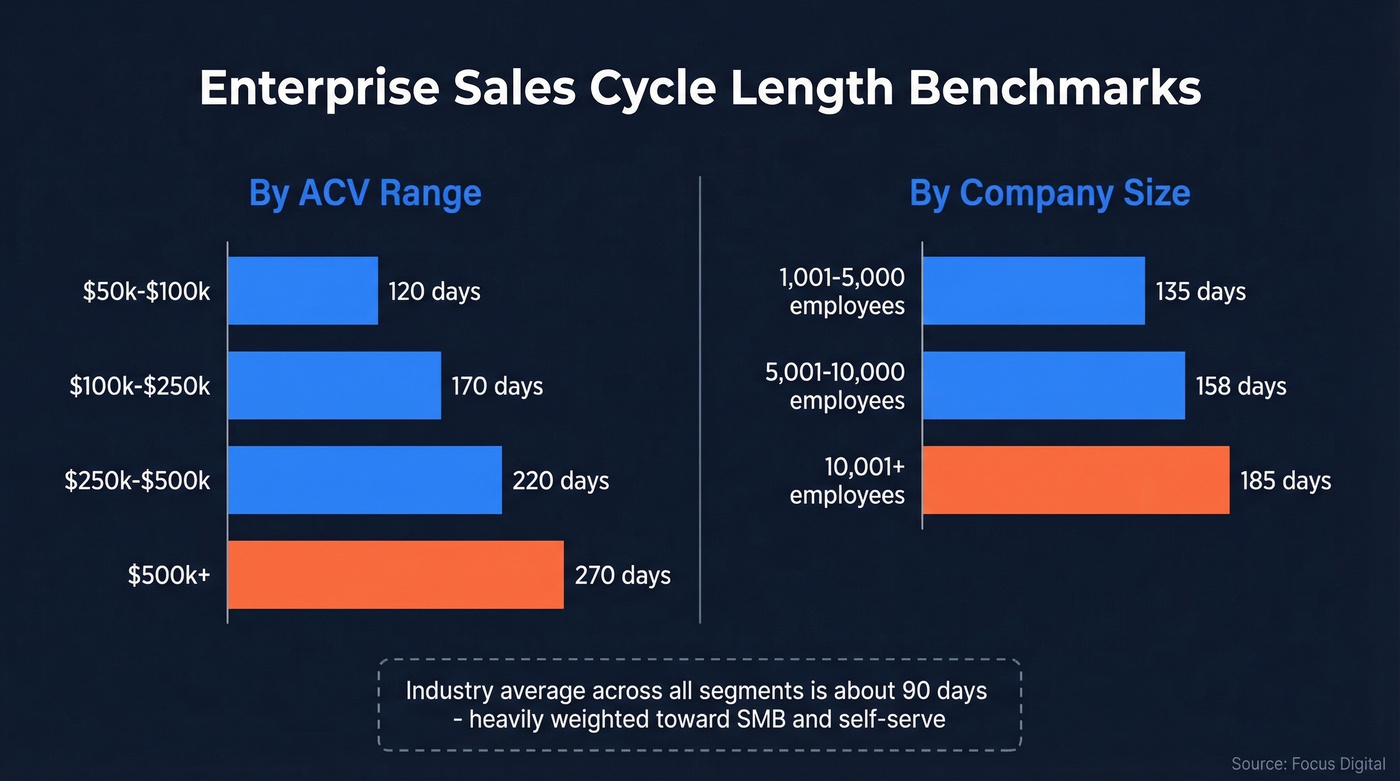
| ACV Range | Avg Cycle Length |
|---|---|
| $50k-$100k | 120 days |
| $100k-$250k | 170 days |
| $250k-$500k | 220 days |
| $500k+ | 270 days |
Company size matters too. Selling into a 1,000-person company is fundamentally different from selling into a 10,000-person one - not because the product changes, but because the internal approval chain gets longer:
| Company Size | Avg Cycle Length |
|---|---|
| 1,001-5,000 employees | 135 days |
| 5,001-10,000 employees | 158 days |
| 10,001+ employees | 185 days |
Channel matters just as much. Referral-sourced deals close in roughly 60 days at high complexity, while trade show leads average 150 days. Pipeline velocity depends as much on how deals enter the funnel as on how you work them.
For context, the software industry average across all segments is about 90 days - heavily weighted toward SMB and mid-market self-serve motions. If you're forecasting enterprise deals on a 90-day timeline, you're going to miss. Badly.
Win Rates by Deal Size
This is where things get psychologically difficult. Your win rate drops as deal size climbs. Data from 939 B2B SaaS companies paints a clear picture:
| ACV Tier | Win Rate |
|---|---|
| SMB (<$10k) | 28-35% |
| Mid-market ($10k-$50k) | 20-28% |
| Upper mid-market ($50k-$100k) | 15-22% |
| Enterprise ($100k+) | 12-18% |
The median enterprise win rate sits around 15%. Winning by Design tracked this declining from roughly 26% to 17% in late 2022/early 2023, and the median has hovered near 15% since.
One methodological note worth internalizing: win rate should be calculated as wins / (wins + losses), excluding open deals. Including open pipeline inflates your numbers and creates false confidence - a trap we've seen RevOps teams fall into repeatedly.
A 15% win rate is fine. The "batting average doesn't matter" framing from enterprise sales veterans is correct. Fifteen opportunities per quarter at a 15% close rate and $150k average deal value produces $337.5k in won revenue. You don't need volume - you need the right deals, qualified hard, with multi-threaded engagement across the buying committee.
That multi-threading piece is critical. Deals with 3+ contacts engaged close at 2.4x the rate of single-threaded deals across all segments - and 3.1x in enterprise specifically. "Known contact" deals hit a 37% win rate versus 19% for cold outreach. Multi-threading requires verified contacts across the buying committee. If your data provider is giving you bounced emails for 3 out of 5 stakeholders, the math falls apart before the first meeting.
The Seven-Stage Sales Process
Enterprise sales isn't harder than SMB or mid-market - it's slower and more structured. Reps who fail usually lack process, not talent.
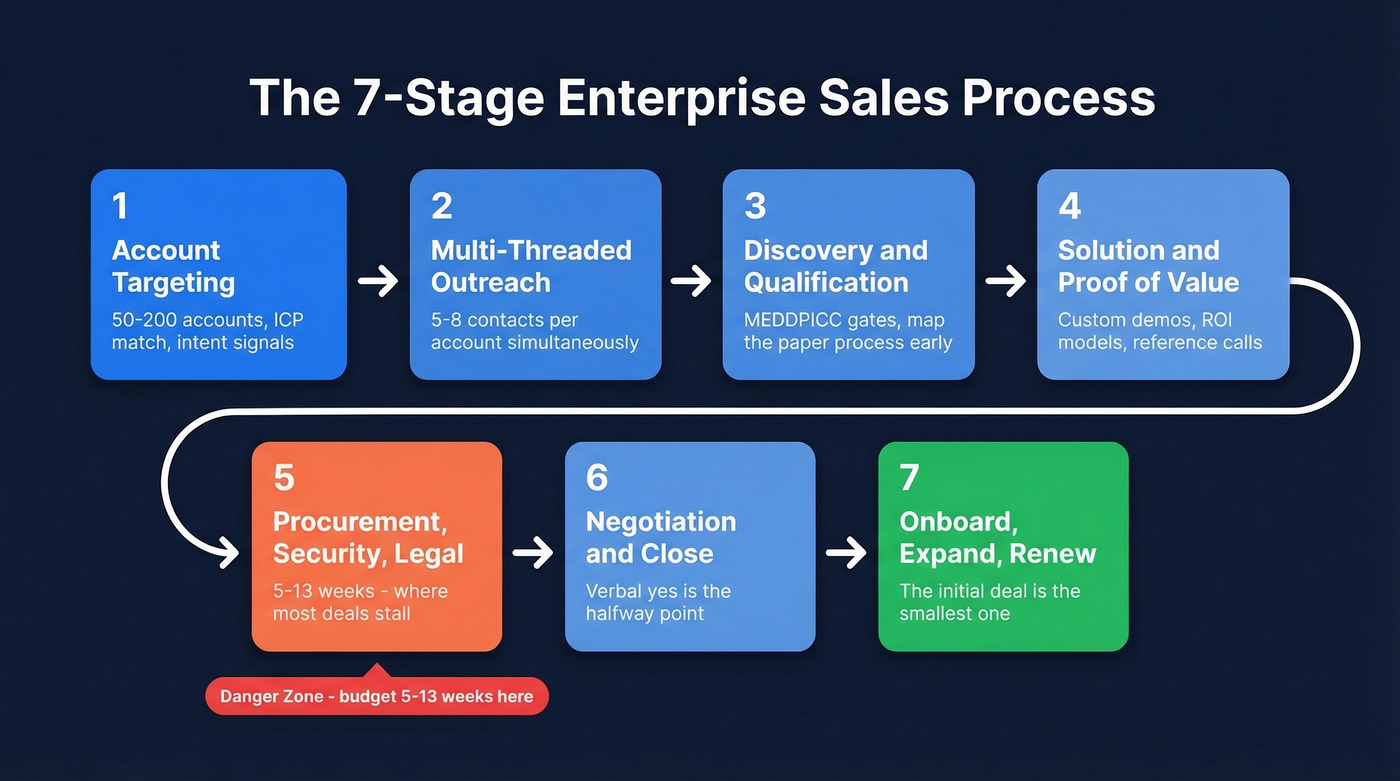
1. Account targeting and ICP definition. You're not spraying emails at a TAM list. Enterprise targeting means identifying 50-200 accounts that match your ideal customer profile by revenue, tech stack, headcount growth, and buying signals. ABM and intent data aren't optional here. They're the operating model.
2. Multi-threaded outreach. You need to reach 5-8 people at each target account simultaneously: the champion, the economic buyer, the technical evaluator, the end users. Single-threading an enterprise deal is the fastest way to lose it.
3. Discovery and qualification. This is where MEDDPICC earns its reputation. You're not just qualifying budget - you're mapping the decision process, identifying the paper process, and confirming there's a compelling event driving urgency. (If you want a tighter discovery structure, use a set of discovery questions that map to each gate.)
4. Solution presentation and proof of value. Enterprise buyers don't care about features. They care about risk reduction, ROI, and integration with their existing stack. Custom demos, ROI models, and reference calls are table stakes.
5. Procurement, security, and legal review. This is where most guides stop and most deals stall. Security questionnaires, SOC 2 requirements, legal redlines on your MSA, vendor onboarding forms. Budget 5-13 weeks for this phase alone.
6. Negotiation and close. Enterprise negotiation involves procurement teams whose job is to extract concessions. Multi-year discounts, payment terms, SLA commitments - all of it gets negotiated. The verbal "yes" from your champion is the halfway point, not the finish line. (If you need a clean way to frame concessions, use an anchor in negotiation before procurement takes over.)
7. Onboarding, expansion, and renewal. Enterprise deals don't end at signature. Implementation can take months, and the renewal conversation starts the day the contract is signed. Land-and-expand is the real revenue model - the initial deal is often the smallest one you'll close with that account.
MEDDPICC: The Qualification Standard
MEDDPICC is the qualification standard used by 73% of companies selling above $100k ARR. Companies that fully adopt it report 18% higher win rates and 24% larger deal sizes.
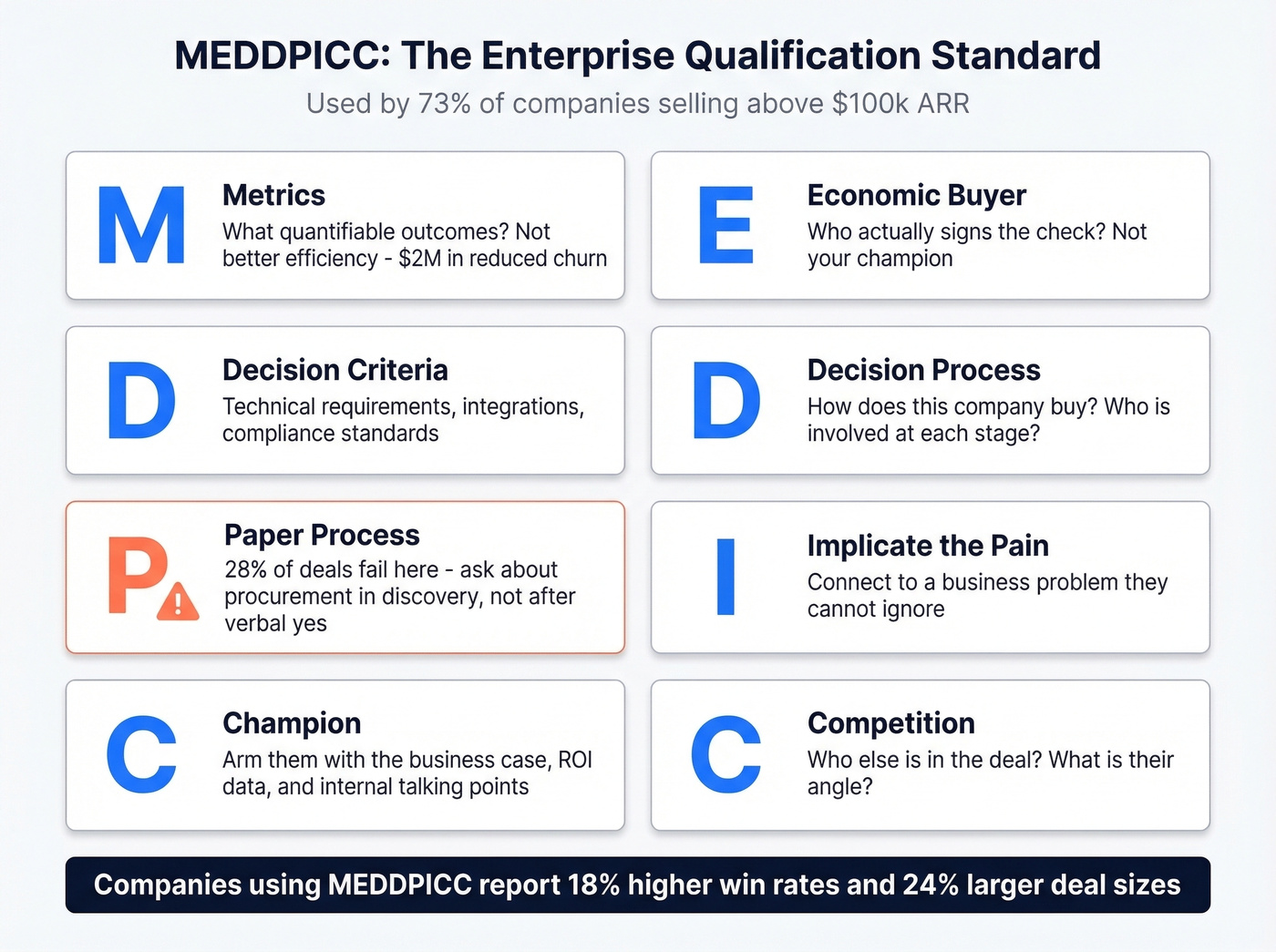
Each letter maps to a specific qualification gate:
Metrics - What quantifiable outcomes does the buyer need? Not "better efficiency" but "$2M in reduced churn" or "40% faster onboarding."
Economic Buyer - Who actually signs the check? Not your champion. The person with budget authority. (More on how to identify them: economic buyer.)
Decision Criteria - The scorecard: technical requirements, integration needs, compliance standards.
Decision Process - How does this company buy? Who's involved at each stage? What's the timeline?
Paper Process - The most overlooked element and the one that kills the most deals. 28% of enterprise deals fail when buyers can't navigate internal procurement approval. Legal redlines, PO processes, security reviews, vendor onboarding - all of it lives here.
Implicate the Pain - Connect your solution to a business problem the buyer can't ignore.
Champion - Your internal advocate. Champion enablement - arming this person with the business case, ROI data, and internal talking points they need - is the difference between a champion who tries and one who succeeds.
Competition - Who else is in the deal? What's their angle?
Here's the thing: most reps map the paper process after they get a verbal agreement. That's backwards. Ask about the procurement process in discovery. "What does your purchasing process look like? Who signs? How long does security review typically take?" If you don't know the paper process by the end of discovery, you don't actually have a qualified deal.

Multi-threaded deals close at 3.1x the rate in enterprise - but only if your contact data actually connects. Prospeo gives you 98% verified emails and 125M+ direct dials across 300M+ profiles, with 30+ filters to pinpoint every stakeholder on the buying committee.
Stop single-threading $100k+ deals with bounced emails.
Procurement and Security
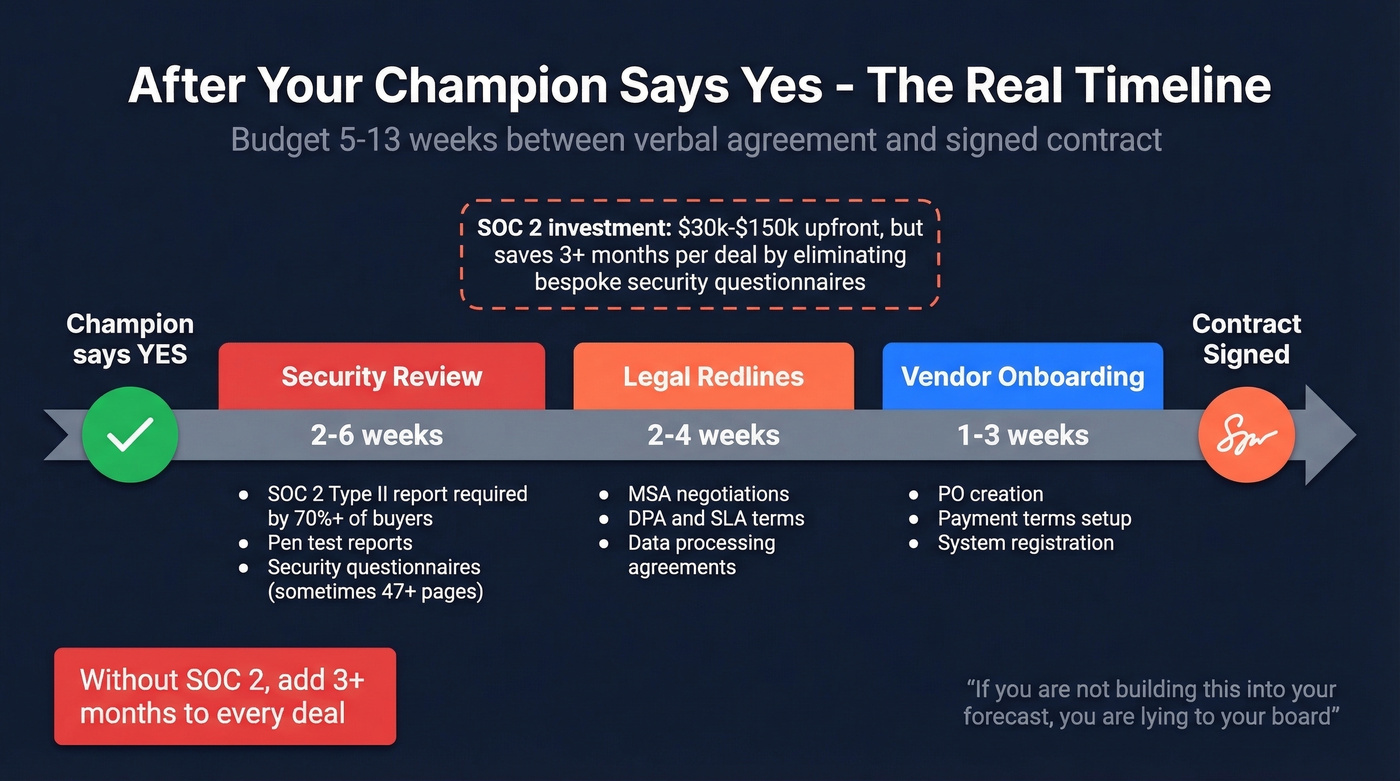
You just got verbal on a $200k deal. Your champion is excited. Your VP is updating the forecast. Then procurement sends a 47-page security questionnaire, legal wants to redline your entire MSA, and the CISO's team needs a SOC 2 Type II report you don't have.
This is where enterprise deals go to die.
70%+ of B2B SaaS deals require a SOC 2 report before signing. It's not a nice-to-have - it's a gate. If you don't have it, you're either losing the deal or adding 3+ months while you scramble to get certified. The investment runs $30k-$150k, but having SOC 2 ready can shrink sales cycles by 3+ months compared to answering bespoke security questionnaires for every prospect. Depending on industry, you'll also need HIPAA, PCI-DSS, or FedRAMP compliance - each adding its own review timeline.
Budget for this timeline after your champion says "yes":
- Security review: 2-6 weeks, longer if you lack SOC 2 or pen test reports
- Legal redlines: 2-4 weeks for MSA, DPA, and SLA negotiations
- Vendor onboarding: 1-3 weeks for PO creation, payment terms, and system setup
That's 5-13 weeks. If you're not building this into your forecast, you're lying to your board.
One founder on Reddit reported it took a full year to close their first enterprise deal, largely because they underestimated procurement infrastructure. Enterprise now accounts for 60% of their revenue. The pain was worth it - but only because they invested in the compliance and legal scaffolding after that first brutal cycle.
Mistakes That Kill Enterprise Deals
Jason Lemkin has been vocal about these on SaaStr, and they match patterns we've seen across dozens of teams:
| Mistake | Why It Kills Deals |
|---|---|
| Single-threading | Your champion changes roles, goes on leave, or loses political capital - and the deal dies with them. Multi-thread or lose. |
| Ignoring compliance | Not having a compliance officer when you're selling six-figure deals is a structural gap, not a cost-saving measure. SOC 2 is table stakes. |
| Never visiting customers | Lemkin's line: "I never lost a customer I visited in person." In-person builds trust Zoom can't replicate, especially for seven-figure renewals. |
| No dedicated RFP owner | Ad hoc RFP responses are slow, inconsistent, and lose. If you're responding to more than a few per quarter, someone owns this full-time. |
| Weak enterprise collateral | Enterprise buyers Google you. If your website looks like a Series A startup and your case studies are all SMB logos, you've lost credibility before the first call. |
| Treating clients like users | Enterprise accounts need dedicated CSMs, executive sponsors, and QBRs. The culture shift from "users" to "clients" is real and necessary. |
| Selling to strangers | Known contacts convert at 37% versus 19% for cold outreach. Your network and warm introductions are worth more than any cold sequence. |
Let's be honest about the psychological reality of enterprise AE life: at a 15% win rate, you lose far more than you win. The reps who thrive treat each loss as qualification data, not a personal failure. The ones who burn out can't separate pipeline math from self-worth.
Compensation and Quotas
Enterprise sales comp reflects the complexity and cycle length of these deals. Current market data from Betts Recruiting:
| Role | Typical Deal Size | Base Salary | OTE |
|---|---|---|---|
| Enterprise AE | $250k-$500k | $150k-$165k | $300k-$330k |
| Strategic EAE | $500k-$1M | $165k-$175k | $330k-$350k |
| Director, Enterprise | $1M-$2.5M | $200k-$225k | $400k-$450k |
| VP, Enterprise | $2.5M+ | $250k-$275k | $500k-$550k |
The median enterprise AE carries a new-business quota of roughly $800k ACV. Only about 58% of reps hit quota - which means your compensation plan, territory design, and pipeline generation strategy need to account for the reality that nearly half your team will miss.
The standard quota-setting rule is 3-5x OTE. An enterprise AE with $330k OTE should carry roughly $990k-$1.65M in quota. Pipeline coverage needs to run at least 3x - a $1M quota requires $3M in qualified pipeline at any given time. (If your team is constantly surprised at quarter-end, you likely have pipeline health issues, not rep issues.)
Quotas scale with company maturity. Seed and Series A companies typically set enterprise quotas around $900k. By Series D, that number climbs to roughly $1.35M as the motion matures and inbound pipeline supplements outbound.
High Touch vs. Low Touch Models
Not every SaaS company needs a full enterprise motion from day one. Understanding the spectrum helps you allocate resources correctly and avoid over-investing in sales infrastructure before your ACV justifies it.
Low touch models rely on self-serve signups, product-led growth, and automated onboarding - ideal for sub-$10k ACV products where the buyer is often the user. High touch models involve dedicated AEs, custom demos, multi-threaded outreach, and the full procurement gauntlet described above. Most companies moving upmarket transition between the two as their ACV crosses the $50k-$100k threshold, and the shift requires fundamentally different hiring, tooling, and forecasting.
You can't automate a 15-person buying committee through a self-serve funnel. But the best teams borrow low touch principles where they can - using digital sales rooms for asynchronous stakeholder alignment, product sandboxes for technical evaluation, and automated nurture sequences to keep secondary contacts warm while the champion drives the deal forward.
The Enterprise Sales Tech Stack
The average enterprise sales team runs 8-12 tools. Most are underutilized. In our experience, the tools that earn daily use fall into seven categories:
CRM - Salesforce dominates enterprise. HubSpot is gaining ground in the mid-market-to-enterprise transition, but Salesforce's customization depth and ecosystem still win for complex deal management. (If you're pressure-testing options, start with a few examples of a CRM to compare categories.)
Outreach and sequencing - Outreach and Salesloft are the two real options. Both handle multi-step, multi-channel sequences. Pick based on your CRM integration depth.
Conversation intelligence - Gong is the standard for call recording, deal intelligence, and coaching. Enterprise teams use it to track multi-threaded engagement and identify deals going sideways before the rep notices.
CPQ - PandaDoc and DealHub handle proposals, contracts, and e-signatures. Enterprise deals with custom pricing and legal terms need CPQ - spreadsheet quotes don't scale past your third deal.
Enablement - Highspot and Seismic manage content, playbooks, and training. If your reps can't find the right case study for a $500k deal in under 60 seconds, you have an enablement problem.
Data and prospecting - This is where your pipeline starts, and where most teams waste the most money. We've talked to SDR teams who sent 500 emails in a week and had 180 bounce. The math doesn't work when your data is stale. (If you're rebuilding your outbound motion, start with proven sales prospecting techniques and then fix the data layer.)
Data quality determines whether multi-threading actually works. When you're reaching into a 15-person buying committee, you need verified contacts for the CISO, the VP of Engineering, the procurement lead, and the CFO - not just the person who downloaded your whitepaper. Prospeo's 98% email accuracy and 7-day refresh cycle mean your outreach actually lands, at roughly $0.01 per email with no annual contracts - a fraction of what ZoomInfo typically costs ($15k-$40k/year) or what custom-priced tools like Cognism run for small teams. (If you're comparing vendors, use a shortlist of B2B company data providers and validate accuracy on your ICP.)

RFP, security review, and buyer enablement - Loopio and SecurityPal automate security questionnaire and RFP response processes. Digital sales rooms from platforms like Dock are an emerging category worth watching - they give buyers a single place to share your materials internally, which matters when 11-20 stakeholders need to align. (If you're building this motion, a dedicated digital sales room can reduce stakeholder chaos.)
Forecasting - Clari is the enterprise standard for pipeline analytics and forecast accuracy. It replaces the spreadsheet your VP updates every Sunday night. (If you're evaluating options, compare a few sales forecasting solutions by workflow fit, not feature checklists.)
Skip tools that aren't used daily by the team they're licensed for. Enterprise sales teams are notorious for accumulating shelfware - and at enterprise tool pricing, that waste adds up fast.
Targeting 50-200 enterprise accounts means you need verified contacts for champions, economic buyers, and technical evaluators at every one. Prospeo's intent data tracks 15,000 topics so you reach in-market buyers - and our 7-day data refresh means you're never working stale records during a 6-month sales cycle.
Enterprise data accuracy at $0.01 per email. No contracts, no sales calls.
FAQ
How long is an enterprise SaaS sales cycle?
Deals in the $100k-$250k range average 170 days; $250k-$500k deals take 220 days; above $500k, expect 270 days. Organizations with 10,000+ employees add another variable, averaging 185-day cycles. Referral-sourced deals close in roughly 60 days at high complexity versus 150 days for trade show leads. Budget 6-12 months and build procurement time into every forecast.
What's a good win rate for $100k+ deals?
Enterprise deals above $100k ACV close at 12-18%, with a median around 15% based on data from 939 B2B SaaS companies. Multi-threading lifts this significantly - deals with 3+ contacts engaged close at 3.1x the rate of single-threaded deals. Focus on qualification rigor and stakeholder coverage, not volume.
Why does MEDDPICC matter for large deals?
MEDDPICC is a deal qualification framework used by 73% of companies selling above $100k ARR, covering Metrics, Economic Buyer, Decision Criteria, Decision Process, Paper Process, Implicate the Pain, Champion, and Competition. The "Paper Process" element is the most overlooked - 28% of deals fail on internal procurement approval. Map it in discovery, not after the verbal "yes."
What data tools support multi-threaded outreach?
Multi-threading a 15-person buying committee requires verified emails and direct dials for each stakeholder. Prospeo delivers 98% email accuracy on 143M+ verified addresses with a 7-day refresh cycle, at roughly $0.01 per lead - compared to ZoomInfo's $15k-$40k annual contracts. Pairing accurate contact data with intent signals from Bombora helps prioritize accounts actively researching your category.
What's the difference between high touch and low touch SaaS sales?
High touch involves dedicated reps, custom demos, and hands-on deal management - required for deals above $50k ACV. Low touch relies on self-serve signups and automated onboarding, working best for sub-$10k products. Most companies moving upmarket shift from low touch to high touch as stakeholder count and compliance requirements increase.