

The Enterprise Sales Funnel Guide That Assumes You've Sold Before
Sixty percent of your pipeline is sitting in "Proposal" and has been there for 90+ days. You know it, your VP knows it, and your board deck is getting creative with the word "committed." The problem isn't your reps - it's that your enterprise sales funnel was built for $15K deals and you're trying to push $150K contracts through it. Sales cycles are 22% longer than they were in 2022, and generic stage definitions aren't cutting it anymore.
Most guides give you stages without exit criteria. This one doesn't. Three things separate enterprise funnels from the generic ones cluttering your CRM: MEDDIC as hard stage-gate criteria, a disqualification-first philosophy, and data quality as the upstream input that determines every downstream conversion rate. If your contact database is 30-40% stale, nothing else matters.
How Enterprise Deals Differ From SMB
Enterprise deals aren't just bigger SMB deals. They're structurally different animals. The average B2B purchase involves 13 stakeholders across multiple departments, and Gartner data shows buyers spend just 17% of their total purchasing time meeting with any vendor - split across every vendor in the evaluation. You're fighting for a sliver of attention from a committee that's already done its homework.
| Dimension | SMB | Enterprise |
|---|---|---|
| Cycle length | 30-90 days | 90-180+ days |
| Decision-makers | 1-3 | 6-10 (often ~13 stakeholders total) |
| Close mechanism | Credit card / PO | Procurement + Legal |
| Biggest time sink | Demo to Decision | Negotiation to Close |
5 Funnel Stages With MEDDIC Gates
Here's the thing: stages without exit criteria are just labels. Every stage below has a hard gate - if you can't check it, the deal doesn't advance. Period.
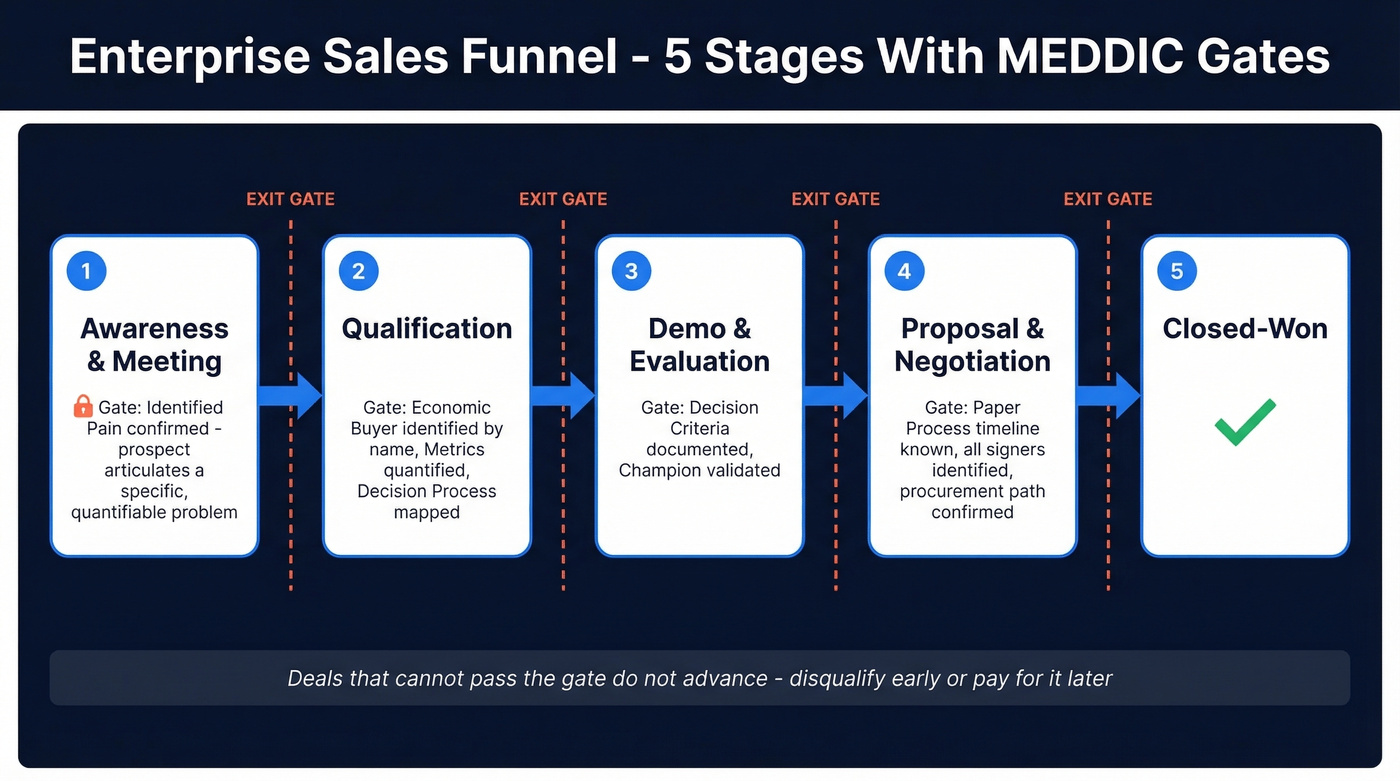
One caveat worth stating once: enterprise buying is non-linear. Buyers bounce between stages, revisit decisions, and loop in new stakeholders mid-process. Eighty-six percent of B2B purchases stall, per Forrester. Stage gates don't pretend the journey is linear - they give sellers discipline and forecasting accuracy when the buyer's path isn't.
Stage 1: Awareness & Meeting
The buyer engages with content or accepts a meeting. Your job isn't to pitch - it's to confirm pain exists and start multi-threading immediately. Deals with 3+ contacts engaged close 2.4x faster.
MEDDIC gate: Identified Pain confirmed - the prospect has articulated a specific, quantifiable problem.
Map the org chart on day one. Get at least two stakeholder names before the second call. 41% of buyers already have a preferred vendor before formal evaluation starts, so if you're not that vendor, you need to know now. Single-threading kills deals here - one champion who goes on PTO and your deal goes dark for three weeks.
Stage 2: Qualification
This is where enterprise funnels earn their keep - or waste six months of seller time.
The deal-killer to watch for: confusing a Coach for a Champion. A Coach will give you information. A Champion will spend political capital internally to push your deal through. If they can't handle objections in rooms you're not in, they're a Coach. Disqualify here or pay for it later - in pipeline reviews, in forecasting misses, in wasted SE time.
MEDDIC gate: Economic Buyer identified by name (not title) + Metrics quantified + Decision Process mapped.
Ask your champion directly: "Walk me through how your company bought the last piece of software at this price point." If they can't answer, you haven't found the real champion yet.
Stage 3: Demo & Evaluation
Multi-stakeholder demos get requested. Each evaluator has different criteria - the technical buyer cares about integrations, the financial approver cares about TCO, the end user cares about workflow friction. One generic demo for a 10-person buying committee is a fast way to lose.
Tailor every demo to the specific evaluator's priorities. The VP doesn't care about your API - they care about the 40 hours per month their team wastes on manual data entry. Demo outcomes, not features.
MEDDIC gate: Decision Criteria documented + Champion validated.
If you need a tighter structure for discovery and evaluation, use a MEDDIC checklist and keep a bank of discovery questions for each stakeholder type.
Stage 4: Proposal & Negotiation
This is where enterprise deals go to die quietly. Legal review, security questionnaires, procurement redlines - this phase consumes 35-40% of total cycle time. That's the single biggest time block in your entire deal.
MEDDPICC gate: Paper Process timeline known + all signers identified + procurement approval path confirmed.
Build a mutual action plan with specific dates for every approval step. Map every signer before sending the contract. We've seen deals slip an entire quarter because a CFO was on vacation and nobody checked the signing authority chain. "Oh, we also need InfoSec to sign off" in week 14 of a deal you forecasted to close in week 12 - that's a planning failure, not a surprise.
If you want a clean way to pressure-test negotiation posture, document your walk away point before procurement gets involved.
Stage 5: Closed-Won
Post-sale expansion is its own funnel. We're covering the new-logo motion here.
If you’re building the full enterprise motion, align this stage with your enterprise B2B sales playbook and track renewal rate early - even for “new logo” teams.
Enterprise Funnel Math
With 50% stage-to-stage progression across four stages, winning 10 deals requires 160 top-of-funnel conversations. Drop that progression to 33% - closer to reality for many enterprise teams - and you need 810 conversations to close the same 10 deals. That's a 5x difference from a 17-point shift in conversion.
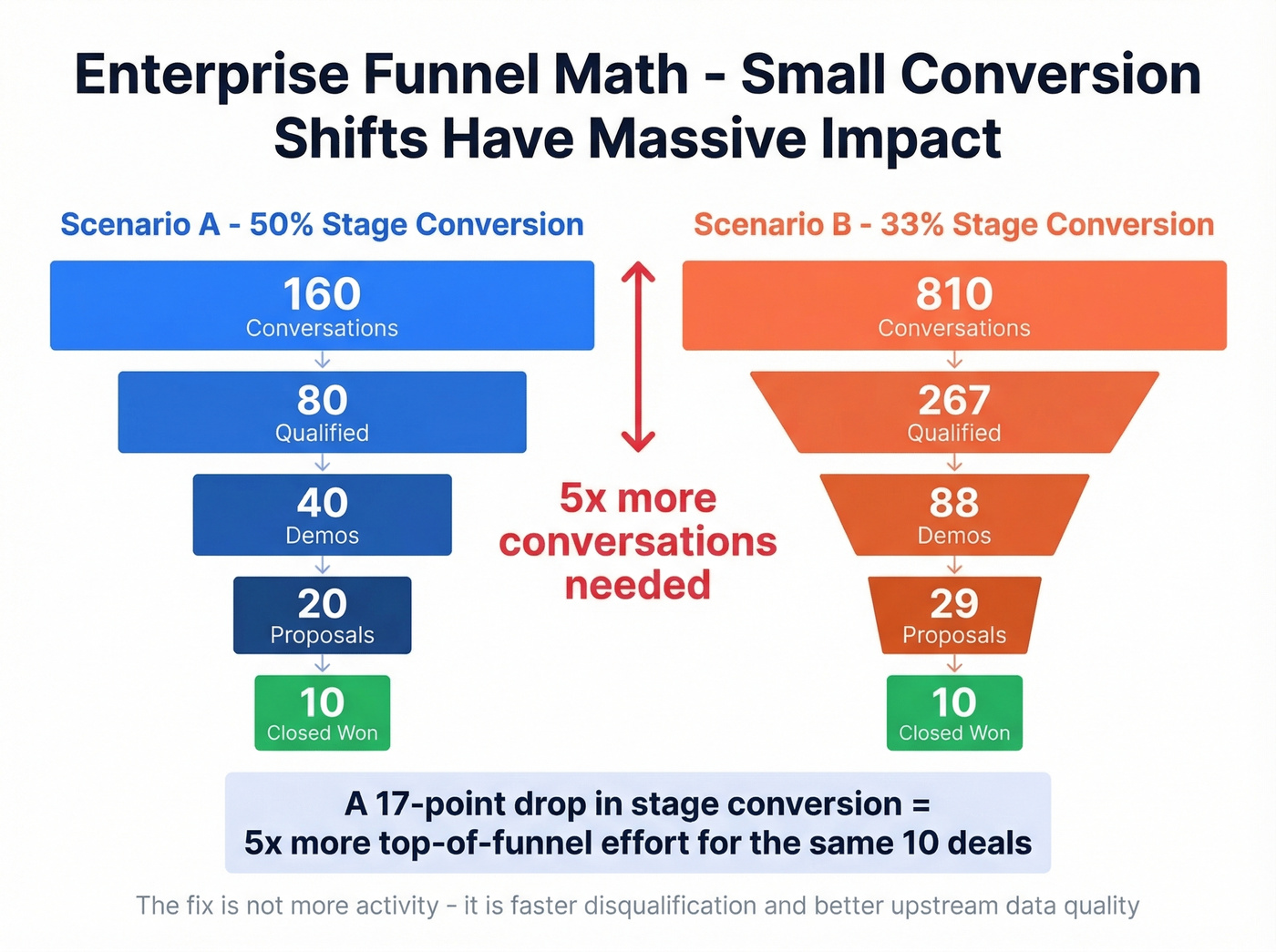
The contrarian take: stop optimizing stage conversion rates. Start optimizing disqualification speed. A deal you kill in week two costs you two weeks. A deal you kill in week sixteen costs you a quarter of a seller's capacity. In our experience, the teams that obsess over disqualification speed outperform those chasing conversion rates every single time.
If you want to operationalize this, define funnel metrics and monitor pipeline health weekly - not quarterly.

You just saw the math: a 17-point drop in stage conversion means 5x more conversations needed to close the same 10 deals. The fastest fix isn't coaching - it's upstream data quality. Prospeo's 98% email accuracy and 7-day refresh cycle mean your reps reach real stakeholders on the first touch, not bounced inboxes.
Stop feeding stale data into a funnel you spent months building.
Benchmarks That Actually Apply
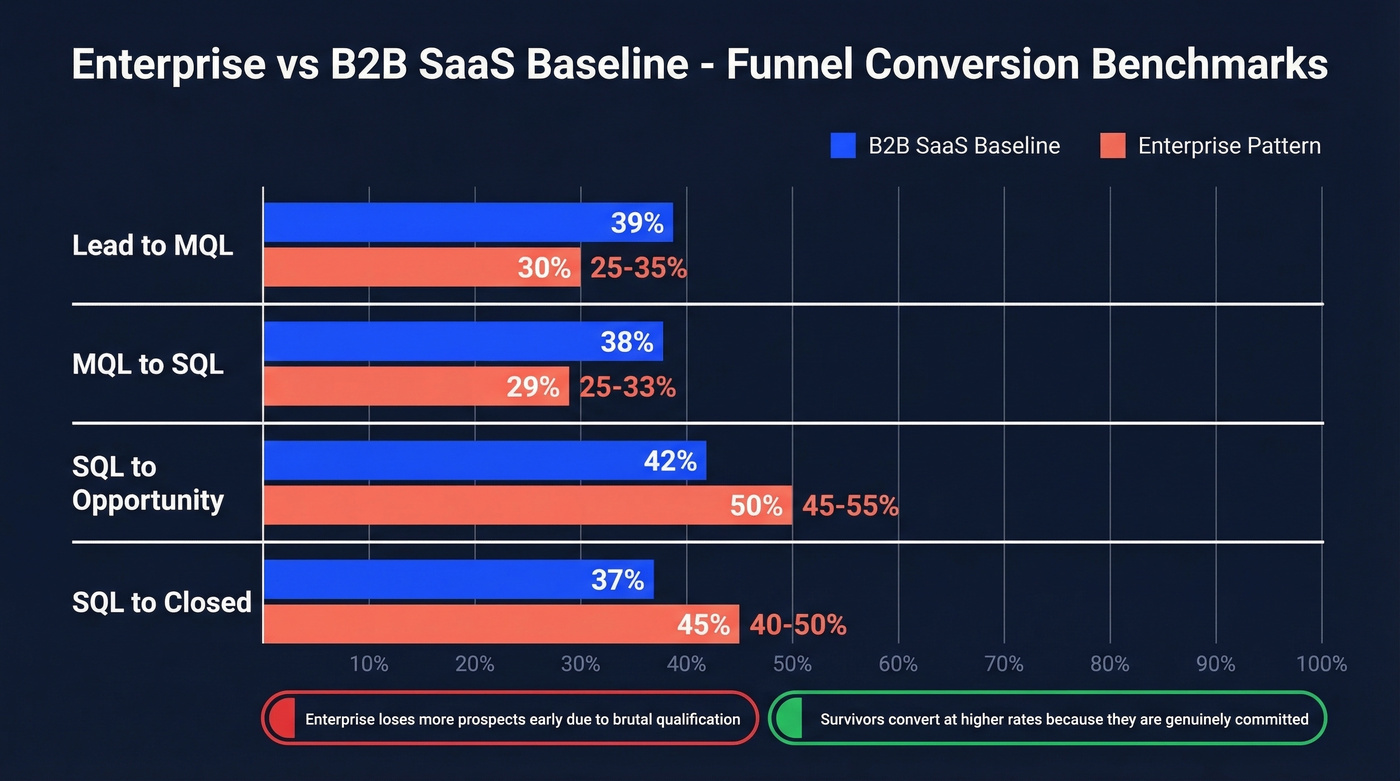
First Page Sage benchmark data gives us a solid B2B SaaS baseline. Enterprise patterns diverge predictably - tighter early-stage qualification, but higher late-stage conversion once stakeholders align.
| Stage | B2B SaaS Baseline | Enterprise Pattern |
|---|---|---|
| Lead to MQL | 39% | ~25-35% (tighter ICP) |
| MQL to SQL | 38% | ~25-33% |
| SQL to Opportunity | 42% | ~45-55% (aligned buyers) |
| SQL to Closed | 37% | ~40-50% |
Cycle length scales with deal size. SMB deals under $15K close in 14-30 days. Mid-market runs 30-90 days. Enterprise above $100K stretches to 90-180+ days. Companies with 10,001+ employees average 185-day cycles, and deals above $500K can hit 270 days.
The enterprise pattern makes intuitive sense: you lose more prospects early because qualification is brutal, but the ones who survive are genuinely committed.
Top-of-Funnel Pressure in 2026
Enterprise cold calling is dying. Buyers live in Teams and Slack, not on desk phones. The consensus on r/sales is blunt: BDR activity metrics aren't translating to closed-won.
But the deeper problem is upstream. Your BDR team made 2,000 calls last month and booked 4 meetings. That's not an effort problem - it's a data problem. If 30-40% of your contact database has wrong titles, dead emails, or personal mobiles flagged as corporate, your conversion rates collapse before qualification even begins. When your data is current, multi-threading - the single most impactful tactic for enterprise deals - actually becomes possible.
If you need more volume without trashing quality, start with proven sales prospecting techniques and a repeatable lead generation workflow.
Let's be honest: if your average deal is under $75K, you probably don't need a six-figure data platform. Prospeo's 7-day data refresh cycle and 98% email accuracy give you enterprise-grade data at roughly $0.01 per email, without the annual contract or the "talk to sales" gate.
The Non-Negotiable Tech Stack
Enterprise funnels need three categories of tooling. Gartner projected that by 2026, 60%+ of B2B sales teams would use ML-derived intent scoring - that's now table stakes.
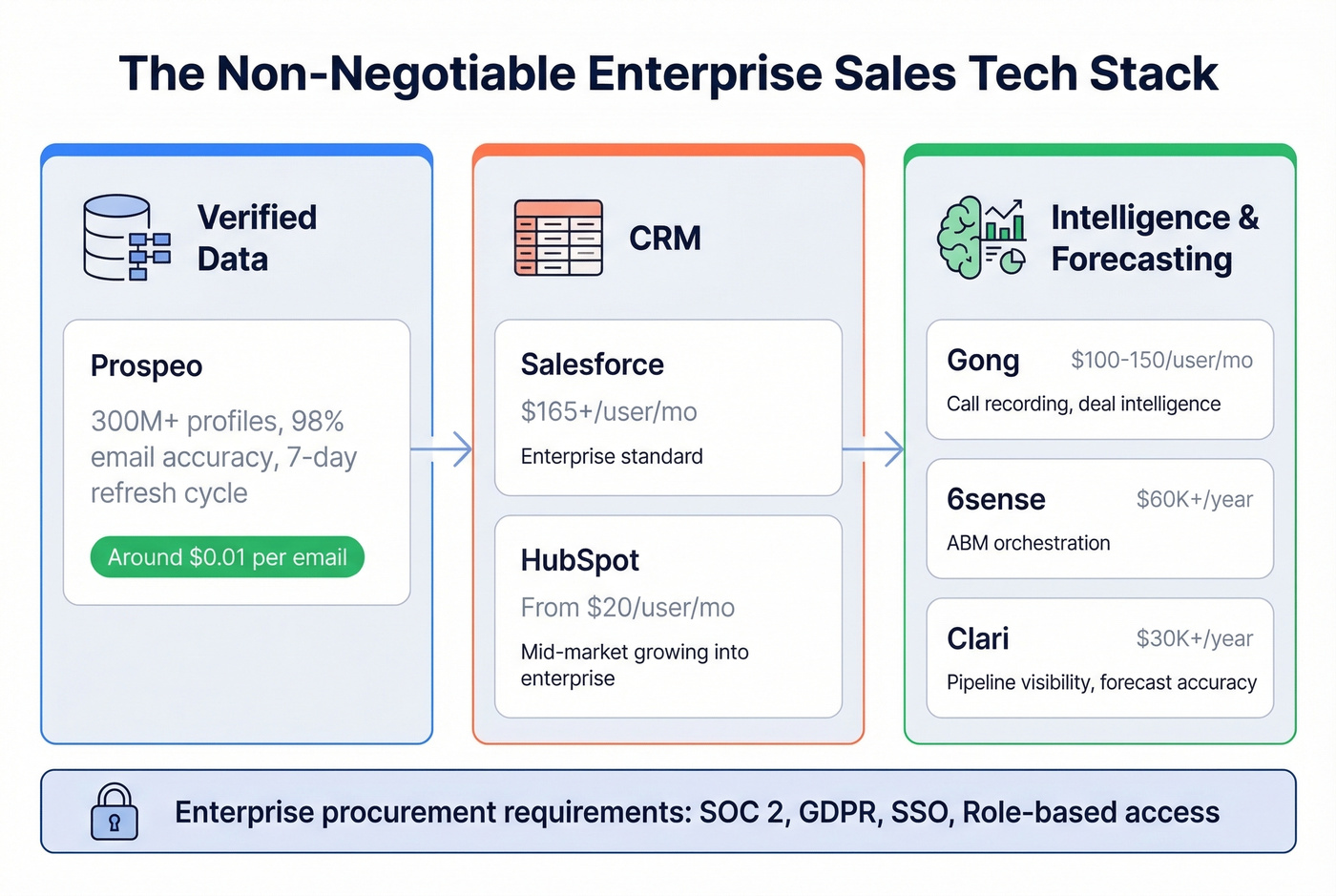
Verified Data
If you’re evaluating vendors, compare data enrichment services and validate your process for lead enrichment before you scale outbound.
CRM
Salesforce ($165/user/mo+) for enterprise. HubSpot (from around $20/user/mo) for mid-market teams growing into enterprise.
If you’re standardizing your stack, it helps to align on examples of a CRM and what “good” looks like for your org.
Intelligence & Forecasting
Gong (around $100-150/user/mo) for call recording and deal intelligence. 6sense ($60K+/year) for full ABM orchestration. Clari (around $30K+/year) for pipeline visibility and forecast accuracy.
If forecasting is the pain point, shortlist sales forecasting solutions that match your deal size and stage definitions.
Enterprise procurement will ask every vendor the same questions: SOC 2 compliance, GDPR, SSO, and role-based access. If a vendor can't check those boxes, they won't survive your security review - which, as we covered, is where deals go to stall.
Multi-threading from day one requires verified contact data for every stakeholder on the buying committee - not just your champion. Prospeo gives you 300M+ profiles with 30+ filters including department headcount, job changes, and buyer intent across 15,000 topics, so you map the full org chart before the second call.
Reach all 13 stakeholders, not just the one who answered your cold email.
FAQ
What's the difference between a sales funnel and a sales pipeline?
A funnel represents the buyer's journey from awareness to purchase; a pipeline represents the seller's stages and deal progression. Enterprise teams need both: the funnel to understand buyer behavior, the pipeline to forecast revenue accurately. Most CRMs conflate the two, which is why forecasting breaks down.
How long does an enterprise sales cycle take?
Enterprise deals above $100K ACV typically close in 90-180 days. Companies with 10,000+ employees average 185-day cycles, and deals over $500K stretch to 270 days. The biggest time sink is negotiation-to-close, where legal and procurement reviews consume 35-40% of total cycle time.
How do you improve enterprise funnel conversion rates?
Start with data quality - if a third of your contact records are stale, every stage suffers. Use MEDDIC as stage-gate criteria to disqualify early. Multi-thread every deal with 3+ contacts engaged for 2.4x faster close rates. A 7-day data refresh cycle eliminates the decay that silently kills top-of-funnel conversion.
What's the best free tool for enterprise prospecting data?
Prospeo offers 75 verified emails and 100 Chrome extension credits per month on its free tier - enough to test data quality on real accounts. For comparison, ZoomInfo requires a sales call and $15K+/year commitment. Hunter's free tier caps at 25 searches with limited enrichment.